

A search for the best Claude SEO rank tracking software should end with more than a leaderboard. The useful answer is a platform—or measurement process—that shows which prompts were tested, what Claude returned, which sources appeared and how the evidence changed over time.
That makes this a measurement decision, not a feature-count contest. Marketing leaders should choose according to the questions they need to answer, the records their teams can audit and the actions they can take from the findings.
What should the best Claude tracker prove?
The best choice is the system that preserves prompt-level responses, cited or referenced sources, brand and competitor appearances, recommendation context and historical comparisons. Buyers should favor inspectable evidence over a single visibility score, then test the workflow against their own prompts before committing.
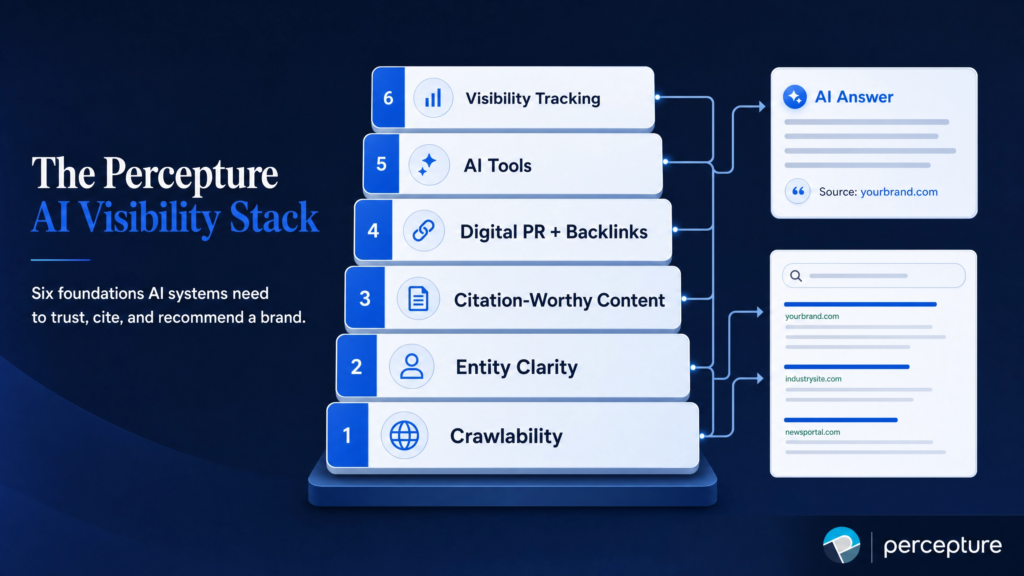
Start with the decision, not the vendor list
Claude monitoring is often described with familiar SEO language: rankings, positions and share of voice. Those labels can be useful shorthand, but a buyer still needs to inspect what sits beneath the metric.
A defensible evaluation begins with five records:
- The prompt: the exact question, qualifiers and intended audience.
- The response: the captured answer associated with that test.
- The source evidence: citations, references or source mentions preserved with the response.
- The entity evidence: whether the brand, product or competitor appeared and in what context.
- The history: comparable records that let an operator review change over time.
If a platform cannot expose those records, its summary score is difficult to investigate. That does not automatically make the tool unsuitable. It means the buyer should understand which decisions the score can and cannot support.
The market snapshot has an evidence limit
Public search listings included Omnia, WorkDuo, AIclicks, Geoptie and Cognizo; use these as discovery candidates, not tested winners.
The entries can be reviewed at Omnia, WorkDuo, AIclicks, Geoptie and Cognizo. They are useful for assembling a candidate pool, but self-published comparison pages are not enough to verify a winner.
For that reason, this guide does not assign unsupported product scores, prices or capability claims. It supplies a consistent test that can be applied to every candidate using current product documentation, a working account and the buyer's own prompt set.
Compare Claude tracking options by use case
Which operating model fits your team?
| Operating model | Best fit | Evidence to request | Main tradeoff to examine |
|---|---|---|---|
| Dedicated AI visibility platform | Teams that want a managed monitoring interface | Prompt records, response captures, source details and history | Depth of evidence versus dashboard simplicity |
| SEO suite with AI-search features | Teams consolidating search workflows | Claude-specific coverage and exportable underlying records | Convenience versus model-level detail |
| Custom monitoring workflow | Technical teams with specialized prompts or data requirements | Stored inputs, outputs, timestamps and reproducible processing rules | Control versus maintenance burden |
| Agency-led measurement program | Leaders who need interpretation and execution support | Testing methodology, source records, reporting cadence and action ownership | Strategic support versus internal control |
Use these categories to check whether each candidate matches the scope of the investigation, the reporting workflow and the team's capacity to maintain the system.
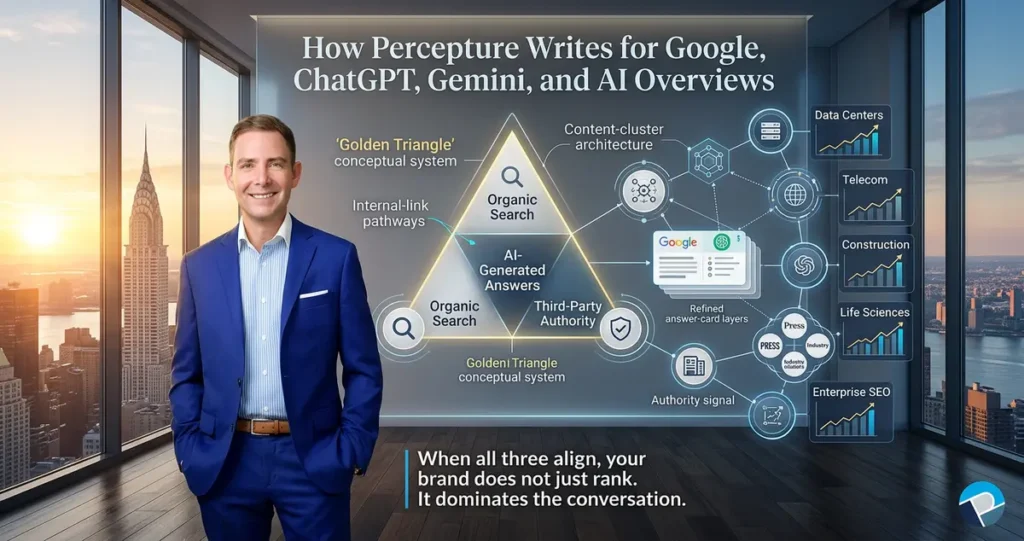
Use the Golden Triangle to inspect the evidence
The Golden Triangle framework uses for three evaluation questions: what was asked, what evidence appeared and what recommendation followed. Treat it as decision architecture, not as a search-engine ranking factor.
The Claude tracking evidence scorecard
| Evaluation area | Question to ask in a demo | Acceptable proof |
|---|---|---|
| Prompt control | Can we inspect the exact tested prompt and its qualifiers? | A prompt-level record rather than a category label alone |
| Response capture | Can we review the answer associated with each test? | A retained response linked to the prompt record |
| Source tracking | Can we inspect the sources connected to the response? | Source URLs or preserved source details where available |
| Entity context | Can we distinguish a mention from a recommendation? | Response excerpts or classifications that an operator can audit |
| Historical comparison | Can we compare like-for-like tests across reporting periods? | Dated records with consistent prompt definitions |
| Segmentation | Can we separate markets, personas, products or funnel stages? | Filters tied to the underlying prompt set |
| Export and ownership | Can our team retrieve the records used in reporting? | A usable export or documented data-access path |
| Actionability | Can we connect a finding to an owner and next step? | A workflow that preserves the evidence behind the recommendation |
A product does not need to solve every row equally. It should perform well on the rows connected to the buyer's actual decision. An executive dashboard may prioritize trend interpretation, while an SEO or digital PR team may need deeper source and page-level records.
Move from a mention to an actionable finding
Use the Source-to-Entity Conversion Ladder as a classification sequence:
- Prompt defined: the monitored question and audience are recorded.
- Response captured: the answer can be inspected.
- Source identified: the supporting source evidence is retained where present.
- Entity connected: the brand, product or expert is associated with the response context.
- Recommendation classified: the operator distinguishes a passing mention from meaningful consideration.
- Action assigned: a content, technical, authority or measurement task has a named owner.
This sequence asks the team to retain the context used to interpret a finding and choose a next step rather than relying only on a visibility percentage.
Build a prompt set that can survive scrutiny
Do not begin a trial with a handful of vanity prompts. Build a compact set tied to buyer questions and business decisions.
A practical prompt set can cover:
- category discovery questions;
- product or provider comparisons;
- problem-aware questions;
- use-case and industry qualifiers;
- objections involving implementation, budget or risk;
- branded questions;
- competitor and alternative questions;
- source-seeking questions that ask for evidence or examples.
Record the prompt exactly. Define the audience and market where those details matter. Keep a stable comparison set, then separate exploratory prompts so changing research does not distort the baseline.
This is also where traditional SEO and Claude monitoring can be evaluated together. Search demand can inform the language included in a prompt set, while prompt testing records how that language appears in captured answers. For a related Percepture resource, see the KeywordIQ system.
Treat visibility as a set of states
When reviewing a visibility number, ask whether the underlying report distinguishes among these six states from the Six-State Visibility Ladder:
- Unobserved: the entity does not appear in the captured response.
- Adjacent: the category or problem appears without the entity.
- Mentioned: the entity appears without meaningful supporting context.
- Sourced: the entity or its content is connected to source evidence.
- Compared: the entity is evaluated alongside alternatives.
- Recommended: the response places the entity within a stated recommendation context.
Use these states as classifications for analysis, not as claims about how Claude ranks information. Apply the same definitions across candidates, prompts and reporting periods.
What to verify during a product trial
A buyer’s trial plan
Before the demo
Prepare representative prompts, required segments, reporting users and the decisions the system must support.
During the demo
Ask the vendor to move from a summary metric to the prompt, response, source and historical records behind it.
Before purchase
Run the same test set, review exports, document evidence gaps and assign each expected report to an internal owner.
Use this checklist before selecting a Claude rank tracker:
- Can the team inspect every monitored prompt?
- Can it retrieve the response associated with a finding?
- Are source details retained in an auditable form?
- Can the team inspect the context surrounding each appearance?
- Can comparable tests be reviewed over time?
- Can results be segmented around real markets and buyer groups?
- Can the underlying records be exported or otherwise retrieved?
- Is the testing method documented?
- Does the vendor disclose how it handles incomplete evidence?
- Can the team turn findings into content, authority or technical actions?
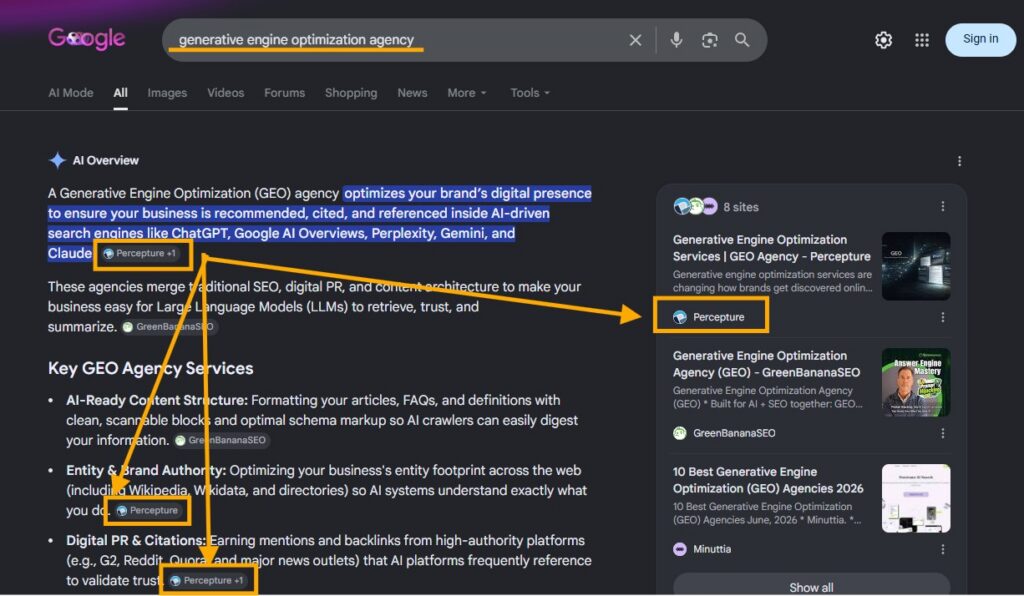
Historical screenshots can be used to discuss a verification method, but do not use this image to declare a current position. Re-run the relevant query or prompt and preserve the new evidence before making a time-sensitive claim.
Connect the tool to an operating process
During evaluation, assign owners for prompt governance, evidence review, opportunity diagnosis and follow-through. Document how each report will move from captured evidence to an approved next step.
Readers can review Percepture's AI search optimization services and published GEO pricing and package information when comparing service options.
Compare the measurement investment with the work it must support
Review Percepture’s broader pricing options, then map the required prompt, source, history and execution work before setting a budget.
Next action: run the same evidence test on every candidate
Do not select a winner from screenshots or a publisher's position in its own list. Give each candidate the same prompt set, ask for the same underlying records and score only what your team can inspect.
Score candidates on three questions: what Claude was asked, what evidence appeared and whether the proposed next action can be traced to that evidence. Document any hidden part of that chain before signing a contract.
Questions buyers ask about Claude SEO tracking
How were the Claude SEO rank tracking options evaluated?
This guide evaluates operating models against a common evidence standard: prompt control, response capture, source tracking, entity context, historical comparison, segmentation, exports and actionability. It does not publish vendor rankings without a completed current product test.
Which option is best for a different use case or budget?
A dedicated platform may suit a managed monitoring workflow, an SEO suite may suit consolidation, a custom system may suit specialized data requirements and an agency-led program may suit teams that need interpretation and execution. Current pricing should be checked directly with each provider.
What proof should a buyer request?
Request the exact prompt, its captured response, associated source details, entity or recommendation context, comparable historical records and a usable export or data-access path. Test those records with prompts from your own market.
How current are the pricing, capabilities and rankings in this guide?
Compare current commercial terms and product capabilities using the same prompts and evaluation criteria.
What commercial relationships are disclosed?
This guide links to Percepture’s own GEO services and pricing pages.

About Bob Generale
Bob Generale is President of Percepture.
Connect with Bob Generale on LinkedIn.