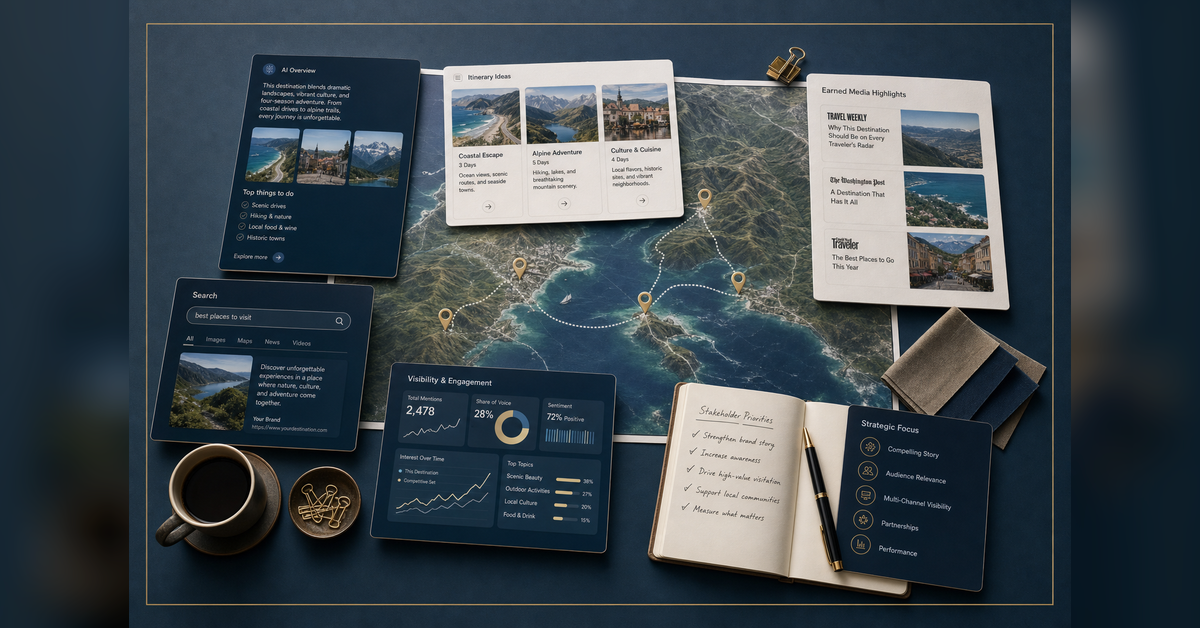

Destination marketing agency work helps DMOs, CVBs, tourism boards, hotels, resorts, and travel brands shape demand, earn trust, and control how a place is discovered across Google, AI search, earned media, paid campaigns, and traveler planning channels. The right partner makes the destination easier to find, understand, cite, and choose.
Proven Destination Strategy
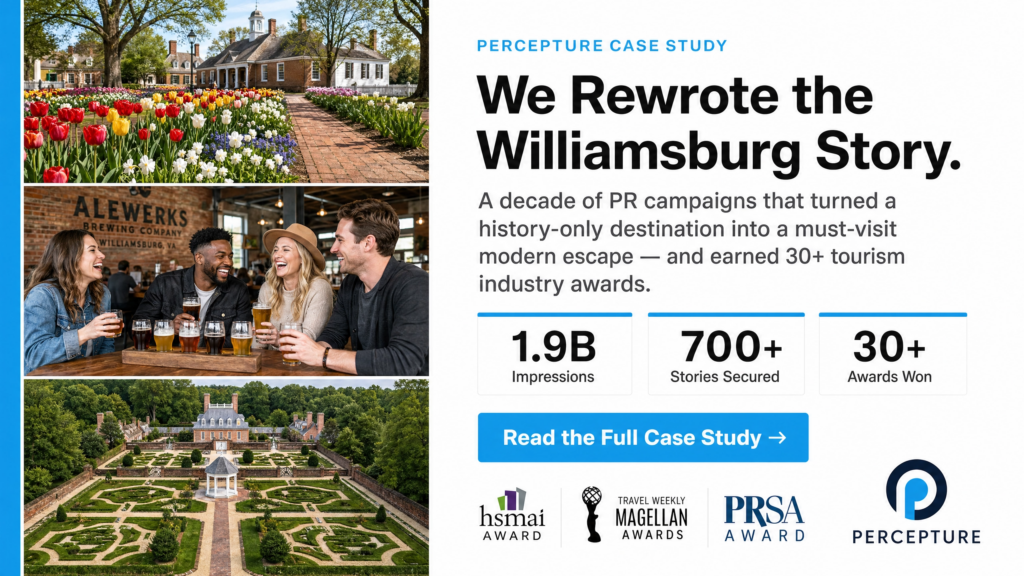
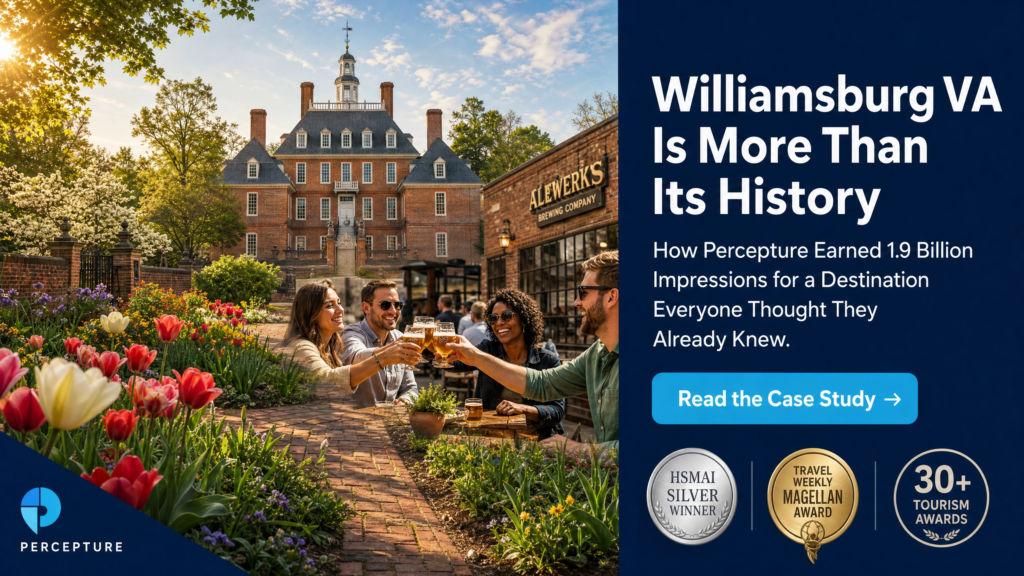
How Williamsburg Reshaped Its Traveler Narrative and Drove Measurable Demand
When Visit Williamsburg needed to control how their destination was discovered across search, AI, and earned media, they didn’t just buy ads. They built a compounding visibility system. Here is the exact impact.
Ready to see what this framework can do for your destination?
For travel and tourism leaders, Destination Marketing Agency should connect technical content, buyer intent, search visibility, and sales follow-up into one operating plan.
What a destination marketing agency does
A destination marketing agency helps a place compete for attention, memory, trust, and demand. That can include destination storytelling, SEO, GEO, public relations, digital PR, paid media, content, analytics, conversion strategy, crisis communications, and partner messaging.
The best Destination Marketing Agency programs measure qualified conversations and sales opportunities, not just impressions, clicks, or rankings.
For a DMO or CVB, the work is rarely simple. A destination has many voices: elected officials, local businesses, hotel partners, restaurants, attractions, event organizers, residents, meeting planners, influencers, and media. A strong agency helps organize those voices into a clear story without flattening what makes the place real.
Percepture approaches destination visibility as a system. The question is not only, “Can we drive more clicks?” The stronger question is, “Are we the clearest, most trusted, most findable source for the destination’s own story?” That is why a destination marketing agency should connect PR, SEO, GEO, content, paid media, and reporting instead of treating each channel as a separate campaign.
A practical Destination Marketing Agency strategy also has to reflect buyer committees, proof needs, comparison searches, and long sales cycles.
Percepture’s travel and tourism work is grounded in authentic destination storytelling, earned media, and visibility. If your team is evaluating a travel and tourism PR agency, the goal should be more than coverage. The goal should be a repeatable way to help travelers, journalists, meeting planners, and AI systems understand why the destination matters.
Definition
A destination marketing agency is a strategic partner that helps a place attract visitors by shaping its story, improving visibility in search and AI, earning media trust, running campaigns, aligning stakeholders, and measuring demand.
When Destination Marketing Agency is built this way, every channel supports the same revenue goal instead of acting like a separate campaign.
Who this buyer guide is for
This guide is for marketing leaders who need to make a smart agency decision, explain the investment to leadership, and protect the destination’s reputation while growing demand.
That is why Destination Marketing Agency needs both category-level execution and executive-level reporting.
It is especially relevant if you lead marketing for a:
- Destination marketing organization or convention and visitors bureau
- Tourism board, tourism authority, or regional promotion group
- Hotel group, resort, attraction, tour operator, or hospitality brand
- Economic development or placemaking initiative with visitor goals
- Travel brand that needs search, AI, PR, and paid media working together
A destination marketing agency should be comfortable with board questions, public funding scrutiny, local stakeholder tension, seasonal demand, partner expectations, and the fact that tourism marketing is not just a traffic problem. It is a trust problem, a clarity problem, and a demand problem.
The Destination Narrative Control System
The best Destination Marketing Agency programs measure qualified conversations and sales opportunities, not just impressions, clicks, or rankings.
Percepture’s framework for this work is The Destination Narrative Control System. It helps DMOs, CVBs, tourism boards, and travel brands control how a destination is discovered, described, trusted, and chosen across search, AI, media, paid campaigns, content, and stakeholder channels.
Percepture framework
The Destination Narrative Control System
A destination does not need more disconnected activity. It needs a visibility system that helps the right story compound across owned, earned, paid, search, AI, and stakeholder channels.
1. Discover the Demand
Identify what travelers, meeting planners, hotel partners, media, locals, and AI systems are already asking.
2. Define the Story
Turn scattered destination assets into a clear narrative that works for people, search engines, journalists, partners, and boards.
3. Distribute the Proof
Use SEO, GEO, PR, content, paid media, local stories, itineraries, and landing pages to make the story visible.
4. Defend the Reputation
Monitor search results, AI answers, media narratives, reviews, local friction, and crisis moments before they define the destination.
5. Drive Measurable Demand
Tie visibility to qualified traffic, itinerary engagement, partner referrals, inquiries, earned media quality, and board-ready dashboards.
A practical Destination Marketing Agency strategy also has to reflect buyer committees, proof needs, comparison searches, and long sales cycles.
This framework is useful because it gives leaders a way to explain why SEO, GEO, PR, content, paid media, and reputation work belong together. A destination marketing agency that only buys media may create impressions. A destination marketing agency that only writes blog posts may create volume. A destination marketing agency that only pitches media may create attention.
The stronger model is compounding visibility. The destination’s most important answers should be easy for people to read, easy for Google to crawl, easy for AI systems to interpret, easy for journalists to cite, and easy for stakeholders to repeat.
When Destination Marketing Agency is built this way, every channel supports the same revenue goal instead of acting like a separate campaign.
How to compare agency options
Most destination leaders are not choosing between good and bad. They are choosing between different operating models. A PR agency, SEO agency, creative studio, media buyer, software platform, freelancer, and in-house team can all be useful. The risk comes from choosing the wrong model for the problem.
That is why Destination Marketing Agency needs both category-level execution and executive-level reporting.
A destination marketing agency is usually the best fit when the work must connect strategy, story, visibility, trust, demand, and reporting.
Destination marketing agency vs. other options
| Option | Best For | Risk | When to Choose It | Percepture POV |
|---|---|---|---|---|
| Destination marketing agency | Integrated destination visibility | Weak fit if it only sells campaigns | Choose when story, search, AI, PR, paid, and reporting must work together | Best when the destination needs narrative control, not just activity |
| PR agency | Earned media, journalist relationships, reputation | Coverage may not connect to search or conversion | Choose for media authority and reputation moments | PR is stronger when it supports SEO, GEO, and owned content |
| SEO agency | Organic visibility and site architecture | May miss the emotional and media story | Choose when the site is hard to find, crawl, or understand | SEO should make the destination’s real proof easier to discover |
| Creative agency | Brand identity, campaigns, visuals | Beautiful work may not be findable or measurable | Choose when brand expression is the main gap | Creative should express the story after the proof is clear |
| Freelancer | Specific tasks or temporary capacity | Limited coverage across channels | Choose for narrow execution with strong internal strategy | Useful for tasks, not always enough for board-level strategy |
| In-house team | Institutional knowledge and local coordination | May be stretched across too many priorities | Choose when daily stakeholder knowledge is central | Best results often come from agency strategy plus in-house knowledge |
| DMO software/platform | Listings, CRM, reporting, workflow | Tools do not create strategy by themselves | Choose when operations and data management are the gap | Platforms should support the strategy, not replace it |
| OTA/media-only dependency | Short-term reach and booking exposure | The destination story may be controlled by others | Choose with care as an amplification channel | Do not let rented platforms become the main narrator |
The work that matters most
A destination marketing agency should help you answer five practical questions.
The best Destination Marketing Agency programs measure qualified conversations and sales opportunities, not just impressions, clicks, or rankings.
1. What are travelers already trying to understand?
Search data, AI-search questions, People Also Ask results, partner questions, event calendars, seasonal patterns, media angles, and itinerary gaps show demand before the campaign starts. This helps the team stop guessing and start building around the questions travelers already ask.
A practical Destination Marketing Agency strategy also has to reflect buyer committees, proof needs, comparison searches, and long sales cycles.
For example, a shoulder-season campaign should not only say “visit now.” It should answer why the season is different, what is open, what is easier to do, where to stay, how to build an itinerary, and what locals already know.
2. What story can the destination credibly own?
When Destination Marketing Agency is built this way, every channel supports the same revenue goal instead of acting like a separate campaign.
A slogan is not enough. A usable destination story must be specific enough for a journalist to pitch, clear enough for a traveler to remember, structured enough for AI systems to interpret, and credible enough for local partners to support.
This is where proof before promotion matters. The strongest story is built from real local assets: attractions, people, culture, food, events, history, geography, access, lodging, experiences, and seasonal reasons to visit.
That is why Destination Marketing Agency needs both category-level execution and executive-level reporting.
3. Is the destination visible in the right places?
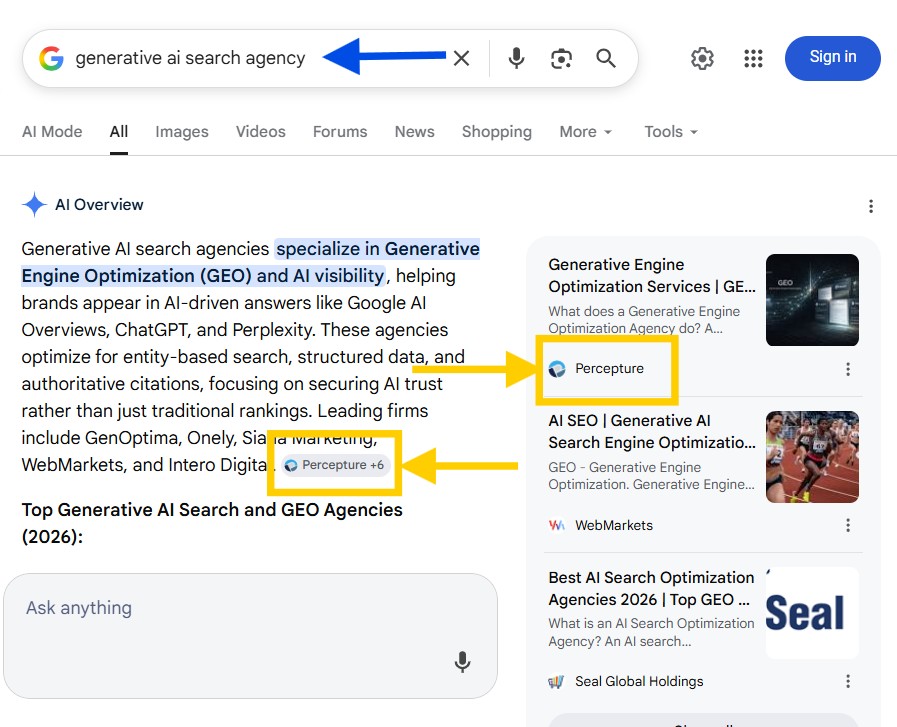
Visibility now means more than a ranking report. It includes Google search, Google AI Overviews, ChatGPT search, Perplexity, map results, earned media, review platforms, travel sites, partner websites, social discovery, and paid media touchpoints.
Percepture connects generative engine optimization services with enterprise SEO services because destination pages must be both findable and understandable. AI systems need clear entities, structured answers, crawlable pages, and source-worthy content. Search engines need the same clarity.
4. Is earned trust supporting owned content?
The best Destination Marketing Agency programs measure qualified conversations and sales opportunities, not just impressions, clicks, or rankings.
Earned media still matters because it can help establish credibility around the destination story. But coverage has more value when it connects back to owned destination pages that answer the next question.
That is why a digital PR agency mindset belongs inside destination marketing. Digital PR can help turn stories, data, events, local expertise, and partner assets into authority signals that support search, AI visibility, and traveler confidence.
A practical Destination Marketing Agency strategy also has to reflect buyer committees, proof needs, comparison searches, and long sales cycles.
For a deeper view of how PR should support destination storytelling, Percepture’s travel PR strategy guide explains how travel brands can build stronger media narratives without treating PR as a blast list.
5. Can leadership see demand signals?
When Destination Marketing Agency is built this way, every channel supports the same revenue goal instead of acting like a separate campaign.
A board does not need vague awareness language. It needs to see how marketing activity connects to visibility, engagement, partner value, and demand signals.
That does not mean every channel can be reduced to one last-click booking. It does mean the reporting should show movement: qualified organic traffic, high-intent page engagement, itinerary actions, partner referrals, meeting planner inquiries, earned media quality, paid media efficiency, AI visibility, search ranking movement, and conversion paths.
That is why Destination Marketing Agency needs both category-level execution and executive-level reporting.
Destination visibility scorecard
Use this quick diagnostic before hiring a destination marketing agency. If several answers are weak, the issue is probably not one channel. It is the visibility system.
Can a traveler, journalist, partner, and AI system explain what your destination owns better than competing places?
Are attractions, itineraries, events, lodging, dining, seasonal experiences, and local entities explained in crawlable text?
Do PR, SEO, content, paid media, and partner channels reinforce the same credible story?
Can leadership see demand signals beyond impressions, clicks, and generic awareness metrics?
How AI search changes destination marketing
AI search is changing destination discovery because travelers can now ask planning questions in long, natural language. Instead of searching only “best weekend trips near me,” a traveler may ask ChatGPT or Perplexity for a three-day itinerary with outdoor activities, local restaurants, boutique lodging, rainy-day ideas, and options for children or older relatives.
Google AI Overviews may summarize answers before a user clicks. ChatGPT search may recommend places based on pages it can understand and sources it can trust. Perplexity may cite pages that give direct, well-structured answers. If your destination’s best information is buried in PDFs, image text, vague copy, old press releases, or disconnected partner pages, AI systems may not understand what the destination actually offers.
The best Destination Marketing Agency programs measure qualified conversations and sales opportunities, not just impressions, clicks, or rankings.
Entity clarity matters. A destination needs clear signals about the place, neighborhoods, attractions, events, hotels, restaurants, trails, venues, transportation options, seasonal experiences, and partner organizations. Those entities should be connected in plain text, not only in design assets.
A destination marketing agency that understands GEO should help you build source-worthy destination pages. These pages answer real traveler questions, use clear headings, connect related entities, include schema that matches visible content, and avoid generic AI copy. They should help both humans and machines understand the destination’s proof.
A practical Destination Marketing Agency strategy also has to reflect buyer committees, proof needs, comparison searches, and long sales cycles.
Percepture’s model connects SEO, GEO, and PR because AI visibility is not only a technical issue. It is also a trust issue. Authoritative mentions, media coverage, partner pages, owned content, and crawlable site structure all help support the destination story.
AI visibility checklist for destinations
- Is the destination crawlable?
- Are top attractions explained in text?
- Are events, itineraries, hotels, restaurants, and seasonal pages structured?
- Are local entities clear and connected?
- Are answers written for real traveler questions?
- Are PR placements and authoritative mentions connected to owned content?
- Are OAI-SearchBot, Googlebot, and other important crawlers not blocked?
- Is schema aligned with visible content?
What not to do
Poor destination marketing usually does not fail because the team lacks effort. It fails because the channels do not reinforce a strong story.
Destination marketing mistakes to avoid
- Do not let OTAs own the destination story.
- Do not treat PR, SEO, GEO, and paid media as disconnected workstreams.
- Do not publish generic AI content.
- Do not buy impressions without a story.
- Do not ignore locals and stakeholders.
- Do not hide your best destination information in PDFs or images.
- Do not report only impressions when the board needs demand signals.
Services a destination marketing agency may provide
The right scope depends on the destination, the market, the season, the team, and the board’s goals. Most programs include some mix of strategy, content, PR, SEO, GEO, paid media, analytics, and conversion improvement.
A destination marketing agency may act as the senior strategy partner while the in-house team manages local coordination. It may also support specific initiatives such as shoulder-season demand, meetings and group travel, hotel partner campaigns, attraction promotion, crisis response, reputation repair, new itinerary development, or market expansion.
Percepture can support destination visibility through integrated PR and digital marketing services. That includes working as a public relations agency for media relations and reputation moments, a content marketing agency for traveler-answer content, and a paid search agency when high-intent paid media should amplify the right landing pages.
The strongest programs do not use paid media to cover up a weak story. They clarify the story first, then use paid search, paid social, media buying, PR, SEO, GEO, and partner content to compound around it.
Destination marketing agency pricing and budget planning
Budget questions should not be hidden. A DMO, CVB, tourism board, hotel group, or travel brand needs to know whether the investment matches the scope.
The planning ranges below are not fixed pricing. They are useful bands for budgeting a destination marketing agency engagement.
Planning ranges for destination marketing agency work
$5,000–$15,000+
$10,000–$40,000+
$7,500–$30,000+
$30,000–$100,000+ per month
Final pricing depends on scope, market size, content needs, PR complexity, paid media budget, reporting, seasonality, and stakeholder support.
For more detail on planning retainers and project scopes, review Percepture’s destination marketing agency pricing page. A mature budget should separate agency strategy and execution fees from paid media spend, production costs, press trip costs, influencer costs, research, photography, video, and platform expenses.
The best ROI conversation starts with the business problem. Are you trying to fill shoulder-season gaps? Increase meeting planner inquiries? Improve destination visibility in search and AI? Support hotels and attractions? Change an outdated reputation? Reduce wasted paid media? Each problem requires a different scope.
Budget clarity
Need a board-ready scope before you commit?
Percepture can help translate visibility goals into a practical scope across SEO, GEO, PR, content, paid media, analytics, and reporting.
How to choose the right partner
A destination marketing agency should be evaluated on how it thinks, not only on what it sells. Look for a partner that asks better questions before proposing tactics.
Strong evaluation questions include:
- How will you discover real traveler demand before building campaigns?
- How will you define a destination story that local partners can support?
- How will PR, SEO, GEO, paid media, and content reinforce each other?
- How will you make our site easier for Google, ChatGPT, Perplexity, and Google AI Overviews to understand?
- How will you measure demand signals, not just impressions?
- How will you communicate with leadership and boards?
- How will you protect reputation if an issue becomes visible in search, media, or AI answers?
Ask to see relevant experience, strategy samples, and reporting examples. Percepture keeps public claims conservative, so public travel client names and logos are intentionally omitted from this version. Buyers can review approved proof resources such as travel PR case studies when evaluating fit.
Why Percepture for destination visibility
Percepture was founded in 2004. That matters because destination marketing has changed several times since then: traditional PR, social media, search, paid media, content marketing, analytics, and now AI search. A short-term campaign shop may chase the newest channel. A senior-led agency should understand what changes and what does not.
What changes: the platforms, formats, interfaces, and planning behaviors.
What does not change: travelers need a reason to care, journalists need a reason to believe, search engines need clarity, AI systems need structured proof, and boards need reporting that connects work to demand.
Percepture is a digital marketing and PR agency that works across SEO, GEO, digital PR, media relations, paid media, content, analytics, CRO, lead generation, and AI agents. The team brings senior experience across public-facing and trust-sensitive categories, including travel, hospitality, healthcare, life sciences, telecom, data centers, construction, engineering, finance, manufacturing, and B2B services.
For destination work, the differentiator is not claiming to be the biggest agency. It is connecting the right disciplines around the destination’s proof.
Percepture proof points for tourism leaders
Built through major shifts in PR, SEO, paid media, content, and AI search.
Percepture positions its strategy and delivery around senior experience with 15+ years of experience.
Experience across travel, tourism, hospitality, destination, resort, and attraction categories.
Percepture does not treat search, AI visibility, earned media, and reputation as separate silos.
Destination marketing must satisfy leadership, partner, public-facing, and reputation-sensitive expectations.
Specific travel client examples and logos are intentionally not included in this public draft.
A simple process for working with a destination marketing agency
A strong engagement usually starts with diagnosis, not production.
Step 1: Visibility forecast
The agency should review current visibility across Google, AI search, media coverage, destination pages, paid campaigns, partner content, and conversion paths. This gives the team a baseline and helps avoid solving the wrong problem.
Step 2: Narrative and entity map
The team should define the destination’s core story, supporting proof, priority entities, key traveler questions, seasonal opportunities, media hooks, and stakeholder messages. This turns scattered information into a usable system.
Step 3: Channel plan
The agency should decide what must be created, improved, pitched, promoted, measured, and protected. This may include landing pages, itinerary content, PR angles, technical SEO fixes, GEO improvements, paid media campaigns, partner assets, and reporting dashboards.
Step 4: Execution and learning
Destination visibility should improve through cycles. Publish the right content, pitch the right stories, amplify what works, monitor search and AI answers, measure demand signals, and adjust before the next season or board meeting.
Optional add-on
Need verified partner, sponsor, group travel, or B2B prospect research?
LeadSeeker can be a practical add-on for travel, tourism, hospitality, and B2B partnership teams that need verified lead discovery alongside broader destination marketing work.
FAQs about hiring a destination marketing agency
What is a destination marketing agency?
A destination marketing agency helps a place attract visitors by shaping the story, improving visibility, earning trust, running campaigns, aligning stakeholders, and measuring demand. The best agencies connect SEO, GEO, PR, content, paid media, and reporting so the destination becomes easier to find and easier to choose.
How is a destination marketing agency different from a tourism PR agency?
A tourism PR agency usually focuses on earned media, journalist relationships, and reputation. A destination marketing agency may include PR, but it also connects search visibility, AI visibility, paid media, content, analytics, conversion paths, and stakeholder messaging. For many DMOs and CVBs, the integrated model is more useful.
How much does destination marketing agency work cost?
Planning ranges often start around $5,000–$15,000+ for strategy or audits, $10,000–$40,000+ for campaign strategy, $7,500–$30,000+ for integrated monthly retainers, and $30,000–$100,000+ per month for enterprise or national destination programs. Scope, market size, PR complexity, content needs, and paid media budget affect cost.
How long does destination marketing take to show results?
Paid media can create faster visibility, but SEO, GEO, PR, reputation, and content authority usually compound over time. A practical plan should separate quick wins from durable visibility. Early work often includes technical cleanup, story clarity, landing page improvements, media angles, and reporting baselines.
Why does AI search matter for destinations?
AI search matters because travelers can ask detailed planning questions and receive summarized answers from Google AI Overviews, ChatGPT, or Perplexity before visiting a website. Destinations need crawlable, structured, source-worthy content that explains attractions, itineraries, events, hotels, restaurants, seasons, and local entities clearly.
Should a DMO hire an agency or build in-house?
Many DMOs need both. In-house teams bring local knowledge, partner relationships, and daily context. An agency can add senior strategy, SEO, GEO, PR, paid media, content, analytics, and outside perspective. The best structure depends on staff capacity, board expectations, market complexity, and the urgency of the visibility problem.
What should be included in destination marketing services?
Common destination marketing services include strategy, destination storytelling, SEO, GEO, PR, digital PR, content, paid search, paid social, media buying, analytics, conversion improvement, reputation management, crisis communications, partner messaging, and board-ready reporting. The scope should match the business problem, not a generic package.
How should a destination measure success?
Measure more than impressions. Useful signals include qualified traffic, itinerary engagement, partner referrals, hotel and attraction interest, meeting planner inquiries, earned media quality, AI visibility, organic ranking movement, paid media efficiency, and conversion paths. A board-ready dashboard should show how visibility connects to demand.
What makes Percepture a fit for destination marketing?
Percepture is a digital marketing and PR agency founded in 2004. Its work connects SEO, GEO, PR, paid media, content, analytics, and reputation strategy. For destinations, Percepture focuses on proof before promotion and helps tourism leaders control how the destination is discovered, described, trusted, and chosen.
Ready to see how your destination is being found, summarized, and compared?
Percepture will review your current destination visibility across search, AI, PR, content, paid media, and conversion paths.

About the author
Bob Generale, President of Percepture
Bob Generale leads Percepture’s strategy across digital marketing, PR, SEO, GEO, paid media, content, analytics, and AI-driven visibility. Percepture was founded in 2004 and works with senior teams in public-facing, trust-sensitive, and growth-focused categories.