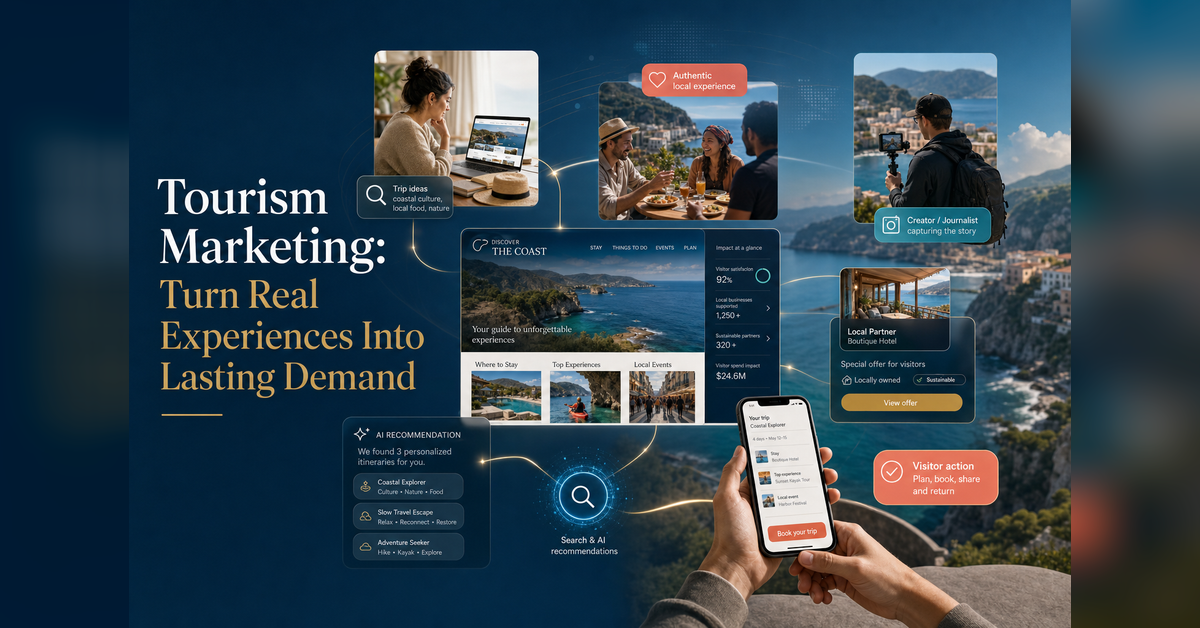

Tourism marketing creates demand for a destination or travel experience by turning real local assets into stories, search visibility, public relations, paid campaigns, creator content, partnerships and clear visitor pathways. Strong programs help the right traveler discover, trust, plan and act on an experience the destination can credibly deliver.
The channels do different jobs inside one traveler decision. Search may capture active planning, a creator may make the experience relatable, public relations may add authority, and a local partner may provide the final path to a ticket, room, itinerary or inquiry.
What is tourism marketing?
Tourism marketing is the coordinated process of creating demand for a destination, attraction, event, accommodation or travel experience. It combines research, positioning, storytelling, search, media, advertising, creators, email, partnerships and visitor experience to move the right audience from awareness to planning, visitation, booking or referral.
It is not one campaign. It is a connected system for creating, capturing and distributing visitor demand.
Executive summary
Start with place truth
Build the promise around experiences the destination can consistently deliver.
Give every channel a job
Define whether each channel creates awareness, trust, planning activity, action or partner distribution.
Capture reusable assets
Turn hosted experiences, interviews and itineraries into content that can work across several channels.
Build search durability
Publish crawlable answers and consistent destination facts that remain useful after a media flight ends.
Create visitor pathways
Connect inspiration to hotels, attractions, tickets, routes, events, local businesses or inquiries.
Measure the right action
Match delivery, behavior and outcome metrics to the organization’s actual role.
Real destination experiences become durable tourism demand
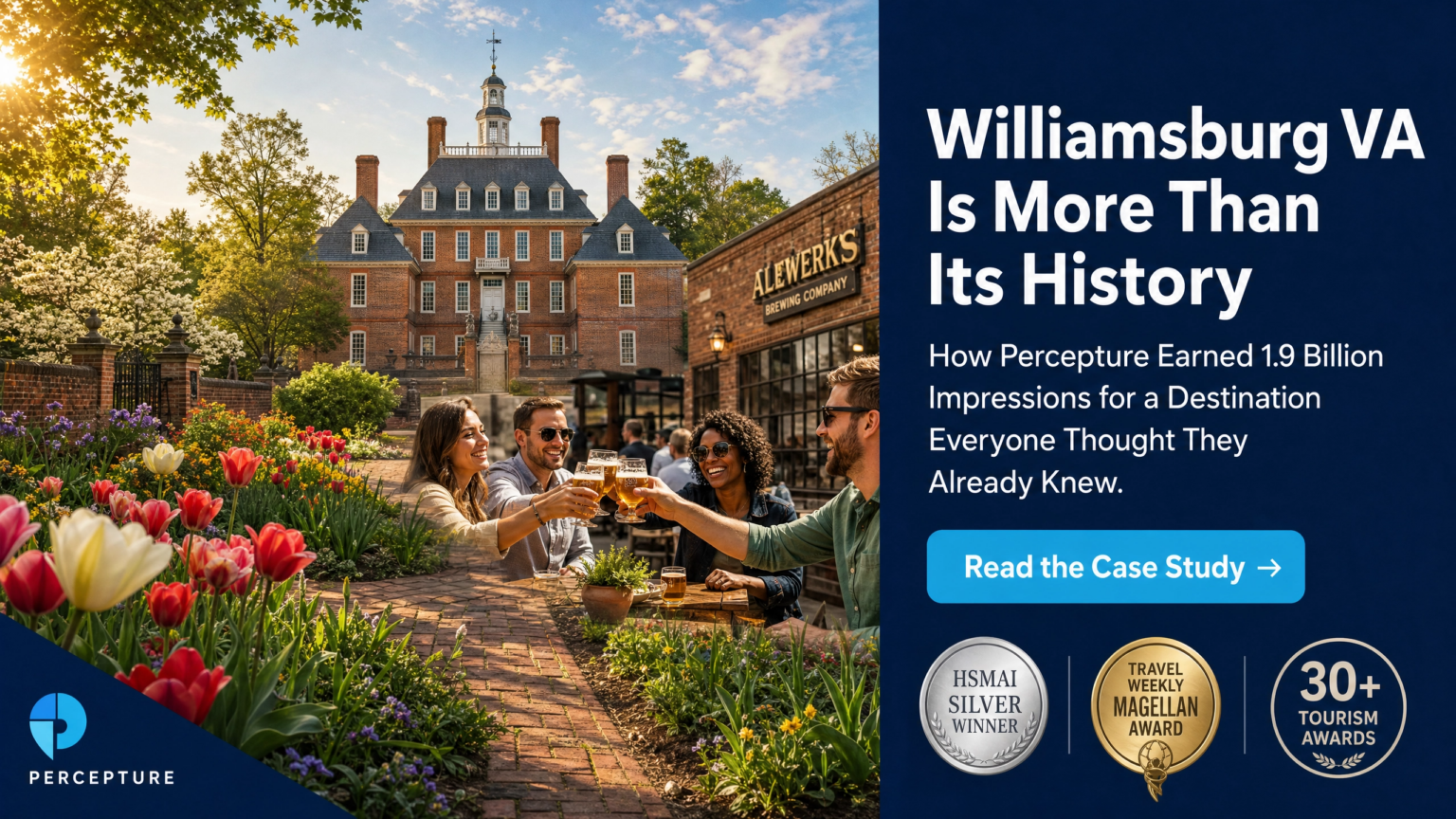
Greater Williamsburg shows how destination positioning, public relations, search visibility and reusable content can work together to broaden traveler perception and create measurable demand beyond one media flight.


Who this guide is for
This tourism marketing guide is for leaders who must coordinate demand across organizations that do not all share the same business model.
DMO and CVB leaders
Use tourism marketing to show how destination demand reaches hotels, attractions, events and local businesses. See the practical differences among a DMO, CVB and tourism board.
Tourism boards and public officials
Separate tourism marketing delivery from visitor behavior and broader economic outcomes.
Attractions and cultural places
Connect destination interest to the decision immediately before a visit.
Hotels and resorts
Create clear paths to property bookings, group inquiries and relevant packages.
Tour operators
Match traveler intent to available departures, itineraries and qualified inquiries.
Municipal and local partners
Build fair inclusion rules, accurate listings and measurable referral paths.
Readers evaluating an outside partner should use the separate travel and tourism marketing agency guide. This page explains the discipline rather than the agency-selection process.
Tourism marketing versus tourism advertising
Advertising is one tourism-marketing tool. Tourism marketing is the complete system for understanding, creating, communicating and measuring visitor demand.
| Decision area | Tourism marketing | Tourism advertising |
|---|---|---|
| Scope | Research, positioning, experience design, content, distribution, pathways and measurement | Paid placement of selected messages |
| Time horizon | Builds current demand and reusable destination assets | Usually runs during a defined media period |
| Evidence | Uses official facts, visitor experience, reviews, media, creators and partners | Uses campaign creative and paid targeting |
| Primary question | Why should this audience visit, trust and act? | Where should we buy attention? |
| Measurement | Delivery, behavior, outcomes and partner distribution | Reach, frequency, clicks, views and campaign conversions |
Buying media before establishing a credible tourism marketing position often scales generic language. A coordinated omnichannel marketing plan starts with the traveler, the experience and the action that each channel must support.
Seventeen hosted experiences. One longer-lasting content system.
Percepture helped New Orleans & Company identify creators, contract participation, coordinate itineraries and logistics, align content requirements, direct audiences to NewOrleans.com and manage 17 creator trips.
One partnership produced 119,000 impressions, 7,800 engagements, 80 high-resolution photos and a guest article. Another produced 213,000 impressions, 22,000 engagements and more than 800 clicks.
An itinerary article reached approximately No. 11 for “3 days in New Orleans” and No. 13 for “New Orleans itinerary,” with roughly six minutes of reader time. The hosted trip was not the finish line. Searchable content, reusable assets and a destination-site pathway extended the program beyond the original social post.
Why travel demand is harder to coordinate
A traveler buys before experiencing the product. That creates emotional and practical risk. Images, reviews, editorial coverage, official facts, maps and firsthand stories help reduce that uncertainty.
Demand is also spread across long planning windows, seasonal need periods and many businesses. A destination marketing organization may inspire a trip without processing the hotel booking, attraction ticket or restaurant reservation. That makes partner pathways part of tourism marketing strategy rather than an afterthought.
Residents and frontline teams also affect whether the promise is believable. The destination cannot market a promise the local experience cannot deliver. When operations and promotion drift apart, stronger reach can expose the gap faster.
Not every channel produces a booking directly; every channel needs a defined job. A DMO, hotel, attraction and tour operator should not use the same KPI model.
Map how your next campaign keeps working
Build a Tourism Marketing Channel Map covering the audience, visitor question, experience, proof source, channel, asset, pathway, partner, KPI, reuse plan and owner. The map shows how tourism marketing activity moves from inspiration to a measurable next step.
Plan your Tourism Marketing Channel MapThe Experience-to-Evergreen tourism marketing framework
Percepture’s Experience-to-Evergreen Tourism Loop turns a real visitor experience into durable demand through design, documentation, distribution, search visibility and measurable visitor pathways.
| Stage | Required work | Useful output |
|---|---|---|
| 1. Place Truth | Identify credible distinctions, audiences and outdated perceptions. | An ownable promise |
| 2. Visitor Question | Start with a planning question the priority traveler is trying to answer. | A defined content job |
| 3. Designed Experience | Select an itinerary, event, route, attraction or hosted experience that proves the promise. | Proof of experience |
| 4. Story Capture | Produce useful articles, video, photography, guides and interviews. | Reusable assets |
| 5. Distribution | Assign roles to PR, creators, social, paid media, email and partners. | Coordinated reach |
| 6. Search and AI Durability | Publish crawlable answers, consistent entities and corroborating evidence. | Ongoing discovery |
| 7. Visitor Pathway | Connect the story to a hotel, attraction, ticket, itinerary or inquiry. | A useful next action |
| 8. Measurement and Reuse | Track reach, behavior, partner action and asset life, then refresh what works. | A better next campaign |
The campaign ends when the media flight stops. The tourism marketing asset keeps working when the experience, story, search visibility and visitor pathway remain connected.
Story capture can combine content marketing services with public relations services. Search durability may require both enterprise SEO services and generative engine optimization services. The point is not to force every channel into every campaign. It is to preserve the handoffs that make the asset useful.
Which tourism marketing channels work best?
The best tourism marketing channel depends on the traveler’s stage and the organization’s conversion. Search captures active planning, PR and creators build trust, paid media scales selected audiences, email nurtures first-party relationships, and partnerships distribute demand locally.
| Channel | Main job | Common failure |
|---|---|---|
| Brand and positioning | Define why the place or experience matters. | Generic language that could describe anywhere |
| Website and content | Answer planning questions and present next steps. | Traffic sent to a generic homepage |
| SEO and local search | Capture active planning and nearby demand. | Chasing volume without visitor relevance |
| AI visibility | Clarify facts, entities and recommendation fit. | Treating AI discovery as a markup trick |
| Public relations | Build third-party authority and context. | Reporting outlet quantity without message value |
| Creators | Make an experience specific and relatable. | Buying one-off reach without reuse rights or pathways |
| Paid search | Capture high-intent planning and purchase activity. | Mixing curiosity with booking intent |
| Paid social and video | Shape and scale demand among selected audiences. | Reporting impressions without a sequence |
| Email and CRM | Nurture first-party preferences over time. | Sending the same message to every subscriber |
| Partnerships | Distribute demand across the local visitor economy. | Letting only the largest partners dominate |
| Events | Create a time-specific reason to travel. | Producing no useful post-event asset |
| On-site experience | Deliver what the campaign promised. | Allowing marketing to outrun operations |
| Analytics | Improve allocation and traveler pathways. | Maintaining a dashboard that changes no decisions |
Channels do not need identical KPIs. They need defined roles in the same traveler decision. Percepture’s paid search services, paid social services and email marketing services support different points in that decision.
What are the 4 Ps, 5 Ps and 7 Ps?
The traditional four-part model becomes more useful when each element is translated into a travel decision.
| 4 P | Application in travel |
|---|---|
| Product | The destination, event, route, accommodation, attraction or experience |
| Price | Money, time, friction, availability and perceived value |
| Place | Where the trip is discovered, planned, accessed and purchased |
| Promotion | Paid, owned, earned and shared communication |
Sources use different fifth elements. For destination work, Partnerships deserves explicit treatment because no single organization owns the entire visitor experience.
| 7 P | Practical meaning |
|---|---|
| Product | A bookable or visitable experience |
| Price | Total trip value and friction |
| Place | Distribution, location and access |
| Promotion | Communication and demand generation |
| People | Staff, residents, guides, hosts and visitors |
| Process | Planning, booking, arrival, service and recovery |
| Physical evidence | Reviews, imagery, coverage, maps and the actual place |
Percepture adds an operating lens called Proof. Travel is purchased before it is experienced, so editorial coverage, reviews, creator evidence, expert guidance and consistent official facts reduce uncertainty. Proof does not rewrite the historic model; it helps teams apply it to a high-consideration purchase.
Tourism marketing by organization type
Shared channels do not create shared economics. Each organization needs a tourism marketing conversion model tied to its role.
| Organization | Main job | Primary conversion |
|---|---|---|
| DMO or CVB | Coordinate destination demand and partner participation. | Referral, room night, event lead or visit signal |
| Tourism board | Build broad demand and visitor-economy value. | Regional demand, visitation or spending evidence |
| Hotel or resort | Win property and group demand. | Booking or request for proposal |
| Attraction | Convert destination interest into a visit. | Ticket, reservation or foot traffic |
| Tour operator | Match travel intent to available inventory. | Booking or qualified inquiry |
| Travel agency | Build confidence and simplify a complex purchase. | Consultation or booking |
| Event | Create a reason to visit during a specific period. | Registration and overnight stay |
| District or cultural place | Build a distinct, visitable identity. | Foot traffic, dining, shopping or event action |
A tour operator may benefit from a focused digital marketing plan for tour operators, while a hotel may require a property-level approach covered in the hotel digital marketing agency guide.
How to build a tourism marketing strategy
- Define the mandate and business model. State what the organization can influence, what it can measure and where the final transaction occurs.
- Establish place or experience truth. Interview operators, residents, visitors and partners. Identify distinctions that can be demonstrated rather than merely claimed.
- Select priority travelers and need periods. Avoid “something for everyone.” Choose audiences whose needs fit available experiences, capacity and timing.
- Map visitor questions and stages. Document what people ask while dreaming, comparing, planning, booking, arriving and sharing.
- Choose a position and proof. Pair the tourism marketing promise with reviews, routes, people, visuals, media evidence and firsthand experience.
- Assign channel roles. Decide which channels create demand, capture intent, build trust, nurture interest or distribute value.
- Create visitor and partner pathways. Make the next step useful: a ticket page, itinerary, lodging option, map, event registration or partner referral.
- Define measurement limits. State where attribution ends and which proxy behaviors are valid.
- Build reuse and refresh rules. Name the owner, review date, rights, derivative formats and conditions for updating each asset.
Customer journey mapping helps teams see where handoffs break between inspiration and action. Tourism marketing strategy and channel decisions can then be organized through Percepture’s strategy and planning services.
Tourism marketing examples with different strategic jobs
The best examples are not interchangeable success stories. Each should show what changed, which part of the system did the work and what another organization can learn.
Explore Hunterdon: establish place truth
Percepture helped define and activate Explore Hunterdon using language including “The Other Side of Jersey,” “Unplug & Reconnect” and “Get away to it all.” The work generated 7 million impressions, 73,000 site visitors and 13,106 direct banner clicks. It also reached nearly 2.85 million Facebook users and received a 2022 New Jersey Tourism Excellence Award for Digital Outreach.
Lesson: discover the identity before buying the media.
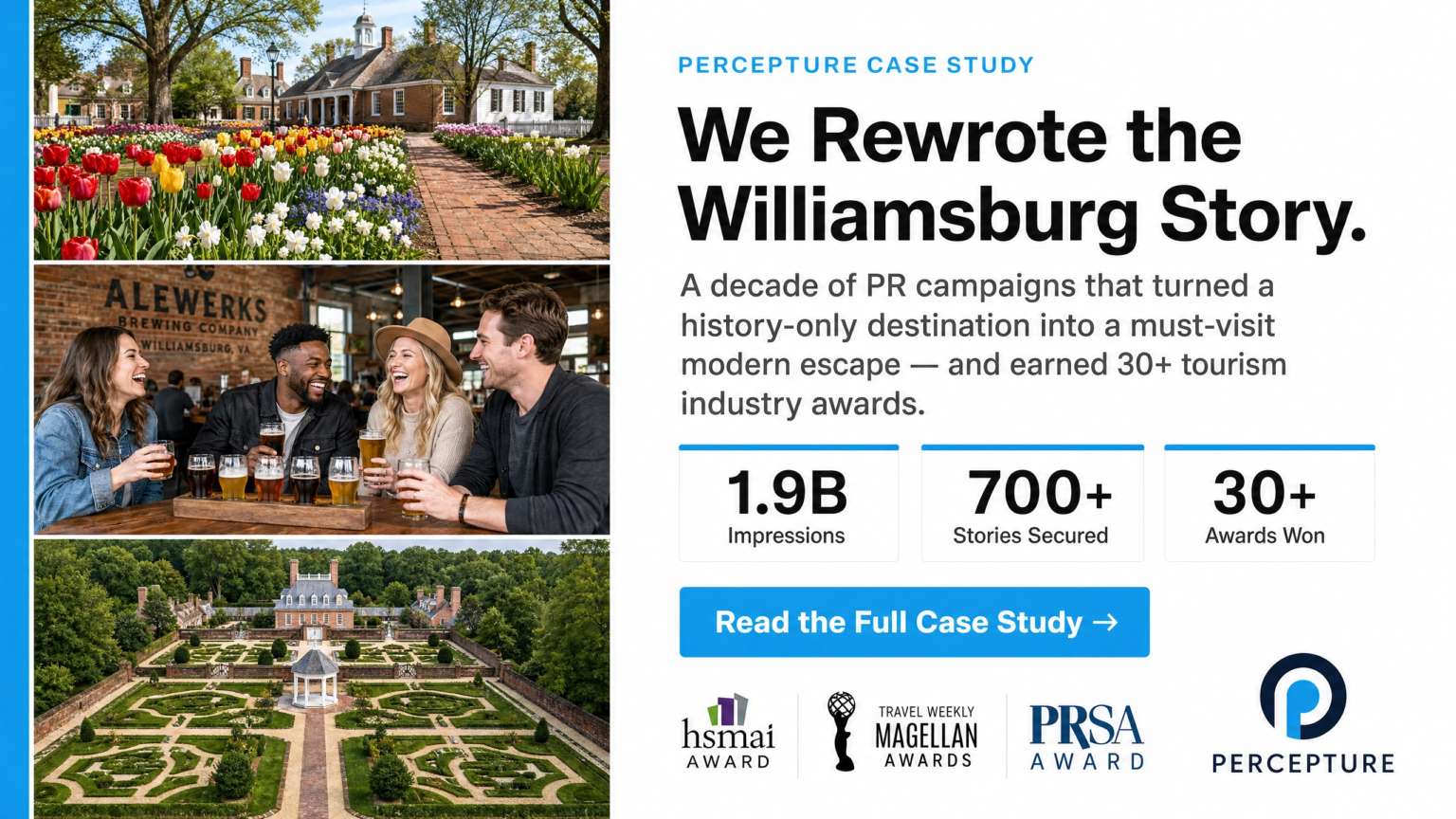
Greater Williamsburg: expand destination perception
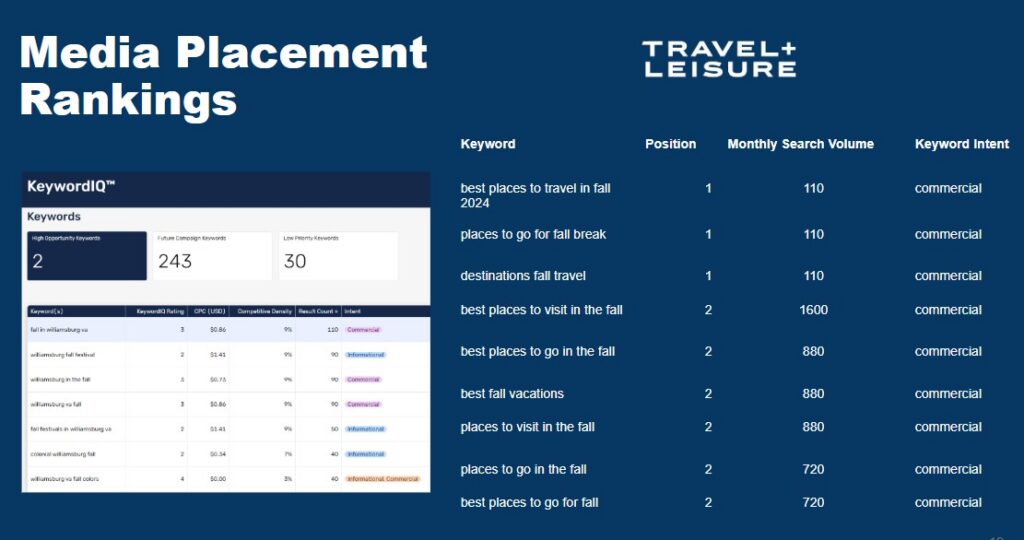
The program generated more than 300 million impressions, 100 stories, 90% message alignment, 10 broadcast segments, 18% organic growth and more than 100,000 new organic visitors. It also supported multiple No. 1 destination rankings.
Lesson: coordinated earned and search visibility can broaden what travelers believe a familiar destination offers.
The Shops at Columbus Circle: market a place, not a tenant list
The program generated nearly one billion media impressions in 2019, a 76% increase, and 215 reusable content assets from 2016 through 2019. A separate Astolat program generated more than 500 million impressions and received an HSMAI award.
Lesson: retail, dining and culture can be organized as one visitor experience.
Which strategies work best for attractions?
Attractions should use tourism marketing to optimize for the decision immediately before the visit while earning inclusion in the broader destination-planning journey.
- Maintain accurate local listings, hours, directions, accessibility details and seasonal availability.
- Earn inclusion in official itineraries, hotel recommendations, media guides and creator plans.
- Publish event and seasonal pages early enough to support trip planning and search discovery.
- Use focused ticket or reservation pages rather than routing high-intent visitors to a generic homepage.
- Host creator and media experiences that show what a real visit looks like.
- Build referral relationships with DMOs, hotels, tour operators and nearby attractions.
- Use email and retargeting to reconnect with visitors who showed intent but did not act.
- Collect and respond to reviews while correcting recurring experience problems.
- Align offers with capacity, operating conditions and the experience the team can deliver.
Search work should focus on practical intent, not vanity rankings. The same principle appears in Percepture’s guide to SEO for tour operators.
Tourism marketing in 2026
Travelers can move among search results, short-form video, social recommendations, official websites, review platforms and AI assistants during one planning session. The tourism marketing response is not a separate trick for each interface. It is a stronger source of truth.
- Keep destination entities consistent. Names, locations, descriptions, hours, seasonal details and relationships should agree across official pages.
- Publish complete textual answers. Important facts should not live only inside images, PDFs or video.
- Use media that answers questions. Show routes, distances, settings, accessibility, group fit and what the visitor will experience.
- Connect PR and search. Earned coverage can corroborate a destination story while official content answers planning questions. The travel PR guide explains the earned-media side.
- Maintain partner information. Old hours, broken booking links and closed businesses weaken trust.
- Capture first-party preferences. Email choices, saved itineraries and declared interests can guide useful follow-up.
- Set creator rules before the trip. Define disclosures, deliverables, rights, reuse and destination pathways in advance.
- Plan flexible allocation. Move budget when demand, capacity or channel performance changes.
- Respect resident and stewardship issues. Marketing promises affect the people who deliver and live with the visitor experience.
Tourism brands improve AI visibility through accurate, crawlable information, clear entities, useful answers and third-party corroboration. Percepture’s guide to AI search for tourism marketing covers this topic in more depth.
How should tourism marketing be measured?
Measure tourism marketing in layers: distribution, visitor behavior and commercial or economic outcome. The layers keep a team from making claims that the available data cannot support.
| Measurement layer | Examples | What it answers |
|---|---|---|
| Delivery | Reach, impressions, clicks, views, coverage and content outputs | Was the program distributed as planned? |
| Behavior | Engaged visits, searches, saves, partner clicks, itinerary use and inquiries | Did the audience show meaningful interest? |
| Outcome | Bookings, tickets, registrations, room nights, spending and partner distribution | Did activity reach a business or visitor-economy result? |
Impressions describe distribution. They do not prove visitation or economic return. A DMO that does not process bookings can still track qualified partner referrals, itinerary actions, event leads, lodging searches, campaign lift studies and partner reporting, provided the limits are stated.
Use attribution and analytics to define measurement boundaries before launch. Dashboards should lead to decisions about audience, creative, allocation, pathways or content refreshes.
Tourism marketing tools by job
A tourism marketing tool should support a defined operating task. Buying software before defining the task usually produces more reporting rather than better decisions.
Research
Visitor surveys, stakeholder interviews, search demand analysis, social listening and seasonal demand reviews.
Search and content
Keyword research, technical crawling, content inventories, local listing management and editorial calendars.
Media and creators
Contact management, outreach tracking, contract records, asset rights and deliverable management.
Paid distribution
Search, social, video and programmatic platforms aligned to audience and intent.
Email and CRM
Preference capture, segmentation, automation, itinerary follow-up and partner communication.
Measurement
Web analytics, campaign tagging, partner referral tracking, surveys, dashboards and reporting workflows.
Tool selection should follow data access, staff capacity, privacy requirements, partner participation and the decisions the team expects to make.
100-point tourism marketing scorecard
Score each tourism marketing area from zero to ten. Use evidence rather than optimism, then prioritize the lowest connected areas instead of adding another isolated channel.
| Area | 0–3 | 4–7 | 8–10 |
|---|---|---|---|
| Place truth | Generic or copied | Partly defined | Distinct and demonstrable |
| Priority audience | Everyone | Broad segments | Chosen by need and fit |
| Position | Feature list | Recognizable theme | Clear promise with proof |
| Experience proof | Stock claims | Some firsthand evidence | Strong stories, media and visitor evidence |
| Channel roles | Independent activity | Partial coordination | Clear jobs and handoffs |
| Search and AI durability | Thin or inaccessible facts | Useful content with gaps | Crawlable answers and consistent entities |
| Partner distribution | No referral model | Uneven participation | Clear and measurable pathways |
| Visitor pathway | Generic homepage | Some useful actions | Specific next step by intent |
| Measurement | Impressions only | Behavior tracking | Layered metrics with stated limits |
| Reuse and governance | No ownership | Informal refreshes | Rights, owners and review rules |
- 85–100: connected demand system
- 70–84: strong foundation with identifiable gaps
- 55–69: active channels without full integration
- Below 55: fragmented promotion
Common mistakes that shorten campaign value
- Choosing channels before defining the identity and audience.
- Positioning the destination as “something for everyone.”
- Copying language used by neighboring destinations.
- Treating creators only as rented media reach.
- Failing to define content rights and reuse rules.
- Sending every audience to the same homepage.
- Creating no pathway to local partners.
- Reporting impressions as proof of visitation.
- Running paid activity without a search or email follow-up plan.
- Promoting an experience that operations cannot consistently deliver.
- Using fake urgency or offers that conflict with capacity.
- Allowing hours, listings and partner data to become outdated.
- Publishing thin pages for every minor search variation.
- Assuming special markup guarantees search or AI visibility.
- Ending asset use when the paid campaign ends.
Why Percepture has a point of view
Percepture’s approach to tourism marketing comes from connecting public relations, search, content, paid distribution, analytics and visitor pathways rather than treating each discipline as a separate report.
New Orleans
Creator trips became social deliverables, reusable assets, destination-site traffic and searchable itinerary content.
Explore Hunterdon
Positioning and place truth came before media scale.
Greater Williamsburg
Earned visibility and organic growth supported a broader destination perception.
Phantom Ranch
A remote Grand Canyon delivery story earned 378 stories, more than 70 million viewers and an HSMAI Silver Adrian Award.
See how a destination story can keep producing demand
Review how Greater Williamsburg used earned media and organic visibility to expand the story travelers associated with the destination and extend the value of its tourism marketing.
Review the Greater Williamsburg case studyFrequently asked questions
What is tourism marketing?
Tourism marketing coordinates research, positioning, storytelling, channels, partnerships and visitor pathways to create demand for a place or travel experience. It helps the right audience discover, trust, plan and act. The work can support a destination, accommodation, attraction, event, route or tour, but the conversion and measurement model should match the organization.
What is the main goal of marketing for tourism?
The main goal of tourism marketing is to attract suitable visitors and move them toward a measurable action while strengthening the destination over time. That action may be a booking, ticket, itinerary use, partner referral, registration or qualified inquiry. Public organizations may also evaluate room nights, spending or broader distribution when reliable data is available.
What are the 4 Ps in travel and tourism?
The four Ps are Product, Price, Place and Promotion. Product is the visitable experience. Price includes money, time and friction. Place covers where the experience is discovered, accessed and purchased. Promotion includes paid, owned, earned and shared communication. The model works best when each element is tied to a real traveler decision.
What is the fifth P in destination work?
Different sources use different fifth elements. Partnerships are especially useful for destination work because no single organization owns the whole trip. Hotels, attractions, restaurants, transportation providers, events and public organizations may all contribute to the experience. A partnership model should define inclusion, information quality, referral paths and measurement.
What are the 7 Ps in tourism?
The seven Ps are Product, Price, Place, Promotion, People, Process and Physical Evidence. People include staff, residents, guides and visitors. Process includes planning, booking, arrival and service recovery. Physical evidence includes reviews, imagery, coverage, maps and the actual place. Percepture also applies a Proof lens to reduce pre-visit uncertainty.
Which strategies work best for attractions?
Attractions benefit from tourism marketing built around accurate local search information, itinerary inclusion, seasonal pages, focused ticket pages, creator and media experiences, hotel and DMO partnerships, email, retargeting and reviews. The attraction should win the decision immediately before the visit while remaining visible during the broader destination-planning process.
How is destination marketing different from tourism advertising?
Destination marketing coordinates the position, visitor experience, content, partnerships, channels and measurement around a place. Advertising is paid distribution within the larger tourism marketing system. Advertising can create reach quickly, but it cannot correct a weak promise, missing visitor pathway, outdated partner information or an experience that does not match the message.
How does social media support visitor demand?
Social media can make an experience visible, specific and relatable. Its value grows when posts connect to reusable photography, video, official trip-planning content, email capture, partner pages or searchable stories. Reach alone is temporary. Rights, disclosures, destination links and a reuse plan should be defined before creator or social production begins.
How is AI search changing travel planning?
AI assistants can become another interface through which travelers compare places, routes and experiences. Tourism organizations can support accurate discovery by publishing crawlable answers, maintaining consistent entity information, keeping partner details current and earning credible third-party corroboration. Structured data can clarify content, but it does not guarantee inclusion in an AI-generated answer.
How should a DMO measure results without processing bookings?
A DMO can measure tourism marketing through media delivery, engaged visits, lodging searches, itinerary actions, event leads, partner clicks, campaign lift and participating-partner reports. The team should state attribution limits and avoid treating impressions as visitation. Consistent campaign tagging and partner referral tracking can show how destination demand moves toward local businesses.
Turn separate tourism campaigns into one demand system
Request a Tourism Demand System Review covering tourism marketing positioning, priority audiences, channel roles, search and AI visibility, partner pathways, proof, measurement and asset reuse.
Percepture can assess where tourism marketing activity is connected, where demand is being lost and which operating gap should be fixed first.
Request a Tourism Demand System Review