
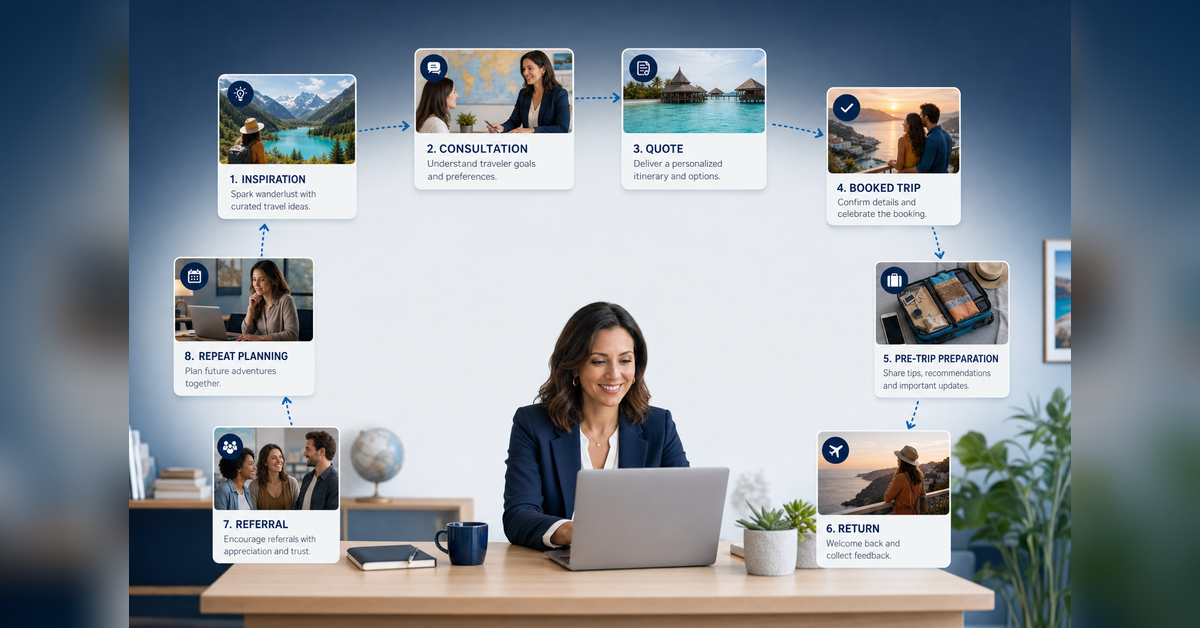

Email marketing for travel agencies uses permission-based campaigns and automated client journeys to turn interest into consultations, bookings, reviews, referrals and repeat travel. A strong program connects list quality, lifecycle stage, traveler preferences, advisor handoffs and measurement to the agency’s real sales process.
The biggest mistake is treating every contact like a newsletter subscriber. Someone downloading an Italy guide, reviewing a safari quote, preparing for departure or returning from a cruise needs a different message, owner and next step.

Travel relationships are built before, during and after the booking
Percepture has worked across travel, hospitality, destinations, national parks, cruises and visitor-economy brands since 2004. That experience informs how email, content, public relations, search, CRM and advisor follow-up should work as one traveler relationship system.



What is a travel-agency email lifecycle?
Email marketing for travel agencies is the planned use of permission-based messages and automated workflows to inspire travelers, qualify interest, support consultations and quotes, prepare booked clients, collect feedback and encourage referrals or repeat travel. Each message should have a lifecycle stage, purpose, owner, stop condition and measurable next action.
The operating model at a glance
Start with permission
Record how a person joined, what they expected and whether marketing is permitted.
Use lifecycle stages
Change the message when a traveler moves from dreaming to inquiry, quote, booking, travel or return.
Keep the advisor visible
Automation should improve timing and create tasks, not hide the person responsible for the relationship.
Measure business movement
Measure email marketing for travel agencies through replies, consultations, quotes, bookings, agency revenue, repeat travel and referrals—not opens alone.
Why email marketing for travel agencies works differently
Travel decisions can involve a long planning window, emotional stakes, several decision-makers and detailed logistics. Many meaningful conversions also happen through replies, phone calls and advisor consultations rather than a simple online checkout.
An agency sells more than a destination. It sells judgment, timing, coordination, confidence and a human relationship. That is why email marketing for travel agencies should reinforce the advisor’s value instead of reducing every message to a promotion.
A broadcast sends one campaign to a selected audience at a scheduled time. An automated flow begins after a defined trigger, such as a guide request, inquiry, quote, booking or return date. In email marketing for travel agencies, both can work, but they serve different jobs.
What makes a strong strategy?
Effective email marketing for travel agencies rests on six connected pillars. If one fails, adding more campaigns usually adds noise rather than value.
Permission and data
Maintain a permission-based list, meaning contacts whose source and marketing eligibility are documented.
Lifecycle stage
A lifecycle stage describes the traveler’s current relationship with the agency and determines the next useful message.
Relevant content
For email marketing for travel agencies, match destination, timing, party type and trip questions instead of relying on first-name tokens.
Advisor ownership
Assign the advisor responsible for replies, consultations, quotes and exceptions generated by email marketing for travel agencies.
Delivery controls
Protect sender identity, consent records, unsubscribe handling and suppression rules.
Commercial measurement
Connect email marketing for travel agencies to sales progression and agency economics.
Percepture’s email marketing services can support the campaign planning and execution required for email marketing for travel agencies, while its strategy and planning services help define the operating model before tools are configured.
The Traveler Relationship Flywheel for email marketing for travel agencies
The Traveler Relationship Flywheel is Percepture’s eight-stage methodology for moving a person from permission and preference discovery through consultation, booking, trip support, advocacy and repeat travel. It extends customer journey mapping into an email operating system.
| Stage | Purpose | Example messages | Stop or handoff signal |
|---|---|---|---|
| 1. Permission and identity | Create a usable relationship record | Confirmation, lead-magnet delivery, preferences | Invalid consent, unsubscribe or suppression |
| 2. Welcome and qualification | Explain value and identify need | Advisor introduction, preference question, consultation option | Inquiry, reply or disqualification |
| 3. Inspiration and confidence | Reduce uncertainty | Destination insight, logistics, itinerary ideas, common mistakes | Specific inquiry or changed preference |
| 4. Inquiry and consultation | Create a useful human conversation | Confirmation, preparation, scheduling, no-show recovery | Held meeting, cancellation or advisor reply |
| 5. Quote and decision | Support a considered choice | Proposal, answers, documented deadline, close-the-loop note | Reply, booking, decline or material change |
| 6. Booked and pre-trip | Prepare and reassure | Documents, payments, transfers, packing and readiness | Task completion, departure or service exception |
| 7. Return, review and referral | Resolve issues and earn advocacy | Welcome home, feedback, review and referral | Open issue, completed request or opt-out |
| 8. Repeat and reactivation | Restart relevant planning | Planning window, anniversary, preference refresh and sunset | New inquiry, lower frequency or suppression |
Framework rule: Every email needs a stage, signal, purpose, owner, stop condition and next action.
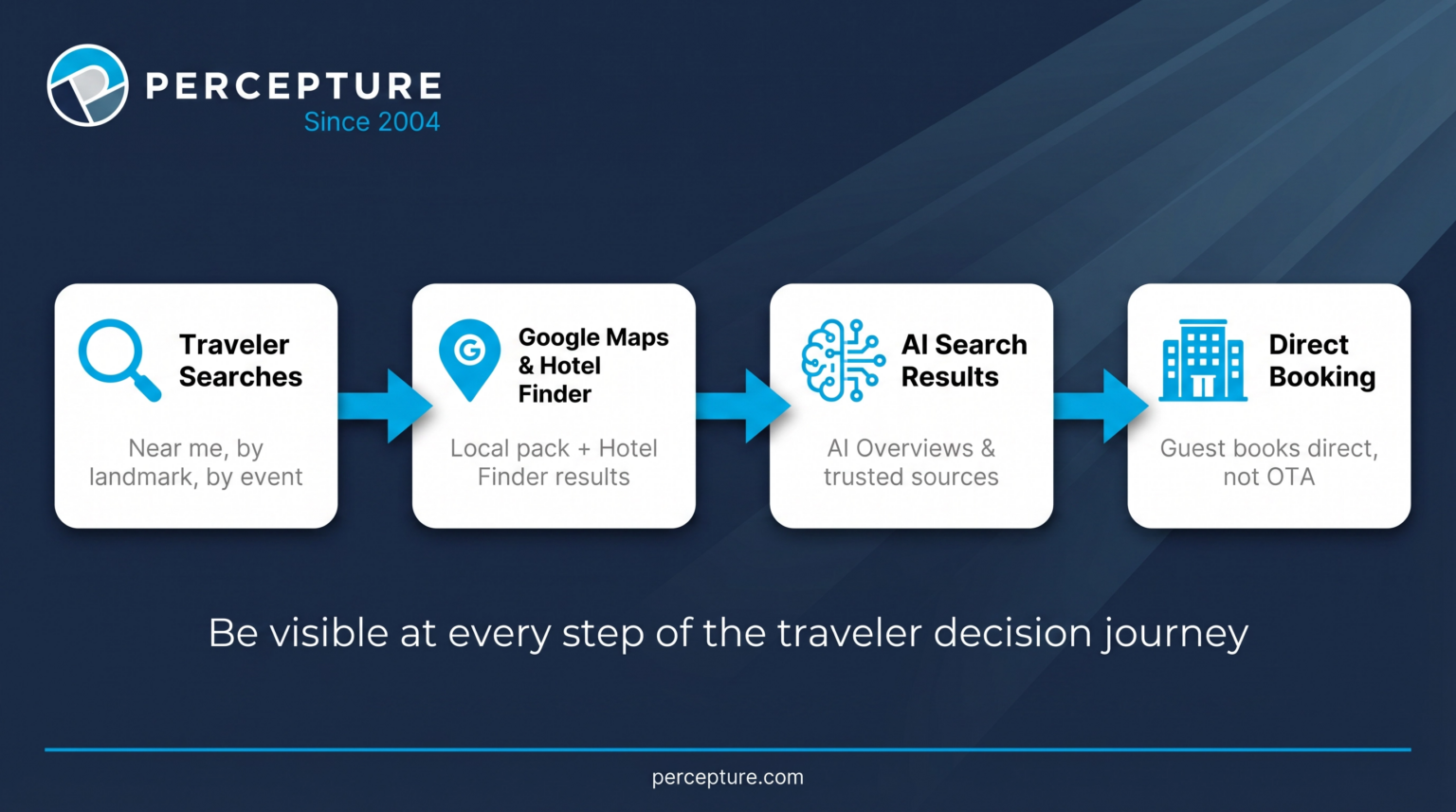
For email marketing for travel agencies, the CRM—customer relationship management system—should know whether the traveler is dreaming, inquiring, quoted, booked, traveling or ready to return. Automation should create better timing, not remove the advisor.
Map the emails your traveler should receive next
Use a Travel Agency Email Flow Planner to document the lifecycle stage, trigger, audience, exclusions, purpose, advisor owner, call to action, stop condition, required data, approval owner and KPI for each flow in email marketing for travel agencies.
Discuss a travel email flow planHow should travel agencies segment subscribers?
Segmentation is the practice of grouping contacts by information that changes the message or next step. For email marketing for travel agencies, segment first by lifecycle stage and intent, then by traveler preference. Do not build dozens of small segments the team cannot maintain.
| Record field | Why it matters | Typical source |
|---|---|---|
| Consent and source | Documents how the record was obtained and its permitted use | Form, event, client record or documented source |
| Subscriber status | Controls marketing eligibility | Email platform |
| Lifecycle stage | Changes the message and CTA | CRM or workflow |
| Destination and trip type | Improves relevance | Form, click, consultation or booking |
| Party profile and travel window | Shapes timing and useful recommendations | Inquiry or CRM |
| Departure market | Affects routes and practical content | Form or CRM |
| Past bookings | Supports repeat planning | Booking system or CRM |
| Advisor owner | Preserves the human relationship | CRM |
| Meaningful engagement | Supports reactivation or suppression | Email platform or CRM |
| Preferred frequency | Reduces fatigue | Preference center |
| Suppression reason | Prevents an accidental send | Email platform or CRM |
Suppression means preventing a contact from receiving a category of email because of an unsubscribe, complaint, invalid address, legal restriction or internal rule. Do not collect sensitive information simply because the software provides a field for it. Define the purpose, access and retention rule first.
Personalization in email marketing for travel agencies starts with relevance, not a first-name token. Departure city, travel window, trip style, quote status, advisor relationship and the traveler’s actual question are more useful than a generic destination image.
Which automations should every agency evaluate?
A small agency can begin email marketing for travel agencies with welcome, inquiry and post-trip flows. A larger operation can add consultation preparation, quote follow-up, pre-trip milestones, repeat planning, reactivation and sunset logic.
| Flow | Trigger | Primary purpose | Next action | Main measurement |
|---|---|---|---|---|
| Welcome | Valid signup | Deliver value and establish fit | Set preferences or consult | Qualified engagement |
| Lead magnet | Guide request | Fulfill the promise and deepen interest | Read, reply or consult | Next-step rate |
| Consultation | Form or calendar event | Prepare the traveler and reduce missed meetings | Complete questions and attend | Held consultations |
| Inquiry nurture | Specific trip interest | Answer questions and build confidence | Speak with an advisor | Qualified consultations |
| Quote follow-up | Proposal sent | Support a decision | Reply, revise or book | Quote progression |
| Pre-trip | Booking and departure date | Prepare and reassure | Complete required task | Task completion |
| Post-trip | Return date | Resolve, learn and request advocacy | Give feedback or a review | Resolved issues, reviews and referrals |
| Repeat planning | Relevant planning window | Reopen a conversation | Discuss the next trip | Repeat inquiries and bookings |
| Reactivation | Defined inactivity | Confirm interest or reduce frequency | Update preferences | Reactivated contacts |
| Sunset | Sustained disengagement | Protect list quality | Remain subscribed or leave | Retention or suppression |
Lead capture for email marketing for travel agencies should connect the form, promise and follow-up. Percepture’s lead generation services address that path, while conversion rate optimization services focus on what happens when an email click reaches a landing page.
What belongs in a welcome sequence?
A practical starting point for email marketing for travel agencies is a three-message welcome sequence, but three emails are not a universal rule.
- Deliver and orient. Provide the promised guide or resource, explain what the subscriber will receive and link to a preference choice.
- Establish expertise. Show how the advisor improves decisions, catches planning risks or saves time. Invite a reply about the trip under consideration.
- Qualify the next step. Ask one focused question about destination, timing or trip type, or offer an appropriate consultation.
An optional fourth message can request frequency and content preferences. Stop or change the sequence when the subscriber replies, books a meeting, becomes a client, unsubscribes or enters a more specific workflow.
How should inquiry and quote follow-up work?
Within email marketing for travel agencies, an inquiry flow should confirm receipt, set a realistic response expectation and identify the advisor. It can then provide one useful planning insight, answer a common objection and prepare the traveler for a consultation.
Quote automation needs tighter controls. It must preserve advisor ownership, stop when the traveler replies or books, use only real deadlines and require human review when price, inventory or itinerary details change. A strong intent signal should create an advisor task rather than another automatic promotion.
The email may assist a sale even when the final step occurs offline. That assisted influence should be recorded without claiming that the email alone produced the booking.
What should clients receive before and after a trip?
Pre-trip email should help the client complete required actions, understand documents and payment dates, prepare for transfers, pack appropriately and know how to obtain support. In email marketing for travel agencies, transactional email is a message needed to complete or service an existing booking; marketing email promotes another commercial action. The two uses require separate planning and controls.
After travel, begin with a service check. Resolve open issues before requesting a public review or referral. Later messages can ask about memories, preferences and the next realistic planning window.
Travel email campaign examples
Broadcasts still have a role in email marketing for travel agencies. The test is whether the audience, purpose and next action are clear.
Destination spotlight
Audience: travelers with relevant interest. CTA: read an itinerary or ask a question. KPI: qualified clicks and replies.
Advisor point of view
Audience: prospects comparing options. CTA: read the recommendation. KPI: engaged visits and replies.
Seasonal planning window
Audience: travelers whose timing fits. CTA: begin planning. KPI: consultations.
Traveler story
Audience: subscribers considering a similar trip. CTA: explore the planning approach. KPI: relevant engagement.
Educational checklist
Audience: early planners. CTA: use the checklist or reply. KPI: resource use and next steps.
Group departure
Audience: qualified trip-type segments. CTA: review details. KPI: inquiries and qualified bookings.
Referral request
Audience: satisfied past clients. CTA: make an introduction. KPI: qualified referrals.
Reactivation
Audience: defined inactive subscribers. CTA: update preferences. KPI: reactivation or suppression.

Campaign material for email marketing for travel agencies can also come from content marketing services and earned attention. The travel PR guide explains how travel organizations can build that broader trust.
How often should travel agencies email?
Frequency should follow subscriber expectation, lifecycle stage, relevance and engagement—not a universal weekly rule. Email marketing for travel agencies should use event-driven timing for welcome, inquiry and booked-client service, then test an appropriate campaign rhythm for engaged prospects and the general audience.
- Welcome and inquiry: event-triggered.
- Booked-client service: tied to real milestones and deadlines.
- Engaged prospects: test weekly or biweekly communication.
- General subscribers: test two to four useful sends per month.
- Disengaged contacts: reduce frequency, refresh permission or sunset the record.
These are test ranges, not performance benchmarks. Watch replies, unsubscribes, complaints, consultation volume and advisor capacity.
Email marketing for travel agencies: platform and investment scorecard
There is no universal best platform for email marketing for travel agencies. Choose the simplest system that can support the required lifecycle, governance and measurement for the next 12 to 18 months. Compare total operating cost, not only the subscription price.
| Decision area | Solo advisor | Multi-advisor agency | Tour operator |
|---|---|---|---|
| CRM connection | Simple contact and task visibility | Clear advisor ownership and permissions | Departure, inventory and booking integration |
| Automation | Core welcome, inquiry and post-trip flows | Handoffs, branching and stop conditions | Date-based and trip-based workflows |
| Segmentation | Stage and major preferences | Stage, advisor, trip type and client status | Departure, market, product and traveler status |
| Governance | Consent, suppression and basic access | Roles, approvals and shared standards | Operational separation and vendor controls |
| Measurement | Replies, consultations and bookings | Advisor and campaign progression | Bookings, agency revenue, margin and assisted influence |
| Investment test | Can one person operate it consistently? | Can the team maintain data and ownership? | Can it connect marketing and operational systems? |
Review implementation, migration, integrations, data cleanup, training, content production and ongoing management. Percepture publishes its broader marketing pricing to help buyers frame service investment.
How should deliverability and consent be protected?
Deliverability is the ability to place legitimate email where recipients can receive and use it. SPF identifies permitted sending systems, DKIM applies a cryptographic signature and DMARC tells receiving systems how to evaluate alignment and report authentication results. Authentication supports identity checks but does not guarantee inbox placement.
Google publishes email sender guidelines covering authentication and sender practices. The FTC publishes its CAN-SPAM compliance guide for commercial email in the United States. Agencies serving people in other jurisdictions should evaluate GDPR, ePrivacy or PECR, CASL and local requirements based on recipient location, source and purpose. These requirements directly affect email marketing for travel agencies. This section is practical guidance, not legal advice.
- Document source, consent language and timestamp.
- Maintain unsubscribe, preference and suppression controls.
- Monitor bounces and complaints.
- Use an aligned and recognizable sender identity.
- Increase sending volume carefully.
- Review vendors and mailbox-provider testing.
- Separate promotional marketing from booking and service communications.
Marketing consent, booking communications and B2B prospecting are different use cases. A permission-based traveler audience and a B2B travel-industry prospect list are not interchangeable. This guide covers subscribers, leads and clients; the travel and tourism email list guide covers sourcing, verification and responsible B2B use.
How should results be measured?
A high open rate is not proof of profitable bookings. Privacy controls and automatic image loading can also limit the usefulness of open data. Email marketing for travel agencies needs a measurement ladder that follows the traveler from delivery to business value.
| Level | Measures | Management question |
|---|---|---|
| 1. Deliverability | Delivery, bounce, complaint, unsubscribe and authentication | Can legitimate recipients receive the message? |
| 2. Relevance | Clicks, replies, preferences and engaged subscribers | Did the content match the traveler’s need? |
| 3. Sales progression | Consultations, held meetings, quotes and completed follow-up | Did the relationship advance? |
| 4. Commercial outcome | Bookings, agency revenue or commission, margin, repeats and referrals | Did the program create economic value? |
| 5. Relationship value | Retention, time between trips, reviews and advisor capacity | Is the system improving the client relationship? |
When evaluating email marketing for travel agencies, opens diagnose attention. Consultations, bookings, commission, repeat travel and referrals diagnose business value. Separate booking value from agency revenue, last-click credit from assisted influence, and online conversions from replies or offline sales.
Percepture’s attribution analytics work can help define those connections. An omnichannel marketing program can then coordinate email with search, paid media, PR, content and sales follow-up.
A 90-day launch plan
A staged launch keeps email marketing for travel agencies tied to operating capacity. Build the controls and core journeys first, then add complexity after the team can maintain them.
- Days 1–30: Set goals, audit list sources and consent, define CRM stages, assign advisor ownership, configure authentication, review forms and establish a baseline. Map the first three flows.
- Days 31–60: Build welcome, inquiry and quote logic. Create templates, preferences, tracking, suppression rules, landing-page alignment and quality checks.
- Days 61–90: Launch in a controlled way. Review delivery, test calls to action, inspect advisor handoffs and begin pre-trip and post-trip workflows.
- Quarter two: Add repeat planning, referrals, reactivation, localization, attribution and cross-channel integration where the data supports them.
Illustrative travel-agency operating model
Illustrative operating model, not a Percepture client case study.
Consider a luxury family-Europe agency implementing email marketing for travel agencies. A traveler requests a planning guide and receives the promised resource, a preference question and an advisor introduction. Destination, party profile and travel window place the person into a relevant nurture path.
A consultation request stops the general nurture and creates an advisor task. After the consultation, a proposal begins quote follow-up, but a reply, booking or material itinerary change stops that automation. Booking starts milestone-based service messages. Return starts feedback and issue-resolution steps before any review or referral request.
Later, a realistic anniversary or planning window can reopen the conversation. The agency measures source quality, replies, consultations, held meetings, quote progression, bookings, agency revenue, resolved service issues, referrals and repeat inquiries without inventing a universal return rate.
Common mistakes to remove
- Sending the same newsletter to every contact.
- Keeping no record of source or permitted use.
- Using fake scarcity or unsupported price-drop language.
- Leaving advisor ownership undefined.
- Running nurture and quote flows without stop conditions.
- Mixing service and promotional messages carelessly.
- Ignoring replies because the workflow is automated.
- Selecting software before mapping the lifecycle.
- Reporting opens without sales progression or commercial outcomes.
- Publishing generic copy that does not answer the traveler’s question.
- Keeping disengaged contacts forever without a sunset policy.
Connect the email flow to the full traveler journey
Percepture approaches email marketing for travel agencies as part of the larger traveler relationship. Review its travel-sector capabilities, customer-journey method and integrated approach before deciding whether outside support fits.
Review Percepture’s travel and tourism capabilitiesWhy Percepture?
Travel context
Percepture has documented experience across destinations, hospitality, cruises, attractions, national parks and travel media relevant to email marketing for travel agencies.
Email and journey design
Its work in email marketing for travel agencies connects permission, lifecycle stages, automation, advisor ownership and measurable handoffs.
Integrated channels
Email can work with content, search, paid media and digital PR services rather than operating as an isolated calendar.
Conversion and attribution
Landing-page behavior, assisted influence and offline sales progression can be evaluated together.
Human review
Automation handles repeatable timing while advisors retain responsibility for judgment, exceptions and relationships.
Frequently asked questions
What is email marketing for travel agencies?
Email marketing for travel agencies is the use of permission-based campaigns and automated workflows to support travelers from first interest through consultation, quote, booking, trip preparation, return and repeat planning. Strong programs connect every message to a lifecycle stage, traveler need, advisor owner and measurable next action.
Which email campaigns work best for travel agencies?
The best campaign in email marketing for travel agencies depends on the audience and lifecycle stage. Useful options include destination spotlights, advisor insights, seasonal planning windows, checklists, traveler stories, group departures, events, referral requests and preference updates. Real relevance matters more than sending every format.
What is the three-email welcome rule?
There is no universal three-email rule. Three messages can form a minimum viable sequence: deliver the promised resource, demonstrate advisor value and qualify the next step. Agencies may need fewer or more messages depending on the signup promise, booking window, traveler response and available data.
How often should a travel agency send marketing emails?
Frequency should reflect subscriber expectations, lifecycle stage, relevance and engagement. Welcome and inquiry messages are event-driven, while broader campaigns require testing. Reduce frequency or use a reactivation process when sustained disengagement, complaints or unsubscribes show that the current rhythm is not useful.
How should travel agencies segment an email list?
Segmentation for email marketing for travel agencies should start with lifecycle stage and intent. Then use destination, trip type, party type, travel window, departure market, past-client status, engagement, advisor ownership, language, jurisdiction and content preference where those fields change the message. Avoid segments the team cannot maintain.
What should pre-trip and post-trip emails include?
In email marketing for travel agencies, pre-trip messages can cover required actions, documents, payments, transfers, packing, support and relevant optional experiences. Post-trip communication should begin with a service check and issue resolution. Review, referral and next-trip messages should follow only when the relationship and timing support them.
When should an email automation stop?
Stop or change a workflow when the traveler replies, books, declines, changes lifecycle stage, completes the required task, unsubscribes or enters a conflicting sequence. Quote and service workflows also need human review when itinerary, inventory, price or deadline information changes.
How much is a 1,000-person travel email list worth?
There is no reliable value based on list size alone. Value depends on permission, data quality, engagement, booking intent, average agency revenue or commission, margin, repeat behavior and the team’s ability to follow up. A smaller qualified audience can be more useful than a larger inactive one.
What is the best email platform for a travel agency?
The best platform for email marketing for travel agencies is the simplest one that supports the agency’s required CRM connection, advisor ownership, automation, stop conditions, segmentation, transactional separation, integrations, reporting, data portability, international controls and team workflow. Evaluate total operating cost instead of subscription price alone.
How should an agency handle international email consent?
International email marketing for travel agencies requires evaluating the recipient’s jurisdiction, the record’s source, the message purpose and applicable rules before sending. United States, European, United Kingdom and Canadian requirements are not interchangeable. Maintain source and consent records, provide clear controls and obtain qualified legal guidance for the agency’s markets.
Turn your email calendar into a traveler lifecycle
A Travel Email Lifecycle Review can examine list sources, segmentation, campaigns, advisor handoffs, delivery controls, landing pages and measurement. Percepture reviews the current traveler stages and operating process before recommending how to improve email marketing for travel agencies.
Request a Travel Email Lifecycle Review