
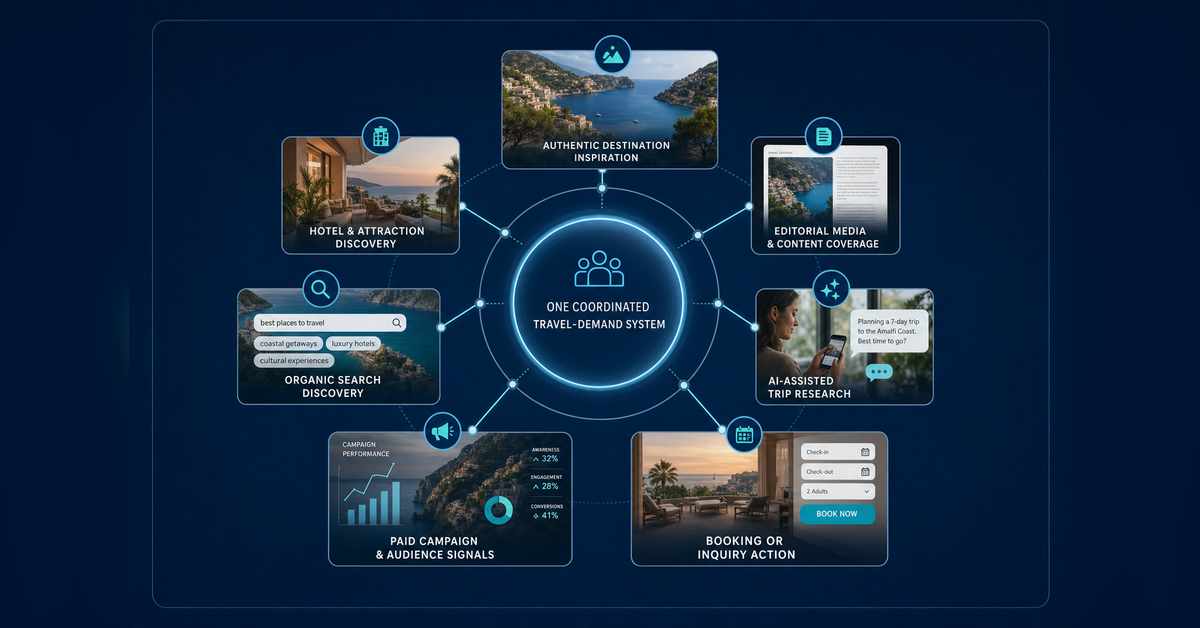

A travel and tourism marketing agency helps destinations, hotels, attractions, tour operators and travel companies create measurable demand through strategy, public relations, SEO, AI search, paid media, content, analytics and conversion. The best agency connects those channels to bookings, room nights, inquiries, partner referrals or visitor value.
The hard part is not finding an agency with a long service list. It is finding a team that understands the travel decision, knows which channels should work together and can show how attention becomes action.
What should an integrated travel marketing partner do?
A travel and tourism marketing agency should connect the story travelers believe, the channels they use to discover and validate it, and the actions the organization can measure. That requires coordinated positioning, PR, search, paid media, content, conversion and reporting—not separate channel plans competing for attention.
Executive summary
Start with the business problem
Define the audience, need period, limiting perception and valuable traveler action before asking a travel and tourism marketing agency to select channels.
Request comparable proof
Look beyond a logo wall. Ask what changed, which team did the work and how the result was measured.
Inspect the handoffs
PR, SEO, GEO, paid media and conversion should share messages, evidence, landing pages and reporting.
Separate the costs
A travel and tourism marketing agency should separate its fees from media, production, technology and pass-through expenses before signing.
Measure traveler action
Impressions and rankings are useful diagnostics, but leadership also needs bookings, inquiries, referrals or pipeline.

Where Amazon Goes, the World Follows
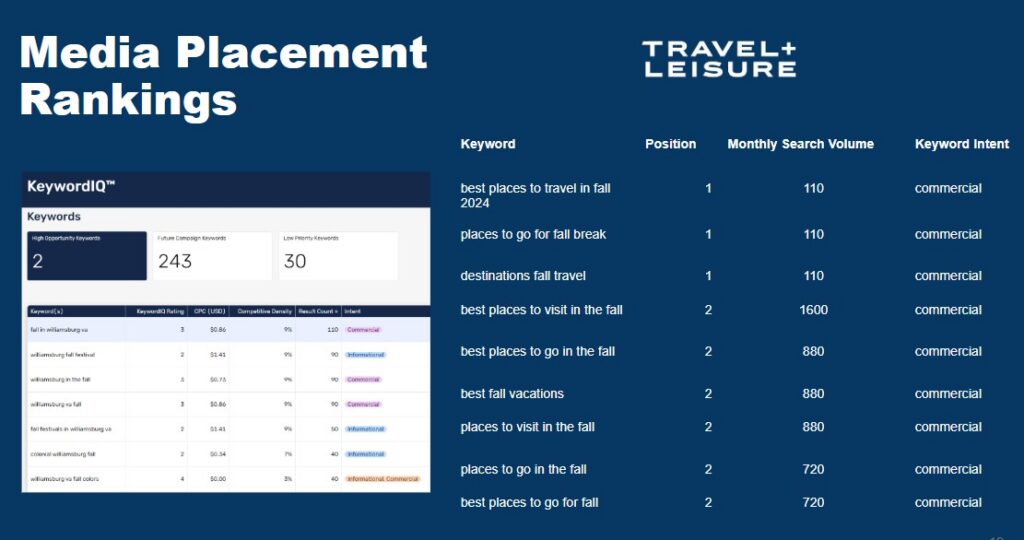
Percepture helped turn Amazon deliveries by mule to Phantom Ranch into a national travel story connecting the Grand Canyon, hospitality, adventure and destination media.



How an unusual delivery became a national travel story
The Amazon and Phantom Ranch campaign shows how a distinctive operating detail can become earned media, destination interest and lasting search authority.
Who this guide is for
This guide is for executives and marketing leaders evaluating a travel and tourism marketing agency, preparing an RFP, deciding between specialists and an integrated team, or setting a realistic operating model.
CEO or executive director
Needs a travel and tourism marketing agency to provide strategic coherence, senior access and a board-ready link between perception and traveler action.
CFO
Needs separated fees, clear ownership, review gates and an explanation of what each investment influences.
CMO
Needs named owners, practical handoffs and one operating plan from the travel and tourism marketing agency rather than disconnected reports.
Revenue or sales leader
Needs agreed conversion definitions for bookings, group leads, consultations or pipeline.
DMO board
Needs transparent reporting on stakeholder value, partner referrals and destination demand.
Technical lead
Needs access requirements, tracking standards, implementation ownership and quality controls.
This guide is about choosing and managing a travel and tourism marketing agency. The linked specialist guides go deeper into destination organizations, hotels, tour operators and individual channels such as travel SEO, public relations and paid search.
What does a travel and tourism marketing agency do?
A travel and tourism marketing agency acts as a strategic adviser, demand operator, trust builder and measurement partner. It identifies why travelers choose, captures demand across relevant channels, gives people credible reasons to believe the promise and reports whether marketing contributed to a valuable action.
The work begins with the traveler decision rather than a fixed package. A destination may need stakeholder alignment and partner referrals. A hotel may need direct-booking demand during specific periods. A tour operator may need qualified inquiries, while a travel technology company may need demos and pipeline.
Agency type and primary job
| Provider type | Primary job | Typical limitation |
|---|---|---|
| Marketing agency | Broad demand generation and conversion | May lack travel depth |
| PR agency | Earned attention, reputation and crisis support | May not capture active search demand |
| Creative studio | Brand identity and campaign expression | May not operate ongoing demand channels |
| Media agency | Audience buying and optimization | Depends on strong positioning and conversion paths |
| SEO agency | Organic discovery and site performance | May not build earned reputation |
| Travel and tourism marketing agency | Coordinates the required roles around one outcome | Breadth must be backed by senior depth |
“Travel agency” by itself can also describe a consumer booking company. Buyers should use precise scope language so prospective partners understand whether the request concerns marketing, distribution, booking or all three.
Which travel organizations need outside agency support?
An outside travel and tourism marketing agency is most useful when the organization has a meaningful demand problem but lacks the capacity, specialist skills or coordination required to solve it. The right model depends on where conversion occurs and who controls the data.
| Organization | Common problem | Priority capabilities | Useful outcomes |
|---|---|---|---|
| DMO or CVB | Fragmented stakeholders and indirect conversion | Brand, PR, paid media, SEO and partner reporting | Visitation, room nights and partner value |
| Hotel or resort | OTA dependence and need periods | SEO, PPC, PR, conversion and group demand | Direct revenue, occupancy and group leads |
| Tour operator | Weak direct inquiry volume | Search, content, paid media and nurture | Qualified inquiries and bookings |
| Attraction | Seasonal or local discovery gaps | Local search, paid media and creator outreach | Tickets, reservations and visits |
| Retail travel agency | Need for high-value trip leads | Specialty SEO, paid search and nurture | Consultations and booked trips |
| Cruise, park or rail operator | Complex stories, logistics and reputation | PR, content, SEO and reputation management | Bookings and authority |
| Travel technology company | Long B2B buying cycle | Thought leadership, PR, SEO and lead nurture | Demos, partnerships and pipeline |
A buyer with a narrow technical issue may need a specialist rather than a full-service travel and tourism marketing agency. A buyer with several channels working toward one goal usually needs stronger coordination.
Which travel marketing services should work together?
A capable travel and tourism marketing agency does not need to perform every task internally. It does need to define ownership, dependencies and handoffs so the traveler receives one credible story from discovery through conversion.
Positioning
Role: define the traveler promise and priority audience. Output: message architecture. Dependency: research and operating facts. KPI: message adoption and qualified response.
Public relations
Role: earn attention and protect reputation. Output: media narratives and outreach. Dependency: source-worthy stories. KPI: relevant coverage, authority and referral activity. Explore public relations services.
Digital PR
Role: connect earned stories to online authority. Output: research, assets and outreach. Dependency: credible sources. KPI: quality mentions and links. Review digital PR.
SEO and local search
Role: capture active planning demand. Output: technical fixes, architecture and useful pages. Dependency: crawlable sites and accurate inventory. KPI: qualified organic actions. See enterprise SEO.
GEO and AI search
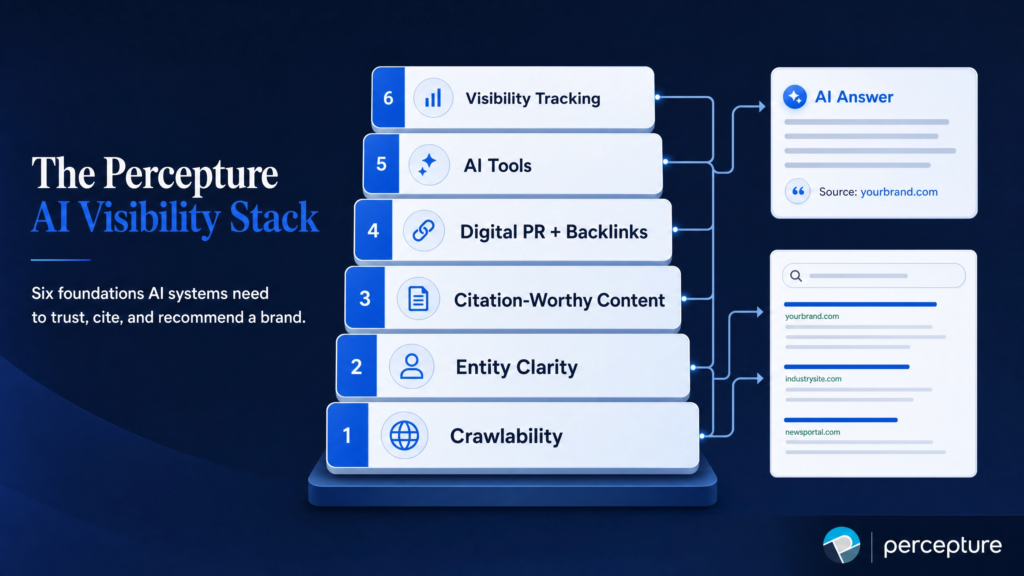
Role: make entities, experiences and experts clear to answer systems. Output: source-worthy content and entity clarity. Dependency: sound SEO and current facts. KPI: relevant citations and assisted discovery. Examine generative engine optimization services.
Paid media
Role: create controlled reach and capture demand. Output: campaigns, audiences and landing pages. Dependency: conversion tracking. KPI: qualified action and acquisition cost. Compare paid search services.
Content and creators
Role: explain experiences and answer planning questions. Output: guides, stories, video briefs and reusable assets. Dependency: editorial access. KPI: engagement and assisted conversion. Review content marketing services.
Conversion and analytics
Role: connect attention to action. Output: measurement plans, tests and reporting. Dependency: booking, CRM or partner data. KPI: bookings, inquiries and referrals. See attribution and analytics and conversion rate optimization.
Score agencies before the pitch takes over
Use the 100-point scorecard below to compare every travel and tourism marketing agency against the same evidence, operating and commercial standards.
The Travel Demand Integration System
Percepture’s Travel Demand Integration System is a six-part operating model for a travel and tourism marketing agency or internal team. It connects positioning, demand capture, earned trust, search and AI authority, conversion, and attribution so the channels reinforce one another.
Position the experience
Clarify the traveler promise, priority audience, limiting perception, need periods and experiences the organization can credibly own.
Capture existing demand
Use SEO, local search, paid search and focused landing pages to reach travelers already planning. Specialist resources such as SEO for tour operators can clarify segment-specific execution.
Create earned trust
Use journalists, creators, experts, reviews, partnerships and original data to provide third-party reasons to believe.
Build search and AI authority
Make the organization, properties, experiences and experts clear and useful across search and answer engines. The guide to AI search for tourism marketing explains this work in greater depth.
Convert and nurture demand
Connect attention to a booking, itinerary, inquiry, partner referral, group lead or email opt-in.
Attribute business impact
Report the path from exposure and authority to revenue, room nights, registrations, partner traffic or another agreed result.
A full-service list is not evidence that a travel and tourism marketing agency is integrated. Ask the agency to show the handoff between every service.
How the framework works in three travel situations
Leisure booking: A distinctive experience earns coverage, supports destination or property pages, informs paid creative and sends interested travelers to a booking path built around the same promise.
Group sales: Search and paid campaigns capture meeting-planner demand while PR and expert content establish credibility. Landing pages route qualified planners to a defined sales handoff.
DMO partner referral: Destination content creates planning demand, itinerary pages organize the experience and tracked partner links show how demand reaches local businesses.
Travel and tourism marketing agency comparison framework
Select the operating model that matches the actual constraint. An integrated travel and tourism marketing agency fits a multi-channel demand problem, but it is not automatically the right answer for a narrow assignment.
| Model | Best when | Strength | Risk to examine |
|---|---|---|---|
| Travel and tourism marketing agency | Several channels share one objective | Coordination and shared accountability | Breadth without senior depth |
| PR specialist | Earned attention or reputation is primary | Media expertise | Weak demand capture |
| SEO or PPC specialist | Search is the main opportunity | Technical channel depth | Limited brand and PR integration |
| Creative studio | The brand or campaign needs reinvention | Concept and design | Limited ongoing demand execution |
| In-house team | Workload is constant and leadership can hire | Institutional knowledge and control | Specialist hiring gaps |
| Freelancer network | Scope is narrow and ownership is clear | Flexibility | Coordination burden |
| Platform | An internal team can operate it | Data and scale | A tool without strategy |
Do not hire a full-service travel and tourism marketing agency when the problem is narrow, the internal team can coordinate specialists, the budget cannot support senior cross-channel work, the organization will not share required data or leadership expects guaranteed outcomes.
The 100-point agency selection scorecard
Score each travel and tourism marketing agency from zero to ten on the ten criteria below. Require notes and evidence for every score; otherwise pitch quality can overshadow operating quality.
| Criterion | What earns a high score | Points |
|---|---|---|
| Travel-segment experience | Comparable traveler, stakeholder and conversion conditions | 0–10 |
| Integrated strategy | Clear channel dependencies and one demand objective | 0–10 |
| Case-study quality | Problem, method, role, result and context are visible | 0–10 |
| Senior-team access | Named leaders remain involved after the pitch | 0–10 |
| SEO, GEO and digital authority | Technical, editorial and entity expertise work together | 0–10 |
| Paid-media and conversion discipline | Landing pages, tracking and media economics are connected | 0–10 |
| Measurement and attribution | Executive outcomes and channel diagnostics share one plan | 0–10 |
| Stakeholder and procurement fluency | The team can operate within approval and reporting structures | 0–10 |
| Reputation and crisis readiness | Roles, escalation paths and monitoring are defined | 0–10 |
| Commercial transparency | Fees, media, production, ownership and terms are separated | 0–10 |
85–100: strong fit. 70–84: viable with gaps to resolve. 55–69: may fit a specialist scope. Below 55: high execution or governance risk.
Greater Williamsburg: changing the reason to visit
Greater Williamsburg faced a limiting history-only stereotype. The assignment was not to hide that history; it was to give travelers broader, credible reasons to reconsider the destination.
Percepture combined destination stories, journalist and influencer outreach, more than 60 media meetings, SEO and digital amplification. Campaign angles included “Move Over Brooklyn,” “Williamsburg Without Your Parents” and the Williamsburg Tasting Trail.
| Documented result | Reported outcome |
|---|---|
| Earned reach | More than 300 million media impressions |
| Stories | 100 stories, with more than 90% aligned to priority themes |
| Broadcast | 10 segments, including NBC’s TODAY |
| Organic growth | 18% |
| New organic visitors | More than 100,000 |
| Engagement | 3.6 pages viewed and more than three minutes of engagement |
| Audience composition | 75% first-time visitors |
The lesson for a travel and tourism marketing agency buyer is straightforward: earned stories can change perception while search captures the demand that follows. Read the full Williamsburg destination marketing case study.

Find the gaps between your travel channels
A Travel Demand Integration Review examines positioning, search, AI visibility, PR, paid media, conversion and reporting. It is designed to show where a travel and tourism marketing agency or internal team must improve the handoffs.
How much does a travel and tourism marketing agency cost?
There is no responsible universal retainer for a travel and tourism marketing agency. Strategy, channel management, production, media, data and technology should be separated so the buyer can see what the budget funds.
| Cost layer | What it can include | Question to ask |
|---|---|---|
| Strategy | Research, positioning, planning and measurement design | Is this a one-time phase or ongoing responsibility? |
| Channel management | PR, SEO, GEO, paid media, content or lifecycle execution | Which named people own each channel and handoff? |
| Production | Writing, design, video, landing pages and campaign assets | What is included, capped or billed separately? |
| Media, data and technology | Advertising spend, platforms, research and reporting tools | Who contracts, pays for and owns each account? |
Cost rises with the number of properties or markets, international scope, PR intensity, media budget, production volume, website complexity, attribution requirements, approval layers and speed. Buyers can review Percepture’s public pricing overview, SEO pricing packages and paid advertising pricing while building a scope.
Ask every travel and tourism marketing agency to state whether media, creator fees, travel, production, technology and subcontractors are included. Also establish ownership of creative assets, advertising accounts, analytics, audiences, source files and reporting history.
What should happen in the first 90 days?
The first 90 days should allow the travel and tourism marketing agency to establish the operating system, launch priority work and create early signals. They do not guarantee mature rankings, full economic impact or a solved reputation problem.
Days 1–30: establish the facts
Align goals, audiences, need periods and conversion definitions. Secure access, audit tracking, review competitors and search demand, inventory messages, and identify quick operational fixes.
Days 31–60: build the system
Set channel architecture, correct technical issues, prepare landing pages, create media and content plans, build paid campaigns and approve the reporting model.
Days 61–90: launch and learn
Begin outreach and campaigns, run conversion tests, review quality, monitor search and AI visibility, and shift effort based on evidence.
What should the agency report?
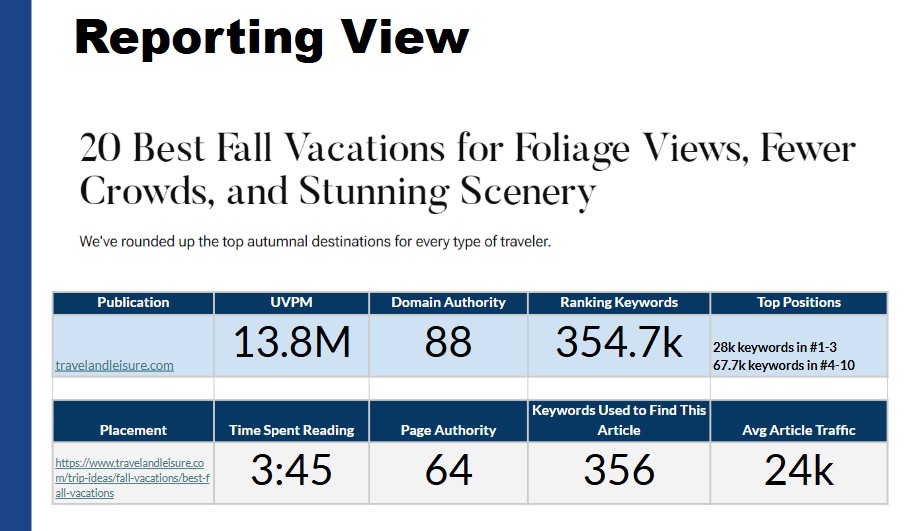
Reporting should have three levels: executive outcomes, channel diagnostics and a test-and-learning log. A travel and tourism marketing agency should not force a hotel, DMO and travel technology company into the same KPI template.
| Business | Primary KPIs | Supporting diagnostics |
|---|---|---|
| Hotel | Revenue, bookings, group leads and need-period occupancy | Qualified sessions and booking progression |
| DMO | Partner referrals, room nights, event demand and economic value | Itinerary use and earned authority |
| Tour operator | Inquiries, bookings and revenue per lead | Visibility and assisted conversions |
| Attraction | Tickets, reservations and visits | Local visibility and engagement |
| Travel agency | Consultations and booked trips | Cost per inquiry and close rate |
| Travel technology | Demos, pipeline and partnerships | Account engagement and relevant citations |
What belongs in a tourism marketing RFP?
A strong RFP defines the business problem and decision criteria without dictating every tactic. It gives each travel and tourism marketing agency enough operating context to propose a useful model.
- Business goals and the traveler actions that matter
- Priority audiences, source markets and need periods
- Stakeholders, approvers and the internal delivery team
- Required services and known channel dependencies
- Website, CRM, analytics, booking and partner environments
- Existing research, creative, content and technical assets
- Accessibility, privacy, procurement and compliance requirements
- Reputation monitoring and crisis responsibilities
- Primary KPIs, supporting diagnostics and reporting audiences
- Budget range with fees and media separated
- Account, data, creative and intellectual-property ownership
- Evaluation criteria, contract terms and review gates
- Expected first-90-day outputs
15 questions to ask before hiring
- Which case most closely matches our traveler, sales or stakeholder problem?
- Who did the work in that case, and who will work on our account?
- Which senior leaders remain involved after the pitch?
- What work is subcontracted, and how is it reviewed?
- How do PR, SEO, GEO, paid media and conversion teams share information?
- How do you define a qualified traveler or buyer action?
- What booking, CRM or partner data do you require?
- What will you complete during days 30, 60 and 90?
- How do you separate management fees, media, production and technology?
- Who owns accounts, audiences, creative files and reporting data?
- What does leadership receive that channel managers do not?
- How do you monitor and escalate reputation risks?
- How will a redesign or campaign launch protect organic visibility?
- How does your plan change across peak, shoulder and need periods?
- What would make you advise us not to hire your full team?
Warning signs in an agency proposal
| Warning sign | Why it matters | Better evidence |
|---|---|---|
| Identical channel mix for every buyer | The plan is package-led rather than problem-led | A scope tied to the conversion path |
| Vanity-only goals | Reach is not connected to a valuable action | Executive outcomes plus diagnostics |
| No senior access | The pitch team may disappear during delivery | Named roles and meeting cadence |
| Repetitive AI keyword content | Volume replaces expertise and source quality | Original evidence and editorial review |
| Ranking or revenue guarantees | The provider claims control it does not have | Forecasts, assumptions and review gates |
| Unclear ownership | Accounts and assets may become difficult to transfer | Written ownership terms |
| PR and SEO silos | Earned authority may not support discoverability | A documented content and link handoff |
| No crisis process | Slow escalation can increase reputational risk | Monitoring, roles and escalation paths |
| Hidden media costs | Leadership cannot compare fees or efficiency | Separated invoices and budget reports |
| No booking-system discussion | The agency cannot see the full conversion path | Access and integration requirements |
| Weak case methods | Results cannot be connected to agency work | Problem, method, role and context |
| Logo wall without evidence | Brand association does not prove performance | Comparable, documented cases |
Why Percepture approaches travel demand as one system
As a travel and tourism marketing agency, Percepture combines visitor-economy experience with omnichannel marketing, PR, SEO, GEO, content, paid media and analytics. The operating principle is simple: proof comes before promotion, and reporting should connect attention to an action the organization can use.
That approach is visible in destination work such as Greater Williamsburg and earned-media work such as Amazon and Phantom Ranch. Supporting campaigns include Hunterdon, which recorded 7 million impressions, 73,000 visitors and 13,106 direct clicks, and SKIFT, which recorded 55 placements in five months and attendance by 30 members of the press at its Global Forum.
A buyer comparing a travel and tourism marketing agency can also explore Percepture’s broader travel marketing and PR services, the specialist destination marketing agency guide, the hotel digital marketing agency guide and the tour operator marketing agency guide.
Frequently asked questions
What is a travel and tourism marketing agency?
A travel and tourism marketing agency helps destinations, hospitality businesses, attractions, operators and travel companies create and capture demand. Its services may include positioning, PR, SEO, AI search, paid media, content, conversion and analytics. An integrated travel and tourism marketing agency coordinates only the capabilities required for a shared business outcome.
How much does a travel marketing agency cost?
The cost of a travel and tourism marketing agency depends on scope, markets, properties, production, media, technology, approval requirements and measurement complexity. Ask providers to separate management fees, production, advertising spend, data and technology.
Is a travel specialist better than a generalist agency?
A travel and tourism marketing agency is useful when travel behavior, distribution, seasonality, stakeholders or reputation create material complexity. A generalist can still fit when it has comparable proof and the required senior expertise. Score the actual team and method rather than relying on category language alone.
Should travel marketing be managed in-house or by an agency?
Keep work in-house when demand is steady, leaders can hire the required specialists and the team can coordinate channels. Use a travel and tourism marketing agency when speed, specialist depth or cross-channel delivery exceeds internal capacity. A hybrid model often works when internal leaders retain strategy and data ownership.
Which services should be prioritized first?
A travel and tourism marketing agency should prioritize the constraint closest to the business problem. Weak positioning requires message work. Low active demand capture points to SEO or paid search. Limited credibility may require PR. Conversion loss requires landing-page, booking or analytics work. Do not start with a channel because it is fashionable.
How long does travel marketing take to work?
Paid campaigns and conversion fixes can produce early signals quickly, while earned reputation, organic search authority and traveler perception usually require sustained work. The first 90 days with a travel and tourism marketing agency should establish access, strategy, measurement, priority assets and initial execution rather than promise mature impact.
How should a DMO measure agency value?
A DMO should agree with its travel and tourism marketing agency on outcomes it can observe and influence, such as partner referrals, itinerary use, room-night indicators, event demand and stakeholder value. Supporting measures can include qualified traffic, earned authority and engagement. Reporting should explain limits in data ownership and attribution.
What proof should an agency provide?
Request a comparable business problem, the travel and tourism marketing agency’s specific role, the named team, the method, documented results and enough context to interpret them. Ask whether the case relied on paid media, existing demand, outside partners or client resources. Historical results should inform selection, not become a guarantee.
What makes agency services truly integrated?
Integration is visible in the handoffs a travel and tourism marketing agency manages. Earned stories inform search content. Search demand shapes campaign pages. Paid media tests messages. Conversion data changes targeting. Reporting connects those activities to a shared traveler action. A bundled invoice or long service list does not prove integration.
What should a tourism marketing RFP include?
Give each travel and tourism marketing agency the business problem, audiences, markets, need periods, stakeholders, internal resources, required capabilities, technology environment, conversion definitions, budget structure, ownership terms and evaluation criteria. Ask for a first-90-day plan and the team that will deliver it.
Build one measurable travel-demand system
The right travel and tourism marketing agency should make the buyer’s operating choices clearer. It should identify what must change, show how channels depend on one another, separate costs and connect reporting to meaningful action.
Request a Travel Demand Integration Review
Percepture will review the organization and its current demand problem. A senior strategist will identify where a travel and tourism marketing agency can close channel gaps and dependencies, then outline a practical first-90-day structure and the inputs required to scope the work.
How this guide was built
This guide combines Percepture’s documented travel campaigns, published service information, search observations and direct experience across destinations, hospitality, travel media, attractions and travel services. Historical campaign results do not guarantee future outcomes.