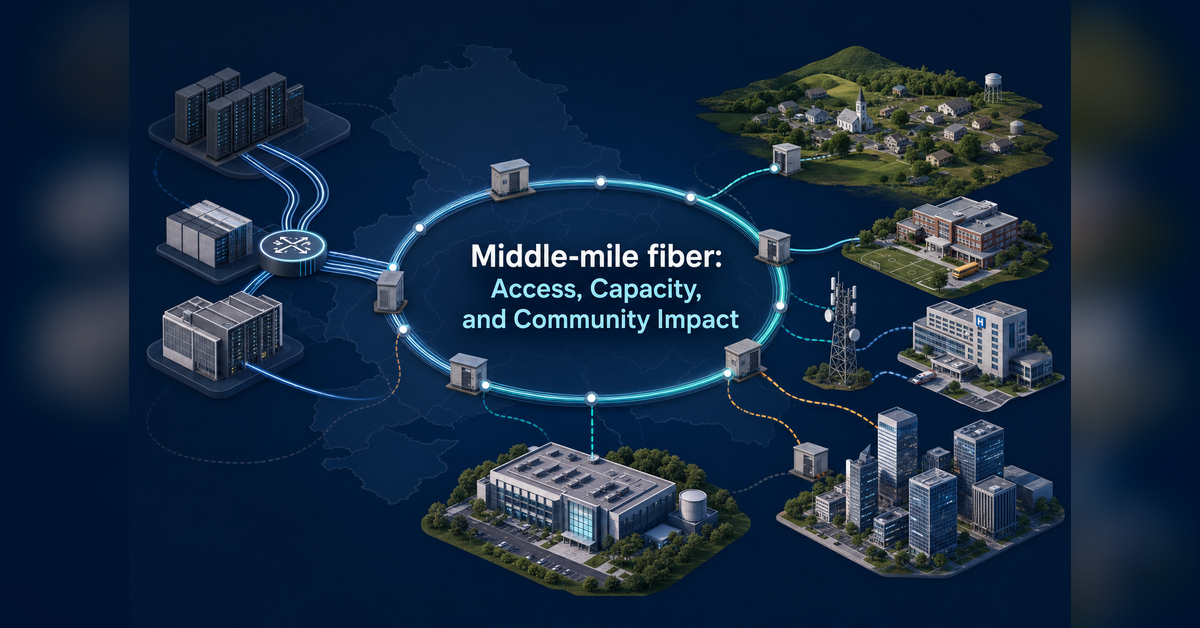

Middle-mile fiber connects local broadband systems to the regional and national networks that carry traffic farther. For an ISP, municipality, cooperative, utility, or investor, that connection can determine whether a last-mile plan has practical access to capacity, interconnection, and dependable transport.
Route miles alone do not settle the case. Middle-mile fiber buyers must examine where providers can connect, what services they can order, how physical diversity is established, who operates the system, and how construction becomes activated use.
See middle-mile infrastructure from an operator’s seat
Bob Generale interviews Cody Clegg of OPTK Networks about the role middle-mile fiber plays in rural broadband economics, cloud connectivity, AI infrastructure, route planning, permitting and community growth.
Cody’s statements reflect the operator perspective documented in the attached July 2026 interview. The discussion does not replace engineering, legal, funding or procurement diligence.
Infrastructure buyers need proof before they need promotion
Percepture works across telecom, data centers, infrastructure, staffing, technology and complex B2B markets. The proof stack gives buyers a quick way to evaluate the team behind the market education, search, GEO, PR and demand strategy.





Infrastructure authority needs more than a route announcement
Network truth: Separate planned, constructed, tested, orderable, activated, and utilized middle-mile fiber infrastructure.
Buyer truth: Explain access points, products, responsibilities, commercial terms, and operating limits.
Market truth: Connect engineering progress to provider adoption, stakeholder understanding, and measurable outcomes.
What is middle-mile fiber?
middle-mile fiber is high-capacity infrastructure that connects local last-mile networks to regional data centers, internet exchanges, cloud networks, carrier hubs, and wider backbones. It usually does not connect directly to homes. Its job is to aggregate traffic and give local providers a practical path to broader networks.
What should an executive know first?
Access beats proximity
A middle-mile fiber route near a community has limited value if a provider cannot reach a point of presence, obtain a lateral, qualify for service, or complete an order.
Construction is not activation
Installed infrastructure still requires testing, products, contracts, support, billing, monitoring, restoration processes, and connected customers.
Open access needs operating rules
The model should define eligibility, pricing principles, available products, capacity allocation, service levels, dispute handling, security, and expansion.
Impact needs separate measures
Track network readiness, provider activation, utilization, financial performance, reliability, affordability, and community outcomes as distinct results.
Where does middle-mile fiber sit in the network?
Telecom terminology varies, so buyers should define each segment by function instead of assuming every operator uses the same boundary. The wider backbone connects major network hubs. The regional layer carries aggregated traffic between that wider core and local access systems. The last mile reaches homes, businesses, institutions, towers, or other end-user locations.
First mile, middle mile, backhaul, and last mile compared
| Network layer | Primary role | Typical connection | Buyer question |
|---|---|---|---|
| Backbone or long haul | Connects major regional, national, or global hubs | Large interconnection markets and core facilities | Where does the route reach wider networks? |
| middle-mile fiber | Moves aggregated traffic across a region | Local providers, POPs, data centers, exchanges, and carrier hubs | Where and how can a qualified user connect? |
| Backhaul | Carries traffic from an access node toward a core | Towers, local aggregation points, and provider facilities | Is the term describing a service, route, or network function? |
| Last mile | Reaches end-user locations | Homes, businesses, and community institutions | Can the local build obtain scalable transport? |
A metro middle-mile fiber route may perform a regional transport function inside a city, while another regional route may carry traffic over much longer distances. A buyer comparing the regional layer with data center market strategy should focus on endpoints, available interfaces, service responsibility, and physical paths rather than the label alone.
“Middle-mile infrastructure is the connective tissue that makes the entire system work.”
Cody Clegg, Director of Sales & Marketing at OPTK Networks
Test the demand behind the route
Identify which providers, institutions, facilities, towers, municipalities and enterprises are actively researching transport, access, route diversity and interconnection before building a larger outreach program.
Why does regional transport matter to local broadband?
A last-mile network can pass locations and still face weak economics if reaching an interconnection market is expensive, constrained, or operationally fragile. middle-mile fiber can create another transport option, aggregate traffic across several local systems, and make regional capacity available closer to the provider. The result still depends on commercial terms and usable access.
Rural markets often involve longer distances between communities, provider facilities, and major exchange points. Shared middle-mile fiber infrastructure may reduce duplicate corridor construction, but it does not automatically reduce a provider’s full cost. Laterals, equipment, colocation, cross-connects, service commitments, migration, and ongoing operations remain part of the decision.
The same discipline applies to towers, edge sites, cloud access, and regional data centers. Compute or wireless infrastructure cannot perform its intended role when regional transport is poorly matched to demand. Teams shaping infrastructure positioning can connect these technical relationships through telecom marketing strategy without turning engineering claims into sales slogans.
What does a regional fiber system include?
middle-mile fiber is more than cable in a corridor. A complete operating view covers conduit or supporting structures, fiber, splice architecture, optical equipment, secure facilities, power, monitoring, points of presence, laterals, interconnection arrangements, maintenance, and restoration procedures.
Which middle-mile fiber components change buyer fit?
Route
The physical middle-mile fiber corridor determines which communities and facilities are near the system, but proximity alone does not establish service.
POP
A point of presence is a location where a customer or another network may obtain transport, interconnection, or an available service.
Lateral
A lateral links the main corridor to a provider, tower, data center, institution, community, or other approved connection site.
Network facility
Huts and related facilities can house optical, power, monitoring, and network equipment needed along the route.
Optical service
The installed platform influences whether the operator can provide managed capacity, wavelengths, Ethernet, or other products.
Interconnection
The route gains broader utility when it reaches networks and facilities that customers actually need.
Interconnection deserves its own diligence track. A corridor can reach a data center without providing every desired carrier, cloud path, exchange, cross-connect, or commercial arrangement. Review the connection between the route and the broader digital ecosystem alongside Percepture’s coverage of digital infrastructure communications.
Interconnection must be explained as a working relationship

Route, facility, network, service, and customer are separate entities. Clear communications show how they relate without disclosing sensitive network details or implying that a nearby facility guarantees access.
The Percepture Middle-Mile Access-to-Impact Control System
The Percepture Middle-Mile Access-to-Impact Control System is a seven-stage method for explaining how middle-mile fiber moves from a proposed corridor to usable access and measurable impact. It is a strategy, authority, and communications framework. It does not replace engineering, legal, funding, security, or operator review.
How does the seven-stage framework work?
- Gap and demand truth: Identify providers, communities, institutions, towers, facilities, traffic needs, existing transport, affordability concerns, and desired outcomes.
- Corridor and access design: Evaluate middle-mile fiber routes, POPs, laterals, facilities, power, crossings, permits, redundancy, capacity, and expansion points with qualified specialists.
- Ownership and access model: Define who owns the assets, who operates them, who may connect, which rights are granted, and how decisions are governed.
- Funding and partnership stack: Align available capital, grants, leases, anchor commitments, partner assets, procurement duties, and long-term obligations.
- Build and operating readiness: Keep construction milestones separate from testing, monitoring, cybersecurity, maintenance, support, and restoration readiness.
- Last-mile activation: Publish products and interfaces, establish ordering, prepare laterals, support migration, and give qualified providers a clear route to service.
- Utilization and impact: Measure activated capacity, access-point use, reliability, revenue, direct costs, provider adoption, service expansion, and approved community outcomes.
For middle-mile fiber, the control system forces the buyer committee to answer a basic question at every stage: what evidence allows the project to move forward? It also gives communications teams a defensible way to separate an approved plan from a completed build and an available service from an activated customer.
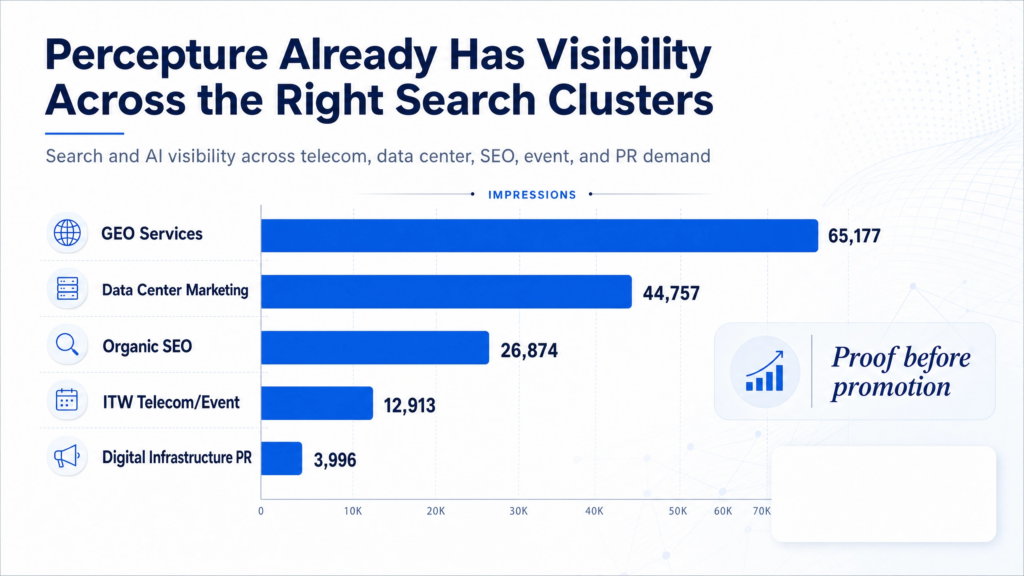
Audit how the network appears in search and AI
Percepture can assess whether access points, transport services, route-development expertise, community value and buyer answers are presented clearly across search, AI answers, media and owned content.

What is an open-access network?
An open-access model allows multiple qualified users to obtain infrastructure or services under governed terms. The owner may be public, private, cooperative, Tribal, utility-based, or part of a public-private partnership. Ownership and operation may also be assigned to different entities.
Calling middle-mile fiber open access does not tell a provider what it can buy. Credible operating rules address eligibility, product availability, interfaces, pricing principles, capacity allocation, service levels, ordering, support, disputes, security, upgrades, and expansion. Funding or policy requirements may differ by program, so each network’s governing documents control.
Which middle-mile fiber ownership model fits the project?
| Model | Potential fit | Main diligence issue | Evidence to review |
|---|---|---|---|
| Private carrier | Markets with commercial demand | Product and access choices | POPs, services, prices, service levels, and expansion policy |
| State or municipal | Regional policy and coverage goals | Operating sustainability and adoption | Operator duties, access rules, readiness, and lifecycle plan |
| Utility or cooperative | Regional service areas with local assets | Telecom operating and sales capability | Partner roles, support model, security, and economics |
| Public-private partnership | Projects combining public mission and private capability | Unclear accountability | Decision rights, risk allocation, revenue rules, and maintenance |
| Joint build or lease | Corridors using existing and new assets | Counterparty dependency | Rights, term, physical route, maintenance, and restoration |
| Provider owned | Operators with sufficient demand and capital | Concentration and lifecycle cost | Traffic, resilience, operating cost, and upgrade path |
Public leaders also need a repeatable engagement process. Percepture’s work on infrastructure community engagement shows why stakeholder questions should be addressed before public announcements harden into expectations.
Community coordination is part of access planning
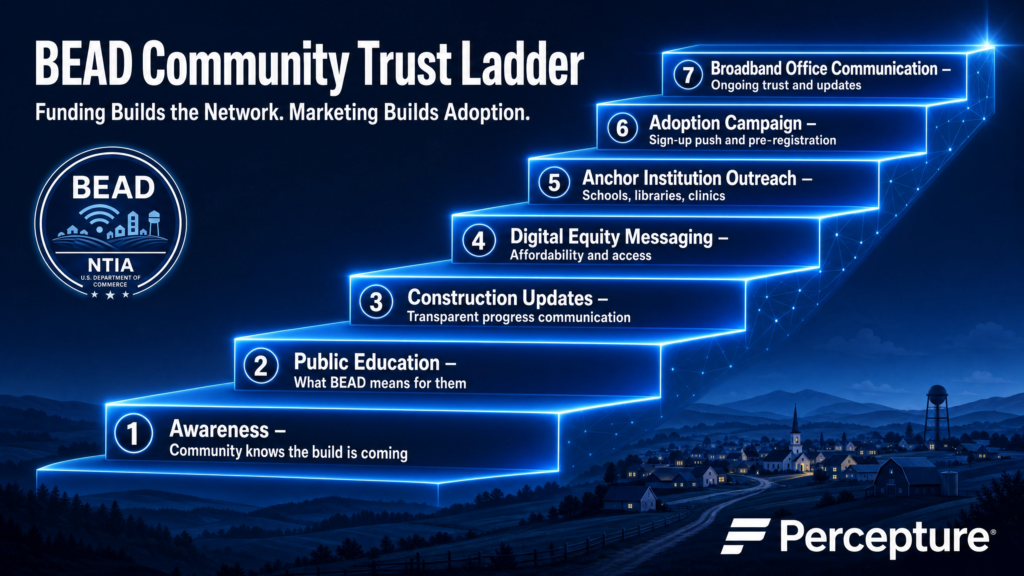
Community input can help teams understand local institutions, provider needs, construction concerns, adoption barriers, and reporting expectations. It should inform decisions without replacing technical and financial diligence.
Which middle-mile fiber services can buyers compare?
The middle-mile fiber service set depends on the operator, optical platform, interconnection, customer requirements, governing rules, and commercial model. Buyers should compare responsibility and control before comparing headline prices.
| Service | Customer control | Provider responsibility | Typical pricing basis | Primary risk to test |
|---|---|---|---|---|
| IP transit or dedicated internet access | Customer buys an internet access service | Provider manages the service and upstream relationship | Port, committed capacity, usage, term, and location may apply | Upstream dependency and service boundaries |
| Ethernet or E-Line | Customer buys managed point-to-point connectivity | Provider operates the connection under its service definition | Capacity, endpoints, interfaces, term, and construction | Interface limits and endpoint availability |
| Wavelength | Customer receives dedicated optical capacity | Provider runs the underlying optical system | Capacity, endpoints, distance, equipment, and term | Upgrade boundaries and optical dependencies |
| Managed transport | Customer buys supported capacity | Provider monitors and maintains the service | Capacity, route, service level, term, and endpoints | Lower infrastructure control |
| Dark fiber | Customer controls its optical equipment | Provider supplies defined unlit strands and related rights | Route, strands, term, access, maintenance, and construction | Engineering and operating burden |
| IRU | Customer receives long-term contractual use rights | Responsibilities depend on the agreement | Asset scope, term, capital payment, maintenance, and access | Contract and lifecycle complexity |
middle-mile fiber pricing comparisons should include nonrecurring construction, lateral work, equipment, colocation, cross-connects, installation, recurring service, maintenance, support, escalation, renewal, and exit terms. A low transport rate may not represent the lowest total cost when the connection requires substantial customer-funded work.
How should a public route map be read?
A middle-mile fiber map is a planning aid, not proof of orderable service. It may show corridors, project status, broad access areas, or facilities while omitting capacity, exact access rights, product availability, pricing, construction responsibility, or physical diversity. California’s Middle-Mile Broadband Initiative is one public example of a state-scale program, not a universal operating template.
For each visible segment, ask who controls the route, what status the map represents, where approved access points exist, whether a lateral is required, which products are offered, and how a qualified customer starts an order. middle-mile fiber diligence should also distinguish a planned corridor from installed infrastructure and installed infrastructure from a tested service.
How is route diversity verified?
Two services are not physically diverse merely because they have different names, carriers, or map colors. Qualified network specialists should review the relevant paths, facilities, shared structures, crossings, entries, power dependencies, and restoration arrangements. Public communications should describe verified diversity at a safe level without publishing sensitive route or facility details.
What can delay delivery?
Possible constraints include design changes, rights-of-way, easements, environmental or historic review, rail and water crossings, utility coordination, procurement, materials, contractors, facility power, testing, and interconnection. Detailed workflow belongs with engineering and delivery teams; market communications should use milestone language tied to approved evidence.
Organizations explaining construction status can pair specialist review with crisis communications planning so schedule changes, outages, and stakeholder concerns have clear owners and escalation paths.
What should the first 90 days evaluate?
Days 1–30: establish need and access truth
Map intended users, communities, institutions, towers, facilities, existing transport, demand, interconnection needs, and desired outcomes. Compare route alternatives, possible POPs, laterals, crossings, power, permits, and expansion points. Do not freeze access locations before speaking with likely users.
Days 31–60: choose the operating model
Compare ownership, operator, governance, products, pricing principles, security, support, maintenance, and restoration. Build the capital and delivery plan from verified inputs. middle-mile fiber should have a credible operating path after construction funding ends.
Days 61–90: test activation and measurement
Document middle-mile fiber service definitions, technical interfaces, order steps, contracts, sales engineering, migration support, billing, monitoring, and reporting. Test whether a qualified provider can understand the offer and move through an end-to-end order path.
Demand validation can combine stakeholder interviews with B2B intent data services. The data should guide outreach and content priorities, not substitute for direct provider qualification or network planning.
How should middle-mile fiber economics be measured?
middle-mile fiber economics should keep capital, operating performance, commercial activation, and public outcomes separate. This prevents route miles from being treated as a proxy for customers, revenue, affordability, or community benefit.
Economics and impact scorecard
| Metric | Calculation or evidence | What it reveals |
|---|---|---|
| Cost per route mile | Total attributable network cost divided by route miles | Corridor-level capital intensity |
| Cost per ready access point | Total attributable cost divided by ready POPs or access points | Cost of creating usable connection opportunities |
| Access-point utilization | Activated access points divided by ready access points | Whether available access is being used |
| Capacity utilization | Committed or activated usable capacity divided by commercially usable capacity | Commercial use of available capacity |
| Transport savings | Verified baseline transport cost minus verified post-connection cost | Direct customer cost change |
| Revenue per route mile | Annual attributable network revenue divided by route miles | Route-level revenue productivity |
| Gross margin | Attributable revenue less direct operating cost, divided by attributable revenue | Operating contribution before broader allocations |
| Last-mile enablement | Qualified projects or service areas made feasible by the network | Practical downstream expansion |
Any community-impact calculation needs an approved method linking verified network use to outcomes such as service availability, reliability, affordability, education, health access, jobs, or economic activity. Do not assign a dollar value simply because a route passes a community.
“It makes last-mile economics work.”
Cody Clegg, Director of Sales & Marketing at OPTK Networks
Boards can use attribution and analytics to define reporting ownership, data sources, and decision thresholds. Public relations and investor materials should then use the same approved definitions.
Bob Generale interviews Cody Clegg on middle-mile fiber
Bob Generale interviewed Cody Clegg, Director of Sales & Marketing at OPTK Networks, about rural broadband economics, AI and cloud growth, regional transport and the execution work behind network expansion.



Why is middle-mile infrastructure receiving renewed attention?
“You can connect every home or business in a community, but that traffic still has to reach cloud platforms, internet exchanges, data centers, and the broader network. Middle-mile infrastructure is the connective tissue that makes the entire system work.”
The operator view shifts attention from route mileage to the working relationship among local access, transport, interconnection and wider networks.
What role does middle-mile fiber play in closing the digital divide?
“Shared and open-access middle-mile infrastructure can lower that barrier and give smaller providers access to scalable transport so they can connect their communities to the networks and services they need.”
Transport can improve last-mile feasibility, but access points, commercial terms, operations and adoption still determine whether the system works in practice.
How does middle-mile investment support AI and cloud growth?
“Compute is becoming distributed across data centers, cloud regions, edge facilities, and local enterprise locations. Middle-mile infrastructure connects those environments to the larger national backbone.”
Capacity claims should be tested against actual routes, interconnection, services, latency needs and customer requirements.
What challenges remain in network expansion?
“The biggest challenges are economics and execution. Rural routes can involve long distances with relatively few immediate revenue opportunities.”
The work requires a sustainable commercial model and delivery discipline across permitting, crossings, rights-of-way, construction, activation and operations.
Interview responses were lightly edited for grammar and length while preserving Cody Clegg’s meaning. Statements reflect the speaker’s perspective.
How should infrastructure expertise become market authority?
Network operators and public programs often hold useful technical knowledge in maps, engineering documents, board materials, service descriptions, and staff interviews. Buyers cannot act on that knowledge when it is scattered, undefined, or written only for internal teams.
Percepture’s role is not to engineer, own, fund, or operate the network. Its role is to turn approved expertise into understandable market education, search architecture, AI-answer content, media narratives, stakeholder materials, and demand programs. That work can combine enterprise SEO services, GEO services, digital PR services, and expert-led content marketing.
For organizations coordinating many audiences, omnichannel marketing can align executive, provider, community, media, and digital touchpoints around the same approved network facts.
Map your middle-mile fiber authority strategy
Bring Percepture your approved middle-mile fiber facts, buyer questions, service model, public materials, and growth goals. We will map the content, search, GEO, PR, stakeholder, and demand work needed to make the infrastructure easier to understand and evaluate.
Regional fiber FAQs
What does middle-mile fiber connect?
middle-mile fiber connects local access networks to regional data centers, internet exchanges, cloud networks, carrier hubs, and wider backbones. It generally carries aggregated traffic rather than connecting directly to individual homes. Exact boundaries vary, so buyers should define the endpoints and function of the route being evaluated.
Is middle mile the same as the internet backbone?
No. A backbone generally connects major network hubs across wider geographies. The middle-mile layer links local or regional systems to those broader networks and to useful interconnection sites. Operators and programs may use different terms, making a functional definition more reliable than the label alone.
Why is regional fiber important in rural markets?
Rural providers may be far from major interconnection markets. middle-mile fiber can bring transport and capacity closer, aggregate demand, and reduce the need for separate corridor builds. Provider economics still depend on access points, laterals, products, prices, operations, support, and customer adoption.
What makes an open-access model credible?
A credible model explains who qualifies, what can be ordered, where customers connect, how pricing is governed, how capacity is allocated, which service levels apply, and how disputes, security, upgrades, and expansion are handled. The open-access label alone does not establish practical or affordable access.
Can a route map prove service availability?
No. A map can identify a corridor, facility, possible access point, or project status. It does not by itself prove capacity, pricing, physical diversity, access rights, lateral cost, service readiness, or an order process. Those items require direct diligence with the owner or operator.
How should buyers compare pricing?
Compare the total lifecycle cost of middle-mile fiber rather than one recurring rate. Include construction, laterals, equipment, colocation, cross-connects, installation, recurring service, maintenance, support, escalation, renewal, and exit terms. Also compare customer responsibility, service levels, upgrade options, and the cost of operational control.
How long does evaluation take?
The first 90 days can establish demand, access assumptions, ownership options, service requirements, delivery constraints, activation steps, and measurement rules. Engineering, permitting, procurement, construction, and commercial launch can require separate schedules based on the project’s scope and governing requirements.
How does regional transport support AI and cloud use?
AI and cloud workloads rely on connections among compute sites, data centers, cloud platforms, enterprises, and users. Regional transport helps connect those environments to wider networks. Its value depends on actual capacity, interconnection, route design, service availability, and customer requirements.