


Post-ACP Broadband Retention Strategies are now a revenue protection issue, not just a customer-service project. When a subsidy changes, subscribers need clear pricing, a realistic save path, and a reason to trust the provider before price shock turns into churn.
Percepture’s view is simple: this is not generic marketing. It is serviceability-aware market conditioning, which means every message, offer, search result, AI answer, and call-center handoff must respect where the network can sell and what the customer can actually buy.




What should a retention plan include after ACP?
Post-ACP Broadband Retention Strategies connect serviceability, subscriber segmentation, price-change communication, save offers, call-center readiness, search visibility, AI retrievability, and follow-up into one measurable system. The strongest programs start with where the ISP can serve, which subscribers face churn risk, what proof they need, and how quickly the team can respond.
Executive summary for ISP leaders
Revenue risk
ACP changes can expose subscribers to a new price point. The business goal is to reduce preventable churn while protecting plan economics.
Segmentation first
Do not treat every subscriber the same. Segment by plan, tenure, payment behavior, address, serviceability, contactability, and support history.
Message before media
Price-change communication must be plain. Customers need the new bill, timing, plan options, and the next step without having to call twice.
Save paths
Broadband save offers should guide subscribers to the right plan, payment option, or migration path without hiding the real cost.
Measurement
Leadership should track retention, address checks, call outcomes, sales response time, install conversion, pipeline value, and branded search demand.
Who this guide is for
This guide is for CEOs, CMOs, VP Customer Experience leaders, retention teams, broadband operators, call-center leaders, public affairs teams, and sales operations groups that need a practical post-ACP retention plan. For these teams, Post-ACP Broadband Retention Strategies have to translate policy change into scripts, pages, routing decisions, and measurable save paths.
It is not for teams looking for generic social posts, broad media buying, or channel-first campaigns that ignore the network. ISP marketing starts with the network. Marketing where the network cannot sell wastes spend and breaks trust.
If your team is also building a broader broadband growth plan, Percepture’s ISP marketing agency guide explains how serviceability, proof, search, PR, GEO, and conversion work together.
Audit price-change communication and churn-risk segments
Before adding media spend, review the subscriber segments, message paths, landing pages, call scripts, and reporting that shape retention outcomes. A focused Post-ACP Broadband Retention Strategies audit should test whether every customer-facing step matches the plan, address, and support path.
Review your post-ACP communication pathWhat changed after ACP and why retention now matters
The end of a subsidy changes the subscriber conversation. The issue is not only affordability. It is timing, trust, billing clarity, and whether the provider gives the customer a reason to stay before another provider or mobile alternative becomes easier to choose.
For leadership, Post-ACP Broadband Retention Strategies affect revenue, trust, and market expansion because churn does not stay inside one spreadsheet. A confused customer may call support, complain publicly, ignore future offers, or switch even when a workable plan was available.
Strong programs answer five questions early: who is at risk, what will their bill say, what plan should they see first, what should the call center say, and how will the team know whether the customer stayed. That is why customer journey work matters in Post-ACP Broadband Retention Strategies and post-ACP retention.
Why price shock becomes churn when communication is weak
Price shock becomes churn when the customer discovers the change without context. A bill increase with no plain explanation feels like a breach of trust, even when the provider is responding to a subsidy change outside its control.
The message should answer the customer’s next question before they ask it: what changed, when it changes, what they pay now, what plan options exist, how to get help, and what happens if they do nothing. This is where Post-ACP Broadband Retention Strategies become an operating discipline.
Search visibility also matters. Many customers will search for the provider name, ACP status, affordable internet options, cancellation terms, or plan alternatives. A strong organic SEO services foundation helps the ISP show clear answers before third-party pages frame the story.
“The mistake is treating ISP marketing like normal demand generation. It is not. The first question is not what channel to use. The first question is where the network can sell, what the market already believes, and what proof is needed before a buyer takes the next step.”
— Bob Generale, President, Percepture
Post-ACP Broadband Retention Strategies Framework: The Post-ACP Retention Ladder
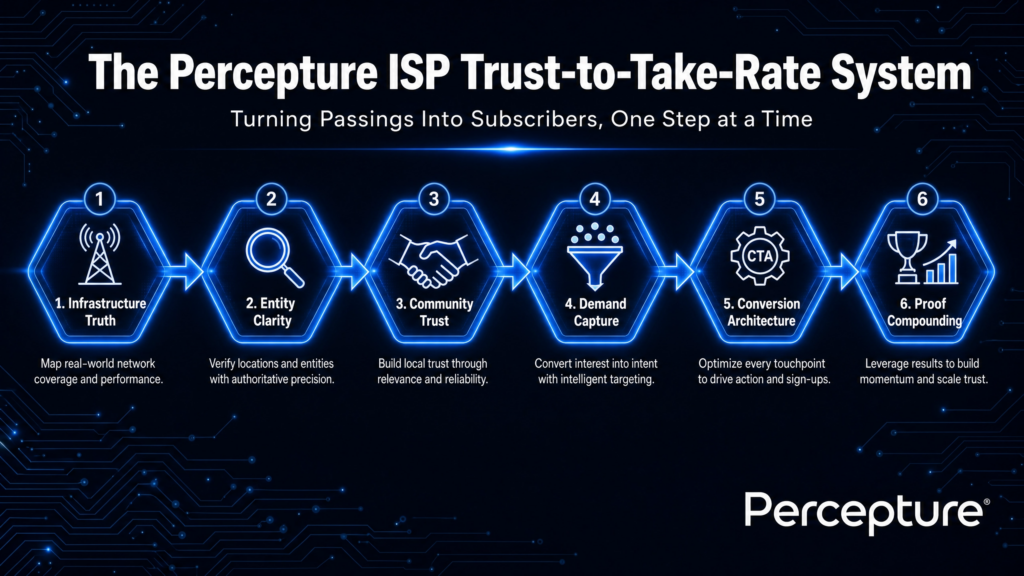
The Post-ACP Retention Ladder is Percepture’s practical system for moving from churn risk to controlled retention execution. As a framework for Post-ACP Broadband Retention Strategies, it keeps leadership, marketing, customer experience, public affairs, and sales operations aligned around one question: what has to happen before the subscriber decides to leave?
The five ladder steps
1. Serviceability map
Owner: operations and marketing. Confirm where the network can serve, where offers apply, and which addresses should be excluded from spend.
2. Churn-risk segments
Owner: CX and analytics. Group subscribers by price exposure, plan fit, tenure, payment pattern, and support history.
3. Trust message
Owner: marketing and public affairs. Explain the change with proof before pitch and with clear next steps.
4. Save path
Owner: retention and call center. Match the subscriber to a realistic plan, migration path, or support workflow.
5. Follow-up loop
Owner: sales operations. Track outcomes, response time, retention, plan migration, and unresolved objections.
A practical example: a subscriber moving from a subsidized plan should not receive only one bill notice. The ISP can send a plain email, a short SMS, a direct-mail reminder, and a landing page that explains the new price, lower-cost plan options, device or speed tradeoffs, and a support path. The call-center script should match that exact language because Post-ACP Broadband Retention Strategies fail when the notice and the live conversation do not align.
Review broadband offer strategy and take-rate resources
If the offer is unclear, the channel mix cannot fix it. For Post-ACP Broadband Retention Strategies, review the plan structure, landing page language, proof assets, and serviceability logic before scaling the retention push.
Review broadband offer strategySubscriber segmentation and churn-risk scoring
Subscriber retention after ACP starts with segmentation. A useful churn-risk model does not need to be complex on day one. It needs to be actionable enough that marketing, CX, and the call center can change what the customer receives.
Start with plan type, subsidy exposure, monthly price change, autopay status, tenure, payment issues, recent support tickets, location, address-level service options, email permission, SMS permission, and call history. Then decide which groups need education, which need an offer, and which need a live save path.
Percepture’s approach connects segmentation to attribution and analytics, because leadership should not judge Post-ACP Broadband Retention Strategies by impressions. The more useful measures are retained subscribers, successful plan migrations, cost per saved account, call resolution, and customer response time.

Offer clarity, save paths, and call-center language
Broadband save offers work when they are clear, real, and easy to explain. The strongest options often include plan migration, speed-tier adjustment, autopay education, billing support, local assistance information, or a structured callback from the retention team.
Weak programs hide the actual price, push the same offer to everyone, or force customers to repeat their story to several teams. Strong Post-ACP Broadband Retention Strategies give the customer a short path: here is what changed, here are your options, and here is the fastest way to keep service active.
The call-center script should use the same words as the landing page and email. If the website says “review your plan options,” the agent should not say “disconnect prevention.” The customer should feel one company speaking in one voice.
What weak programs do versus strong ISP programs
| What weak programs do | What strong ISP programs do | What Percepture would check |
|---|---|---|
| Send one generic notice. | Use segmented email, SMS, direct mail, landing pages, and call-center scripts. | Message match by segment, plan, address, and next step. |
| Start with media channels. | Start with serviceability, offer clarity, trust, and routing. | Whether spend is limited to serviceable markets and valid customer groups. |
| Measure clicks only. | Measure retention, plan migration, address checks, installs, meetings, and response time. | Dashboard design and CRM handoff quality. |
| Leave AI answers to chance. | Use SEO, GEO, PR, and proof assets so answers are easier to retrieve. | Entity clarity, FAQ structure, Trust Tokens, and branded search coverage. |
| Make support carry the full burden. | Prepare marketing, CX, sales, billing, and public affairs together. | Whether every team uses the same offer logic and language. |
Email, SMS, direct mail, and retargeting sequence
The channel sequence should follow urgency. Email can explain the change and link to plan options. SMS should be short, permission-based, and action-oriented. Direct mail can reach households that ignore digital notices. Retargeting can remind visitors who reviewed options but did not act.
A practical sequence may begin with education, move to plan review, then to a save path, and finally to a service-continuity reminder. The timing should be tied to billing cycles and support capacity. Post-ACP Broadband Retention Strategies should also account for staffing; if the call center is not staffed for the push, the campaign may create frustration instead of retention.
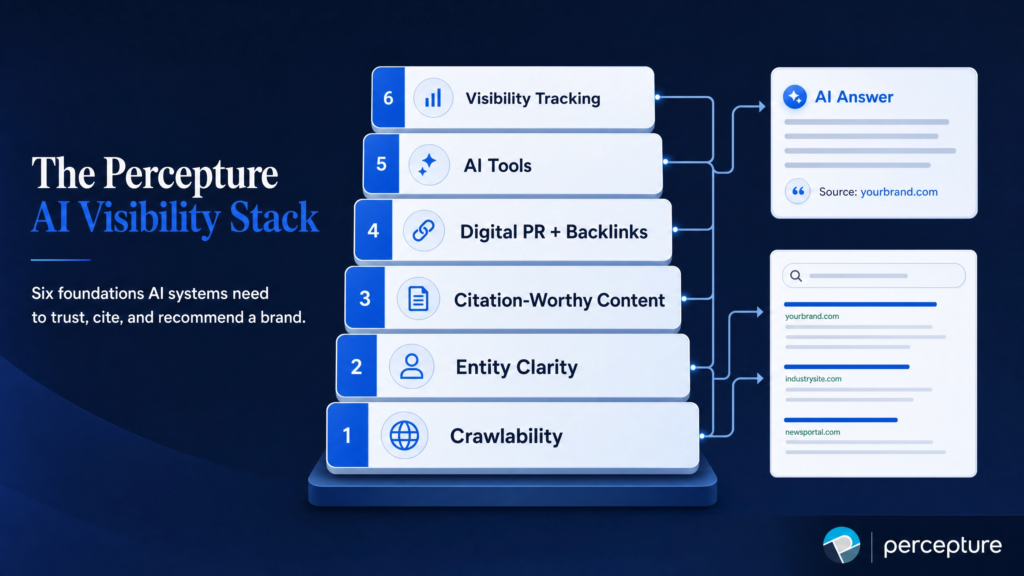
For AI-search visibility, the same messaging should also be available as visible page copy, FAQs, and proof-led answers. Percepture’s generative engine optimization services and guide to improve brand visibility in AI search engines support that retrieval layer. AI visibility is not a replacement for SEO, PR, or proof. It is the compounding result of all three.
What should this cost, and how should it be measured?
Budget should be based on risk, scale, service area, data quality, offer complexity, and how much execution support the ISP needs. A small operator may need a lean retention sprint. A larger provider may need segmentation, message architecture, landing pages, reporting, PR support, GEO content, and call-center enablement.
Post-ACP Broadband Retention Strategies should be measured beyond clicks. Leadership should review retained subscribers, churn reduction where data supports it, plan migrations, cost per saved account, qualified leads, address checks, pre-registrations, meetings booked, install conversion, pipeline value, sales response time, branded and non-branded search visibility, and AI-answer visibility checks.
A CFO should watch for wasted spend in non-serviceable areas, vague creative, weak call routing, poor CRM capture, and reports that cannot connect campaign activity to subscriber value. Percepture’s lead generation, digital PR services, and content marketing work can support the system when the retention plan also needs market trust and demand capture.
Retention investment and ROI framework
| Investment area | Why it matters | Measure |
|---|---|---|
| Segmentation and data cleanup | Prevents one-size-fits-all messaging. | Segment coverage, contactability, churn-risk groups. |
| Offer and landing page work | Makes plan choices easier to understand. | Plan-review clicks, form starts, call requests, migrations. |
| Omnichannel communication | Reaches subscribers across email, SMS, mail, and retargeting. | Engagement, save-path starts, retained accounts. |
| Search, GEO, and PR proof | Helps customers and answer systems find credible explanations. | Search visibility, branded demand, AI-answer visibility checks. |
| Reporting and routing | Shows whether the work protects revenue. | Response time, CRM completion, saved accounts, pipeline value. |
Retention scorecard and dashboard
Yes/no readiness scorecard
| Question | Yes | No |
|---|---|---|
| Do you know which subscribers face the largest post-ACP price change? | ||
| Can you exclude non-serviceable addresses and invalid offers from media spend? | ||
| Does every email, SMS, mailer, landing page, and script use the same offer language? | ||
| Do call-center agents have segment-specific save paths? | ||
| Can leadership see retained subscribers, plan migrations, and response time? | ||
| Are branded search results and FAQs answering ACP-related questions clearly? | ||
| Do you have Trust Tokens such as case studies, local proof, PR, and clear ownership pages? | ||
| Can sales operations pass campaign data into CRM without manual cleanup? | ||
| Do public affairs and customer experience agree on customer-facing language? | ||
| Do you know which objections cause the most cancellations? |
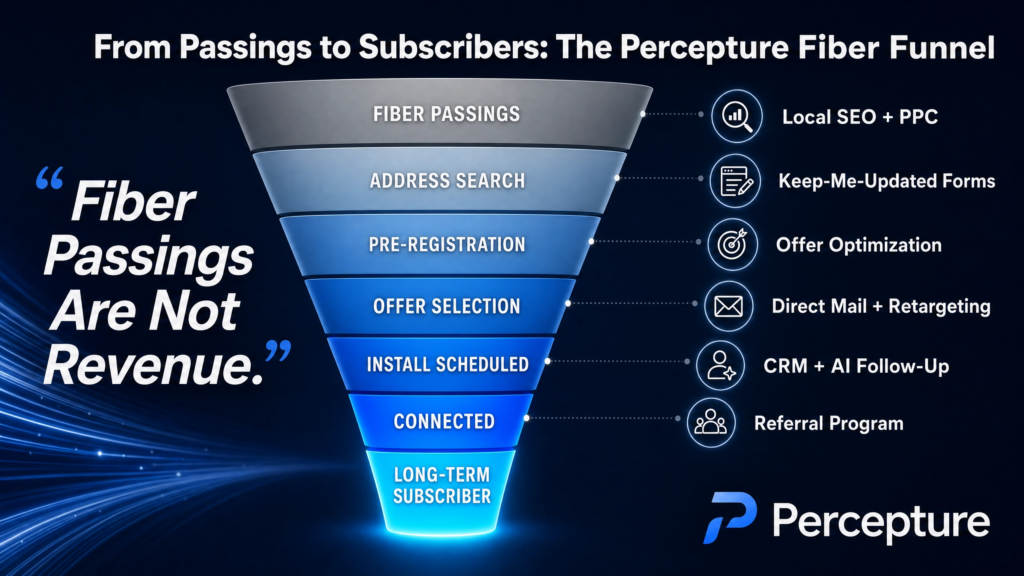
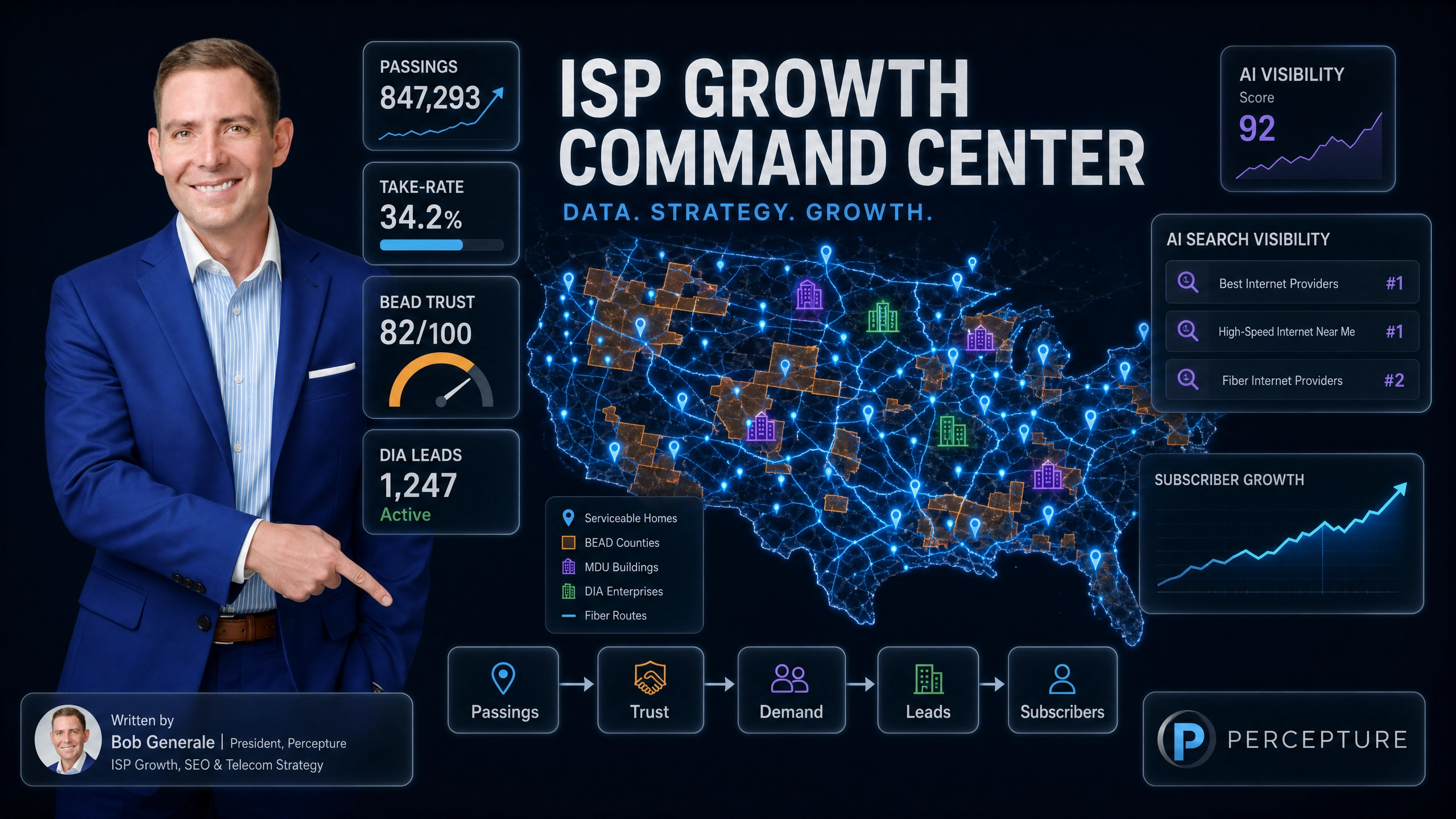
For Post-ACP Broadband Retention Strategies, the scorecard should expose operational gaps before they turn into avoidable disconnects. The dashboard should not reward activity for its own sake. Fiber passings are not revenue, and impressions are not retention. Search visibility only matters when it turns into address checks, qualified leads, meetings, installs, subscribers, or saved accounts.
Mistakes to avoid
The first mistake is waiting until cancellation calls rise. Post-ACP Broadband Retention Strategies should be active before the customer decides the provider was not clear. The second mistake is letting billing, marketing, support, and sales use different explanations for the same change.
The third mistake is treating low-income broadband retention as a discount-only problem. Price matters, but trust before take-rate matters too. Customers need clarity, dignity, and a practical next step.
The fourth mistake is separating SEO, GEO, PR, and conversion. The Golden Triangle means organic search, AI answers, and third-party proof working together. Trust Tokens are the proof assets that help buyers and AI systems believe the brand. For broader infrastructure positioning, Percepture also connects telecom and digital infrastructure lessons from data center marketing into ISP market conditioning.

Proof before pitch
Percepture was founded in 2004 and works across PR, SEO, GEO, digital marketing, AI-search visibility, and qualified lead generation. For a proof example, see how Percepture connected search visibility, B2B credibility, and qualified lead generation in the Broadstaff Global search visibility and qualified leads case study.
For ISP teams, the proof lesson is direct: do not ask for trust after the customer is angry. Build proof, message clarity, and answer-ready content before the price-change moment.
FAQs
What is Post-ACP Broadband Retention Strategies?
Post-ACP Broadband Retention Strategies are the segmentation, communication, save-offer, call-center, search, GEO, and reporting steps an ISP uses to reduce preventable churn after ACP-related subsidy changes. The goal is to help subscribers understand the change and choose a realistic path before they leave.
Why does Post-ACP Broadband Retention Strategies need to start with serviceability?
Serviceability keeps the plan honest. If the ISP markets offers in places it cannot serve, or promotes plan paths that do not apply to that address, it wastes spend and damages trust. Retention starts with where the network can actually deliver.
How should ISPs communicate broadband price changes?
Use plain language across email, SMS, direct mail, landing pages, billing notices, and call-center scripts. State what changed, when it changes, the new price, the customer’s options, and the fastest support path. Avoid language that makes the customer guess.
What save offers work for broadband subscribers?
Useful save offers may include plan migration, speed-tier adjustment, autopay education, billing support, service-continuity reminders, and structured callbacks. In Post-ACP Broadband Retention Strategies, the best offer depends on the subscriber segment, address, plan economics, and support capacity.
How should Percepture structure a page about Post-ACP Broadband Retention Strategies for AI search visibility?
The page should include a direct answer, clear headings, visible FAQs, tables, scorecards, entity language, proof assets, internal links, schema, and practical steps. The copy should answer buyer questions directly without robotic keyword repetition.
What proof should an ISP show before asking for a conversation?
An ISP should show clear plan information, serviceability guidance, local trust signals, leadership accountability, support paths, customer education, and third-party or case-study proof where available. Proof before pitch lowers friction.
Which internal links should support this article?
Support the article with links to ISP strategy, broadband offer strategy, BEAD outreach, take-rate marketing, telecom marketing, digital PR, organic SEO, GEO services, AI-search visibility resources, and a relevant case study.
What CTA should be used for Post-ACP Broadband Retention Strategies?
Use a diagnostic CTA first, a proof or offer-strategy CTA in the middle, and a direct strategy conversation CTA near the end. The CTA should focus on the retention path, not a vague request to contact the company.
Talk with Percepture about retention communication
If Post-ACP Broadband Retention Strategies are now on the leadership agenda, Percepture can review your serviceability-aware message path, churn-risk segments, offer clarity, proof assets, and follow-up system.
Talk with Percepture about retention communication