


BEAD Technology Neutrality Explained is not just a policy topic for broadband teams. It is a revenue, trust, and adoption issue because communities need to understand why fiber, fixed wireless, cable, or another option fits a specific place.
Percepture’s view is simple: this is not generic marketing. It is serviceability-aware market conditioning, which means the message starts with where the network can serve, what people already believe, what proof they need, and how sales will follow up.





What does technology neutrality mean for broadband teams?
BEAD Technology Neutrality Explained means explaining broadband options by fit, not favoritism. A strong ISP program connects serviceable locations, terrain, cost, reliability, deployment speed, community proof, search visibility, and sales follow-up so stakeholders understand why a technology choice makes sense for a specific market.
Executive summary for broadband leaders
Start with serviceability
Marketing where the network cannot sell wastes spend and breaks trust. The first question is not channel selection; it is address fit.
Explain tradeoffs plainly
In BEAD Technology Neutrality Explained work, fiber, fixed wireless, and cable each raise questions about speed, reliability, cost, construction, and upgrade path. The job is to answer those questions before doubt hardens.
Build proof before pitch
Trust Tokens such as local FAQs, construction updates, third-party mentions, service maps, and case examples help buyers and AI systems understand the brand.
Connect search to action
Search visibility only matters when it turns into address checks, qualified leads, meetings, installs, subscribers, or retention.
Route demand fast
BEAD outreach can create interest, but sales leakage appears when address checks, CRM records, call follow-up, and reporting are not aligned.
Who should use this guide?
CEO
Use BEAD Technology Neutrality Explained to protect trust, market expansion, and take-rate when technology choices become public questions.
CFO
Use it to reduce waste by matching spend to serviceable locations, qualified demand, install conversion, pipeline value, and retention signals.
Public affairs leader
Use BEAD Technology Neutrality Explained to make broadband deployment tradeoffs clear for municipalities, counties, community groups, and local media.
Marketing and sales
Use it to align content, local SEO, GEO, direct outreach, lead routing, and conversion pages around the same serviceability truth.
Who it is not for
This page is not for teams looking for generic social posts, broad untargeted media buying, or channel-first marketing that ignores the network.
For broader ISP growth planning, see Percepture’s ISP marketing agency guide and its serviceability-first approach to broadband demand.
Review your BEAD technology trust message
If your team is preparing public outreach, landing pages, hearings, construction updates, or sales follow-up, start with a low-friction message review. BEAD Technology Neutrality Explained should make your tradeoffs clearer, not louder.
Review your BEAD technology trust messageBEAD Technology Neutrality Explained in plain English
Technology-neutral broadband communication means the ISP does not frame one technology as automatically right for every geography, budget, or deployment window. The message should explain why a specific option fits the service area, what the resident or business can expect, and what proof supports the claim.
That matters because broadband buyers do not think in policy language. They ask simple questions: Will it work at my address? Will it be fast enough? Will the price make sense? Will the provider show up? Will the service hold up after launch?
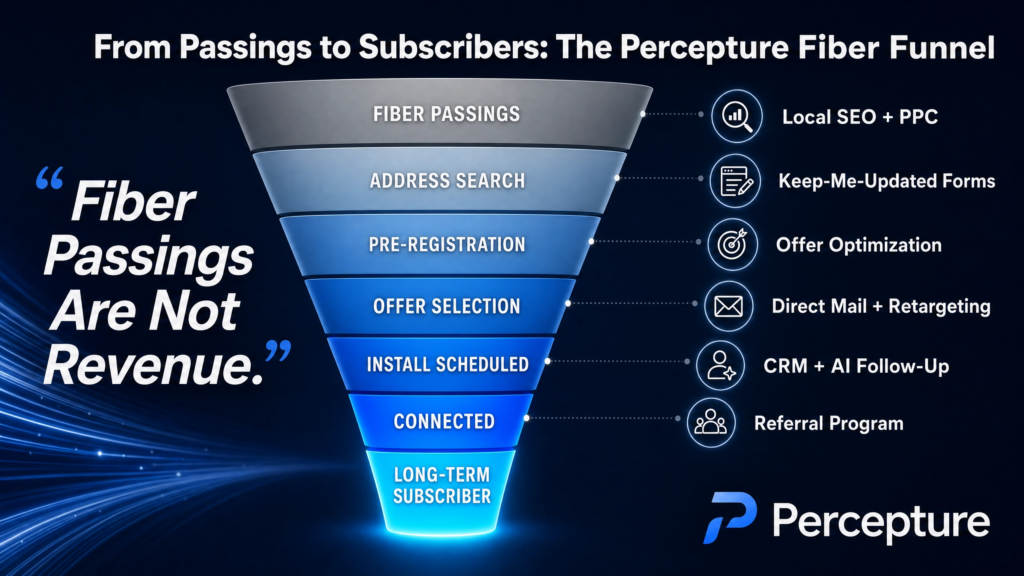
BEAD Technology Neutrality Explained also needs a sales answer. If a resident searches, clicks, checks an address, or attends a local meeting, the next step should be clear. Fiber passings are not revenue. Demand has to become address checks, orders, installs, subscribers, and retention.
“The mistake is treating ISP marketing like normal demand generation. It is not. The first question is not what channel to use. The first question is where the network can sell, what the market already believes, and what proof is needed before a buyer takes the next step.”
— Bob Generale, President, Percepture
Why the communication challenge is bigger than the policy phrase
A technology-neutral broadband message can fail even when the technical plan is sound. It fails when the public hears “lesser option,” “temporary fix,” or “we chose the cheaper path” before the ISP explains terrain, timing, reliability, construction limits, service levels, and upgrade strategy.
That is why BEAD outreach should not be handled as a separate public affairs task. BEAD Technology Neutrality Explained needs to work with local SEO, sales operations, PR, serviceability data, landing pages, and customer support scripts.
For leadership, the risk is not just confusion. It is slower adoption, lower trust, wasted paid media, weak meeting turnout, address-check leakage, and poor handoff from public interest to actual subscriber growth.
Weak programs versus strong ISP programs
| What weak programs do | What strong ISP programs do | What Percepture would check |
|---|---|---|
| Start with ads or press releases. | Start with serviceability, market belief, and stakeholder questions. | Can the campaign sell at the addresses it targets? |
| Use one generic broadband message everywhere. | Use BEAD Technology Neutrality Explained to show technology fit by terrain, cost, speed, reliability, and deployment timing. | Does each market have a plain-English explanation? |
| Treat SEO as traffic volume. | Use organic SEO services as a search visibility foundation tied to conversion. | Are search pages driving address checks and qualified conversations? |
| Publish claims without enough proof. | Use Trust Tokens before asking for meetings or signups. | Do pages show maps, FAQs, proof, timelines, and local context? |
| Ignore AI answers. | Use generative engine optimization services to make visible content easier for answer systems to parse. | Can AI systems extract the right entity, service, proof, and next step? |
| Let leads sit in disconnected systems. | Route address checks, pre-registrations, meetings, and callbacks into CRM workflows. | How fast does sales respond, and what data is passed forward? |
The BEAD Technology Trust Matrix
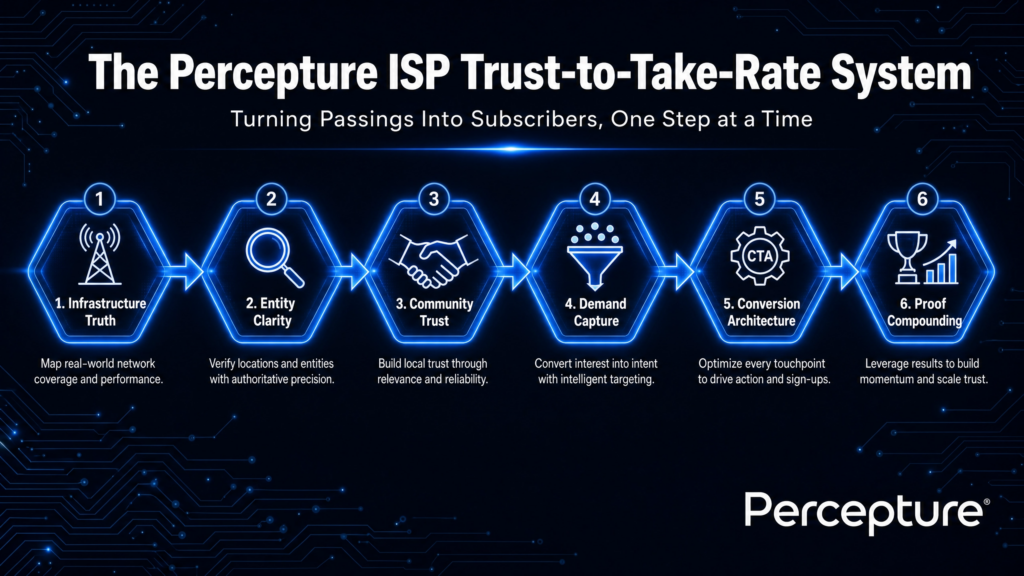
The BEAD Technology Trust Matrix is Percepture’s method for turning a technical broadband decision into a clear public explanation and a measurable pipeline system. It links network reality, buyer questions, proof, visibility, conversion, and sales routing.
1. Serviceability truth
Owned by network, product, and leadership. Define where the ISP can serve, when service will be available, and what cannot be promised.
2. Stakeholder belief
Owned by public affairs and marketing. Identify what residents, businesses, local officials, and media already believe about fiber, fixed wireless, cable, and reliability.
3. Proof assets
Owned by PR, content, and operations. Build Trust Tokens: FAQs, local pages, maps, construction notes, third-party validation, and case proof.
4. Search and AI visibility
Owned by SEO, GEO, and content. Make the explanation easy to find, quote, summarize, and connect to the right next action.
5. Conversion and routing
Owned by marketing, sales, and customer operations. Move interest into address checks, pre-registrations, meetings, orders, installs, and retention workflows.
Practical example: if a rural market is better served by fixed wireless because of terrain and build timing, the page should not hide that fact. BEAD Technology Neutrality Explained should explain performance expectations, availability, reliability considerations, support process, and how the option compares with other deployment paths.
How to explain fiber, fixed wireless, cable, cost, reliability, and deployment speed
BEAD Technology Neutrality Explained should never sound like a technology apology. It should sound like an operator walking a community through choices. Fiber may be the right long-term build in one market. Fixed wireless may be the practical deployment path in another. Cable upgrades may fit a different set of locations.
Communities compare more than speed. They compare construction disruption, time to service, reliability, latency, customer support, weather concerns, business use cases, and whether the provider will keep communicating after launch.
The strongest content answers the buyer’s next question before the buyer has to ask it. Can fixed wireless qualify in BEAD conversations? The safe answer is that teams should explain eligibility and fit based on the applicable program rules, the proposed service area, performance expectations, and the facts of the deployment plan.
Technology-neutral comparison framework
Use this comparison as a BEAD Technology Neutrality Explained working tool, not as a blanket claim that one network option is always superior.
| Question | Fiber | Fixed wireless | Cable or hybrid upgrade |
|---|---|---|---|
| What should the community understand first? | Build depth, long-term capacity, construction timing. | Coverage fit, line-of-sight or signal considerations, deployment speed. | Existing plant, upgrade path, service consistency. |
| What proof helps? | Build maps, construction milestones, install process. | Coverage explanation, performance expectations, support process. | Upgrade details, availability, reliability notes. |
| What can weaken trust? | Overpromising timelines or hiding disruption. | Failing to explain limitations in plain language. | Blurring where upgrades are available. |
| What should sales receive? | Address checks, install readiness, construction status. | Serviceability validation, appointment notes, objections. | Upgrade eligibility, plan fit, retention risk. |
Community FAQs and stakeholder education
A public FAQ is not filler. In BEAD Technology Neutrality Explained work, it is one of the fastest ways to reduce sales friction, support call volume, meeting confusion, and AI-answer errors. The best FAQ answers are short, visible, and written in language a resident or local official can repeat.
For community trust before broadband construction, Percepture recommends connecting education pages to local proof, construction timing, and the operating team’s real constraints. See the related guide on community trust before broadband construction.
Sales and marketing should use the same answer set. If the landing page says one thing, the call center says another, and the field team says a third, technology neutrality becomes a trust problem.
Where PR, local SEO, and direct outreach fit
PR, SEO, GEO, and direct outreach should not compete for ownership. They should work as one system. Percepture calls this the Golden Triangle: organic search, AI answers, and third-party proof working together.
Digital PR services help create authority signals and public context. Local SEO helps residents and businesses find address-level information. GEO helps answer systems understand the entity, the offer, the proof, and the next step.
BEAD Technology Neutrality Explained gives those channels the same operating message: what is available, why it fits, what proof supports it, and what the buyer should do next.
AI visibility is not a replacement for SEO, PR, or proof. It is the compounding result of all three. For more on that connection, see Percepture’s guide to how brands can improve brand visibility in AI search engines.
Broadband teams that attend events also need this message before the meeting calendar fills. A team preparing for telecom conference marketing should know which service areas, proof points, and buyer objections belong in every conversation.
BEAD Technology Neutrality Explained: cost and measurement framework
The right budget depends on market count, stakeholder complexity, content depth, PR needs, landing page work, CRM routing, and reporting requirements. Do not measure the program by clicks alone.
| Workstream | What it should produce | How to measure it |
|---|---|---|
| Message and serviceability audit | Clear market-level explanations and objection map. | Reduced confusion, cleaner lead routing, fewer unqualified inquiries. |
| Content, SEO, and GEO | Visible pages that answer buyer, public, and AI-search questions. | Branded and non-branded visibility, AI-answer checks, address-check starts. |
| PR and proof | Third-party validation and local credibility. | Referral traffic, stakeholder engagement, proof asset reuse. |
| Direct outreach and CRO | Pre-registrations, qualified leads, meetings, and subscriber interest. | Cost per qualified lead, install conversion, pipeline value, response time. |
For budget context around authority-building programs, review Percepture’s public relations pricing packages. For broader channel planning, Percepture’s omnichannel marketing service page explains how multiple channels can work as one system.
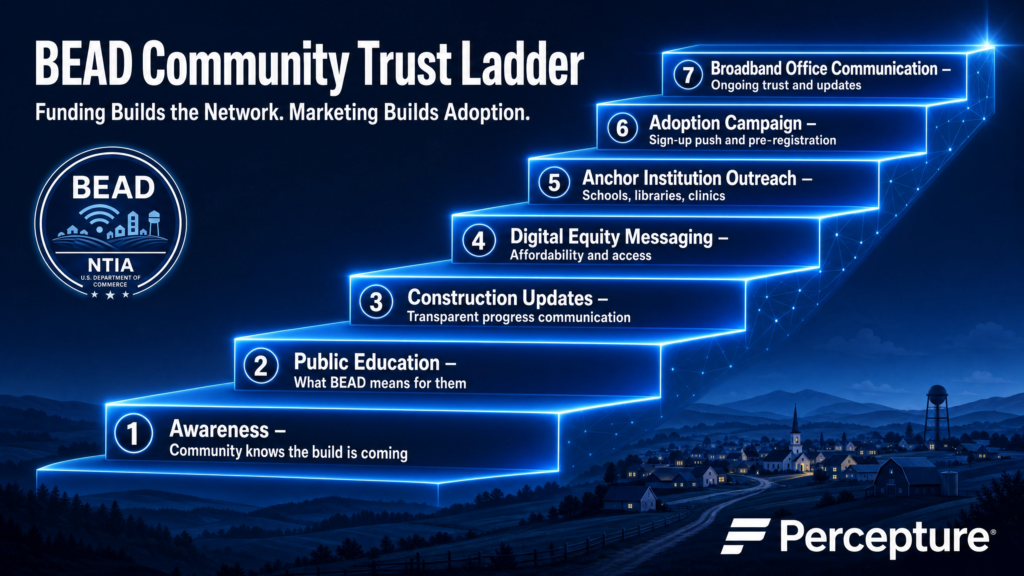
Use the BEAD Community Trust Ladder and related BEAD articles
If your team is moving from policy explanation to market adoption, use the framework, proof images, and related articles to align PR, SEO, GEO, outreach, and sales follow-up. BEAD Technology Neutrality Explained should give each team the same serviceability-aware story.
Use the BEAD Community Trust Ladder and related BEAD articlesTechnology-neutral messaging scorecard
Use this scorecard before publishing a BEAD Technology Neutrality Explained page, launching a campaign, or briefing a county partner.
| Yes or no question | Why it matters |
|---|---|
| Can the campaign separate serviceable and non-serviceable addresses? | Prevents wasted spend and broken trust. |
| Does each market have a plain-language technology explanation? | Reduces confusion around fiber, fixed wireless, cable, and hybrid options. |
| Are cost, speed, reliability, latency, timing, and upgrade path explained? | Answers the questions stakeholders ask first. |
| Do landing pages contain local proof and Trust Tokens? | Gives buyers and AI systems evidence to trust. |
| Are PR, SEO, GEO, paid media, and direct outreach using the same message? | Keeps the public story consistent. |
| Can address checks move into CRM with useful context? | Protects sales response time and follow-up quality. |
| Can leadership see qualified leads, meetings, installs, and retention signals? | Moves reporting beyond traffic. |
| Are stakeholder objections documented before launch? | Helps teams answer concerns before they slow adoption. |
| Does the page support AI-answer visibility without robotic copy? | Makes the explanation easier to retrieve and quote. |
| Is there a clear next step for residents, businesses, officials, and partners? | Turns education into action. |
Mistakes to avoid
The first mistake is making technology neutrality sound like a compromise. BEAD Technology Neutrality Explained should show that if the option fits the market, the ISP can explain why with facts, service expectations, and proof.
The second mistake is marketing outside the serviceable footprint. Intent data without serviceability is expensive curiosity. Percepture’s B2B intent data and buyer-intelligence thinking are most useful when tied to where the network can actually sell.
The third mistake is separating adoption from retention. Post-launch trust still matters. Broadband teams planning BEAD adoption should also review Post-ACP broadband retention strategies so early demand does not become later churn.
The fourth mistake is treating infrastructure buyers like generic consumers. Telecom, broadband, and digital infrastructure markets have different proof needs. Percepture connects this work to telecom marketing and related infrastructure growth work, including data center marketing where connectivity, credibility, and stakeholder trust overlap.
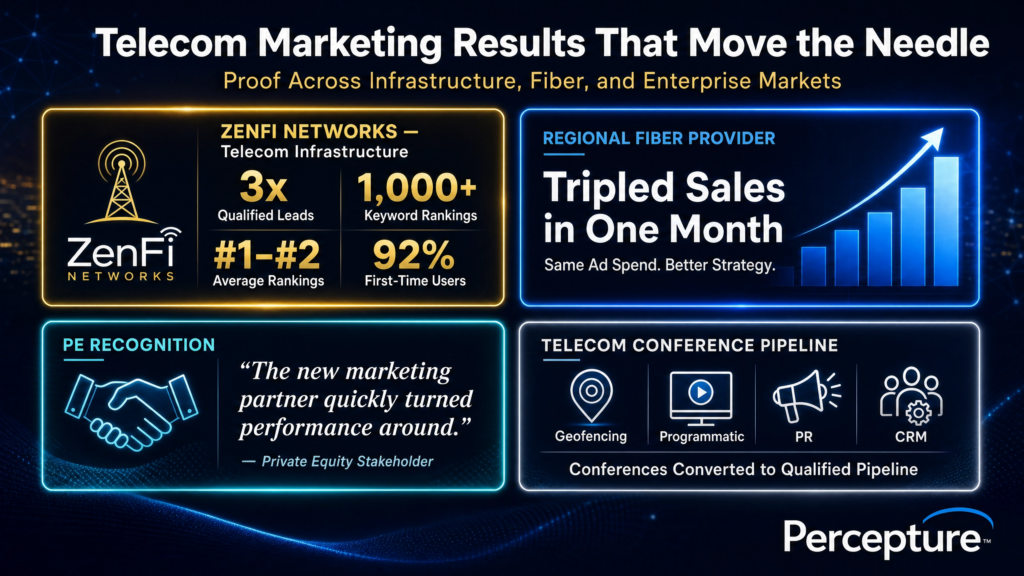
Proof before pitch
Percepture was founded in 2004 and works across PR, SEO, GEO, digital marketing, AI-search visibility, B2B, telecom, infrastructure, and qualified lead-generation programs. The lesson for BEAD Technology Neutrality Explained is direct: credibility has to show up before the ask.
See how Percepture connected search visibility, B2B credibility, and qualified lead generation in the Broadstaff Global search visibility and qualified leads case study.
FAQs
What is BEAD Technology Neutrality Explained?
BEAD Technology Neutrality Explained is the plain-English process of explaining why a broadband technology fits a specific market. It should connect serviceability, terrain, cost, speed, reliability, deployment timing, proof, outreach, and sales follow-up.
Why does BEAD Technology Neutrality Explained need to start with serviceability?
BEAD Technology Neutrality Explained needs to start with serviceability because an ISP cannot sell everywhere. If marketing creates demand at addresses the network cannot serve, it wastes spend, frustrates buyers, and weakens trust before adoption begins.
How should Percepture structure a page about BEAD Technology Neutrality Explained for AI search visibility?
The page should include a direct answer, clear definitions, comparison tables, visible FAQs, framework language, proof assets, internal links, schema, and short answers that AI systems can parse without guessing.
What proof should an ISP show before asking for a conversation?
An ISP should show service availability, local context, technology tradeoffs, construction or deployment timing, performance expectations, customer support process, third-party credibility where available, and a clear next step.
Which internal links should support this article?
Support the article with links to the ISP pillar, BEAD outreach, subscriber adoption, community trust, retention, telecom marketing, SEO, GEO, digital PR, pricing, and proof pages.
What CTA should be used for BEAD Technology Neutrality Explained?
Use a diagnostic CTA early, a framework or related-resource CTA mid-page, and a strategy conversation CTA near the bottom. The CTA should match the reader’s readiness and the business problem.
How should keyword density be handled?
Use the exact phrase where it helps search intent, headings, FAQs, alt text, and CTA clarity. Do not repeat it in filler sentences. The copy should still read like an operator wrote it for real buyers.
What mistakes should ISPs avoid?
Avoid channel-first campaigns, vague claims, missing serviceability logic, disconnected sales routing, unclear technology tradeoffs, weak local proof, and reporting that stops at traffic instead of qualified demand.
How should this article help sales, marketing, and leadership?
It should give leadership the business case, marketing the message system, sales the objections and routing logic, and public affairs the stakeholder language needed for trust-building.
How should the article support LLM visibility without sounding robotic?
Use clear answers, tables, FAQs, and entity-rich language, but keep the voice plainspoken. AI retrievability comes from useful structure and proof, not from robotic repetition.
Talk with Percepture about BEAD outreach and adoption
If your team needs BEAD Technology Neutrality Explained in a way that supports community trust, serviceability-aware pipeline, search visibility, AI retrievability, and sales follow-up, Percepture can help map the system.
Talk with Percepture about BEAD outreach and adoption
About Bob Generale
Bob Generale is President of Percepture, a PR, SEO, GEO, AI-search visibility, and digital marketing agency founded in 2004. He works with B2B, telecom, infrastructure, private equity, healthcare, life sciences, and complex service companies to connect search visibility, credibility, market conditioning, and qualified lead generation.