
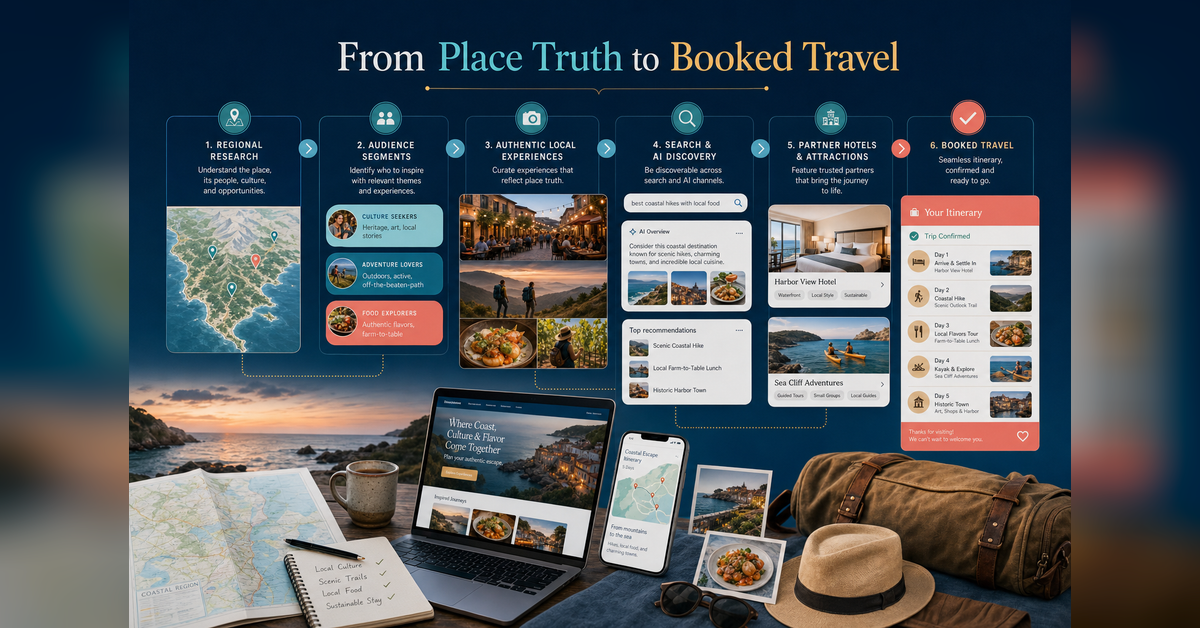

Destination marketing strategies are the deliberate choices a place makes to define what it can credibly own, select the visitors and periods it needs, turn local experiences into trusted proof, make that proof discoverable, and connect traveler interest to bookable or partner action.
The best strategy is not a longer channel list. It is a clear path from place truth to demand choice, signature experience, external proof, search and AI discovery, partner conversion, and measurable visitor value.
Travel experience, independent recognition and proof that earns attention






A distinctive remote-delivery story became an earned-media campaign with lasting authority.
Read the case study →What are the most effective destination marketing strategies in 2026?
The strongest destination marketing strategies begin with credible positioning, then combine the right experience, market, authority, discoverability, distribution, and conversion pathway for the destination’s specific demand problem. The channel is not the strategy. The strategy explains which demand is needed and why a channel can create it.
What destination leaders should decide first
Place truth
Identify the distinctive and deliverable promise that residents, partners, and visitors can recognize in the real experience.
Demand problem
Choose whether the priority is awareness, perception, seasonality, itinerary depth, planner demand, dispersion, or partner action.
Proof system
Document the experiences, sources, experts, partner facts, and external references that make the promise believable.
Trip pathway
Define how destination marketing strategies will move interest into an itinerary, referral, ticket, RFP, directions request, or booking action.
Who this guide is for
DMO and CVB executives
Choose which strategic plays deserve investment and board support.
Public officials and boards
Connect promotion to partner value, visitor fit, capacity, and public outcomes.
Hotels, venues, and attractions
Understand how destination interest should reach local partners.
Marketing teams and agencies
Clarify the approved audience, proof, owner, KPI, and channel role before launch.
When evaluating destination marketing strategies, what a DMO does affects governance and execution, but the strategic decision remains the same: choose the demand problem before choosing the media mix.
Destination marketing strategies vs. plans, campaigns, and tactics
| Term | Question it answers | Example | Operating result |
|---|---|---|---|
| Strategy | Which demand should we create, and why? | Shift perception to support overnight travel | Decision logic |
| Plan | Who acts, when, and with what resources? | Annual destination operating plan | Accountability |
| Campaign | What coordinated activation pursues one objective? | Shoulder-season culinary campaign | Coordination |
| Tactic | Which action supports the campaign? | Paid search, press trip, creator brief, or email | Execution |
Destination marketing strategies create the decision logic. The plan creates accountability. The campaign creates coordination. The tactic creates execution. Leaders building the annual calendar should use a dedicated CVB marketing plan after the strategic choices are settled.
Which strategy fits your destination’s real demand problem?
Use the Destination Strategy Selection Matrix to compare destination demand strategy by problem, proof requirement, first measure, and operating risk.
Review the Strategy Selection MatrixPlace truth becomes strategy when it changes visitor action
Explore Hunterdon demonstrates the sequence from stakeholder discovery to destination essence, positioning, market activation, website interest, and onward traffic to towns and tourism initiatives. Its documented brand outputs included the essence “Unplug & Reconnect,” the promise “Get away to it all,” and the positioning “The Other Side of Jersey.”
The 108-day launch recorded 7 million impressions, 73,000 site visitors, and 13,106 direct banner clicks. The operational lesson matters more than a slogan: place truth must remain auditable after the workshop, and visitor interest must have somewhere useful to go.
Broader travel and tourism marketing can activate the operating strategy across the visitor journey without confusing channels with strategy.
Documented launch results from the supplied case material. They show the operating sequence, not a universal performance benchmark.
The Place Truth-to-Trip Strategy System
The Place Truth-to-Trip Strategy System is Percepture’s nine-stage method for turning credible destination identity into qualified demand, partner action, and visitor value. It gives destination strategy a decision sequence that boards, staff, partners, and agencies can follow.
| Stage | Decision | Required output |
|---|---|---|
| 1. Place Truth | What can the place credibly own? | Place Truth Statement |
| 2. Demand Choice | Which demand problem matters most? | Prioritized Demand Problem |
| 3. Visitor Fit | Which traveler, planner, and market fit? | Visitor-Market Matrix |
| 4. Signature Experience | Which experiences carry the promise? | Experience Portfolio |
| 5. Proof | Why should the market believe it? | Destination Proof Library |
| 6. Discoverability | How will search, AI, and media retrieve it? | Visibility Map |
| 7. Distribution | Which channels play which role? | Channel Sequence |
| 8. Partner Action | What is the next trip step? | Visitor-to-Partner Path |
| 9. Value and Learning | What changed, and what follows? | Strategy Learning Log |
Do not move the destination approach to channels until place truth, demand choice, visitor fit, and signature experiences are clear. Strategy and planning support can help leadership teams make and document those choices.
1. Own a credible place truth
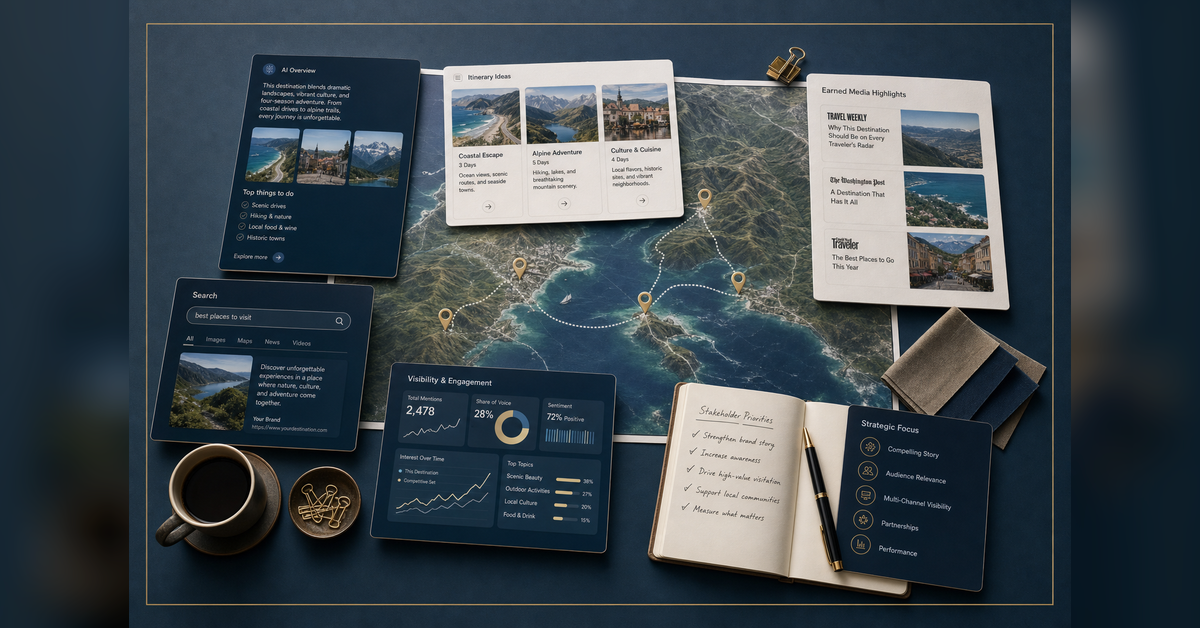
Place truth is not everything true about a place. It is the most distinctive, relevant, and deliverable truth the destination chooses to elevate. A destination brand is a promise the visitor should be able to experience.
Best for
Fragmented identity, generic messages, and partners using conflicting stories.
How it works
Combine resident and stakeholder input, visitor perception, competitive whitespace, experience inventory, source validation, promise, personality, and acknowledged trade-offs.
First KPI
Message adoption across destination and partner touchpoints.
Common failure
Writing a tagline before resolving the underlying identity conflict.
These the strategy should not move into campaign production when leadership has not agreed on what the place can deliver. Start with discovery and evidence instead.
2. Shift an outdated perception
A perception strategy moves the market from an existing belief to overlooked proof, a new narrative, external validation, discoverable demand, and itinerary action. New creative cannot compensate for an experience that still supports the old belief.

The Greater Williamsburg work expanded the story beyond a narrow history perception toward food, recreation, culture, and adult travel. The supplied case material reports more than 300 million impressions, 18% organic growth, and more than 100,000 new visitors. The Greater Williamsburg case study provides the broader context.
Use these destination demand strategy when overlooked, current experiences can substantiate the desired belief. Do not use them when the promised experience is unavailable, inconsistent, or outside destination control.
3. Create signature experiences
Within the operating strategy, a signature experience makes a place easier to understand and a trip easier to assemble. Formats can include tasting trails, heritage routes, outdoor loops, themed weekends, cultural collections, meeting extensions, neighborhood itineraries, and seasonal series.
Effective destination strategy treat the experience as an operating product, not a campaign name. Define partner standards, accurate visitor information, ownership, referral paths, accessibility, and measurement before promotion. Customer journey mapping can expose the gaps between inspiration and action.
When not to use: Do not launch a named trail, route, or collection when partner participation, hours, capacity, visitor information, or referral paths are unreliable.
4. Shape demand by time and place
Among the destination approach, demand shaping focuses promotion on the periods, locations, markets, and traveler types that improve destination fit. It can address shoulder seasons, weekdays, underused areas, short stays, group demand, or crowd dispersion.
A destination can create too much demand in the wrong place or at the wrong time. More visitors is not always the correct objective; better timing, distribution, stay length, or fit may matter more. The strategy in this category may use alternate feeder markets, date-specific trip reasons, geographic distribution, convention extensions, or reduced promotion when capacity is constrained.
When not to use: Do not buy additional demand where capacity is already full or where the visitor experience, workforce, infrastructure, or resident tolerance is under pressure.
5. Turn earned stories into authority
Earned authority supports destination demand strategy when a place has surprising stories but limited trust or awareness. Experts, original data, visual access, public relations, and digital PR can give outside publishers a reason to validate the destination’s relevance.

The supplied Amazon and Phantom Ranch material reports 378 stories and more than 70 million viewers for a campaign at Phantom Ranch in the Grand Canyon. Readers can review the Amazon and Phantom Ranch case study. Percepture’s public relations services and digital PR services connect story development with media and search authority.
Use the operating strategy based on earned authority when the story is specific, supportable, timely, and relevant. Do not chase reach without a clear audience or destination action.
6. Build creator-to-evergreen discovery
A hosted creator experience should answer durable trip-planning questions, not disappear after a short social burst. The supplied New Orleans & Company material documents 17 coordinated influencer trips addressing family, food, solo, celebration, and event interests.
Sound destination strategy match creator fit with a search-informed itinerary, partner diversity, disclosure, source accuracy, durable URLs, referral tracking, and refresh ownership. Content marketing services can turn first-person experience into useful owned resources rather than disposable posts.
When not to use: Do not pay for temporary reach when there is no lasting page, no partner pathway, no source review, or no way to evaluate qualified visitor behavior.
7. Win search and AI trip planning
The destination approach for search and AI require consistent facts about destination entities, experiences, locations, dates, partners, and visitor choices. Useful pages answer itinerary and comparison questions in crawlable HTML and support those answers with current evidence.

AI visibility begins with a fact system consistent enough to retrieve and credible enough to cite. The strategy for discoverability should include clear entities, concise answers, internal links, validated claims, visual proof, earned references, consistent partner data, and matching structured data.
Enterprise SEO services support technical and editorial discovery, while generative engine optimization services organize information for AI-assisted research. The AI search for tourism marketing guide covers this work in more depth.
| Claim | Primary source | External validation | Owner | Review date |
|---|---|---|---|---|
| Destination fact or experience claim | Official record or partner source | Award, expert, media, or third-party record | Named destination owner | Scheduled review date |
When not to use: Do not scale publication while core facts, partner details, opening information, or ownership remain inconsistent.
8. Test and accelerate demand with paid media
Paid media works best as a controlled test: hypothesis, audience, proof, landing path, qualified action, learning, and a decision to scale or reallocate. Search can capture intent, video can establish a story, and social or programmatic placements can test market response.
Destination demand strategy using paid media need exclusions, frequency controls, capacity checks, landing-page alignment, partner paths, attribution windows, and stop-or-scale rules. Percepture’s paid media services connect distribution to these operating controls.
When not to use: Do not use paid media to hide unclear positioning, weak proof, a broken landing experience, or unavailable partner inventory.
9. Build visitor-to-partner pathways
Partner value should be designed before launch. The basic path is discovery, destination answer, itinerary context, hotel or venue or attraction, and then a booking, ticket, RFP, directions request, or saved trip.
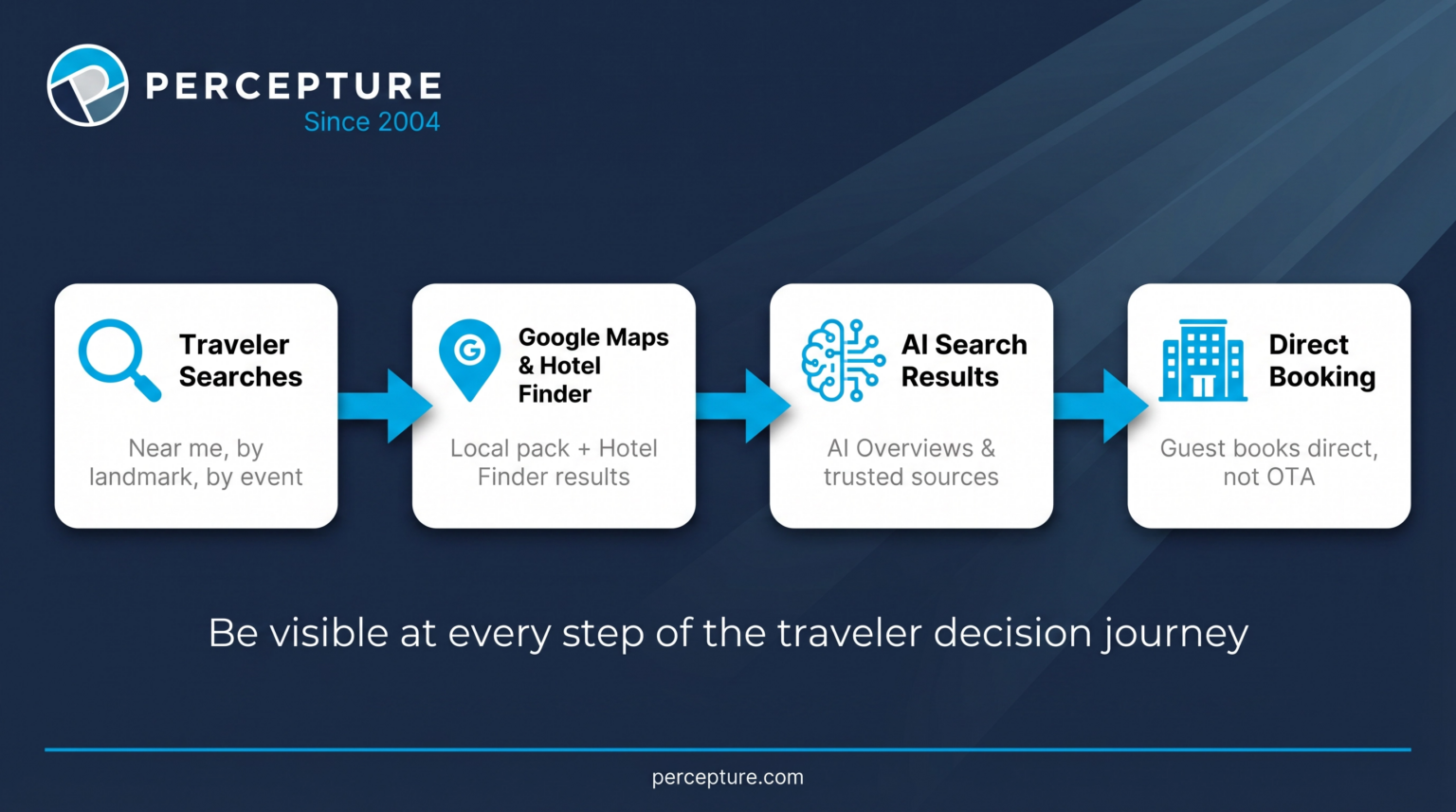
The operating strategy should define contextual links, partner eligibility, accurate availability, accessibility, tracking, and mobile usability. Conversion rate optimization can help remove dead ends between destination content and partner action.
When not to use: Do not drive more traffic into stale partner data, unclear eligibility rules, inaccessible pages, or referral paths that cannot be measured.
10. Use events to create a travel reason
Events can create a date-specific reason to travel, a partner opportunity, a media hook, and a repeatable demand asset. The event must be connected to lodging, attractions, dining, transportation, and the broader destination story.
Event-led destination strategy should test travel-worthiness, need-period fit, ticket or registration paths, lodging extensions, communications, capacity effects, and repeat potential. Email can then support reminders and return visits; email marketing services provide that owned follow-up layer.
When not to use: Do not promote an event as a travel product when it lacks a clear visitor proposition, partner extension, capacity plan, or repeatable audience.
Choose the strategy before the channel
The following matrix matches the destination approach to the demand problem they are built to solve. It is a decision aid, not a fixed media prescription.
| Destination problem | Primary strategy | Supporting strategy | Initial measure |
|---|---|---|---|
| Low awareness | Earned authority | Paid reach | Qualified awareness and search lift |
| Outdated perception | Perception shift | Creator and search proof | Priority themes and query mix |
| Weak shoulder season | Demand shaping | Events and paid testing | Need-period action |
| Short stays | Signature experience | Partner pathway | Itinerary depth and referrals |
| Weak planner pipeline | Search and AI proof | Paid account outreach | RFP or site-visit action |
| Low partner value | Partner conversion | Measurement | Qualified partner actions |
| Overcrowding | Distribution and stewardship | Alternate experiences | Time and place dispersion |
| Weak trust | Source-backed authority | PR and experts | Relevant citations and sentiment |
| Low repeat demand | Events and owned content | First-party audience | Repeat intent |
| Fragmented identity | Place truth | Signature experience | Message adoption |
Before assigning the strategy, a comparison of DMOs, CVBs, and tourism boards can clarify which organization owns each decision. Broader portfolio choices belong in a separate CVB marketing strategy.
Measure visitor value and stewardship
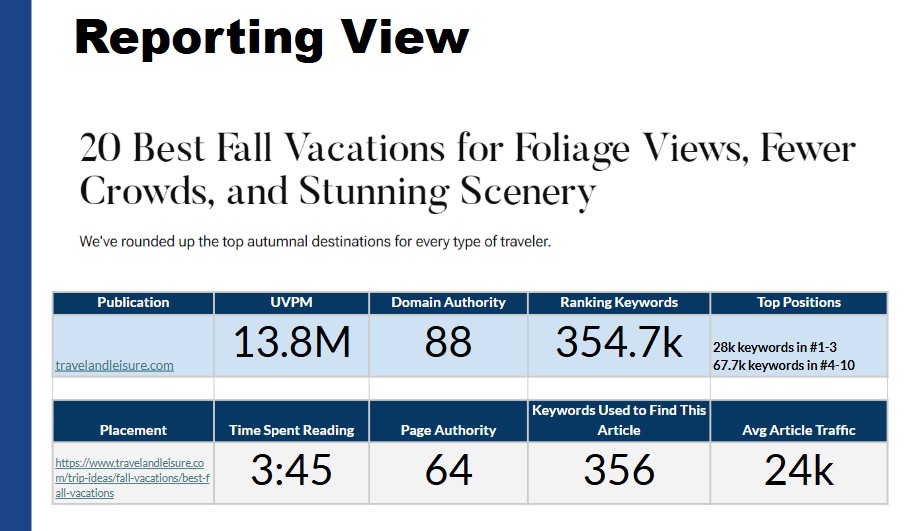
Measurement should show whether destination demand strategy created the intended demand, sent it to useful partners, and respected destination capacity. Reach alone cannot answer those questions.
| Measurement layer | Examples | Decision supported |
|---|---|---|
| Delivery | Reach, frequency, and completed assets | Was execution delivered? |
| Qualified behavior | Itinerary use, partner clicks, and planner-guide use | Did the right audience engage? |
| Conversion | Referral, registration, RFP, and booking action | Did interest become a trip step? |
| Destination outcome | Visitation, room nights, attendance, and stay length | Did destination demand change? |
| Economic and public value | Spending, tax, and partner value | What broader value was created? |
| Authority | Search visibility, AI citation, earned coverage, and first-party audience | Did future discoverability improve? |
| Stewardship | Resident sentiment, capacity, dispersion, and accessibility | Should activity be scaled, redirected, or stopped? |
Label results by method, such as observed, platform-attributed, modeled, partner-reported, estimated economic impact, experimental, or directional. Attribution and analytics can establish those distinctions. The best the operating strategy improve the fit between visitor demand, partner value, and destination capacity.
Run a 90-day strategy sprint
Days 1–30: Truth and evidence
Research stakeholders and visitors, inventory experiences, audit claims and partner data, map search and AI perception, identify need periods, and establish baselines.
Days 31–60: Choice and design
Choose one demand problem, score markets, refine place truth, select experiences, build proof, map partner action, and assign channel and measurement roles.
Days 61–90: Focused test
Run one controlled test with a hypothesis, owner, KPI, risk control, and stop-or-scale rule. Record what changed and what the next decision should be.
A 90-day sprint can test destination strategy and improve the evidence behind a decision. It should not be presented as a promise of complete destination change.
Common mistakes
These failures weaken the destination approach because they separate the promise from the operating conditions that make it credible.
Why Percepture has a point of view
Percepture’s supplied destination work spans place discovery and activation for Hunterdon, perception and search work for Greater Williamsburg, creator-to-evergreen programming for New Orleans, and earned-story development for Amazon at Phantom Ranch.
The common thread is integration. Omnichannel marketing assigns each channel a role after the audience, promise, proof, and action path are defined. That allows the strategy to operate as one system rather than a collection of disconnected campaigns.
Turn the strategy into an annual operating plan
Once the strategic choice is clear, assign budgets, owners, calendars, partner responsibilities, and decision points. Review the companion planning resources before committing destination demand strategy to a full-year channel schedule.
Review Percepture pricing optionsDestination strategy FAQs
What is a destination marketing strategy?
The operating strategy are deliberate choices about which visitor demand a place should create and how that demand will become a real trip. Each strategy defines the place truth, priority audience, timing, experience, proof, discovery path, partner action, and measure of value before channels are selected.
What are the most effective destination marketing strategies?
The best destination approaches depend on the problem. Place truth helps fragmented brands. Perception work addresses outdated beliefs. Demand shaping supports need periods. Signature experiences deepen itineraries. Earned authority builds trust. Search and AI improve discovery. Partner pathways turn interest into local action.
How is destination marketing different from tourism marketing?
Tourism marketing is the broader discipline used to attract and serve visitors through research, brand, content, media, partnerships, and sales. Destination strategy makes the narrower choices about what a specific place can own, which demand it needs, and how that demand should create visitor and partner value.
How do you create a destination strategy?
Build destination marketing strategies from stakeholder and visitor evidence. Define a credible place truth, choose one priority demand problem, identify the best-fit travelers and markets, select signature experiences, document proof, map discovery, assign channel roles, design partner actions, and establish a learning log with decision-based measures.
What is place branding?
Place branding is the work of defining and expressing a credible promise about a location. The promise must be supported by real experiences, partner delivery, resident context, and evidence. A logo or slogan can express the brand, but it cannot replace the research and operating choices behind it.
How should a destination choose target markets?
Destination marketing strategies should choose markets by fit, not size alone. Consider traveler motivation, access, booking window, seasonality, likely stay pattern, partner capacity, current perception, media cost, and the destination’s ability to deliver the promised experience. Test uncertain assumptions before committing a large annual budget.
How can a destination change traveler perception?
Identify the current belief, find overlooked experiences that can support a broader belief, build a clear narrative, secure outside validation, make the evidence discoverable, and connect the new story to itineraries and partners. The experience must change or already exist; creative alone will not sustain the shift.
How should destinations optimize for AI trip planning?
Publish consistent facts about places, experiences, dates, locations, partners, and visitor choices. Use crawlable HTML, concise answers, strong internal links, descriptive images, current source references, and matching structured data. Assign an owner and review date to claims that can change.
How does a DMO create partner value?
A DMO creates partner value by designing pathways from destination discovery into hotels, venues, attractions, restaurants, events, and local services. The pathway should provide useful context, accurate availability, clear eligibility, mobile usability, accessibility, tracking, and an action such as booking, ticketing, directions, or an RFP.
How should destination marketing success be measured?
Measure delivery, qualified behavior, conversion, destination outcomes, economic or public value, future authority, and stewardship. State whether each result is observed, attributed, modeled, partner-reported, estimated, experimental, or directional. The final decision should be whether to scale, redirect, repair, or stop the activity.
Move from disconnected campaigns to one defensible path from place truth to booked travel
Percepture can review your destination marketing strategies, fact system, search and AI visibility, partner pathways, measurement model, and readiness for a focused market test. The review identifies which destination marketing strategies fit the demand problem and which operating gaps should be resolved before launch.
Request a Destination Strategy and Visibility Review