
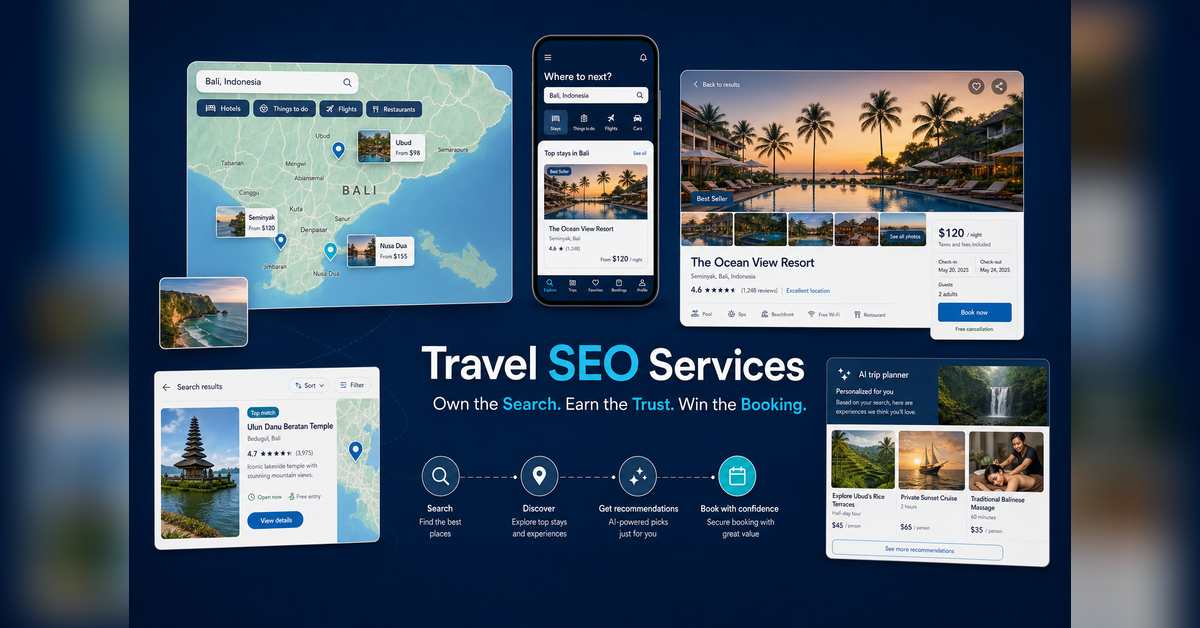

Travel SEO services help hotels, destinations, tour operators, travel agencies and attractions earn visibility in Google, Maps and AI-generated travel answers. A complete program connects technical SEO, traveler-intent research, destination content, local search, digital PR, structured data, conversion improvement and measurement to direct bookings or qualified traveler actions.
The hard part is not producing a keyword list or publishing more blog posts. It is connecting discovery, comparison and validation to a booking engine, inquiry form, partner page, registration or other meaningful visitor outcome.
Travel-sector experience, independent recognition and proof that earns attention
Percepture brings search, content, digital PR, AI visibility and conversion measurement into one operating plan for hotels, destinations, tour operators, travel agencies and attractions.





Percepture helped turn a remote-delivery story into 378 stories, more than 70 million viewers and lasting travel authority.
Read the case study →What are travel SEO services?
Travel SEO services are the technical, content, local, authority and measurement activities used to help a travel organization appear when people research destinations, compare experiences and choose where to book. The work should improve discoverability while making the next traveler action clear, useful and measurable.
Executive takeaways
Own decisions, not isolated rankings
Effective programs map the searches that influence discovery, comparison, trust and action.
Protect the booking path
A travel search program has limited value when booking engines, forms or partner links create friction.
Use travel-specific intent
Season, location, party type, experience and booking window change what a useful page must answer.
Connect SEO and authority
Useful owned pages and credible third-party coverage can reinforce the same destination or experience.
Measure qualified demand
The program should report bookings, inquiries, partner referrals and assisted conversions alongside rankings and traffic.
Prioritize implementation
An audit is useful only when findings have owners, severity levels and a realistic order of work.
Who this guide is for
Hotels and resorts
Protect brand demand, improve local discovery and reduce friction between content and the booking engine.
DMOs and CVBs
Connect destination discovery with events, itineraries, partner referrals and measurable visitor action.
Tour operators and agencies
Build authority around destinations, activities, itineraries and advisor expertise that lead to qualified inquiries.
Attractions and travel groups
Govern local information, seasonal pages, complex inventories and multi-property search architecture.
What the best travel SEO services include
The strongest programs combine technical search work, traveler-intent content, local visibility, authority building and conversion measurement. The scope commonly includes crawlability, page architecture, keyword-to-page mapping, on-page optimization, internal linking, structured data, destination content, local profiles, digital PR, AI-answer coverage, conversion review and reporting.
This page covers service scope, deliverables, pricing and provider selection. Broader implementation work may also require enterprise SEO services, a focused SEO Sprint or support from the wider travel and tourism marketing practice.
Why travel SEO differs from general SEO
A provider can understand SEO and still misunderstand the trip. A travel search strategy must account for seasonality, booking windows, origin markets, local intent, reviews, temporary events, availability, transportation, comparison sites and multiple people influencing the purchase.
An origin market is the place from which a traveler begins a trip. A booking window is the time between reservation and arrival. Both affect the language people use, the pages they need and when the program should promote those pages.
An online travel agency, or OTA, is a marketplace that lists and sells travel inventory. An official site does not need to eliminate OTAs to benefit from organic search. It needs accurate brand results, useful comparison information, a clear direct-booking path and a reason for travelers to trust the official source.
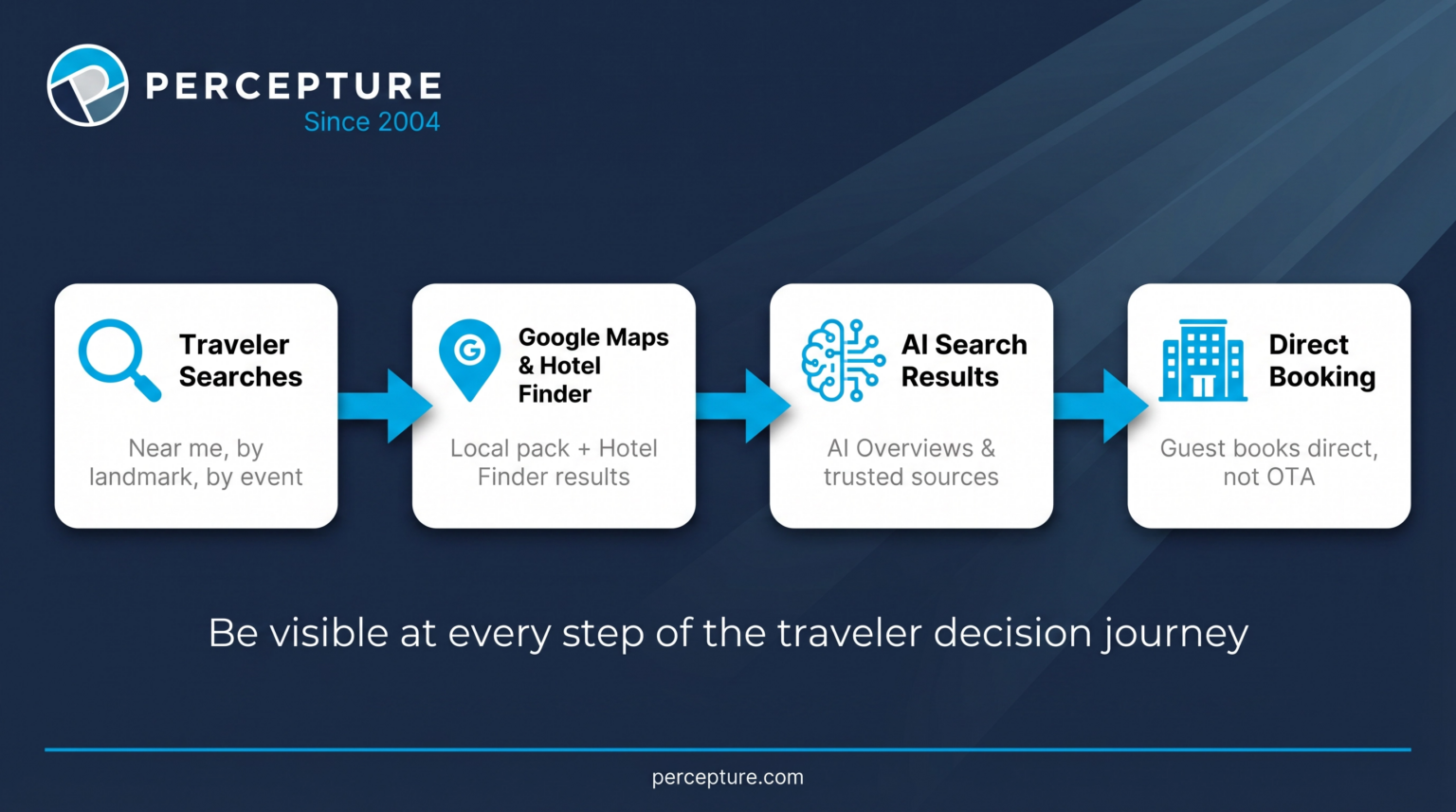
Travel sites also carry technical risks. Property templates, itinerary variations, filtered listings and seasonal pages can create duplicate or competing URLs. International programs may need hreflang, which helps search engines understand language and regional page versions. Canonical tags identify the preferred URL when similar pages exist.
Which travel organizations benefit?
The program should reflect each organization’s search territory, primary conversion and operational risks.
| Organization | Priority territory | Primary conversion | Common risk |
|---|---|---|---|
| Hotels and resorts | Brand, local and experience demand | Direct booking or group inquiry | Booking-engine friction |
| DMOs and CVBs | Destination and event discovery | Partner referral or visitor action | Thin partner and seasonal pages |
| Tour operators | Activity and itinerary demand | Booking or qualified inquiry | Duplicate itinerary pages |
| Travel agencies | Specialty and advisor expertise | Consultation request | Broad pages without clear expertise |
| Attractions and parks | Local, seasonal and trip-planning intent | Ticket, pass or reservation | Expired event pages |
| Cruise and rail brands | Route, itinerary and experience demand | Booking or agent referral | Complex inventory architecture |
| Park concessionaires | Official facts and in-market search | Lodging, activity or dining booking | Entity confusion |
| Travel platforms | Category and programmatic inventory | Transaction or qualified lead | Uncontrolled indexation |
| Multi-property groups | Brand, property and market demand | Property booking | Internal competition between properties |
A DMO is a destination marketing organization. A CVB is a convention and visitors bureau. A destination management company, or DMC, typically plans and delivers local services for groups, events or itineraries. Each has different conversions and accountability requirements.
Are you buying activity or building search territory?
Use the Travel SEO Services Evaluation Scorecard to assess whether travel search services cover technical execution, traveler intent, local visibility, content, authority, AI search, conversion and reporting.
Use the evaluation scorecardWhat should travel SEO services include?
1. Technical foundation
The technical plan within the program should identify what prevents important pages from being crawled, indexed, understood or used. It should cover response codes, robots rules, sitemaps, canonical tags, redirects, internal links, page speed, structured data and booking-path handoffs.
A prioritized backlog is more useful than a long audit. Each issue should carry a severity, affected template, owner and acceptance test. Complex portfolios may need enterprise web development support in addition to search direction.
2. Keyword and traveler-intent map
A keyword list records phrases. An intent map enables the search program to decide which traveler question belongs on which page and what action should follow. It separates brand protection, destination discovery, property comparison, local intent and high-value booking queries.
Hotel teams can use the guide to SEO keywords for hotels as a specialist resource. Tour businesses should review the distinct requirements of SEO for tour operators.

3. Destination and experience architecture
Travelers often enter through an experience rather than a brand name. The program should connect destinations, neighborhoods, seasons, events, itineraries, properties and packages without producing a separate low-value page for every phrase.
Programmatic SEO uses templates and structured data to create pages at scale. It can support large inventories, but only when each page has distinct value, reliable information and controlled indexation. Automation without governance creates duplication faster than it creates demand.
4. Local SEO
Local work within the engagement covers Google Business Profile information, categories, hours, reviews, directions, local landing pages and consistency across official sources. It is especially relevant to lodging, attractions, dining, visitor centers and activities where the traveler is already in market.
The local plan should define who updates information and how changes are checked. Property teams can review the more focused guide to local SEO for hotels.

5. Digital PR and authority
Travel brands have source material that generic outreach often overlooks: local expertise, access, seasonal data, unusual logistics, itineraries and credible spokespeople. The program can use digital PR services to turn those assets into useful stories and third-party validation.
Coverage should not be treated as an automatic ranking increase. Its role is broader: build awareness, create credible references, support discovery and strengthen the authority around a destination, organization or experience.

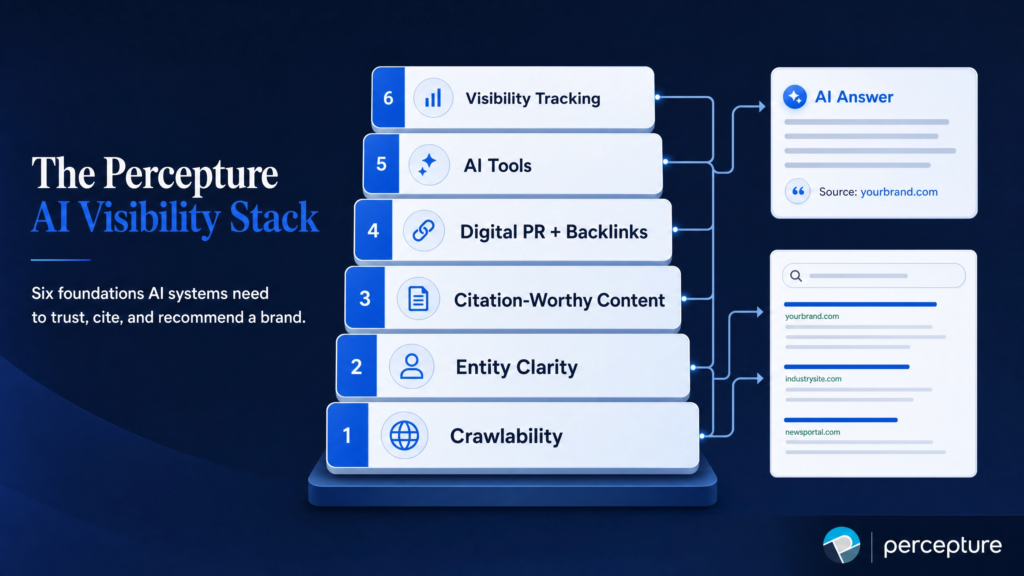
6. AI search and entity clarity
AI-generated travel answers may draw from official pages, third-party sources and structured facts. An AI citation is a visible reference or link used to support an answer. The program improves eligibility by publishing crawlable answers, keeping entities accurate and earning corroboration from credible sources.
Generative engine optimization services extend search work into systems such as Google AI Overviews, ChatGPT, Gemini and Perplexity. Schema can help machines interpret content, but it does not guarantee inclusion. The guide to AI search for tourism marketing covers this topic in greater depth.
7. Conversion and attribution
The program should evaluate whether the next action works, because rankings alone do not produce a booking. Conversion rate optimization services can improve landing-page clarity, booking transitions, mobile usability and calls to action.
Attribution connects marketing touchpoints to outcomes. A direct conversion follows the tracked visit being evaluated. An assisted conversion means search contributed earlier in the journey. Directional metrics show movement when complete revenue attribution is unavailable. Percepture’s attribution and analytics work supports this measurement layer.
The Travel Search Territory Map
The Travel Search Territory Map is Percepture’s method for organizing the searches a travel brand must protect, earn and convert. A travel search roadmap should identify the territory with business value and the gap blocking the traveler instead of attacking every keyword at once.
1. Brand protection
Brand terms, reviews, official facts, reputation and accurate entity information.
2. Nonbrand discovery
Categories, traveler types, seasons, activities and early planning questions.
3. Destination and experience demand
Things to do, events, itineraries, packages, neighborhoods and nearby attractions.
4. Local and Maps
Profiles, reviews, directions, hours and pages designed for in-market intent.
5. OTA and marketplace defense
Official brand results, comparison content, direct-path value and booking usability.
6. AI recommendation visibility
Accurate entities, crawlable answers, citations and visibility in generated shortlists.
7. Conversion and measurement
Bookings, calls, forms, partner clicks, registrations and assisted outcomes.
Start by asking three questions: Which territory is already protected? Which territory has commercial value? Which missing page or technical barrier prevents the traveler from moving forward? The answers establish the first quarter of travel search services.
Required provider deliverables
Credible providers produce decisions and implementation assets, not just dashboards.
| Workstream | Required output | Good standard | Warning sign |
|---|---|---|---|
| Baseline | Analytics, search and conversion baseline | Starting point and limits are documented | No baseline |
| Technical | Prioritized backlog | Owners, severity and tests are included | Unprioritized audit |
| Intent | Query and page map | One dominant intent per URL | Large keyword list without page decisions |
| Content | Briefs, optimization plan and calendar | Each asset supports an experience and action | Commodity blog production |
| Local | Profile and local-page plan | Information is accurate and governed | Listings work without review or conversion planning |
| Authority | Digital PR and source plan | Relevant stories and credible sources | Purchased links |
| AI | Entity and answer coverage | Important answers are accurate and monitored | Claims of secret ranking tricks |
| Conversion | Landing-page and path recommendations | The next action is clear and trackable | Traffic-only scope |
| Reporting | Visibility, page, conversion and decision review | Insights lead to next actions | Automated dashboard without interpretation |
Travel SEO services by business type
Hotels and resorts
SEO services for hotels should start with brand, rooms, amenities, offers, weddings, meetings and local experience pages. The main conversion is a booking or qualified group inquiry. Booking-engine handoffs and property duplication are common technical risks.
Use a specialist hotel SEO agency guide when evaluating hotel-specific providers.
Destinations and visitor bureaus
SEO services for destinations should start with destination themes, things to do, events, itineraries, seasonal travel and partner pathways. Measure partner referrals and meaningful planning actions. Governance becomes difficult when event and partner pages multiply.
See how a destination marketing agency should support the wider visitor economy.
Tour operators
SEO services for tour operators should improve activity, destination, itinerary and traveler-fit pages first. Bookings and qualified inquiries are the primary outcomes. Repeated itinerary copy and unavailable departure pages can weaken index quality.
Travel agencies
SEO services for agencies should lead with destination expertise, specialties, advisor credibility and consultation pages. The primary conversion is usually an inquiry. Broad destination pages without firsthand value are a common weakness.
Attractions and parks
Prioritize official facts, hours, tickets, directions, seasonal events and nearby planning information. Ticket and reservation actions should be easy on mobile. Expired event pages require a defined retention or redirect policy.
Multi-property and international groups
Begin with property templates, market pages, brand rules and internal competition. The technical plan may include canonical controls and hreflang. Governance must prevent one property or regional team from competing with another.
Greater Williamsburg: destination positioning and search working together
Greater Williamsburg faced a one-dimensional historic perception. The program aligned search architecture, useful destination content, hosted media and original story angles around a broader experience.
The search territory included Williamsburg, events, vacation packages, Christmas travel and things to do. Documented results included more than 300 million media impressions, 100 new stories, 10 broadcast segments and an 18% increase in organic traffic. The program also produced more than 100,000 new organic visitors.
Visitors viewed 3.6 pages and stayed more than three minutes on average. Seventy-five percent of monthly traffic came from first-time visitors. The destination achieved No. 1 visibility for Williamsburg VA, Christmas Williamsburg VA, events and vacation packages, while tourism terms reached No. 1 and No. 2 and “things to do” reached approximately No. 2.

These results did not come from generic blog volume. Positioning, owned content, technical structure and credible third-party stories reinforced the same destination themes.
See the destination strategy behind the results
Review how Greater Williamsburg used useful content, search architecture and earned media to broaden its destination story.
Review the Williamsburg case studyHow SEO and digital PR compound
Search data reveals what travelers ask and where official information is weak. Those findings guide owned content within the engagement. Strong owned material gives journalists, partners and other sources accurate information to reference. Relevant third-party coverage can then expand awareness and corroboration.
The loop is search data, owned content, third-party validation, authority, broader visibility and better next decisions. Not every media placement changes rankings, and not every link carries the same value. The operating benefit is a more coherent entity and experience across channels.
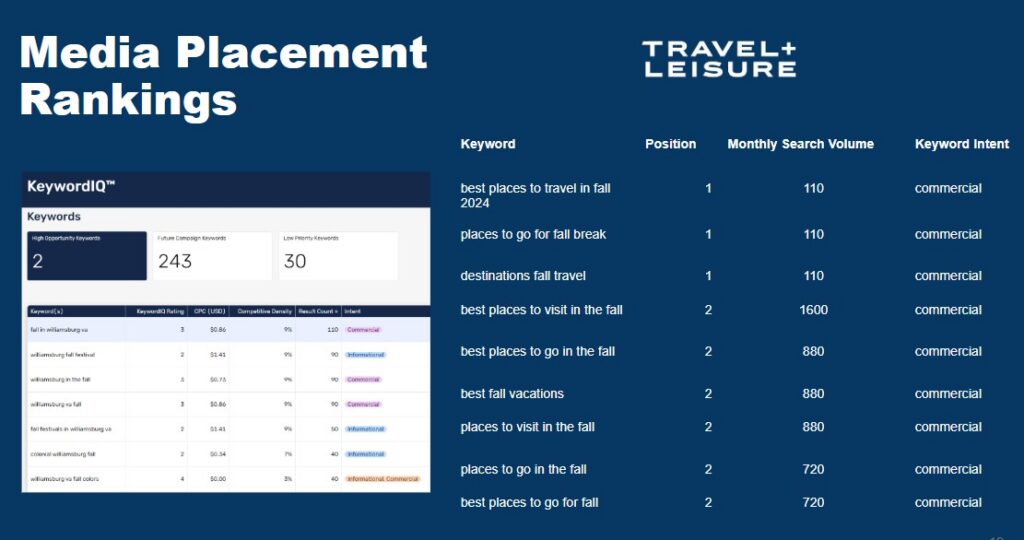
Percepture combines this work through content marketing services, digital PR and search strategy. The travel PR guide explains the earned-media side of the system.
How much do travel SEO services cost?
Percepture’s published monthly starting points are $3,000 for Launch, $5,500 for Growth, $8,000 for Authority and $10,000 or more for Enterprise. Actual scope depends on site size, property count, markets, content requirements, technical complexity, implementation support and authority needs.
| Package | Starting monthly price | Best fit |
|---|---|---|
| Launch | $3,000 | A focused initial program |
| Growth | $5,500 | Steady expansion across priority pages |
| Authority | $8,000 | A competitive destination or multi-segment brand |
| Enterprise | $10,000+ | A multi-property, multi-market or complex platform |
Pricing for the program should be evaluated against the actual work included. Compare technical analysis, implementation support, content production, local management, digital PR, conversion work and reporting before comparing monthly totals. See the current SEO pricing packages for package details.
What should happen in the first 90 days?
- Days 1–30: The program should establish analytics, Search Console and conversion baselines. Triage technical barriers, map intent, assess competitors, identify quick wins and assign implementation owners.
- Days 31–60: Address high-severity fixes, optimize priority pages, improve internal links, correct local information, validate schema and prepare the first landing pages.
- Days 61–90: Publish supporting content, test calls to action, review early visibility, begin authority work and set the next quarter’s priorities.
- Days 91–180: Expand proven clusters, improve high-impression pages, build relevant authority and strengthen conversion attribution.
A 90-day plan for the program should not promise page-one rankings. Early indicators include successful indexation, resolved technical issues, stronger impressions, improved query relevance and cleaner conversion tracking. Bookings and inquiries may take longer, especially when buying cycles are seasonal.
How should travel SEO services be measured?
- Technical eligibility: Important pages can be crawled, indexed, rendered and understood.
- Visibility: The brand appears for relevant rankings, map results and monitored AI answers.
- Qualified engagement: Travelers reach appropriate pages, continue to useful details and engage with booking or inquiry paths.
- Business action: The program contributes to bookings, calls, forms, partner referrals, registrations or group requests.
- Strategic value: The organization protects brand demand, strengthens direct pathways and makes better investment decisions.
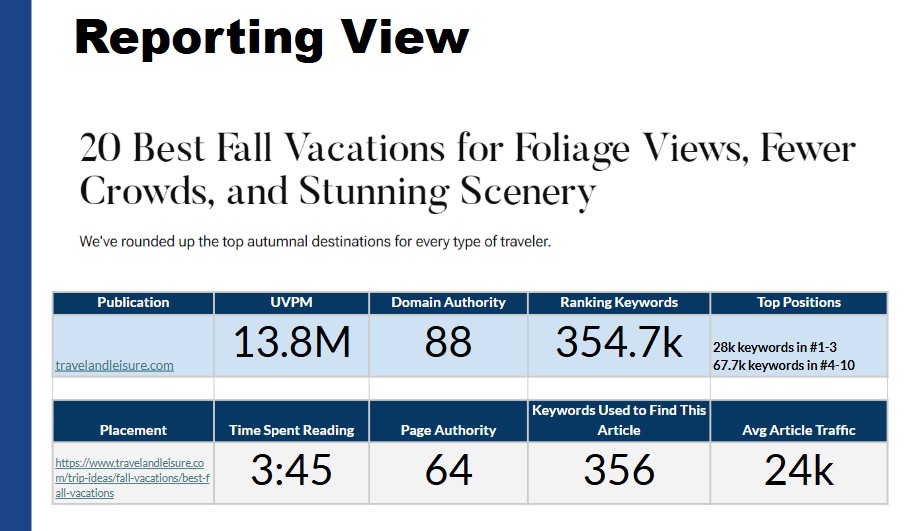
Reports for the program should distinguish direct, assisted and directional outcomes. They should also explain what changed, why it matters, what the team learned and what will happen next. A dashboard without interpretation transfers the decision burden back to the buyer.
Specialist, generalist, consultant, in-house team or platform?
| Option | Best fit | Strength | Tradeoff |
|---|---|---|---|
| Travel specialist | Organizations with travel-specific search and booking complexity | Understands trip planning, local intent and inventory | May require a larger engagement |
| Generalist agency | Brands needing several coordinated marketing services | Broad delivery capacity | Travel depth varies |
| Consultant | Teams with strong internal implementers | Focused senior guidance | Execution remains internal |
| In-house team | Large organizations with continuous demand | Close access to systems and stakeholders | Hiring across every specialty is difficult |
| Software platform | Teams that can interpret and act on recommendations | Efficient monitoring and workflow support | Software does not resolve governance or implementation gaps |
Hire for the capability gap. Do not buy a full-service engagement for one narrow technical task, and do not buy software when the team cannot act on its recommendations. The right delivery model depends on the work the current team can execute.
100-point provider evaluation scorecard
Score each category from zero to 10 when comparing travel search services. Ask the provider to support each score with a deliverable, process example or documented result.
| Category | What a high score requires |
|---|---|
| Travel knowledge | Understands traveler stages, seasonality, local intent and booking paths |
| Intent architecture | Maps one dominant purpose to each priority URL |
| Technical SEO | Produces prioritized, implementation-ready requirements |
| Local SEO | Connects accurate profiles and local pages to in-market actions |
| Content quality | Creates useful experience-led information rather than generic volume |
| Digital PR and authority | Builds relevant stories and credible third-party validation |
| AI and entity clarity | Improves crawlable answers, entities and monitored citations without guarantees |
| Conversion understanding | Reviews the complete path to booking, inquiry or referral |
| Reporting | Connects visibility, engagement and outcomes to decisions |
| Governance | Defines owners, approvals, implementation and quality checks |
85–100: strong partner. 70–84: credible with identifiable gaps. 55–69: primarily tactical. Below 55: high execution risk.
Questions to ask a travel SEO company
Use these questions to determine whether proposed services match the organization’s implementation and measurement needs.
- Which travel segments have you worked in, and what work did your team perform?
- Which results came from organic search rather than paid media?
- How will you track booking-engine transitions, calls, forms and partner referrals?
- How do you decide whether a page should be improved, consolidated or removed?
- How do you handle seasonal and expired event pages?
- What local SEO work is included, and who governs profile changes?
- How do you approach relevant authority without buying links?
- How will you assess visibility in Google AI Overviews, ChatGPT, Gemini and Perplexity?
- Who converts audit findings into implementation requirements?
- How do you prevent properties, itineraries or destination pages from competing?
- How do you manage multi-property or international architecture?
- What is excluded from the monthly fee?
- Which leading indicators will appear before revenue outcomes?
- What decisions will be included in each reporting cycle?
Warning signs when selecting a provider
The engagement carries higher execution risk when a provider shows any of these warning signs.
- Guaranteed rankings, traffic or bookings.
- Generic machine-produced content without travel expertise or editorial review.
- Purchased links or authority packages with no source standards.
- Traffic reporting that excludes bookings, inquiries and referrals.
- No discussion of booking engines, mobile transitions or conversion friction.
- No plan for Maps, reviews or local information.
- No policy for seasonal, unavailable or expired pages.
- Audits without implementation owners.
- Claims that schema or one technical file guarantees AI visibility.
- Case studies that combine paid, organic and PR results without distinction.
- Low fees that exclude the technical, content or authority work required to execute the strategy.
Why Percepture for travel SEO services?
Travel breadth
Percepture brings travel-search experience across hotels, resorts, destinations, parks, cruises, attractions and travel media.
Search visibility
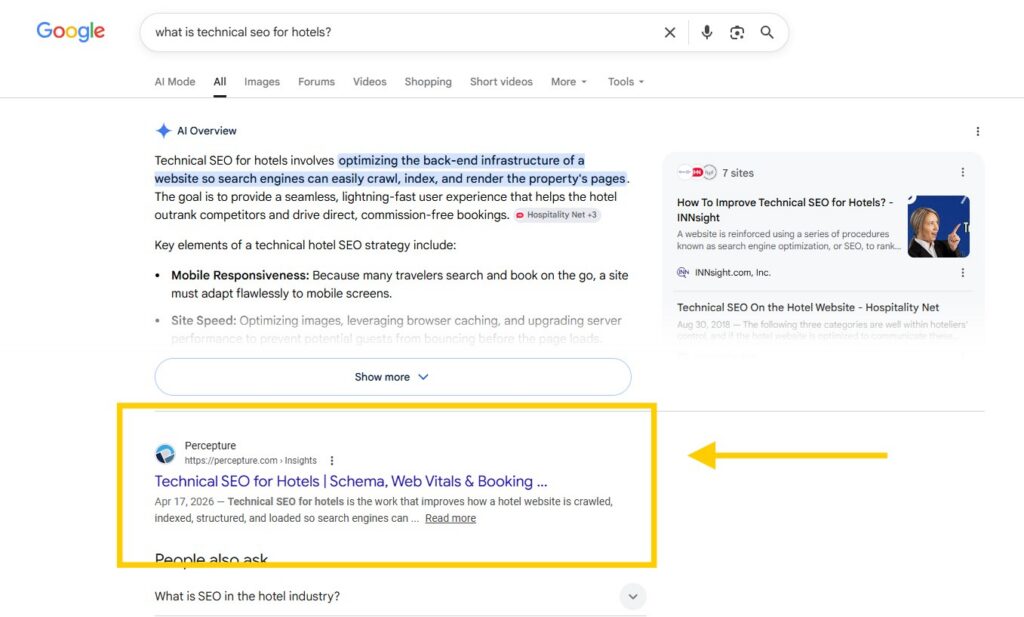
Search Console data supplied for 2026 shows Percepture pages appearing for hotel SEO agency and technical SEO for hotels queries. Positions and impressions change over time.
Integrated delivery
Search, GEO, content, digital PR, conversion and analytics can operate against one traveler-intent map.
Operating history
Percepture was founded in 2004 and brings senior strategy to complex marketing programs.
Measurement
The program can combine Search Console, analytics, conversion events, ranking review and monitored AI visibility.
Travel SEO services FAQs
What do travel SEO services include?
Travel SEO services usually include technical analysis, traveler-intent research, page architecture, content optimization, internal linking, local SEO, structured data, digital PR, AI-answer coverage, conversion review and reporting. The exact mix should reflect the organization’s properties, destinations, markets, inventory and primary conversion.
How much does a travel SEO program cost?
The cost of travel search services depends on site size, market competition, property count, content production, technical implementation and authority work. Percepture’s published packages start at $3,000 per month for Launch, $5,500 for Growth, $8,000 for Authority and $10,000 or more for Enterprise.
How long does travel SEO take?
The program can begin producing technical and measurement improvements in the first month. Indexation, impressions and ranking movement may follow, while qualified bookings and inquiries can take longer. Seasonality, site condition, implementation speed and competition affect timing. A provider should report leading indicators without promising page-one results by a fixed date.
How is travel SEO different from regular SEO?
A travel search program must account for trip stages, origin markets, seasonality, local intent, reviews, inventory, booking engines, temporary events and marketplace competition. The work also needs to connect destination inspiration with accurate planning information and a usable booking, inquiry or partner-referral path.
Can SEO increase direct bookings?
The program can strengthen the direct-booking path by improving official brand results, nonbrand discovery, landing-page usefulness and booking usability. Results depend on availability, pricing, brand trust, the booking system and other commercial factors. A program should measure booking-engine transitions and completed outcomes where tracking permits.
Does travel SEO eliminate dependence on OTAs?
No. OTAs can remain valuable distribution and discovery channels. Search work can help a brand protect official results, explain direct-booking value and make its website easier to use. The goal is a stronger direct pathway, not an unsupported promise that marketplaces will become unnecessary.
Is local SEO included?
It should be included in the engagement when travelers visit a physical place or search within a destination. Local work can cover Google Business Profile information, categories, hours, reviews, directions and local landing pages. The provider should also define who maintains those facts during closures, seasonal changes and special events.
Do schema and GEO guarantee AI visibility?
No. Structured data can help systems interpret a page, while GEO can improve entity clarity and answer coverage. Neither guarantees an AI citation. Eligibility also depends on crawlable content, accurate facts, relevance, third-party corroboration and the retrieval choices made by each search or answer system.
Find the travel searches you should own next
Percepture can review your travel SEO services scope, search territory, traveler-intent architecture, AI visibility, booking paths and measurement model. The result is a prioritized view of what the brand should protect, earn and convert next.
No ranking guarantees and no generic keyword dump—just a clear view of where the brand appears, where it is absent and what should happen next.
Request a Travel Search Territory Review