

SEO Pay Per Lead lets a company pay for inquiries attributed to organic search instead of paying only a fixed retainer. The model can reduce upfront exposure, but it does not automatically protect lead quality, exclusivity, attribution, data, or ownership.
The better buying question is not whether performance pricing is good or bad. It is which mix of organic search, paid search, AI visibility, remarketing, and third-party authority creates the lowest sustainable cost per sales-accepted opportunity.
Search visibility should create qualified demand
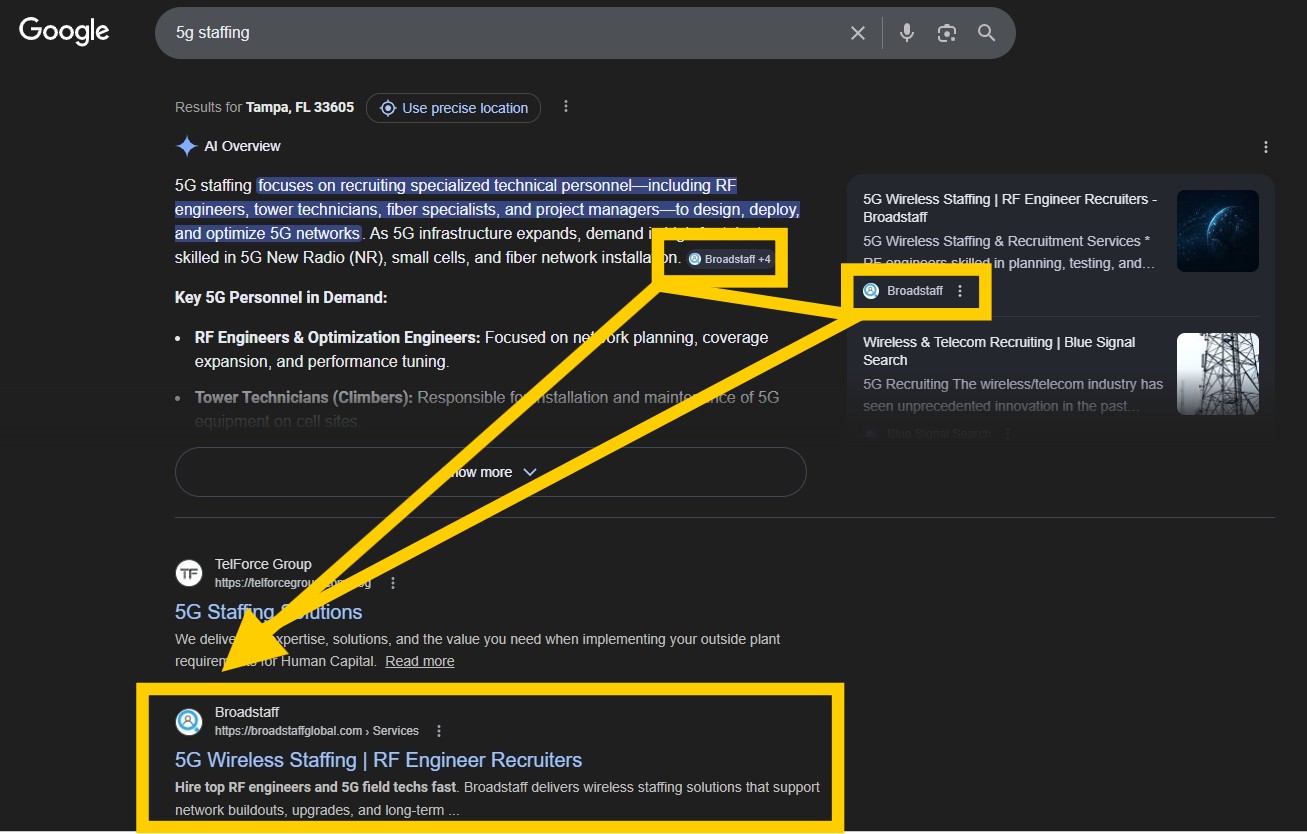
Broadstaff Global is a useful example because the reported outcome did not stop at rankings. The documented 12-month period connected page-one visibility with threefold qualified-lead growth. Results vary by market, authority, competition, execution and sales follow-up.
“What they’ve done for Broadstaff has been really nothing short of miraculous.”
Read the testimonial summary
Carrie Charles explains that Percepture helped Broadstaff become easier to find and understand across Google and AI-assisted search. She describes the work as “nothing short of miraculous.”
This is a concise crawlable summary of the testimonial, not a word-for-word transcript. The case study should be reviewed for the scope, reporting period and stated limitations.




What does performance-based SEO actually mean?
SEO Pay Per Lead is a performance-based arrangement in which a company pays for leads attributed to organic search. It works best when both parties define qualification, attribution, exclusivity, ownership, rejection evidence, and dispute rules before any lead becomes billable.
The executive view
Measure accepted demand
Raw form fills are an activity count. Sales-accepted leads, opportunities, pipeline, and customers reveal whether the program produces useful demand.
Know what you own
A low lead price can hide a weak deal if the provider controls the domain, content, analytics, call data, or ranking pages.
Use the right channel mix
SEO Pay Per Lead may fit a simple and verifiable local offer. Retainers and hybrid agreements are often better suited to companies building durable authority and broader visibility.
Put risk in writing
Performance pricing redistributes risk. It does not remove ranking risk, attribution risk, fraud risk, sales-execution risk, or market-demand risk.
Who this guide is for
CEO or founder
Determine whether SEO Pay Per Lead builds an asset or rents access to someone else’s audience.
CFO
Evaluate SEO Pay Per Lead using cost per accepted lead, opportunity, customer, and qualified pipeline dollar rather than raw cost per lead.
Marketing leader
Create one attribution policy that distinguishes SEO Pay Per Lead results from paid, referral, remarketing, and AI-assisted visits.
Sales and revenue operations
Define acceptance standards, response expectations, CRM stages, duplicates, and rejection evidence.
What Is SEO Pay Per Lead?
In a standard retainer, the buyer funds research, technical work, content, authority development, reporting, and conversion improvement. In a performance arrangement, some or all compensation is tied to a defined lead event. SEO Pay Per Lead changes the billing trigger, not the underlying work required to earn qualified visibility.
The phrase also covers several materially different arrangements. A provider may generate inquiries on the client’s website, operate a separate ranking property, sell a raw form submission, verify a lead against agreed criteria, or charge only after sales accepts an opportunity. Buyers should never treat those structures as interchangeable.
A company building on its own domain can retain content, ranking history, first-party data, and conversion learning. A company buying leads from a provider-owned property may receive demand without owning the system that produced it. That distinction should shape the price and the contract.
How Does SEO Pay Per Lead Work?
A sound SEO Pay Per Lead program starts with a market, service, geography, and lead definition. The provider then builds or improves the search assets needed to attract demand. Tracking captures the first landing page, source, campaign data, calls, forms, and downstream CRM outcomes.
Each submitted lead moves through validation. Identity, location, service need, duplicate status, intent, and exclusivity are checked against the contract. The buyer accepts, rejects, or disputes the record using documented reasons. Billing follows the agreed stage rather than an informal judgment.
The operating sequence should be visible:
- Define the event. State whether billing begins at a raw inquiry, verified lead, booked appointment, held meeting, or sales-accepted opportunity.
- Set source rules. Separate nonbranded organic traffic from branded, paid, referral, direct, and AI-assisted activity.
- Build the asset. Improve technical health, search intent coverage, content, authority, and conversion paths.
- Validate each record. Apply objective acceptance, duplicate, spam, geography, and fit criteria.
- Reconcile outcomes. Feed rejection reasons, opportunities, pipeline, and revenue into search and landing-page decisions.
SEO Pay Per Lead vs PPC, Retainers and Other Pricing Models
SEO Pay Per Lead is only one way to buy demand. The right model depends on the speed required, the buyer’s tolerance for upfront investment, the ability to verify outcomes, and whether ownership matters.
Search pricing and delivery comparison
| Model | Buyer pays for | Primary advantage | Main exposure | Best fit |
|---|---|---|---|---|
| PPC | Clicks and campaign management | Immediate demand capture and fast testing | Visibility tied to active spend | Urgent demand, testing, seasonality, or ranking gaps |
| Raw SEO Pay Per Lead | Call, form, or registration | Simple billing trigger | Spam, weak intent, duplicates, and disputes | Highly standardized inquiries with objective validation |
| Qualified pay per lead | Lead meeting agreed criteria | Better alignment with buyer fit | Subjective qualification if rules are vague | Clear geography, need, identity, and fit standards |
| Pay per appointment | Scheduled meeting | Closer to sales activity | No-shows and low-value meetings | Offers with reliable scheduling and confirmation |
| Pay per opportunity | Sales-accepted opportunity | Strong commercial alignment | Longer reconciliation and greater CRM discipline | Teams with stable stages and documented acceptance |
| SEO retainer | Strategy and asset development | Builds owned authority and content | Investment begins before full results develop | Companies seeking durable organic and AI visibility |
| Hybrid | Base program plus outcome incentive | Funds durable work while rewarding results | Requires baselines and precise incentive rules | Complex markets where both sides share risk |
| Revenue share | Attributed closed revenue | Direct outcome alignment | Long delays, attribution disputes, and accounting access | Businesses with reliable revenue records and margins |
| Provider-owned lead property | Access to leads from an outside asset | No need to build the ranking property internally | Limited control, transfer rights, and continuity | Buyers who knowingly prefer rented demand |
Test lead quality before debating price
Review identity, intent, fit, duplicates and the difference between a raw inquiry and sales-accepted demand before agreeing to a billable-lead price.

What Counts as a Qualified Lead?
A billable SEO Pay Per Lead record should meet written standards that can be checked by both parties. A download, anonymous visit, vendor pitch, job inquiry, student request, bot submission, or duplicate contact should not become qualified merely because it entered a form.
Percepture’s SEARCH-to-Revenue approach evaluates the path from query to commercial outcome. It considers search intent, entry-page value, account or audience fit, research depth, conversion commitment, human verification, noise, and confidence. The related lead generation service connects acquisition work to lead handling rather than treating traffic as the finish line.
Minimum billable-lead standard
- Valid identity and usable contact information
- Relevant service need
- Correct geography
- Agreed company, role, household, or customer criteria
- No known duplicate inside the attribution window
- No spam, bot, job, vendor, or student intent
- Recorded source and first landing page
- Exclusive status when exclusivity was promised
- Documented acceptance or rejection reason
SEO Pay Per Lead qualification also depends on sales behavior. A valid lead can be lost through slow follow-up, weak discovery, or broken routing. The contract should separate marketing validity from sales execution so neither side uses the other’s failure as a blanket explanation.
When SEO Pay Per Lead Can Fit
Pure performance pricing is most practical when the service, location, and valid action are easy to define. The lead can be checked quickly, duplicates are visible, sales follows up consistently, and the expected transaction value supports the provider’s cost of doing the work.
It may fit selected local services, appointment businesses, or focused offers with objective qualification. That does not mean it fits every company in those categories. Complex B2B sales, long buying committees, broad awareness programs, and multi-touch journeys often require a wider measurement model.
Conditions that improve fit
Simple definition
The SEO Pay Per Lead billing event can be validated without a subjective sales debate.
Supportable economics
Expected margin and close rate can support acquisition and fulfillment costs.
Reliable tracking
SEO Pay Per Lead calls, forms, landing pages, sources, and CRM outcomes can be reconciled.
Clear ownership
The agreement identifies who controls domains, content, accounts, and data.
When the Model Breaks
SEO Pay Per Lead becomes unstable when “lead” means any submission, the same record is sold repeatedly, branded demand is counted as newly created demand, or organic and paid sources are blended without a policy. It also breaks when the provider owns every ranking asset and the buyer discovers that nothing transfers at termination.
SEO Pay Per Lead reconciliation also fails when CRM stages are weak, response is slow, rejections are undocumented, territories change, or sales follow-up is inconsistent. A provider may then chase easy keywords that generate volume but little revenue, while the buyer rejects records without useful evidence.
Risk allocation scorecard
| Risk | Typical carrier | Contract safeguard |
|---|---|---|
| Upfront work | Provider under pure performance pricing | Baseline fee, scope limits, or hybrid structure |
| Ranking volatility | Provider and buyer | No ranking guarantees; diversified query and channel plan |
| Attribution | Both parties | Source hierarchy, attribution window, and CRM source of truth |
| Lead fraud or spam | Provider unless otherwise defined | Validation rules, evidence, and credit process |
| Sales execution | Buyer | Response-time standard and documented disposition |
| Asset continuity | Buyer if the provider owns the property | Ownership, export, transfer, and termination clauses |
| Market demand | Both parties | Volume ranges, seasonality rules, and periodic forecasts |
The Percepture Full-Spread Search Framework
The Full-Spread Search Framework coordinates paid search, organic search, generative search, remarketing, and third-party authority. Its purpose is to prevent a company from depending on one listing, one channel, or one definition of demand. It also puts SEO Pay Per Lead inside a larger revenue system rather than treating it as a standalone trick.
Six moves in the Full-Spread Search Framework
- Rent the gap. Use paid search services when the company needs demand now, lacks organic visibility, is testing a new offer, or must cover a seasonal market.
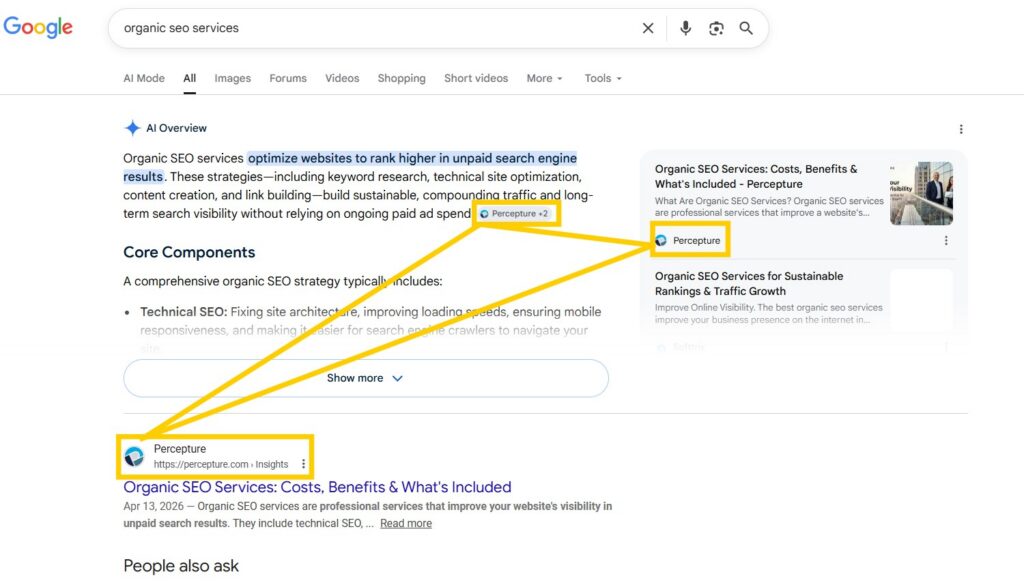
- Earn the trust. Build useful pages, technical strength, internal relevance, and authority on assets the company controls. Percepture’s guide to organic SEO services explains the owned-search side of that work.
- Surround the buyer. Coordinate search results with generative engine optimization services, proof, editorial assets, reviews, and digital PR services.
- Recapture interest. Return non-converters to relevant proof, pricing, and service pages through segmented remarketing while excluding converters and respecting privacy choices.
- Convert by channel. Match each landing experience to the visitor’s source and intent. Use conversion rate optimization to test the message, proof, friction, and next step.
- Reinvest the truth. Feed search terms, landing pages, lead scores, rejection reasons, opportunities, pipeline, and revenue back into the next cycle.
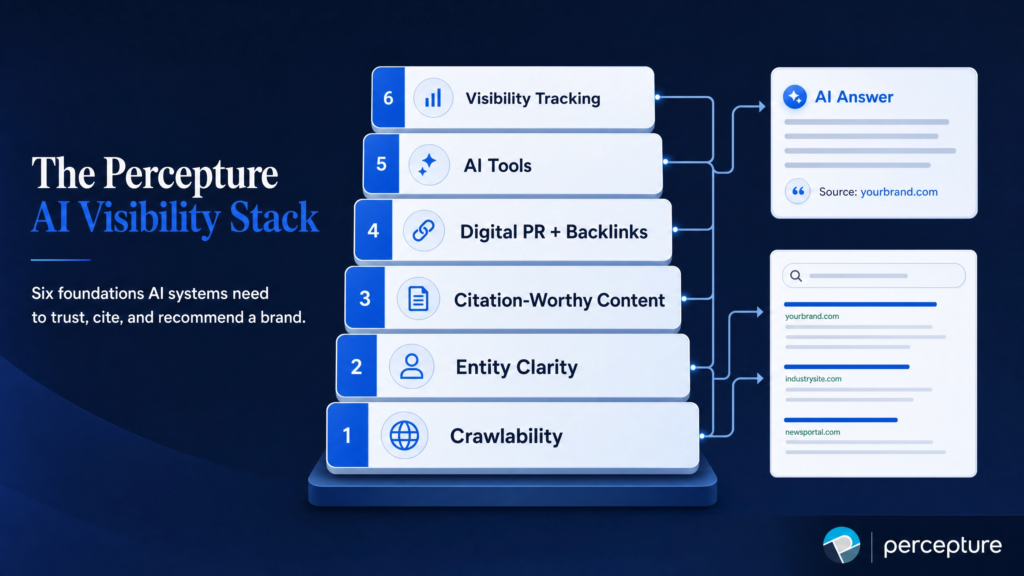
The framework resembles a strong magazine spread: one placement attracts attention, while the surrounding presence makes the brand difficult to miss. Search works the same way. An ad can capture immediate intent, an organic page can answer the full question, an AI answer can introduce the brand, and third-party coverage can corroborate it.
How Paid Search Feeds the Owned Search Engine
Paid search can test demand before an SEO Pay Per Lead page earns stable organic visibility. Search terms and conversion records reveal which commercial phrases attract action. That information can inform service pages, comparisons, FAQs, case studies, and content clusters.
The loop should not become permanent dependence on media spend. Use PPC to learn, then build assets with the findings. A focused SEO Sprint can address a defined visibility problem, while enterprise SEO supports larger sites, teams, and governance needs.
The Feed-the-Search-Engine loop
- Test. Paid campaigns reveal search language, demand, message response, and conversion friction.
- Build. Organic and AI-ready pages turn winning lessons into owned search assets.
- Correct. Sales outcomes show which terms, pages, and audiences deserve more investment.
Why Paid and Organic Landing Pages Often Differ
A paid landing page usually serves one campaign, one audience, and one offer. Tight message match, limited navigation, concise proof, and a focused conversion path reduce distractions. The page can be tested directly because the traffic source is controlled.
An SEO Pay Per Lead landing page has a broader organic-search job. It must answer the main question, cover adjacent concerns, demonstrate experience, explain alternatives, and offer internal paths for readers at different stages. A strong organic page earns continued discovery rather than only handling a purchased click.
The two pages should share facts, positioning, and measurement rules without becoming duplicates. Marketing attribution and analytics should preserve the original landing page and source so the CRM does not erase the distinction later.
Who Owns the Rankings, Content, and Data?
Ownership is one of the most important SEO Pay Per Lead contract issues. The agreement should list the domain, subdomains, content, design files, analytics properties, search accounts, call-tracking numbers, CRM records, backlinks, creative assets, and conversion data.
If SEO Pay Per Lead work happens on the buyer’s domain and accounts, continuity is usually easier. If the provider uses a separate ranking site, the buyer may be purchasing access rather than building equity. That can still be a conscious commercial choice, but the pricing should reflect the lack of transfer rights.
Ask what happens on the final day of the agreement. Can the company export every lead and disposition? Do phone numbers transfer? Are pages retained? Are tracking codes removed safely? Can the provider redirect or resell the property? A clear exit clause is more useful than a vague promise of partnership.
SEO Pay Per Lead Costs and Lead-Economics Formulas
There is no universal SEO Pay Per Lead price because value depends on the market, qualification rules, exclusivity, expected close rate, competition, geography, sales cycle, and asset structure. Compare proposals using a shared economic model rather than a headline price.
Formulas that move beyond raw CPL
| Metric | Formula | What it reveals |
|---|---|---|
| Raw cost per lead | Total channel cost ÷ raw leads | Cost of every recorded inquiry |
| Qualified cost per lead | Total channel cost ÷ sales-accepted leads | Cost of demand sales agrees is worth pursuing |
| Cost per held meeting | Total channel cost ÷ held meetings | Cost after scheduling and attendance loss |
| Cost per opportunity | Total channel cost ÷ created opportunities | Cost of pipeline-producing demand |
| Customer acquisition cost | Total search investment ÷ new customers | Acquisition cost after the full sales process |
| Pipeline efficiency | Qualified pipeline value ÷ total search investment | Pipeline generated for each invested dollar |
| Blended search CPL | SEO, GEO, PR, PPC, CRO, and content cost ÷ accepted search leads | Combined cost across the search system |
These formulas allow an SEO Pay Per Lead proposal to be compared with other search investments at the accepted-lead, opportunity, customer, and pipeline levels. The enterprise SEO ROI calculator offers a related way to connect organic investment with commercial return. Buyers can also compare published SEO pricing packages and paid ads pricing when planning a blended program.
A Hypothetical Lead-Economics Example
Assume a company invests $6,000 in SEO, content, and authority work and $9,000 in paid media and management. Total monthly search investment is $15,000. The program produces 75 raw leads, 30 sales-accepted leads, 18 held meetings, eight opportunities, three customers, and $240,000 in qualified pipeline.
- Raw CPL: $15,000 ÷ 75 = $200
- Qualified CPL: $15,000 ÷ 30 = $500
- Cost per held meeting: $15,000 ÷ 18 = about $833
- Cost per opportunity: $15,000 ÷ 8 = $1,875
- Customer acquisition cost: $15,000 ÷ 3 = $5,000
- Pipeline efficiency: $240,000 ÷ $15,000 = 16x
This hypothetical example shows why the cheapest raw inquiry may not produce the best SEO Pay Per Lead result. If one source creates more accepted opportunities or customers, it can justify a higher headline CPL.
Compare the investment before choosing the billing trigger
A low headline CPL can become expensive after weak qualification, duplicate records, cross-channel overlap or lost ownership are included. Compare the complete search and sales system.
The Contract Checklist
An SEO Pay Per Lead agreement should answer the following questions before work starts. If a term cannot be measured or documented, it should not control billing.
Twenty points to put in writing
- What exact event creates a billable SEO Pay Per Lead record?
- Is the event raw, verified, booked, held, qualified, or sales accepted?
- Are leads exclusive or shared?
- Which services and locations qualify?
- Which company sizes, roles, or consumer attributes qualify?
- How are calls and forms validated?
- What counts as spam, a duplicate, or solicitation?
- What is the attribution window?
- Are branded searches billable?
- How are paid, organic, referral, direct, and AI-assisted sources separated?
- Who owns the domain, content, links, and ranking history?
- Who controls analytics, advertising, call tracking, and CRM accounts?
- How are AI referrals recorded?
- How quickly must sales respond?
- What evidence supports a rejection?
- How are disputes and credits handled?
- What volume range is expected?
- How are seasonality and market changes treated?
- What transfers when the agreement ends?
- Can the buyer export every record and performance field?
Pricing-Model Decision Matrix
| Business condition | Better starting model | Reason |
|---|---|---|
| Simple local service with objective verification | SEO Pay Per Lead or qualified-lead pricing | The billable event can be checked quickly. |
| New offer requiring immediate demand data | PPC | Paid search can test terms, offers, and landing pages quickly. |
| Company building authority on its own domain | SEO retainer | The investment funds durable content, technical work, and ranking history. |
| Complex market with shared risk | Hybrid | A base program funds the work while incentives reward accepted outcomes. |
| Strong CRM and clear opportunity stages | Pay per opportunity | Compensation can move closer to pipeline. |
| Reliable revenue reporting and long partnership horizon | Revenue share | Both parties can reconcile closed revenue and margins. |
| Buyer prefers volume without owning the search asset | Provider-owned lead property | The buyer knowingly rents demand instead of building the property. |
Common Buying Mistakes
The first SEO Pay Per Lead mistake is accepting the cheapest lead without examining acceptance rate, exclusivity, or opportunity creation. A low price can conceal duplicate records, weak intent, irrelevant geography, or leads that were already familiar with the brand.
The second is allowing the provider to define attribution alone. SEO Pay Per Lead billing should use a source hierarchy both sides can inspect. Preserve the first landing page, campaign data, call record, CRM stage, and disposition reason.
The third is ignoring technical and conversion quality. A technical SEO audit service can identify crawl, indexation, site, and page issues, while B2B intent data can add context about account interest where appropriate.
The fourth is publishing only commercial pages. Informational and navigational content form the foundation beneath commercial and transactional pages. A company trying to rank only “hire us,” “pricing,” and “best provider” pages is attempting to build the penthouse before the lower floors.
Measure qualified demand, not traffic alone
The Broadstaff case study records page-one growth and threefold qualified-lead growth during the supplied 12-month period. The operating lesson is more important than the screenshot: visibility, trust, conversion, qualification and sales feedback must work together.

Case-study outcomes vary. A ranking, citation or form fill should not be presented as accepted pipeline until the downstream sales record supports it.
Frequently Asked Questions
What is SEO Pay Per Lead?
SEO Pay Per Lead is a performance arrangement in which payment is tied to leads attributed to organic search. A workable agreement defines the billable event, qualification standards, attribution window, duplicate rules, exclusivity, data access, asset ownership, rejection evidence, and dispute process.
How much does an organic SEO lead cost?
There is no universal SEO Pay Per Lead price. Cost depends on competition, geography, service value, qualification depth, exclusivity, expected volume, sales cycle, and who owns the ranking asset. Compare qualified CPL, opportunity cost, acquisition cost, and pipeline efficiency instead of relying only on raw CPL.
Is pay-per-lead SEO legitimate?
SEO Pay Per Lead can be a legitimate pricing model when the provider, lead source, qualification process, tracking, and ownership terms are transparent. Warning signs include shared leads presented as exclusive, unclear attribution, provider-controlled data, vague rejection rules, ranking guarantees, and no transfer rights.
Are pay-per-lead inquiries always exclusive?
No. Exclusivity depends on the provider and the contract. Ask whether the same record can be sold to another company, how duplicates are detected, how long exclusivity lasts, and what evidence is available if the buyer believes a lead was shared.
Is SEO or PPC better for lead generation?
Neither is universally better. PPC can capture and test demand quickly. SEO can build visibility and content on owned assets. Many companies use paid search to fill immediate gaps while organic, AI-search, and authority work develops, then judge both channels by accepted opportunities and revenue.
Should PPC and SEO use the same landing page?
Not always. Paid traffic often benefits from a focused page with tight message match and one offer. Organic pages usually need broader answers, comparisons, proof, and internal links. Both experiences should share accurate positioning, conversion tracking, and downstream CRM measurement.
Who should own the rankings, content, and data?
The contract should identify ownership of domains, pages, content, analytics, advertising accounts, call-tracking numbers, CRM records, links, and creative files. Companies seeking a durable search asset generally benefit from using accounts and web properties they control.
How should AI-search leads be tracked?
Preserve referral information when it is available, record the first landing page, and provide an AI-assisted source category in the CRM. Use the same identity, fit, duplicate, acceptance, opportunity, and revenue standards applied to other channels rather than treating every AI referral as qualified.
Build a search plan around qualified opportunity cost
Use SEO Pay Per Lead only when its definitions, economics, and ownership terms fit the business. Percepture can help map where paid search should fill a gap, where organic and AI visibility should build an asset, and how every channel should be measured against accepted pipeline.