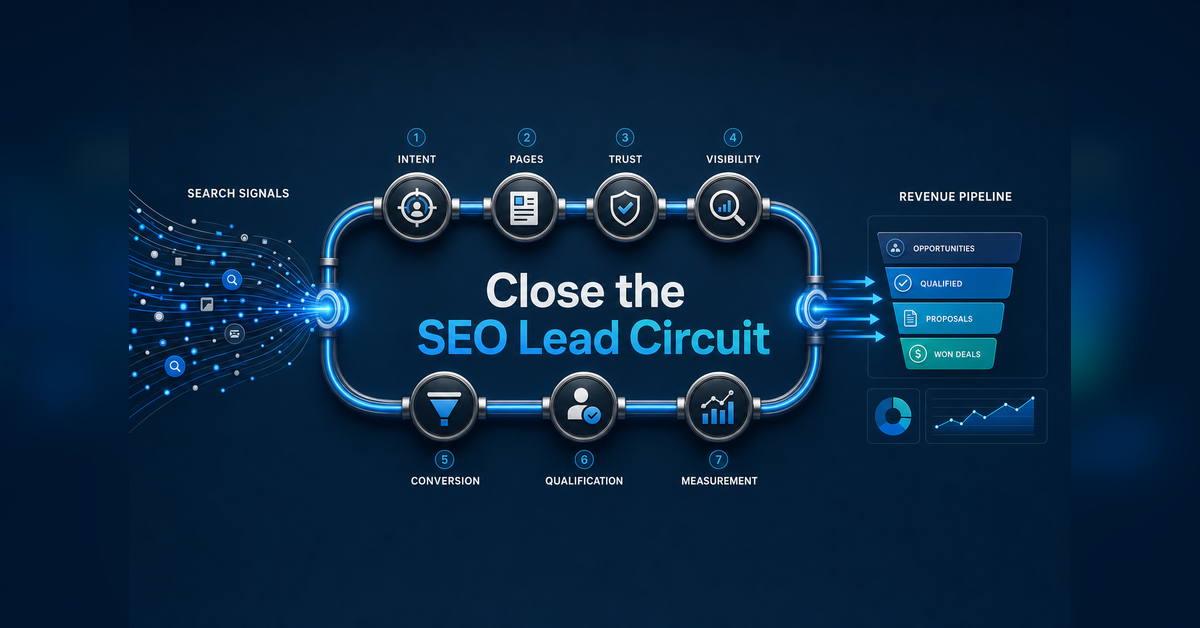

To understand How to Generate Leads With SEO, start with the business outcome, not the keyword list. Define a qualified lead, map the searches those buyers use, build the right pages, earn trust, offer a useful next step, qualify each inquiry, and send sales outcomes back into the strategy.
A ranking is an opportunity to be considered. It becomes a lead only when the page matches intent, answers the buyer’s questions, proves fit, and carries useful context into the sales process.





How does SEO turn search demand into leads?
SEO lead generation is a search-to-revenue process: define the lead, identify demand, route each query to the right page, build trust, expand visibility, install the right conversion path, and track accepted leads, opportunities, and revenue.
The executive summary
Start with lead quality
Write down who sales wants, which work is profitable, where the company can operate, and what makes an inquiry worth pursuing.
Build a connected path
A strong plan for the search-to-pipeline process connects intent, page ownership, proof, conversion, qualification, routing, and measurement.
Measure commercial movement
Rankings and traffic are diagnostic metrics. The business measures accepted leads, held meetings, opportunities, pipeline, revenue, and rejected-lead reasons.
Who this guide is for
Business leaders
CEOs and owners evaluating organic lead generation as a source of durable demand without confusing traffic with pipeline.
Revenue leaders
Sales and marketing leaders who need shared definitions, routing rules, and source-to-revenue reporting to manage the strategy.
Construction operators
Contractors and construction firms applying the search-to-revenue system while matching service type, geography, project fit, timing, and capacity before an inquiry reaches sales.
Why rankings and traffic do not automatically create leads
A page can rank and still fail commercially. It may attract students instead of buyers, answer an informational query with a hard sales pitch, hide the proof a decision-maker needs, or send every visitor to the same generic form.
The operating question is not simply whether traffic increased. Ask whether the right people entered, reached the right page, took an appropriate next step, met the qualification rules, received a useful response, and progressed toward revenue. This is the commercial test for SEO-driven demand generation.
This distinction matters in construction. A visitor looking for do-it-yourself instructions is different from a property owner evaluating contractors. A general information request is different from a viable project inside the company’s geography, capability, schedule, and commercial requirements.
A connected enterprise SEO program creates page ownership and technical discipline. Content marketing services build education and decision support. Conversion rate optimization improves the path from useful visit to meaningful action. None of these should operate as an isolated workstream.
Score the quality of your current lead flow
Use a low-friction diagnostic to examine whether the targeting, conversion path, and lead-quality rules required for the operating model are connected.
Use the sample to inspect company fit, contact quality, research context, and the next sales action.

How to Generate Leads With SEO using the CIRCUIT Framework
The Percepture CIRCUIT Framework treats traffic as current moving through a business system. It provides an operating model for the lead-generation program because an open connection anywhere between search demand and sales feedback can stop that current from reaching pipeline.
The Percepture CIRCUIT Framework
C — Clarify the qualified lead
Define fit, value, geography, decision role, urgency, exclusions, and sales-acceptance rules before choosing keywords.
I — Identify demand and intent
Map the questions buyers ask while learning, comparing, checking risk, evaluating providers, and preparing to act.
R — Route every query correctly
Give each meaningful query one page owner and match it to the correct page type.
C — Create trust before the CTA
Use direct answers, expert context, process detail, limitations, comparisons, authorship, and approved proof.
U — Unify visibility across search surfaces
Coordinate organic search, AI-search discovery, earned media, paid search, remarketing, video, and internal links.
I — Install conversion, qualification, and routing
Match the offer to intent, capture useful context, score fit, and send the inquiry to the correct owner.
T — Track pipeline and tune the system
Return sales acceptance, opportunity, revenue, and rejection data to marketing so the next decision is better.
Step 1: Define a qualified lead and revenue goal
The best strategy for the organic search program does not begin with monthly search volume. It begins with a shared definition of the lead the business can serve and wants to win.
For a construction company, that definition may include project type, service area, estimated scope, desired start date, procurement path, and whether the contact can influence the decision. The final fields should reflect the company’s real sales process rather than a copied form template.
Marketing and sales should document the minimum criteria for acceptance. They should also record why leads are rejected. If many inquiries fail for the same reason, the targeting, page language, form, or offer likely needs correction.
Work backward from revenue
Set a revenue target, average customer value, close rate, accepted-lead-to-opportunity rate, raw-lead acceptance rate, and visitor-to-lead rate. These inputs let the team estimate the amount of demand required and identify which connection has the most leverage.
Step 2: Map buyer problems, questions, and search intent
Buyers researching this process do not make one search and immediately call. They may look for a definition, compare approaches, check costs, evaluate risk, review providers, validate a brand, and return later through a branded query.
Classify searches as informational, commercial, transactional, navigational, and local when location matters. Then connect them to the buyer’s real questions. A strong keyword map includes money searches, decision-support searches, and authority topics.
- Money searches: service, provider, agency, pricing, quote, cost, comparison, and hire terms.
- Decision-support searches: process, timeline, requirements, alternatives, mistakes, ROI, and case-study terms.
- Authority searches: definitions, technical questions, industry issues, research, and educational topics.
Use B2B intent data when account-level signals can help prioritize follow-up, but do not treat a signal as a qualified lead. It is context that can improve timing and relevance.
Step 3: Match each search to the right page
For the system, one page should own one primary intent. This keeps the site from publishing several weak pages that compete for the same query while leaving important buyer questions unanswered.
Query-to-page matrix
| Search pattern | Likely intent | Best page type |
|---|---|---|
| What is | Learning | Definition or educational guide |
| How to | Solving a process problem | Detailed process guide |
| Best or versus | Comparing choices | Buyer guide or comparison |
| Cost or pricing | Checking investment | Pricing guide |
| Services or provider | Evaluating vendors | Commercial service page |
| Near me or city name | Checking local availability | Qualified location page |
| Brand or reviews | Validating trust | Homepage, team, proof, or case study |
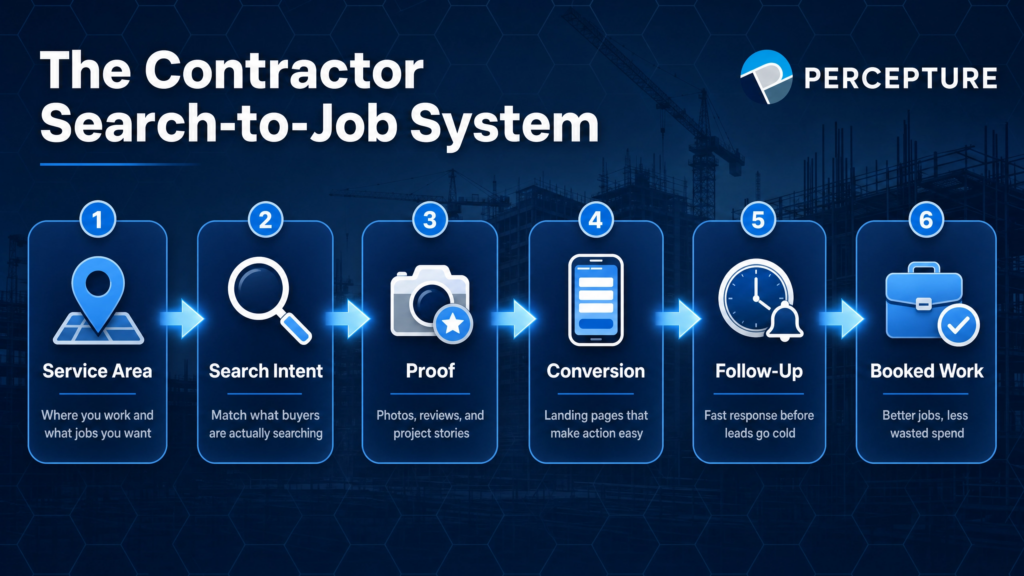
Construction firms can apply this model through a dedicated SEO guide for construction companies, while this article retains ownership of the broader process behind the strategy.
Step 4: Create useful content that builds trust
In a plan for search-led demand generation, useful content reduces the uncertainty that blocks a buyer from taking the next step. It should explain the problem, show how the work is approached, identify tradeoffs, answer objections, and make limitations clear.
For complex sales, content also supports due diligence before a conversation. The buyer may need technical guidance, comparison criteria, pricing context, proof of experience, a clear process, and an explanation of what happens after contact.
A practical construction content marketing program can connect educational questions with commercial service pages. Broader teams can use digital marketing guidance for construction companies to coordinate search with other channels.
Make the page easy to extract and evaluate
Use descriptive headings, short answers, tables, named methods, clear entity language, and visible authorship. This helps people scan the page and gives search and AI systems well-structured passages to interpret.
Step 5: Strengthen technical SEO, internal links, and authority
The technical foundation of the search program matters because a good page cannot perform if search engines cannot crawl it, understand it, or identify its relationship to the rest of the site. Technical work should address indexability, canonical signals, mobile usability, page performance, structured data, and avoidable duplication.
Internal links should connect educational pages to the next useful resource, not merely push every reader toward a sale. They also help establish topic relationships and show which page owns each subject. Teams evaluating implementation depth can review technical SEO audit considerations and the role of organic SEO services.
Authority also comes from credible third-party references, expert participation, and earned coverage. Digital PR can support discovery and corroboration when the story is useful enough to earn attention.
Step 6: Match every page to the right conversion path
A conversion path is part of the answer. A reader learning this operating approach may want a diagnostic or checklist before a sales call. A pricing reader may be ready to compare investment. A service-page visitor may need proof, fit details, and a direct conversation.
Page-to-CTA scorecard
| Page intent | Reader state | Useful next step | Weak next step |
|---|---|---|---|
| Informational | Learning | Checklist, scorecard, or related guide | Long sales form |
| Commercial | Comparing | Proof, pricing, or evaluation tool | Newsletter only |
| Transactional | Ready to act | Quote, consultation, or booking | Generic article |
| Technical | Reducing risk | Expert review or specification guide | Vague learn-more link |
| Local | Checking fit | Availability, call, or appointment | National generic page |
When implementing the process, reduce unnecessary fields but preserve the context sales needs. The right balance depends on deal value, sales capacity, qualification requirements, and the cost of handling poor-fit inquiries.
Step 7: Qualify, route, and follow up with SEO leads
In the program, a form submission is an inquiry, not automatically a qualified lead. Score fit using the factors that matter to the business, route the record to the correct owner, and define the response process.
Useful fields may include service interest, geography, organization type, project need, timing, decision role, and source page. Enrichment can add context, but the scoring model should remain understandable to the people who use it.
Connect the process to lead-generation strategy rather than letting SEO end at the form. The sales team should return acceptance, rejection, opportunity, and close information so marketing can improve targeting and page design.
How to calculate the organic traffic and leads you need
Reverse lead math makes organic search lead generation a business planning exercise. Start with the revenue target and work backward through the sales funnel.
Reverse lead math
| Required output | Formula |
|---|---|
| Customers | Revenue goal ÷ average customer value |
| Opportunities | Customers ÷ opportunity close rate |
| Sales-accepted leads | Opportunities ÷ accepted-lead-to-opportunity rate |
| Raw leads | Sales-accepted leads ÷ raw-lead acceptance rate |
| Organic sessions | Raw leads ÷ visitor-to-lead conversion rate |
Hypothetical example
Assume a $600,000 revenue goal, $50,000 average first-year customer value, 25% opportunity close rate, 40% accepted-lead-to-opportunity rate, 50% raw-lead acceptance rate, and 2% organic visitor-to-lead rate.
- 12 customers are required.
- 48 opportunities are required.
- 120 sales-accepted leads are required.
- 240 raw leads are required.
- 12,000 organic sessions are required.
This is a planning example, not a benchmark or forecast. Replace every input with your own data. If the required organic demand exceeds the realistic search market, improve conversion and acceptance, raise close rates, expand qualified coverage, or use other channels to support the target.
Compare the investment paths
Review Percepture’s pricing options when you are ready to compare the organic search, content, paid support, and broader visibility programs involved in the search-to-sales system.
Compare the workstreams, implementation requirements, and measurement plan before choosing a retainer.
The SEO Lead Leakage Map
A team learning the strategy should diagnose the open connection before publishing more pages. Score each area from zero to two: zero means disconnected, one means partial, and two means measured and operating.
SEO Lead Leakage Scorecard
| Leakage point | Common symptom | First correction |
|---|---|---|
| Demand | Impressions without useful clicks | Rebuild intent mapping and search packaging |
| Page | Visibility with weak engagement | Match the query to the correct page type |
| Trust | Readers do not take a next step | Add relevant explanations, comparison, and proof |
| Conversion | CTA views without action | Match the offer to intent and remove friction |
| Qualification | Many inquiries but few accepted | Tighten targeting, fields, and scoring |
| Handoff | Good inquiries do not progress | Set routing, ownership, and response rules |
| Attribution | Revenue cannot be tied to demand | Preserve source, landing page, CTA, and opportunity data |
11–14: The circuit is connected; focus on scale and efficiency.
7–10: Visibility is useful, but material leakage remains.
0–6: Search activity and revenue are largely disconnected.
How AI search changes SEO lead generation
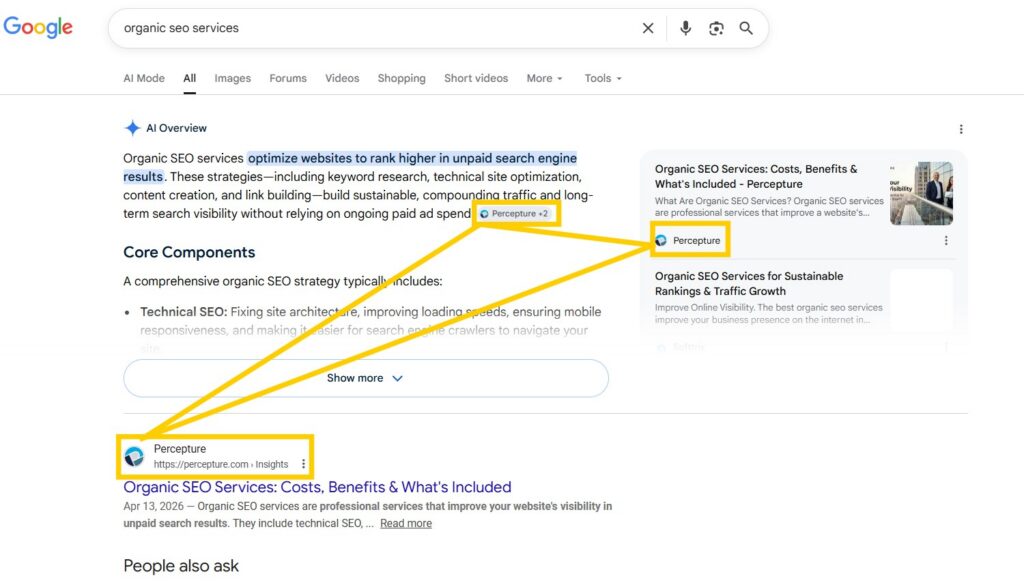
AI-search visibility can introduce a brand, cite a source, influence a comparison, generate a referral visit, or contribute to a later branded search. It does not guarantee a click or lead.
For the program to work across traditional and AI search, publish direct answers, define entities clearly, show authorship, keep core content indexable, build connected topic coverage, and provide useful evidence. Track direct referrals when available and examine assisted movement in the broader buyer journey.
Percepture’s generative engine optimization services focus on visibility across AI-assisted discovery, while the organic program retains responsibility for crawlability, page ownership, and conventional search demand.
the process, PPC, remarketing, and digital PR
Channel role comparison
| Channel | Best operating role | Primary limitation |
|---|---|---|
| SEO | Build owned visibility for recurring demand | Visibility can take time and is not guaranteed |
| Paid search | Test commercial terms and cover urgent demand | Visibility generally stops when spending stops |
| Remarketing | Return researchers to proof, pricing, or the next step | Requires a qualified audience and disciplined segmentation |
| Digital PR | Earn authority, links, and third-party validation | Coverage cannot be guaranteed |
| GEO | Improve clarity and discoverability in AI answers | A citation may not produce a visit |
Paid search can test offer language and commercial queries while organic pages develop. An omnichannel marketing strategy can then coordinate repeated buyer contact instead of making each channel compete for full credit.
Percepture calls this broader position Landscape Domination. It is not one number-one ranking. It is a search environment where owned pages, earned coverage, paid visibility, proof, and AI-readable answers tell the same credible story.
How long does SEO take to generate leads?
There is no universal timeline for SEO lead generation. Existing authority, technical condition, current rankings, competition, content quality, resources, market demand, conversion design, and sales execution can accelerate or delay results.
Early progress may appear as corrected indexation, stronger page ownership, improved query relevance, or better conversion paths. Commercial impact should be judged over a period that reflects the sales cycle and the time required to build meaningful visibility.
A 90-day SEO lead-generation plan
First-quarter operating sequence
Days 1–30: Close foundation gaps
- Define qualified-lead and rejection rules.
- Verify analytics and CRM source fields.
- Map commercial demand and assign page ownership.
- Improve priority service pages and technical blockers.
- Add relevant proof and conversion paths.
Days 31–60: Build decision support
- Publish comparison, pricing, process, and objection content.
- Add contextual internal links.
- Improve forms, scoring, routing, and remarketing audiences.
- Test commercial language through paid search where appropriate.
Days 61–90: Compound and correct
- Review queries, visibility, and page engagement.
- Compare accepted and rejected inquiries.
- Improve search packaging, proof, and CTA placement.
- Prioritize the next quarter using sales and revenue data.
The purpose of the 90-day sequence is to build the operating foundation for the system. It is not a promise that rankings, leads, or revenue will arrive within 90 days.
How to measure SEO lead generation
Measurement for SEO lead generation should follow the buyer from discovery to revenue. Preserve first source, first landing page, latest source, CTA, form, service interest, lead score, sales acceptance, rejection reason, opportunity identifier, and revenue.
The four measurement layers
Visibility
Impressions, position, click-through rate, nonbranded clicks, branded demand, AI citations, and referral sessions.
Conversion
CTA views, CTA clicks, form starts, form completions, calls, downloads, and booked meetings.
Qualification
Valid inquiries, accepted leads, fit, rejected-lead reasons, duplicates, and spam.
Revenue
Held meetings, opportunities, proposals, pipeline, customers, revenue, cost per accepted lead, and time to close.
Use attribution and analytics to connect marketing records with CRM outcomes. The purpose is not to force one channel to claim every dollar. It is to understand which touchpoints helped create and progress qualified demand.
Teams can also use an enterprise SEO ROI calculator to structure business assumptions, provided each input reflects the company’s own economics.
Common SEO lead-generation mistakes
- Starting with search volume instead of a qualified-lead definition.
- Targeting only high-intent terms and ignoring decision support.
- Publishing informational content with no relevant next step.
- Sending every page to the same contact form.
- Creating separate pages for trivial keyword variations.
- Treating every form completion as a qualified lead.
- Ignoring rejected-lead reasons and slow handoffs.
- Hiding useful proof in sales documents that searchers cannot access.
- Failing to preserve landing-page and source data.
- Reporting rankings without accepted leads, opportunities, or revenue.
A disciplined plan for SEO lead generation corrects the system before adding more publishing volume.
What credible SEO lead proof should show
When assessing claims about SEO lead generation, evaluate proof by looking for a defined starting point, the work completed, the period measured, the visibility change, the lead-quality outcome, and clear limitations. A ranking screenshot alone does not establish qualified pipeline.
- Was lead quality defined?
- Were the relevant pages and queries identified?
- Was the conversion path explained?
- Were accepted leads separated from raw inquiries?
- Was revenue or opportunity movement measured?
OPTK Networks: a focused SEO and AI-search case study
OPTK Networks is an adjacent telecom and infrastructure example. The video documents a focused search and AI-visibility effort reported as reaching a number-one result in 48 hours. It is evidence of a bounded case, not a promise that every query or market will move at the same speed.
What to inspect before applying this case to your business
- Was the target query and source page clearly defined?
- Which technical, content, internal-link, authority, and distribution actions changed?
- Was the result a point-in-time position or a period-based average?
- Did visibility influence qualified visits, meetings, opportunities, or sales use?
Frequently asked questions
How can I use SEO to generate qualified leads?
How to Generate Leads With SEO starts by defining the lead sales wants, mapping the searches those buyers use, assigning each query to the correct page, providing useful proof, matching the CTA to intent, capturing qualification context, and returning sales outcomes to marketing.
SEO lead generation without paid ads?
SEO lead generation without paid ads requires enough relevant search demand, technically sound pages, useful content, authority, intent-matched conversion paths, and reliable follow-up. Paid search can help test demand, but it is not required for every organic program.
Which keywords generate the best SEO leads?
For SEO lead generation, the best keywords combine buyer fit, clear intent, a relevant offer, and realistic commercial value. Service, provider, pricing, comparison, and quote searches can be valuable, but decision-support content often helps buyers gain confidence before acting.
How much organic traffic do I need?
To plan SEO lead generation, work backward from revenue using average customer value, close rate, opportunity rate, lead acceptance, and visitor-to-lead rate. The result is a planning estimate. Use your own data instead of a general traffic benchmark.
How long does SEO take to produce leads?
There is no fixed timeline. Current authority, technical condition, competition, market demand, resources, page quality, conversion design, and the sales process all affect the outcome.
Are SEO leads better than paid-search leads?
Neither source is automatically better. Compare accepted-lead rate, opportunity rate, customer acquisition cost, deal value, time to close, and revenue. Paid search can provide faster testing, while SEO can build owned visibility over time.
How does AI search generate leads?
AI search can introduce a brand, cite a source, influence a comparison, create a referral visit, or contribute to a later branded search. Track direct referrals and assisted movement, because an AI citation does not guarantee a click.
How should SEO leads be scored?
A process for SEO lead generation should score the factors that determine business fit, such as service need, geography, organization type, project value, timing, decision role, and disqualifying conditions. Keep the model clear enough for marketing and sales to review together.
Build your search-to-pipeline plan
If your team knows SEO lead generation but cannot see where demand is leaking, Percepture can review the connections between intent, pages, proof, conversion, qualification, and measurement.
- Define the qualified lead and commercial target.
- Identify the highest-value demand and page ownership gaps.
- Review proof, conversion, qualification, routing, and attribution.
- Choose the smallest useful execution plan.

About Bob Generale
Bob Generale is President of Percepture. He works across enterprise SEO, GEO, digital PR, content, conversion, lead intelligence, telecom, data centers, construction, and complex B2B growth systems.
Percepture was founded in 2004. Bob’s operating approach connects search visibility to buyer trust, qualification, sales response, and measurable pipeline instead of treating rankings as the final outcome.
Key takeaway: How to Generate Leads With SEO is not a ranking exercise. It is a connected operating system that moves qualified search demand through the right page, proof, CTA, qualification, response, and revenue measurement.