
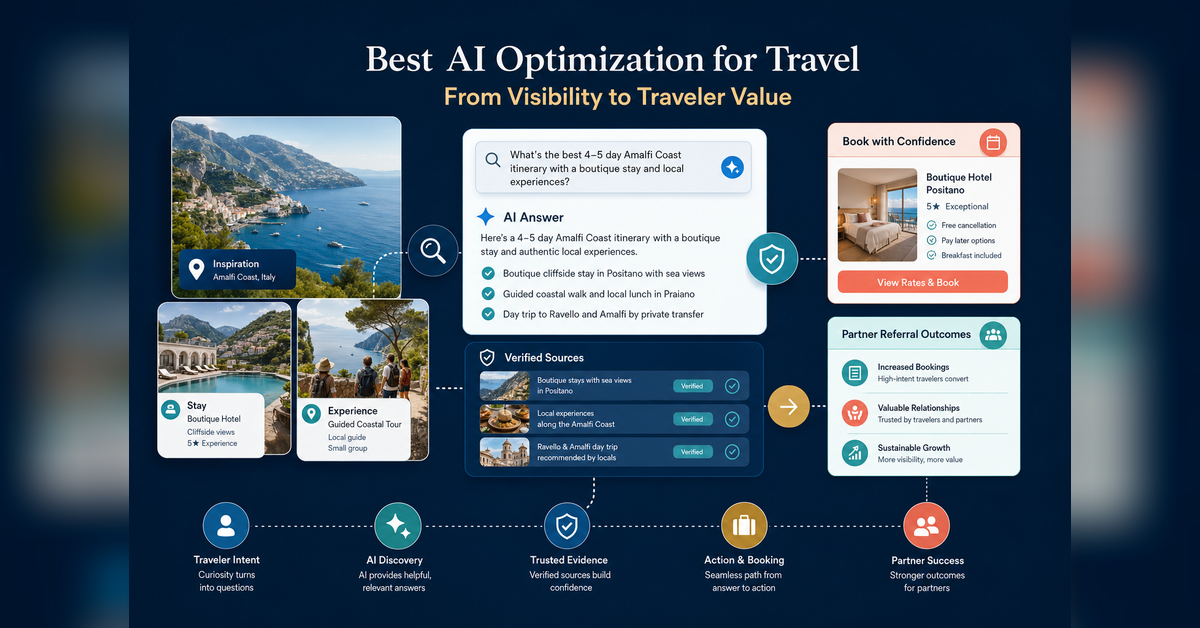

The best AI optimization for travel industry starts with accurate, crawlable travel facts; builds pages around real traveler decisions; earns third-party authority; connects recommendations to a useful booking or partner path; and measures visibility against qualified traveler action. Personalization, chatbots and agents should come after the source, search and conversion foundation is trustworthy.
Travel organizations are being sold chatbots, agents, personalization platforms, GEO services and automation. The practical question is which optimization improves a traveler decision, uses trustworthy evidence and creates measurable value.





What is the best AI optimization for travel industry?
A strong travel AI optimization program combines source truth, technical SEO, traveler-decision content, independent authority, a useful booking or partner path and outcome measurement. Add personalization, chatbots or agents only when that foundation is accurate, accessible and governed.
The executive summary
Fix the source
Assign owners to names, locations, rooms, routes, hours, prices, policies, accessibility details and availability rules.
Preserve SEO
AI search optimization does not replace SEO; it expands the retrieval surface.
Answer decisions
Build around questions that help a traveler compare fit, timing, access, value and next steps.
Earn authority
Third-party editorial authority matters because travel decisions are trust-heavy.
Connect action
Every visibility initiative needs a booking, inquiry, ticketing, itinerary or partner-referral path.
Govern automation
Optimization should reduce decision friction without creating privacy friction.
This guide helps travel organizations decide which AI optimization deserves priority and whether it is the right priority for their operating model. Use specialist resources for implementation depth, including Percepture’s generative engine optimization services, enterprise SEO and travel and tourism marketing capabilities.
Who this guide is for
Destinations and tourism organizations
DMOs and CVBs that need official facts, itineraries, events, accessibility information, partner referrals and measurable destination demand.
Hotels, resorts and lodging groups
Property teams that need accurate room, policy, experience and booking information to appear consistently across search, AI answers and direct-booking paths.
Tours, attractions and travel advisors
Organizations that need expert-led decision content, qualified inquiries, clear availability and a stronger path from discovery to consultation or booking.
Airlines, cruise, transport and marketplaces
Operators managing routes, schedules, policies, inventory, disruption information and high-volume customer journeys across several systems and markets.
What AI optimization for travel means
AI optimization for travel improves how travel facts, experiences and offers are found, interpreted, recommended, personalized and converted across search engines, AI answers, websites, booking paths and operational systems. The travel AI optimization is therefore a connected operating system, not a single tool.
For the travel AI optimization, SEO handles crawlability, indexing, relevance and organic visibility. GEO improves retrieval, citation and accurate representation in generated answers. Answer engine optimization makes direct responses clear. Content marketing supplies useful decision evidence, while digital PR creates independent corroboration.
Conversion work turns attention into a booking, inquiry or partner action. Personalization narrows choices using appropriate context. Agents can support or complete tasks under defined permissions. Each discipline has a job, and none can repair every weak point alone.
What makes an AI strategy “best”
“Best” means highest defensible value for this travel business—not the longest feature list. The travel AI optimization is matched to the business model and the next traveler decision.
Eight questions for evaluating the travel AI optimization
Traveler value
Does it improve a real traveler decision?
Source control
Does the organization control or maintain the underlying facts?
Retrieval
Can search and AI systems access the supporting evidence?
Corroboration
Is the promise supported by independent authority?
Next action
Can the traveler book, inquire, save, compare or reach a partner?
Fulfillment
Can operations deliver what the content promises?
Measurement
Can the team connect the travel AI optimization with qualified action and value?
Governance
Is data use lawful, proportionate and controlled?
For most organizations, the sequence for the travel AI optimization is source truth, crawlability, traveler-decision content, third-party authority, conversion, measurement, personalization and then automation. A chatbot cannot fix an unindexable site, inconsistent facts, weak authority or a broken booking path.
Score the optimization before buying another AI tool
Use Percepture’s strategy process to determine the travel AI optimization by mapping the outcome, traveler decisions, source ledger, crawl controls, prompt families, authority gaps, conversion path, measurement plan and first 90 days.
Build a Travel AI Optimization Priority MatrixProof of AI-search and travel experience
Percepture’s category snapshots show experience competing around GEO and AI-search terms. No ranking screenshot is a guarantee; dated proof and transparent limitations make it useful. Results can vary by date, query wording, market, location, model and personalization.
Dated proof that Percepture competes inside the category it explains
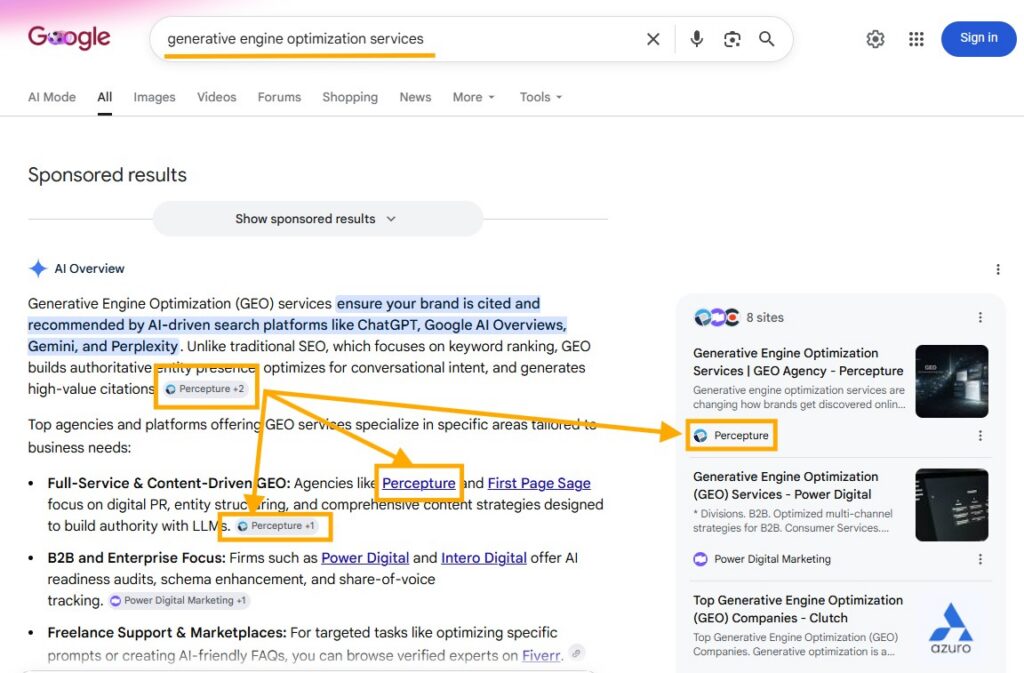
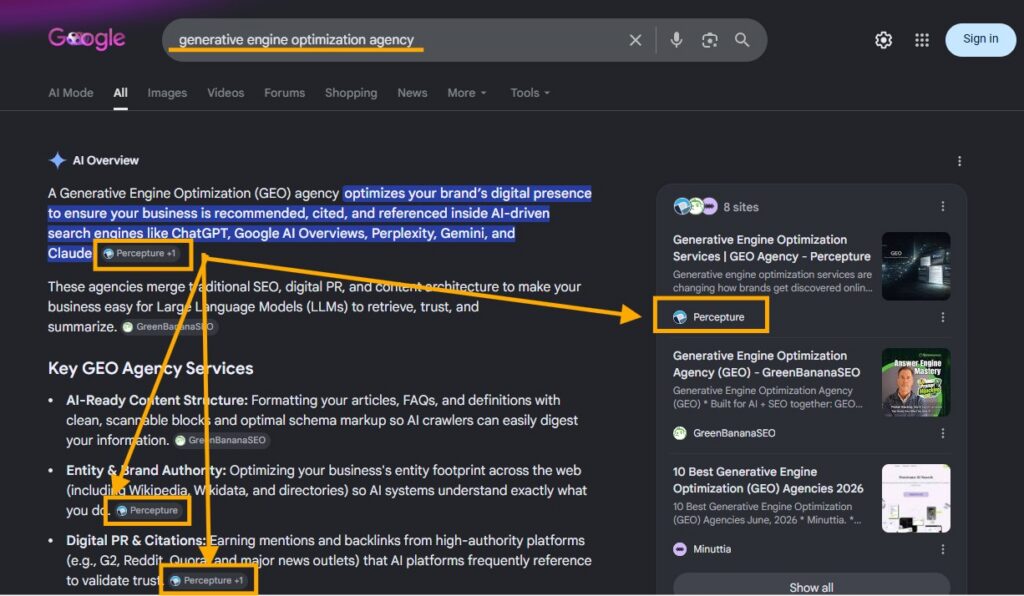
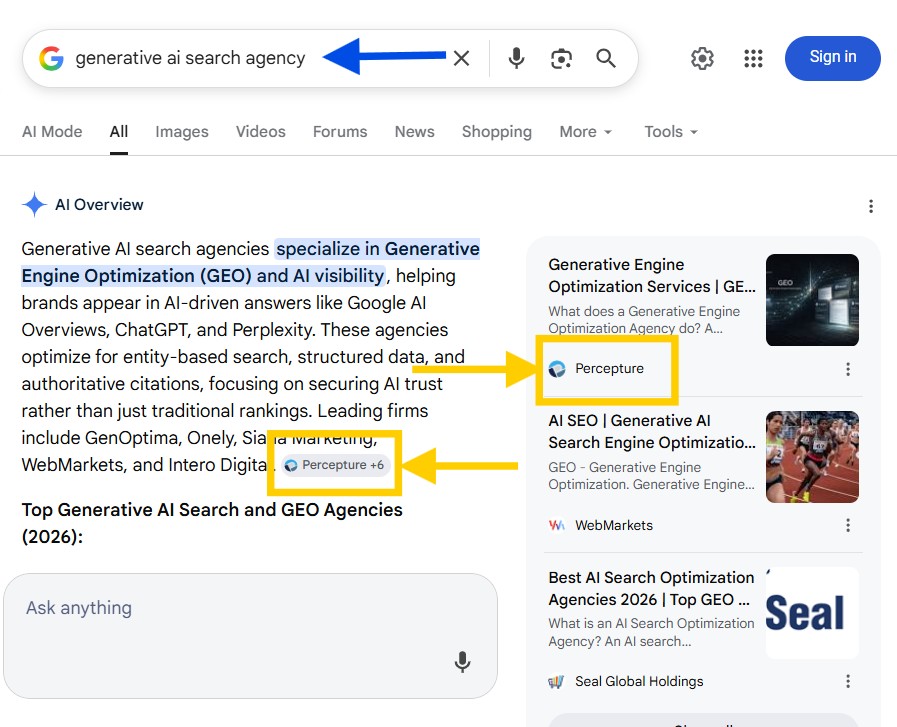
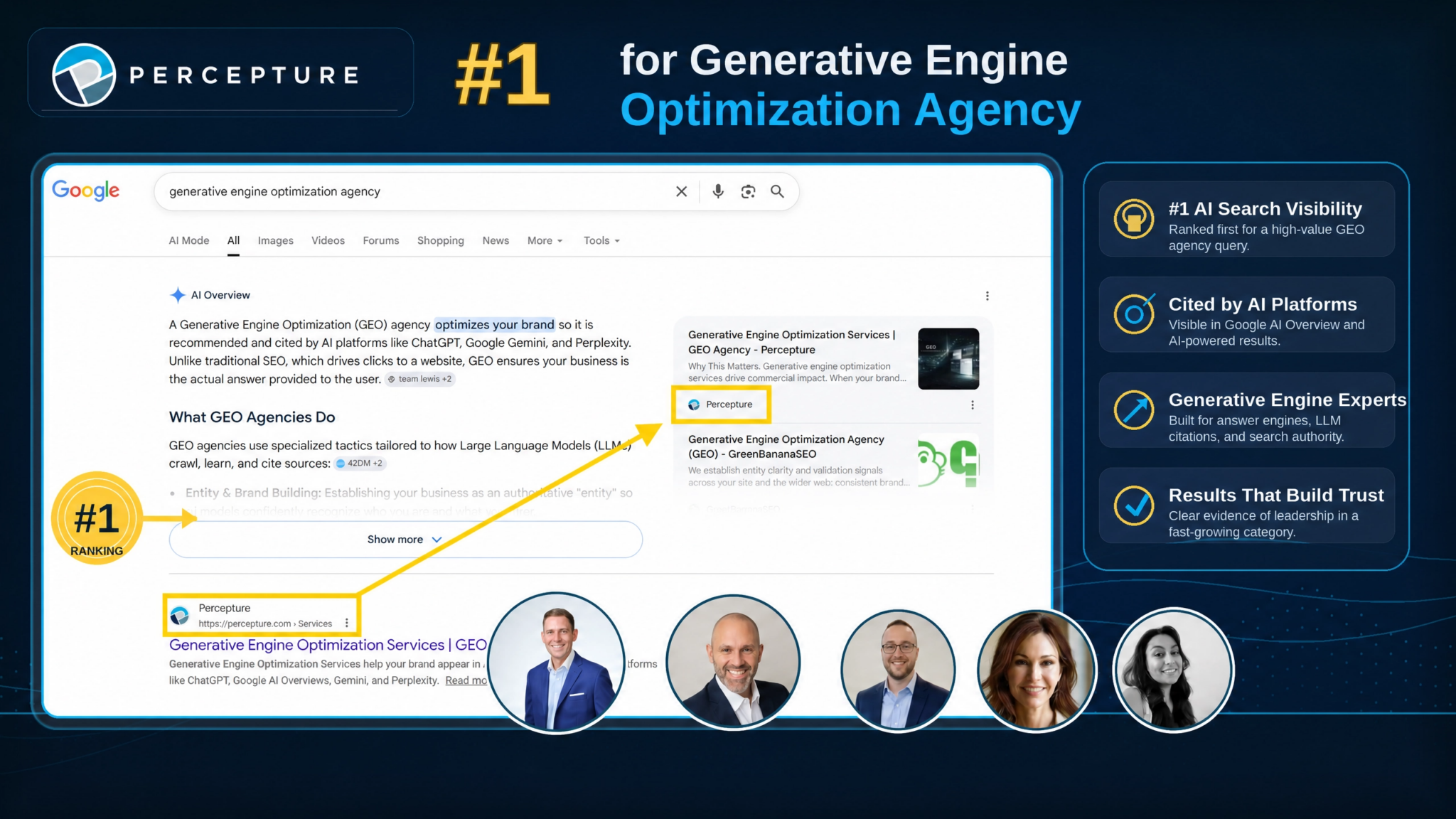
These screenshots document visibility when captured. They demonstrate category experience rather than a future ranking outcome.
Travel storytelling and independent recognition

The Amazon and Phantom Ranch campaign produced 378 stories, including 357 online stories and 21 broadcast stories, with an audience reported at more than 70 million viewers. The work also received HSMAI Silver recognition. This is travel authority and storytelling proof, not direct AI-search attribution.
Review the Amazon and Phantom Ranch case study.
The Travel AI Visibility-to-Value System
The Travel AI Visibility-to-Value System is Percepture’s eight-layer methodology for turning authoritative travel information into search visibility, AI recommendations and measurable traveler action. It gives leadership a practical way to evaluate the travel AI optimization without starting with a vendor’s feature list.
| Layer | Operating question | Required output |
|---|---|---|
| 1. Outcome | Which traveler action matters? | Value and Decision Map |
| 2. Source Truth | Which facts are authoritative? | Travel Source Ledger |
| 3. Retrieval | Can systems access the evidence? | Technical Access Plan |
| 4. Decision Coverage | Which questions must be answered? | Prompt and Page Architecture |
| 5. Authority | Who corroborates the promise? | Trust and Citation Plan |
| 6. Experience | Can the traveler judge fit? | Content and UX System |
| 7. Action | Can the traveler act? | Conversion Path |
| 8. Learning | Which visibility creates value? | Measurement and Governance Loop |
No AI optimization initiative enters scale until its source owner, target traveler decision, conversion path and measurement method are visible. Travel AI optimization starts with source truth and ends with traveler action.
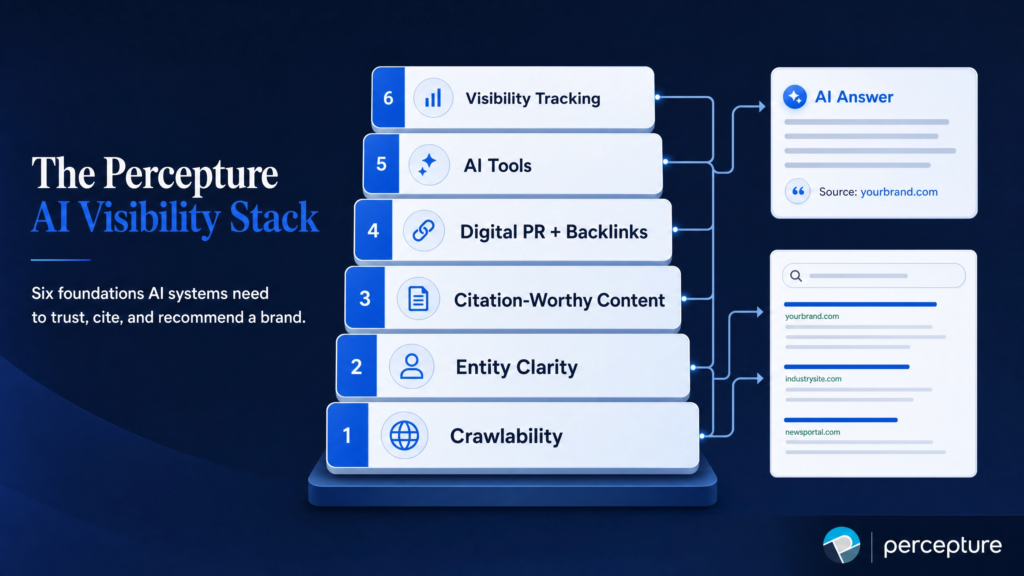
Which AI optimization creates value
The travel AI optimization usually begins with a foundation that supports several later use cases. Source accuracy and technical access can improve traditional search, generated answers, website support and downstream automation at the same time.
Optimization by business goal
| Business goal | Best first move | Useful KPI |
|---|---|---|
| AI-answer visibility | Source truth plus SEO and GEO | Inclusion, citation and accuracy |
| Direct bookings | Decision pages plus CRO | Qualified booking value |
| DMO partner referrals | Official itinerary and partner architecture | Qualified partner clicks |
| Inquiry quality | Specialist content and clear qualification | Qualified inquiry rate |
| Service efficiency | Maintained knowledge and support routing | Resolution and escalation |
| International growth | Localized entities and market pages | Qualified market action |
Best AI optimization for travel industry: comparison and investment framework
There is no honest universal price for the travel AI optimization. Investment depends on the number of brands or properties, CMS condition, languages, source quality, content gaps, booking integrations, analytics, authority work and governance needs.
| Optimization type | Main job | Prerequisite | Common failure mode |
|---|---|---|---|
| Technical SEO and entities | Improve access and clarity | Site control | Adding schema without useful pages |
| GEO and AI search | Improve retrieval and citation | Reliable sources and authority | Publishing thin prompt-chasing pages |
| Decision content | Answer traveler questions | First-hand expertise | Commodity generated copy |
| Digital PR | Create independent corroboration | Relevant evidence or stories | Counting placements without strategy |
| CRO and booking | Turn attention into action | Offer clarity and tracking | Generic landing pages |
| Personalization | Reduce choice friction | Appropriate, consented context | Intrusive or irrelevant targeting |
| Chatbots and agents | Answer, route or complete tasks | Maintained knowledge and controls | Automation before governance |
AI tools are implementation choices. Selecting the travel AI optimization begins with the traveler decision, source and value model. Teams needing conversion support should connect this work with conversion rate optimization and customer journey analysis.
How priorities change by travel business
The industry does not have one AI stack because the source, inventory, conversion and accountability model changes by business type. The travel AI optimization must reflect those differences.
| Business model | Priority sources and pages | Primary action |
|---|---|---|
| DMO or CVB | Official destination facts, seasons, events, itineraries, partners and accessibility | Planning or partner referral |
| Hotel or resort | Property, room, policy, experience, review and booking information | Direct booking |
| Tour or attraction | Routes, departures, duration, inclusions, safety and availability | Booking or inquiry |
| Agency or advisor | Specialty, advisor expertise, sample itineraries and process | Qualified consultation |
| Airline, cruise or transport | Routes, schedules, cabins, disruptions, access and policy | Booking or service |
| OTA or marketplace | Canonical inventory, reviews, comparison, fees and freshness | Transaction |
| Corporate travel | Policy, negotiated rates, preference, duty of care and expense | Compliant booking |
Hotel teams evaluating the travel AI optimization can go deeper with Percepture’s guides to choosing a hotel SEO agency, implementing technical SEO for hotels and coordinating paid demand through a hotel PPC agency.
How travel brands improve AI search presence
The travel AI optimization begins with the travel brand owning its source of truth. Create a maintained ledger for official names, locations, room or route details, schedules, prices, policies, accessibility, contacts, experts, review sources, owners and refresh dates.
Then audit robots rules, CDN behavior, canonical tags, sitemaps, indexability, internal links, server-rendered text, JavaScript dependencies, page performance and language signals. Important facts should not exist only inside images, PDFs or booking widgets.
Google’s current guidance says established SEO practices remain relevant to its AI features. It does not describe extra technical requirements or special AI schema. Pages still need to be indexed, eligible for snippets and supported by useful text, media, internal links and accurate structured data. These requirements remain foundational to the travel AI optimization. Review Google’s official AI features guidance.
OpenAI distinguishes OAI-SearchBot for ChatGPT search, GPTBot for potential model training and ChatGPT-User for user-triggered access. A site can allow OAI-SearchBot for search while separately controlling GPTBot for training. Review OpenAI’s crawler documentation.
Why SEO still matters
AI search optimization does not replace SEO; it expands the retrieval surface. The travel AI optimization still depends on accessible pages, clear entities, relevant internal links, evidence, authority and a strong user experience.
Google does not describe a secret GEO markup. Relevant structured data should match visible content and eligible page types. Google also says no new AI text file is required, so teams pursuing the travel AI optimization should not claim that llms.txt improves rankings or citations without evidence.
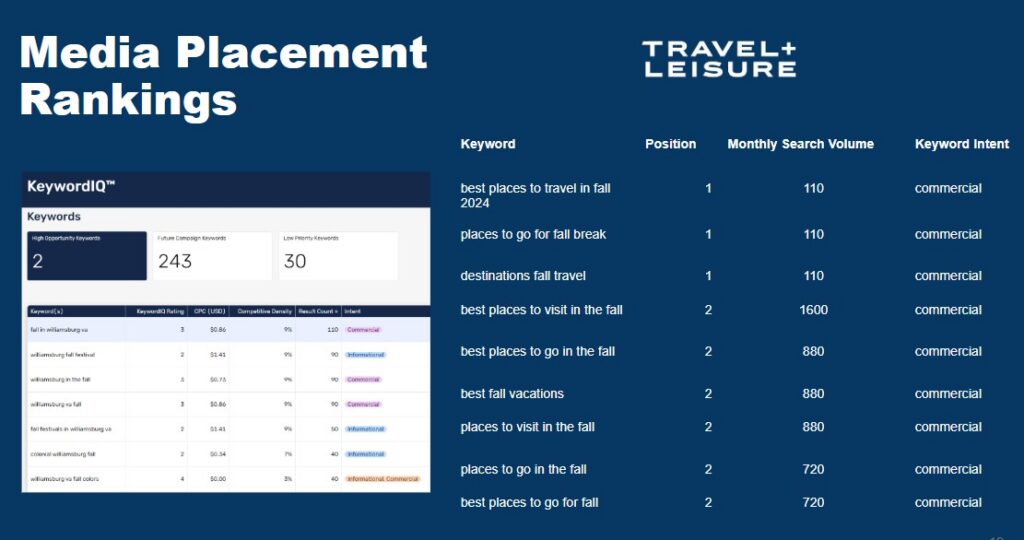
A technical review can use the same disciplines described in Percepture’s technical SEO audit guide and organic SEO services guide.
Build prompt and page architecture
A prompt deserves a page only when it helps a traveler make a distinct decision. Do not create a separate page for every prompt variation.
Useful prompt families for the travel AI optimization combine destination and origin, traveler type, occasion, season, duration, route, budget, comparison, accessibility, policy, availability and booking preference. Examples include connecting-suite requirements for a multigenerational trip, accessible tour options, shoulder-season itineraries and the value of an advisor for a complex route.
Every cluster should name the intent, entity, source owner, supporting evidence, next action, refresh date and measurement method. The travel AI optimization consolidates overlapping questions into strong decision pages instead of creating a thin page for each wording change.
Combine content, PR and authority
Owned content states the fact. SEO makes it retrievable. Digital PR creates corroboration. Media coverage and reviews expand entity relationships. Internal links connect expertise. Conversion pages capture demand.

Non-commodity travel content uses first-hand itineraries, named experts, precise property or route details, constraints, comparisons, accessibility information, local voices, logistics, policies, original media and case evidence. Generic listicles and copied destination descriptions add little decision value.

A brand cannot control every answer, but it can improve the available evidence. Digital PR should earn relevant authority, not merely count placements. The travel AI optimization relies on a source ecosystem that agrees on names, facts, expertise and experience.
Connect visibility to booking
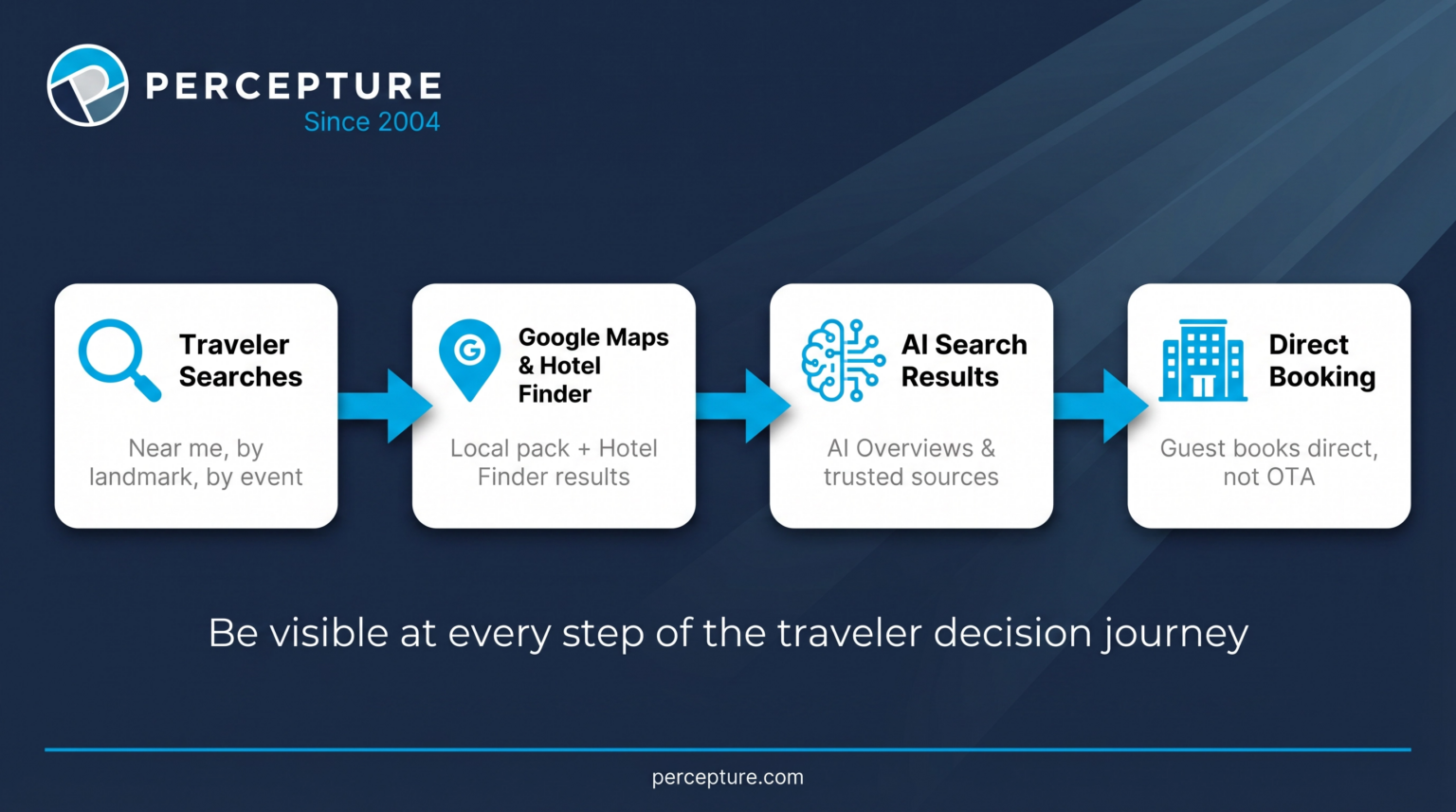
AI visibility without authority is fragile; authority without conversion is unfinished. The travel AI optimization connects useful recommendations with booking, ticketing, availability, itinerary saving, partner referral, consultation, trip briefs, meeting inquiries or human support.
A DMO, hotel, advisor and tour operator should not share one definition of conversion. Measurement plans for the travel AI optimization should reflect the actual operating model and preserve source information across domains and booking systems.
Strong pathways need mobile performance, accessible interfaces, clear next steps, privacy controls and realistic inventory or response expectations. Percepture’s attribution and analytics services help connect visibility evidence with downstream activity, while omnichannel marketing coordinates the surrounding customer journey.
Use personalization and agents responsibly
Personalization should use appropriate context to reduce repeated work and improve relevance. It should not infer sensitive traits, obscure terms, manufacture urgency or retain unnecessary information.
A travel assistant should use maintained sources, link to evidence, admit uncertainty and escalate to a person. A travel chatbot should know when it does not know.
Agent readiness requires current inventory, permissions, identity and payment controls, logs, reversible steps and confirmation before consequential actions. The travel AI optimization follows a foundation-first sequence, adds controlled assistance second and expands automation only after the evidence supports it.
Score readiness before scaling
A practical score keeps the travel AI optimization tied to value and operational readiness. A flashy initiative with no source owner, action or measurement should score poorly.
| Factor | Maximum points |
|---|---|
| Traveler decision value | 15 |
| Business value | 15 |
| Source-data readiness | 15 |
| Search and AI opportunity | 10 |
| Authority and proof readiness | 10 |
| Conversion readiness | 10 |
| Operational capacity | 10 |
| Measurement clarity | 10 |
| Privacy, safety and governance | 5 |
- 85–100: proceed with a controlled implementation.
- 70–84: proceed after closing named gaps.
- 55–69: run a limited pilot or foundation project.
- Below 55: repair the foundation before scaling automation.
Measure AI visibility and value
Citation share is not market share. Results vary by engine, model, session, location and date, and AI referrals are one part of a longer travel decision.
The AI Visibility Evidence Ladder
| Level | Evidence |
|---|---|
| 1. Access | Crawl and index eligibility |
| 2. Retrieval | Search or prompt inclusion |
| 3. Citation | Named or clickable source |
| 4. Accuracy | Correct facts and relationships |
| 5. Engagement | Qualified visit or partner click |
| 6. Action | Inquiry, save, ticket or booking |
| 7. Value | Revenue, partner value or pipeline |
| 8. Incrementality | Controlled or modeled lift |
To measure the travel AI optimization, track a fixed prompt set by date, market, product or model, query, brand inclusion, competitors, citations, accuracy and context. Connect that record to Search Console, analytics, CRM, booking systems, call tracking and partner referrals.
Separate observed, attributed, partner-reported, modeled, assisted and unknown evidence. That discipline helps leadership judge whether the travel AI optimization is creating business value or merely producing screenshots.
Choose a partner: cost, timeline and accountability
Do not publish or accept one universal price for the travel AI optimization. Cost changes with source condition, technical debt, content depth, authority needs, markets, languages, integrations, monitoring and governance.
Illustrative planning timelines
| Scope | Planning timeline |
|---|---|
| Visibility and source diagnostic | 3–6 weeks |
| Priority fixes and prompt baseline | 8–12 weeks |
| Full visibility-to-value system | 4–6 months |
| Multi-brand, multilingual or agent program | 6–12+ months |
These ranges are planning guides, not delivery guarantees.
When choosing a provider for the travel AI optimization, ask which outcomes they prioritize, who owns each source, which prompts and engines they test, how they integrate SEO, GEO, PR and CRO, how accounts and data are controlled, how errors are corrected and what the first 90 days will deliver.
Buy software for a defined job. Hire expertise for decisions, integration and accountability. Buyers can also review Percepture’s GEO pricing and package guidance and broader pricing options.
Launch a 90-day program
Days 1–30: truth and baseline
Choose one outcome, define traveler decisions, audit entities and facts, assign owners, review crawl controls, map pages and prompts, baseline visibility and conversions, and score which initiative deserves priority.
Days 31–60: build the system
Repair technical blockers, consolidate duplicates, improve priority pages, add expertise, strengthen internal links, improve booking or partner paths, add valid structured data and begin authority outreach.
Days 61–90: test and govern
Monitor prompts and citations, validate facts, review analytics, track qualified actions, improve weak pages and test one controlled personalization or support use case when the foundation is ready.
Ninety days should create a trustworthy visibility-to-value system, not a promise that every AI engine will cite the brand. The goal is to establish whether the travel AI optimization can move from access and retrieval toward accurate recommendations and useful action.
Avoid common mistakes
The most expensive mistake when pursuing the travel AI optimization is automating an unreliable source or a broken customer journey.
- Launching a chatbot before fixing the website foundation.
- Treating generated copy as the complete strategy.
- Blocking crawlers at the CDN while expecting search visibility.
- Blocking OAI-SearchBot while expecting ChatGPT search access.
- Claiming that llms.txt improves rankings without evidence.
- Inventing special AI schema.
- Creating one page for every prompt variation.
- Hiding important facts in images, PDFs or widgets.
- Publishing inconsistent names, hours, prices or policies.
- Operating without a source owner or refresh date.
- Using undated screenshots or undocumented prompt tests.
- Confusing citation with conversion.
- Using sensitive data or invasive personalization.
- Deploying agents without permissions, logs or human escalation.
- Attributing integrated outcomes to one tactic.
- Guaranteeing rankings, citations or bookings.
Why Percepture has a point of view
Percepture’s travel E-E-A-T is a chain: real travel work, category visibility, independent recognition, named expertise and transparent limitations. That combination informs how Percepture evaluates the travel AI optimization.

The approved Greater Williamsburg evidence includes more than 300 million PR impressions, 100 stories, 18% organic growth and more than 100,000 new organic visitors. These were integrated outcomes rather than results from one isolated channel and help frame how the travel AI optimization should be evaluated.
Review the evidence behind the strategy
Compare Percepture’s AI-search, travel SEO, digital PR and integrated case experience before deciding who should lead the travel AI optimization.
Explore Percepture Case StudiesFrequently asked questions
What is AI optimization for travel?
AI optimization for travel improves how accurate travel facts, experiences and offers are found, interpreted, recommended and converted across search engines, generated answers, websites and booking paths. The travel AI optimization combines source governance, SEO, GEO, decision content, authority, conversion and measurement. Personalization or agents can follow when the supporting sources and controls are reliable.
What is the best AI optimization for travel industry?
The best AI optimization for travel industry begins with authoritative source data, crawlable pages, useful traveler-decision content, independent corroboration and a measurable booking or partner path. The right priority varies by business model. A hotel may focus on room and policy truth, while a DMO may focus on official destination information and qualified partner referrals.
Is AI-search optimization different from SEO?
It extends SEO rather than replacing it. SEO supports crawling, indexing, relevance, internal linking and authority. The travel AI optimization adds a stronger focus on retrieval, citation, entity clarity and accurate representation inside generated answers. Both depend on useful pages and accessible evidence.
How does AI search affect tourism and travel brands?
AI search can summarize choices before a traveler visits a website. That raises the value of accurate source information, clear comparison content and third-party authority within the travel AI optimization. It also makes measurement more complex because a recommendation may influence a later branded search, partner click, call or direct booking rather than creating an immediate referral.
Does a travel website need special AI schema?
No special AI schema is described in Google’s official guidance. Use structured data that matches visible content and an eligible page type, such as Organization, Person, Article, Event, Offer or an appropriate lodging type. Schema should clarify genuine content; it cannot replace weak pages or inaccessible facts.
Should travel brands allow OAI-SearchBot and GPTBot?
The choice should follow the organization’s search and training policies. OpenAI identifies OAI-SearchBot for ChatGPT search and GPTBot for potential model training, so a site can allow search access while separately controlling training access. Teams should also check CDN and robots behavior to ensure the implemented policy matches the intended one.
Are chatbots the best first AI investment?
Usually not when source data, indexing, content or booking paths are weak. A chatbot can repeat inconsistent facts faster, but it cannot repair the underlying journey. The travel AI optimization starts with maintained sources, technical access, decision pages, authority and measurement. Add a chatbot when it can cite reliable information, acknowledge uncertainty and escalate to a person.
How long does travel AI optimization take?
A focused source and visibility diagnostic for the travel AI optimization may take three to six weeks. Priority repairs and a prompt baseline may take eight to twelve weeks, while a broader visibility-to-value program may take four to six months. Multi-brand, multilingual or agent programs can take longer. These are planning ranges rather than guarantees.
Connect AI visibility to a traveler action the business can measure
Percepture can assess source truth, technical access, decision content, independent authority, booking or partner pathways and measurement to identify the right travel AI optimization priorities for your operating model.
- Priority traveler decisions and markets
- Source, crawl and entity gaps
- AI-search and authority opportunities
- Booking, referral and measurement path

Key takeaway: the best AI optimization for travel industry starts with accurate sources, clear traveler decisions, independent authority and a measurable action. Automation should follow a trustworthy foundation, not substitute for it.