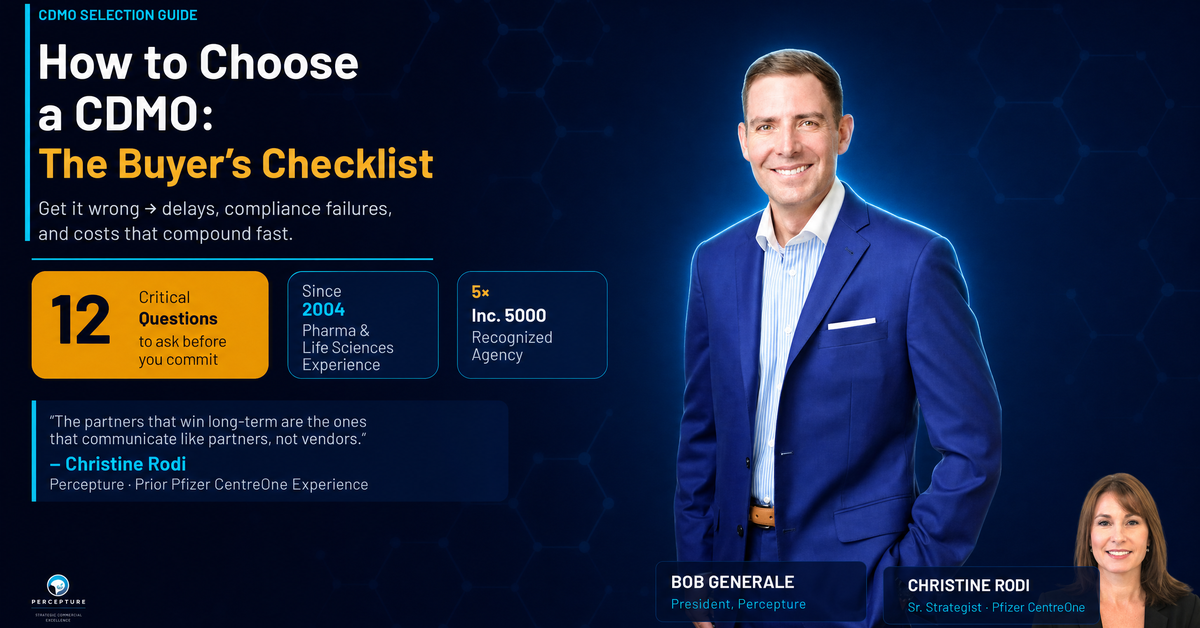

Choosing a contract development and manufacturing organization is one of the highest-stakes decisions a pharma or biotech team will make. Get it right, and you gain a partner who accelerates your timeline, protects your quality, and scales with your growth. Get it wrong, and you face delays, compliance headaches, and costs that compound fast.
The challenge? There are hundreds of CDMOs in the market. Some specialize in small molecules. Others focus on biologics, cell and gene therapy, or sterile injectables. A few claim to do it all. Sorting through the noise takes more than a Google search. It takes a structured process.
This guide walks you through exactly how to choose a CDMO, step by step. You’ll find a practical scorecard, a buyer-priority matrix, and a 12-question checklist you can use before you commit. Whether you’re a procurement lead, a CMC director, or a business development executive, this is the framework that separates confident decisions from costly mistakes.
If you’re still getting up to speed on the basics, start with our guide on what is a CDMO before diving in here.
Built for technical, regulated B2B decisions


How Do You Choose the Right CDMO?
The short answer: you choose a CDMO based on fit, not fame.
The biggest name in the industry is not always the best partner for your program. A global CDMO with 50 sites might deprioritize your Phase I project in favor of a blockbuster commercial contract. A mid-sized specialist might give you dedicated attention, faster timelines, and deeper expertise in your exact modality.
The right CDMO is the one that matches your:
- Program requirements (molecule type, dosage form, phase)
- Timeline and risk tolerance
- Quality and regulatory expectations
- Budget and long-term growth plans
Fit matters more than size. That’s the principle that should guide every step of your selection process.
Choose on fit, evidence and operating discipline
Match molecule, modality, dosage form, phase and transfer requirements before comparing price.
Review inspection history, repeat findings, documentation and validation discipline.
Confirm utilization, protected slots, scale-up paths, redundant equipment and supply resilience.
Define the project manager, reporting cadence, escalation paths and change-order rules.
A working guide for the CDMO buying committee
This framework is designed for procurement leaders, CMC teams, quality and regulatory leaders, biotech founders, business-development executives and private-equity operating teams comparing contract manufacturers.
Start With Your Program, Phase, and Modality
Before you evaluate a single CDMO, get clear on what you actually need.
Ask yourself:
- What is the molecule type? (small molecule, biologic, ADC, cell therapy, gene therapy)
- What dosage form do you need? (oral solid, sterile injectable, lyophilized, topical)
- What phase are you in? (preclinical, Phase I, Phase II, Phase III, commercial)
- What’s your timeline? (standard, accelerated, emergency)
- What geographies matter? (US, EU, Asia-Pacific, global)
These answers shape everything. A partner that excels at commercial-scale oral solids may have no experience with early-phase sterile injectables. A partner with deep FDA expertise may lack EMA or PMDA relationships.
Take the 12 questions into your first shortlist call
Use the checklist to compare technical fit, quality history, capacity, governance, supply risk and commercial terms on the same basis.
Review the 12-question checklistEvaluate Technical Fit and Transfer Readiness
Technical fit is the foundation. If a manufacturer can’t handle your molecule, nothing else matters.
Process Fit
Does the manufacturer have experience with your specific manufacturing process? For biologics, that means cell line development, upstream and downstream processing, and fill-finish. For small molecules, it means synthesis, purification, and formulation. Ask for case studies or references from similar programs.
Formulation Fit
Can they develop and optimize your dosage form? Some manufacturers specialize in complex formulations, modified release, nanoparticles, or lipid nanoparticles. Others focus on standard tablets and capsules. Match your formulation complexity to their track record.
Analytical Capabilities
Strong analytical development is non-negotiable. Your partner should have validated methods for identity, purity, potency, and stability. Ask about their analytical lab capacity, instrumentation, and turnaround times.
Tech Transfer Readiness
How smoothly can they receive your process from a previous partner or your internal team? Experienced partners have dedicated tech transfer teams, clear SOPs, and a history of successful transfers. Ask how many tech transfers they’ve completed in the last two years, and how many failed.
Review Quality Systems and Regulatory History
Quality is where outsourcing relationships succeed or fail. A single 483 observation can delay your program by months. A warning letter can derail it entirely.
Inspection History
Request the manufacturer’s FDA, EMA, and other regulatory inspection history for the past five years. Look for patterns. One minor observation is normal. Repeated findings in the same area, data integrity, cleaning validation, or environmental monitoring, are red flags.
GMP Readiness
Is the facility current Good Manufacturing Practice (cGMP) compliant for your product type? Confirm that their GMP status covers your specific dosage form and phase. A facility approved for commercial oral solids may not be qualified for clinical-phase sterile injectables.
Documentation Quality
Ask to see sample batch records, deviation reports, and change control documentation. High-quality partners have clean, consistent documentation. Sloppy records signal deeper problems.
Validation Discipline
How rigorous is their approach to process validation, cleaning validation, and equipment qualification? Ask about their validation master plan and how they handle revalidation after changes.
According to the NIH SEED Office, regulatory compliance and quality systems are among the top factors that determine outsourcing partnership success, especially for early-stage sponsors navigating their first IND filing.
Check Capacity, Scalability, and Supply Resilience
Capacity constraints are one of the most common reasons outsourcing relationships break down. A partner who can handle your Phase I batches may not have room for Phase III or commercial scale.
Questions to ask:
- What is your current capacity utilization?
- How far out is your production schedule booked?
- Can you guarantee capacity for my program through commercial launch?
- What’s your lead time for scheduling new batches?
- Do you have backup equipment or redundant lines?
Scalability is equally important. Your manufacturing partner should have a clear path from clinical to commercial manufacturing, ideally within the same site or network. Transferring to a new facility mid-program adds risk, cost, and time.
Supply resilience matters more than ever. Ask about their raw material sourcing, supplier qualification, and inventory policies. A partner with single-source suppliers for critical excipients is a liability.
Assess Communication, Governance, and Project Management
Technical capability gets you in the door. Communication keeps the relationship working.
The best partners assign dedicated project managers, hold regular status calls, and provide transparent reporting. They escalate issues early, not after they’ve become crises.
What to look for:
- Dedicated project manager with relevant experience
- Clear escalation paths for quality, timeline, and cost issues
- Regular reporting cadence (weekly, biweekly, or milestone-based)
- Defined governance structure for decision-making
- Responsiveness during the RFP and due diligence process
“The partners that win long-term engagements are the ones that communicate like partners, not vendors. They tell you what’s going wrong before you have to ask. That transparency builds trust, and trust is what keeps programs on track when things get complicated.”
If a prospective partner is slow to respond during the sales process, expect worse once you’re a customer.
Balance Cost, Value, and Long-Term Fit
Price matters, but it’s rarely the deciding factor for sophisticated buyers.
The lowest-cost bid often becomes the most expensive when you factor in delays, quality failures, and rework. A slightly higher price from a partner with a strong track record can save millions in avoided setbacks.
How to evaluate cost:
- Compare total cost of ownership, not just per-batch pricing
- Factor in tech transfer fees, change order costs, and timeline risk
- Ask about pricing models (fixed, cost-plus, milestone-based)
- Understand what’s included vs. what triggers additional charges
Long-term fit is the final filter. If you’re selecting a partner for a single Phase I batch, flexibility matters most. If you’re choosing a partner for a decade-long commercial relationship, cultural alignment, financial stability, and strategic vision matter just as much as technical capability.
The Percepture CDMO Fit Score
When comparing candidates, structure your evaluation across these eight dimensions:
How to use it: Score each candidate from 1-10 across all eight dimensions. Favor the partner with the strongest balanced profile, then validate the score through documents, references and site-level diligence.
Use a Practical Buyer Scorecard
A structured scorecard helps you compare candidates objectively. Here’s a framework you can adapt:
| Selection Factor | Why It Matters | What to Ask | Green Flag |
|---|---|---|---|
| Technical Fit | Ensures they can handle your molecule and process | “Show me similar programs you’ve completed.” | Case studies with matching modality and phase |
| Quality Systems | Protects your regulatory standing | “Share your last 3 inspection reports.” | Clean history, no repeat findings |
| Regulatory Track Record | Reduces filing risk | “How many INDs/NDAs have you supported?” | Multiple successful filings in your target market |
| Capacity & Scalability | Guarantees room to grow | “What’s your utilization rate and expansion plan?” | Dedicated capacity commitment in writing |
| Communication & Governance | Keeps projects on track | “Who will be my project manager?” | Dedicated PM with relevant experience |
| Supply Resilience | Avoids disruptions | “How do you qualify and monitor suppliers?” | Dual-sourced critical materials |
| Proof & Reputation | Validates claims | “Can I speak with 3 recent clients?” | Strong references, visible case studies |
| Cost & Value | Ensures sustainable partnership | “What’s included in your pricing?” | Transparent, all-in pricing with clear change order policy |
Scoring tip: Weight each factor based on your program’s priorities. A Phase I oncology program might weight technical fit and speed highest. A commercial launch might prioritize capacity and supply resilience.
Buyer-Priority Matrix: What Different Buyers Prioritize
Not every buyer values the same things. Here’s how priorities shift by buyer type:
| Buyer Type | Top Priority | Secondary Priority | Common Mistake |
|---|---|---|---|
| Early-stage biotech | Speed to IND | Flexibility, cost | Choosing the cheapest option without checking quality history |
| Mid-stage biotech | Scalability | Regulatory expertise | Selecting a partner who can’t support Phase III or commercial |
| Large pharma | Capacity guarantee | Global footprint | Over-relying on existing relationships without competitive evaluation |
| Virtual pharma | Full-service capability | Communication | Underestimating the importance of project management |
| Private equity portfolio company | Speed, cost efficiency | Exit-readiness | Ignoring quality risks that surface during due diligence |
Use this matrix to calibrate your own evaluation criteria.
Questions to Ask Before You Commit
Before you sign a contract, ask these 12 questions:
- What similar programs have you completed in the last 3 years?
- Can I speak with 3 references from comparable projects?
- What does your FDA/EMA inspection history look like?
- Who will be my dedicated project manager, and what’s their background?
- How do you handle tech transfer, and what’s your success rate?
- What’s your current capacity utilization, and can you guarantee my slots?
- How do you manage supply chain risk for critical raw materials?
- What’s your change order policy, and how are cost overruns handled?
- How do you escalate quality or timeline issues?
- What’s your approach to communication and reporting?
- Can you support my program from current phase through commercial?
- What proof can you show me, case studies, awards, third-party recognition?
Document the answers. Compare them across your shortlist. The differences will be revealing.
How Search Visibility and Proof Support the Shortlist
Here’s something most selection guides miss: buyers validate their shortlist through search.
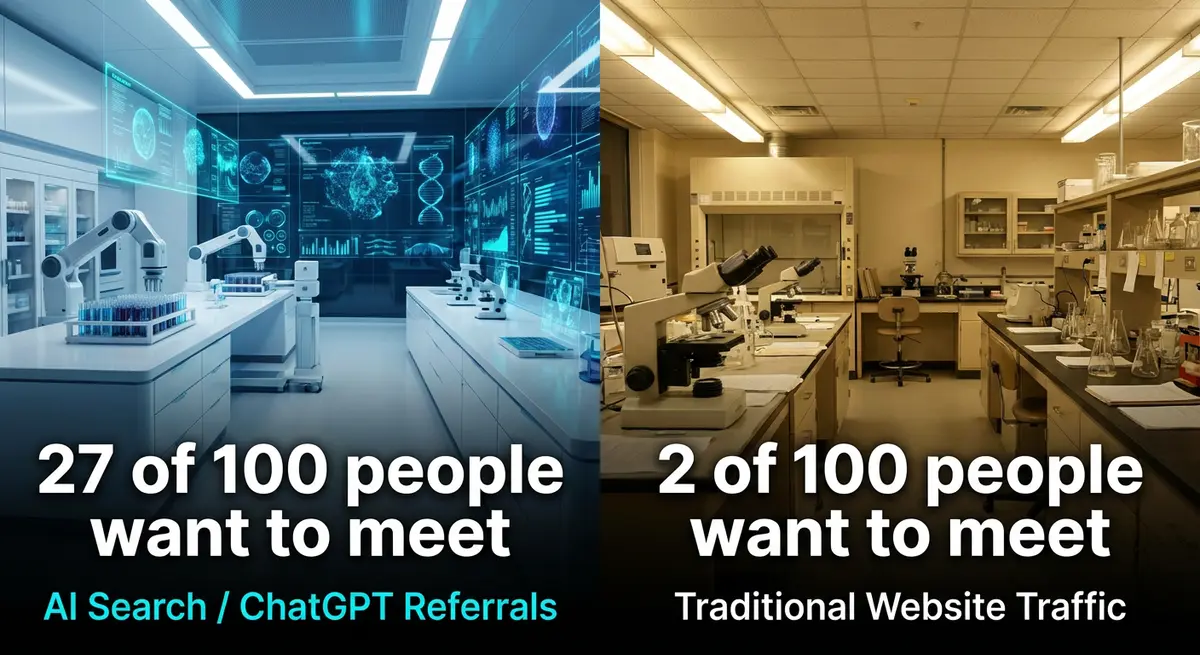
Before a procurement team schedules a site visit, they Google the company. They check LinkedIn. They look for case studies, press coverage, and third-party recognition. They ask AI assistants like ChatGPT or Google’s AI Overview for recommendations.
If the company doesn’t show up, or shows up with thin, outdated content, you lose credibility before the first call.
This is where CDMO marketing strategy and CDMO public relations become competitive advantages. Manufacturers that invest in visibility don’t just attract more RFPs. They convert more of the RFPs they receive, because buyers arrive pre-sold on their credibility.
In one engagement, Percepture helped a leading global pharma contract manufacturer increase inbound leads 3x, grow web traffic 435%, and support growth from about $250M to more than $1B in annual sales. That growth wasn’t just about manufacturing excellence. It was about being visible, credible, and easy to find when buyers were ready to choose. Read the full case study here.
For buyers: When evaluating candidates, look for partners who invest in their own visibility. A partner with strong search presence, published case studies, and consistent thought leadership is signaling that they take reputation seriously, and that they have results worth sharing.
For contract manufacturers: If you want to win more shortlists, CDMO lead generation starts with being findable, credible, and citation-worthy in both traditional search and AI-powered discovery.

See how one global pharma manufacturer strengthened demand
The supplied case study reports 3x inbound leads, 435% web-traffic growth and support for growth from roughly $250 million to more than $1 billion in annual sales.
Read the pharma CDMO case studyFrequently Asked Questions About Choosing a CDMO
What is the most important factor when choosing a CDMO?
Technical fit is the most important factor. If a CDMO can’t handle your molecule type, dosage form, and manufacturing process, nothing else matters. After technical fit, prioritize quality systems, regulatory track record, and communication.
How many CDMOs should I evaluate before making a decision?
Most buyers evaluate 3-5 candidates before making a final decision. Start with a long list of 8-10 based on initial research, then narrow to 3-5 for detailed RFPs and site visits. Comparing fewer than 3 limits your leverage and perspective.
Should I choose a global provider or a smaller specialist?
It depends on your program. Large providers offer global scale and breadth of services but may deprioritize smaller projects. Smaller specialists often provide more attention, faster timelines, and deeper expertise in specific modalities. Match the CDMO’s focus to your needs.
How do I verify a CDMO’s quality and regulatory claims?
Request FDA and EMA inspection reports for the past five years. Ask for references from similar programs. Check for warning letters or consent decrees in public databases. Look for third-party certifications and industry recognition.
What role does digital presence play in CDMO selection?
Digital presence is increasingly important. Buyers research CDMOs online before engaging. A manufacturer with strong search visibility, published case studies, and thought leadership signals credibility and investment in reputation. AI-powered search tools also surface manufacturers with robust digital footprints.
Final Thought: Fit Over Fame
The best CDMO for your program is not the one with the biggest name or the most sites. It’s the one that fits your molecule, your phase, your timeline, and your team.
Use the scorecard. Ask the hard questions. Validate through references and proof. And remember: the manufacturers that invest in visibility and reputation are often the ones that deliver on their promises.
If you’re a contract manufacturer looking to attract more of the right buyers, Percepture can help. We specialize in life sciences marketing, enterprise SEO, and AI search optimization for contract manufacturers ready to grow.
Contact us to start the conversation.
Make your CDMO expertise easier for buyers to verify
Percepture can review your search visibility, AI-answer presence, case-study proof, technical content and conversion path. The goal is a clearer route from buyer research to a qualified meeting.
Schedule a CDMO visibility review
About Bob Generale
Bob Generale is President of Percepture. He helps pharma, life-sciences, manufacturing and complex B2B organizations connect SEO, AI-search visibility, digital PR, content and conversion strategy to qualified demand. Percepture was founded in 2004 and has been recognized five times on the Inc. 5000.