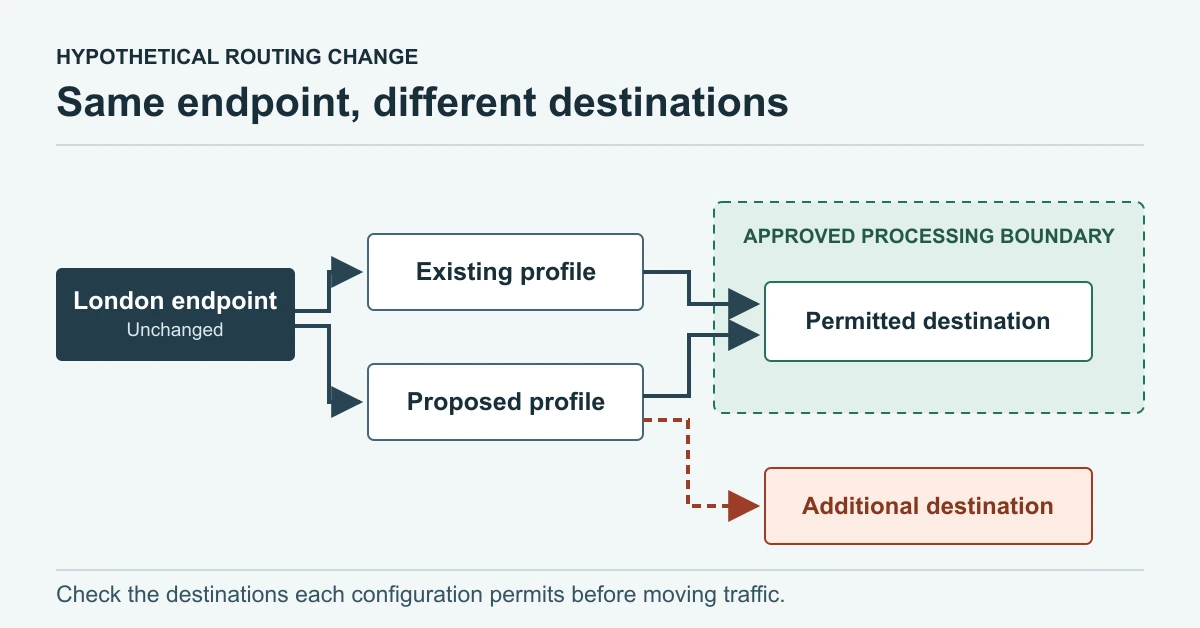

Your application can keep calling a London endpoint after a model upgrade and still change where requests are processed. Before switching production traffic, compare the old and proposed routing settings. Check which regions can run the model, which other services handle the request, and what happens when a permitted destination runs out of capacity.
That comparison matters when a customer contract or your own policy limits where certain requests may be processed. A faster response doesn't excuse a route outside that boundary. A route that stays inside it still has to meet your performance and capacity requirements. Treat those as two separate decisions.
Record the change, not just the London address
Start with one workload and two configurations: the one serving it now and the one that would replace it. For each, record the source region, model version, deployment type, routing profile or equivalent setting, and date checked. Use the identifiers in the deployed configuration rather than copying names from a sales deck.
Then trace one request. Where does it enter? Where can inference run? Which retrieval or logging services receive the prompt, response or material derived from either? A London endpoint answers the first question. It cannot answer the others on its own.
If you are also choosing a building or physical connection, use Percepture's London colocation buyer's guide for that decision. Keep the facility and the software's routing settings in separate records. Either can change without the other.
Compare every destination the new configuration permits
A test that returns from an approved location shows what happened to that request. It doesn't show where the next one could run. Ask for the configured destination list and the provider's description of what the setting permits. Record the list for each source region, including any secondary entry points your application can use.
Amazon Bedrock's inference profile documentation explains how to check the destinations for a specific profile. The documented GetInferenceProfile response can identify destination regions from its model ARNs. The destinations may differ by source region, so check each source you intend to use rather than inferring the list from a geographic prefix.
Microsoft Foundry's deployment guide distinguishes global, data-zone and geography-based deployments. Confirm the exact type and model offered to you. Don't assume an option with the word "zone" matches a UK-only requirement, or that one provider's region label means the same thing as another's.
Record an unresolved dependency as open. If your application delegates retrieval, guardrail evaluation or a tool call to another service, an inference profile does not establish where that service handles data. Likewise, data processing and storage are different questions. Check request logs and retained outputs separately.
A routing-change worksheet
Save the evidence for the old and proposed configurations side by side. The person signing off should be able to identify what changed without opening the provider console.
| Compare | Evidence to retain | Decision before switching |
|---|---|---|
| Model and deployment | Version or model ID, deployment type, source region and profile ID from the actual configuration. | Does this record describe what production would call? |
| Possible processing locations | Provider-documented destination list checked from each planned source, plus any app-level alternative routes. | Is every possible destination within the approved boundary? |
| Other services and copies | The retrieval, logging and storage services in the request path and their handling terms. | Do the same requirements hold beyond the model invocation? |
| Capacity and recovery | Agreed response and load targets, permitted fallback behavior, and the owner who can stop or reverse the change. | What should happen when a permitted route is unavailable? |
What to do when a new profile widens the route
Consider a hypothetical London-facing support assistant. Its buyer has set a UK-only processing rule for this workload. The current model configuration permits UK processing. An upgrade keeps the same entry address but its proposed profile allows a destination outside that boundary when traffic is busy.
The team should not switch that workload to the new profile on the strength of a good latency test. First find an option whose permitted destinations fit, or keep the existing deployment while the owners decide what to do. If compliant capacity is temporarily unavailable, use the response agreed in advance, such as pausing automated replies and keeping the human queue open. Do not quietly widen the route to preserve response time.
The UK-only rule in this example is a buyer requirement, not a statement that UK law requires all inference to run domestically. The ICO's guide to international transfers describes factors that determine whether a transfer is restricted. Have the privacy owner evaluate the actual flows, recipients and contracts rather than treating an infrastructure configuration as a legal determination.
Make the evidence survive the next model upgrade
Store the approved destination list with the deployed model and profile identifiers. Require a new comparison when the team changes the model, profile, source region, fallback provider or a service that handles the request. A version change that appears minor in an application release can change what the underlying service permits.
Once the allowed routes are understood, use synthetic inputs to exercise the normal route and the agreed failure path in an authorized test environment. Record the load, response-time measurement, and whether the app used fallback, queued the request or stopped. Use those observations to check behavior; use configuration and provider evidence to establish what other routes are possible.
If the provider can't account for a destination that matters to your policy, leave the change open. Before launch, name the person who can roll back and the condition that calls for it. A credible London inference proposal includes what the service does when it cannot meet both the processing boundary and the response target.
If you sell infrastructure for these workloads, bring buyers a sample change record with the supported configurations, evidence and unresolved conditions. Talk to Percepture about telecom marketing if your team needs to turn that technical evidence into material buyers can evaluate.