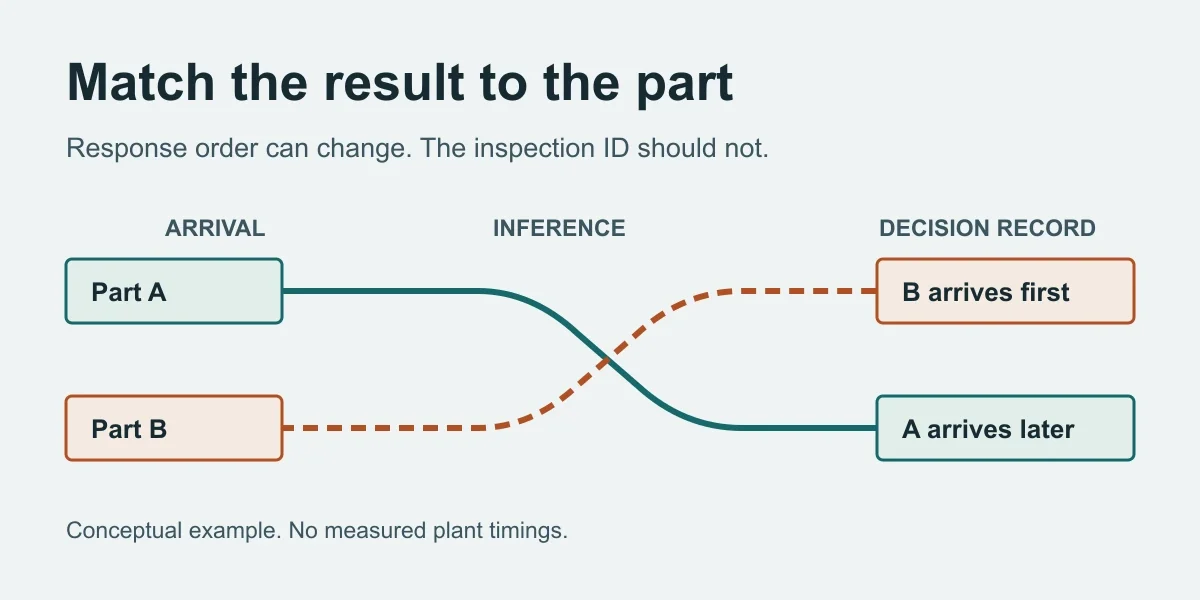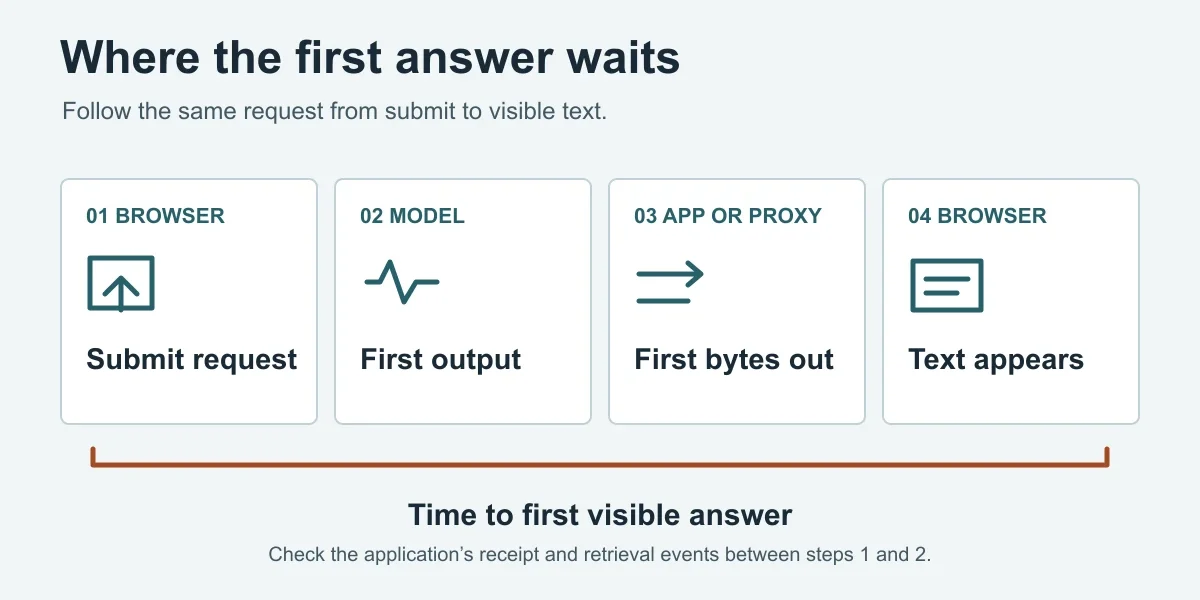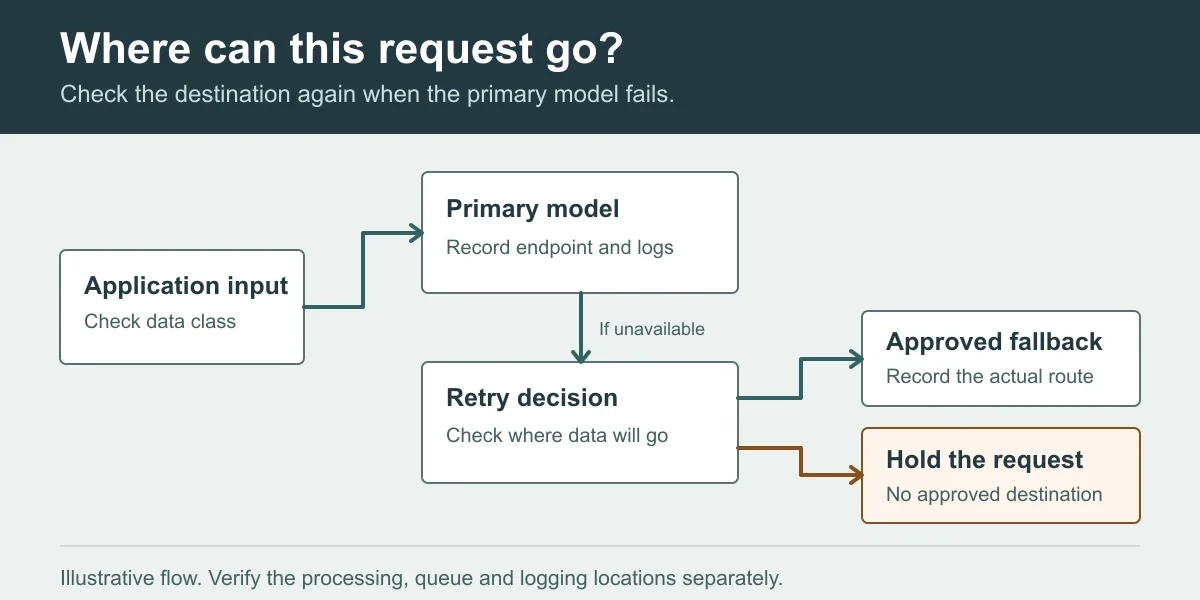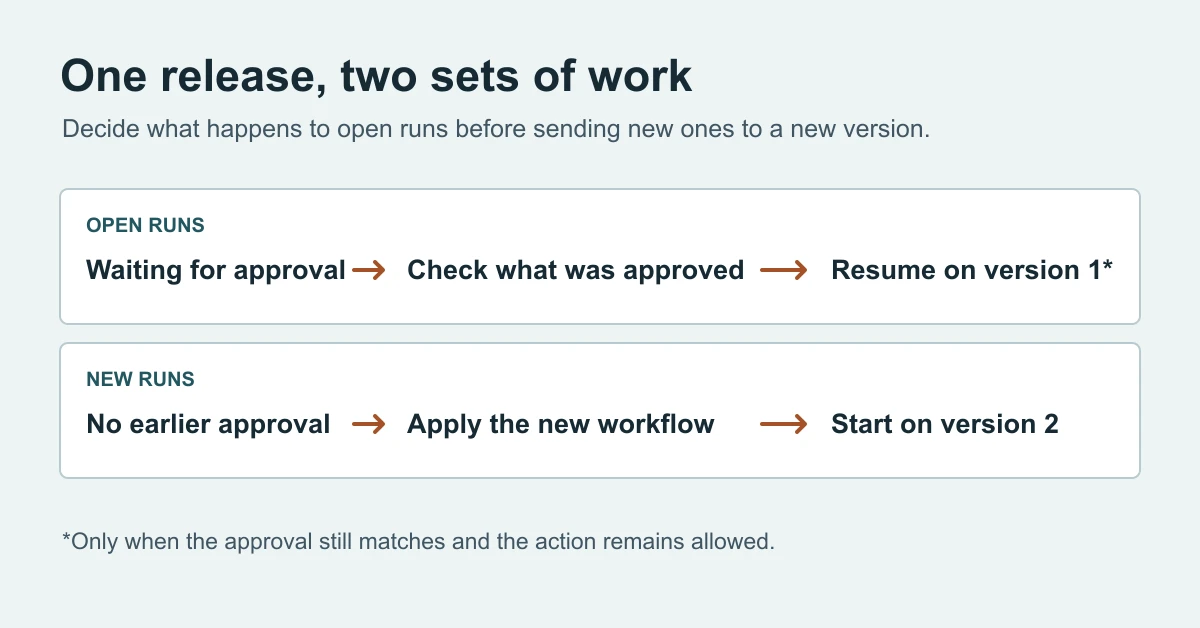

A team changes an AI workflow on Friday. On Monday a reviewer approves a request that was waiting before the release. Which version should act on that approval? The answer cannot be "whichever version is running now." The new release might use a different policy, write to a different field, or treat the approval as permission for an action the reviewer never saw.
An agentic AI architecture should make that choice explicit. Give each run a known workflow version and each approval a record of what the reviewer saw. Let a compatible run finish on its original version. Move it to a newer version only when you can account for its saved state, pending approvals and any actions it has already taken.
Save the version of the decision, not just the model
The model version is useful for diagnosing output, but it does not tell you which steps the workflow runs or what an approval authorizes. Store an immutable reference to the workflow definition alongside the current step and the version of the artifact under review. Keep a reference to the instructions, relevant tool contract and approval policy in use at that step. Don't copy sensitive inputs into every execution log just to make a version visible.
Consider an illustrative support workflow. The original version drafts a refund recommendation and asks a supervisor to approve placing it in a service ticket. A later version also offers to submit a refund through billing. The same ticket, customer and amount don't make those actions equivalent. The old approval belongs to the recommendation in the ticket. It cannot authorize the billing request.
Record the reviewer, the specific operation and destination, the version of the reviewed artifact, and any expiry or other condition that limits the decision. At execution time, check that the action still matches that record and is permitted under current access and safety rules. Keeping an old workflow version in service does not preserve a permission the organization has since revoked.
Choose what happens to the runs already open
Before changing the version used for new requests, list the open runs by state: not yet reviewed, waiting for a decision, ready to act, or waiting for confirmation from an outside system. For each group, decide whether it finishes on the old version, migrates at a known checkpoint, or stops for review. The version number alone won't make that decision for you.
| Change or run state | How to handle the open run | What to demonstrate |
|---|---|---|
| New release changes the flow for new requests only | Keep the old run on the compatible version and admit new requests to the new one | An old waiting run resumes on the old path while a new run follows the new path |
| An open run needs a new state format | Move it at a defined checkpoint only after validating the mapping and preserving its record of completed work | The new version reads the mapped state, uses the correct next step and does not call a completed action again |
| The action under review changes | Invalidate the affected approval and show the reviewer the new action and destination | The new version cannot act on the old approval even when the case ID stays the same |
| A previous write has an uncertain outcome | Reconcile the destination before the migration can authorize another write | A missing response remains unresolved until the destination or its supported receipt confirms what happened |
AWS Step Functions documents versions and aliases as a way to control which state-machine definition new executions use. Temporal's worker deployment guidance describes pinning workflows to a worker version and retaining workers for older pinned executions. These are examples of version control in runtimes, not substitutes for checking the business meaning of a saved approval or whether a downstream tool contract changed.
Test the release with unfinished work
Create test runs using synthetic cases and a test destination. Put one run on each side of the approval step. Release the new version for new requests and then resume the old runs. Change one test approval's proposed operation or destination and verify that the workflow rejects the old approval. For a run interrupted after an external write, check the destination record and the stored receipt before allowing it to move. Verify the effect at the destination, not just a completed label in the agent interface.
Decide how the team will stop taking new work on a defective version and what it will do with cases already on it. Sending new requests to an older version does not erase a completed write or migrate the runs still waiting. Track the age and number of open runs on each version. Retire the old path only when its runs have finished or have a documented destination and its history remains available under the applicable retention rules.
Bring an actual waiting case, a proposed change, and the record of what the reviewer approved to the release review. Ask the team to demonstrate what the old run does after the change. The agentic AI orchestration guide helps design the underlying states and actions. Use Percepture's agentic AI development services guide to scope who will own the implementation, testing and operation.