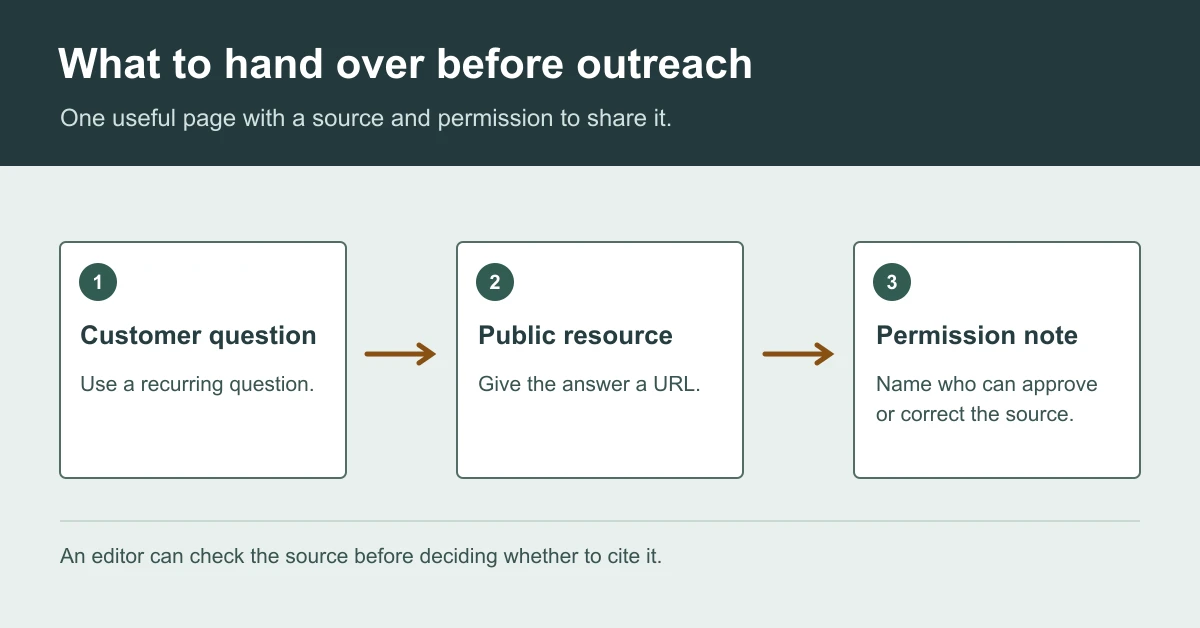

A small business link building service can pitch a useful resource, but it cannot supply the firsthand knowledge that makes your resource worth citing. Before asking a partner to start outreach, give them one public page, one person who can stand behind it, and a record of what they may share.
That's a different job from choosing a vendor. If you're still comparing offers, use this guide to choosing a link building SEO company. If you've already decided to get help, here's what to hand over so work can start without a month of emails asking for the same details.
Pick a question you already answer for customers
Look at what comes up before someone places an order. You're looking for a question with a concrete answer you can publish, not the service page you most want to promote. Start with common inquiries, installation instructions, or a checklist your staff already uses. Don't copy names, addresses, files, or individual customer messages out of your inbox.
Imagine a print shop whose customers submit event programs with missing pages or the wrong fold order. Its designer could make a one-page file handoff checklist, with a diagram drawn for the example and a plain explanation of what to check before exporting. A local event organizer could point volunteers to the checklist because it saves rework. The link would help readers even if they never buy printing from the shop.
Set an exclusion before you write: the checklist shouldn't claim every printer uses the same file settings. Put that limit beside the instructions. Where a setting depends on the shop or document, tell readers to ask the printer rather than guessing.
Hand over one page and its source notes
Share the public URL, then open it on your phone while signed out. If a reader has to enter an email address to see the answer, an editor can't verify your source without signing up. Keep the useful part on the page. Offer the downloadable version separately if it helps.
| What to give your outreach partner | What to include | What to keep private |
|---|---|---|
| The public reference | One URL, the reader's question, the version or review date, and a sentence on why it is useful | Staging URLs and account access |
| The source notes | The staff role responsible for the instructions and the exact claim they can verify | Customer examples, internal files, and staff contact details that haven't been cleared |
| The permission note | The public lines, diagrams or excerpts the partner may offer and who approves anything new | Photos, testimonials or personal details without permission |
| The correction contact | A person on your team who can answer factual questions and update the public page | Personal addresses; use a shared business inbox where possible |
In the print-shop example, the designer verifies the generic fold-order illustration. The owner checks that nothing was taken from a customer file and approves the public checklist. The outreach partner gets both decisions in one place. Nobody has to guess whether the example is cleared or resubmit the entire project for a one-line factual correction.
Give the partner a reason to write, not an anchor to demand
Ask your partner to explain in one sentence why a particular publication's readers would use the resource. An event planning association might share the checklist with volunteers. A generic directory with no relevant audience doesn't become a fit because it offers a large placement count. Neither is a promised link.
The first pitch can be simple: identify the recurring reader problem, point to the usable section, and offer a person who can answer follow-up questions. Let the editor choose whether to use it, how to describe it, and whether to include a link. Don't ask for exact-match anchor text as a condition of sharing the material.
If a publisher offers paid promotion, log it separately. Google's guidance on qualifying outbound links recommends rel="sponsored" for paid placements and accepts nofollow. A paid placement isn't an earned citation simply because it runs next to editorial content.
Set a clear handoff and review point
Agree in advance who can approve a pitch, who can correct the public page, and what the partner should do when a question goes unanswered. When a resource changes, have the partner use the new version and stop offering the old one. If the page loses its source or permission, pause its outreach rather than substituting your homepage.
At the first review, ask for the exact destinations pitched, any factual questions editors raised, and the live source and destination of any coverage. Treat a decline as information: if the editor says the resource isn't suitable for their readers, fix the audience or the resource before increasing the email count. Track actual referrals separately from search changes; placement counts alone won't tell you what the work did.
If you have a page people can use but can't tell whether it is crawlable or ready to share, include it in an SEO Sprint conversation. Bring the public URL and the customer question it answers. If neither is ready, build that one resource before spending on the pitch.