

You have an hour with a prospective link building SEO company and a proposal built around monthly backlink totals. Use that meeting to test how the work supports your wider organic SEO services, rather than debating who offers the biggest package.
For business owners and marketing leaders, the decision is about relevance, evidence and accountability. This guide shows how to compare service models, inspect a vendor’s work and turn a promising pitch into a scope your team can manage.
What should a link-building partner deliver?
A link building SEO company plans and executes work intended to earn links from other websites to yours. Choose a partner that can explain publisher relevance, show inspectable examples, disclose outreach practices and connect its scope to your business priorities. Treat backlink totals as one reporting field, not the buying decision.
Decide what you need before comparing companies
Start with the page and the buyer, not the backlink package. Which business priority should this engagement support? Which audience needs to discover or trust your material? Which page deserves attention, and what makes it worth referencing?
Write those answers into a short brief. A useful version names the priority audience, target pages, available expertise, content gaps and internal owner. It also states what the agency will not handle. Otherwise, a proposal for outreach can quietly become an assumption that someone else will write the research, repair the website or approve every pitch.
Before commissioning promotion, ask your web team whether the destination pages are ready. If there are unresolved crawlability, indexing or site-structure questions, put a technical SEO audit into the planning conversation. Do not ask an outreach contract to stand in for that diagnosis.
Then choose the kind of engagement you actually want to buy.
Compare service models before provider names
| Buying situation | Scope to request | Boundary to settle |
|---|---|---|
| You already have material worth citing | Publisher research, tailored outreach and placement documentation | Who updates the material when editors request changes? |
| You need a stronger reason for coverage | Research, expert input, content development and outreach | Who supplies the underlying evidence and approves publication? |
| You want broader editorial coverage | A digital PR brief with audience, story and media objectives | How will coverage, mentions and links be reported separately? |
| You need several marketing disciplines coordinated | A shared plan for technical work, content, outreach and measurement | Who owns prioritization and resolves competing recommendations? |
For a coverage-led brief, compare the proposed work with digital PR services, not only with link-placement packages. Keep the distinction practical: specify the work and reporting you want, rather than assuming every agency uses the same service labels.
Use the Golden Triangle to build your shortlist
Percepture’s Golden Triangle gives this decision three lenses: relevant competence, proof and buyer fit. Use it as a procurement tool, not a badge a vendor can award itself.
A polished presentation should not compensate for missing evidence. Equally, an impressive example should not excuse a delivery model your team cannot support. Record the answers while comparing proposals so the eventual choice is explainable to finance, leadership and the people doing the work.
The Golden Triangle vendor scorecard
| Dimension | Evidence to request | Decision question |
|---|---|---|
| Relevant competence | A proposed audience, publisher rationale, target-page plan and sample outreach approach | Can this team explain why the work belongs in our market? |
| Proof | Live examples, the agency’s specific contribution, working records and clearly bounded outcome claims | Can we inspect what happened rather than accept a summary? |
| Buyer fit | Named delivery roles, approval requirements, reporting examples, exclusions and contract terms | Can our team realistically operate this engagement? |
Do not average away a serious concern. An unresolved publisher-payment arrangement or unclear responsibility for content should remain a separate decision item, even when the rest of the presentation looks strong.
For each shortlisted link building SEO company, write one sentence explaining the fit and one condition that must be satisfied before signing. That is more useful than a ranking unsupported by the details of your assignment.
Best link building services provider: verify relevance and editorial control
Before you agree to pay per placement, ask two bidders to complete the same line in a placement register. One quotes for researching publications, developing a source and pitching editors. The other quotes for a guaranteed link. Those fees buy different things, even when both proposals promise coverage in the same trade publication.
Agree on what finance can accept and what marketing must inspect. If you commission outreach, a well-targeted pitch that an editor declines can still be work you agreed to buy. It is not a published mention. If the contract sells advertising, assess the audience and terms as advertising, not as an earned editorial endorsement.
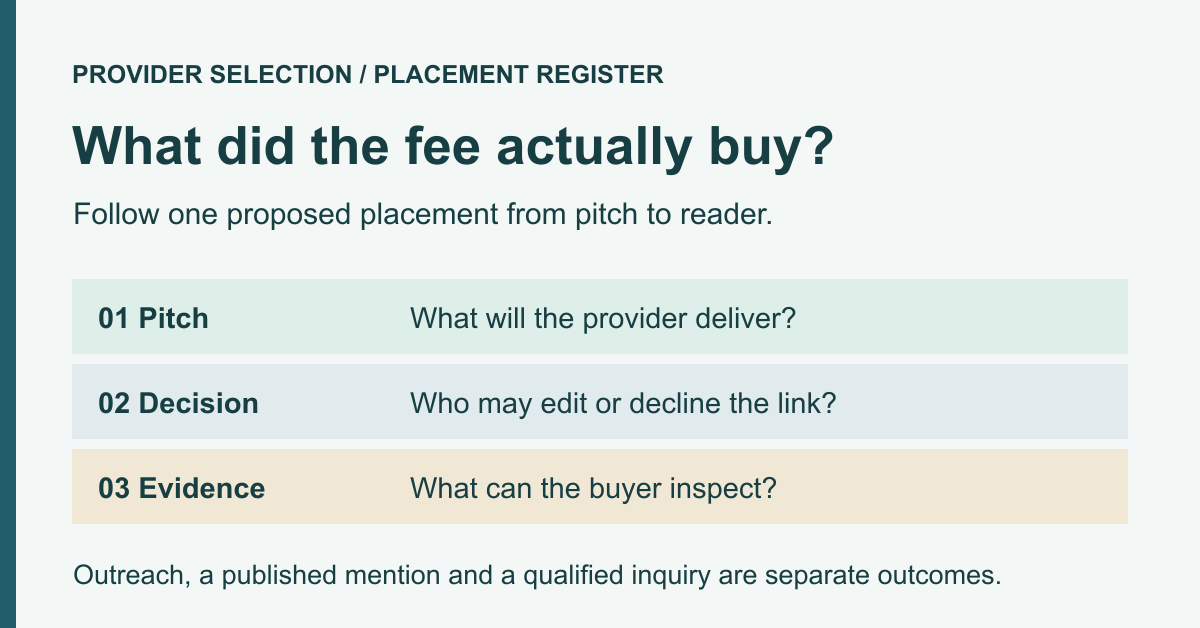
| Field | What the buyer records |
|---|---|
| Audience | Name the publication, intended reader and the question this source would help that reader answer. A domain score cannot fill this field. |
| Control | Identify who can reject the pitch, edit the wording or leave the link out. Record any fee, gift or intermediary and how the relationship will be disclosed. |
| Link | Save the published page, linked words and actual destination. Note whether the link is editorial or paid and how a paid link is marked. |
| Decision | Record the date, reviewer and one decision: accept under the agreed terms, ask for a correction, or exclude. Keep any sales outcome in a separate field. |
Suppose a pump supplier publishes a sizing chart. A trade editor cites it in a maintenance guide because readers need to choose a replacement. Marketing can check that the link leads to the chart rather than a sales homepage. Sales can separately record whether a referred buyer asks for a compatible model. A mention, a referral and a qualified inquiry are three different events; this example does not assume that any of them happened.
Reject a proposal that sells followed links for ranking credit. Google’s link spam policy distinguishes that practice from advertising. Its link qualification guidance prefers rel="sponsored" for paid placements and also accepts nofollow.
For a B2B shortlist, bring one redacted record to the agency selection discussion. If no provider can identify a useful destination for the pitch, start with the source itself. An earned digital PR review can help identify what a trade editor might actually cite before you buy outreach.
Ask the vendor to walk one example backward
Choose one completed example and work backward from the published page. Ask the agency to separate its contribution from work performed by the client, publisher or another partner.
First, inspect the context. What is the page about? Where does the link appear? Why would a reader follow it? Does the destination answer the need created by the surrounding passage? Treat a domain-rating threshold as a screening preference, not your entire acceptance test.
Next, ask how the opportunity was developed. Request an explanation of publisher selection, the pitch angle, content ownership and editorial review. Ask about subcontractors and intermediaries. Where confidential information cannot be shared, request a redacted working sample that still explains the process.
Finally, separate the placement record from any performance claim. If a case study attributes growth to the engagement, ask for the measurement period, baseline, affected pages and other work occurring at the same time. A screenshot alone should not settle an attribution question.
Useful follow-up questions include:
- What did your team create, change or negotiate in this example?
- Was any publisher or intermediary compensated, and how was that recorded?
- Who controlled the final wording, link destination and publication decision?
- What happened when an editor declined the pitch or requested changes?
- What would you do differently for our audience and target pages?
The purpose is not to demand access to another client’s private information. It is to establish whether the vendor can explain its work precisely and share appropriate supporting material.
Put outreach practices in writing
Ask the provider to document permitted tactics, prohibited tactics and any publisher-payment arrangements. Record sponsorship disclosures and link attributes alongside the publisher and destination. Do not leave these details hidden behind labels such as “premium,” “white hat” or “editorial.”
Use Google’s link spam policy and outbound-link qualification documentation as reference documents during technical review. Ask the vendor to explain how its proposed work relates to that guidance, including how it handles paid opportunities.
Keep a clear distinction between commissioning research and outreach work and paying for a particular placement. Require the proposal to explain exactly what the fee purchases. If the answer remains vague, leave that item unresolved rather than interpreting it generously.
A buying example: two proposals, different obligations
Consider a hypothetical B2B software company with a useful implementation guide, limited internal writing capacity and a marketing leader who must approve technical claims.
Proposal A emphasizes a monthly placement total and a minimum domain-rating threshold. It leaves content production, publisher selection, approval handling and performance reporting largely unspecified.
Proposal B defines an audience of implementation leaders, proposes publisher categories, names the guide as a destination and includes a review step for technical claims. It also identifies what the client must supply and distinguishes outreach activity from publication outcomes.
Do not choose B merely because its proposal is longer. Test whether those commitments survive the contract and a walk-through of prior work. Ask A to answer the same questions. A concise proposal with clear answers may be a better fit than a detailed document whose delivery team cannot explain it.
Now add the operating constraint: the marketing leader cannot review a fresh technical article every week. Ask both vendors to revise the plan around an agreed source interview, reusable approved material and a manageable review process. Price the revised scopes, not the original packages.
That is the practical value of buyer fit. The selection should reflect the work your organization can support, not just the output a sales presentation makes attractive.
Compare fees by what the scope includes
When comparing link building services, ask each provider to price the same responsibilities. Separate strategy and publisher research, content development, outreach, account management and reporting. Identify which charges are recurring, optional or dependent on a third party.
Then read the assumptions. Who pays for research or licensed data? Who supplies subject-matter expertise? How many revision rounds are included? What happens when a proposed destination needs substantial editing? Is implementation included, or does the agency only deliver recommendations?
For each link building SEO company, request a plain-language explanation of what happens when outreach does not produce a publication. Distinguish completed work, future commitments, credits and refunds. Any replacement provision should explain eligibility and exclusions rather than relying on the word “guaranteed.”
Avoid a single cost-per-link figure until the underlying scopes are comparable. As a buying recommendation, prioritize a clear, affordable scope over a larger commitment whose content and management requirements remain undefined.
Build a report your leadership team can use
Specify the report before signing. Ask for a sample that separates activity, published work, search performance and business observations.
The placement record should identify the live source page, destination, publication date, surrounding context and relevant disclosures. The activity record should explain what was researched, pitched, declined or revised. These are different records; keep them distinguishable.
For search evaluation, choose the target pages and query groups in advance. Review impressions, clicks and average position alongside other changes to those pages. Use agreed comparison periods and annotate major content or technical updates rather than crediting every movement to outreach.
For business evaluation, define the referral visits, relevant conversions and sales feedback your team wants to examine. Align these definitions with your wider attribution and analytics work. Do not force an agency to turn an unexplained traffic chart into a revenue claim.
If AI-answer visibility is also part of the brief, specify the questions, answer surfaces and observation method separately. Ask for actual captures and a clear reporting scope, not an unsupported promise that backlinks will secure an AI citation.
Put the working agreement ahead of the signature
Before committing, settle who owns the source material, who approves claims, who sends outreach and who communicates with publishers. Name the person responsible for resolving a stalled approval or an unsuitable opportunity.
The contract should also address subcontracting, data access, content ownership, cancellation and handoff. Require a useful closing record: published URLs, destination pages, completed assets, outstanding work and any maintenance responsibilities. Ask what the agency can contractually commit to and what remains outside its control.
Where outreach sits inside a broader program, compare how an omnichannel marketing engagement assigns responsibility across content, PR, search and measurement. The question is not whether every discipline must be included. It is whether the interfaces between them have an owner.
Your final recommendation should fit on a page: the business objective, chosen scope, evidence supporting the vendor, unresolved risks, internal workload and review criteria. If you cannot explain the purchase without repeating the proposal’s marketing language, return to the evidence before signing.
Compare the investment with a defined scope
Bring your priority pages, available content and internal review capacity to the pricing discussion. Use those inputs to identify the responsibilities, exclusions and reporting you want priced.

About Bob Generale
Bob Generale is President of Percepture. His editorial focus is connecting SEO, digital PR and marketing decisions to business priorities, with clear evidence and accountable next steps.