
Your application can accept a request in Querétaro and still handle part of it somewhere else. A worker can retry through another endpoint. A logging integration can copy the payload. A queue can fall back to a service with a different location policy. None of that is visible from the address of the primary deployment.
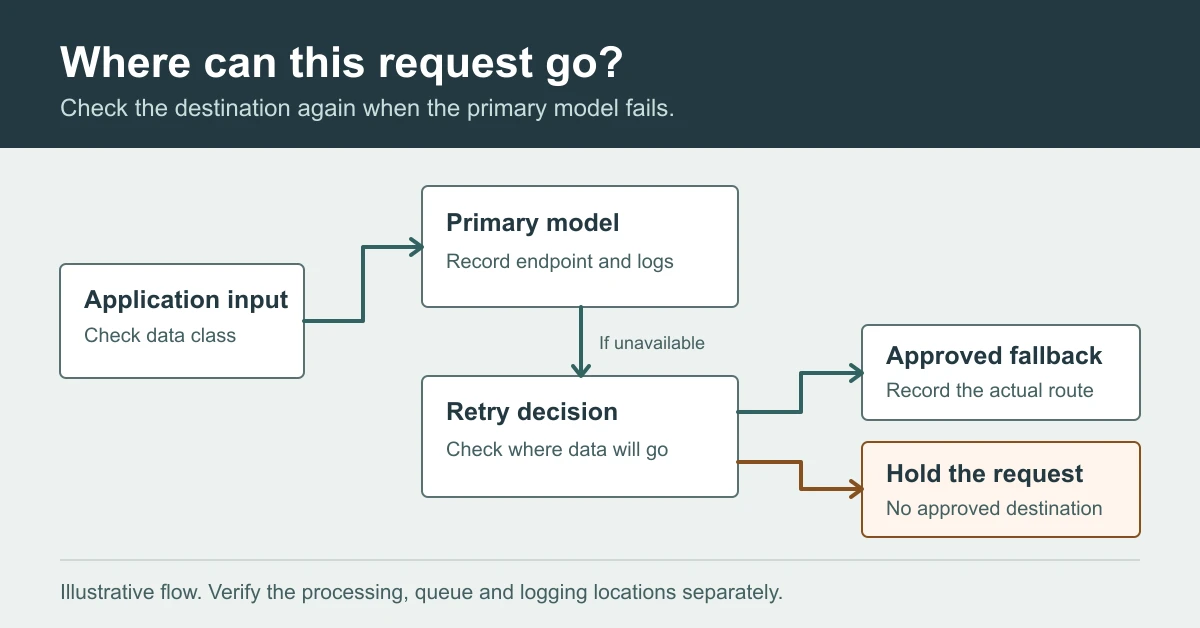
For AI inference in Querétaro, start with this question: when the primary model stops answering, where may each part of the request go? If your company requires certain material to stay in Mexico, name that material before evaluating a deployment. Then ask your team and provider to show where it is processed, stored and copied, on a normal day and under failure.
Write down the boundary before comparing endpoints
Specify which data the requirement covers. It might apply to the prompt, the retrieved documents, the generated answer or all three. Does it also cover copies in retry queues, traces or support tickets? Who can grant an exception, and what must the application do when an approved destination isn't available?
For a hypothetical Spanish-language service desk, assume the company allows public help articles to travel but requires account details and excerpts from internal manuals to be processed and stored in Mexico. That gives the engineers two different classes of work. A question about posted business hours may qualify for an approved alternate path. A request about a specific account may need to wait or go to an authorized person. The same failover switch shouldn't decide both.
Ask for evidence about the exact service and model
Google Cloud announced the opening of its Querétaro region in December 2024. Its model deployment guidance distinguishes an endpoint from a guarantee about where model processing takes place. Likewise, AWS lists a Mexico Region runtime endpoint for Amazon Bedrock, but its model availability guidance separates in-region processing from geographic and global routing.
Those are different checks. Ask for the exact model and version, service, endpoint, routing option and account configuration you will use. Record what the provider says about the processing and storage of the data you named. If the proposed failover uses another service or model, ask the same questions again. A working demo tells you the request completed; it doesn't prove where each part ran.
Trace where the data goes when a request fails
Use this ledger in a design review. Fill it out for the normal path and the fallback, with a different row for each component that receives or retains data.
| Component | What to record | Evidence to request |
|---|---|---|
| Application and retry queue | Which fields are retained, how long they wait and which worker may retrieve them | Queue configuration, retention setting and a synthetic request traced through a retry |
| Document retrieval | Which index and document store each model can reach | The configured locations and an example showing which approved document version was returned |
| Model processing | Exact model, endpoint, routing option and permitted processing location | Service documentation, configured route and provider evidence for the actual deployment |
| Logs and support | What a trace, error report or support export contains and where copies go | Logging and export settings plus a redacted test entry |
| Recovery and backups | Which data is restored, where it is held and what happens when no approved target responds | Backup location, failover configuration and the observed result of a controlled recovery test |
For equipment and facility questions, use the separate Querétaro data centers and colocation guide. A facility proposal can help establish where your equipment sits. It can't establish where an application sends a retry or exports a trace.
Prove that the application can stop safely
Use fictitious requests tagged like your production data, with no customer records. Run one ordinary request, then make the approved endpoint unavailable in a controlled test. Inspect the queue, logs and recovery destination. Compare what the system did with what the service owner approved. Record a missing or unverifiable destination as unresolved, not as a pass.
If the hypothetical service desk can't use a permitted route for an account request, its approved behavior might be to hold the request, stop the automated answer and notify a person. The router should not send the restricted input to a global endpoint just to meet a response time target. Test that failure mode before relying on the control.
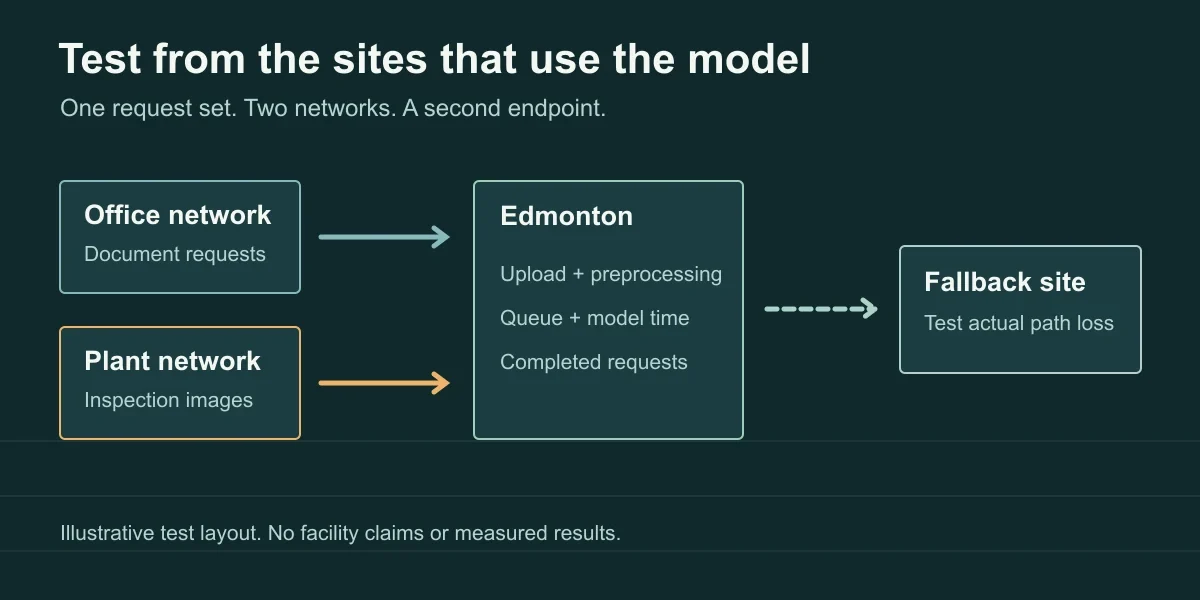
Once the paths match, measure response time and completion by workload and by route. A fast primary path and a safe fallback are different requirements. Write both into the acceptance record, with the component owner and the evidence they'll rerun when the model, queue or logging configuration changes.
For help explaining infrastructure capabilities to enterprise buyers without overstating them, review Percepture's telecom and digital infrastructure work.