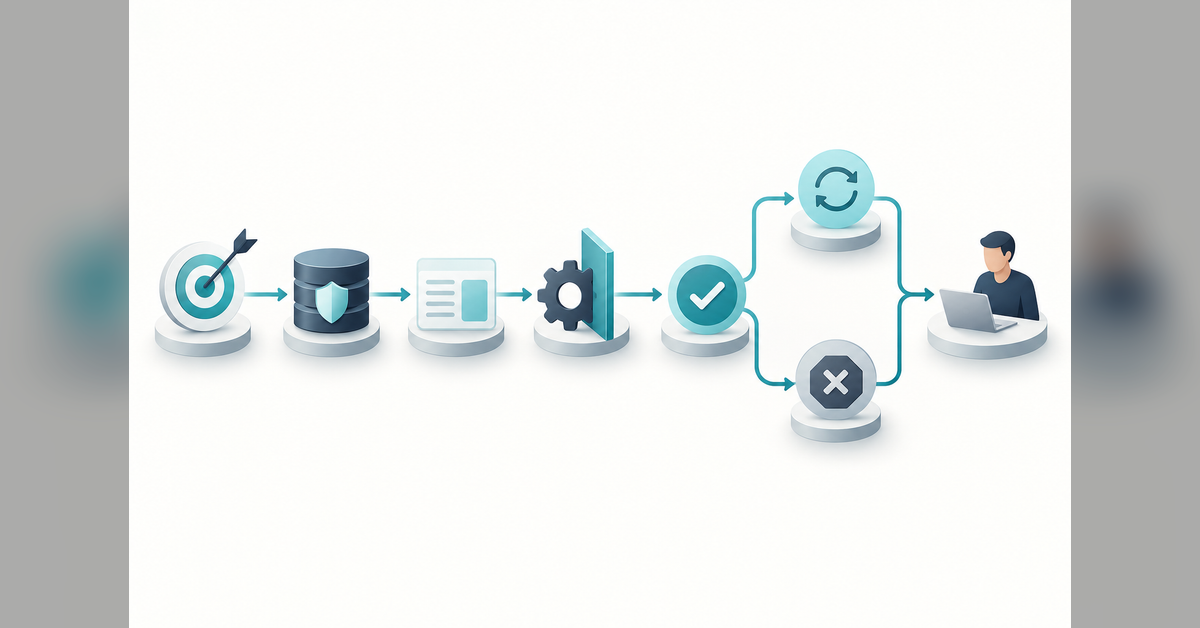

Agentic AI orchestration should make one business job finish predictably—not turn every step into a conversation between agents. For AI marketing agents, that means deciding who researches, who checks the evidence and who may change a business record.
Choose the simplest coordination pattern that fits those responsibilities. Before comparing platforms, ask what happens when a task stops halfway through: what progress survives, which actions might already have happened and who owns the next decision?
What is agentic AI orchestration?
Agentic AI orchestration is the coordination of model-driven decisions, tools, task state and handoffs within a workflow. It determines what runs next, which information and permissions each step receives, how results are checked, and when execution resumes, stops or transfers to a person.
A model generates an output. An agent uses model-driven decisions to pursue a task, potentially through tools. The workflow defines the surrounding execution path. Keep those responsibilities separate: a useful model response is not proof that the requested business action completed.
Choose the least complex pattern that works
Start with task dependencies and decision rights, not the number of agents. If the order is known, encode it. Add model-directed routing only where the next step genuinely depends on interpretation. Add specialists when their separate responsibilities justify the extra coordination and give every handoff an acceptance condition.
Microsoft’s AI agent orchestration patterns provides a useful reference for sequential, concurrent and handoff approaches. The business question is which pattern matches the work—not which sounds most autonomous.
| Pattern | Buyer fit and scope | Implementation owner | Evidence to request | Question to resolve |
|---|---|---|---|---|
| Deterministic chain | Known steps with explicit branches; useful as the baseline. | Workflow engineer and process owner. | Branch rules and failed-step handling. | Does any step need model-directed planning? |
| Single tool-using agent | One bounded task requiring judgment and tool selection. | Agent developer and tool owner. | Tool allowlist, validation and stopping behavior. | Can one agent finish within clear limits? |
| Sequential specialists | Ordered work with distinct research, drafting or review responsibilities. | Workflow engineer and specialist owners. | Input/output contracts at each boundary. | What makes an output acceptable to the next step? |
| Parallel workers | Independent subtasks that feed a later merge. | Orchestration engineer and merge owner. | Join rules and partial-result handling. | What happens when one worker fails or disagrees? |
| Handoff | Responsibility transfers as the task changes. | Routing engineer and receiving owner. | Transfer conditions and acknowledgment. | Who owns the task before acceptance? |
These implementation roles are suggested accountabilities, not platform requirements. A marketing process might combine a fixed research sequence with a bounded drafting agent and a human approval gate. If every branch can be specified reliably in advance, the job may not need agentic AI orchestration at all.
Save progress separately from prompt context
In agentic AI orchestration, durable state should record authoritative progress; context should contain the information needed for the next model call. Do not make a chat transcript the only record of completed work. A restart needs explicit task status, accepted artifacts and action outcomes—not a model’s reconstruction of what probably happened.
Design three separate records:
- Task state: job identifier, current step, accepted output version, approval status, action keys and remaining budget.
- Model context: the current instruction, relevant evidence and permitted choices for this step.
- Execution history: attempts, tool responses, validation failures and ownership changes, subject to appropriate access and retention controls.
Persist a reference to a reviewed research artifact rather than copying the entire research history into every prompt. When evidence changes, record the new version and decide which downstream approvals are no longer valid. A checkpoint should tell the next worker what is accepted, not merely what was generated.
Use the State-to-Action Contract before implementation
Percepture’s State-to-Action Contract is an applied design worksheet for connecting a business goal to an accountable execution path. Resolve these seven questions for each consequential transition.
- Goal: What observable condition means the job is complete?
- Persisted task state: What accepted progress must survive an interruption?
- Bounded context: What information does this decision actually require?
- Authorized action: Which tool operation may run, against which record?
- Validated result: What evidence establishes that the result is usable?
- Checkpoint, retry or stop: Which conditions select the next transition?
- Human ownership: Who receives uncertainty, rejection or an exhausted budget?
Apply the worksheet to one job first. Reusable contracts, rather than a growing collection of agent personas, are the useful bridge to an AI agent factory operating model.
Make permissions and stopping rules executable
Define authorization outside the model’s persuasive ability to request an action. Specify the operations available at each step, the records they may affect and the checks required before execution. A drafting step does not need publishing rights; a research step does not need permission to change a CRM record.
- Bound access: restrict tools, operations, credentials and record scope.
- Validate requests: check required fields, allowed values and approval conditions.
- Limit execution: set turn, elapsed-time, retry and spending boundaries.
- Define terminal states: completed, rejected, cancelled, budget exhausted or escalated.
An approval should apply to a specific action and payload. If the proposed recipient, record or content changes, reassess that approval rather than treating it as a permanent permission. Use an agentic AI governance framework to assign action rights and exception owners.
The difference between bot governance and AI agent governance is especially relevant when a system can select its next action. In administrative applications of AI agents in healthcare, keep those permissions separate from clinical decision-making and use appropriate privacy and professional oversight.
Treat an unknown outcome differently from a failed action
A recovery plan for agentic AI orchestration must distinguish a failed action from an unknown outcome. A timeout does not tell you whether an external write completed. Before repeating a consequential operation, reconcile the destination’s state, the action identifier and the saved result. Retry only when the action contract permits it.
An illustrative research-to-CRM workflow
Consider a content team preparing an account research brief and a follow-up task. The workflow collects evidence, saves an accepted research artifact, drafts the brief and waits for human approval. Only then may a narrowly authorized CRM step create the follow-up task. This is a design example, not a client result.
| Observed state | Required check | Next transition |
|---|---|---|
| Research accepted; drafting interrupted | Confirm the accepted artifact version. | Resume drafting from that checkpoint. |
| CRM write acknowledged | Save the destination record identifier. | Mark the action successful. |
| CRM request timed out | Reconcile the action key and destination record. | Record success if completed; otherwise retry only when safe. |
| Payload rejected | Determine whether correction is authorized. | Correct within bounds or escalate; do not blindly repeat. |
| Outcome remains uncertain | Assign a named exception owner. | Stop automated writes and escalate. |
Use a stable action key for the same intended operation across attempts. A read-before-write check alone cannot prevent two concurrent attempts from creating duplicates. Request downstream uniqueness or an atomic deduplication mechanism where available; otherwise design reconciliation and escalation before allowing automatic retries.
Acceptance testing should interrupt the workflow before and after the external write, reject a payload and exhaust a retry budget. The AI agent reliability question is whether the business task reaches a valid state—not whether the agent can produce another fluent explanation.
Buy runtime responsibilities, not a framework label
Choose an agentic AI orchestration stack by assigning each required responsibility to a specific component and owner. An agent loop, a retrieval layer and a durable workflow engine solve different parts of the problem. A product may combine them, but require current documentation and a task-specific demonstration before treating that combination as delivered scope.
- Agent loop: model decisions, tool selection and local stopping behavior.
- Durable workflow: persisted transitions, restart behavior, scheduled waits and recovery coordination.
- Retrieval layer: selecting relevant information with appropriate source and access boundaries.
- Managed runtime: hosting, deployment and operational controls within the purchased service’s documented scope.
The AWS agentic patterns guide is another primary reference for examining design options. For a proposal, ask who implements persistence, approvals, deduplication and incident handling. Do not accept “the framework handles it” without identifying the mechanism and its limits.
Separate initial implementation from model usage, maintenance and incident ownership when estimating AI agent development cost. When reviewing commercial AI systems, bring the same responsibility map: which duties are included, which remain with your team and which need another component?
Measure completed work and inspect the execution path
Evaluate agentic AI orchestration against an accepted business outcome and the behavior used to reach it. Define success before running the workflow. For the illustrative example, success means an approved brief and one correct follow-up task assigned to the intended owner—not merely a completed model response or a successful API request.
Track these separately:
- Task results: accepted completion, rejection, unresolved work and human intervention.
- Execution behavior: retries, invalid actions, duplicate prevention and checkpoint recovery.
- Operating burden: elapsed time, model and tool spending, review effort and incidents.
Specify denominators and exclusions. Report interrupted or escalated jobs rather than quietly removing them from completion rates. In revenue workflows, the handoff deserves its own check: AI agents in RevOps need business ownership, while CRM lead routing connects the inquiry to the person responsible for follow-up.
For AI-search content work, distinguish a brand mention from a linked citation, a visit and a qualified opportunity. Monitoring records an observation; optimization changes something and tests the result. Neither a saved answer nor a completed content task establishes commercial impact on its own.
If your team uses Prime AI Visibility, a Percepture product, treat saved-answer evidence as an input to investigation—not permission to publish an edit. Review how Prime AI Visibility works when scoping that workstream, then assign the page action, approval and recheck as separate responsibilities.
Bring these decisions to the architecture review
A useful review should produce an execution contract for one workflow, not just a platform shortlist. Ask the proposed implementation owner to explain:
- The simplest pattern that satisfies the task.
- The authoritative state and accepted artifact versions.
- The exact actions requiring approval.
- The response to an ambiguous external write.
- The enforced retry, time and spending limits.
- The person responsible for unresolved work.
If an answer depends on a product capability, request the current documentation and a demonstration of that specific behavior. Keep unresolved capabilities out of the implementation commitment until their scope is established.
Questions to resolve before choosing a stack
What does orchestration add beyond an agent?
Agentic AI orchestration adds workflow-level coordination: routing, persisted progress, permissions, result checks and ownership across steps. An individual agent may choose tools, but the surrounding system still needs to establish what is complete and what should happen next.
Is a multi-agent design always better?
No. Use multiple agents when distinct responsibilities or independent subtasks justify them. Compare that design with a deterministic chain or one bounded agent, including the added handoffs, merge decisions and recovery paths your team would need to operate.
How should we prevent infinite loops?
Enforce turn, elapsed-time, spending and retry limits outside the model’s own decision to stop. Define successful completion, repeated failure and escalation conditions. A stopped workflow should save its status and route unresolved work to an accountable owner.
Is context the same as state?
No. State records authoritative progress and accepted decisions. Context is the selected information supplied to a model for its current task. Rebuild context from appropriate state and evidence rather than relying on a conversation transcript as the sole progress record.
How can an interrupted workflow resume safely?
Resume from an accepted checkpoint, then reconcile any action whose outcome is uncertain. Reuse the intended operation’s action key and apply the destination’s deduplication controls where available. Do not repeat an external write merely because its response was lost.
Which orchestration framework is best?
Choose by required responsibilities, integration boundaries and operational ownership—not a universal ranking. Verify current support for persistence, approvals, permissions and recovery, then demonstrate those behaviors with your workflow’s failure cases before committing to the implementation.
Start with one workflow and its hardest restart
Bring the business goal, a sample input and the action you cannot afford to repeat. Use those to frame a conversation with Percepture about pattern selection, execution boundaries and reliability requirements.

About Bob Generale
Bob Generale is President of Percepture, a global digital marketing, public relations and AI systems agency established in 2004. His work connects search strategy, digital PR, useful content and conversion planning around the questions buyers need answered. Bob’s approach starts with understanding the audience, learning how the business actually works and turning that expertise into clear explanations people can use. He advocates practical frameworks, coordinated execution and measurement that separates visibility from qualified opportunities and revenue. Prime AI Visibility is a Percepture product, reflecting his interest in making AI search insights actionable for marketing teams. In this article, he brings that operator perspective to evaluating options, clarifying tradeoffs and helping readers decide what to do next.