

Buying AI marketing agents starts with a simple question: which marketing job needs help, and what should the software be allowed to do? A polished demo is not enough. Your team needs a clear task, a named owner, and a way to judge the finished work.
Start with one bounded workflow. Keep strategy and final approval with people. Expand only when the pilot meets the quality, cost, and control standards you set before testing.
What are AI marketing agents?
AI marketing agents are AI systems that carry out marketing work within a defined scope. That scope should specify the goal, allowed actions, data access, and approval gates. Evaluate the system on a complete workflow, not a polished response. Keep budget changes and public claims under human review.
Why should marketing leaders consider them?
The buying case for AI marketing agents should rest on a specific bottleneck, not a promise to replace the department. Look for a repeated job with clear inputs and an output that someone can judge. Then ask whether the proposed system can handle it within acceptable limits.
IBM’s overview of agents in marketing describes tasks such as analyzing customer data, writing and sending personalized messages, and managing ad campaigns. Treat those as areas to investigate—not evidence that any particular platform is suitable for your business.
Start with the cost of the current process. Include the time spent finding information, preparing work, checking it, and correcting mistakes. That gives the pilot a useful baseline. More output is not a business case if nobody can use it.
Where do they fit in the marketing stack?
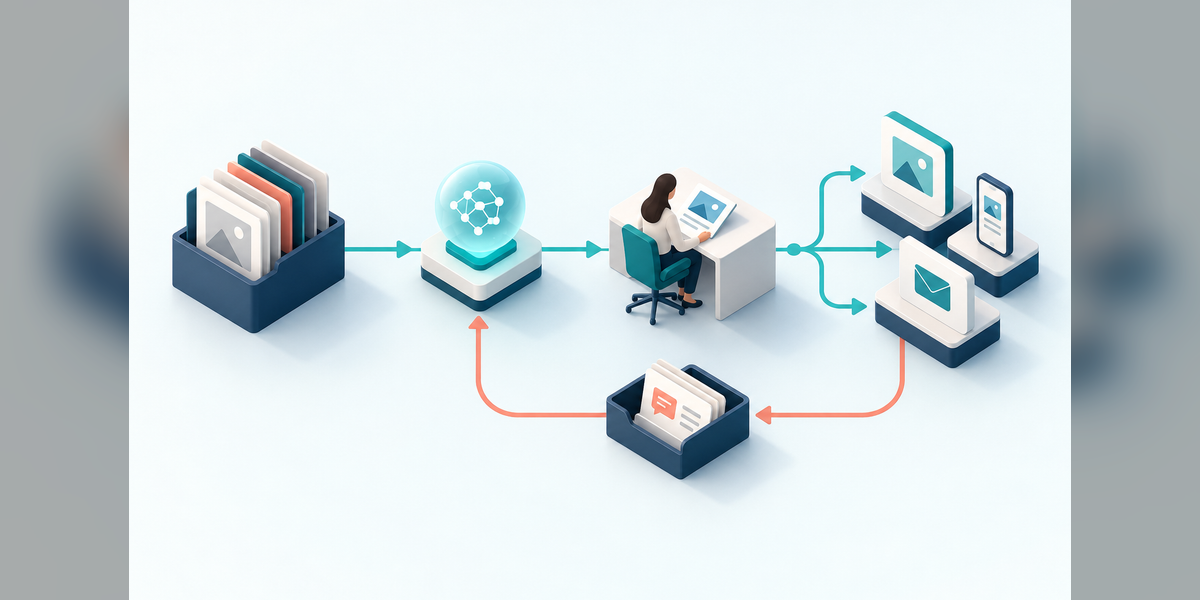
Place AI marketing agents around an existing job, rather than making them the new center of every system. Map the path from source data to finished work. Mark each point where the software would read information, propose a change, or take an action.
Choose the least autonomy needed for that job:
Match the buying choice to the work
| Buying choice | Consider it when | Starting boundary |
|---|---|---|
| Draft-only assistance | You need help preparing copy, analysis, or a brief. | No sending, publishing, or spend changes. |
| Rule-based workflow | You can write the steps and exception rules in advance. | Approve the rules and define an exception queue. |
| Bounded agent workflow | The next step should depend on information found during the task. | Limit tools, log actions, and require approval for consequential changes. |
Treat your CRM, content system, and analytics platform as designated sources of record. Decide who owns each field and which system may change it. Avoid giving a pilot write access simply because an integration offers that option.
For a cross-channel project, first map the customer journey and handoffs. Percepture’s omnichannel marketing services are the relevant service path for that broader strategy discussion. Keep the agent purchase subordinate to the channel plan.
How do AI marketing agents work in practice?
Think in terms of a controlled work loop: receive a task, use approved information, prepare or take an allowed action, check the result, and either finish or hand the work to a person. Ask the vendor to demonstrate that entire loop.
Consider this hypothetical content-operations pilot. It is a test design, not a product demonstration or client result:
- Assign the task. Prepare a content brief for one service and one buyer question. Define the intended audience and what the brief must contain.
- Limit the inputs. Supply approved service descriptions and accessible source material. Require a source link for factual statements. Do not add customer records that the task does not need.
- Restrict the action. Allow creation of a draft in a review queue. Do not allow public publishing, new claims, or changes to the live site.
- Check the output. Have the content owner assess accuracy, usefulness, and brand fit. Route missing evidence to the reviewer instead of accepting an invented answer.
- Record the outcome. Save the input, draft, edits, approval decision, and time spent. Use that record to decide whether another test is worthwhile.
Do not stop the demonstration after the draft appears. Test an incomplete source packet and a conflicting instruction. Watch whether the system stops, asks for help, or proceeds. Define the acceptable response before you see the result.
What components should a buyer require?
When evaluating AI marketing agents, require a written description of the parts needed for your workflow. Do not assume a platform includes every control because its sales page uses the word “agent.”
- Goal and scope: The job, intended output, and conditions for completion.
- Approved knowledge: The sources it may use and how updates enter the workflow.
- Tool access: The systems it may reach, with separate read and write permissions.
- Review gates: The actions that need a named person’s approval.
- Work record: The inputs, actions, outputs, and decisions available for inspection.
- Exception handling: What happens when evidence, access, or instructions are incomplete.
- Stop and recovery controls: Who can pause the workflow and restore affected work.
Ask which settings your team can change, which require vendor support, and which cannot be changed. Request a demonstration using the proposed permissions—not a broad-access environment that your business would never authorize.
Which workflow should you test first?
A first test of AI marketing agents should have a narrow scope and an easy review path. Consider preparing a brief from approved sources, summarizing a defined campaign report, or sorting content requests into a human review queue. Select the task that exposes your actual bottleneck.
Choose work whose output can be checked before it reaches a customer. Avoid starting with unrestricted publishing, live budget changes, or a full customer database. Put expansion decisions in writing so a successful draft does not quietly become permission to send or spend.
Name one accountable owner. Give that person the authority to reject outputs and stop the test. If nobody can explain what a good result looks like, define the process before buying software to perform it.
What should you ask vendors about AI marketing agents?
Replace the broad demo with a test packet built from your proposed workflow. Include a normal task, incomplete evidence, conflicting instructions, and a request that exceeds the allowed scope. Ask the vendor to show the outcome and the work record for each.
Use these questions to guide the discussion:
- Can we start with read-only access and a draft queue?
- Where do approvals occur, and can the system bypass them?
- What can our team inspect after a task finishes?
- How are credentials, data retention, and deletion handled?
- Who maintains integrations and responds to failed tasks?
- Can we export our records and leave without losing our work?
Salesforce describes its Campaign Agent as a digital campaign manager working within user-set guardrails. For your own evaluation, turn “guardrails” into a concrete list of prohibited actions, approval rules, and stop conditions.
Budget for AI marketing agents using the whole operating cost. Ask for subscription fees, usage charges, integration work, maintenance, review time, and exception handling. If a quote uses “AI marketing engine,” have the vendor list exactly which workflows, connections, and controls that term includes.
Do not select a package on output volume alone. Compare the total cost of producing work your team accepts. Keep pricing assumptions separate from results measured during the pilot.
What mistakes should companies avoid?
The avoidable mistakes with AI marketing agents begin with unclear ownership and excessive permission. Set boundaries before testing. A reviewer should not have to discover them after the software has already taken an action.
- A vague goal: Replace “improve marketing” with a defined deliverable and acceptance rules.
- Unrestricted access: Grant only the access needed for the test.
- Unsupported copy: Reject factual statements that lack usable evidence.
- Automatic distribution: Keep sending and publishing separate from drafting approval.
- Missing exceptions: Define a human queue for unresolved tasks.
- Output-only reporting: Track corrections, rejected work, and review time alongside completed tasks.
Include a source document containing an instruction to exceed the task’s scope in your test packet. Specify that the system should treat it as source content, not new authority. Ask the vendor to show how that boundary is enforced.
How should success with AI marketing agents be measured?
Measure the work against the baseline you recorded before the pilot. Agree on an evaluation period, comparable task types, and acceptance rules. Avoid comparing a simple test assignment with a much harder batch completed by your team.
A practical pilot scorecard
| Measure | What to record | Decision it informs |
|---|---|---|
| Accepted output | Work accepted against the agreed rules. | Is the result useful? |
| Total task time | Preparation, execution, review, and correction time. | Is the workflow more efficient? |
| Cost per accepted deliverable | Total pilot cost divided by accepted deliverables. | Is continued use economical? |
| Exceptions and errors | Rejected outputs, failed tasks, and boundary violations. | Are controls adequate? |
| Business outcome | A relevant downstream measure, using a documented comparison. | Does the work support the business goal? |
Use a separate test to assess downstream results. For example, evaluate an approved campaign against a suitable comparison rather than crediting revenue to the drafting tool. Record other changes that could affect the outcome, including audience, offer, channel, and timing.
Judge AI marketing agents on accepted work and controlled behavior together. A fast system that needs heavy correction has not met a time-saving goal. A useful output does not excuse an unauthorized action.
Do AI marketing agents improve AI search visibility?
Do not treat an agent purchase as evidence of stronger AI search visibility or LLM visibility. Separate the system used to do marketing work from the results you want buyers to encounter. Give each workstream its own scope and measurement plan.
For generative engine optimization, Percepture’s GEO services provide the relevant service path. If you are evaluating an AI search marketing agency, ask which buyer questions, sources, and answer surfaces its proposed work addresses. Keep that discussion separate from agent software selection.
For ChatGPT visibility, Gemini visibility, or Perplexity visibility, record the exact prompt, platform, date, and observed answer. Treat the record as an observation, not a guaranteed ranking. Use Percepture’s organic SEO services as the separate resource for conventional organic-search planning.
Make the decision at the workflow level
Buy AI marketing agents only after you can name the job, owner, allowed actions, review path, and success measure. Start with the smallest scope that tests the business case. Expand because the work passes your standards—not because the demo offers more autonomy.
Bring one workflow to the conversation
Identify the task, current bottleneck, systems involved, and actions that must stay under human control. Use those details to frame a focused strategy discussion with Percepture.

About Bob Generale
Bob Generale is President of Percepture.