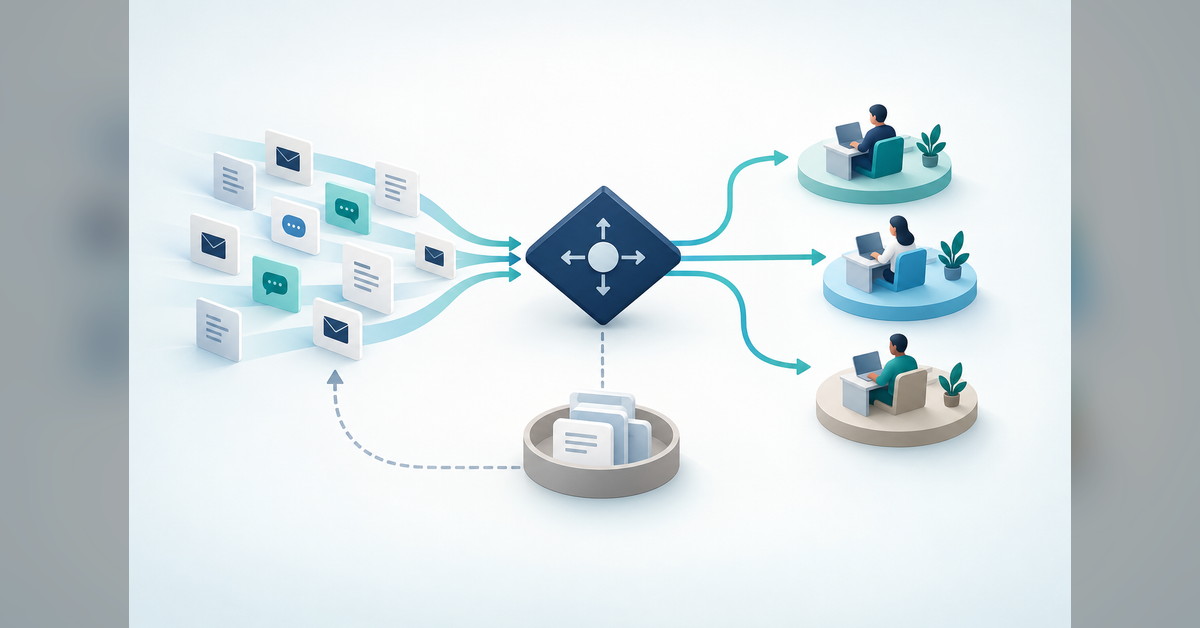

Evaluate CRM lead routing by what happens after assignment: who accepts the inquiry, when follow-up is due, and who takes over if the first handoff fails. Make those decisions before comparing automation features.
Before adding an AI agent or another integration, define account ownership, duplicate handling and response expectations. Then ask each provider to demonstrate the same difficult cases—not just a clean form submission that reaches an available salesperson.
What is CRM lead routing?
CRM lead routing is the process of assigning an incoming inquiry to an accountable sales owner or queue using defined rules. Those rules may consider account ownership, territory, product interest, availability and capacity. A complete routing design also specifies duplicate handling, response deadlines, escalation and fallback ownership when the intended handoff cannot be completed.
Who needs tighter handoff controls?
This guide serves business owners, marketing leaders and sales operators choosing or repairing CRM lead routing. Use it when the buying decision involves multiple teams, overlapping territories, existing customer relationships or AI-assisted interpretation of inquiries.
Keep the boundaries clear. Define lead scoring as your prioritization policy, routing as your assignment policy, and qualification as your criteria for a sales conversation. Do not let an assignment event automatically stand in for an accepted or qualified lead.
Compare the assignment approach, not the feature count
Compare CRM lead routing options against the same operating requirements. The table below presents design choices, not vendor capability claims or tested rankings. Ask providers to substantiate fit with configuration, execution records and a demonstration using your acceptance cases.
| Option | Audience fit | Evidence | Technical constraint | Cost and reliability checks | Tradeoff | Verification source |
|---|---|---|---|---|---|---|
| Named-account ownership | Teams protecting existing relationships | Owner match and exception record | Reliable account identity | Include ownership maintenance | Decide how stale owners are handled | Your account records and configured rules |
| Territory or product rules | Teams with defined coverage | Boundary and overlap cases | Consistent field values | Include territory-change testing | Define precedence for overlapping rules | Your territory map and rule export |
| Round-robin allocation | Teams seeking an allocation sequence | Assignments across eligible representatives | Eligibility and concurrent updates | Test absence and duplicate events | Equal turns need not mean equal workload | Configuration and assignment history |
| Capacity-aware allocation | Teams allocating against workload limits | Full-capacity and availability cases | Defined capacity measure | Include availability-data upkeep | Choose how capacity differs from performance | Capacity policy and execution records |
| AI-assisted classification plus rules | Teams interpreting free-text inquiries | Expected classifications and resulting routes | Bounded model input and write authority | Include evaluation, review and usage costs | Specify when uncertainty requires review | Your evaluation set and integration logs |
For an existing customer asking about a second product, should account ownership outrank product specialization? For a new prospect, should territory outrank capacity? Resolve those conflicts explicitly. A polished demonstration is not a substitute for an agreed precedence policy.
Build CRM lead routing around a durable handoff
Ask the implementation team to walk one inquiry through the entire chain. At every step, identify the record being changed, the decision being made and the person responsible for an exception.
Capture the inquiry without losing its origin
Require a stable inquiry identifier, receipt time, source channel and destination record. Define what happens when the same submission arrives twice or an integration retries after a timeout. Separate the original inquiry from later status changes so a reassignment does not rewrite how the conversation began.
Resolve identity before changing ownership
Document the matching order for contacts, companies and accounts. Decide which identifiers permit an automatic match and which require review. A company domain alone should not be your unquestioned ownership authority; test subsidiaries, shared domains and ambiguous matches. Specify whether a duplicate submission updates an existing record or creates a linked inquiry.
Enrich only what the decision requires
For CRM lead routing, request only enrichment fields that change an assignment or review decision. Set a freshness rule and a timeout path for each dependency. If enrichment is unavailable, decide whether the inquiry can proceed with its submitted data or must enter a staffed review queue.
When considering B2B intent data, ask which signal would change priority and which ownership rules it must never override. Keep inferred interest separate from information the buyer supplied directly.
Assign once, then record acceptance
Choose the rule precedence and document the eligible owner pool. Require a check for ownership changes made while the workflow was running. Before retrying an uncertain assignment, reconcile the current record state. Track assignment and acceptance as separate events rather than treating a notification as proof that someone has taken responsibility.
Start a defined response clock
Write the service-level agreement in operational terms: the start event, staffed hours, time zone, deadline and qualifying action. Distinguish internal acknowledgment from a customer-facing response. Name the escalation recipient and fallback queue, and specify who monitors that queue when the original owner is unavailable.
Preserve attribution through reassignment
Record original source, campaign context, ownership changes and conversation milestones separately. Do not use the latest owner field as the entire history. For reporting design, connect the routing event model with attribution and analytics, including an explicit definition of an accepted lead and a qualified conversation.
Apply the Authority Envelope and Recovery Loop
Use the Authority Envelope and Recovery Loop as a two-part decision aid for CRM lead routing. The Authority Envelope defines what automation may decide or change. The Recovery Loop defines what happens when a decision cannot be completed, is disputed or produces an uncertain result.
- Authority Envelope: List permitted inputs, eligible records, writable fields, assignment rules and actions requiring human review.
- Recovery Loop: Detect the exception, preserve the inquiry, reconcile record state, place it with an accountable fallback owner and document the resolution.
Apply both parts to ordinary rules and AI-assisted steps. A deterministic workflow still needs a recovery path; an AI recommendation still needs an enforceable boundary.
An illustrative inquiry with conflicting signals
Consider a hypothetical CRM lead routing test: an existing customer submits a request about another product, the company name differs from the account record, and the account owner is absent. Assume the team has chosen a 15-minute staffed-hours acknowledgment target.
Under the proposed policy, preserve the existing relationship while resolving the identity conflict. Let the AI component suggest a product category, but do not authorize it to replace account ownership. Send the ambiguous match to the designated review queue with the original submission attached.
If the queue misses the chosen deadline, escalate to its named supervisor. If an assignment request times out, inspect the CRM before retrying. The expected result is one preserved inquiry, a traceable ownership decision and an accountable next action—not an invented sales outcome.
| Control | Pass condition | Repair condition |
|---|---|---|
| Identity | Ambiguity enters the designated review path | A weak match silently replaces ownership |
| Authority | Classification stays within permitted actions | Model output directly changes restricted fields |
| Response | Deadline and escalation recipient are recorded | The inquiry waits without an accountable owner |
| Recovery | State is reconciled before a retry | A retry creates another conflicting assignment |
Control what an AI agent can read and change
In CRM lead routing, ask for the exact integration identity and permissions—not a general assurance about security. Specify which objects and fields it may read, which it may update, and which records are outside its scope. Keep credentials in the application’s credential-management path rather than including them in model input.
Write the agent’s instructions around a narrow task, such as selecting a permitted product category. Require a defined output format and an explicit uncertain result. Have application logic validate that output against allowed values before using it in an assignment decision.
Treat inquiry text, attachments and enrichment responses as untrusted inputs. Include evaluation cases where submitted text asks the agent to ignore routing rules or select an unauthorized owner. Enforce permissions outside the prompt; do not make prompt wording the only control.
If the project extends into AI sales agents, define routing and outreach permissions separately. Approval to classify an inquiry should not automatically authorize sending messages, changing commercial terms or modifying unrelated records.
Test CRM lead routing failures before launch
Give every provider the same acceptance set, including clean inquiries and exceptions. For each case, record the expected owner or queue, allowed record changes and recovery action. Include:
- A duplicate submission and a repeated integration event.
- An existing account with an inactive owner.
- Overlapping territories and missing assignment fields.
- An enrichment timeout and an exhausted owner pool.
- A manual ownership change during processing.
- An instruction embedded in inquiry text that requests an unauthorized action.
For CRM lead routing performance, measure correct assignments against your expected results, time without an accountable owner, response-target attainment and unresolved exceptions. Report automated completion and human-review rates separately. Keep a person’s correction visible rather than counting the corrected record as an initially correct automated decision.
Require error records that identify the event, affected record, rule version, attempted action and resolution without unnecessarily exposing customer content. Name the person who can stop writes, the incident contact and the process for reconciling affected inquiries before restarting.
Use the NIST AI Risk Management Framework as a risk-planning reference. For an OpenAI-based component, consult the OpenAI evaluation documentation when planning its evaluation work.
Budget for maintenance and recovery, not just setup
Scope the CRM lead routing budget around the work required: field mapping, matching rules, integrations, historical-data cleanup, evaluation cases, operator training and ongoing changes. Ask vendors to separate licenses and usage charges from implementation and support.
Then ask who maintains territories, owner eligibility, prompts and tests. Include review-queue staffing, incident investigation and regression testing after configuration changes. Request a priced scope with assumptions and exclusions rather than treating an introductory platform price as the cost of the operating workflow.
Questions to settle before choosing a provider
How does CRM lead routing differ from lead scoring?
Treat routing as the ownership decision and scoring as the prioritization decision. Specify whether a score changes urgency, eligibility or queue order. Do not let a high score override an existing account relationship unless that exception is part of your documented assignment policy.
Which tools should a routing agent access?
Authorize only the tools needed for its assigned task. Define access to record lookup, approved enrichment, assignment and notification separately. Require the provider to show the integration identity, permitted actions and record scope, including what happens when an attempted action falls outside those permissions.
What data should stay outside the model?
Start with the minimum fields needed for classification. Keep credentials, unrelated records and unnecessary sensitive content out of model input. Decide which submission fields may be sent to the selected provider, which require redaction and how retention settings fit your organization’s data-handling requirements.
Who should be able to override or stop automation?
Name an accountable operations owner and a backup. Give them a documented way to pause assignment writes, redirect new inquiries and correct ownership. Require overrides to record who changed what and why, and define when automation may resume without replacing the human decision.
How should routing accuracy and failures be evaluated?
Use representative cases with expected owners or queues, then assess incorrect assignments, unresolved exceptions and response delays separately. Include retries, missing data, unavailable owners and conflicting updates. Review results by source and route type so a strong overall result does not conceal a failing path.
How much does CRM lead routing implementation cost?
Request a quote tied to your systems, routing policy, data cleanup and acceptance tests. Separate setup, recurring platform fees, usage, support and internal review effort. Ask what changes trigger additional work and who pays for maintenance when territories, staffing or integration requirements change.
Make the next decision with one real inquiry
Choose a recent inquiry and trace it from capture to conversation. Bring the ownership policy, response clock and exception history into the buying discussion. For a broader channel-to-sales handoff, connect that exercise with your omnichannel marketing strategy rather than evaluating routing in isolation.
Scope the work before comparing proposals
For a broader Percepture marketing engagement, review the available pricing options. Use your inquiry walkthrough to identify which strategy, measurement and implementation work belongs in the scope.
About Bob Generale

Bob Generale is President of Percepture. His work connects organic search, AI search visibility, digital PR, audience targeting and sales intelligence. For this guide, his editorial focus is the connection between a marketing inquiry and an accountable sales conversation: what the buyer asked, who should respond and how the organization handles an exception. He brings Percepture’s research, strategy and publishing teams around the goal of earning qualified conversations rather than evaluating impressions in isolation. The article applies that perspective to capture, identity matching, assignment, escalation and attribution. Its comparisons give business and marketing leaders practical questions to take into planning discussions with their sales operations teams and prospective providers.