
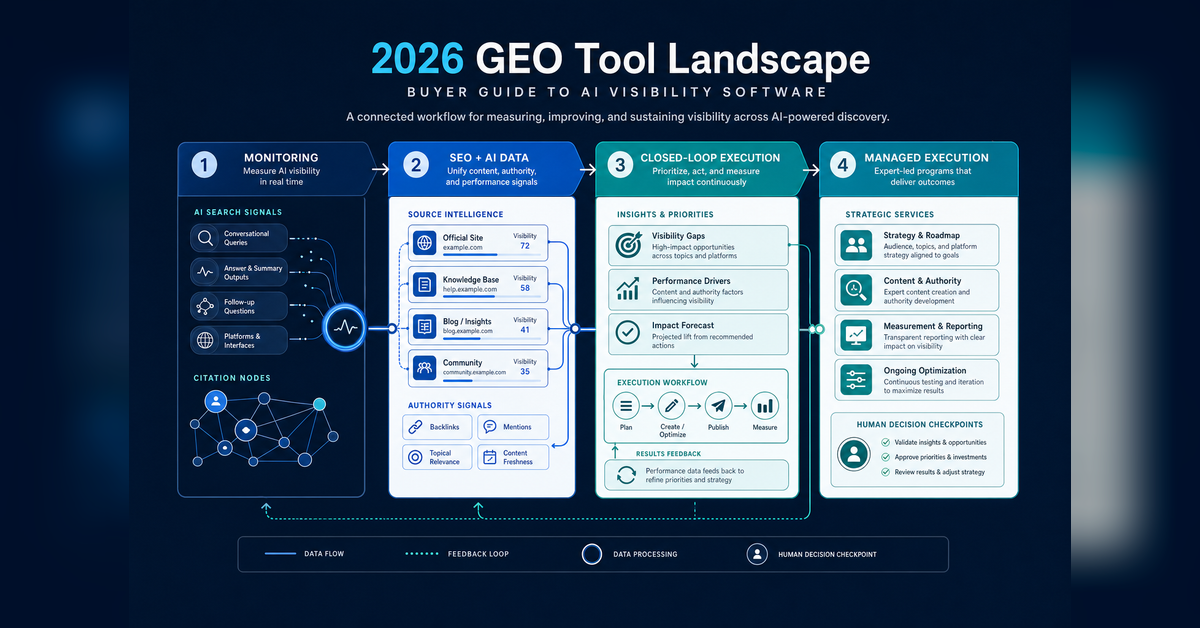

The best Generative Engine Optimization Tools depend on what happens after they find a visibility gap. Prime AI Visibility fits monitor-to-content workflows, Profound fits enterprise AEO operations, Semrush and Ahrefs fit teams that want AI data beside SEO data, and Otterly.AI fits straightforward monitoring.
The main buying decision is not which dashboard has the longest feature list. It is whether you need monitoring, SEO context, content execution, attribution, or a managed team. Percepture collaborates on Prime AI Visibility, so Prime is evaluated here with that relationship disclosed rather than presented as an independent inclusion.
Which GEO tools are best for each job?
Generative Engine Optimization Tools measure how brands, competitors, and sources appear in AI-generated answers. Prime is a strong fit for turning buyer-question gaps into draft inputs. Profound serves complex enterprise operations. Semrush and Ahrefs connect AI visibility to established SEO datasets. Goodie connects monitoring with action and attribution, while Otterly.AI emphasizes accessible prompt monitoring.
Quick picks for marketing leaders
Monitor and create
Shortlist Prime, Goodie, Profound, AthenaHQ, and Writesonic when the team expects Generative Engine Optimization Tools to recommend or support content work after measurement.
Add AI data to an SEO stack
Start with Semrush or Ahrefs when Generative Engine Optimization Tools, search rankings, backlinks, and technical findings must be reviewed together.
Build a clean monitoring layer
Consider Peec AI or Otterly.AI when the immediate need is prompt tracking, competitor comparison, and citation review.
Run managed execution
Use software with a human operator when the work includes technical SEO, editorial planning, authority building, digital PR, and conversion paths.
Best Generative Engine Optimization Tools at a glance
This table separates monitoring from action across the leading Generative Engine Optimization Tools. Product features and plan structures can change quickly, so buyers should compare the current plan against their required engines, prompt volume, regions, exports, and workflow.
2026 GEO platform comparison
| Tool | Best for | Monitoring focus | Content or action | SEO or attribution | Published entry point | Main limitation |
|---|---|---|---|---|---|---|
| Prime AI Visibility | Measure-to-draft workflow | Buyer questions, mentions, citations, gaps | Source-enriched draft inputs | Designed to pair with an SEO layer | Check current public plan | Newer historical ecosystem |
| Profound | Enterprise AEO operations | Visibility, citations, sentiment, share of voice | Agents support content workflows | Enterprise workflow context | $99 plan described in supplied documentation | Engine and workflow access varies by plan |
| Semrush AI Visibility Toolkit | Existing SEO-suite users | Brand, competitor, and prompt research | AI Site Audit supports action planning | Broad SEO context | $99 per month per domain in supplied documentation | Prompt and domain limits |
| Ahrefs Brand Radar | Search-backed prompt and web data | Mentions, citations, impressions, AI share of voice | Requires a separate execution workflow | Search, backlink, and web context | Check current plan | Less vertically integrated execution |
| Goodie | Closed-loop action and attribution | Prompts, responses, citations | Optimization actions | Analytics attribution support | $399 per month in supplied documentation | Higher entry price |
| Peec AI | Clean monitoring and agency views | Visibility and competitor benchmarking | Monitoring-led workflow | Reporting context | Check current plan | Execution happens elsewhere |
| AthenaHQ | Prescriptive on-page workflows | Prompt and visibility analysis | Action-oriented workflow | On-page context | Check current plan | Feature access can vary by plan |
| Scrunch AI | AI content delivery infrastructure | Platform monitoring and audits | Content delivery on larger plans | Infrastructure and governance context | $250 per month in supplied documentation | Broadest capabilities sit above the core plan |
| Writesonic | Content-heavy GEO workflow | AI visibility and traffic analysis | Content creation workflow | Content and search context | Check current plan | Confirm which GEO features are included |
| Otterly.AI | Budget-conscious monitoring | Daily prompt and citation tracking | Limited native execution | Exports and GEO audits | Plans based on tracked prompt volume | Content work happens in another system |
Prices shown above come from the supplied official-documentation research. Vendors change plans frequently. Confirm current pricing, included engines, prompt limits, and add-ons before purchase.
No single product wins every column. The strongest shortlist starts with the operating job, then checks whether the selected Generative Engine Optimization Tools retain raw answers, distinguish mentions from citations, and give the team a practical next action.
Want to see what AI search says about your brand?
Use Generative Engine Optimization Tools to map buyer questions, mentions, citations, and missing coverage before deciding what to fix.
How we evaluated GEO tools
This is a documentation-based operator comparison of Generative Engine Optimization Tools, not a controlled test. Percepture reviewed the supplied product documentation and applied the same eight criteria to each platform. Percepture collaborates on Prime AI Visibility, so its placement includes first-party familiarity and a clear affiliation disclosure.
Eight criteria that change the buying decision
Engine coverage
Identify which consumer answer engines a plan monitors and whether coverage changes by tier.
Prompt quality
Check how Generative Engine Optimization Tools handle custom prompts, search-backed datasets, prompt research, regional controls, and rerun frequency.
Citation evidence
Require Generative Engine Optimization Tools to provide linked sources, source pages, raw answers, timestamps, and an audit trail.
Competitive intelligence
Compare share of voice, competitor mentions, positioning, sentiment, and topic gaps.
Execution
Separate dashboard-only Generative Engine Optimization Tools from products that recommend, optimize, draft, refresh, or publish content.
SEO connection
Determine whether keyword, technical, backlink, ranking, and traffic data are available beside AI results.
Attribution
Check whether Generative Engine Optimization Tools support AI referral, analytics, conversion, or revenue analysis.
Price transparency
Review prompt limits, add-ons, workspaces, domains, history, exports, and enterprise gates.
Three metrics from Generative Engine Optimization Tools should remain separate. A mention means the brand appears in an answer. A citation means an answer links to a source. A recommendation means the brand is actively suggested. Combining them can make a weak result look stronger than it is.
AI answers also vary by model, time, region, search state, and personalization. The best Generative Engine Optimization Tools preserve enough context to explain what was measured instead of presenting one volatile answer as a permanent score.
The 10 best GEO and AI visibility platforms in 2026
These profiles focus on buyer fit, workflow, limitation, and the practical next step. They do not use star ratings or unsupported accuracy claims.
1. Prime AI Visibility: best for turning gaps into content
Best for: teams and agencies that want buyer-question monitoring, citation analysis, and draft inputs in one workflow.
Prime maps buyer questions across major AI answer environments, classifies whether a brand is cited, mentioned, or missing, and surfaces competitor and source gaps. Its practical distinction is the sequence: measure the gap, create source-enriched draft inputs tied to that gap, publish through an accountable editorial process, and monitor again.
That makes Prime one of the more action-oriented Generative Engine Optimization Tools in this comparison. It does not remove the need for keyword research, technical SEO, expert review, original proof, digital PR, or conversion planning.
Main limitation: Prime is a newer platform with a smaller historical ecosystem than established SEO suites. Features and plan details can also change as the product develops. Percepture collaborates on Prime, and buyers should weigh that disclosed relationship when reading this ranking.
2. Profound: best for enterprise AEO operations
Best for: larger organizations that need structured answer-engine intelligence, workflow controls, and broader operational support.
Among enterprise-oriented Generative Engine Optimization Tools, Profound’s Answer Engine Insights covers visibility, citations, sentiment, share of voice, and positioning. Its Agents capability extends the workflow into finding gaps, generating or refreshing content, and publishing. Supplied official documentation describes a $99 entry plan with limited engine and prompt access, while higher plans expand engines and operational features.
Profound stands out when multiple teams need a formal AEO operating layer rather than a small monitoring utility. Search-backed prompt data also helps teams move beyond a list made entirely from internally invented prompts.
Main limitation: engine access, prompt capacity, and advanced workflows vary by plan. The platform may be more complex than a small team needs. Review the current Profound pricing and plan documentation against the exact markets and engines in scope.
3. Semrush AI Visibility Toolkit: best SEO and AI suite
Best for: marketing teams that already use Semrush and want AI visibility reviewed beside established SEO data.
The supplied documentation describes brand performance, competitor research, prompt research, tracked prompts, and an AI Site Audit. That combination helps an operator connect answer-engine findings with keyword, technical, and competitive search work rather than moving data between unrelated dashboards.
Semrush is a practical choice when Generative Engine Optimization Tools must fit an existing SEO reporting process. Its value is the surrounding search ecosystem, not just a stand-alone AI score.
Main limitation: tracked prompts and domains are limited by plan, and broader execution may require additional products or human work. Confirm the engines and limits included for each domain before standardizing the toolkit across a portfolio.
4. Ahrefs Brand Radar: best for search-backed AI demand data
Best for: teams that value prompt discovery, web-scale search context, backlinks, and source analysis.
Ahrefs Brand Radar is positioned around mentions, citations, impressions, AI share of voice, major AI indexes, and custom prompts. The supplied documentation describes a large search-backed prompt dataset, which is useful because custom prompts and observed demand answer different questions.
Custom prompts show how a chosen buying journey performs. Search-backed prompt data helps reveal questions the team did not think to write. Ahrefs can then connect that intelligence to its wider web and backlink dataset.
Main limitation: compared with vertically integrated Generative Engine Optimization Tools, Ahrefs is stronger as a data and SEO context layer than as a measure-to-draft workflow. Teams still need a clear editorial, technical, and authority-building process after a gap is identified.
5. Goodie: best for closed-loop action and attribution
Best for: teams that want research, monitoring, optimization actions, and analytics attribution in one operating model.
The supplied official documentation describes an Explorer plan at $399 per month with tracked prompts, response capacity, optimization actions, and analytics attribution. Larger tiers expand scale and engine coverage. This makes Goodie relevant when the buyer expects more than a visibility chart.
Goodie’s strength is the research-to-action-to-measure loop. Among Generative Engine Optimization Tools, that workflow is useful for teams trying to connect content work with business reporting instead of treating mentions as the final outcome.
Main limitation: the entry price is higher than a simple fixed-prompt monitor. Buyers should confirm that the included action capacity, engines, analytics connection, and response limits match their monthly operating volume.
6. Peec AI: best for clean monitoring and agency views
Best for: teams that want a focused visibility interface and agencies that compare brands, markets, or competitors.
Peec AI belongs on the shortlist of Generative Engine Optimization Tools when the core job is recurring AI visibility monitoring rather than content production. A clean monitoring layer can be easier to adopt when clients need understandable competitor comparisons and repeatable reports.
The buyer should inspect prompt setup, country support, data retention, screenshots or raw-answer evidence, exports, workspaces, and account permissions. Those details often matter more to an agency than another top-level score.
Main limitation: the workflow is primarily monitoring-led. Editorial strategy, content development, technical changes, authority work, and conversion updates still need another system or an operator. Confirm current engines and pricing directly before purchase.
7. AthenaHQ: best for prescriptive on-page workflows
Best for: teams that want visibility findings translated into on-page and entity-oriented actions.
AthenaHQ is positioned closer to prescriptive execution than a passive rank tracker. Supplied research identifies action-oriented workflows, prompt analysis, schema and entity support, and ecommerce use cases. That direction can fit teams that want clearer recommendations after monitoring.
When comparing AthenaHQ with other Generative Engine Optimization Tools, ask which recommendations are available in the selected plan, how each action is supported by evidence, and whether the platform retains the answer and source record behind the recommendation.
Main limitation: plan-level access to specific capabilities must be checked at purchase. Buyers should also determine where the platform stops and where developers, editors, subject experts, or digital PR teams must take over.
8. Scrunch AI: best for AI content delivery infrastructure
Best for: organizations that view AI visibility as part of a broader content and agent-experience infrastructure program.
The supplied official documentation describes a $250-per-month Core plan with prompt monitoring, audits, one workspace, and platform coverage. Enterprise capabilities expand content delivery, platform coverage, API access, and organizational controls.
Scrunch differs from lightweight Generative Engine Optimization Tools because its scope reaches toward how content is prepared and delivered for AI experiences. That can suit organizations where governance, integration, and infrastructure matter alongside visibility.
Main limitation: the broadest delivery and governance capabilities sit in higher plans. A smaller content team may pay for complexity it does not yet need, while an enterprise buyer should document security, API, permission, and implementation requirements before selection.
9. Writesonic: best for a content-heavy GEO workflow
Best for: content teams that want AI visibility work close to an established content generation and optimization environment.
Writesonic brings content-production experience into Generative Engine Optimization Tools and AI visibility workflows. That makes it relevant when the team expects to move quickly from a missing topic or source pattern into a content brief, draft, optimization task, or refresh.
Speed is useful only when the resulting content has expert judgment, original evidence, clear sourcing, internal links, entity coverage, and a real conversion path. Generated volume without those controls can create more pages without creating stronger authority.
Main limitation: buyers should confirm current engine coverage, prompt sourcing, plan limits, and which GEO capabilities are included in the selected tier. Ask whether the system preserves raw answers and source conditions for later review.
10. Otterly.AI: best for budget-conscious monitoring
Best for: smaller teams that want fixed-prompt monitoring, citation analysis, and daily tracking without a large execution platform.
The supplied official help documentation describes plans based on 15, 100, or 400 tracked prompts. It also describes tracking across core AI answer environments, with some engines available through add-ons, plus citation analysis, GEO audits, prompt research, and exports.
Among accessible Generative Engine Optimization Tools, Otterly.AI is a sensible starting point when the immediate goal is to create a baseline, watch a focused prompt set, and identify source patterns. It can also help a team learn which questions deserve deeper investment before purchasing a larger platform.
Main limitation: native execution is lighter than closed-loop platforms. Teams still need a process for prioritization, content, technical fixes, authority building, and measurement beyond the dashboard.
Monitoring tools versus execution tools
Generative Engine Optimization Tools do not form one uniform software category. A buyer can purchase an excellent monitor and still have no process for fixing what it finds. The four operating models below prevent that mismatch.
Choose the operating model before the vendor
| Model | What it does well | What remains | Typical fit |
|---|---|---|---|
| Visibility monitor | Tracks prompts, mentions, citations, competitors, and trends | Prioritization and execution | Small teams, agencies, baseline programs |
| SEO suite with AI module | Connects AI findings with keywords, rankings, backlinks, and technical data | Dedicated GEO production workflow | Established SEO teams |
| Closed-loop GEO platform | Monitors and supports recommendations, drafts, optimization, or automation | Expert review, proof, authority, and governance | Content and growth teams |
| Managed GEO execution | Turns data into technical, editorial, authority, PR, and conversion work | Internal alignment and approvals | Teams without dedicated operators |
This distinction should guide every demo of Generative Engine Optimization Tools. Ask the vendor to show the complete path from a missing answer to the final action. If the workflow ends at a chart, the buyer is purchasing intelligence rather than execution.
What features matter most?
Prompt quality comes first. The prompt systems inside Generative Engine Optimization Tools should combine a custom set for known buyer journeys with search-backed discovery that can reveal demand outside that list. Strong programs use both without pretending SEO keyword demand and AI prompt demand are the same dataset.
Citation evidence comes next. A dashboard should distinguish a brand mention from a linked citation and a recommendation. Raw answers, source URLs, dates, engine conditions, and regional settings make findings easier to audit.
Coverage must match the market. A longer engine list does not automatically make Generative Engine Optimization Tools more useful. Select the engines buyers actually use, then check whether the required coverage sits inside the proposed plan or behind an add-on.
Action determines operating value. Some Generative Engine Optimization Tools stop after identifying a gap. Others recommend changes, create draft inputs, optimize pages, or support publishing. Human operators still have to validate claims, add proof, protect brand voice, and decide whether a topic deserves investment.
Attribution needs separate measures. Track search rankings, AI inclusion, mentions, linked citations, recommendations, referral traffic, conversions, and qualified pipeline separately. One blended visibility score cannot explain which part of the system improved.
The Percepture Measure, Prioritize, Build, Prove framework
- Measure: capture buyer questions, mentions, citations, recommendations, competitors, and source gaps.
- Prioritize: compare visibility gaps with keyword demand, difficulty, paid competition, commercial fit, and organizational value.
- Build: create or improve the page, technical foundation, entity signals, internal links, authority, PR support, and conversion path.
- Prove: remeasure rankings, AI inclusion, citations, traffic, conversions, and qualified demand as separate outcomes.
How Percepture uses Prime AI Visibility and KeywordIQ together
Prime and KeywordIQ answer different questions. Prime maps buyer questions and AI visibility gaps. KeywordIQ keyword intelligence helps prioritize search opportunities using demand, difficulty, paid competition, and organic opportunity. One describes AI-answer visibility. The other adds search economics.
The operator workflow
- Map the answer space. Prime identifies buyer questions and separates cited, mentioned, recommended, and missing coverage.
- Choose commercially useful work. A strategist compares findings from Generative Engine Optimization Tools with search demand, business fit, competition, and likely buyer value. An SEO forecasting tool can add planning context without turning a projection into a promise.
- Build and remeasure. Draft inputs become expert-led content with technical SEO, proof, entities, internal links, schema, authority support, and conversion paths.
Percepture’s work on how AI search optimization tools increase organic traffic shows why the dashboard is only one part of the operating system. The broader job includes search targeting, useful content, technical access, and repeated measurement.
Teams that want the execution layer can combine GEO analysis with enterprise SEO, content marketing, digital PR, and attribution and analytics. That mix addresses discovery, authority, production, measurement, and business reporting.
What software cannot do by itself
Generative Engine Optimization Tools can expose missing topics and source patterns. They cannot interview the subject expert, approve a claim, earn third-party authority, repair a technical template, align a sales path, or decide whether a high-volume topic attracts the right buyer.
That is why Percepture also connects AI-search findings with conversion rate optimization and omnichannel marketing. Visibility is useful when the next step helps the buyer and creates a measurable commercial path.
A dashboard finds the gap. Execution closes it.
Percepture can connect findings from Generative Engine Optimization Tools with SEO, content, authority, technical work, and conversion planning.
Which GEO tool should you choose?
The right shortlist of Generative Engine Optimization Tools depends on the current operating gap. Use this decision table before scheduling product demos or comparing annual contracts.
Buyer selection framework
| Your primary need | Start with | What to verify |
|---|---|---|
| Enterprise orchestration | Profound or Scrunch AI | Security, governance, API access, engines, workspaces, implementation |
| SEO and AI in one reporting stack | Semrush or Ahrefs | Prompt limits, domains, AI indexes, exports, execution handoff |
| Monitor-to-content workflow | Prime, Goodie, AthenaHQ, or Writesonic | Evidence behind recommendations, editorial controls, publishing workflow |
| Agency monitoring | Peec AI or Otterly.AI | Clients, countries, workspaces, exports, screenshots, history |
| Managed execution | Percepture | Scope, proof requirements, technical access, production capacity, reporting |
Before buying Generative Engine Optimization Tools, run the same five questions through each demo: What is measured? How are prompts sourced? Can we inspect the raw answer and citation? What action follows a gap? How will that action connect to traffic, conversion, and qualified demand?
Who should buy now?
Buy a monitor
Choose monitoring-focused Generative Engine Optimization Tools when you have people who can act on findings but no reliable baseline for AI answers, citations, or competitors.
Buy a closed-loop platform
Your content team needs a shorter path from visibility gap to a reviewed production task.
Extend an SEO suite
Your search program is mature, and the team wants AI visibility inside familiar data and reporting.
Use a managed team
You lack the technical, editorial, authority, or conversion resources required after monitoring.
Related GEO and AI-search resources
Frequently asked questions
What are Generative Engine Optimization Tools?
Generative Engine Optimization Tools measure how a brand, competitor, product, or source appears in AI-generated answers. Common functions include prompt tracking, mention monitoring, linked-citation analysis, share of voice, sentiment, source discovery, competitor gaps, recommendations, content support, and attribution. Capabilities vary widely, so buyers should separate monitoring products from execution platforms.
What is the best GEO tool in 2026?
There is no universal winner among Generative Engine Optimization Tools. Prime fits monitor-to-content workflows. Profound fits enterprise AEO operations. Semrush and Ahrefs fit teams that want AI data beside SEO data. Goodie fits closed-loop action and attribution. Otterly.AI fits accessible prompt monitoring. Choose based on the job, required engines, prompt quality, evidence, execution, and budget.
Is there a free GEO monitoring option?
Some Generative Engine Optimization Tools offer limited entry options, trials, or small prompt allowances, but availability can change. A free or low-cost plan is useful for learning the workflow and establishing a small baseline. Confirm engine coverage, rerun frequency, historical retention, citation evidence, exports, and whether important features require an add-on.
Which tools track ChatGPT and Google AI Overviews?
Several Generative Engine Optimization Tools in this guide describe coverage for ChatGPT, Google AI experiences, or both. Coverage can vary by plan, country, product index, and collection method. Ask the vendor to demonstrate the exact environment, show a retained raw answer, identify the region and date, and explain whether linked citations are stored separately from brand mentions.
Can GEO platforms create content after finding a gap?
Some Generative Engine Optimization Tools can. Prime creates source-enriched draft inputs tied to buyer-question and citation gaps. Profound, Goodie, AthenaHQ, Scrunch AI, and Writesonic also support action-oriented workflows in different forms. Generated output still requires subject expertise, factual review, sourcing, brand controls, internal linking, technical checks, and conversion planning.
How much do GEO tools cost?
Pricing for Generative Engine Optimization Tools ranges from limited entry plans to enterprise contracts. The subscription price is only one part of cost. Compare tracked prompts, response volume, domains, workspaces, regions, engines, history, exports, analytics connections, API access, content actions, and required human labor. Percepture’s AI search and GEO pricing explains the separate managed-execution path.
Do GEO tools replace SEO tools?
No. GEO platforms measure visibility in AI-generated answers, while SEO platforms provide keyword, ranking, backlink, crawling, technical, and traffic context. The datasets complement each other. AI visibility can reveal an answer gap, while SEO research helps determine whether the related topic has organic demand, commercial value, and a realistic path to visibility.
Integrated execution matters after the dashboard
The published Broadstaff Global case study reports that 90% of tracked keywords reached page one and qualified leads increased threefold within 12 months. The case supports the value of coordinated search execution. It does not prove that a GEO dashboard alone created the outcome.
Marketing leaders should apply the same standard to Generative Engine Optimization Tools: require clear measurement, documented limitations, accountable execution, and separate business reporting.
Need the tool and the team?
Percepture can audit where your brand is missing across Google and AI search, prioritize the opportunities worth pursuing, and build the technical, editorial, authority, and conversion work behind the fix.
Use Generative Engine Optimization Tools to find the gap. Use an accountable operating team to close it.

About Bob Generale
Bob Generale is President of Percepture. He works with Percepture’s strategy, SEO, GEO, content, analytics, and digital communications teams to help organizations connect search visibility with practical execution and measurable buyer paths.