
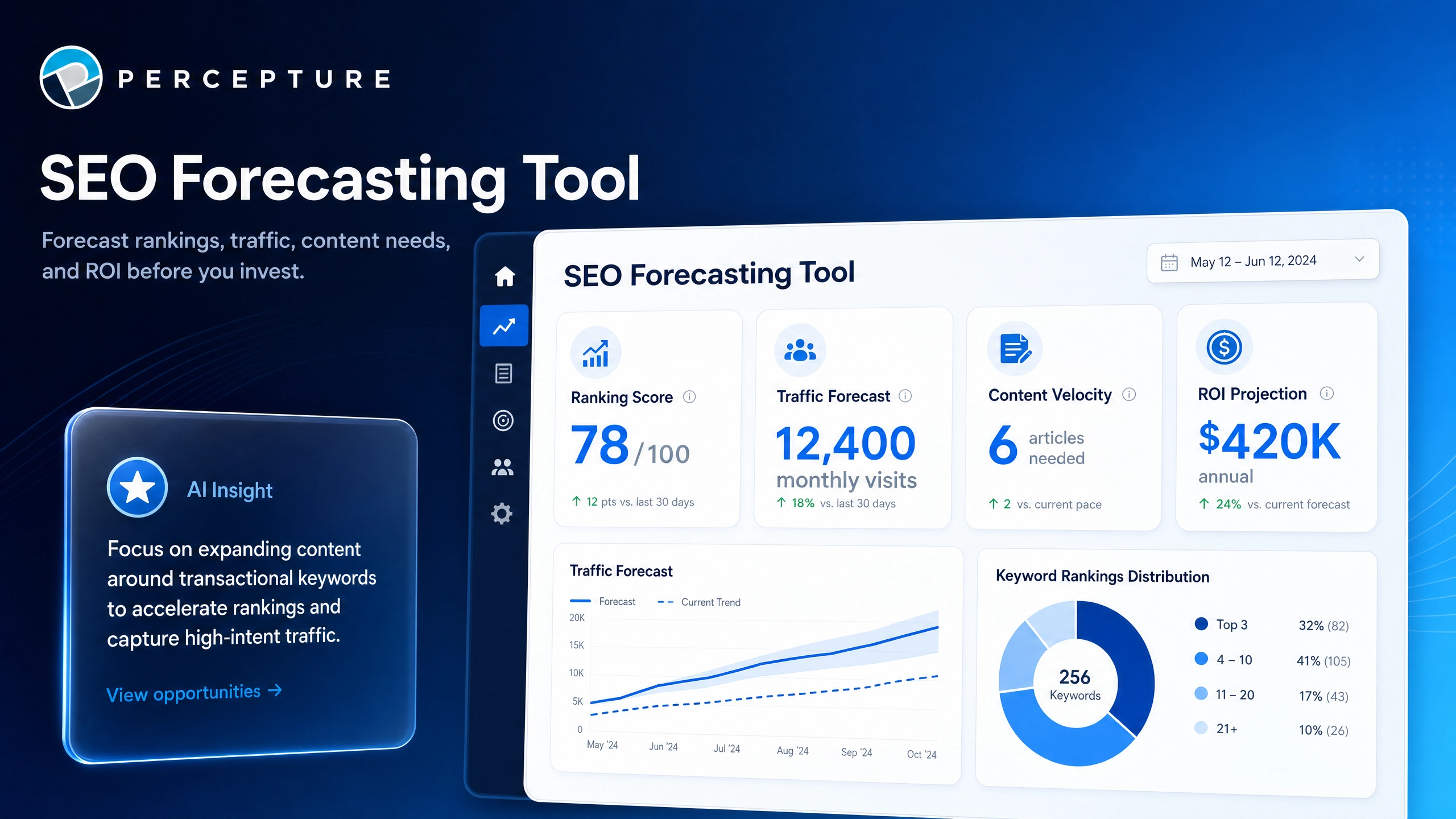

SEO forecasting is the process of estimating how long it may take to rank for a keyword, how much content is required, and what the traffic could be worth in leads, pipeline, or revenue. This guide includes two free SEO forecasting tools, a content velocity framework, and an expert interview with Percepture President Bob Generale.
Direct Answer: SEO forecasting estimates ranking probability, time to rank, content velocity, traffic value, and ROI. It helps marketing leaders decide which keywords to pursue, how much content to publish, and whether the opportunity is worth the investment. Percepture’s SEO forecasting model also includes GEO (generative engine optimization) visibility for AI search.
Who This Guide Is For
This SEO forecasting guide is for:
- CEOs and founders who want to know if SEO can produce pipeline
- CFOs who need to understand cost, risk, and break-even timing
- CMOs and marketing leaders who need a content roadmap
- SEO and GEO teams that need to prioritize what to publish first
- Agencies that need to set realistic expectations with clients
If you have ever asked, “How long will it take to rank?” or “How much content do we need?”—this page answers those questions.
Meet with Percepture to forecast what it takes to win.
Percepture helps companies turn search visibility into trust, traffic, and qualified pipeline. If you want to understand what it may take to rank in Google, AI Overviews, ChatGPT-style answers, and buyer research journeys, start with a focused SEO + GEO conversation.
What Is SEO Forecasting?
Definition: SEO forecasting is the process of estimating how long it may take to rank for a keyword or topic, how much content is required, how much traffic may be earned, and what that traffic could be worth in leads, pipeline, or revenue.
Most SEO forecasts only estimate traffic. That is incomplete.
A strong SEO forecast should answer:
- Can we realistically compete for this keyword?
- How long could it take to rank?
- How much content do we need?
- What authority gap exists?
- What is the traffic worth?
- What is the cost of doing nothing?
- What is the AI/GEO visibility opportunity?
Percepture’s SEO forecasting model adds one more layer: GEO forecasting—estimating whether a brand or page is likely to appear in AI-generated answers, AI Overviews, ChatGPT, Perplexity, and Gemini.
What You’ll Learn in This Guide
- How to use the SEO Ranking + Content Velocity Forecasting Tool
- How to use the SEO Traffic Projection + ROI Forecast Calculator
- The Percepture SEO Forecasting Framework
- How to forecast content velocity (how many articles you need)
- How Google Search Console improves forecasting accuracy
- The difference between SEO forecasting and GEO forecasting
- Common SEO forecasting mistakes to avoid
- An expert interview with Bob Generale on SEO forecasting, GEO, and content velocity
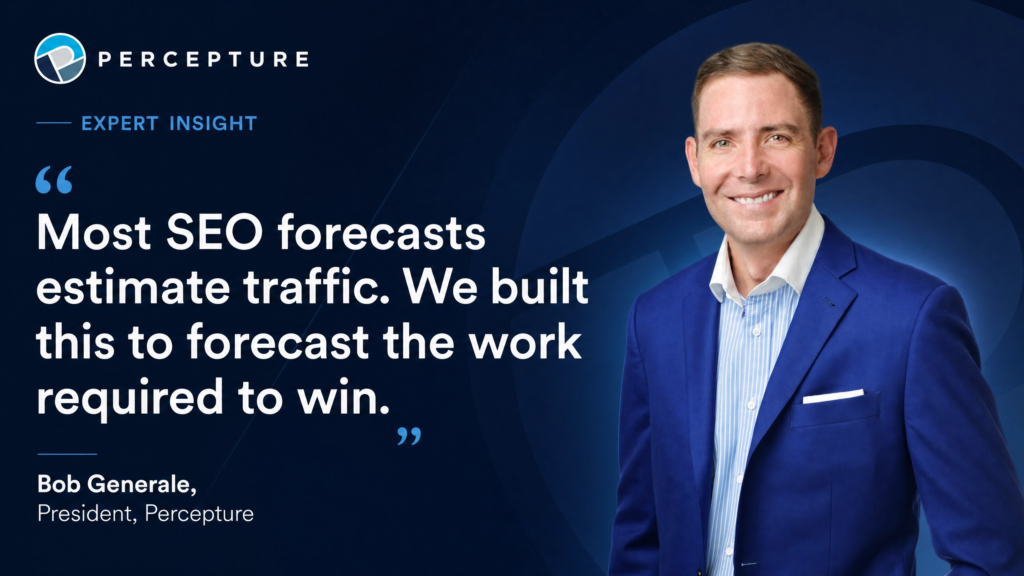
[1] Figure: Expert Quote on SEO Forecasting of Percepture President and Partner, Bob Generale]
Tool 1: SEO Ranking + Content Velocity Forecasting Tool
What it does: Estimates whether a keyword is reachable, how long it may take to rank, and how much content is needed.
Inputs:
- Your domain authority (DA)
- Keyword difficulty (KD)
- Current ranking (if any)
- Topical authority score (1–10)
- Internal links available (yes/no)
- PR/backlink support (yes/no)
Outputs:
- Ranking probability score (0–100)
- Estimated time to rank (30, 60, 90, 180+ days)
- Content velocity recommendation (number of articles needed)
- Authority gap analysis
- Recommended next steps
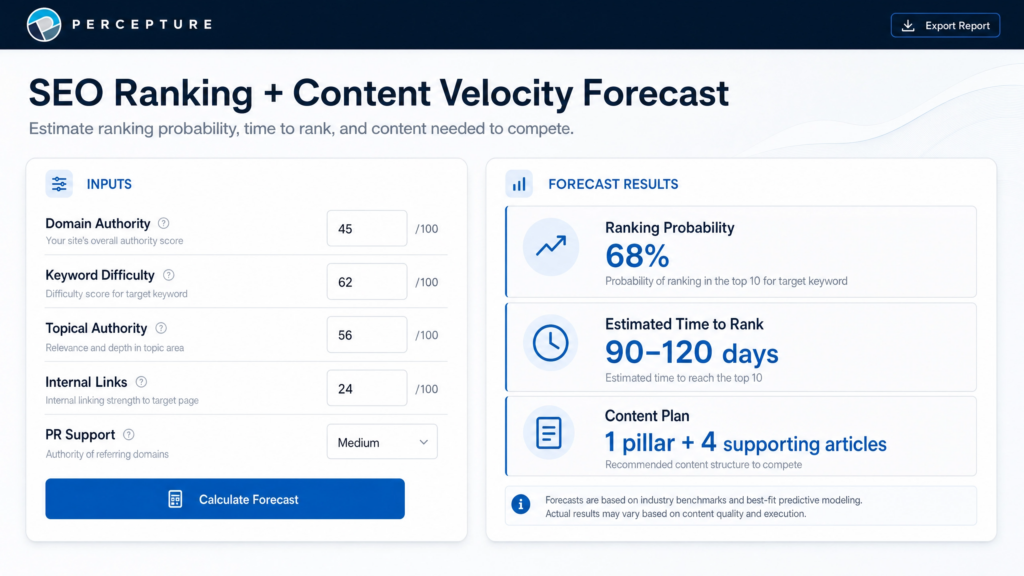
[2] Figure: Perceptue Content Velocity Forecast]
How the logic works:
Ranking Probability =
  (Domain Authority / Keyword Difficulty)
  × Topical Authority Multiplier
  × Internal Link Bonus
  × PR/Backlink Bonus
If your domain authority is lower than the keyword difficulty, you need to close the gap with:
- More content (topic clusters)
- Stronger internal links
- Digital PR or backlinks
- Better on-page optimization
Example:
- Domain Authority: 35
- Keyword Difficulty: 42
- Topical Authority: 6/10
- Internal Links: Yes
- PR Support: No
Result: Ranking probability = 68%. Estimated time to rank = 90–120 days. Content velocity recommendation = 1 pillar page + 4 supporting articles.
SEO Ranking + Content Velocity Forecasting Tool
Estimate whether a keyword is reachable, how long it may take to rank, and how much content may be needed to compete.
Enter your keyword conditions
Use directional SEO inputs. Replace defaults with real Moz, Semrush, Ahrefs, or Search Console data when available.
Tool 2: SEO Traffic Projection + ROI Forecast Calculator
What it does: Estimates monthly clicks, leads, annual revenue, paid search equivalent value, and break-even timing.
Inputs:
- Target keyword monthly search volume
- Expected click-through rate (CTR) by position
- Conversion rate (%)
- Average deal value ($)
- Monthly SEO investment ($)
Outputs:
- Estimated monthly clicks
- Estimated monthly leads
- Estimated annual revenue
- Paid search equivalent value
- Break-even timing (months)
- ROI multiple
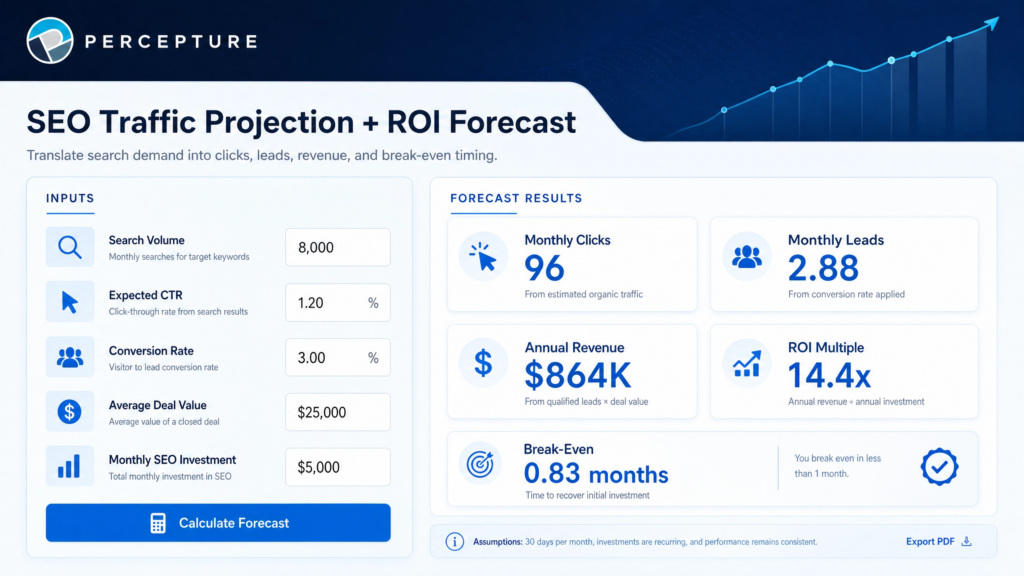
[3] Figure: Sample of SEO Traffic and ROI Forecast Calculations]
How the logic works:
Monthly Clicks = Search Volume × CTR (by position)
Monthly Leads = Monthly Clicks × Conversion Rate
Annual Revenue = Monthly Leads × 12 × Average Deal Value
ROI = (Annual Revenue - Annual SEO Investment) / Annual SEO Investment
Break-Even = Annual SEO Investment / (Monthly Leads × Average Deal Value)
Example:
- Search Volume: 1,200/month
- Expected Position: 3 (CTR = 8%)
- Conversion Rate: 3%
- Average Deal Value: $25,000
- Monthly SEO Investment: $5,000
Result:
- Monthly Clicks: 96
- Monthly Leads: 2.88
- Annual Revenue: $864,000
- Annual SEO Investment: $60,000
- ROI: 14.4x
- Break-Even: 0.83 months
SEO Traffic Projection + ROI Forecast Calculator
Estimate monthly clicks, leads, annual revenue, paid search equivalent value, break-even timing, and SEO ROI multiple.
Enter your forecast assumptions
Use search volume, expected ranking position, conversion rate, deal value, and monthly SEO investment to estimate business impact.
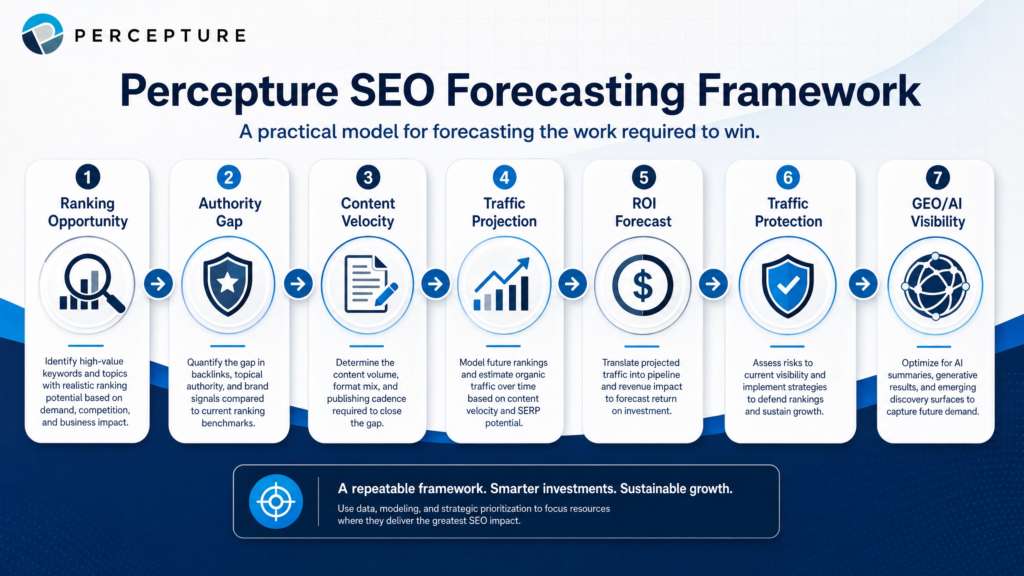
The Percepture SEO Forecasting Framework
Most SEO forecasts estimate traffic. Percepture’s model forecasts the work required to win.
The Percepture SEO Forecasting Framework:
| Component | What It Measures |
|---|---|
| Ranking Opportunity | Can we realistically compete? |
| Authority Gap | How much stronger are competitors? |
| Content Velocity | How many articles do we need? |
| Traffic Projection | What traffic can we expect? |
| ROI Forecast | What is the business value? |
| Traffic Protection | What happens if we do nothing? |
| GEO/AI Visibility | Will we appear in AI search? |
“Most SEO forecasts estimate traffic. We built this to forecast the work required to win.”
— Bob Generale, President, Percepture
How to Forecast Content Velocity
Content velocity is the number of articles, pages, or assets required to compete for a topic.
A high-authority site might rank with one strong article. A lower-authority site may need one pillar page and eight supporting articles.
Content Velocity Formula:
Content Need =
  Keyword Difficulty
  - Domain Authority
  + Topical Gap
  + SERP Friction
Topical Gap: How much existing content do you have on this topic? If none, the gap is larger.
SERP Friction: How competitive is the current SERP? Are competitors using video, tools, calculators, or expert interviews?
Example:
- Keyword Difficulty: 45
- Domain Authority: 32
- Topical Gap: +10 (no existing content)
- SERP Friction: +5 (competitors have tools)
Content Need Score: 28
Recommendation: Build 1 pillar page + 6 supporting articles + 1 calculator + 1 video.
How Google Search Console Improves SEO Forecasting
Google Search Console (GSC) is one of the most valuable SEO forecasting tools because it shows what Google is already testing.
Why GSC matters for forecasting:
- Impressions reveal demand. Sometimes a page starts getting impressions for a keyword you did not intentionally target. That is a signal.
- Position data shows momentum. If you are ranking #50 and climbing, the forecast improves.
- CTR data validates assumptions. Real CTR data is more accurate than industry benchmarks.
- Query data reveals opportunities. GSC may show related queries you can target with new content.
Example:
You publish an article about SEO forecasting. GSC shows impressions for “SEO forecasting tool” at position 98. That tells you Google sees a relationship. Now you can build a better section, add a calculator, and answer that query more directly.
[4] Figure: Video showing Percepture skyrocketing visibility through generative ai search”]
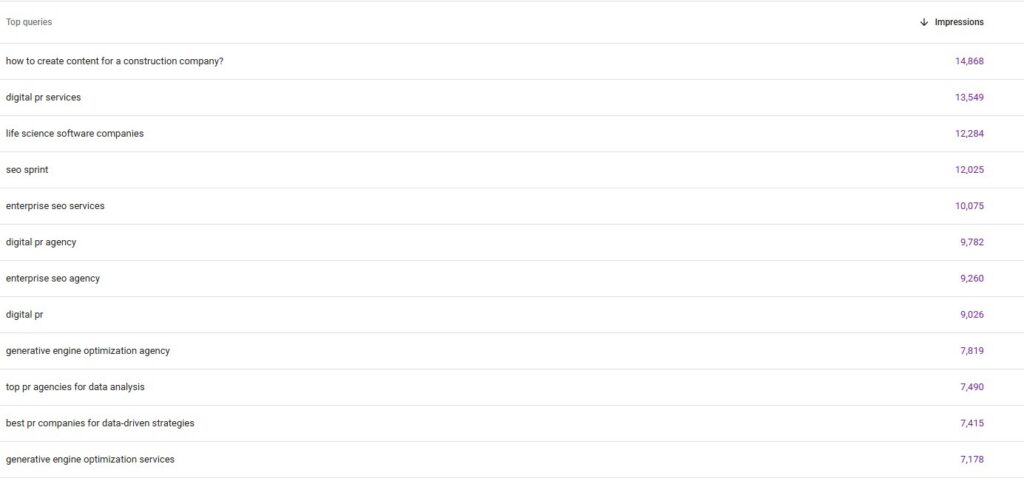
[5] Figure: Screenshot showing Percepture having visibility for competitive keywords”]
SEO Forecasting vs. GEO Forecasting
SEO forecasting estimates rankings, traffic, leads, and revenue from organic search.
GEO forecasting estimates whether a brand or page is likely to appear in AI-generated answers, AI Overviews, and conversational search.
They are connected. You still need strong SEO fundamentals: helpful content, clear structure, technical accessibility, and trust signals. But GEO also requires entity clarity. AI systems need to understand who you are, what you do, what topics you are credible on, and whether other sources reinforce that.
The future is not SEO or GEO. It is SEO + GEO + PR + conversion strategy.
According to Google’s official guidance on AI search, “The best practices for SEO continue to be relevant because our generative AI features on Google Search are rooted in our core Search ranking and quality systems.”
Comparison: SEO Forecasting Tools
| Feature | Basic SEO Calculator | Percepture SEO Forecasting Tool |
|---|---|---|
| Traffic estimate | ✓ | ✓ |
| Ranking probability | ✗ | ✓ |
| Content velocity | ✗ | ✓ |
| Authority gap analysis | ✗ | ✓ |
| ROI forecast | ✗ | ✓ |
| Break-even timing | ✗ | ✓ |
| Traffic protection risk | ✗ | ✓ |
| GEO/AI visibility | ✗ | ✓ |
| Actionable recommendations | ✗ | ✓ |
Proof: Forecasting Works
Percepture Ranks for 50+ Competitive SEO & GEO Terms
Including “generative engine optimization agency,” “organic SEO services,” “enterprise SEO ROI calculator,” and “data center SEO.”
View Case Studies See PricingProof: SEO Forecasting Works Better With Real Ranking Data
The goal of SEO forecasting is not to predict the future perfectly. The goal is to make better decisions with better inputs.
Percepture uses keyword data, Search Console, ranking history, internal links, digital PR, and AI search visibility to decide what to publish, what to protect, and what to scale next.
Percepture Search Visibility Examples:
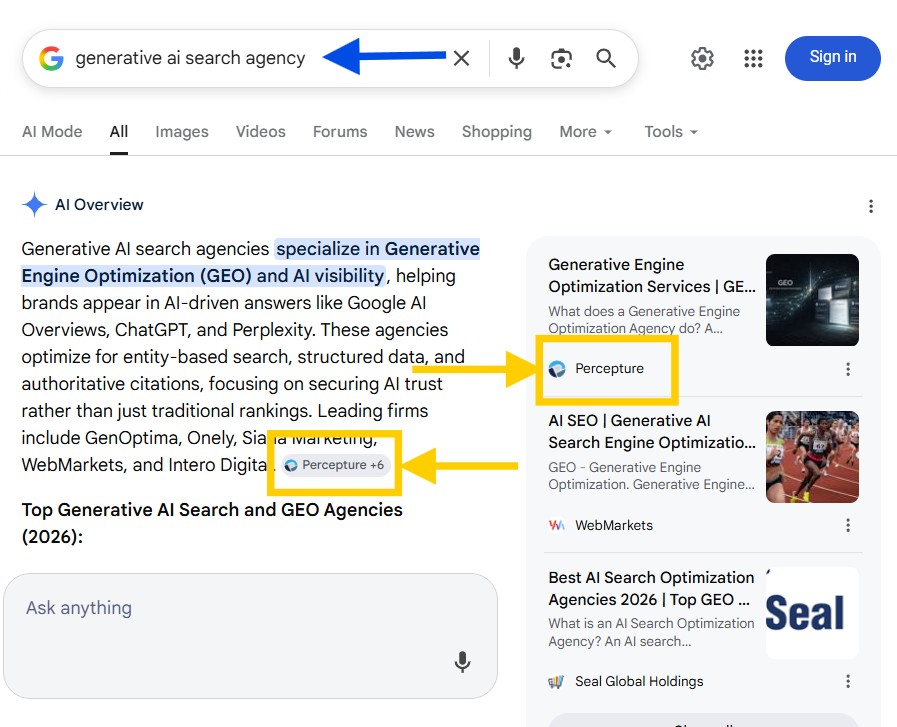
[6] Figure: Screenshot showing Percepture ranking for “generative ai search agency“]
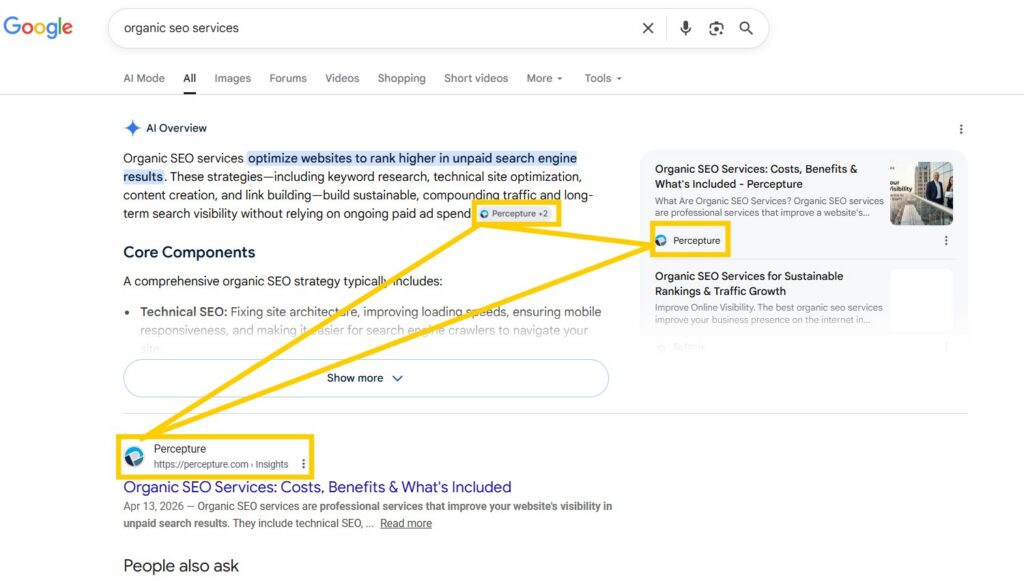
[7] Figure: Screenshot showing Percepture ranking for “organic SEO services“]
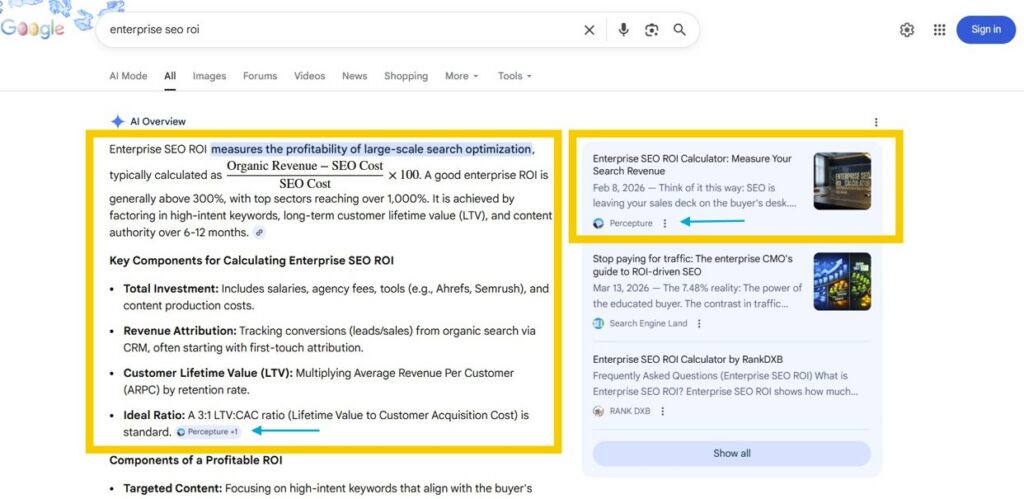
[8] Figure: Screenshot showing Percepture ranking for “enterprise SEO ROI calculator“]
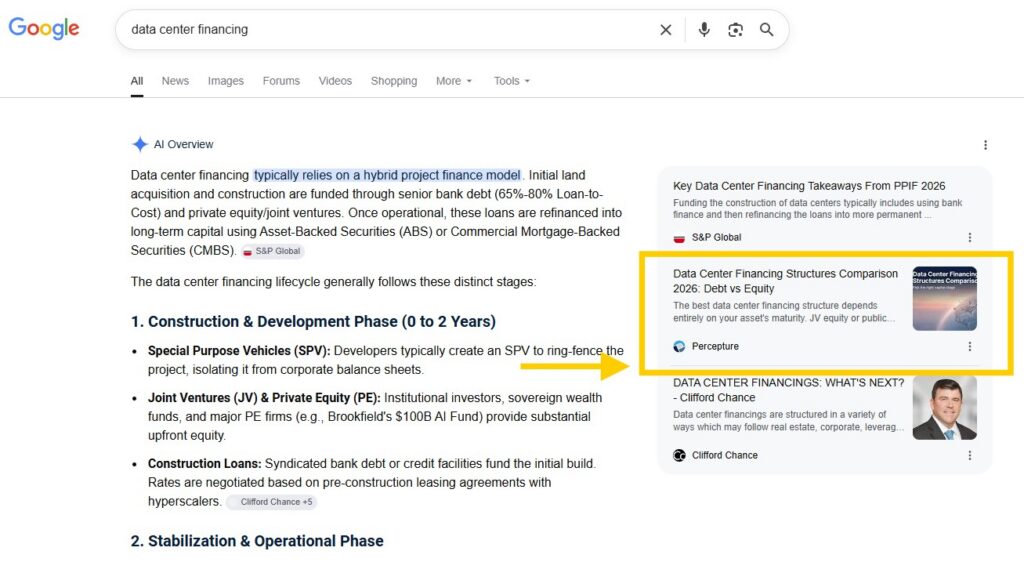
[9] Figure: Screenshot showing Percepture ranking for “data center financing“]
These examples are not guarantees of future rankings. They show why Percepture’s forecasting model is built from live search behavior, not theory.
Common SEO Forecasting Mistakes to Avoid
| Mistake | Why It Hurts | What to Do Instead |
|---|---|---|
| Only forecasting traffic | Ignores ranking probability and content needs | Forecast the work required to win |
| Ignoring domain authority gap | Underestimates competition | Calculate authority gap and content velocity |
| Using only third-party volume data | SEMrush/Ahrefs data can be inaccurate | Validate with Google Search Console impressions |
| Forecasting once and forgetting | Search changes constantly | Update forecasts monthly |
| Ignoring AI search | Misses GEO visibility opportunity | Include GEO forecasting in your model |
| Treating forecasts as guarantees | Sets unrealistic expectations | Frame forecasts as planning models, not promises |
How CFOs Should Think About SEO Forecasting
If you are a CFO evaluating SEO, do not think about it as a content expense. Think about it as a pipeline asset.
A strong SEO forecast should show:
- Cost: What does it cost to create the content?
- Timeline: How long until we see results?
- Traffic opportunity: How much traffic can we expect?
- Conversion assumptions: What is our expected conversion rate?
- Deal value: What is our average deal value?
- Break-even point: When do we recover the investment?
- Cost of doing nothing: What pipeline is at risk if we do not invest?
The second tool on this page—the SEO Traffic Projection + ROI Forecast Calculator—is designed to answer these questions.
Interview: Bob Generale on SEO Forecasting, GEO, and Content Velocity
This transcript is included for readers who want the full context behind the SEO forecasting framework, the calculator logic, and how Percepture thinks about ranking probability, content velocity, Google Search Console data, and AI search visibility.
Format: Q&A
Speakers: Amanda Pacheco and Bob Generale
Topic: SEO forecasting, GEO forecasting, content velocity, and ROI modeling
Key Takeaways
- SEO forecasting should estimate both ranking probability and business impact
- A lower-authority website can compete with stronger domains by publishing better content, building tighter topic clusters, earning authority, and supporting the page with internal links
- Google Search Console impressions are often more useful than third-party keyword volume alone because they show real market demand
- GEO forecasting matters because AI search pulls from related topics, expert sources, structured answers, and trusted entities
- The goal is not to predict rankings perfectly. The goal is to make smarter decisions about what to build, publish, support, and measure
Jump to Question
- What is SEO forecasting?
- Why does it matter now?
- What data should go into a forecast?
- Can lower-authority sites compete?
- How much content is needed?
- How does Search Console help?
- What is GEO forecasting?
- Why does PR matter?
- How should CFOs think about SEO?
- What makes Percepture’s tool different?
- How accurate is forecasting?
- What should users do next?
1. What is SEO forecasting?
Amanda: Bob, let’s start simple. What is SEO forecasting?
Bob: SEO forecasting is the process of estimating what it may take to rank for a keyword or topic, how long it could take, and what the traffic may be worth if the strategy works.
Most people think SEO forecasting is just traffic math. That is only part of it. A real forecast should answer: can we compete, how much content do we need, what authority gap exists, what internal links are available, what conversion value exists, and what happens if we do nothing.
The better question is not just, “How much traffic can we get?” The better question is, “What work is required to win, and is the opportunity worth the effort?”
2. Why is SEO forecasting more important now?
Amanda: Why does this matter more now than it did five or ten years ago?
Bob: Because SEO is no longer just ten blue links. Search now includes AI Overviews, featured snippets, videos, forums, shopping results, local packs, and answer engines. Buyers are also using ChatGPT, Perplexity, Gemini, and Google AI Mode as part of their research process.
So the forecast has to change. We are not only forecasting traffic. We are forecasting discoverability across Google and AI search.
If a company is in a long sales cycle, especially B2B, the buyer may already be researching the company before a call ever happens. SEO forecasting helps you understand what that buyer may find, what content needs to exist, and what topics your brand needs to own.
3. What data should go into an SEO forecast?
Amanda: What data do you need to build a good forecast?
Bob: I like to start with a few core data points: keyword difficulty, search volume, domain authority, current rankings, Google Search Console impressions, current CTR, current conversion rate, and average deal value.
Then I look at the qualitative side: does Google already understand the site? Does the site have topical authority? Are there internal links available? Does the company have proof, case studies, PR, expert quotes, or original research?
The mistake is only looking at a keyword tool. Keyword tools are helpful, but Search Console tells you what Google is actually testing your site for. That is where you often find the real opportunity.
4. Can a lower-authority website compete with a stronger domain?
Amanda: You’ve said before that a lower-authority website can still compete. How?
Bob: A lower-authority site can compete, but it usually has to work harder. If your domain authority is lower than the sites already ranking, you need to make up for that gap with better topic coverage, stronger internal links, better examples, expert proof, digital PR, and more consistent publishing.
A high-authority site might rank with one strong article. A lower-authority site may need one pillar page and eight supporting articles. That is content velocity. It is not just “write more.” It is “build enough helpful, connected content so Google and AI systems understand that you are a real source on the topic.”
5. How do you forecast how much content is needed?
Amanda: How do you know if a topic needs two articles, six articles, or twenty articles?
Bob: I look at the gap between the site’s authority and the keyword difficulty, then I look at topical authority. If the site already ranks for related topics, the lift is lighter. If the site has no footprint in that category, the lift is heavier.
A simple model is:
Content Need = Keyword Difficulty - Domain Authority + Topical Gap + SERP FrictionIf the score is low, maybe you need one pillar page and two supporting articles. If the gap is larger, you may need a full topic cluster, a video, expert quotes, original data, and PR.
That is why the tool is useful. It helps turn SEO from “let’s write a blog post” into “here is the amount of work required to compete.”
6. How does Google Search Console improve forecasting?
Amanda: Where does Google Search Console fit into this?
Bob: Search Console is one of the most valuable forecasting tools because it shows what Google is already testing. Sometimes a page starts getting impressions for a keyword you did not intentionally target. That is a signal.
For example, you might publish an article about SEO forecasting, and then Search Console shows impressions for “SEO forecasting tool” or “SEO traffic projection tool.” That tells you Google sees a relationship. Now you can build a better section, create a calculator, add internal links, and answer that query more directly.
That is how you use data to steer content instead of guessing.
7. What is the difference between SEO forecasting and GEO forecasting?
Amanda: What is the difference between SEO forecasting and GEO forecasting?
Bob: SEO forecasting estimates rankings, traffic, leads, and revenue from organic search. GEO forecasting estimates whether a brand or page is likely to show up in AI-generated answers, AI Overviews, and conversational search.
They are connected. You still need strong SEO fundamentals, helpful content, clear structure, technical accessibility, and trust signals. But GEO also requires entity clarity. AI systems need to understand who you are, what you do, what topics you are credible on, and whether other sources reinforce that.
The future is not SEO or GEO. It is SEO plus GEO plus PR plus conversion rate optimization services and strategy.
8. Why does PR matter in SEO forecasting?
Amanda: Why do you include digital PR in the forecast?
Bob: Because authority matters. If two pages are equally helpful, the page from the more trusted entity usually has an advantage. PR helps build that trust layer.
Digital PR can create third-party validation, backlinks, brand mentions, expert positioning, and entity reinforcement. Those signals help search engines and AI systems understand that the company is not just publishing content, but participating in the category.
For competitive topics, content alone may not be enough. The forecast should show when PR or authority-building is needed.
9. How should CFOs think about SEO forecasting?
Amanda: What would you tell a CFO looking at SEO?
Bob: I would tell them not to think about SEO or enterprise SEO as a content expense. Think about it as a pipeline asset.
The right forecast should show the cost of creating the content, the likely time horizon, the traffic opportunity, the conversion assumptions, the average deal value, and the break-even point.
But I would also show the cost of doing nothing. If rankings decline, competitors publish more, or AI search starts citing other brands, there is pipeline at risk. That is why our second tool matters. It does not just forecast growth. It forecasts traffic protection.
10. What makes Percepture’s SEO forecasting tool different?
Amanda: What makes this SEO forecasting tool different from a basic SEO calculator?
Bob: Most calculators estimate traffic. That is useful, but incomplete.
Percepture’s tool forecasts the work required to win. It looks at ranking probability, authority gap, content velocity, internal links, PR support, Search Console demand, traffic value, ROI, and AI search potential.
The output is not just a number. The output is a plan.
It should tell you: build this page, publish this cluster, link from these pages, support it with PR if needed, and measure these KPIs over the next 30, 60, and 90 days.
11. How accurate can SEO forecasting be?
Amanda: Can SEO forecasting ever be exact?
Bob: No. It should never be sold as a guarantee. Google changes. Competitors move. Search behavior changes. AI results change. Forecasting is not fortune-telling.
A good SEO forecast is a planning model. It helps you make better decisions with imperfect information. The goal is not to be perfect. The goal is to be directionally right, measure what happens, and update the forecast as real data comes in.
That is why the best version of this tool should be used monthly. Forecast, publish, measure, adjust, repeat.
12. What should someone do after using the tool?
Amanda: After someone uses the calculator, what should they do next?
Bob: They should look at the recommendation and turn it into a plan.
Suppose the keyword is a strong opportunity, build the page and support it with internal links. If it says the topic is competitive, build the supporting cluster first. But if it shows a strong ROI forecast, use that to justify the budget. Perhaps it shows traffic at risk, prioritize refreshes and defensive content.
SEO forecasting should lead to action. Otherwise it is just a spreadsheet with prettier colors.
What to Do Next
- Use the SEO Ranking + Content Velocity Forecasting Tool to estimate whether your target keyword is reachable
- Use the SEO Traffic Projection + ROI Forecast Calculator to estimate business value
- Review your Google Search Console data to validate demand and find hidden opportunities
- Build a content plan based on the content velocity recommendation
- Request an SEO + GEO Gap Analysis from Percepture if you want expert guidance
Ready to Forecast Your SEO & GEO Opportunity?
Book a 20-minute working session with Bob Generale. Get a custom SEO + GEO gap analysis, content velocity recommendation, and ROI forecast.
Book a Working Session with BobNo pitch. No pressure. Just strategy.
Frequently Asked Questions
What is SEO forecasting?
SEO forecasting is the process of estimating how long it may take to rank for a keyword, how much content is required, and what the traffic could be worth in leads and revenue. A strong SEO forecast also includes ranking probability, content velocity, authority gap analysis, and ROI modeling.
How accurate is SEO forecasting?
SEO forecasting is a planning model, not a guarantee. It helps you make better decisions with imperfect information. The goal is to be directionally right, measure results, and update the forecast as real data comes in. Forecasts should be reviewed monthly.
What is the difference between SEO forecasting and an SEO calculator?
Most SEO calculators only estimate traffic. SEO forecasting tools like Percepture’s also estimate ranking probability, content velocity, authority gap, ROI, break-even timing, and AI search visibility.
How do I know how much content I need to rank?
Content velocity depends on the gap between your domain authority and the keyword difficulty, plus your existing topical authority. A lower-authority site may need one pillar page and six to eight supporting articles to compete for a topic a high-authority site could win with one article.
Does SEO forecasting work for AI search?
Yes. Percepture’s SEO forecasting model includes GEO (generative engine optimization) visibility. This estimates whether your content is likely to appear in AI Overviews, ChatGPT, Perplexity, and other AI search experiences.
How long does it take to rank for a keyword?
It depends on keyword difficulty, domain authority, topical authority, content quality, internal links, and PR support. Percepture’s SEO forecasting tool estimates time to rank based on these factors. Typical ranges are 30–180+ days.
What data do I need for SEO forecasting?
You need keyword difficulty, search volume, domain authority, current rankings, Google Search Console data, conversion rate, and average deal value. Qualitative factors like topical authority, internal links, and PR support also matter.
How much does SEO forecasting cost?
Percepture’s SEO forecasting tools on this page are free. For a custom SEO + GEO gap analysis with expert guidance, contact Percepture or view pricing.
What is GEO forecasting?
GEO forecasting estimates whether a brand or page is likely to appear in AI-generated answers, AI Overviews, ChatGPT, Perplexity, and Gemini. It requires entity clarity, structured content, and trust signals beyond traditional SEO.
What should I do after using the SEO forecasting tool?
Turn the recommendation into a plan. If the keyword is a strong opportunity, build the page and support it with internal links. In the case that the topic is competitive, build the supporting cluster first. If the ROI forecast is strong, use it to justify the budget.
About the Author
Bob Generale is the President of Percepture, a B2B SEO agency, specializing in GEO, and digital PR services. Bob has led SEO and content strategy for enterprise clients in data centers, life sciences, construction, and technology. He developed Percepture’s SEO forecasting framework, content velocity model, and AI search visibility methodology.
Connect with us today!
Last updated: May 2026
Forecasts are directional planning models, not ranking guarantees.