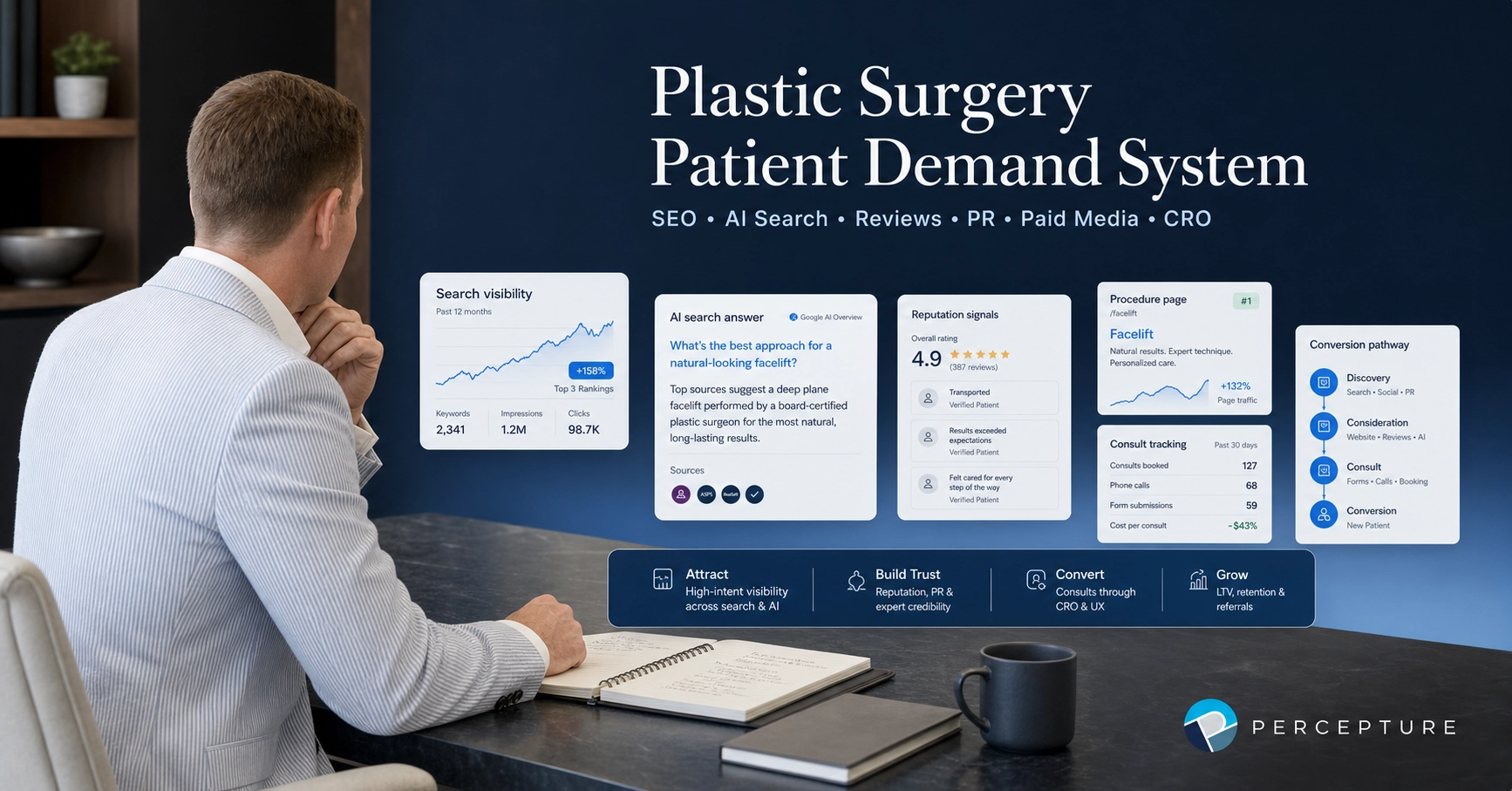

Quick Answer: A plastic surgery marketing agency helps surgeons and aesthetic practices attract more qualified consultations through SEO, AI search visibility, paid media, social proof, reviews, PR, content, and conversion tracking. The goal is not just more leads. The goal is more of the right patients choosing the practice with confidence.
Most plastic surgery practices do not have a marketing problem. They have a patient-demand system problem.
A plastic surgery marketing agency should not just generate leads. It should diagnose the entire patient-demand system: search visibility, AI search, reviews, procedure pages, social proof, paid media, PR, website conversion, tracking, and consult follow-up.
That is the difference between a vendor and a partner.
This guide explains what a plastic surgery marketing agency should actually do, how to evaluate one, and how Percepture builds patient-demand systems that drive real consultations—not just clicks.
Who This Guide Is For
- Plastic surgeons and practice owners evaluating marketing agencies
- Practice administrators and marketing directors comparing vendors
- Multi-location aesthetic groups seeking a unified marketing strategy
- Patient acquisition leaders who want qualified consults, not just leads
Definition
Plastic Surgery Marketing Agency: A firm that helps plastic surgeons and aesthetic practices attract, convert, and retain patients through a combination of SEO, AI search optimization, paid media, social proof, reputation management, digital PR, content, and conversion tracking.
What You’ll Learn
- Why plastic surgery marketing is different from general healthcare marketing
- The five-part Plastic Surgery Patient Demand System
- What a plastic surgery marketing agency should actually do
- How SEO, GEO, Google Ads, social, PR, and CRO work together
- Pricing ranges and budget expectations
- Red flags when hiring an agency
- FAQs from practice owners and marketing directors
See Where Your Patient Demand System Needs Work
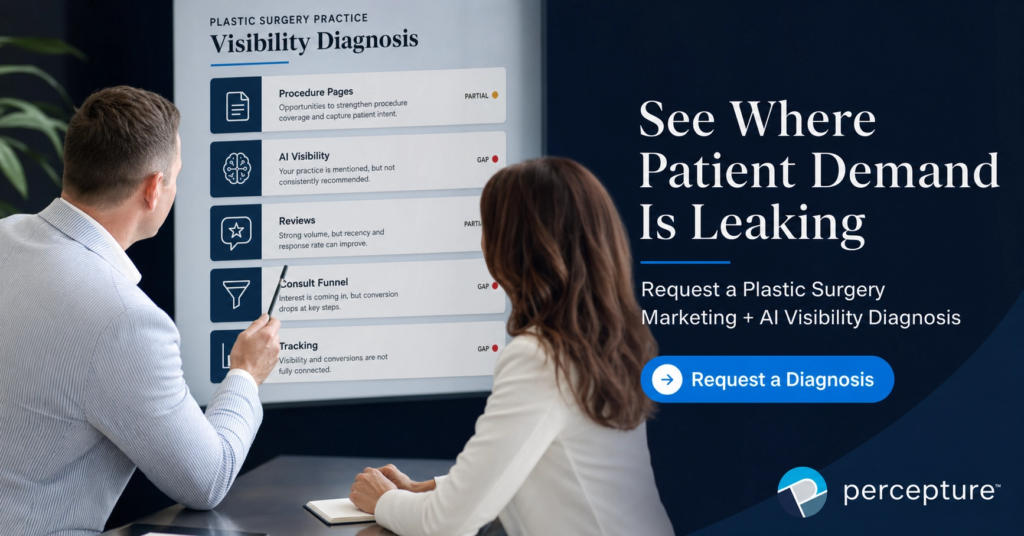
Request a Plastic Surgery Marketing + AI Visibility Diagnosis. We’ll show you which procedures, channels, reviews, pages, and conversion paths need the most attention first.
Request a DiagnosisWhy Plastic Surgery Marketing Is Different
Plastic surgery is not like general healthcare marketing. The patient journey is longer, more emotional, and more research-intensive.
Patients considering rhinoplasty, facelifts, breast augmentation, mommy makeovers, or liposuction do not book consultations on impulse. They research, compare,, and read reviews. Patients look at before-and-after galleries, ask friends and search Google. Their behavior is shifting, where they ask ChatGPT, which is turning into a form of “word-of-mouth” advertising. They are well researched, they check RealSelf and watch videos.
By the time they request a consultation, they have already formed an opinion about the surgeon.
That means a plastic surgery marketing agency must do more than run ads or post on Instagram. It must shape the patient’s perception across every channel they touch—before they ever pick up the phone.
Plastic Surgery Marketing Is Surgical: Diagnose Before You Cut
“Plastic surgery marketing is surgical. You do not pull every lever at once. You diagnose the practice, the market, the website, the reviews, the ads, and the consult funnel. Then you cut where it matters.”
— Bob Generale, President and Partner, Percepture
A good plastic surgery marketing agency does not start with tactics. It starts with diagnosis.
Before touching the website, the ads, or the content, the agency should understand:
- Which procedures drive the most revenue?
- Which procedures have the most local competition?
- Where does the practice rank in Google and AI search?
- What do the reviews say—and what do they not say?
- How does the website convert mobile visitors?
- What happens after a lead comes in?
Only after diagnosis should the agency recommend a treatment plan.
The Plastic Surgery Patient Demand System
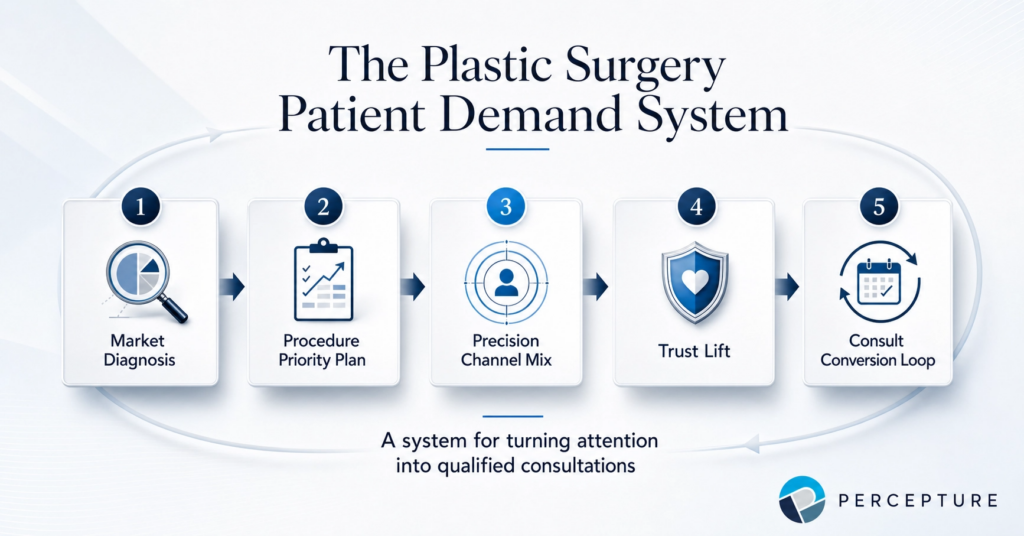
Percepture uses a five-part framework to build patient-demand systems for plastic surgery practices. We call it the Plastic Surgery Patient Demand System.
The Plastic Surgery Patient Demand System
- Market Diagnosis: Audit the practice, competitors, procedure mix, website, domain authority, reviews, local rankings, AI visibility, ads, tracking, and consult flow.
- Procedure Priority Plan: Choose the procedures and patient segments worth pursuing first—rhinoplasty, facelift, breast augmentation, mommy makeover, liposuction, tummy tuck, injectables, or med spa services.
- Precision Channel Mix: Use the right combination of SEO, GEO, Google Ads, paid social, retargeting, email, reviews, PR, video, and content.
- Trust Lift: Build proof through surgeon bios, credentials, reviews, before-and-after galleries, patient education, expert commentary, local authority, and digital PR.
- Consult Conversion Loop: Track calls, forms, chats, bookings, lead source, procedure interest, follow-up, no-shows, and booked procedures.
This framework connects SEO, GEO, CRO, paid media, PR, and analytics into one system. Each part supports the others.
What a Plastic Surgery Marketing Agency Should Actually Do
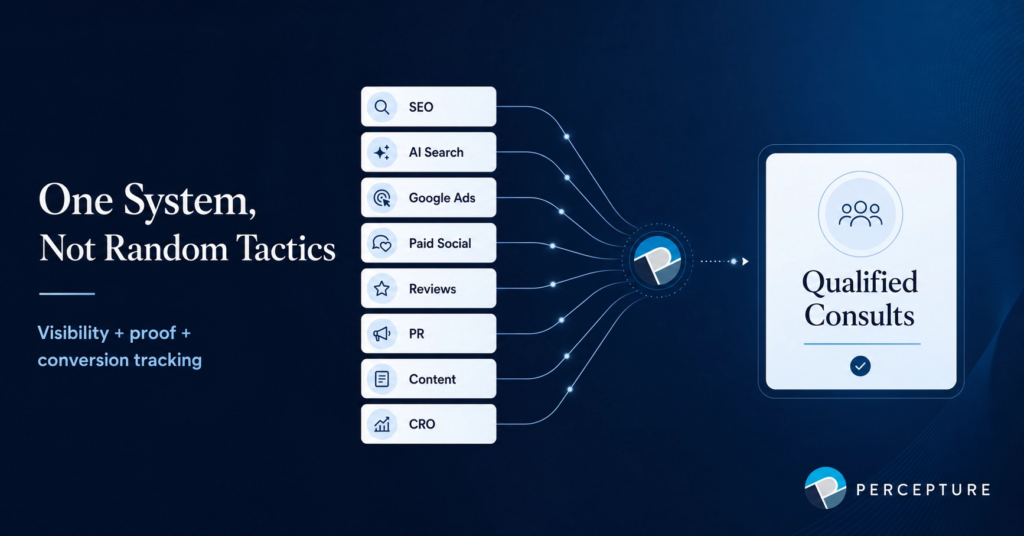
A plastic surgery marketing agency should cover the full patient-demand system. Here is what that looks like in practice.
SEO and GEO for Plastic Surgeons
Search engine optimization (SEO) captures demand from patients already searching for procedures. Plastic surgery SEO services should include:
- Procedure page optimization (rhinoplasty, facelift, breast augmentation, etc.)
- Local SEO and Google Business Profile management
- Technical SEO audits and fixes
- Content strategy for patient education
- Schema markup for procedures, FAQs, and surgeon credentials
Generative engine optimization (GEO) ensures the practice appears in AI search results—Google AI Overviews, ChatGPT, Perplexity, Claude, and others. GEO services should include:
- Entity clarity for the practice, surgeon, and procedures
- Structured content that AI systems can cite
- FAQ and definition blocks that match AI query patterns
“AI search needs clean entity signals. If the practice does not clearly connect procedures, location, surgeon expertise, proof, and patient questions, AI systems have less reason to cite it.”
— Alex Mannine, Head of Global Strategy and AI, Percepture
Google’s own guidance confirms that AI Overviews and AI Mode still rely on foundational SEO, indexed pages, internal links, helpful content, and structured data that matches visible content (Google Search Central).
Google Ads and PPC for High-Intent Procedures
Paid search captures urgent demand. Google Ads for doctors should focus on:
- High-intent procedure keywords (e.g., “rhinoplasty consultation near me”)
- Location-based targeting
- Call tracking and form attribution
- Landing page optimization
- Retargeting for undecided visitors
Google Ads can produce fast results, but cost-per-click for plastic surgery keywords is high. A good agency balances paid and organic to reduce long-term acquisition cost.
Paid Social for Awareness and Retargeting
Social media advertising builds awareness and retargets visitors who did not convert. Channels include:
- Instagram and Facebook for before-and-after galleries and patient stories
- YouTube for surgeon videos and procedure explainers
- Retargeting ads for website visitors who did not book
Social is not usually the first conversion channel. But it keeps the practice visible during the patient’s research phase.
Reviews, Reputation, RealSelf, Healthgrades, and Trust
Patients research surgeons on Google, RealSelf, Healthgrades, Zocdoc, and Yelp. A plastic surgery marketing agency should help the practice:
- Build a review generation system
- Respond to reviews professionally
- Monitor reputation across platforms
- Optimize RealSelf and Healthgrades profiles
Reviews are trust signals. They influence both patient decisions and search rankings.
Before-and-After Galleries and Visual Proof
Before-and-after photos are the most powerful proof a plastic surgery practice can show. A marketing agency should help:
- Organize galleries by procedure
- Optimize images for search (file names, alt text, compression)
- Ensure galleries are mobile-friendly
- Use galleries in ads and social content
Note: Before-and-after images must be used with patient consent and in compliance with applicable privacy rules. Practices should review image use with their compliance or legal team.
Digital PR and Surgeon Authority
Digital PR services build surgeon authority through:
- Expert commentary in media outlets
- Thought leadership content
- Backlinks from authoritative publications
- Local media coverage
PR supports SEO by earning backlinks. It also builds trust with patients who see the surgeon quoted in credible sources.
Email, CRM, Nurture, and Patient Follow-Up
Not every lead books immediately. A marketing agency should help the practice:
- Set up email nurture sequences
- Integrate CRM with lead sources
- Track follow-up and no-shows
- Re-engage cold leads
Lead generation services should include the full funnel—not just the top.
CRO: Turning Attention Into Booked Consults
Conversion rate optimization services improve the website so more visitors become consultations. This includes:
- Form optimization
- Call tracking
- Chat integration
- Mobile experience
- Page speed
- Clear calls to action
Traffic is not the win. Qualified consults are the win.
Pricing and Budget Ranges
Plastic surgery marketing costs vary by scope, competition, and goals. Here are typical ranges:
| Scope | Typical Monthly Range |
|---|---|
| Visibility audit / diagnostic | Custom / low-friction offer |
| Single-location practice SEO + CRO | $3,500–$7,500/month |
| SEO + Google Ads + social retargeting | $7,500–$15,000/month |
| Full SEO + GEO + PR + paid + CRM + CRO | $12,000–$25,000+/month |
| Multi-location aesthetic group | Custom |
For detailed pricing, see AI search SEO pricing.
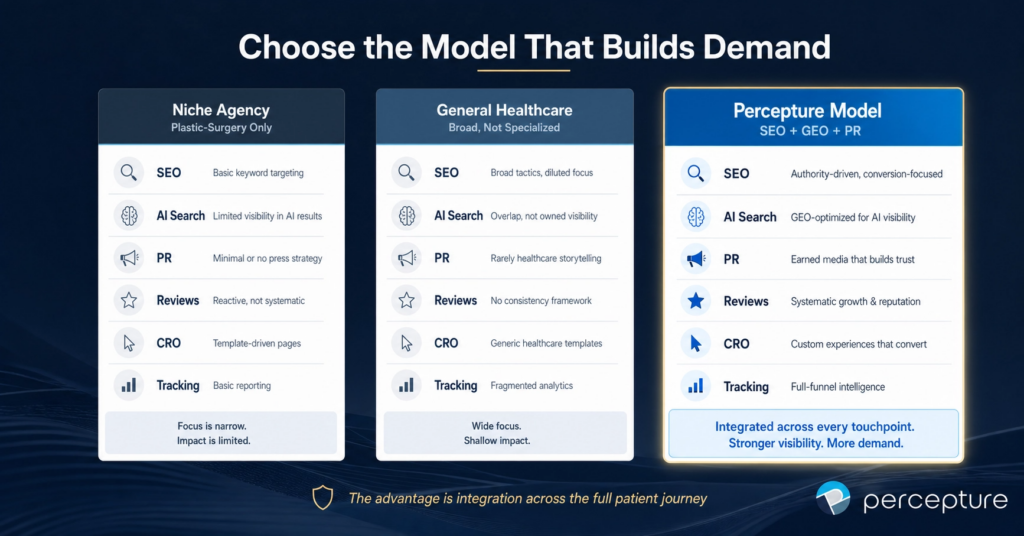
Comparison: Plastic Surgery-Only Agency vs. Healthcare Marketing Agency vs. Percepture
| Attribute | Plastic Surgery-Only Agency | General Healthcare Agency | Percepture (SEO + GEO + PR) |
|---|---|---|---|
| Best for | Practices wanting niche aesthetic execution | Broad, unspecialized healthcare support | Practices needing high visibility, trust, and booked consults |
| SEO | Basic keyword targeting | Diluted, high-level tactics | Authority-driven & conversion-focused core foundation |
| AI Visibility (GEO) | Limited to no optimization | Emerging / basic approach | Fully optimized to rank in ChatGPT & AI Overviews |
| Paid Media | Strong standalone ad setups | Varies significantly | Directly connected to organic search and CRO to maximize ROI |
| PR Authority | Minimal or non-existent | Often outsourced or separate | Built-in digital PR that drives media placements & trust |
| Reputation Loop | Reactive review collection | No consistent framework | Systematic growth tied directly into patient trust systems |
| CRO & Tracking | Template-driven pages | Fragmented analytics | Custom, consult-focused full-funnel intelligence |
| Strategy | Account manager execution | Varies by client spend | 100% Senior-led data and growth strategy |
Get a 90-Day Patient Demand Plan
See how SEO, GEO, paid media, PR, reviews, and CRO can work together for your practice.
See Pricing Talk With PerceptureRed Flags When Hiring a Plastic Surgery Marketing Agency
Not every agency is a good fit. Watch for these warning signs:
- Guaranteed rankings or consults. No agency can guarantee Google rankings or patient bookings.
- No tracking or attribution. If the agency cannot show which channels drive consults, you cannot measure ROI.
- Generic content. If the agency uses the same blog posts for every practice, the content will not rank or convert.
- No healthcare experience. Plastic surgery marketing has compliance, privacy, and trust requirements that generalist agencies often miss.
- No clear process. If the agency cannot explain how they diagnose, plan, execute, and measure, they are guessing.
- Cheap lead packages. Low-cost lead vendors often deliver low-quality leads that waste patient coordinator time.
- No AI search strategy. If the agency is not thinking about Google AI Overviews, ChatGPT, and Perplexity, they are behind.
Percepture’s Healthcare Marketing Experience
Percepture has worked with healthcare practices, specialty medical groups, and health systems on SEO, GEO, digital PR, paid media, content, and analytics.
Examples include:
- Concierge medicine practice (Tampa): Percepture improved metadata, headings, local search targeting, schema, FAQs, and content expansion for a premium concierge medicine practice. (Anonymized)
- Multi-specialty medical practice (Manhattan): Percepture proposed integrated SEO and digital PR, including technical SEO, local SEO, GMB optimization, content, link cleanup, authority building, healthcare PR, expert commentary, and media outreach. (Anonymized)
- Healthcare marketing capabilities: Percepture has built healthcare marketing programs across content, SEO, Google Ads, PR, programmatic, social, email, and measurement.
Percepture was founded in 2004. The senior team averages 15+ years of experience in SEO, PR, paid media, and analytics. Percepture is NMSDC certified and has been recognized six times on the Inc. 5000 list of fastest-growing companies.
For more on Percepture’s healthcare work, see healthcare marketing agency.
What Happens Next With Percepture
If you contact Percepture, here is what to expect:
- Discovery call: We learn about your practice, procedures, goals, and current marketing.
- Diagnosis: We audit your website, rankings, AI visibility, reviews, ads, and consult funnel.
- Recommendation: We present a 90-day plan with priorities, channels, and expected outcomes.
- Execution: We build and optimize the patient-demand system.
- Reporting: We track rankings, traffic, leads, consults, and booked procedures.
No long-term contracts required to start. We earn the relationship.
Frequently Asked Questions
What does a plastic surgery marketing agency do?
A plastic surgery marketing agency helps surgeons and aesthetic practices attract more qualified consultations. Services typically include SEO, AI search optimization, Google Ads, paid social, reputation management, digital PR, content, and conversion tracking. The goal is to build a patient-demand system that drives real consults—not just clicks.
How much does plastic surgery marketing cost?
Costs vary by scope and competition. Single-location SEO and CRO typically range from $3,500 to $7,500 per month. Full-service programs including SEO, GEO, PR, paid media, and CRO can range from $12,000 to $25,000+ per month. Multi-location groups require custom pricing.
What marketing channels work best for plastic surgeons?
The best channels depend on the practice and market. Most practices benefit from a combination of SEO (for organic search), Google Ads (for urgent demand), social media (for awareness and retargeting), reviews (for trust), and PR (for authority). AI search visibility is increasingly important.
How do plastic surgeons get more consultations?
More consultations come from a combination of visibility, trust, and conversion. The practice must appear in search and AI results, build trust through reviews and proof, and convert visitors into consultation requests. Tracking and follow-up close the loop.
Should plastic surgeons invest in SEO or Google Ads first?
It depends on urgency and budget. Google Ads can produce fast results but cost more per lead. SEO takes longer but builds sustainable visibility. Most practices benefit from both, with the mix shifting over time as organic rankings improve.
How does AI search affect plastic surgery marketing?
AI search engines like Google AI Overviews, ChatGPT, Perplexity, and Claude are changing how patients research procedures and surgeons. Practices that structure content for AI—clear definitions, FAQs, entity clarity—are more likely to be cited. This is called generative engine optimization (GEO).
Do reviews and before-and-after photos help marketing?
Yes. Reviews are trust signals that influence both patient decisions and search rankings. Before-and-after photos are the most powerful proof a plastic surgery practice can show. Both should be optimized for search and used across channels.
How should plastic surgery practices track leads and consults?
Practices should use call tracking, form tracking, chat tracking, and CRM integration to connect leads to their source. This allows the practice to measure cost per lead, cost per consult, and cost per booked procedure by channel.
Should I hire a niche plastic surgery agency or a broader healthcare marketing agency?
Niche agencies often have strong aesthetic execution but may lack depth in SEO, GEO, PR, or analytics. Broader healthcare agencies may lack aesthetic-specific experience. The best fit depends on your goals. Look for an agency that can diagnose the full patient-demand system and connect channels.
What should I ask before hiring a plastic surgery marketing agency?
Ask about their healthcare experience, their process for diagnosis and planning, how they track results, whether they handle SEO and GEO, how they approach reviews and PR, and what happens after you sign. Ask for case studies or references.
What to Do Next
If you are evaluating plastic surgery marketing agencies, start with a diagnosis—not a pitch.
Percepture can show you where your patient-demand system needs work: which procedures, channels, reviews, pages, and conversion paths need the most attention first.
Build Your Plastic Surgery Patient Demand System
Request a Plastic Surgery Marketing + AI Visibility Diagnosis. See where your practice stands—and what to fix first.
Request a DiagnosisFounded in 2004 · Senior-led SEO, GEO, PR, paid media, healthcare, and lead-generation strategy · NMSDC Certified · Inc. 5000 (6x)