

Architect SEO is the practice of making an architecture firm visible in Google Search, Google Maps, Google AI Overviews, ChatGPT search, Perplexity, and other AI answer engines—without sacrificing the visual quality that defines the firm’s brand. It connects portfolio pages, project details, local signals, and digital authority into a system that attracts qualified project inquiries.
Most architecture firms already have the proof. It lives in project photos, renderings, awards, sketches, RFPs, materials, site constraints, design narratives, and client wins. Architect SEO turns that proof into pages, answers, visuals, rankings, and qualified project conversations.
Who This Guide Is For
This guide is for:
- Architecture firm principals and partners
- Marketing directors at design and AEC firms
- Business development leaders seeking better-fit inquiries
- Design-build executives expanding into new markets
- Luxury residential, commercial, hospitality, and institutional architects
- AEC operators evaluating SEO, GEO, and digital PR investments
If your firm has strong work but weak search visibility, this guide explains how to fix that.
Definition: Architect SEO
Architect SEO is the discipline of structuring an architecture firm’s website, portfolio, project pages, local presence, and digital authority so that Google, AI search systems, and qualified buyers can find, understand, and trust the firm’s expertise.
What You’ll Learn
- Why beautiful architecture websites often fail in search
- The Architect Portfolio Visibility System (Percepture’s framework)
- How to turn every project into a ranking asset
- Image SEO for architects
- Local SEO and Google Business Profile optimization
- How architects show up in AI search (GEO)
- Digital PR for architecture authority
- Common architect SEO mistakes
- Pricing, ROI, and timeline expectations
- FAQs from architecture firm buyers
Want to see where your firm stands in search and AI visibility?
Get an Architect SEO + GEO Gap AnalysisWhy Beautiful Architecture Websites Often Fail in Search
Architecture firms invest heavily in visual presentation. The portfolio is stunning. The photography is editorial. The site feels like a gallery.
But Google and AI systems cannot “see” a beautiful rendering the way a human can. They parse the code, text, metadata, and structure surrounding the image. If the portfolio page has no project description, no location, no project type, no materials, no challenge-and-solution narrative—then search engines have almost nothing to index.
The result: a firm with award-winning work that is invisible when a developer, homeowner, institution, or hospitality group searches for an architect online.
This is not a design problem. It is a translation problem. We optimze using not just our seo buy our Generative AI Search services.
The work is beautiful. But Google, AI systems, and buyers need context to understand why it matters.
The Architect Portfolio Visibility System
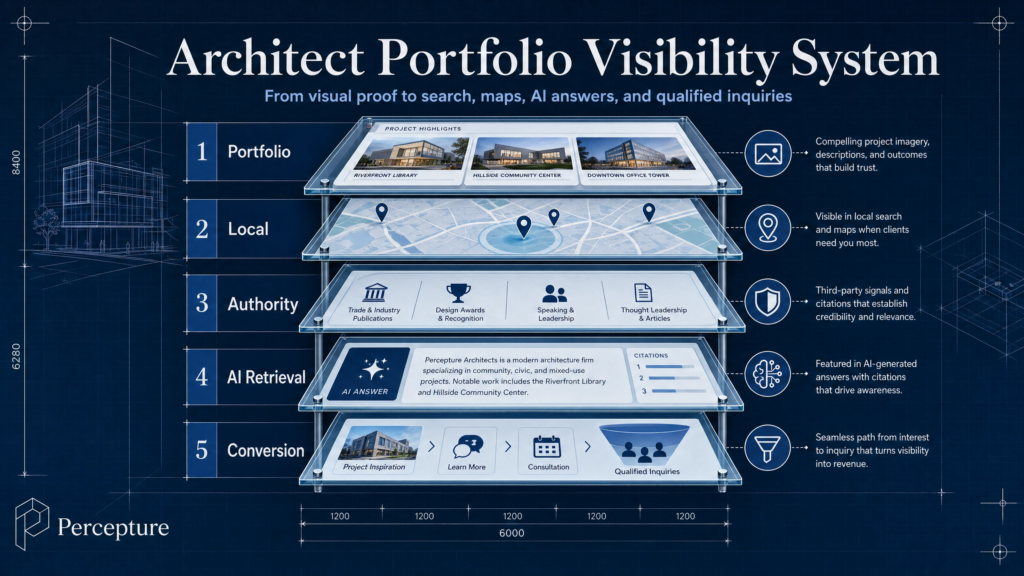
Percepture developed the Architect Portfolio Visibility System to help architecture firms turn visual portfolios into search-visible, AI-readable, locally relevant, and conversion-ready business assets.
| Layer | What It Does |
|---|---|
| Portfolio Layer | Turns each project into an indexable page with project type, location, style, scope, challenge, solution, materials, and outcome. |
| Local Layer | Connects the firm to cities, neighborhoods, service areas, Google Business Profile, reviews, and project locations. |
| Authority Layer | Uses awards, publications, design features, associations, digital PR, and backlinks to build trust. |
| AI Retrieval Layer | Makes the firm easy for Google AI Overviews, AI Mode, ChatGPT search, Perplexity, Gemini, and other answer systems to summarize and cite. |
| Conversion Layer | Converts visitors into qualified consultations, RFP conversations, and project-fit inquiries. |
This framework connects SEO, GEO, local search, PR, and CRO into one system. It is not about adding ugly SEO copy to a beautiful site. It is about giving search engines and AI systems the context they need to understand and recommend the firm.
How to Turn Every Architecture Project Into a Search Asset
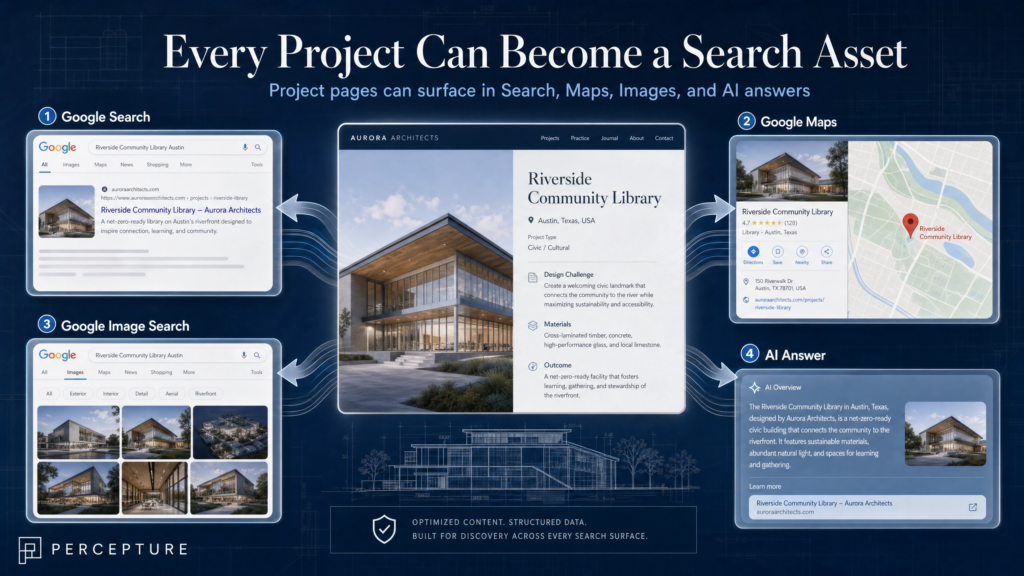
Every completed project is a potential ranking asset. But most architecture portfolio pages are image galleries with no text.
A search-optimized project page should include:
- Project name (H1 or prominent heading)
- Project type (residential, commercial, hospitality, civic, institutional, mixed-use, adaptive reuse, etc.)
- Location (city, neighborhood, region)
- Client type (developer, homeowner, institution, hospitality group, etc.)
- Design challenge (site constraints, zoning, budget, sustainability goals, historic preservation, etc.)
- Design solution (how the firm addressed the challenge)
- Materials and methods (steel, glass, timber, prefab, passive house, LEED, etc.)
- Outcome (awards, client feedback, occupancy, press coverage, etc.)
- High-quality images (compressed, named descriptively, with alt text and captions)
- Internal links to related service pages and other projects
- CTA (contact, consultation, or related project)
This structure gives Google and AI systems enough context to understand the project, match it to relevant queries, and cite it in AI-generated answers.
Image SEO for Architects
Architecture is a visual discipline. Image SEO is not optional.
Best practices:
- File names: Rename raw files before upload. Use descriptive names like
modern-commercial-office-design-tampa.webpinstead ofFinal_Render_v2.jpg. - Alt text: Describe the image for accessibility and search. Example: “Modern commercial office building with glass facade and rooftop terrace in Tampa, Florida.”
- Captions: Add visible captions where appropriate. Captions are often read more than body text.
- Compression: Use WebP or AVIF formats. Compress images to reduce load time without sacrificing quality.
- Surrounding text: Place images near relevant text. Google uses surrounding content to understand image context.
- Structured data: Use schema markup for images where applicable.
Google Image Search is a major traffic driver for design inspiration. Optimized images can appear in image search, AI Overviews, and generative AI responses.
Local SEO for Architects
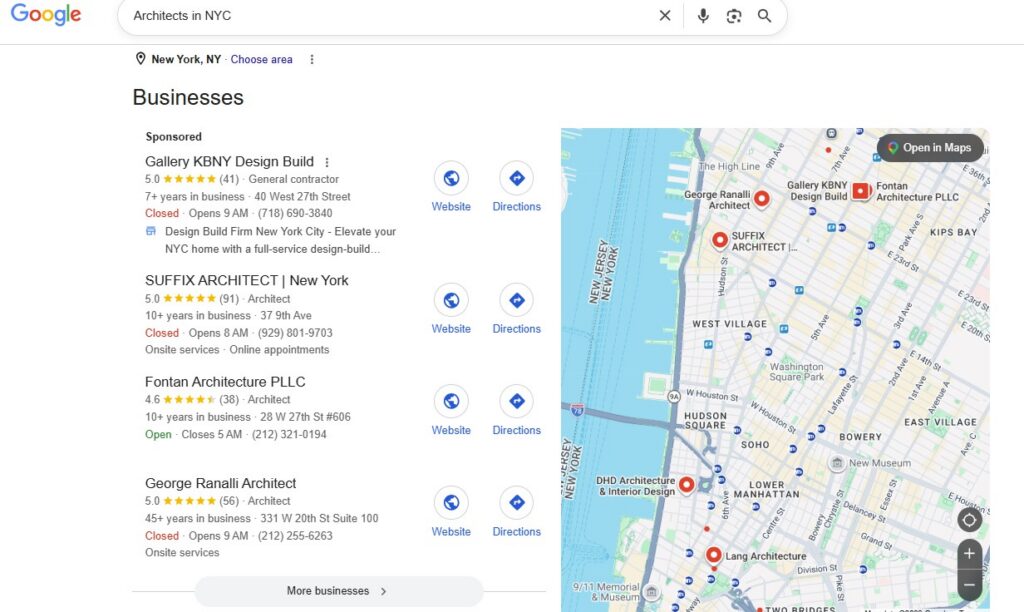
Architecture is fundamentally a regional business. Many high-intent searches include a geographic modifier: “architect in [city],” “residential architect near me,” “commercial architect [neighborhood].”
Local SEO priorities:
- Google Business Profile (GBP): Claim and optimize your profile. Use accurate NAP (Name, Address, Phone). Select the right categories. Add project photos. Post updates.
- Reviews: Encourage satisfied clients to leave Google reviews. Respond to reviews professionally.
- Service-area pages: Create dedicated pages for each city, neighborhood, or region you serve. Include local project examples.
- Local citations: Ensure consistent NAP across directories, industry associations, and local business listings.
- Map Pack: Optimize for the Google Maps 3-pack by combining GBP optimization, reviews, and local content.
Local SEO helps architecture firms attract better-fit inquiries—clients aligned with budget, project scope, location, and design ambition.
How Architects Show Up in AI Search (GEO)
AI search is changing how buyers research architects. Google AI Overviews, Google AI Mode, ChatGPT search, Perplexity, Gemini, and other answer engines now summarize, compare, and recommend firms based on indexed content.
Google’s official guidance confirms that SEO fundamentals remain relevant for AI search. Generative AI features use retrieval-augmented generation (RAG) and query fan-out to pull from the Search index. Pages must be indexed and eligible for snippets to appear in AI responses.
GEO priorities for architects:
- Clear definitions: Define your services, project types, and expertise in plain language.
- Structured sections: Use H2/H3 headings, bullet lists, and tables to make content easy to extract.
- FAQs: Answer common buyer questions directly. AI systems often pull from FAQ sections.
- Entity clarity: Clearly state your firm name, services, locations, and credentials. Consistency helps AI systems recognize and cite your brand.
- Crawl access: Do not block AI crawlers (Googlebot, OAI-SearchBot, etc.) in robots.txt unless you have a specific reason.
- Digital PR: Third-party mentions in design publications, local business journals, and industry platforms help AI systems associate your firm with relevant topics.
AI search is not a separate channel. It is an extension of search. Firms that are easy to summarize, cite, and recommend will appear more often in AI-generated answers.
Digital PR for Architecture Authority
Backlinks and third-party mentions remain important for both traditional SEO and AI visibility. For architecture firms, digital PR means getting featured in:
- Design publications (ArchDaily, Dezeen, Architectural Record, etc.)
- Local business journals
- Industry associations and award programs
- University and alumni publications
- Sustainability and green building platforms
These mentions build the Authority Layer of the Architect Portfolio Visibility System. They signal to Google and AI systems that the firm is recognized, trusted, and worth citing.
Percepture’s Built-Environment Experience
Percepture has supported visibility programs across the built environment, including Autodesk, Queen of Prefab, XSite Modular, and MEP/fabrication-focused thought leadership. In one Autodesk + Queen of Prefab campaign, Percepture helped package industrialized construction expertise into a content engine that reached millions of viewers, built YouTube engagement, grew subscribers, and created a stronger bridge between thought leadership, product education, audience targeting, and search visibility.
The lesson for architecture firms is simple: great work is not enough if the market cannot find it, understand it, or connect it to the problem they need solved.
View Case StudiesArchitect SEO vs. General SEO vs. Local SEO vs. GEO
| Dimension | General SEO | Local SEO | Architect SEO | GEO |
|---|---|---|---|---|
| Primary goal | Organic rankings | Map Pack / local visibility | Portfolio + local + authority | AI answer visibility |
| Key assets | Blog, service pages | GBP, reviews, citations | Project pages, images, PR | Structured answers, FAQs, entity clarity |
| Buyer intent | Varies | High local intent | Project-fit intent | Research and comparison |
| Technical focus | On-page, links, speed | NAP, reviews, local schema | Image SEO, project structure, PR | Crawl access, clear definitions, citations |
| Proof signals | Backlinks, authority | Reviews, local mentions | Awards, publications, project outcomes | Third-party mentions, entity recognition |
Architect SEO combines elements of all four. It is not just local SEO or content marketing. We’ build a Search a ‘ve built a AI search system that connects portfolio, local, authority, AI retrieval, and conversion into one visibility strategy.
Common Architect SEO Mistakes
- Portfolio pages with no text. Beautiful images, but nothing for Google to index.
- Generic service pages. “We design beautiful spaces” tells search engines nothing specific.
- No project-type pages. Missing pages for residential, commercial, hospitality, civic, etc.
- No city or neighborhood pages. Missing local intent signals.
- Poor image optimization. Large files, generic names, missing alt text.
- No Google Business Profile. Or an incomplete, outdated profile.
- No reviews. Or no strategy to encourage and respond to reviews.
- Orphaned portfolio pages. Projects not linked from service pages or navigation.
- Blocking AI crawlers. Accidentally blocking Googlebot or OAI-SearchBot.
- No digital PR. No third-party mentions, awards, or publication features.
Avoiding these mistakes is often more valuable than adding new tactics.
How Long Does Architect SEO Take?
SEO is not instant. Typical timelines:
| Phase | Timeline | Focus |
|---|---|---|
| Foundation | Months 1–3 | Technical audit, GBP optimization, project page structure, image SEO, internal linking |
| Content build | Months 3–6 | Service pages, city pages, project pages, FAQs, blog content |
| Authority growth | Months 6–12+ | Digital PR, backlinks, reviews, awards, publication features |
| AI visibility | Ongoing | Structured answers, entity clarity, crawl access, citation monitoring |
Results depend on competition, current site health, content depth, and PR activity. Most firms see measurable progress within 90–180 days, with compounding returns over 12–24 months.
What Does Architect SEO Cost?
Architect SEO is not about traffic volume. One qualified commercial project, luxury residential project, or institutional RFP can justify the investment.
Cost factors:
- Number of services and project types
- Number of locations and service areas
- Number of project pages to optimize
- Technical debt (site speed, crawl issues, duplicate content)
- Image volume and optimization needs
- Digital PR and publication outreach
- Reporting and analytics depth
Percepture offers SEO pricing packages tailored to architecture and AEC firms. Programs range from foundational audits to full-service SEO + GEO + digital PR retainers.
Percepture Proof: AEC and Built-Environment Visibility
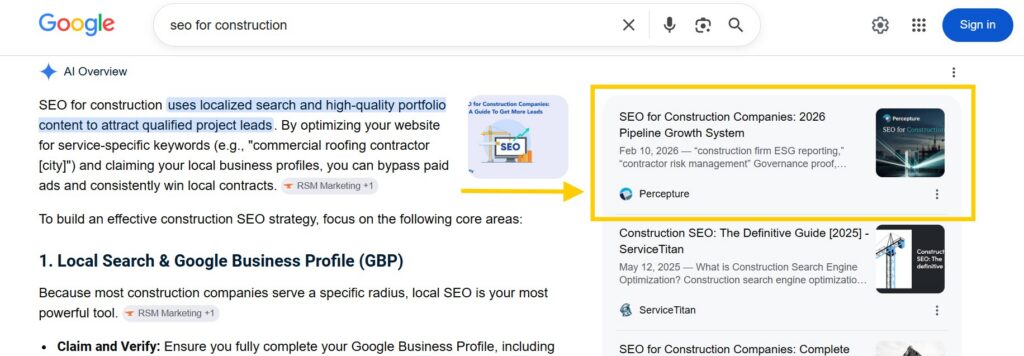
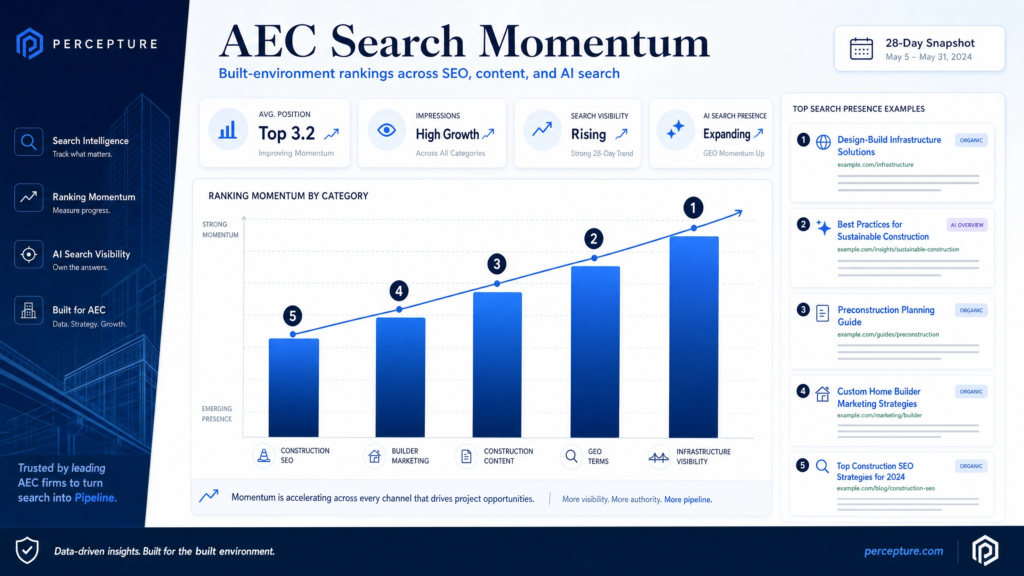
Percepture is not starting from zero in the built-environment search category. The firm already has search visibility across construction SEO, builder marketing, construction content, and infrastructure-related topics.
Sample GSC rankings (28-day snapshot):
| Query | Avg. Position | Impressions |
|---|---|---|
| digital marketing for builders | 1.83 | 4,150 |
| how to create content for a construction company? | 3.65 | 13,789 |
| content marketing for construction | 3.50 | 511 |
| seo for construction | 4.02 | 511 |
| seo for construction companies | 5.66 | 2,504 |
| construction SEO | 6.35 | 1,873 |
Architect SEO is the visual portfolio extension of that same AEC search system.
“Most architecture firms do not have a portfolio problem. They have a translation problem. The work is beautiful, but Google, AI systems, and buyers need context to understand why it matters.”
— Bob Generale, Founder, Percepture
Frequently Asked Questions
What is architect SEO?
Architect SEO is the process of optimizing an architecture firm’s website, portfolio, project pages, local presence, and digital authority so that Google, AI search systems, and qualified buyers can find, understand, and trust the firm’s expertise. It combines on-page SEO, image optimization, local search, digital PR, and AI visibility into one system.
Does SEO work for architecture firms?
Yes. Architecture firms benefit from SEO because high-value buyers—developers, homeowners, institutions, hospitality groups—research online before contacting a firm. SEO helps firms appear when buyers search by project type, location, style, or design challenge.
How should architecture firms optimize portfolio pages?
Each project page should include the project name, type, location, client type, design challenge, solution, materials, outcome, high-quality images with alt text, internal links, and a CTA. This structure gives search engines and AI systems enough context to index and cite the project.
Is image SEO important for architects?
Yes. Architecture is a visual discipline. Image SEO—descriptive file names, alt text, captions, compression, and surrounding text—helps images appear in Google Image Search, AI Overviews, and generative AI responses.
How does local SEO help architects?
Local SEO helps architecture firms appear in Google Maps, the local 3-pack, and location-modified searches. It attracts better-fit inquiries from clients aligned with budget, project scope, location, and design ambition.
How can architects show up in AI search?
AI search systems use indexed content to generate answers. Architects can improve AI visibility by using clear definitions, structured sections, FAQs, entity clarity, crawl access, and digital PR. Google confirms that SEO fundamentals remain relevant for AI Overviews and AI Mode.
How long does architect SEO take?
Most firms see measurable progress within 90–180 days, with compounding returns over 12–24 months. Timelines depend on competition, current site health, content depth, and PR activity.
What does architect SEO cost?
Cost depends on the number of services, locations, project pages, technical debt, image volume, and PR needs. One qualified project can justify the investment. Percepture offers SEO pricing packages tailored to architecture and AEC firms.
Should every architecture project have its own page?
Ideally, yes. Each project page is a potential ranking asset. Projects with unique locations, types, challenges, or outcomes deserve dedicated pages with structured content and optimized images.
How do I choose an architect SEO agency?
Look for an agency with AEC or built-environment experience, a clear framework, proof of results, and a focus on qualified leads—not just traffic. Ask about their approach to portfolio SEO, local search, image optimization, digital PR, and AI visibility.
Ready to Make Your Firm Easier to Find?
Request an Architect SEO + GEO Visibility Audit. We’ll show you where your firm stands in search, maps, and AI—and what to do next.
Request an Architect SEO + GEO Visibility AuditWhat to Do Next
- Audit your portfolio pages. Do they have text, project details, and optimized images—or just galleries?
- Check your Google Business Profile. Is it complete, accurate, and active?
- Review your project-type and location pages. Are you targeting the services and cities you want to win?
- Assess your digital PR. Are you earning third-party mentions, awards, and publication features?
- Request a visibility audit. Percepture can show you where your firm stands in Google, Maps, and AI search—and what to prioritize.
About the Author
Bob Generale is the founder of Percepture, a digital marketing agency focused on SEO, GEO, digital PR, paid media, and conversion strategy for B2B and technical brands. Since 2004, Bob has helped companies across construction, AEC, technology, hospitality, and professional services build search visibility and qualified pipelines, making us a leading b2b seo agency. He leads Percepture’s strategy practice and works directly with clients on visibility audits, content systems, and AI search readiness.