


SEO Lead Generation Services should do more than increase rankings and traffic. They should help the right buyers find your company, understand its value, validate its proof and take a next step that sales can qualify.
This is search-driven word of mouth. The buyer asks the question, search and AI systems shape the shortlist, and repeated evidence helps the buyer decide which company deserves a closer look.
What are SEO lead generation services?
SEO lead generation services combine buyer-intent research, technical SEO, content, AI-search visibility, authority building, conversion optimization, lead qualification and attribution. The goal is to help people researching a problem find and trust your company, then turn that self-directed demand into qualified sales opportunities.
What matters before you choose a provider
- Start with intent. Prioritize the problems, services and comparisons your ideal buyers choose to research.
- Connect visibility to proof. Rankings need credible answers, relevant examples and a clear next step.
- Build SEO and GEO together. Accessible pages and consistent, useful evidence support organic and AI-assisted discovery.
- Measure sales quality. Sales acceptance, opportunities and revenue give traffic and form fills their business context.
- Ask about the operating work. Scope, cost drivers, timing, asset ownership and accountability belong in the proposal.
Who this guide is for
This guide is for marketing leaders, founders and revenue teams comparing SEO lead generation services for a considered B2B purchase. It is especially relevant when technical buyers, multiple decision-makers and a long sales cycle make credibility as important as discovery.
Telecom, dark fiber, digital infrastructure and specialist staffing firms face that challenge. Their buyers need evidence that a provider understands the service, the market and the questions that precede a qualified conversation.
Why search acts like modern word of mouth
Traditional word of mouth starts when a trusted person recommends a company. Search-driven word of mouth begins when a buyer asks Google, an AI system or another research platform for help, then compares the sources behind the answer.
The buyer can review service pages, expert articles, videos, case studies, news coverage and executive commentary before speaking with sales. Search can extend the research around a referral and help the buyer test whether the recommendation holds up.
The common mistake is treating rankings and publishing volume as the finish line. Lead-generating SEO starts with the ideal customer, the questions that signal a buying need and the evidence required to move that buyer forward.
Expert-led content marketing services supply useful owned answers. Digital PR can add relevant third-party coverage, while conversion rate optimization improves the path from interest to action.
How complete is your current plan?
Use the 100-point scorecard below to compare proof, technical capability, content, conversion and reporting. You can assess the proposal before starting a sales conversation.
What should SEO lead generation services include?
| Deliverable | Business purpose | Useful measurement |
|---|---|---|
| Buyer and ICP research | Define the companies, roles, pains and buying triggers worth attracting. | Qualified-account fit and sales acceptance |
| Intent and keyword research | Separate research questions from commercial and decision-stage demand. | Query coverage by intent and selected landing page |
| Technical SEO | Keep important pages crawlable, indexable, fast and structurally clear. | Indexation, crawl issues, performance and page selection |
| Site and topic architecture | Give services, industries, comparisons, proof and articles distinct jobs. | Organic entry pages, assisted paths and cannibalization |
| Expert-led content | Answer buyer questions with accurate, differentiated knowledge. | Qualified visits, engagement and assisted conversions |
| GEO and AI visibility | Make public information clear and useful for AI-assisted research. | Citations, cited URLs, referral sessions and assisted actions |
| Authority development | Earn credible references and reinforce expertise beyond the company site. | Relevant mentions, links, referral traffic and branded demand |
| Conversion optimization | Match cold, warm and hot visitors with an appropriate next step. | CTA engagement, form completion, calls and bookings |
| CRM and attribution | Connect landing pages and captured source data to lead quality and pipeline. | MQLs, sales acceptance, meetings, opportunities and revenue |
| Testing and sales feedback | Use buyer behavior and sales outcomes to revise priorities. | Conversion quality, loss reasons and opportunity progression |
These workstreams should operate as one system. A focused technical SEO audit service can identify indexation, rendering, architecture and performance issues before a team scales content.
Generative engine optimization services extend the work into AI-assisted discovery. Keep the plan grounded in accessible sources, clear entities and accurate evidence. Google states that its AI search features use established SEO foundations and require no special AI schema. Read Google’s guidance on AI features.
A broader lead generation services program may also include paid media, outbound or account-level activity. Clarify which responsibilities are included in the organic-search engagement.
Bob’s Search-Driven Word-of-Mouth Engine
Percepture’s framework connects six parts of SEO lead generation services, from the buyer’s question to feedback from the sales team.
Buyer-initiated question
Start with a real problem, buying trigger or comparison the target account has chosen to research.
Answer ownership
Assign a clear page to each distinct buyer need: service, industry, comparison, pricing, proof or diagnostic. Closely related wording can belong on the same page.
Golden Triangle visibility
Work toward a strong organic result, an AI answer or overview, and supporting proof such as video, news, images or a case study. Availability and placement vary by query and platform.
Trust tokens
Reinforce the answer with expert authorship, case studies, testimonials, citations, transparent explanations and relevant third-party coverage.
Conversion path
Give early researchers a diagnostic, evaluators proof or pricing, and ready buyers a strategy conversation.
Qualified-pipeline feedback
Connect landing pages and captured source data to CRM stages, sales acceptance, opportunities and revenue. Use aggregate query data to refine priorities.
Apply it to a dark fiber buyer
For example, an early researcher may need a clear comparison of dark fiber and managed connectivity. An evaluator may need service-area information and a relevant deployment example. A buyer ready to act needs a route-specific inquiry that collects the locations and requirements the provider needs to assess fit.
Illustrative buyer journey, not a reported client result.
The framework makes publication part of a continuing process. Search data informs the content; sales outcomes inform the next priorities. B2B intent data can add account-level context, and LeadSeeker’s sales intelligence platform supports the broader account-research workflow.
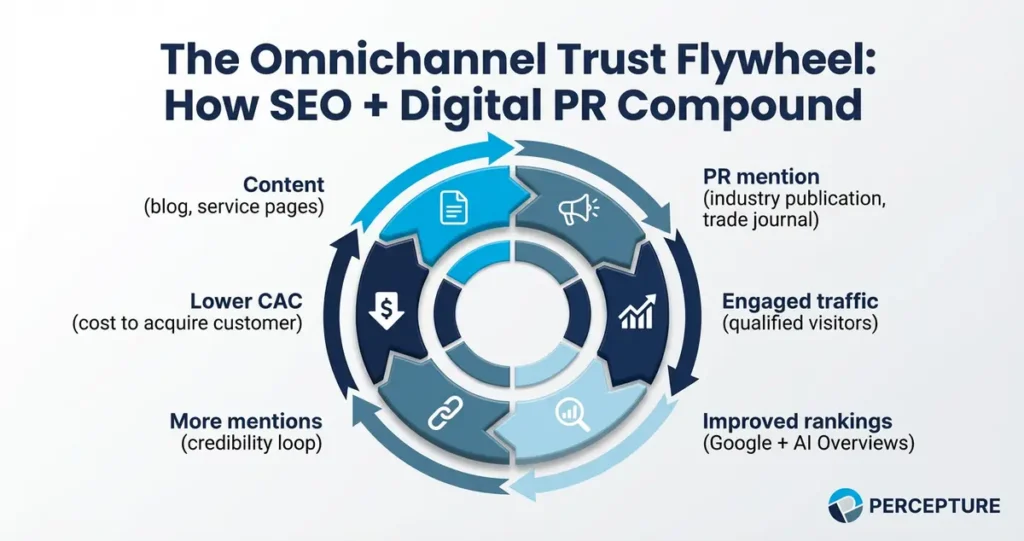
Match the page and offer to the buyer’s stage
A visitor learning the problem should not face the same ask as a procurement-ready executive. Give each priority page a defined buyer need and an appropriate next step.
Discovery
Understand the problem and possible approaches.
Content and proof: Definitions, guides, diagnostics and expert explanations.
Next step: Use a scorecard or read the topic hub.
Validation
Decide whether the approach is credible.
Content and proof: Frameworks, comparisons, videos, case studies and third-party proof.
Next step: Review the evidence and service depth.
Decision
Compare providers, scope, cost and risk.
Content and proof: Service pages, pricing factors, process, accountability and reporting.
Next step: Discuss the plan and commercial fit.
Activation
Understand onboarding and early priorities.
Content and proof: Baseline, tracking plan, technical work, ownership and milestones.
Next step: Review the proposed roadmap.
Percepture’s guide to organic SEO services explains the operating work. Its B2B SEO agency guide adds context for longer, committee-led buying cycles.
SEO lead generation services vs. other channels
No channel wins every situation. Compare how demand begins, how quickly the channel can operate and what remains after the campaign ends.
| Channel and activation | Trust and lasting value | Main trade-off |
|---|---|---|
| SEO and AI searchUsually buyer initiated; typically a slower build. | Owned content and accumulated proof can continue to support discovery. | Time, competition and execution quality; rankings and citations remain variable. |
| Paid searchBuyer initiated; can activate quickly. | Paid placement captures existing intent; landing pages and learning remain useful. | Ad visibility depends on continued spend; lead quality still requires testing. |
| Cold outboundSeller initiated; can activate quickly. | Salesperson credibility, account research and reusable messaging. | Interruption, poor timing and weak account fit. |
| Purchased leadsVaries by source; usually available quickly. | Limited owned assets; demand may be shared or resold. | Quality, exclusivity and the prospect’s expectations. |
| Social advertisingUsually advertiser initiated; can activate quickly. | Creative-led attention and campaign learning. | Immediate buying intent may be limited. |
| Human referralIntroductions may be buyer or referrer initiated; timing varies. | Personal trust and relationships. | Limited control and predictability at scale. |
SEO can work alongside paid search, PR, sales activation and remarketing. Percepture’s omnichannel marketing service addresses that broader coordination.
A 100-point scorecard for comparing providers
A team selling SEO lead generation services should show how strategy, execution, proof and reporting connect. Score documented capabilities and named ownership.
How to score: Award full points for a demonstrated capability, half for partial evidence and zero when it is absent. Add the points out of 100. These weights are Percepture’s evaluation aid, not a validated predictor of results.
| Evaluation area | Points | What to inspect |
|---|---|---|
| Qualified-lead proof | 15 | Documented movement beyond traffic and raw inquiries |
| Buyer-intent strategy | 10 | ICP, query stages, page ownership and commercial priorities |
| Technical SEO | 10 | Crawlability, indexation, architecture and performance capability |
| Expert content | 10 | Named expertise, useful answers, editorial controls and differentiation |
| GEO grounded in SEO | 10 | Accessible sources, entity clarity, citation monitoring and realistic limits |
| Digital PR and authority | 10 | Relevant third-party visibility rather than bulk link activity |
| Conversion capability | 10 | Offers, buyer-stage CTAs, friction analysis and testing |
| CRM and attribution | 10 | Connection between landing pages, leads, opportunities and revenue |
| Industry knowledge | 5 | Understanding of the sale, committee, risk and terminology |
| Cost and timeline clarity | 5 | Assumptions, dependencies, exclusions and sequencing |
| Senior accountability | 5 | Named ownership and access to decision-makers |
85–100: strong candidate for further review. 70–84: resolve the gaps. 50–69: consider a narrower tactical role. Below 50: request substantially more evidence before proceeding.
Unsupported claims, unclear asset ownership or missing accountability can outweigh a high total score.
Can your current program answer yes?
Before expanding SEO lead generation services, check whether the operating foundation can support the additional activity.
- Can you identify which landing pages produced sales-accepted leads?
- Does the site answer the commercial questions buyers ask before a call?
- Can you distinguish traditional search visibility from AI citations and referrals?
- Does important proof appear before the strongest sales ask?
- Do articles create a clear path to services, pricing and case studies?
- Can the CRM distinguish inquiries, MQLs, accepted leads and opportunities?
- Does sales provide structured feedback about lead fit and loss reasons?
- Are high-value pages crawlable, indexable and assigned distinct topics?
- Is there a process for updating evidence, internal links and conversion paths?
- Can a buyer understand what happens after taking the next step?
If several answers are no, resolve those gaps before assuming more content will improve pipeline quality.
What results should a provider report?
SEO lead generation services need reporting that starts with visibility and reaches business outcomes. Separate an inquiry from a sales-accepted lead and an opportunity.
Visibility
Rankings, impressions, selected URLs, observed AI citations, cited pages and branded search patterns.
Engagement
Relevant visits, video plays, proof clicks, pricing clicks and movement between related pages.
Conversion
CTA clicks, form completions, calls and booked conversations.
Quality
Marketing-qualified leads, sales-accepted leads, meetings, opportunities and disqualification reasons.
Revenue
Sourced and assisted pipeline, closed revenue and cost per qualified opportunity when attribution supports the claim.
Marketing, sales and the CRM need shared definitions to identify sales-qualified leads. Connect landing pages to later stages where tracking allows, and review organic queries in aggregate. Avoid implying that every anonymous search can be matched to an individual lead.
Measurement boundary: Google includes AI Overviews and AI Mode in Search Console’s overall Web performance data. Monitor observed AI citations and identifiable referral sessions separately; those measures are not interchangeable. Google’s measurement guidance.
SEO lead generation services cost and timeline
There is no universal price for a complete program. Competition, website condition, market coverage, technical complexity, content depth, authority work and measurement needs change the work required.
| Cost driver | Why it changes the work | Question to ask |
|---|---|---|
| Competitive density | Established results may have stronger sites, deeper coverage and more authority. | Which gaps can be closed first? |
| Site condition | Indexation, rendering or architecture issues can limit new content. | What must be fixed before publishing scales? |
| Markets and services | Each market or offer may require distinct research, pages and proof. | Which opportunities have priority? |
| Subject complexity | Technical and regulated topics require deeper expert input and review. | Who supplies and checks the expertise? |
| Authority requirements | Competitive categories may need sustained PR and source development. | What authority work is included? |
| Measurement maturity | Weak analytics and CRM structure add setup and governance work. | Can we trace a lead to an opportunity? |
Review Percepture’s SEO pricing packages for the published package structure. Compare deliverables and the measurement plan alongside price.
First, establish the foundation
Research the buyer, capture baselines, define qualified leads and prioritize technical issues. Agree on owners and measurement before scaling production.
Then, implement and measure
Publish or improve priority pages, resolve technical barriers and test conversion paths. Indexation, broader visibility and useful conversion evidence may take months.
Use sales feedback to expand
Refine topics, offers and proof as opportunities progress. Focused openings sometimes move faster, but there is no universal timetable for qualified pipeline.
Red flags when hiring a provider
Ask operational questions before accepting the proposal. These warning signs deserve a specific explanation.
- Guaranteed rankings, leads, revenue or AI citations.
- Reporting that stops at keyword movement and total sessions.
- Large-scale generic content without named expertise or editorial control.
- Overlapping service, article, industry and location pages with no clear purpose.
- Missing technical, authority, conversion or analytics capability.
- A hidden delivery team or no named senior accountability.
- Vague cost, timing, dependencies and exclusions.
- The same plan for every market and sales cycle.
- No process for collecting sales feedback.
- Assets the client cannot retain, or attribution claims the data cannot support.
Look for a clear sequence of work and a method for preventing overlapping pages from competing. Percepture’s guide to the SEO sprint explains how to organize focused work around a defined objective.
What qualified search demand looks like
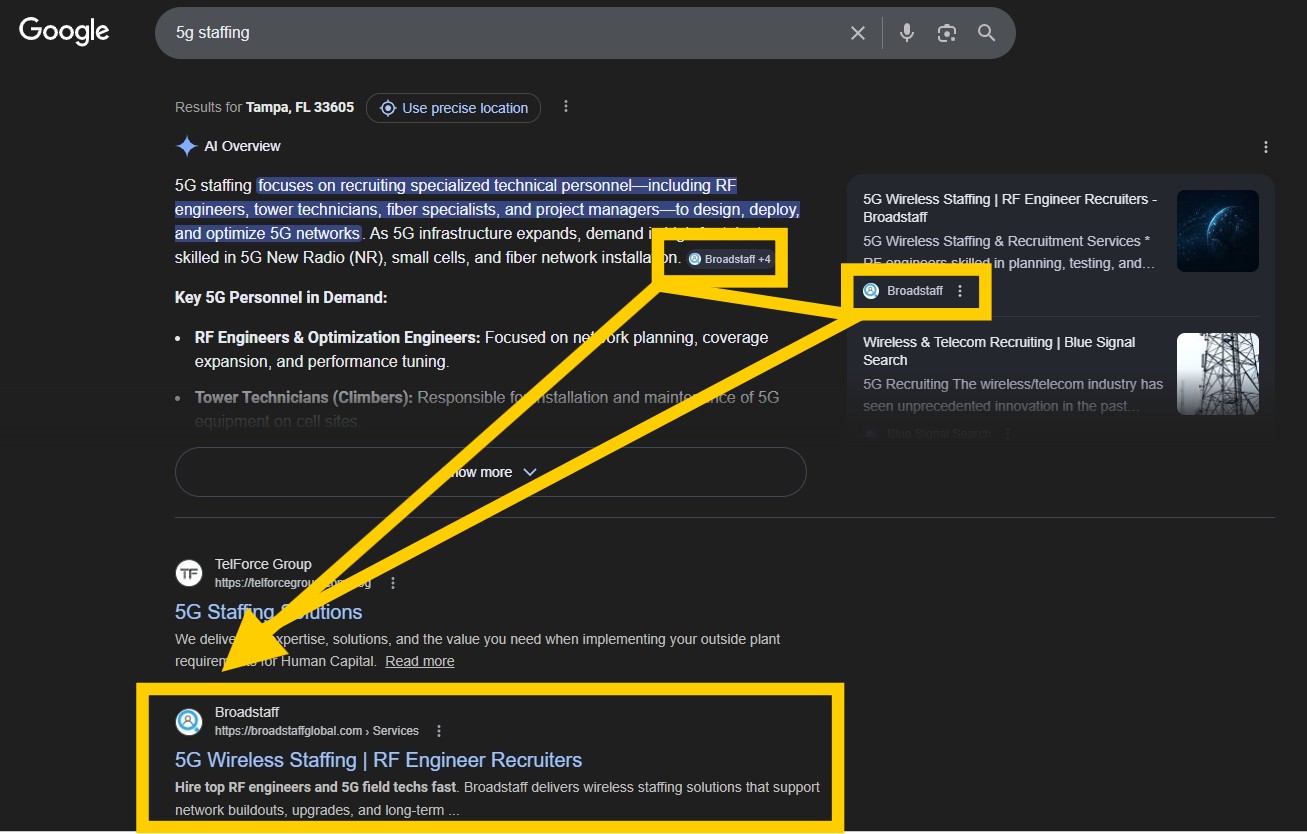
Broadstaff serves the digital infrastructure staffing market, including telecom, fiber and data centers. Its public case study describes work on search priorities, content alignment, authority and AI-search visibility.
- 90%
- of tracked keywords reached page one.
- 3×
- qualified leads within a 12-month period.
These are reported results from one engagement. Read the Broadstaff case study and its results.
“What they’ve done for Broadstaff has been really nothing short of miraculous.”
Carrie Charles, Broadstaff Global client testimonial
What makes Percepture’s approach different?
Percepture has operated since 2004 and brings SEO, GEO, PR, content, conversion and analytics into a coordinated commercial program. The Search-Driven Word-of-Mouth Engine gives each workstream a defined role.
Research identifies the question. Architecture gives the answer a clear home. SEO and GEO support discovery. PR and proof help buyers assess credibility. Conversion paths match the buyer’s stage, and sales feedback shows which inquiries become opportunities.
For more on the operating model, continue to Percepture’s guide to SEO lead generation. Use this buyer guide to evaluate providers, scope, cost, proof and measurement.
Review scope before comparing price
Use the evidence and scorecard to compare the technical, content, authority, conversion and reporting work included in each option.
Continue your research
Frequently asked questions
What are SEO lead generation services?
SEO lead generation services help qualified buyers discover, evaluate and contact a company through organic and AI-assisted search. A complete program connects buyer research, technical SEO, useful content, authority, conversion paths, lead qualification and attribution instead of treating traffic as the final result.
What should a lead-generation SEO package include?
SEO lead generation services should include ICP research, search-intent analysis, technical SEO, page architecture, expert content, AI-search visibility, authority development, conversion optimization and reporting tied to CRM stages. The exact mix should reflect the website’s condition, competition, sales cycle and internal capabilities.
How much does a lead-generation SEO program cost?
Pricing for SEO lead generation services depends on competition, technical condition, target markets, content complexity, authority needs, conversion work, measurement setup and senior involvement. Compare the work, assumptions, ownership and reporting included in each proposal. A low price can be expensive if the program produces traffic that sales cannot use.
How long does SEO-led lead generation take?
Timing for SEO lead generation services varies by starting position and scope. Research, baselines and technical priorities come first, followed by implementation, indexation and testing. Broader visibility and conversion data can take months, while authority and revenue feedback may compound over a longer period. No responsible provider should promise a universal timeline.
How should I compare providers?
Compare providers of SEO lead generation services on qualified-lead proof, buyer-intent strategy, technical skill, expert content, GEO, authority, conversion work, CRM attribution, industry knowledge, commercial clarity and senior accountability. Ask who performs each task, which assets you own and how sales feedback changes the plan.
Are SEO leads more qualified than paid or outbound leads?
Not automatically. Search can begin with strong intent because the buyer chose to research the issue, but lead quality still depends on the query, audience, page, offer and qualification process. Paid search and outbound can also produce strong opportunities when targeting, timing and execution are sound.
How does AI search affect lead generation?
AI systems can help buyers discover explanations, sources and providers during research. Accessible pages, clear entities, consistent facts and useful evidence support that process. Track observed citations, identifiable referral traffic and assisted conversions separately. Google AI feature traffic is included in Search Console’s overall Web reporting.
Which metrics should the provider report?
Reporting should cover visibility, engagement, conversion, quality and revenue: impressions, rankings, observed citations, relevant visits, CTA actions, inquiries, sales acceptance, meetings and opportunities. Include sourced or assisted pipeline only when attribution supports the claim. Rankings alone do not demonstrate pipeline impact.
Can an agency guarantee leads or rankings?
No provider controls search rankings, AI citations, buyer behavior or sales outcomes. An agency can commit to a documented strategy, defined deliverables, sound execution, transparent reporting and ongoing improvement. Guarantees tied to positions, lead counts or revenue should trigger closer scrutiny.
How is lead-generating SEO different from generic SEO?
Generic SEO may stop at technical health, rankings and traffic. Lead-generating SEO starts with the target buyer and connects priority pages to proof, suitable conversion paths and CRM outcomes. Aggregate query research guides the plan; sales feedback helps determine which opportunities to pursue next.
Build a plan sales can evaluate
Percepture can review how your SEO lead generation services plan connects buyer demand, search visibility, proof, conversion and qualified pipeline.
Use the contact form to share your website, target customers and the gap you want to address. That context gives the team a practical starting point for the conversation.