

SEO Lead Generation should turn the right searches into qualified pipeline, not stop at rankings or traffic. That requires one connected system for buyer intent, visibility, trust, conversion, qualification, sales follow-up, and revenue feedback.
A page can rank and still fail commercially. If it attracts the wrong audience, offers weak proof, or sends every visitor to the same generic form, the pipeline will leak before sales sees a viable opportunity.
From search visibility to three times more qualified leads
Carrie Charles, CEO of Broadstaff Global, explains how Percepture helped the company become easier to find, understand, and trust across Google and AI-assisted search. The result was not traffic for traffic’s sake. Broadstaff reported stronger visibility and threefold qualified-lead growth during the documented 12-month period.
“What they’ve done for Broadstaff has been really nothing short of miraculous.”
Carrie Charles, CEO, Broadstaff Global
Read the verified testimonial excerpt
Carrie Charles describes Percepture’s work for Broadstaff as “nothing short of miraculous.” This excerpt is included as a crawlable summary of the approved testimonial. It is not presented as a complete word-for-word transcript.
Results vary by market demand, authority, competition, resources, implementation speed, sales follow-up, and measurement quality.
See the visibility system working across Google and AI search
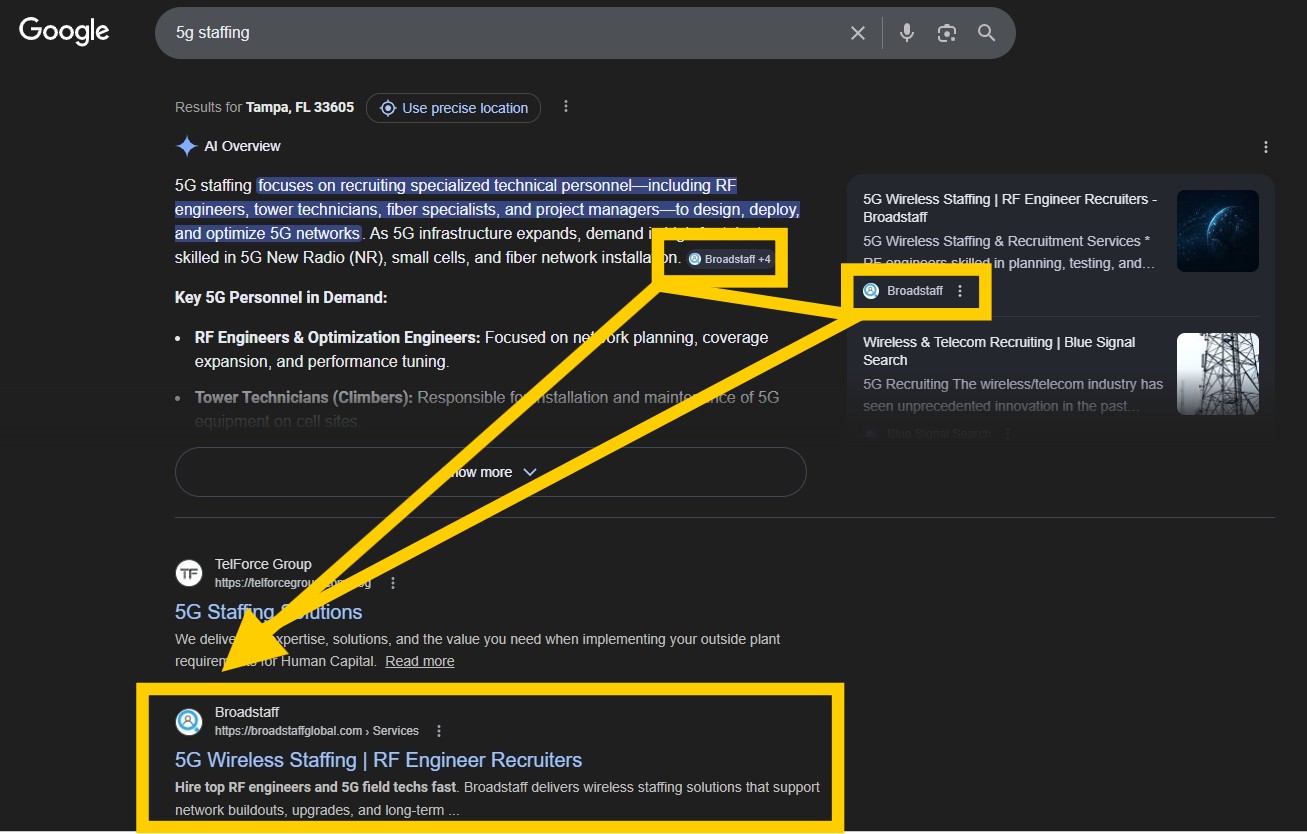
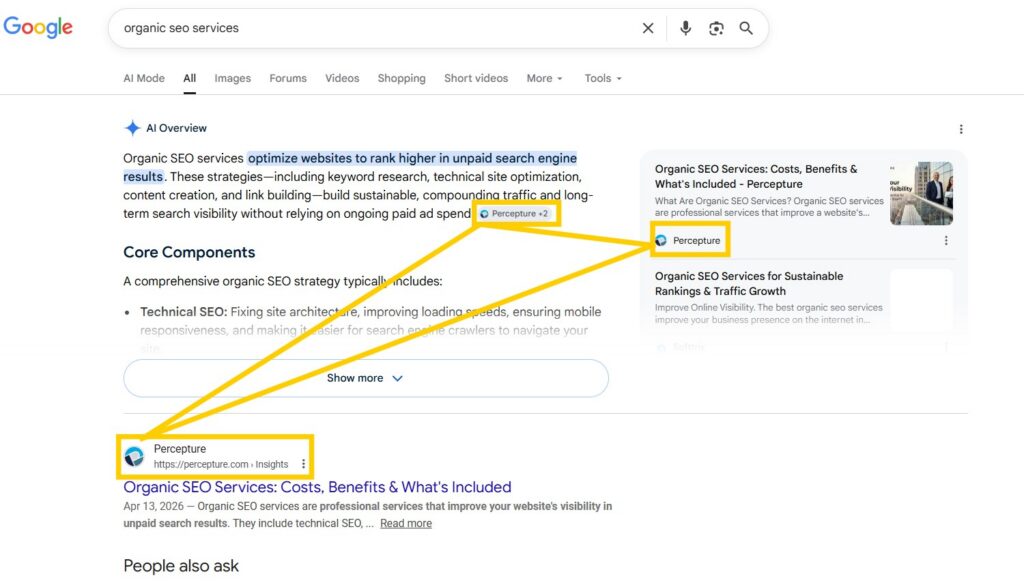
Ranking proof matters most when it supports a qualified buyer journey. These examples show Percepture appearing across AI answers, cited source cards, and organic search for commercially relevant terms.




What is SEO Lead Generation?
SEO Lead Generation is the process of using organic search and AI-answer visibility to attract potential buyers, build trust, and turn visits into qualified opportunities. It combines buyer-intent keywords, useful content, technical SEO, authority signals, conversion paths, lead scoring, and revenue attribution.
Executive summary
Traffic is an input
Qualified pipeline is the business outcome. SEO Lead Generation reporting should show whether search is reaching buyers, not just producing sessions.
Intent sets the priority
Pages should be planned around buyer questions, commercial relevance, fit, and the next decision.
Proof creates trust
Methods, expert context, case studies, testimonials, and clear limits help buyers evaluate a claim.
Conversion must match intent
A diagnostic can fit early research, while pricing, proof, and a strategy conversation fit later stages.
Sales closes the loop
SEO Lead Generation improves when sales reports which inquiries became accepted leads, opportunities, and revenue.
What Is SEO Lead Generation?
An SEO lead is a person or company that discovers a business through organic search or an AI-assisted answer and then takes an identifiable next step. That action may be a diagnostic, case-study visit, pricing review, product trial, meeting request, or direct inquiry.
A visitor is not automatically a lead. A lead is not automatically qualified, and a qualified lead is not yet an opportunity. Strong SEO Lead Generation keeps those stages separate so marketing does not report form fills as pipeline before sales has assessed fit and intent.
Organic search often captures demand that already exists. A buyer recognizes a problem, searches for an answer, evaluates possible approaches, and compares providers. Useful pages can also shape demand by helping that buyer understand the cost of the problem or the choices involved.
Traditional search and AI-assisted discovery are different interfaces for a related job. Buyers may discover a page in standard results, Google AI features, ChatGPT, Copilot, Perplexity, Claude, or Brave. The source still needs to be crawlable, clear, useful, well connected, and supported by evidence.
B2C journeys may move from search to purchase quickly. Complex B2B and SaaS journeys often involve a buying committee, technical validation, budget review, security questions, and several touches. That makes qualification and revenue attribution central to SEO Lead Generation strategy.
The technical foundation also matters. A technical SEO audit service can expose crawl, rendering, internal-link, schema, performance, and indexation problems that keep strong commercial content from being discovered.
How Does SEO Generate Leads?
SEO Lead Generation works by meeting a buyer at a useful moment, answering the immediate question, establishing trust, and presenting a next step that fits the buyer’s intent. The path is easier to manage when teams treat it as a sequence rather than a traffic campaign.
- A problem is recognized. The buyer sees a performance gap, operational risk, growth target, or missed opportunity.
- A search or AI query is made. The wording may describe a symptom, method, service, comparison, price, vendor, or implementation concern.
- A useful source is discovered. The buyer reaches a page through an organic result, cited answer, video, image, or related resource.
- Expertise is evaluated. The buyer checks whether the source understands the issue, audience, constraints, and decision.
- Proof is reviewed. Case studies, methods, testimonials, credentials, pricing context, and third-party authority reduce uncertainty.
- A suitable action is taken. The visitor uses a diagnostic, reviews proof, examines pricing, or requests a conversation.
- The lead is qualified and followed up. Marketing and sales assess company fit, role, intent, timing, engagement, and the requested next step.
This sequence is why organic SEO services should connect technical work, content architecture, authority, conversion, and measurement. Optimizing only the ranking step leaves most of the SEO Lead Generation system unmanaged.
Who needs a search-to-pipeline system?
CEO or founder
Needs SEO Lead Generation to support durable growth, differentiation, qualified demand, and a roadmap tied to business outcomes.
CFO
Needs cost categories, controlled risk, lifecycle definitions, and a defensible link between investment and opportunity value.
Marketing leader
Needs an SEO Lead Generation plan that connects topic ownership, search visibility, AI citations, sound architecture, useful content, and conversion performance.
Sales leader
Needs fewer low-fit inquiries, clear routing, fast response, and agreement on sales acceptance.
RevOps
Needs SEO Lead Generation source data, defined lifecycle stages, CRM governance, and landing-page attribution.
Technical operator
Needs crawlable HTML, maintainable pages, valid schema, stable media, and limited script dependence.
Why More SEO Traffic Does Not Always Mean More Leads
Traffic can rise while pipeline stays flat. In SEO Lead Generation, the usual cause is not one isolated SEO error. It is a break between the query, page, proof, offer, form, routing process, and sales response.
- Low commercial intent: The content attracts broad curiosity without reaching a buyer problem the company solves.
- Wrong audience or geography: Visitors fall outside the company’s market, company-size range, industry, or service area.
- Page mismatch: A general article ranks for a query that requires a service page, comparison, case study, pricing page, or tool.
- Weak proof: Claims appear without a method, example, expert, source, or useful limitation.
- Generic conversion path: Every visitor receives the same “contact” request regardless of readiness.
- Form friction: The form asks too much before delivering value or performs poorly on mobile devices.
- No qualification: The business captures a name and email but lacks company, role, need, timing, or intent context.
- Slow follow-up: A viable buyer receives no clear next step or timely human response.
- Broken attribution: Search source, landing page, campaign context, and lifecycle outcomes fail to reach the CRM.
SEO Lead Generation becomes commercially useful when each leak has an owner. Search teams manage discovery, content teams manage clarity, conversion teams manage action, RevOps manages data, and sales reports lead quality.
Score your search-to-pipeline gaps
Use a low-friction SEO Lead Generation diagnostic to examine whether your visibility, proof, conversion paths, and qualification signals work as one system.
The Percepture Search-to-Qualified-Pipeline System
The Percepture Search-to-Qualified-Pipeline System is a six-part methodology for connecting what buyers search, what they trust, how they convert, which leads sales should pursue, and what revenue data should improve next. It gives SEO Lead Generation a shared operating model across marketing, sales, and RevOps.
1. Intent Discovery
Map the problems, desired outcomes, service needs, budget awareness, vendor comparisons, timing questions, implementation concerns, and purchase signals buyers express. Search volume helps size an SEO Lead Generation topic, but it does not determine commercial value on its own.
2. Visibility Architecture
Assign each intent to the correct page type. Options include a service page, industry page, pillar, how-to article, comparison, pricing guide, case study, tool, or local page. Clear ownership reduces duplication and gives internal links a logical destination.
3. Trust Velocity
Help buyers validate the answer quickly through experts, bylines, methods, case studies, ranking evidence, video testimonials, third-party mentions, process clarity, and consistent entity information. Trust should appear close to the claim it supports.
4. Conversion Path
Match the action to the buyer’s readiness. A scorecard or checklist can serve early research. A case study, pricing page, audit, product trial, meeting, or direct conversation can serve a buyer with stronger intent.
5. Lead Qualification
Define the SEO Lead Generation progression from visitor to engaged visitor, inquiry, marketing-qualified lead, sales-accepted lead, meeting, opportunity, pipeline, and revenue. Each stage should have a clear entry condition and owner.
6. Revenue Feedback
Use CRM and sales outcomes to refine keywords, page types, offers, industries, proof, scoring, internal links, content updates, and budget. The process does not end at a form fill. It improves when sales reports which leads were worth pursuing.
Which Keywords Generate the Best SEO Leads?
The best SEO Lead Generation keywords combine a relevant buyer problem with a page your company can answer credibly and an action the buyer can reasonably take. A low-volume vendor or pricing query can be more valuable than a high-volume definition if it reaches the right account at the right stage.
Keyword intent scorecard
| Keyword class | Buyer question | Best page type | Useful next step |
|---|---|---|---|
| Problem | Why is this happening? | Diagnostic article or guide | Checklist or assessment |
| Definition | What does this mean? | Pillar or glossary guide | Related method or guide |
| Solution | How can we solve it? | Methodology or solution page | Framework or case study |
| Service | Who can execute it? | Service page | Scope or strategy review |
| Comparison | Which approach fits? | Comparison page | Decision matrix |
| Pricing | What drives investment? | Pricing guide | Package or budget review |
| Vendor | Which provider should we evaluate? | Buyer guide or proof page | Case study or meeting |
| Local | Who serves this market? | Substantive local page | Local consultation |
A strong SEO Lead Generation keyword plan also separates broad education from service intent. That prevents the authority hub from duplicating a service page and lets a specialist enterprise SEO program address execution needs directly.
SEO Lead Generation Across the Buyer Journey
SEO Lead Generation should help the buyer move through discovery, validation, decision, and activation. The content and CTA change at each stage because the buyer’s question and level of commitment are different.
| Journey stage | Buyer need | Useful content | Best-fit action |
|---|---|---|---|
| Discovery | Understand the problem | Definitions, diagnostics, research, and how-to guidance | Run a scorecard |
| Validation | Confirm the approach | Frameworks, technical guidance, proof, and comparisons | Read a case study |
| Decision | Evaluate fit and risk | Service scope, pricing context, team expertise, and process | Review options |
| Activation | Plan implementation | Roadmap, responsibilities, measurement plan, and intake | Request a strategy conversation |
Complex B2B teams may revisit these stages as new stakeholders enter. A CFO may arrive through pricing, a technical operator through an audit question, and a sales leader through lead-quality concerns. A capable B2B SEO agency should account for that committee rather than optimize for one persona.
How AI Search Changes SEO Lead Generation
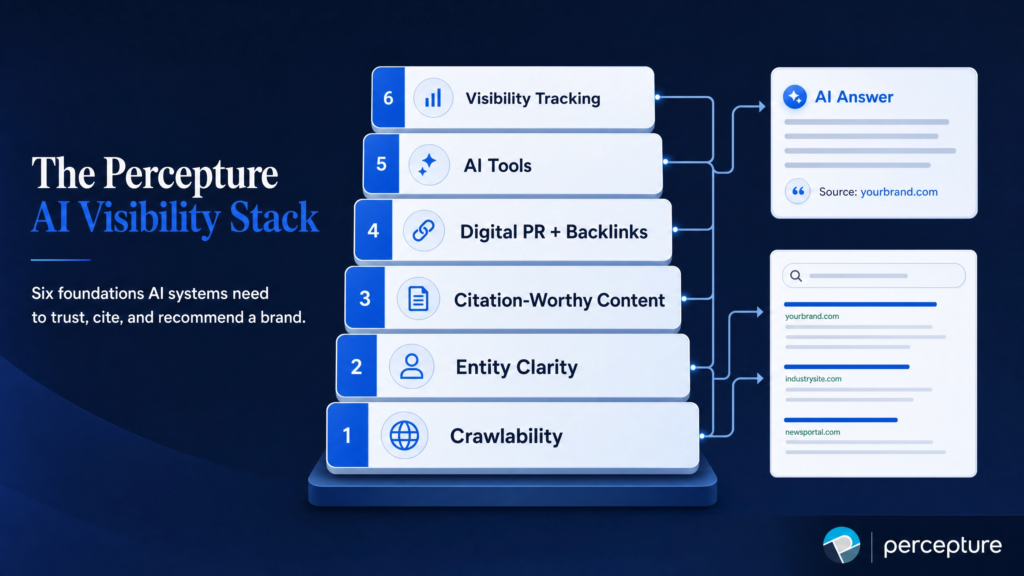
AI search adds new discovery and validation surfaces, but it does not remove the need for sound SEO. Clear page ownership, crawlable answers, consistent entities, original evidence, useful links, and visible text still provide the foundation.
Google Search, AI Overviews, and AI Mode
Keep important answers visible in the HTML, use descriptive headings, and support claims near the relevant passage. Monitor the selected landing page, organic queries, citations where observable, and changes in click behavior. Do not depend on special AI schema or hidden text.
ChatGPT Search
Allow the relevant search crawler when business policy permits, check CDN and firewall rules, and give the page clear authorship and evidence. Track referral traffic and assisted SEO Lead Generation conversions, but do not treat a mention as guaranteed or permanent.
Bing and Copilot
Verify the site in Bing Webmaster Tools, submit important URLs, and use IndexNow after publication or a meaningful update. Track cited URLs and the questions that surface them when those data are available.
Perplexity
Use clear, standalone answer passages and claim-level evidence. Current dates should represent real publication or meaningful updates rather than artificial freshness. Test broad, technical, and executive prompts separately.
Claude
Treat user-directed retrieval controls separately from model-training controls. Keep the page available through relevant search partners, make the source easy to interpret, and avoid assuming that one crawler policy governs every use.
Brave Search and Ask Brave
Maintain crawlability, clear entity relationships, and strong organic relevance. Test conventional search results and AI-generated answers as separate surfaces because visibility in one does not prove visibility in the other.
Percepture’s generative engine optimization services connect these discovery surfaces with the underlying search, entity, authority, and measurement work. The guide to improving brand visibility in AI search provides a deeper view of that work.

How Trust Converts Search Visibility Into Leads
Buyers rarely convert because a page repeats a benefit. Effective SEO Lead Generation requires the source to demonstrate that it understands the problem, offers a credible method, shows relevant proof, and explains what happens next.
Place proof before heavy promotion. Useful trust signals include named experts, clear bylines, operating methods, public case studies, video testimonials, third-party mentions, pricing context, and consistent company information. Digital PR services can support this layer by building relevant authority and earned visibility beyond the company’s own site.
Trust also depends on limits. Results should include the client, metric, period, and conditions that affect transferability. Current rankings should include query, location, and date context because results can change.
For Broadstaff, the approved proof includes 90% page-one coverage for tracked keywords, threefold qualified-lead growth over the reported 12-month period, and Carrie Charles’s testimonial. The full SEO lead-generation case study connects the evidence to the broader program.

How to Convert SEO Traffic Into Qualified Leads
SEO Lead Generation conversion begins by matching the offer to the query. A visitor researching a problem may not be ready for a sales meeting, while a buyer comparing vendors may find a generic checklist too weak.
- Show value first. Answer the question before asking for personal information.
- Use intent-matched CTAs. Offer diagnostics to cold visitors, proof and pricing to warm buyers, and planning conversations to high-intent prospects.
- Keep forms proportionate. Ask only for information needed to deliver the offer and route the response.
- Explain the next step. Tell the buyer what will be reviewed, who will respond, and what information will help.
- Capture qualification context. Company, role, industry, challenge, timing, website, and desired next step can help when appropriate.
- Route quickly. Assign ownership and create a clear response process for viable inquiries.
- Preserve source data. Pass the landing page, search source, offer, and campaign context into the CRM.
Conversion rate optimization addresses the path from visit to action, while B2B lead-generation services can support activation and follow-up beyond the organic visit. Both should work from the same lifecycle definitions.
How Should SEO Leads Be Scored?
SEO Lead Generation scoring should combine fit and behavior rather than reward activity alone. A visitor who reads five articles may still be a poor account fit. A target-account executive who reviews pricing and a case study may deserve prompt attention even after a short session.
| Signal | What it can indicate | Guardrail |
|---|---|---|
| Query intent | Problem, service, comparison, vendor, or pricing interest | Do not infer identity from a query alone |
| Page intent | The commercial role of the landing page | Keep page ownership explicit |
| Company fit | Industry, size, geography, and use-case alignment | Use agreed qualification criteria |
| Buyer role | Influence, authority, or technical responsibility | Account for buying committees |
| Proof activity | Case-study, testimonial, or pricing engagement | Avoid treating one click as readiness |
| Form context | Stated problem, timing, and requested next step | Keep optional fields proportionate |
| Sales acceptance | Human validation that the lead merits pursuit | Record rejection reasons consistently |
B2B intent data can add account-level context to SEO Lead Generation when used carefully. The practical guide to identify sales-qualified leads explains how intent signals can support, rather than replace, qualification.
How to Measure SEO Lead Generation
SEO Lead Generation measurement should follow the full lifecycle. A dashboard that ends at clicks or forms cannot show whether search created opportunities sales wanted to pursue.
Search-to-revenue measurement scorecard
| Layer | Measures | Decision supported |
|---|---|---|
| Visibility | Impressions, rankings, selected URL, image or video visibility, and observable AI citations | Where is the brand being discovered? |
| Engagement | Relevant landing-page visits, proof views, video engagement, and related-resource clicks | Are buyers finding useful evidence? |
| Conversion | Diagnostic starts, completions, pricing visits, form starts, inquiries, and bookings | Does the next step fit intent? |
| Quality | Company fit, buyer role, MQLs, sales acceptance, meetings, and rejection reasons | Are leads worth pursuing? |
| Pipeline | Opportunities, proposals, stage progression, and pipeline value | Is organic demand advancing? |
| Revenue | Closed outcomes, revenue by landing page, and cost per qualified opportunity | Where should investment change? |
Attribution and analytics should preserve the original landing page and source while recording later touches. Teams should agree on SEO Lead Generation lifecycle definitions before comparing channel performance.
SEO Lead Generation Cost, ROI, and Timeline
SEO Lead Generation investment depends on the gap between the current site and the required search-to-pipeline system. Cost may include strategy, technical SEO, research, content, design, development, digital PR, conversion work, analytics, CRM integration, and ongoing refinement.
| Investment area | What it addresses | Risk if omitted |
|---|---|---|
| Strategy and intent research | Audience, topics, page ownership, and priorities | Traffic without buyer relevance |
| Technical foundation | Crawlability, indexation, rendering, performance, and schema | Strong content remains hard to discover |
| Content and design | Answers, comparison tools, proof, and usable page experiences | Visibility fails to build trust |
| Authority development | Expert signals, earned mentions, and relevant links | Weak competitive credibility |
| Conversion work | Offers, forms, UX, and intent-matched next steps | Qualified traffic does not act |
| Analytics and CRM | Source capture, lifecycle stages, and revenue feedback | Marketing cannot learn from sales outcomes |
SEO Lead Generation ROI should be modeled from accepted leads, opportunity rates, pipeline value, closed revenue, and the full cost of execution. Avoid using a traffic-value estimate as if it were realized revenue.
There is no universal timeline. Existing authority, technical condition, competition, content depth, implementation speed, sales cycle, and available resources all affect progress. Review SEO pricing packages to understand Percepture’s published options without treating a package as a performance guarantee.
Common SEO Lead Generation Mistakes
- Targeting traffic first: Volume takes priority over fit, intent, or opportunity value.
- Creating duplicate intent pages: Several URLs compete to answer the same buyer question.
- Publishing generic content: The page restates common advice without a method, proof, or expert perspective.
- Using one CTA everywhere: Early and late-stage buyers receive the same request.
- Calling every form fill pipeline: Inquiry, qualification, sales acceptance, opportunity, and revenue are blended together.
- Ignoring sales feedback: Marketing never learns which accounts fit, advanced, or were rejected.
- Hiding important content: Key answers depend on scripts or interactions that make retrieval less reliable.
- Blocking relevant crawlers: Search and user-directed retrieval access is restricted without a deliberate policy.
- Making unsupported claims: Results lack a client, period, source, or limitation.
- Using artificial freshness: Dates change without a meaningful content update.
- Treating schema as a trick: Structured data describes content that is not visible on the page.
SEO Lead Generation Case Study: Broadstaff Global
Broadstaff’s SEO Lead Generation program combined SEO, AI-search visibility, content, and authority building. During the reported 12-month period, 90% of tracked keywords reached page one and qualified leads grew threefold.
The case demonstrates an important operating point: ranking coverage matters more when the company becomes easier for the right buyer to find, understand, and trust. The testimonial, ranking evidence, and lead result connect visibility to a commercial outcome without claiming that every market will produce the same result.
Broadstaff’s outcome does not establish a universal benchmark. Market demand, existing authority, competition, resources, technical condition, offer strength, and execution can change results.

See how search visibility became qualified demand
Review Percepture’s SEO Lead Generation services, pricing, and proof before deciding whether the operating model fits your market and sales process.
Self-Assessment: Is Your Search-to-Pipeline System Connected?
- Do priority keywords map to a defined buyer problem and page owner?
- Can the team distinguish traffic, inquiries, accepted leads, opportunities, pipeline, and revenue?
- Does each major page offer a next step suited to its intent?
- Can buyers find relevant proof before reaching a sales form?
- Are important answers visible in crawlable HTML?
- Does the CRM preserve source and landing-page data?
- Does sales record acceptance and rejection reasons?
- Can the team identify which organic landing pages create opportunities?
- Are search and AI-discovery surfaces monitored separately?
- Does revenue feedback change keyword, content, offer, and budget decisions?
8–10 yes answers: The core SEO Lead Generation system is connected, though individual leaks may remain.
5–7 yes answers: Material leakage exists between discovery, conversion, qualification, or measurement.
0–4 yes answers: Search activity and pipeline operations are largely disconnected.
Frequently Asked Questions
What is SEO Lead Generation?
SEO Lead Generation uses organic search and AI-answer visibility to attract potential buyers and move them toward a qualified opportunity. It combines buyer-intent research, useful content, technical SEO, authority, conversion paths, lead scoring, sales follow-up, and revenue attribution.
How does SEO generate leads?
SEO Lead Generation works when a useful page appears for a relevant buyer question, answers it clearly, provides credible proof, and offers a next step suited to the visitor’s intent. Qualification and timely follow-up then determine whether the inquiry should become a sales opportunity.
Are SEO leads better than paid leads?
Neither source is automatically better. Quality depends on buyer intent, audience fit, offer, landing-page experience, qualification, and follow-up. Paid search can create faster visibility, while SEO Lead Generation can build durable discovery. Compare both using accepted leads, opportunities, cost, and revenue.
How long does SEO take to generate leads?
There is no universal SEO Lead Generation timeline. Existing authority, technical condition, competition, market demand, content quality, implementation speed, conversion paths, and sales cycle all affect progress. Use staged milestones for indexation, visibility, engagement, qualified inquiries, opportunities, and revenue.
Which keywords create the highest-quality leads?
The best SEO Lead Generation keywords express a relevant buyer problem and match a page the company can answer credibly. Service, comparison, pricing, vendor, and implementation queries may show stronger commercial intent, but lower-funnel wording does not replace company-fit and sales-acceptance checks.
How do you convert organic traffic into qualified leads?
SEO Lead Generation conversion requires answering the query first, showing relevant proof, and matching the CTA to buyer readiness. Use proportional forms, capture useful qualification context, explain the next step, route viable inquiries quickly, and pass source and landing-page data into the CRM.
What is the difference between SEO and lead generation?
SEO improves discovery through organic search and related answer surfaces. Lead generation covers the broader process of attracting, capturing, qualifying, and activating potential buyers across channels. SEO Lead Generation connects those disciplines, but rankings alone do not complete the process.
How should organic leads be tracked?
SEO Lead Generation tracking should include the original source and landing page, conversion action, company and role context, marketing qualification, sales acceptance, meetings, opportunities, pipeline, and closed outcomes. Preserve the original touch while recording later interactions so channel reporting does not erase the buyer journey.
Can SEO lead results be guaranteed?
No responsible SEO Lead Generation plan can guarantee rankings, AI citations, lead volume, or revenue. Search systems, competitors, demand, buyer behavior, and implementation conditions change. A sound program can define work, measurement, decision rules, and reporting while documenting the limits on any forecast.
How does AI search affect SaaS SEO strategy?
AI search creates additional discovery and validation surfaces across Google, ChatGPT, Copilot, Perplexity, Claude, and Brave. Strong visibility still depends on crawlable pages, clear answers, consistent entities, relevant authority, original proof, and measurement. Placement can change and should not be guaranteed.
Build a Search-to-Pipeline Plan
Percepture can review how your buyer intent, search visibility, proof, conversion paths, lead qualification, sales follow-up, and revenue data work together.
Book a Search-to-Pipeline Strategy Conversation Review SEO Pricing