
How to Optimize Your Website for ChatGPT, Perplexity and AI Search starts with a simple decision: identify the buyer questions that matter, then assign each question to the page best equipped to answer it. The work is not a sitewide rewrite or a hunt for one technical shortcut.
A strong program connects technical access, clear answers, credible evidence, outside authority and conversion paths. It also measures the same buyer questions over time instead of treating one AI response as a permanent ranking.





What should you optimize for AI search?
How to Optimize Your Website for ChatGPT, Perplexity and AI Search: research commercially important buyer questions, make the correct pages accessible and easy to interpret, support claims with evidence, strengthen entity and source authority, and rerun a stable question set to see where the brand is cited, mentioned or missing.
The executive summary
For leadership teams, How to Optimize Your Website for ChatGPT, Perplexity and AI Search is a source strategy rather than a content-volume contest. Every page should have a defined question, a clear owner, useful proof and a next action.
Start with demand
Build the question set from real buyer concerns, sales conversations, search demand and commercial priorities.
Fix the right URL
Improve an existing page when it already owns the intent. Create a new URL only when the audience, intent or buyer stage is meaningfully different.
Make answers extractable
Use direct language, descriptive headings, concise definitions, tables, FAQs and clearly attributed evidence.
Measure the evidence
Track the question, engine, response, cited source and date. A summary score without those details does not tell the team what to fix.
Who this guide is for
Business owners and CEOs
For business owners, How to Optimize Your Website for ChatGPT, Perplexity and AI Search is a revenue, reputation and market-positioning decision rather than another disconnected marketing task.
CMOs and marketing leaders
For CMOs, How to Optimize Your Website for ChatGPT, Perplexity and AI Search provides a shared operating brief for enterprise SEO, content, public relations, web development and conversion around one buyer-question map.
Construction leadership teams
Use it to explain complex services, project capabilities, locations, sectors and proof in language that buyers and answer systems can interpret.
Technical and web teams
Use it to diagnose access, rendering, canonicalization, structured data and page-template issues before commissioning more content.
Find the first visibility gap
Before funding a rewrite, test the questions that influence your pipeline. A focused diagnostic can show whether How to Optimize Your Website for ChatGPT, Perplexity and AI Search should begin with access, page ownership, evidence, authority or conversion.
How to Optimize Your Website for ChatGPT, Perplexity and AI Search in eight steps
Use How to Optimize Your Website for ChatGPT, Perplexity and AI Search as an operating plan: the eight steps below turn a broad goal into coordinated SEO, GEO, digital PR and web work.
1. Build a buyer-question baseline
In How to Optimize Your Website for ChatGPT, Perplexity and AI Search, the baseline should begin with questions that a qualified buyer may ask before making a shortlist. For a construction company, those questions may cover project type, service area, delivery model, safety documentation, technical capability, procurement fit, schedule risk or the evidence behind a claim.
Separate informational questions from commercial questions. “What is design-build?” and “Which contractor can deliver this type of project in this region?” require different pages, evidence and calls to action. Percepture’s strategy and planning work connects those questions to business priorities before production starts.
“We’re identifying these questions we want to be the answer to.”
Create a controlled list rather than collecting random prompts. Record the persona, funnel stage, geography, service line and intended page owner for each question. That list becomes the baseline for How to Optimize Your Website for ChatGPT, Perplexity and AI Search and prevents measurement from drifting from one month to the next.
2. Confirm that important pages can be accessed and interpreted
For How to Optimize Your Website for ChatGPT, Perplexity and AI Search, confirm that relevant systems can retrieve important pages and that useful content does not depend on fragile client-side interactions. Review robots directives, response codes, canonical tags, redirects, page rendering and indexability. Check whether important explanations are present in the delivered HTML and whether navigation exposes them through normal links.
OpenAI publishes information about its web crawlers and user agents in its official bot documentation. Google also explains how established search controls apply to its AI search features in its AI features and website guidance. These controls govern access and presentation; they do not guarantee that a page will be selected as a source.
Technical access is one layer of How to Optimize Your Website for ChatGPT, Perplexity and AI Search. If templates, rendering or architecture are the problem, coordinate the fix with enterprise web development rather than asking writers to work around a broken delivery system.
3. Assign one primary URL to each intent
A disciplined approach to How to Optimize Your Website for ChatGPT, Perplexity and AI Search assigns one primary URL to each intent because AI-search programs can create duplication quickly. One team publishes a broad guide, another creates an FAQ page, and a third adds a near-identical service article. The result is several weak candidates with overlapping purpose.
Choose one canonical owner for each intent. Review its existing rankings, links, evidence, conversion path and topical fit. If it already answers the right question, improve it before creating another page. This protects accumulated authority and makes the site easier to maintain.
“You can improve a page you might already have so you’re not recreating a whole new page from scratch.”
This rule matters for construction sites with many service and market combinations. The existing guide to SEO for construction companies, for example, should retain its construction-SEO purpose. A new AI-search page should address a distinct question instead of copying the same service explanation with a different label.
4. Write answer-first page sections
When applying How to Optimize Your Website for ChatGPT, Perplexity and AI Search, every major section should answer its heading promptly. Put the definition, recommendation or decision rule first, then explain the conditions and evidence. Readers should not have to cross several introductory paragraphs to understand the point.
Use short paragraphs, descriptive headings, ordered steps and real tables where comparison is useful. Give entities their full names and relationships. State who provides a service, what it covers, who it fits and what evidence supports the claim. These practices make How to Optimize Your Website for ChatGPT, Perplexity and AI Search useful to people first while also creating clean passages that answer systems can interpret.
A mature content marketing program should maintain this structure across service pages, buyer guides, proof pages and FAQs. The goal is consistency of meaning, not identical wording.
5. Add evidence at the point of the claim
Evidence is central to How to Optimize Your Website for ChatGPT, Perplexity and AI Search because unsupported superlatives are weak inputs for both buyers and answer systems. Replace them with named methods, documented experience, clear definitions, dated observations, attributed quotes and links to primary evidence where appropriate.
For construction companies, evidence can include accurately described capabilities, project types, markets served, staff expertise, process documentation and public case material. The evidence must fit the specific claim. A broad company award does not prove a technical project result, and a project image does not prove a ranking claim.
Within How to Optimize Your Website for ChatGPT, Perplexity and AI Search, outside authority also matters. Digital PR can support the source ecosystem by earning credible coverage and references that corroborate expertise. It should not be treated as a bulk-link exercise or a substitute for a clear website.
The Percepture SOURCE Framework for How to Optimize Your Website for ChatGPT, Perplexity and AI Search
The SOURCE Framework gives leaders a practical way to diagnose AI visibility. It joins measurement to execution so a visibility gap results in a defined fix.
- S — Select buyer questions: choose prompts tied to a real audience, service and business decision.
- O — Own the correct URL: assign each intent to one primary page and prevent avoidable duplication.
- U — Unblock access: review crawl controls, rendering, status codes, canonicalization and internal discovery.
- R — Resolve the answer: state the answer early, define entities and organize supporting detail clearly.
- C — Corroborate claims: add first-party proof and strengthen relevant outside authority.
- E — Evaluate and improve: rerun stable questions, inspect sources and choose the next practical fix.
How to Optimize Your Website for ChatGPT, Perplexity and AI Search becomes manageable when every recommendation maps to one of these six operating areas.

AI-search visibility scorecard for How to Optimize Your Website for ChatGPT, Perplexity and AI Search
| Area | What to inspect | Good operating condition |
|---|---|---|
| Buyer questions | Persona, intent, service, geography and commercial value | A controlled question set tied to decisions |
| Page ownership | Overlapping URLs, canonicals and competing page purposes | One primary owner for each intent |
| Technical access | Robots controls, status codes, rendering and internal links | Important content is accessible and stable |
| Answer clarity | Definitions, headings, direct responses and comparison structures | The core answer appears early and plainly |
| Evidence | Sources, expert attribution, dates and first-party proof | Material claims have relevant support |
| Authority | Independent references and topic-relevant coverage | Outside sources corroborate important entities |
| Measurement | Questions, engines, dates, responses and cited URLs | Changes can be compared against a stable baseline |
| Conversion | Buyer-fit language, next steps and attribution | Visibility has a path to qualified action |
The scorecard turns How to Optimize Your Website for ChatGPT, Perplexity and AI Search into defined operating areas. A low score identifies the workstream, not the outcome. Use attribution and analytics to connect visibility activity with meaningful website and pipeline behavior where the data permits it.
6. Clarify entities and relationships
Entity clarity gives How to Optimize Your Website for ChatGPT, Perplexity and AI Search a consistent factual foundation. An entity is a distinct person, company, service, product, location or concept. A strong page should make it clear that Percepture is the operating agency, Bob Generale is its President, Alex Mannine leads AI strategy at Percepture, Prime AI Visibility supplies a measurement and intelligence layer, and Percepture provides strategy and implementation.
Structured data can reinforce facts already visible on the page, but it should not introduce claims that readers cannot see. Use Article, Person, Organization, BreadcrumbList and FAQPage markup when the visible content supports those types. Keep names, titles, URLs and relationships consistent.
Schema is one component of How to Optimize Your Website for ChatGPT, Perplexity and AI Search. It does not compensate for thin explanations, conflicting entities or missing evidence.
7. Build authority beyond the page
Authority beyond owned pages is part of How to Optimize Your Website for ChatGPT, Perplexity and AI Search because a company cannot establish every important claim by referring only to itself. Search and AI visibility benefit from a broader source environment that includes relevant publications, associations, interviews, partner references and other credible third-party material.
The objective is not to manufacture mentions. It is to make genuine expertise visible in places buyers already trust. Percepture’s omnichannel marketing approach can coordinate search, content, earned media and conversion so those signals reinforce one market position.
Construction companies should focus on the topics they can support in detail. A specialty contractor may have stronger authority around one system, project environment or geographic market than around broad construction advice. Specificity makes the evidence more useful.
8. Measure questions, answers and sources over time
Measurement for How to Optimize Your Website for ChatGPT, Perplexity and AI Search cannot rely on a single permanent rank. Responses can vary by engine, date, context and question wording. Treat measurement as repeated observation rather than a guarantee.
Prime AI Visibility is the measurement and intelligence layer in this methodology. It checks selected buyer questions, records whether a brand is cited, mentioned or missing, and captures source behavior for continued analysis. Percepture uses that diagnosis to choose implementation work such as technical remediation, an existing-page update, new content, digital PR or conversion improvement.
“It’s about the business. It’s about the fix.”
For How to Optimize Your Website for ChatGPT, Perplexity and AI Search, preserve the exact question set, engines tested, dates and source URLs. Look for patterns across repeated checks. One response can reveal a lead, but it should not be presented as a stable market position.
Observed search proof and commercial context
As dated evidence relevant to How to Optimize Your Website for ChatGPT, Perplexity and AI Search, Percepture’s Google Search Console data for March 24 through June 22, 2026 recorded 12,158 impressions and an average position of 5.10 for the query “generative engine optimization agency” on the GEO services page. The related query “generative engine optimization services” recorded 12,912 impressions and an average position of 8.39 during the same period.
These are dated Google Search observations, not official AI-engine rankings. Positions change, and the figures should be interpreted within the stated query, URL and time window.
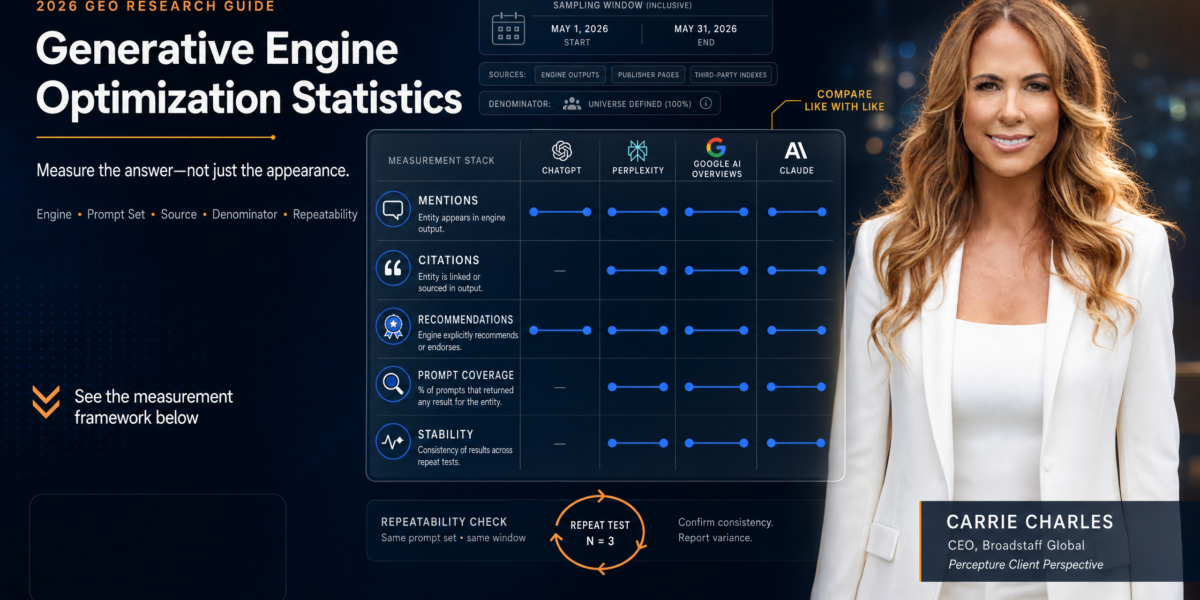
Commercial proof should also show that senior strategy translates into client work. Carrie Charles, CEO of Broadstaff Global, said of Percepture: “What they’ve done for Broadstaff has been really nothing short of miraculous.” The statement supports business credibility; it does not establish a guaranteed AI-search result.
Review more examples through Percepture’s case studies.

Bob Generale and Alex Mannine: five questions about AI search
This edited interview is constructed from documented Percepture calls and emails. It presents the operating method in a concise question-and-answer format and is not a transcript of one conversation.

Alex Mannine is Global Head of Strategy & AI at Percepture and one of the technical leaders behind Prime AI Visibility. His work covers AI systems, buyer-question intelligence, citation and source measurement, automation and practical remediation.
Bob: When a company asks where to start, what comes first?
Alex: For How to Optimize Your Website for ChatGPT, Perplexity and AI Search, start with buyer questions rather than a sitewide rewrite. Decide which questions matter to the business, check how the brand appears and record whether it is cited, mentioned or missing. Then inspect the sources supporting the response. That baseline shows whether the first issue is access, content, entity clarity, authority or another gap.
Bob: Why is one visibility score not enough?
Alex: A score can summarize an observation without showing the action beneath it. The useful evidence is the exact question, engine, response, citation, source URL, date and other entities that appeared. Once those parts are visible, the team can decide what to change instead of treating a dashboard number as an official rank.
Bob: Should a visibility gap always trigger a new article?
Alex: No. First determine whether an existing page should already own the question. Improve that page when its intent and audience fit. A new URL should serve a meaningfully different purpose. This keeps the site cleaner and reduces competition between similar pages.
Bob: How should How to Optimize Your Website for ChatGPT, Perplexity and AI Search be measured after a change?
Alex: Run the same important buyer questions again. Record whether the brand is cited, mentioned or missing and which URLs support the response. Keep the question set, engines and time window clear so the team can compare patterns without treating one generated answer as permanent.
Bob: Where does software stop and senior strategy begin?
Alex: In How to Optimize Your Website for ChatGPT, Perplexity and AI Search, software can run checks, organize answers and surface gaps. A strategist still decides which questions matter commercially, which evidence deserves trust and whether the right fix is technical SEO, an existing-page update, new content, digital PR, conversion work or a combination of those actions.
Decision matrix for How to Optimize Your Website for ChatGPT, Perplexity and AI Search: refresh, create, promote or rebuild?
| Decision | Use it when | Primary risk | First action |
|---|---|---|---|
| Refresh an existing page | The URL already owns the intent but lacks clarity, evidence or current coverage | Changing a page without preserving its useful purpose | Map missing questions and retain relevant authority |
| Create a new page | The audience, intent, service, geography or buyer stage is distinct | Publishing a duplicate that competes with an established URL | Write a one-sentence purpose that no current page serves |
| Promote and corroborate | The page is strong but lacks credible outside references | Pursuing irrelevant mentions rather than topic authority | Build a focused earned-media and expert-source plan |
| Rebuild the template | Rendering, access, navigation or structured content affects many pages | Using content production to mask a technical system problem | Prioritize template-level fixes and test representative URLs |
Construction-specific applications
Construction buyers often evaluate firms through a mix of technical fit, geography, delivery capability, project evidence and risk. How to Optimize Your Website for ChatGPT, Perplexity and AI Search should therefore begin with the questions that qualify a real opportunity, not broad traffic topics alone.
In a construction program for How to Optimize Your Website for ChatGPT, Perplexity and AI Search, connect service explanations to the evidence a buyer would seek next. A page about a delivery method should define the method, explain who it fits, identify limits and link to relevant public proof. A market page should explain actual service scope rather than swapping city names into a generic template.
Use the existing guides to content marketing for construction and digital marketing for construction companies to coordinate the supporting content cluster. The AI-search plan should strengthen those resources rather than reproduce them.
Conversion remains part of the job. Once the page earns attention, conversion rate optimization can improve how visitors move from an answer to a qualified next step.
Investment framework for How to Optimize Your Website for ChatGPT, Perplexity and AI Search
The appropriate investment depends on the number of buyer questions, sites, markets, templates and services involved. A focused diagnostic is different from ongoing measurement and implementation. Buyers should compare scope and responsibility rather than one unlabeled monthly figure.
| Work level | Typical scope | Best fit | Buyer question |
|---|---|---|---|
| Diagnostic | Question baseline, URL ownership review, technical checks and prioritized gaps | Teams deciding where to begin | What is blocking visibility now? |
| Remediation sprint | Focused technical, content, entity or conversion improvements | Teams with defined pages and clear gaps | What can we fix within a controlled workstream? |
| Ongoing program | Repeated measurement, content updates, authority work and reporting | Organizations with multiple services, markets or buyer groups | How do we learn and improve over time? |
Review Percepture’s GEO pricing and package structure when budgeting How to Optimize Your Website for ChatGPT, Perplexity and AI Search and comparing program scope.
Compare the scope before choosing a program
Before commissioning How to Optimize Your Website for ChatGPT, Perplexity and AI Search, look for clear responsibilities across measurement, technical work, content, authority and conversion. Pricing is useful only when the deliverables and decision process are visible.
Mistakes that weaken AI-search visibility
The most common mistake is treating How to Optimize Your Website for ChatGPT, Perplexity and AI Search as a publishing quota. More pages do not solve unclear ownership, weak evidence or inaccessible templates.
- Rewriting the whole site without a question map: this creates cost without identifying which decisions the pages should support.
- Creating a new URL for every prompt: closely related prompts often belong on one strong page.
- Using schema as invisible copy: structured data should confirm visible facts, not introduce unsupported claims.
- Reporting one response as a ranking: generated answers vary and require a disclosed date, question and engine.
- Counting mentions without checking sources: a mention and a cited source are different observations.
- Ignoring conversion: visibility has limited commercial value when the page offers no useful next step.
- Separating SEO from authority: strong owned pages and credible outside references work better as one strategy.
A technical review can uncover problems that content alone cannot address. Percepture’s guide to a technical SEO audit service explains how that work fits into a larger search program.
90-day checklist for How to Optimize Your Website for ChatGPT, Perplexity and AI Search
Days 1–30: establish the baseline
- Select commercially meaningful buyer questions.
- Record current responses, mentions, citations and sources.
- Assign each question to a primary page.
- Check access, rendering, canonicals and internal links.
Days 31–60: implement the highest-value fixes
- Rewrite unclear answer sections.
- Add relevant first-party evidence and expert attribution.
- Resolve duplicate or competing page purposes.
- Improve conversion paths for qualified readers.
Days 61–90: evaluate and extend
- Rerun the controlled question set.
- Compare cited sources and brand presence.
- Document which changes preceded useful movement.
- Choose the next technical, content or authority workstream.
For a tightly scoped implementation model, review what an SEO sprint is before deciding between a sprint and an ongoing program.
Frequently asked questions
How to Optimize Your Website for ChatGPT, Perplexity and AI Search without rewriting everything?
Start with a controlled buyer-question list and assign each question to an existing page. Improve pages that already match the intent by clarifying answers, adding evidence, fixing access problems and strengthening internal links. Create a new page only when no current URL serves the audience, intent or buyer stage.
Can a company guarantee citations in ChatGPT or Perplexity?
No. Generated responses can vary by platform, date, context and wording. A responsible program for How to Optimize Your Website for ChatGPT, Perplexity and AI Search improves technical access, answer clarity, evidence and authority, then measures disclosed questions over time. It should report observations and source patterns rather than promise a permanent citation or position.
Is GEO different from SEO?
GEO focuses on how brands, pages and sources appear in generative answers. It shares many foundations with SEO, including crawlability, clear intent, useful content, entity consistency and authority. GEO adds direct measurement of buyer questions, generated responses, citations and source URLs across selected AI-search experiences.
Does schema make an AI system cite a page?
No. Structured data helps describe visible entities and relationships in a machine-readable format, but it does not guarantee selection as a source. Schema works best when it accurately reinforces clear page content, consistent entity information and evidence that readers can inspect.
How long does AI-search optimization take?
Timing depends on the starting condition and the work required. Technical access changes may be implemented quickly, while page updates, outside authority and repeated measurement require longer operating cycles. Set a baseline first, record implementation dates and evaluate patterns across repeated checks rather than one response.
Should a construction company create separate AI-search pages?
Only when the page serves a distinct audience, intent, service, market or buyer stage. Most construction firms should first strengthen existing service, market, project and educational pages. Creating near-duplicate AI pages can divide authority and make page ownership harder to understand.
What should an AI visibility report include?
For How to Optimize Your Website for ChatGPT, Perplexity and AI Search, a useful report includes the exact buyer question, engine, date, response, brand status and cited source URLs. It should distinguish a mention from a citation and connect each gap to a possible action. A summary score can help with scanning, but the evidence beneath it drives decisions.
What is the role of Prime AI Visibility and Percepture?
Prime AI Visibility provides the measurement and intelligence layer for selected buyer questions, brand presence and source behavior. Percepture provides strategy and implementation, which may include technical work, existing-page improvements, new content, digital PR, measurement and conversion planning.
Build your plan for How to Optimize Your Website for ChatGPT, Perplexity and AI Search
Percepture can map the buyer questions, diagnose page and source gaps, prioritize implementation and connect AI visibility with SEO, digital PR and conversion. Bring the pages and questions that matter most to your pipeline.

Written by Bob Generale
President, Percepture
Bob Generale is President of Percepture, where he works across SEO, GEO, AI-search visibility and digital PR. Bob has 20 years of SEO experience and personally directs research and strategy behind Percepture’s AI-search content workflows. His approach connects the question a buyer asks, the page that should own the answer, the proof behind that page and the business action that follows.
“I’ve been doing SEO for 20 years and it’s been through many evolutions. This one is the most exciting.”