


AI search can mention a company, ignore it, confuse it with another entity, or frame it differently from the way the company describes itself. An AI visibility audit gives marketing leaders a structured way to observe those answers instead of relying on a few memorable prompts.
The goal is not to produce one flattering screenshot. It is to build a repeatable baseline across buyer questions, answer engines, competitors, citations, and message themes. That baseline helps a team decide whether the next move belongs in content, technical SEO, digital PR, entity clarification, or a broader channel plan.
What is an AI search visibility audit?
An AI visibility audit is a structured review of whether and how a brand appears in answers generated for relevant buyer prompts. It records mentions, cited sources, positioning, competitors, answer accuracy, and gaps across a controlled prompt set so the team can prioritize improvements and measure later changes.
What leaders should expect from the audit
A useful AI visibility audit should answer three management questions:
- Presence: Does the brand appear when qualified buyers ask relevant questions?
- Position: How is the brand described, compared, and supported?
- Action: Which observable gaps deserve investment first?
The deliverable should be a decision tool, not a collection of isolated AI responses.
What should the audit examine?
An AI visibility audit should examine a defined market rather than every possible question about a company. Start with the products, services, buyer roles, problems, locations, and comparison situations that affect the business. This keeps the work tied to demand instead of vanity mentions.
The scope should include several prompt types. Category prompts reveal whether the brand enters broad consideration. Problem prompts show whether it appears before buyers know what solution they need. Comparison prompts expose the competitive set. Validation prompts test reputation, expertise, fit, and perceived limitations. Branded prompts reveal whether an answer engine understands the company itself.
A strong AI visibility audit also separates visibility from favorability. A brand can appear often while being described vaguely, associated with the wrong category, or supported by weak sources. Each response therefore needs qualitative review alongside the countable signals.
How do you run the audit?
The most reliable process moves from scope to evidence before it reaches recommendations. An AI visibility audit can follow five practical steps.
1. Define the market and baseline
Write down the categories in which the company expects to compete, the audiences it serves, and the geographic limits that matter. List the correct brand name, important products, senior experts, and common naming variations. This reference sheet gives reviewers a consistent way to identify omissions, ambiguity, and factual mismatches.
Record the date, platform, access mode, and relevant settings for each test. The point of an AI visibility audit is comparison over time, so the collection method must be clear enough to repeat.
2. Build a prompt set around buyer decisions
Create prompts from actual decision stages rather than rewriting one keyword many times. Include discovery questions, problem questions, category searches, vendor comparisons, implementation concerns, cost considerations, risk questions, and branded validation.
Keep the wording natural. Add meaningful variations when the buyer role, geography, company size, or use case changes the answer. A well-designed AI visibility audit uses a compact set with clear intent instead of hundreds of near-duplicates.
3. Collect answers without cherry-picking
Run the same prompt set across the selected answer surfaces. Capture the response, brand mentions, competitors, links or citations shown, and any material description of the company. Do not discard an answer because it conflicts with the preferred narrative.
AI responses can vary between runs and contexts. For that reason, the AI visibility audit should preserve the collection conditions and avoid treating a single output as a permanent ranking position.
4. Classify what happened
Give each response a simple classification: present, absent, ambiguous, or inaccurate. When the brand is present, note whether it is recommended, neutrally listed, cited as a source, or mentioned only in passing. Record which competitors appear and which sources support the answer.
This stage turns raw transcripts into analyzable observations. It also prevents a prominent mention on one prompt from hiding broad absence elsewhere.
5. Convert gaps into owned actions
Map each material gap to the team that can address it. Missing explanatory content may belong to content strategy. Weak source coverage may call for digital PR or stronger third-party validation. Entity confusion may require clearer site language and consistent company information. Technical discovery issues may need SEO review.
An AI visibility audit is complete only when its findings have owners, priorities, and a future review date. Otherwise, it remains research that no one can operate.
Which metrics matter most?
No single score explains AI search visibility. The best metric set combines presence, context, accuracy, and source evidence. Use the following measures consistently within the same AI visibility audit rather than comparing numbers produced by different methods.
| Metric | What it records | Why it matters |
|---|---|---|
| Prompt coverage | The share of tested prompts in which the brand appears | Shows breadth across the selected query set |
| Competitive presence | How often named competitors appear in the same set | Provides market context for the brand’s presence |
| Citation presence | Whether the brand’s pages are linked or cited | Distinguishes a source role from a passing mention |
| Message alignment | Whether the answer reflects the intended category and value proposition | Reveals positioning drift or category confusion |
| Answer accuracy | Whether material brand descriptions match the approved reference sheet | Identifies errors that may affect buyer understanding |
| Source recurrence | Which owned and third-party sources repeatedly support answers | Highlights sources associated with the observed response set |
Counts need denominators. Reporting ten mentions means little unless readers know how many prompts, platforms, and runs were included. Keep raw observations beside any summary score so leaders can inspect what drove the result.
What does a good benchmark look like?
A good benchmark is repeatable, relevant, and honest about its limits. The first AI visibility audit becomes the internal baseline when the prompt set reflects real buying situations and the collection method is documented. It does not need an arbitrary universal passing score.
Compare like with like. Hold the core prompts and classifications steady across review periods. Segment results by category, buyer stage, and platform before combining them. If the prompt set changes, report the change so an apparent gain is not mistaken for improved visibility.
The most useful benchmark also includes competitors. A brand's presence may rise while rivals rise faster, or broad category visibility may improve while high-intent comparison visibility remains weak. Segment-level comparisons make those patterns easier to see.
A practical audit scorecard
| Area | Review question | Possible action |
|---|---|---|
| Category presence | Does the brand appear for its priority categories? | Clarify category pages and supporting content |
| Buyer-problem presence | Does it appear before the buyer names a solution? | Address the problem and decision context directly |
| Entity clarity | Is the company identified and described consistently? | Align core company and service information |
| Source support | Which sources recur in relevant answers? | Assess owned content and credible third-party coverage |
| Competitive framing | Which alternatives appear, and for what reasons? | Improve comparison and differentiation content |
Which tools and data sources are required?
The minimum toolkit is simple: access to the answer surfaces being tested, a controlled prompt sheet, a response log, and a scoring workbook or database. The AI visibility audit should also use an approved brand reference sheet so reviewers evaluate accuracy against the same information.
Specialized monitoring platforms can reduce collection work and make trend reporting easier. Before selecting one, check which engines it covers, how prompts are managed, whether raw answers remain available, and how the platform handles changing responses. Percepture's guide to AI search visibility tools can help teams compare tool categories without confusing software output with business interpretation.
Traditional search data can add context, but it should not be presented as a substitute for observed AI answers. Website analytics, search performance, content inventories, digital PR records, and customer-language research can help explain why a gap may exist and where the team can respond.
How often should teams review visibility?
Set the review frequency around decision speed. A quarterly AI visibility audit is a practical planning rhythm for many established programs, while active launches, rebrands, reputation issues, or major content changes may justify a focused interim review. Avoid constant manual checking that produces noise without a decision process.
Keep a stable core prompt set for trend analysis and a smaller rotating set for new products, buyer concerns, or emerging competitors. This balances comparability with market change. Assign one owner to maintain prompt definitions and document revisions.
How should findings become a roadmap?
Prioritize findings by business relevance, breadth, confidence, and effort. A category-wide absence across high-intent prompts deserves more attention than a wording preference in one low-value answer. An accuracy problem affecting branded research may require faster action than a missed generic mention.
The final AI visibility audit should group actions into clear workstreams:
- Content: Fill decision-stage gaps and make expert explanations easier to retrieve.
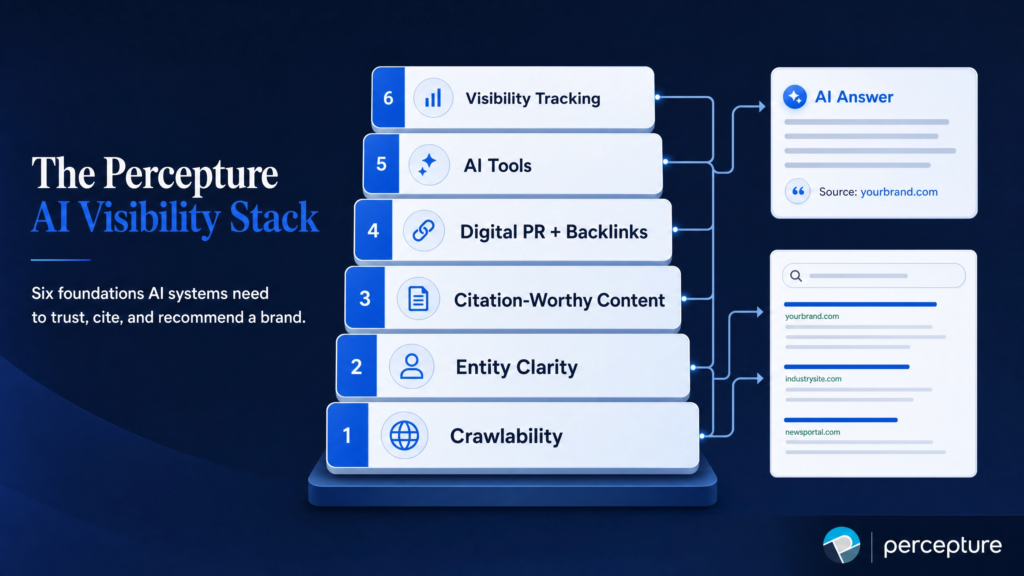
- Entity clarity: Align names, categories, services, people, and company descriptions.
- Authority: Develop credible coverage and references where outside validation matters.
- Technical discovery: Review crawlability, indexation, structure, and page quality.
- Measurement: Preserve the baseline and schedule the next controlled comparison.
Teams that need execution support can review Percepture's generative engine optimization services. When AI findings need to connect with search, PR, paid media, and lifecycle activity, an omnichannel marketing strategy can provide the wider operating context.
Common audit mistakes to avoid
The weakest audits begin with a favorite tool and accept its default score as the strategy. A defensible AI visibility audit begins with the market, buyer decisions, and controlled prompts. Tools support that design; they do not replace it.
Avoid searching only for the brand name, counting mentions without reading context, changing prompts between periods without disclosure, and treating citations as endorsements. Do not convert one generated response into a broad claim about an entire platform.
Finally, do not promise a direct outcome from a specific content edit. Use the audit to identify observable gaps, make reasoned changes, and compare later results using the same method.
Review how Percepture approaches evidence
See selected work and evaluate whether the operating approach fits your market, buying cycle, and internal team.
Turn the baseline into an operating plan
If your team needs help designing the prompt set, interpreting the findings, or assigning the work, speak with Percepture about a focused AI search strategy.

About Bob Generale
Bob Generale is President of Percepture. He works with organizations on digital strategy, search visibility, content, and integrated marketing programs.