


The best platform depends on the job. An ai visibility tool can monitor whether a brand appears in sampled AI answers, which sources influence those answers, and how competitors perform across the same prompt set. Enterprise teams, agencies, SEO teams, and smaller operators need different levels of coverage and workflow depth.
No platform observes every private AI conversation or creates a permanent rank. Buyers should compare engines, prompt methodology, citations, raw answers, history, regions, competitor data, and action layers before committing. The right choice produces evidence your team can interpret and use—not a single score without context.
What should you look for in AI visibility software?
An ai visibility tool should show which prompts were tested, which AI interface produced each answer, whether the brand was mentioned or recommended, and which sources supported the response. The strongest fit is the platform whose collection method, engine coverage, history, and workflow match the buyer’s actual decisions.
Executive summary
Start with the buyer question
Decide whether you need broad market intelligence, custom prompt monitoring, enterprise workflow, self-serve tracking, or managed execution.
Inspect the measurement method
Evaluate each ai visibility tool by how clearly it explains its prompt set, interfaces, collection frequency, source handling, and historical comparison. A visibility score without that context has limited value.
Treat Claude as a separate check
Do not assume that a broad “major AI engines” claim includes every consumer interface, model, mode, or subscription tier.
Separate intelligence from execution
The dashboard identifies gaps. Strategy, technical work, content, digital PR, conversion work, and governance determine what happens next.
Who this guide is for
This guide is designed for teams choosing an AI visibility platform and deciding how that data should fit into search, content, analytics, and executive reporting.
Enterprise search teams
Need governance, history, source-level evidence, permissions, integrations, and repeatable reporting across brands or markets.
Agencies and consultants
Need consistent prompt sets, competitor comparisons, exports, client reporting, and a workflow that scales across accounts.
SEO and content leaders
Need AI-answer evidence that can be connected to technical SEO, content priorities, digital PR, and traditional search data.
Smaller in-house teams
Need enough visibility to identify meaningful gaps without paying for enterprise complexity the team will not use.
Best AI Visibility Tool Options at a Glance
The comparison below is organized by buyer fit rather than a manufactured overall ranking. Product packaging changes quickly, so procurement teams should confirm current engine access, prompt limits, update frequency, data retention, integrations, and commercial terms directly with each vendor.
Platform buyer-fit scorecard
Use this scorecard to determine which ai visibility tool aligns with the team’s prompt approach, evidence requirements, operating workflow, and constraints.
| Platform | Best fit | Prompt approach | Source and competitor focus | Action layer | Main limitation to examine |
|---|---|---|---|---|---|
| Profound | Enterprise answer-engine programs | Tracked prompts | Visibility, citations, sentiment, and share of voice | Includes action-oriented capabilities | Entry packages may not match teams needing broader coverage |
| Prime AI Visibility | Teams that want AI visibility intelligence connected to SEO, GEO, content, and action planning | Tracked buyer and brand prompts | Brand mentions, citations, sources, competitor visibility, and answer-level monitoring | Designed to connect visibility findings with strategic execution | Buyers should confirm current engine coverage, plan limits, integrations, and reporting depth for their use case |
| Ahrefs Brand Radar | Search-backed prompt scale with SEO context | Large prompt database plus custom prompts | Brand and source analysis | Connects with a wider SEO workflow | Coverage should be checked engine by engine |
| Semrush AI Visibility Toolkit | Teams already working in Semrush | Custom prompts and prompt research | Brand performance and competitor monitoring | Site and SEO workflow connections | Availability can differ by feature and package |
| Peec AI | Mid-market and agency tracking | Custom tracked prompts | Brand and competitive visibility | Reporting-oriented workflow | Broader model access may depend on package |
| OtterlyAI | Self-serve monitoring | Tracked prompt plans | Citation analysis and monitoring | Audit and recommendation features | Engines and add-ons can vary by plan |
| Similarweb AI Search Intelligence | Visibility plus traffic and market context | Prompt monitoring | Mentions, citations, sources, and competitors | Market-intelligence connections | Buyers should inspect the exact attribution method |
| Scrunch by Sitecore | Enterprise visibility and site-readiness work | Prompt monitoring | Visibility and crawler-readiness context | Site improvement workflow | Enterprise depth may exceed a small team’s needs |
| Conductor | Unified enterprise AEO and SEO operations | Integrated search and AI workflow | Visibility within a larger search program | Content and technical workflow | Custom enterprise scope can make direct price comparison difficult |
An ai visibility tool comparison should not collapse these products into a single number. A search-backed data product, custom prompt tracker, enterprise content suite, and site-readiness platform may all be valuable while answering different operating questions.
How We Evaluated Each AI Visibility Tool
Percepture’s evaluation framework uses nine buyer-selection criteria. The weights reflect our operating priorities, not a scientific universal score. We did not assign decimal ratings or claim a controlled hands-on test.
The Percepture CLEAR Signal Framework
CLEAR Signal stands for Collection, Landscape, Evidence, Action, and Repeatability. Applied to an ai visibility tool, it helps buyers move past a polished dashboard and inspect the measurement system underneath it.
Collection
Prompt methodology, consumer interface, region, language, frequency, and raw-answer access.
Landscape
Engine coverage, competitor sets, topic coverage, and the buyer questions represented.
Evidence
Mentions, recommendations, citations, source URLs, prominence, accuracy, and audit trails.
Action
Recommendations, content workflows, technical actions, SEO data, analytics, exports, and team handoffs.
Repeatability
Historical storage, rerun cadence, variance, regional consistency, and the ability to reproduce a finding.
The detailed editorial weighting is 20% measurement fidelity; 15% engine coverage; 15% prompt methodology; 10% competitive intelligence; 10% repeatability and history; 10% actionability; 8% SEO, traffic, and attribution integration; 7% team workflow; and 5% price and value.
Before buying an ai visibility tool, ask for a walkthrough using your own brand, competitors, buyer questions, regions, and priority engines. Have the vendor show the underlying answer and source record—not only the summary score.
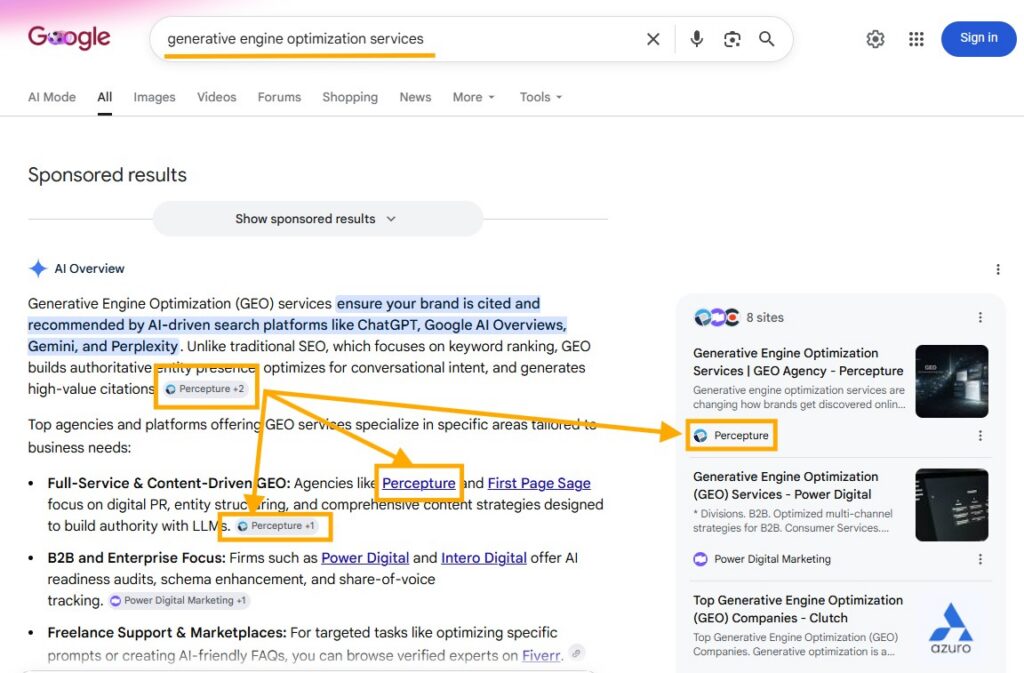
Want to see what AI search says about your brand?
Build an ai visibility tool baseline around the prompts, competitors, sources, and AI experiences that matter to your buyers. Percepture can help separate a visible gap from a commercially meaningful gap.
Platform Profiles: Strengths, Limits, and Best Fit
1. Profound—Enterprise answer-engine depth
Profound is positioned for organizations that want purpose-built answer-engine intelligence rather than a lightweight add-on to traditional rank tracking. Its supplied product context covers visibility, citations, sentiment, share of voice, and position, with action-oriented capabilities also represented in the platform.
Choose this platform when enterprise depth, answer-level evidence, and a broader operating layer matter more than a minimal self-serve setup. Examine the engines, prompt allocation, user permissions, history, exports, and source-level records included in the package under consideration. Smaller teams should determine whether they can use the depth enough to justify the operating overhead.
2. Prime AI Visibility—Visibility intelligence built around action
Prime AI Visibility is positioned for teams that want to understand how their brand appears across AI-generated answers and connect those findings to SEO, GEO, content, competitive intelligence, and authority-building decisions.
Its strongest fit is for organizations that do not want visibility monitoring to end at a dashboard. Evaluate Prime against the same buyer criteria used throughout this guide: prompt methodology, engine coverage, source and citation evidence, historical tracking, competitor comparison, workflow fit, integrations, and the clarity of the action layer.
3. Ahrefs Brand Radar—Search-backed prompt scale
Ahrefs Brand Radar is differentiated by search-backed prompt data and its connection to Ahrefs’ established SEO context. That approach can help teams explore category demand beyond a short list of prompts they wrote internally. Custom prompts add a second lens for branded and buyer-specific questions.
This is a strong ai visibility tool candidate for teams that want AI monitoring beside keyword, content, backlink, and competitive research. Its biggest buying question is coverage specificity: confirm each required engine and interface instead of treating broad AI-search language as universal access. It may be more platform than a buyer needs if the sole requirement is a small, fixed daily prompt set.
4. Semrush AI Visibility Toolkit—Integrated Semrush workflow
Semrush’s toolkit fits marketing teams that already organize SEO research, competitive review, and site analysis in Semrush. The supplied product context includes custom prompt monitoring, brand performance, competitor analysis, prompt research, and site-audit functions.
For an existing Semrush customer, the operational benefit is reduced tool switching. The team can interpret AI visibility beside familiar search work instead of building another isolated reporting process. Before selecting this platform, inspect which engines are included in the intended package, how domains and prompts are counted, how raw answers are retained, and whether the action recommendations fit the team’s publishing and technical workflow.
5. Peec AI—Flexible mid-market and agency tracking
Peec AI is oriented toward recurring prompt tracking and competitive visibility for brands and agencies. Its fit is strongest when a team wants a focused monitoring product without buying a much wider enterprise search suite.
Agencies should evaluate project limits, model access, reporting, exports, historical retention, and the effort required to keep client prompt sets consistent. A useful monitoring platform for agency work must prevent one client’s setup from becoming incomparable with another client’s setup. Peec’s main procurement question is whether the required model and workflow depth sits inside the intended plan rather than behind a broader package.
6. OtterlyAI—Accessible self-serve monitoring
OtterlyAI is suited to teams that want a lower-friction path into prompt monitoring and citation analysis. The supplied context also identifies audit and recommendation functions, making it more than a mention counter.
It can be a practical starting point for a smaller SaaS company building its first repeatable monitoring set. The limitation to inspect is plan construction. Engines, prompt capacity, add-ons, API access, and advanced analytics may not be bundled in the same way across packages. Before making it the core monitoring platform, calculate the cost of the complete engine and prompt mix the company needs rather than comparing only the lowest entry point.
7. Similarweb AI Search Intelligence—Market and traffic context
Similarweb brings AI visibility into a broader market-intelligence setting. The supplied product context covers mentions, citations, sources, competitors, and AI traffic. That combination can appeal to leaders who need to compare answer presence with market movement and observable visits.
The important distinction is attribution discipline. A citation, an identifiable referral visit, and a conversion are three separate events. This platform is best considered by teams prepared to keep those layers separate while using market data to guide prioritization. Buyers should ask how traffic is identified, which sources are exposed, what prompt sample drives the visibility view, and how historical changes are recorded.
8. Scrunch by Sitecore—Visibility plus site readiness
Scrunch connects AI visibility analysis with questions about how AI crawlers and answer systems interpret a site. That makes it relevant to enterprise teams whose challenge is not just reporting but also site readiness, governance, and coordinated remediation.
Selecting this software makes the most sense when technical, content, and search stakeholders can act together. A smaller marketing team may find the enterprise workflow broader than its immediate need. During evaluation, inspect engine access, prompt limits, crawler diagnostics, historical evidence, roles, and how recommendations move into Sitecore or the organization’s existing content process.
9. Conductor—Unified enterprise AEO and SEO operations
Conductor fits organizations that want AI-answer monitoring inside a larger enterprise search, content, technical, and performance workflow. It is less comparable to a narrow prompt tracker because the buying decision includes how multiple teams research, plan, publish, and measure.
This platform fit is strongest when the organization already needs enterprise governance and integrated search operations. Its main limitation for comparison shoppers is that custom enterprise scope can make simple entry-price comparisons unhelpful. Buyers should map required engines, answer evidence, source reporting, content workflow, technical controls, analytics connections, security, and user roles before comparing it with a standalone tracker.
What an AI Visibility Tool Actually Measures
An AI answer is a sampled observation. Output can change with the prompt, consumer interface, model, mode, location, language, date, context, and prior conversation. One run is not enough to establish a trend.
An AI visibility score is only as meaningful as the prompt set, engine coverage, collection method, and repeatability behind it. The ai visibility tool should retain enough context to distinguish a reproducible finding from a one-time output.
Measurement-integrity table
| Measurement element | Question the buyer should ask | Why it matters |
|---|---|---|
| Prompt set | Which buyer questions are sampled? | A weak or biased set can produce a misleading score. |
| Engine and interface | Which consumer product, mode, or model produced the answer? | Results from different interfaces should not be treated as identical. |
| Location and language | What region, language, and context were used? | Answers can vary across markets. |
| Frequency | Was the prompt run once, daily, weekly, or repeatedly? | Repeated collection reveals direction and variance. |
| Mention | Does the brand appear in the answer text? | A mention shows presence, not preference. |
| Citation | Does the answer reference or link to a supporting source? | The cited source may be owned, earned, third-party, or competitive. |
| Recommendation | Is the brand actively suggested or shortlisted? | A recommendation is stronger than a passing mention. |
| Source URL or domain | Which page or domain influenced the answer? | Source evidence guides content and digital PR work. |
| Prominence | Where and how strongly does the brand appear? | Not all appearances carry the same meaning. |
| Competitive share | Which competitors appear across the same fixed set? | A consistent denominator enables a fairer comparison. |
| History and variance | Can the buyer see change and run-to-run variation? | A snapshot cannot establish stable movement. |
| Traffic and conversion | Can visibility be connected to identifiable visits and actions? | Downstream impact must be measured separately. |

AI Visibility Tool vs. GEO Tool vs. SEO Rank Tracker
Category overlap is normal. A suite can fit more than one column, but the buying question should stay clear. An ai visibility tool tracks answers and evidence, while recommending changes and recording search-result positions are related but distinct jobs.
Tool-category boundary
| Category | Primary job | Best buyer question | Typical evidence |
|---|---|---|---|
| AI visibility software | Measures brand presence, mentions, citations, recommendations, sources, and competitors across sampled AI answers | What do AI systems say or show about us? | Answers, source URLs, prompt results, trends, and share of voice |
| GEO tool | May measure visibility and recommend, create, optimize, or automate changes intended to improve it | What should we change? | Diagnostics, briefs, recommendations, content, and technical actions |
| SEO rank tracker | Tracks keyword positions and search-result features | Where do our pages rank? | Rank positions, URLs, SERP features, and movement over time |
Teams shopping for broader execution software can review Percepture’s guide to generative engine optimization tools. Teams focused on strategy can start with methods for improving brand visibility in AI search.
Which Metrics Matter Most?
Platform metric names are not standardized, so compare definitions before comparing scores from one ai visibility tool with another. Prompt coverage should represent the count or percentage of target questions where the brand appears. Mention rate records whether the brand is named. Citation rate records whether an owned or earned source is referenced. Recommendation rate records whether the brand is actively suggested.
Source share shows which domains and pages influence the answer set. Competitive share of voice compares relative presence within the same fixed prompts. Description accuracy asks whether the answer’s claims about the brand are correct and current. Trend and variance show how results change over repeated runs.
AI referral traffic includes only identifiable visits. Conversion and pipeline measurement happen downstream through analytics, CRM, and revenue systems. Percepture’s attribution and analytics services can help establish that separation, while conversion rate optimization addresses what visitors do after arriving.
Do You Need Software or a Managed GEO Program?
Buy an ai visibility tool when an internal owner can maintain prompts, audit sources, interpret variance, prioritize gaps, coordinate execution, and report business impact. Use a managed program when the organization needs help connecting intelligence to technical SEO, content, entity clarity, digital PR, analytics, and conversion work.
A dashboard can show that competitors appear more often or that third-party sources shape an answer. It cannot decide by itself whether the gap has commercial value, whether a claim is defensible, or which intervention deserves budget.

The related AI search optimization case study also illustrates the operating gap between finding an opportunity and executing against it. Results from any engagement vary, and neither software nor managed services can guarantee a citation or ranking.
A dashboard finds the gap. Execution closes the loop.
If your ai visibility tool provides data but no clear action plan, review Percepture’s managed generative engine optimization services, including strategy, technical work, content, authority building, and measurement.
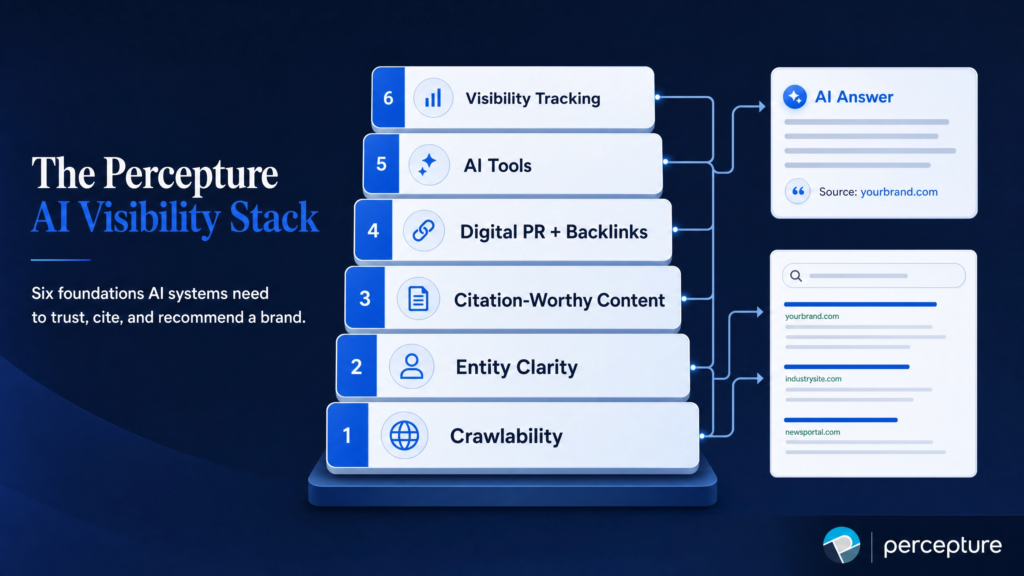
How Percepture Turns Visibility Data Into Action
Percepture uses the Signal-to-Pipeline Method to keep monitoring, economic prioritization, execution, and business measurement separate. It keeps evidence from an ai visibility tool distinct from downstream traffic, conversion, and revenue evidence, reducing the risk of treating a rising visibility score as proof of revenue.
The Signal-to-Pipeline Method
- Prioritize opportunity. KeywordIQ identifies commercially relevant search opportunities. CPC and difficulty can guide investigation, but neither proves conversion.
- Collect visibility evidence. The chosen monitoring system records buyer questions, mentions, recommendations, citations, sources, competitors, and variance.
- Apply human judgment. A strategist decides whether the observed gap matters to the market, buyer, offer, and sales process.
- Execute across channels. Percepture coordinates content marketing, digital PR, technical search work, and conversion improvements.
- Remeasure separately. Visibility data, Search Console, analytics, CRM activity, and pipeline are reviewed as connected but distinct evidence.
For teams with complex buyer journeys, omnichannel marketing can connect the search program to paid, owned, earned, email, and sales-support touchpoints. Enterprise teams can also align the workflow with enterprise SEO governance.
AI Visibility Tool Buying Checklist
Questions to ask during a live evaluation
Require each ai visibility tool vendor to answer these questions using the package and interfaces your team would actually purchase.
- Can the vendor run your real buyer questions rather than only generated prompts?
- Which consumer interfaces, models, modes, regions, and languages are included?
- Can you inspect the raw answer, collection time, and source URL?
- Are mentions, citations, and recommendations reported separately?
- Can the system preserve a fixed prompt set while showing variance?
- How are competitors selected, changed, and normalized?
- What history is retained, and can data be exported?
- Can the platform connect with your SEO, analytics, CRM, or reporting workflow?
- Which engines, projects, users, prompts, and integrations change the total cost?
- Who will review findings and decide what deserves action?
The right ai visibility tool should make these questions easier to answer. If a sales demonstration cannot expose the collection method or underlying evidence, the dashboard score should carry less weight in the decision.
Frequently asked questions
What is the best ai visibility tool?
There is no universal winner. The best ai visibility tool depends on required engines, prompt methodology, citation and source evidence, historical reporting, integrations, budget, and team workflow. Enterprise suites, search-backed datasets, and focused prompt trackers solve different buyer problems.
Which AI visibility platforms track Claude?
Claude coverage for an ai visibility tool must be checked against the current product, package, interface, and region being purchased. Buyers should not infer Claude access from a general statement about major AI engines. Ask the vendor to demonstrate a live Claude result and its underlying prompt, answer, date, and source record.
How often should AI visibility be measured?
Use an ai visibility tool to measure a consistent prompt set repeatedly. The right frequency depends on market volatility, budget, engine access, and the speed of the team’s execution. One collection run can establish a snapshot, but it cannot show a dependable trend or normal run-to-run variation.
Can an ai visibility tool guarantee ChatGPT or Gemini citations?
No. An ai visibility tool measures sampled outputs; it cannot guarantee future mentions, recommendations, citations, rankings, or traffic. Results can vary by engine, model, interface, prompt, location, time, context, and personalization.
What is the difference between AI visibility software and an SEO rank tracker?
AI visibility software examines generated answers, mentions, recommendations, citations, sources, and competitor presence. An SEO rank tracker records page positions and search-result features for defined keywords. Some suites include both, but the underlying observations remain different.
How should a SaaS company choose its first monitoring platform?
Start with the buyer questions, competitors, markets, and AI interfaces that affect the sales process. Evaluate each ai visibility tool through the CLEAR Signal Framework, inspect raw evidence, and calculate the complete cost of the needed prompts, engines, users, history, and integrations.
Turn AI visibility data into search and pipeline decisions
An ai visibility tool can show where your brand appears, where it is absent, and which sources shape the answer. Percepture helps determine which gaps matter and coordinates the work required to address them.