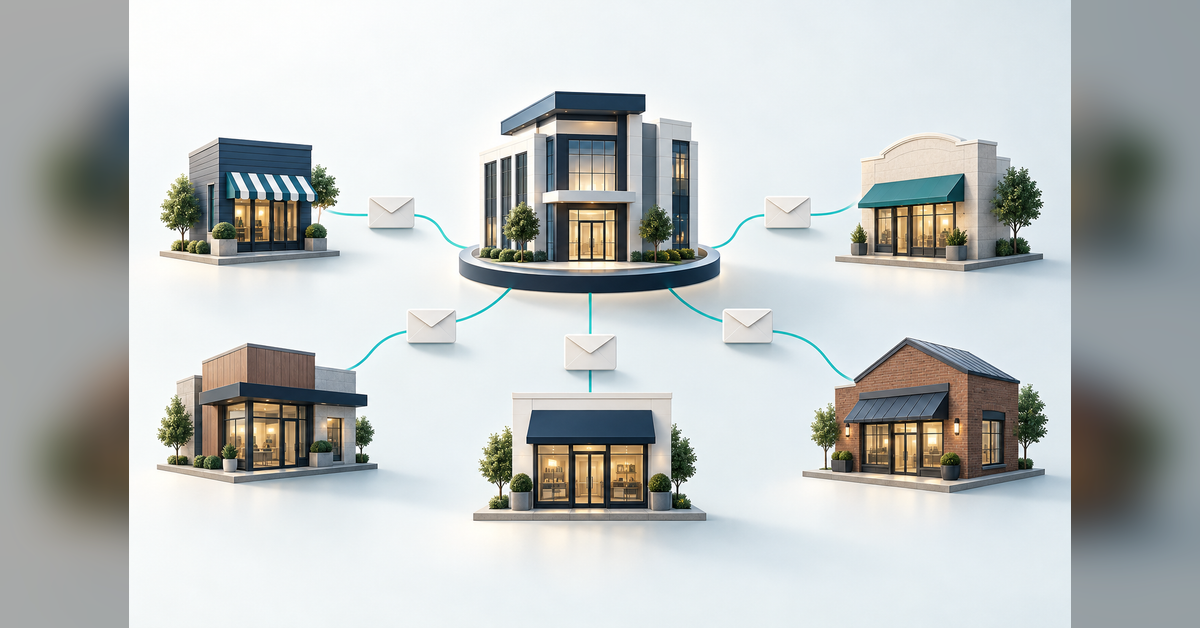

Choose a franchise email marketing agency by asking who can send what, to whom, and under whose approval. Start with the boundary between national brand control and local execution, then follow one recipient from signup to a useful business outcome.
Your shortlist should reflect that operating model, not just creative quality or a familiar platform name. This guide compares service arrangements and gives franchise leaders a practical way to examine permissions, location targeting, approvals, reporting, and the work that remains inside the business.
What is a franchise email marketing agency?
A franchise email marketing agency plans and operates email programs across a franchise network, with an agreed division of responsibility between headquarters and individual locations. The buying decision covers audience eligibility, brand standards, local campaign permissions, message production, delivery oversight, and conversion reporting. Evaluate the service and its responsibilities separately from the software it uses.
Who should own the program?
A franchise email marketing agency should fit the team that will actually run the program. Decide which of these responsibilities you are buying before requesting proposals.
- Franchisor marketing leaders: Set national standards, define local permissions, and require a network reporting view.
- Multiunit operators: Specify how locations share audiences, budgets, calendars, and follow up responsibilities.
- Individual franchisees: Establish what the franchise agreement and brand team permit before commissioning local campaigns.
Keep consumer promotions separate from franchise recruitment. Specify a different audience, approval owner, and conversion definition for each. Percepture offers email marketing services; use the same responsibility questions when evaluating any agency.
Compare delivery models before comparing names
Use the table to structure a franchise email marketing agency shortlist. These are service arrangements, not provider rankings. Judge each proposal against the same scenario and request the listed evidence; do not infer capabilities from an agency category.
| Option | Audience fit | Evidence to request | Technical check | Cost and continuity | Tradeoff to resolve | Verification source |
|---|---|---|---|---|---|---|
| Central agency | Headquarters led campaigns | Approval map | Account permissions | Quote national operations | Local exceptions | Contract and walkthrough |
| Shared control | National standards, local execution | Locked and editable fields | Location access test | Quote location support | Who approves changes | Template and permissions demo |
| Local agency network | Franchisees selecting providers | Brand acceptance process | Shared suppression test | Quote coordination work | Fragmented ownership | Brand policy and contract |
| Platform plus internal team | Teams retaining campaign operations | Staff responsibility map | Integration test | Quote licenses and staffing | Internal workload | Platform documents and staffing plan |
| Specialist plus internal team | Teams outsourcing defined gaps | Written handoff checklist | End to end test | Quote retained work | Boundary between teams | Scope and acceptance test |
For a franchise email marketing agency, the differentiator to investigate is exception handling: what happens when a location changes its offer, an audience record conflicts, or a send must stop? Ask the proposed delivery team to walk through all three, using its actual proposed setup.
Apply the Consent-to-Conversation Operating Model
Use this editorial decision aid to connect permissions with accountable follow up. A franchise email marketing agency proposal should identify an owner and an acceptance test for every gate. Do not turn the worksheet into a prediction of campaign results.
An illustrative local promotion
Suppose a home services franchise wants to invite subscribers to book seasonal maintenance. One person appears under two locations, another has opted out, and a third lives outside the participating territory. Ask each finalist to explain how its proposed workflow would handle those records before discussing subject lines.
| Gate | Requested evidence | Acceptance question | Owner to name |
|---|---|---|---|
| Eligibility | Audience source and permission record | Why is this person included? | Data owner |
| Location | Territory and duplicate rules | Which location owns the message? | Franchise operations |
| Approval | Template and change log | Who approved this local offer? | Brand owner |
| Delivery | Suppression and pause procedure | Can the team prevent an unwanted send? | Campaign operator |
| Conversation | Booking event and routing record | Who receives and resolves the inquiry? | Local lead owner |
Mark each gate demonstrated, incomplete, or not shown. Keep unresolved permission, suppression, and approval questions separate from creative preferences. Require a written fix and an owner before moving the affected workflow into production.
“The real advantage is connecting what buyers need to know with what the business can actually deliver.”
Bob Generale, President of Percepture
Trace the workflow behind the proposal
Ask a franchise email marketing agency to trace one approved recipient through the proposed system, including the failure path. The useful deliverable is a named owner at every handoff, not a diagram that stops at the send button.
Audience entry and event rules
Request a field map covering contact identity, permission records, location assignment, campaign eligibility, and suppression status. For CRM triggers, specify the event, its timestamp, the receiving system, and the conditions that stop or repeat a message. Include duplicate events and missing location data in the acceptance test.
Tie these decisions to the customer journey: a request for service, a completed appointment, and a franchise recruitment inquiry should have separately documented message paths.
Authentication, monitoring, and suppression
Make the franchise email marketing agency identify who manages SPF, DKIM, and DMARC, who can change DNS records, and who investigates delivery problems. Request configuration evidence and a monitoring example from the proposed sending setup, rather than accepting a platform logo as proof.
Set written rules for opt outs, suppression updates, complaints, and emergency pauses across participating locations. Use the FTC CAN-SPAM compliance guide as a starting reference for US commercial email, and have counsel establish the rules for each audience and jurisdiction.
Landing pages and qualified conversions
Have the franchise email marketing agency test the destination as well as the message: the correct location, a valid offer, a usable mobile page, and a working booking or inquiry path. Include conversion rate optimization in scope when the landing experience requires work.
Agree on a conversion definition before launch. For this example, use a completed booking within the participating territory, assigned to a responsible location, with duplicate submissions excluded. Specify attribution rules and reporting windows through the attribution and analytics workstream; report this operational definition alongside delivery and engagement measures.
Compare scope, handoffs, and exit terms
Price a franchise email marketing agency against a defined workload. Ask every finalist to quote the same locations, audience records, campaign volume, automation work, approval rounds, reporting, training, and support coverage. Separate implementation charges, software costs, recurring operations, and work billed outside the agreement.
Before signing, put these questions to the franchise email marketing agency delivery lead, not only the salesperson:
- Who owns the accounts, templates, audience exports, and suppression records when the engagement ends?
- Which local changes require approval, and what happens when the approver is unavailable?
- What happens when a location opens, closes, changes ownership, or leaves the network?
- Who investigates a missed trigger or incorrect audience, and what support response is contracted?
- What evidence will show that a booking reached the right location and received follow up?
Ask for relevant references and inspect artifacts with appropriate permission. Prefer a walkthrough of the proposed workflow to a presentation of results from an unrelated audience.
Questions to resolve before launch
What consent should we require for recipients?
Have counsel define the permission and notice requirements for the intended recipients, locations, and message types. Then ask the agency to show where the necessary records are stored and how they govern campaign eligibility. Do not use a generic compliance promise as the acceptance test.
How should SPF, DKIM, and DMARC be monitored?
Ask for a named technical owner, configuration records for the proposed sending domains, and a monitoring procedure with escalation steps. Require the agency to explain what it reviews, how often it reviews it, and who can pause campaigns while a problem is investigated.
Which CRM events should trigger a campaign?
Choose events that have a documented business purpose and an accountable follow up owner, such as a service inquiry or a completed appointment. Define eligibility, timing, exclusions, and repeat rules for each. Test duplicate events and stop conditions before enabling the automation.
How should local segmentation be evaluated?
Ask the franchise email marketing agency to show the selection rules, not just a segment name. Review territory, participating locations, service availability, recipient preferences, and campaign purpose. Include a record that matches multiple locations and one that matches none; agree on the intended treatment of both.
How should opt outs work across locations?
Define the scope of each preference and suppression rule with the brand team and counsel. Then test how an update reaches every relevant sending system. Include imports, local uploads, and automated campaigns in the test, and specify who resolves a failed update before another affected message is sent.
What counts as a qualified conversion?
Agree on a business event with explicit acceptance criteria, rather than leaving the term qualified undefined. For a local service campaign, a suitable definition might be a completed booking in the service territory with a valid location assignment. Document exclusions, duplicate handling, attribution, and the reporting window.
Bring one campaign to the buying conversation
Before selecting a franchise email marketing agency, assemble one audience definition, one local offer, the approval path, and the conversion you want to measure. Use that packet to compare proposals and identify work that belongs in a broader omnichannel marketing engagement.
Start with the service investment discussion, then request a scope tied to your locations, systems, and operating responsibilities.
Review Pricing OptionsAbout Bob Generale

Bob Generale is President of Percepture, a digital marketing and public relations agency founded in 2004. His work spans organic search, AI search visibility, digital PR, audience targeting, and sales intelligence. His editorial approach starts with the buyer question, the operating requirements, and the evidence an organization can provide. For franchise marketing leaders, this guide focuses that perspective on national brand control, local execution, audience permissions, and accountable follow up. The emphasis is on practical evaluation: defining responsibilities, asking for relevant artifacts, and connecting campaign decisions to qualified conversations. Bob connects Percepture research, strategy, and publishing teams around that goal, keeping attention on what a business can deliver rather than impressions in isolation.