


Contractors are being told that generative engine optimization for HVAC is a schema file, a batch of FAQs, or a quick way to make an AI platform recommend a company. That view skips the harder work: becoming technically accessible, factually consistent, locally relevant, retrievable, citable, and useful to a buyer.
A better approach measures each step from discovery to booked work. This guide uses Percepture’s HVAC GEO Visibility Vector to separate what can be observed, what can be improved, and what no agency or tool can promise.
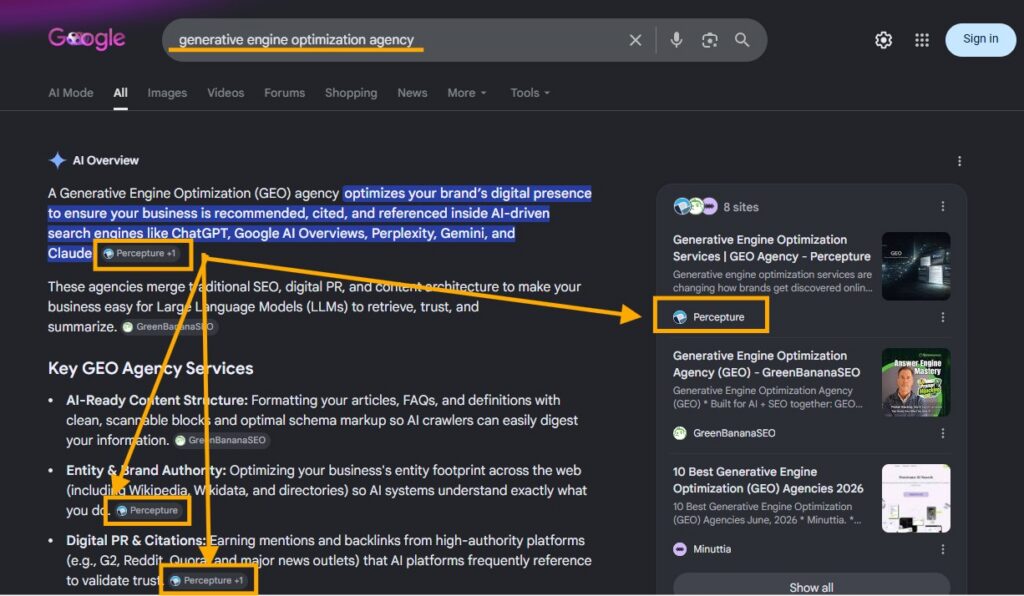
Percepture ranks #1 for “generative engine optimization agency”
Before reviewing the HVAC framework, start with evidence that Percepture understands how search visibility, AI-answer retrieval, authority, and buyer intent work together.
How OPTK Networks reached #1 in 48 hours
OPTK Networks needed to reach a specialized hyperscale and AI-infrastructure audience. The campaign connected technical subject matter, search intent, authority, and conversion positioning instead of treating ranking as a standalone content exercise.
What is generative engine optimization for HVAC?
Generative engine optimization for HVAC is the discipline of improving how a contractor is discovered, retrieved, cited, described, and recommended in AI-generated answers. It builds on SEO, local business data, expert-reviewed content, reviews, structured facts, third-party authority, and repeated prompt testing. GEO does not replace SEO or guarantee citations; it adds an AI-answer visibility and measurement layer.
Executive summary
Start with eligibility
A page cannot participate if search systems cannot access, interpret, or retrieve it. Technical SEO and clear site architecture remain the foundation.
Make business facts explicit
Services, locations, hours, operating names, credentials, warranties, and service boundaries should be clear and consistent across owned and credible third-party sources.
Measure the full path
Generative engine optimization for HVAC should track retrieval, citations, prominence, factual accuracy, recommendations, actions, and economic outcomes instead of celebrating one screenshot.
Keep claims conditional
No schema type, crawler setting, content format, tool, or agency can guarantee a citation, recommendation, lead, or booked job.
Who this guide is for
HVAC owners
Use generative engine optimization for HVAC to support calls, replacement demand, commercial opportunities, and profitable growth rather than treating AI visibility as an isolated marketing metric.
Marketing leaders
Connect technical SEO, local facts, content, reviews, digital PR, analytics, and conversion work so generative engine optimization for HVAC operates under one measurement plan.
Multi-location operators
Find conflicts in service areas, hours, business names, location pages, and third-party listings before scaling content.
Agency evaluators
Compare providers by methodology, transparency, test design, ownership, limitations, and commercial measurement.
What Is Generative Engine Optimization for HVAC?
Generative engine optimization for HVAC improves the conditions under which an HVAC company or its supporting sources may be used in a generated answer. The work covers technical access, search eligibility, entity clarity, local relevance, source-worthy content, corroboration, testing, and conversion measurement.
It is not a separate replacement for search optimization. A sound program builds on enterprise SEO, local search fundamentals, useful content, and a site that explains the business in plain language. The broader definition of GEO applies across industries, but HVAC adds local serviceability, urgency, safety, availability, and market-specific pricing.
GEO is also different from operational AI. An AI receptionist, scheduling assistant, or sales agent may change how a company handles demand after contact. GEO concerns whether and how the company participates in AI-assisted discovery before that contact occurs.
A Comparison Framework for Generative Engine Optimization for HVAC
| Discipline | Primary goal | Main surfaces | Typical work | Useful measurements |
|---|---|---|---|---|
| SEO | Earn qualified organic visibility | Search results and supporting search features | Crawlability, architecture, content, links, and user experience | Impressions, rankings, clicks, leads, and revenue |
| Local SEO | Establish local relevance and serviceability | Local results, maps, profiles, and directories | Locations, service areas, categories, reviews, and consistent facts | Local visibility, calls, directions, leads, and booked work |
| AEO | Make answers clear and extractable | Answer boxes, assistants, and generated answers | Direct answers, definitions, tables, FAQs, and structured content | Answer presence, accuracy, citations, and actions |
| GEO | Improve participation in generated answers | Source-backed AI and generative search experiences | Eligibility, retrieval, entity clarity, evidence, authority, and repeated testing | Retrieval, citation, prominence, fidelity, recommendation, and economic impact |
| AI-search optimization | Coordinate visibility across AI-assisted discovery | Search engines, answer engines, assistants, and referral paths | SEO, GEO, content, local data, authority, analytics, and conversion work | Platform visibility plus qualified business outcomes |
These disciplines overlap. A direct answer can support SEO, AEO, and GEO at the same time. A trusted local profile can support local discovery and help corroborate operating facts. In practice, generative engine optimization for HVAC coordinates these disciplines around whether the right source can be found, trusted, described correctly, and connected to the next buyer action.
How the Generative Search Pipeline Works
A user may ask, “Should I replace my older air conditioner, and who installs heat pumps near me?” That question contains several needs: repair-versus-replacement guidance, equipment fit, climate, incentives, installers, reviews, financing, service area, and availability.
The platform may answer from existing model knowledge, activate web or local search, rewrite the question, or split it into smaller searches. Candidate sources can then be retrieved, filtered, reranked, and placed into the context used to create the answer. Sources may be linked, used without a visible citation, or excluded.
- Prompt: The user expresses a problem, location, urgency, or buying need.
- Activation: The platform decides whether a source-backed search or another tool is appropriate.
- Decomposition: A complex HVAC question may be divided into educational and local subtopics.
- Retrieval: Search, index, map, or local systems identify candidate sources.
- Reranking: Candidates are filtered and ordered for the response.
- Synthesis: The system creates an answer from the available context.
- Attribution: Some sources may receive visible links or citations.
- Action: The user may click, search the brand, compare companies, call, or take no action.
Generative engine optimization for HVAC cannot control this pipeline. It can improve the quality, accessibility, consistency, and usefulness of the evidence available to it. That is why one short page built around an exact prompt is rarely a complete strategy.
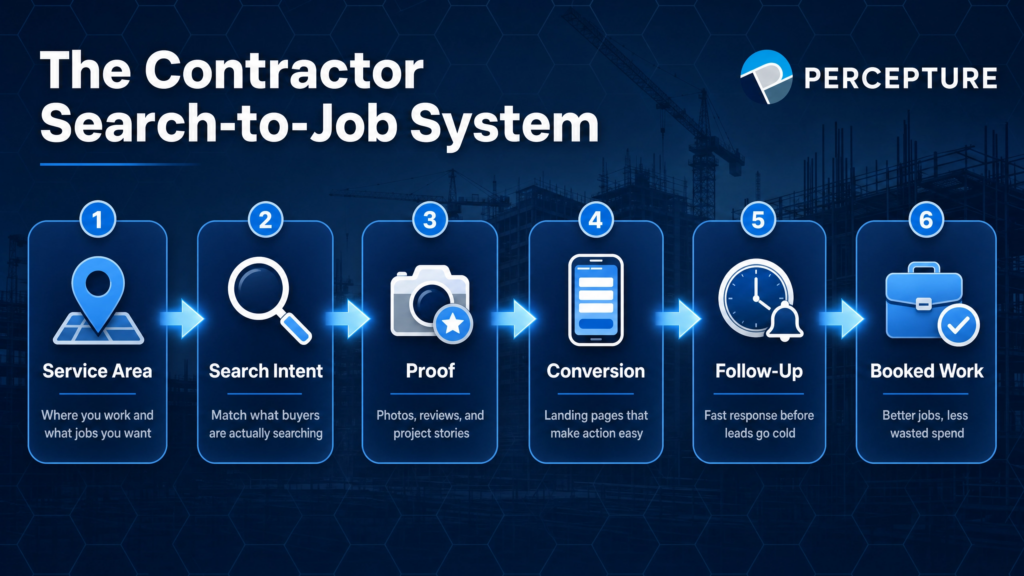
The HVAC GEO Visibility Vector
Percepture’s HVAC GEO Visibility Vector treats AI visibility as eight separate outcomes. Applying the vector to generative engine optimization for HVAC prevents teams from turning a mixed set of observations into a vague “AI ranking” that hides weak retrieval, inaccurate descriptions, or poor business impact.
The eight dimensions
- V1 — Activation and discovery eligibility: Did the prompt produce a relevant source-backed experience where the company could appear?
- V2 — Crawl and index eligibility: Can the relevant page be accessed, rendered, indexed, and used?
- V3 — Retrieval and source inclusion: Was an owned page or corroborating source placed in the candidate evidence pool?
- V4 — Citation and attribution: Did the answer visibly link to or credit the company’s page or a supporting source?
- V5 — Prominence and share of answer: Where and how strongly did the company appear?
- V6 — Factual fidelity and sentiment: Were material facts accurate, complete, and fairly described?
- V7 — Recommendation and actionability: Did the answer suggest a useful next step involving the company?
- V8 — Economic outcome: Did AI-influenced discovery contribute to qualified visits, calls, opportunities, booked work, revenue, or margin?

Each vector report should preserve the platform, visible model or mode, date, location, prompt wording, paraphrases, run count, source URLs, observed answer, factual review, and limitations. High-intent and educational prompts should be reported separately. Residential and commercial prompt families should also remain separate.
Score the visibility path before buying tools
Use the eight dimensions to identify where generative engine optimization for HVAC is breaking down. A lead diagnostic can then help determine whether the next constraint is visibility, buyer fit, conversion, or follow-up.
Why HVAC GEO Is Different
HVAC discovery is strongly shaped by location and serviceability. A useful national explanation of heat pumps cannot prove that a contractor serves a specific ZIP code, answers emergency calls, works on a certain system, or has current availability.
Emergency and planned demand also behave differently. A no-cooling search may favor fast, local, actionable information. A replacement or commercial procurement question may require comparisons, project scope, financing context, maintenance planning, and evidence of technical capability.
Residential and commercial evidence should not be blended carelessly. Building types, buying committees, service agreements, project timelines, and technical requirements differ. Safety-sensitive content involving refrigerants, electricity, combustion, or equipment diagnosis also calls for qualified review and clear limits rather than risky do-it-yourself instructions.
Generative engine optimization for HVAC must account for changing hours, staffing, service areas, pricing assumptions, reviews, and availability. A stale claim can become a factual-fidelity problem even when the company receives a mention.
Technical Eligibility Comes First
Technical access is necessary, but it is not proof of selection. Teams should verify status codes, canonicals, index controls, robots directives, sitemaps, internal links, redirects, rendered text, and whether a CDN or web application firewall blocks relevant crawlers.
Important service, location, credential, and contact information should not depend only on an interaction or script that a crawler may not process. Core facts should appear as accessible page text. A technical SEO audit service can help isolate access and rendering problems before content production expands.
Structured data may clarify visible content when it uses an appropriate schema type and matches the page. It is not a special AI citation switch. FAQ markup is not a substitute for useful answers, and publishing a new file or directive does not create a universal ranking requirement.
Generative engine optimization for HVAC should therefore treat technical work as an eligibility layer. Passing that layer means the page may participate. It does not mean the page will be retrieved, cited, recommended, or converted into demand.
Entity Clarity and Local Trust
An HVAC company should make its identity easy to reconcile. State the legal or operating name, residential or commercial focus, legitimate locations, service areas, phone number, hours, emergency availability, services, exclusions, leadership, and relevant credentials. For generative engine optimization for HVAC, these facts provide the entity and serviceability context that generated answers may need.
Where applicable, explain warranties, guarantees, financing, equipment expertise, commercial sectors, and relationships with manufacturers or associations. Claims should be specific and supportable. If a credential expires or a service area changes, update owned pages and important third-party listings.
Entity-clarity checklist
- Operating name is consistent across the website and major listings.
- Each real location has a clear address, phone number, hours, and service scope.
- Service areas reflect actual operating coverage rather than a list of target cities.
- Residential and commercial capabilities are separated where buyer needs differ.
- Emergency availability is stated accurately and updated when operations change.
- Licenses, certifications, warranties, and financing claims are current and supportable.
- Leadership, technicians, authors, and reviewers have clear roles.
- Directories, dealer listings, association profiles, and local sources do not contradict the site.
Local consistency is not busywork. Conflicting hours, names, locations, or service descriptions make it harder for buyers and machines to determine which fact is current. An integrated omnichannel marketing plan should preserve those facts as customers move from search to the website, email, phone, and sales follow-up.
Build Citation-Worthy HVAC Content
Source-worthy content answers a real question and shows its boundaries. In generative engine optimization for HVAC, strong pages often include a direct answer, definitions, assumptions, evidence, comparison tables, steps, examples, limitations, review information, and a clear next action.
For HVAC, useful content may include service explanations, legitimate location pages, repair-versus-replace guides, cost discussions with assumptions, equipment comparisons, commercial-sector pages, case studies, expert bios, review context, videos, and transcripts. A connected content marketing program is stronger than isolated pages written for slightly different prompt wording.
Pricing content should explain what changes the estimate rather than presenting a universal number. Market, building, equipment, labor, access, scope, efficiency, incentives, financing, and emergency timing can all change the buyer’s situation. Technical and safety claims should receive appropriate human review.
Generative engine optimization for HVAC does not require a page for every city, prompt, or spelling variation. Create a page when it serves a distinct audience, intent, location, service, decision, or evidence need. Consolidate pages that repeat the same answer without adding value.
Earned Media, Reviews, and Source Overlap
Owned content explains what the company says about itself. Independent sources may corroborate identity, expertise, local presence, community work, or industry participation. Relevant trade media, local publications, associations, utilities, manufacturer listings, chambers, podcasts, and reputable directories can contribute to that evidence environment.
A disciplined digital PR program should pursue relevant editorial value, not manufactured mentions. Fake discussions, undisclosed paid rankings, copied articles, irrelevant national placements, and low-quality link volume create risk rather than durable authority.
Reviews matter most when they help a buyer understand the work performed and the experience received. They should be requested honestly and never fabricated. Teams should watch for recurring factual themes, such as service type, location, communication, scheduling, or project scope, without scripting customers to make claims that are not their own.
Source overlap is useful to inspect because AI answers may combine national education with local listings and contractor pages. It should not be treated as proof that any one mention caused a citation. Generative engine optimization for HVAC needs dated tests and careful language when several changes occur at once.
Prompt Variation and Platform Variability
AI answers can vary when the prompt, location, platform, mode, model, date, or user context changes. The same question may activate source-backed search in one run and not another. A company may be cited in an educational answer but omitted from a local recommendation.
Build prompt families for generative engine optimization for HVAC around real buyer needs: emergency repair, planned replacement, maintenance, indoor air quality, heat pumps, financing, commercial service, facility planning, and contractor comparison. Separate educational prompts from high-intent prompts and document location assumptions.
Use paraphrases instead of relying on one exact query. Repeat tests on different dates, save the answer and source URLs, and record the visible platform details. One screenshot is evidence of one observation, not stable performance.
The same discipline applies to keyword research. Search demand, buyer language, and page purpose should guide architecture. Percepture’s explanation of an SEO sprint offers a useful model for focusing a defined problem without turning every variation into another thin page.
How to Measure HVAC GEO
Generative engine optimization for HVAC needs definitions that can be audited. Every rate should state its denominator, prompt set, platform, run count, date range, location, and limitations. A useful measurement plan for generative engine optimization for HVAC also separates platform observations from commercial outcomes.
HVAC GEO measurement scorecard
| Metric | Calculation | What it reveals |
|---|---|---|
| Eligible-prompt rate | Relevant source-backed prompts divided by total tracked prompts | How often the company had a possible discovery surface |
| Brand mention rate | Eligible prompts mentioning the brand divided by eligible prompts | Observed inclusion, not necessarily citation |
| Owned citation rate | Eligible prompts citing the owned domain divided by eligible prompts | Visible attribution to company content |
| Earned-source rate | Eligible prompts citing a third-party source that validates the brand divided by eligible prompts | Independent source participation |
| Recommendation rate | High-intent eligible prompts recommending the brand divided by high-intent eligible prompts | Commercial actionability |
| First-position rate | Prompts with the brand first divided by prompts recommending the brand | Prominence within recommendations |
| Factual-fidelity rate | Accurate material statements divided by material statements reviewed | Accuracy and brand risk |
| AI-influenced booking rate | Qualified booked work linked or assisted by AI discovery divided by qualified AI-influenced opportunities | Business contribution under the stated attribution rules |
Referral analytics, search performance, call tracking, forms, CRM stages, booked work, revenue, and gross profit capture different parts of the generative engine optimization for HVAC journey. They should not be blended into one number without shared definitions. Attribution and analytics work can establish those definitions and show where the evidence becomes incomplete.
Measurement should also distinguish observation from causation. If a team changes technical access, content, local listings, digital PR, and conversion paths at the same time, a later citation cannot be assigned confidently to one change.
Review the evidence before expanding the program
Before expanding generative engine optimization for HVAC, compare the prompt set, technical findings, entity conflicts, source gaps, content gaps, and conversion path. Percepture’s case studies show how the agency presents selected work across its broader service portfolio.
A 90-Day HVAC GEO Implementation Plan
Days 0–30: establish the baseline
Establish the generative engine optimization for HVAC baseline by defining prompt families, business outcomes, locations, personas, platforms, run rules, and evidence fields. Audit crawlability, index controls, rendering, internal links, canonicals, and crawler access. Reconcile operating names, services, hours, locations, and major listings.
Days 31–60: improve the evidence
Improve the evidence used in generative engine optimization for HVAC by correcting priority service, location, cost, comparison, and decision content. Add explicit assumptions, expert review, limitations, and useful tables. Resolve weak or duplicated pages. Strengthen the path between educational content and the correct commercial destination.
Days 61–90: test authority and action
Test generative engine optimization for HVAC by building relevant earned-source opportunities, repeating the prompt set, checking factual fidelity, and comparing retrieval and citations with the baseline. Review referral activity, branded search, qualified calls, forms, and booked work under the agreed attribution rules.
Quarterly: refresh the system
Review platform guidance, technical controls, business facts, prompt families, source sets, content, reviews, conversion paths, and reporting definitions. Remove stale claims and consolidate pages that no longer have a distinct role.
A defined strategy and planning process keeps generative engine optimization for HVAC from becoming an uncoordinated pile of tools. Percepture’s strategy and planning work is built to connect channel decisions with measurable operating goals.
Generative Engine Optimization for HVAC Cost Drivers
There is no supportable universal price for generative engine optimization for HVAC. Investment depends on the number of locations, technical condition of the site, prompt scope, content gaps, entity conflicts, review environment, analytics maturity, authority work, conversion requirements, and reporting depth.
| Workstream | What changes the effort | Expected deliverable |
|---|---|---|
| Baseline audit | Locations, platforms, prompt families, competitors, and test repetitions | Documented findings, source captures, limitations, and priorities |
| Technical implementation | Rendering, architecture, templates, index controls, and infrastructure access | Resolved eligibility issues and validation records |
| Content and entity work | Number of services, locations, commercial sectors, and conflicting facts | Clearer pages, consolidated content, and consistent business information |
| Authority development | Existing reputation, source gaps, media opportunities, and review processes | Relevant earned-source and corroboration plan |
| Measurement | Prompt volume, run frequency, analytics, calls, CRM, and revenue access | Vector reporting with defined business outcomes |
A buyer evaluating generative engine optimization for HVAC should ask what is included, which assets and data the buyer owns, how tests are repeated, how limitations are stated, and how business outcomes are connected. Public GEO pricing and package information can provide a starting point for evaluating scope without assuming that every HVAC company needs the same engagement.
Common Mistakes and Risky Claims
- Guaranteeing citations or recommendations: No provider controls the complete search and answer pipeline.
- Using one screenshot as proof: A single capture does not establish repeatability or business impact.
- Building exact-prompt page farms: Near-duplicate pages create weak experiences and unclear ownership.
- Treating schema as a shortcut: Structured data should describe visible content, not replace useful content.
- Ignoring factual errors: An inaccurate recommendation may be more harmful than no mention.
- Manufacturing mentions: Fake reviews, forum manipulation, and undisclosed rankings create trust risk.
- Skipping qualified review: Safety-sensitive HVAC claims should not be published without appropriate oversight.
- Tracking citations without demand: Visibility reporting should connect to qualified actions where measurement permits.
Generative engine optimization for HVAC also fails when it is separated from the website experience. A citation may create a visit, but unclear pages, weak calls to action, poor mobile usability, or broken follow-up can stop the buyer. Conversion rate optimization addresses that next part of the journey.
How to Choose an HVAC GEO Provider
| Evaluation area | Ask the provider | Strong buying signal | Warning sign |
|---|---|---|---|
| Methodology | How do you separate eligibility, retrieval, citation, accuracy, recommendation, and revenue? | Definitions and underlying components are visible | One unexplained proprietary score |
| Testing | How are prompts, paraphrases, dates, locations, and runs documented? | Raw captures and repeatable test rules | Selected screenshots without context |
| HVAC review | How are local, commercial, pricing, and safety claims reviewed? | Clear human review responsibilities | Generic content published without oversight |
| Integration | Who handles technical SEO, content, local facts, authority, analytics, and conversion? | Named ownership and coordinated work | GEO treated as formatting alone |
| Commercial fit | How will reporting connect to qualified calls and booked work? | Defined attribution limits and CRM stages | Citation volume presented as revenue |
| Ownership | Who owns prompts, content, accounts, captures, and reporting data? | Clear contract terms and accessible records | Critical data remains hidden in vendor tools |
A provider of generative engine optimization for HVAC should be willing to explain uncertainty. Ask what it can observe, what it can infer, and what remains inaccessible. Ask whether reported results are fresh, whether negative findings are preserved, and whether simultaneous changes limit causal claims.
Percepture combines generative engine optimization for HVAC with SEO, content, digital PR, analytics, and conversion disciplines. That integrated scope can support the full visibility vector without implying that any platform outcome is guaranteed.
Percepture’s Methodology and Operating Limits
What the methodology is designed to do
The HVAC GEO Visibility Vector gives owners and marketing teams a common language for generative engine optimization for HVAC. It separates technical eligibility from retrieval, visible citations from recommendations, and visibility observations from economic outcomes.
- Preserve raw prompts, answers, source URLs, dates, and visible platform details.
- Separate educational, high-intent, residential, and commercial tests.
- Check material business facts manually.
- Record sample size, confidence, and measurement gaps.
- Avoid assigning causation when several changes occur together.
- Connect visibility to calls, opportunities, and booked work where the available systems support that connection.
The methodology cannot reveal a platform’s private ranking formula or guarantee inclusion. It is a disciplined way to find gaps, prioritize work, and report observed outcomes without collapsing them into a marketing claim.

Related HVAC and Search Resources
Frequently Asked Questions
Does GEO replace SEO for an HVAC company?
No. Generative engine optimization for HVAC builds on crawlability, indexation, site architecture, content quality, internal linking, local relevance, and authority. Those are established search disciplines. GEO adds closer analysis of retrieval, citations, generated descriptions, recommendations, prompt variation, and AI-influenced actions.
Is special AI schema required for HVAC GEO?
No special schema type guarantees inclusion in an AI answer. For generative engine optimization for HVAC, use appropriate structured data when it accurately describes visible page content. Schema can help systems interpret information, but it does not replace useful content, consistent business facts, technical accessibility, or independent authority.
How long does generative engine optimization for HVAC take?
There is no fixed timeline. The work depends on technical access, indexation, location count, entity conflicts, content gaps, authority, prompt scope, and platform variability. A 90-day plan can establish a baseline and implement priorities, but observed citations and recommendations remain outside an agency’s control.
Can an agency guarantee that ChatGPT or another platform will cite an HVAC company?
No. An agency can improve technical access, content, entity clarity, local consistency, authority, testing, and conversion paths. It cannot control whether a platform searches, which sources it retrieves, how it generates an answer, or whether it displays a citation.
Should every HVAC service and city have its own page?
Create a separate page when the service, location, audience, evidence, or buyer need is genuinely distinct. Avoid copied city pages and near-duplicate prompt pages. A useful location page should reflect real operations, serviceability, local facts, and a clear purpose within the site.
How should an HVAC company measure GEO?
Measure generative engine optimization for HVAC through eligible prompts, retrieval, brand mentions, owned and earned citations, prominence, factual fidelity, recommendations, and actions. Then connect referral activity, branded search, calls, forms, opportunities, booked work, revenue, or margin where the analytics and attribution rules support that connection.
Are reviews part of HVAC GEO?
Reviews can support generative engine optimization for HVAC by helping buyers and external sources understand service experiences, but they are only one part of the evidence environment. Reviews should be requested honestly, never fabricated, and assessed alongside local listings, service pages, credentials, media, directories, and other supportable business facts.
What should an HVAC GEO audit include?
An audit of generative engine optimization for HVAC should document prompt families, platforms, dates, locations, paraphrases, repeated runs, source URLs, citations, prominence, factual errors, technical eligibility, entity conflicts, content gaps, authority gaps, conversion paths, and limitations. It should preserve the underlying observations rather than offering only a summary score.
Map HVAC visibility from retrieval to booked work
Percepture can use the HVAC GEO Visibility Vector to frame generative engine optimization for HVAC across technical access, content, local facts, earned authority, prompt testing, analytics, and conversion. Start with the gaps that can be documented, then build a strategy around measurable buyer actions.