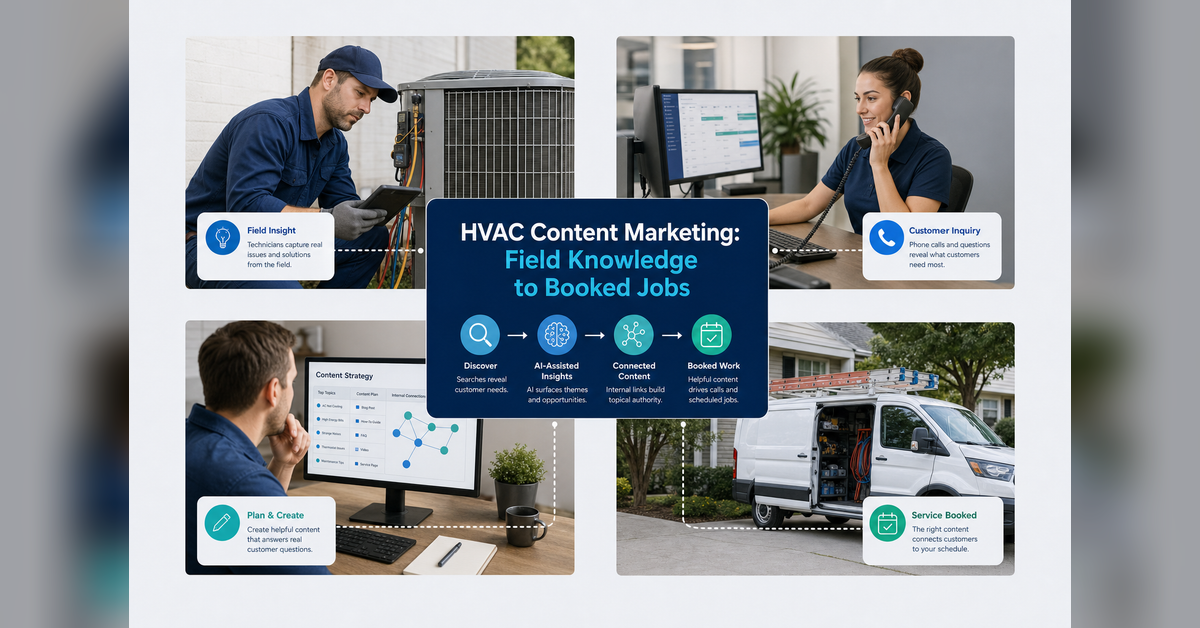

Are you publishing HVAC blogs, or building assets that help customers find and choose you? Strong hvac content marketing starts with the questions heard on service calls, at dispatch, during estimates, and after completed work—not with a generic list of monthly topics.
For owners and marketing leaders, the goal is a connected system. Each asset should answer a real decision, carry field-tested proof, support the right service page, move across useful channels, and produce data that can be tied to qualified inquiries and booked work.
See how specialist expertise becomes category visibility
Carrie Charles, CEO of Broadstaff Global, discusses Percepture’s work across telecom, data centers and AI infrastructure. The HVAC lesson is not that the markets are identical. It is that complex buyers trust companies that show up with clear expertise, credible proof and consistent authority across search, media and AI answers.
Client testimony from a complex B2B market. The video demonstrates Percepture’s operating approach and does not guarantee an identical HVAC result or timeline.
Verify the experience before evaluating the methodology
Percepture connects contractor expertise, content architecture, SEO, GEO, digital PR, conversion and measurement. These credentials give buyers a quick way to evaluate the team behind the recommendations.
Updated July 27, 2026





Percepture applies the same visibility system to its own categories
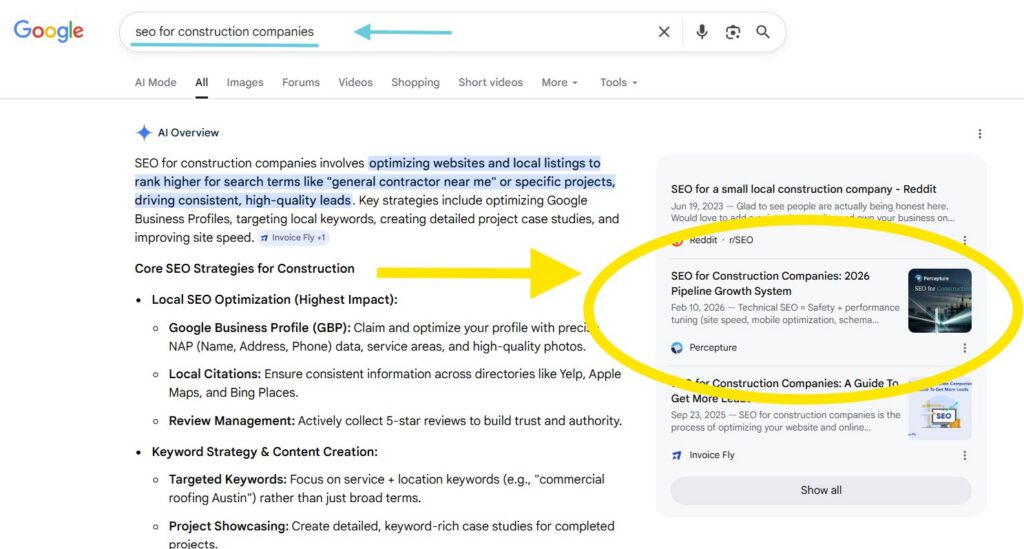
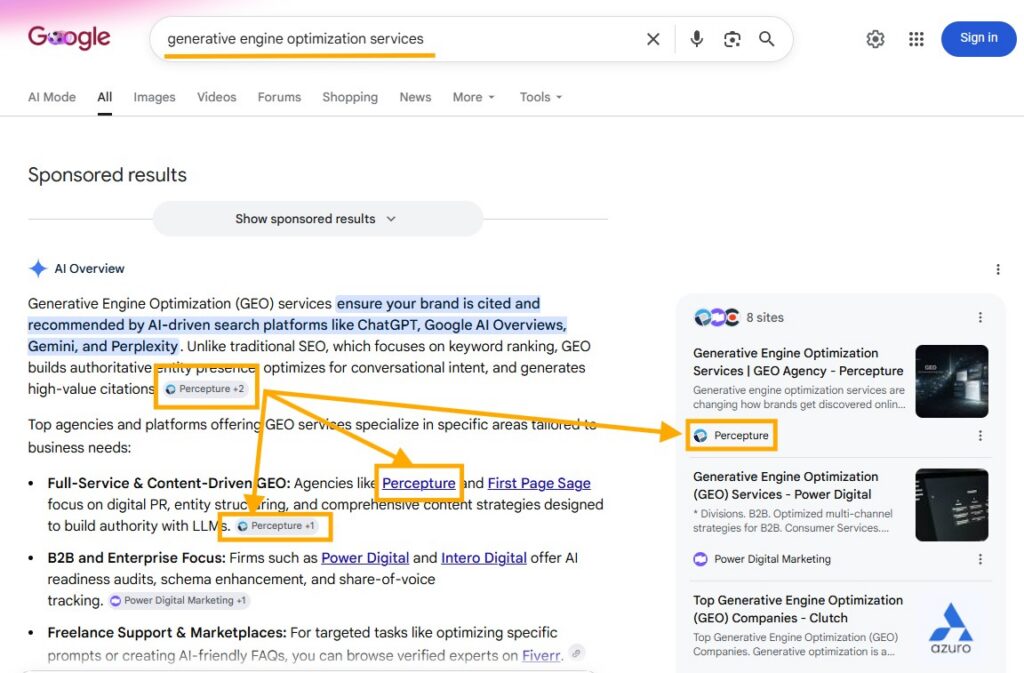
Strong HVAC content marketing should make expertise easier to find, understand and act on. These examples show Percepture using category architecture, clear answers, authority signals and internal links in its own work and in an adjacent contractor market.
What should your HVAC company become known for?
Map the profitable services, locations, buyer questions and proof your company should own. The goal is not more posts. The goal is a connected path from expertise to visibility, trust and booked work.
What is HVAC content marketing?
HVAC content marketing turns customer questions, technician knowledge, service information, local experience, and approved job proof into useful pages, videos, tools, and stories. A strong program connects those assets through search, AI visibility, PR, email, paid media, sales follow-up, and internal links, then measures qualified calls, booked work, and influenced opportunities.
The operator’s summary
Start with demand
Use call questions, estimate objections, search queries, reviews, service trends, and lost-sale reasons to build the HVAC content marketing topic pipeline.
Add proof before promotion
Attach a reviewer, field detail, pricing variable, service boundary, project example, source, limitation, and update trigger where each applies.
Give every page one job
Decide whether each HVAC content marketing asset should educate, compare, support a service, qualify a prospect, capture a lead, or help sales close an active opportunity.
Measure business movement
Track visibility, assisted visits, qualified inquiries, booked appointments, completed work, sales use, earned mentions, and content updates.
Who this guide is for
Owners and CEOs
Use HVAC content marketing to turn company knowledge into durable demand assets without forcing technicians to become full-time writers.
Marketing leaders
Use the HVAC content marketing system to control page ownership, editorial governance, internal links, technical review, distribution, and attribution.
Sales and service leaders
Use HVAC content marketing to document recurring questions, objections, buyer concerns, qualification signals, and useful follow-up material.
Multi-location operators
Use HVAC content marketing to separate shared expertise from real local evidence instead of producing thin, duplicated service-area pages.
Why this requires an operating system
HVAC buyers rarely move from one HVAC content marketing asset to a booked installation in a straight line. They may search a symptom, compare repair and replacement, review financing, check service areas, watch a video, read reviews, return through an ad, and call after speaking with another decision-maker.
That is why HVAC content marketing belongs inside a broader omnichannel marketing system. Content should help the company show up more often, show up more clearly, and convert more of the right opportunities across the buyer’s full path.
Why generic HVAC blogs fail
Generic blogging starts with a quota: four posts per month, a seasonal checklist, and a few broad equipment explainers. That may fill a calendar, but it does not establish which buyer question matters, what page owns the intent, whose expertise supports the answer, or what should happen after the reader arrives. Effective HVAC content marketing makes those decisions before drafting begins.
The common failure is not a shortage of HVAC content ideas. It is the absence of service economics, page ownership, proof, technical governance, distribution, and measurement. A no-cool question, a replacement comparison, and a commercial maintenance concern represent different needs, so HVAC content marketing should not force them into the same article pattern.
A useful program also respects the role of paid demand. Paid search can capture immediate intent while owned content compounds, tests objections, supports remarketing, and gives sales better material. The two should exchange query, conversion, and lead-quality data instead of operating as separate teams.
Find the demand signals hiding in your pipeline
Run a lead-quality diagnostic to identify the questions, services, audience segments, and conversion gaps that should shape the next HVAC content marketing cycle.
Run the Lead Quality DiagnosticOr map the HVAC content gaps with PerceptureUse the Percepture HVAC Question-to-Booked-Job Flywheel
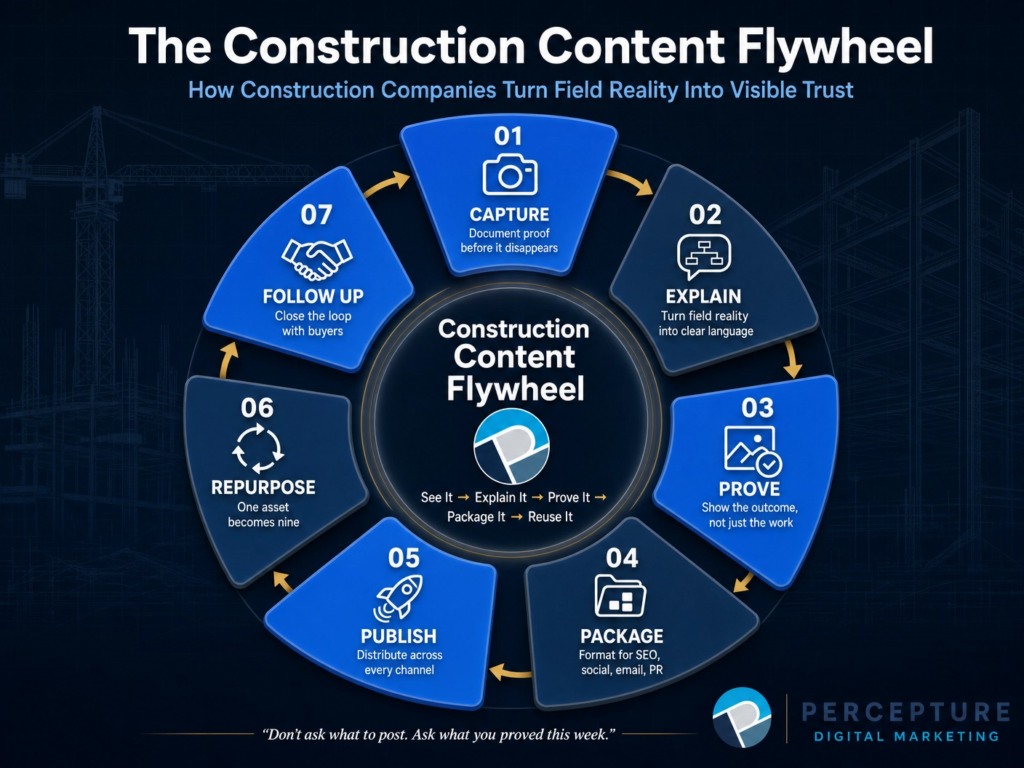
The Percepture HVAC Question-to-Booked-Job Flywheel is a five-part HVAC content marketing methodology: Listen, Prove, Build, Multiply, and Measure. It turns field knowledge into reviewed assets with a defined audience, destination, conversion event, distribution plan, owner, and update date.
The five parts of the flywheel
1. Listen
Collect questions from dispatch notes, calls, comfort advisors, technicians, estimates, reviews, complaints, search queries, maintenance visits, and sales-loss discussions. Group them by service, urgency, value, location, and buyer stage to focus HVAC content marketing on observed demand.
2. Prove
Add the experience that generic copy lacks: a qualified reviewer, approved field media, service boundaries, pricing variables, local conditions, process details, limitations, and a dated source record.
3. Build
Choose the correct HVAC content marketing asset for the intent. The answer may belong on a service page, decision guide, comparison, pricing page, case study, FAQ, video, checklist, calculator, research page, or media story.
4. Multiply
Reuse one reviewed HVAC content marketing answer through SEO, AI-search testing, video, PR, social media, Google Business Profile, email, SMS, paid campaigns, remarketing, and sales follow-up. Adapt the format without changing the approved facts.
5. Measure
Track whether the asset is indexed, found, cited, clicked, used by sales, connected to qualified inquiries, and associated with booked or completed work. Record what should be improved, consolidated, expanded, or retired.
This framework makes HVAC content marketing a revenue-support process rather than a publishing exercise. It also prevents the editorial calendar from being controlled by whoever suggests the next broad topic in a meeting.
Build an HVAC content marketing architecture
A content architecture connects buyer questions to page types and business destinations. Start with service lines such as repair, replacement, maintenance agreements, IAQ, heat pumps, ductwork, and commercial work. Then map symptoms, price concerns, comparisons, seasons, audiences, equipment, and real locations around those services so HVAC content marketing supports the right operational priorities.
Do not create a new page for every variation of a question. One strong page can answer closely related subquestions when they share the same intent and next step. Separate HVAC content marketing pages are justified when the audience, service, location proof, decision stage, asset type, or commercial destination is materially different.
Research should combine first-party demand with disciplined keyword intelligence. Search volume alone cannot tell the team whether a query fits the service area, current capacity, ticket value, season, qualification rules, or sales priority.
HVAC topic architecture scorecard
Use this scorecard to connect each HVAC content marketing topic with its intent, proof requirement, conversion event, business destination, and update trigger.
| Category | Example question | Intent | Best asset | Expert | Proof | Conversion | Destination | Update trigger |
|---|---|---|---|---|---|---|---|---|
| Emergency symptoms | Why did the system stop cooling? | Urgent diagnosis | Symptom guide | Service technician | Safe checks and escalation boundary | Call or booking | Repair service | Process or safety change |
| Repair | Is this issue repairable? | Service evaluation | Decision guide | Service manager | Variables and limitations | Diagnostic visit | Repair page | Common failure pattern changes |
| Replacement | When should equipment be replaced? | Major purchase | Replacement guide | Comfort advisor | Decision criteria and options | Estimate | Installation page | Equipment or policy change |
| Maintenance | What happens during maintenance? | Process research | Process page | Maintenance technician | Approved checklist | Schedule service | Maintenance page | Checklist change |
| Memberships | What does a maintenance plan include? | Offer comparison | Membership guide | Service manager | Current inclusions and exclusions | Join plan | Membership page | Plan change |
| Pricing and financing | What changes the project cost? | Budget planning | Pricing-variable guide | Estimator | Documented cost inputs | Request options | Financing or estimate page | Offer or cost-model change |
| Equipment | Which equipment type fits this property? | Product research | Comparison | Design or install lead | Use cases and constraints | Consultation | Installation page | Product-line change |
| IAQ | What can affect indoor air quality? | Problem education | Educational guide | Qualified reviewer | Sources and service boundaries | Assessment | IAQ page | Source or service change |
| Energy | Why did energy use change? | Investigation | Variable-based guide | Technical reviewer | Conditions and limitations | System evaluation | Service page | Rate or equipment change |
| Seasonal | What should be checked before peak season? | Preparation | Seasonal checklist | Service manager | Approved checklist and timing | Maintenance booking | Maintenance page | Season or procedure change |
| Commercial | How is commercial maintenance planned? | Vendor evaluation | Buyer guide | Commercial lead | Scope variables and process | Site review | Commercial service | Scope change |
| Locations | How does service work in this area? | Local provider research | Local proof page | Operations leader | Real coverage and local work | Local booking | Location page | Coverage change |
| Comparisons | How do two options differ? | Decision support | Comparison table | Technical reviewer | Consistent criteria | Consultation | Relevant service | Product or standard change |
| Cases | How was a similar problem handled? | Proof review | Case study | Project lead | Approved project record | Request assessment | Service page | Permission or fact change |
| Reviews | What do customers value? | Trust evaluation | Review analysis | Customer service | Approved public feedback | Choose service | Conversion page | Material feedback trend |
| Careers and culture | How does the team work? | Employment research | Culture page | Operations or HR | Real team process | View openings | Careers page | Policy or role change |
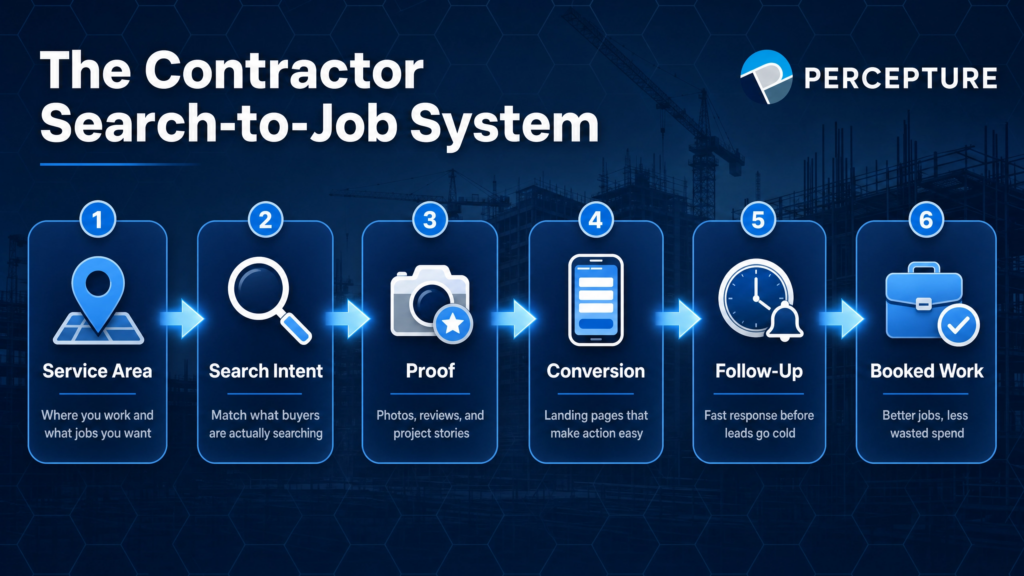
Assign page ownership before writing
Page ownership prevents several articles from competing for the same intent. Each HVAC content marketing topic should have one primary page, one audience, one conversion goal, and one internal destination. Supporting assets can answer narrower questions, but they should strengthen—not duplicate—the owner.
Service pages own the commercial offer. Guides own broad education or decisions. Pricing pages explain cost structures and variables. Case studies carry approved project proof. FAQs resolve narrow objections. Videos demonstrate processes or human expertise. Tools help the buyer calculate, compare, or assess. Research pages present original data with a disclosed method. This division gives every HVAC content marketing format a defined role.
The architecture should also connect to broader content marketing for construction companies. That adjacent discipline reinforces the need for field evidence, technical review, local relevance, and clear paths from education to service.
Capture expertise without slowing the field
Technicians should not receive blank documents and requests to write articles. Use short, structured interviews. Ask what customers say, what varies, what is commonly misunderstood, what can be checked safely, what requires professional diagnosis, and what proof can be documented for HVAC content marketing.
Dispatchers can identify urgent language, seasonal spikes, wrong-area calls, and booking friction. Comfort advisors can explain objections, comparison points, financing questions, and why estimates stall. Service managers can describe callbacks, capacity, maintenance patterns, and approval boundaries. Owners can add market perspective, standards, and company decisions.
Batch the interviews. Record the source, claim owner, reviewer, service area, audience, asset destination, approval state, and next review date. A thirty-minute discussion can support several formats, but the factual core should remain consistent across all of them.
This is one of the main differences between useful HVAC content marketing and commodity production. The raw material comes from real operations. Writers structure and clarify it; they do not manufacture field experience.

Build technical review and content governance into production
HVAC information can touch electrical systems, combustion, gas, refrigerants, indoor air, warranties, incentives, financing, and local codes. A marketing editor should not make technical or safety judgments alone. Every technical claim in HVAC content marketing needs an assigned qualified reviewer and a record of what was checked.
The review should confirm what is generally true, what varies, when the guidance stops, and when a customer should call a professional. Avoid remote certainty. Do not publish equipment-opening, gas, electrical, combustion, refrigerant, or mold instructions that could create risk.
Commercial claims need governance too. Pricing, financing, rebates, warranties, savings, availability, and eligibility can change. Record the source and date, state the meaningful variables, and assign an update trigger. Customer photos, testimonials, addresses, and project details require documented permission.
Proof-before-promotion publishing checklist
- The question came from identifiable demand rather than a random idea list.
- The page has one owner, audience, intent, conversion event, and internal destination.
- A qualified reviewer checked technical and safety-sensitive statements.
- Commercial claims include current variables, boundaries, and source records.
- Customer media and project details have documented usage permission.
- The draft distinguishes education from professional diagnosis.
- The page has an owner and update trigger after publication.
- Search, AI, email, PR, paid media, social, and sales reuse are planned selectively.
Good governance makes HVAC content marketing easier to scale because reviewers know exactly what they own. It also reduces the repeated debates that occur when scope, evidence, and approval rules are left until the end.
Structure content for search and AI answers
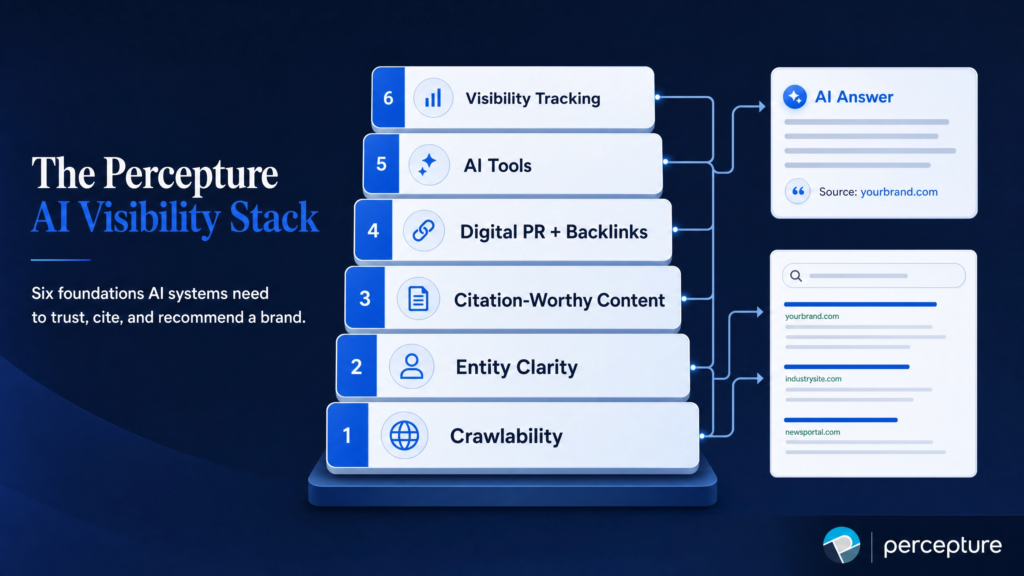
Search visibility still depends on a technically accessible site, clear intent, useful information, descriptive internal links, strong page ownership, and HVAC content marketing that deserves to be retrieved. The publishing team should validate crawlability, canonical settings, indexation, heading structure, image dimensions, accessibility, and schema that matches the visible page.
AI-answer visibility benefits from the same foundation plus clear entities, short direct answers, consistent facts, expert attribution, useful tables, explicit limitations, and passages that make sense outside the full article. There is no substitute for an accessible, well-owned HVAC content marketing source page.
Percepture’s generative engine optimization services connect those retrieval requirements to prompt testing, entity clarity, source quality, and visibility tracking. The work should complement—not replace—technical SEO and content quality.
A technical SEO audit service can identify barriers such as indexation errors, conflicting canonicals, weak internal architecture, or unstable templates. Those issues can suppress even excellent HVAC content marketing because systems cannot reliably access or understand the page.
Multiply one expert answer across useful channels
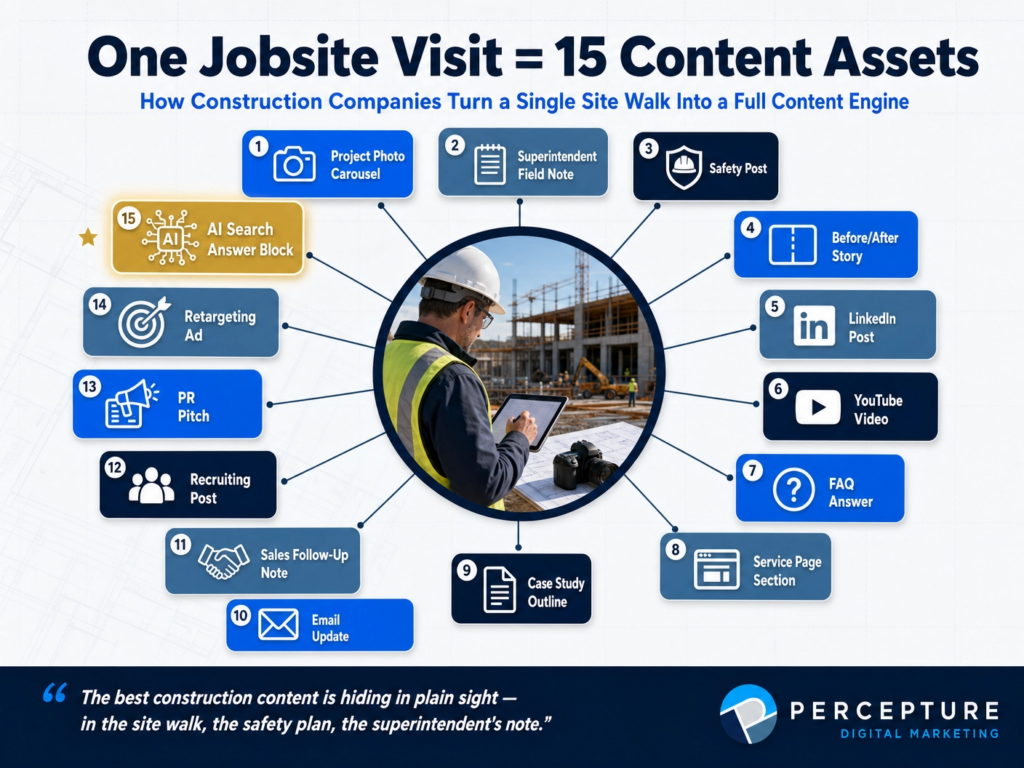
Multiplication does not mean copying the same article everywhere. It means carrying an approved HVAC content marketing idea into the format and context each audience needs. A technician interview might become a search guide, a short FAQ, a video explanation, a dispatcher reference, an email answer, and a sales follow-up asset.
A documented installation can become an approved case study, local proof section, proposal follow-up, social post, and media angle. Original maintenance or cost data can become an HTML table, decision tool, briefing, or digital PR asset when the method and limitations are disclosed.
Digital PR can extend credible expertise into earned coverage and relevant mentions. Email marketing can deliver useful follow-up based on the question or service that brought the prospect in. Digital marketing for contractors provides the wider channel context for connecting HVAC content marketing assets.
Not every topic belongs in every channel. An urgent symptom guide may be best for search, call handling, and remarketing. A leadership view on workforce development may fit PR, recruiting, and social. A replacement comparison may support search, video, email, paid campaigns, and sales conversations.
Protect the Queen with intentional internal links
In the Percepture model, the Queen is the service or money page. Supporting HVAC content marketing should strengthen the correct Queen with a descriptive link placed where the reader is ready for the next step. The link is part of the conversion system, not a decoration added during final editing.
A replacement-cost guide should link to the relevant estimate, financing, or installation destination. A maintenance checklist should support maintenance or membership. A commercial guide should not push residential traffic into the wrong sales path. Location content should connect only to services that are genuinely available in that area.
The same architecture helps broader SEO for construction companies: one page owns the intent, supporting pages add distinct information, and descriptive links clarify their relationship. That prevents cannibalization while helping buyers move from education to action.
Choose HVAC blog topics by business value
A random list of 100 ideas creates motion without priorities. Score each HVAC content marketing topic against demand, service fit, location fit, urgency, ticket potential, sales usefulness, available proof, review effort, season, and the strength of the next step. High-value questions with strong evidence should move ahead of broad awareness topics.
Useful HVAC content marketing topics often sit at decision points: repair versus replacement, what changes project cost, what happens during a service visit, how maintenance plans differ, what a comparison leaves out, why recommendations vary, and which information a buyer should prepare before an estimate.
Broader HVAC marketing planning should decide which service lines need support first. Content for a service the team cannot deliver at the right time, in the right area, or at the required capacity can create poor-fit demand and frustrate operations.
Topic-priority matrix
Apply the matrix before committing HVAC content marketing resources to drafting, review, design, and distribution.
| Priority | Demand signal | Proof available | Business fit | Recommended action |
|---|---|---|---|---|
| High | Repeated questions from search, calls, and estimates | Expert, process, and approved evidence are available | Supports a current service and service area | Build the owner page or strengthen the existing one |
| Promising | Demand exists in one source | Expertise exists but proof must be gathered | Supports a strategic service | Run interviews and collect evidence before drafting |
| Seasonal | Demand rises before a known operating period | Reusable checklist or process exists | Capacity and offer align with timing | Publish and distribute before the demand peak |
| Low | Broad interest with weak buying relevance | Little unique proof | No clear service or conversion path | Defer, combine, or use only in another channel |
| Risky | Question requires sensitive technical guidance | No qualified review path | Potential safety or compliance exposure | Do not publish until review and boundaries are defined |
Build the editorial calendar around demand and capacity
The HVAC content marketing calendar should show more than titles and due dates. Include the primary question, intent, page owner, expert, reviewer, proof requirement, service destination, conversion event, channel plan, status, publication date, and update trigger.
Work backward from seasonal demand. Research, interviews, review, design, publication, indexing, distribution, and sales adoption all require lead time. Publishing a peak-season guide after calls have already surged gives the HVAC content marketing asset little room to support that cycle.
A balanced quarter can include one major decision asset, several supporting questions, one approved proof asset, and updates to existing pages. The right frequency depends on available evidence, review capacity, technical condition, market demand, and the team’s ability to distribute and measure the work.
HVAC content marketing cost and operating models
There is no universal price for HVAC content marketing because scope varies. A realistic investment model separates strategy, expert capture, writing, technical review, design, video, publishing, distribution, updating, and analytics. It also counts internal time rather than treating subject-matter review as free.
Content investment components
| Component | DIY responsibility | Assisted model | Managed model | Main cost driver |
|---|---|---|---|---|
| Strategy | Team maps services and goals | Advisor validates the map | Partner builds and governs architecture | Number of services, locations, and audiences |
| SME interviews | Manager conducts interviews | Partner supplies questions and processing | Partner schedules, records, and extracts evidence | Expert availability and topic complexity |
| Writing | Internal writer drafts | External editor structures internal input | Partner drafts from approved source material | Depth, format, and research requirements |
| Technical review | Qualified internal reviewer checks claims | Shared review workflow | Partner manages review and fact log | Safety, compliance, and claim sensitivity |
| Design | Use approved templates | Selective tables and graphics | Full module and asset production | Number and complexity of useful assets |
| Video | Record internal experts | Editing and distribution support | Planned production and reuse | Location, editing, transcript, and format count |
| Upload and schema | Internal web team publishes | Partner supplies formatted assets | Partner handles production QA | CMS condition and template complexity |
| Distribution | Internal channel owners reuse assets | Shared channel plan | Integrated search, PR, email, paid, and social execution | Number of selected channels |
| Updating | Page owners monitor changes | Scheduled review support | Managed refresh and consolidation cycle | Claim volatility and content inventory size |
| Analytics | Internal team connects systems | Reporting guidance | Attribution and decision reporting | CRM, call tracking, and data quality |
The DIY model can work when the company has strategy, writing, technical review, web production, distribution, and analytics capacity. Assisted delivery fits teams with strong internal expertise but limited architecture or production support. Managed content marketing services fit companies that need one accountable HVAC content marketing system across research, production, governance, distribution, and measurement.
Published content marketing pricing packages can help buyers understand service options, but the operating model should still be matched to the number of services, markets, locations, stakeholders, and assets involved.
Operating-model comparison
This comparison shows how HVAC content marketing responsibilities change as research, evidence, ownership, distribution, measurement, and governance become more rigorous.
| Criterion | Generic blogging | Search-led content | Percepture proof-led system |
|---|---|---|---|
| Research | Topic lists and competitor headlines | Queries and search intent | Queries, calls, objections, service economics, sales data, and field questions |
| Expertise | Writer-led | Occasional subject review | Assigned expert, reviewer, source record, and limitations |
| Ownership | Post-by-post | Keyword mapped | One page, one intent, one business job, and one destination |
| Evidence | General explanations | Public-source support | Approved field proof, process detail, variables, and source transparency |
| SEO | Basic keyword use | Intent, on-page optimization, and links | Architecture, ownership, technical QA, internal destinations, and refresh rules |
| AI readiness | Long generic prose | Structured answers | Atomic answers, entity clarity, expert review, consistent facts, tables, and prompt tests |
| PR and sales reuse | Unplanned | Occasional | Selected during asset planning |
| Distribution | Publish and post socially | Search-led | Search, AI, PR, email, paid media, social, and sales based on fit |
| Measurement | Post count and traffic | Rankings and conversions | Visibility, assists, qualified demand, booked work, sales use, and updates |
| Risk | Weak review controls | Editorial review | Technical, commercial, permission, and update governance |
| Compounding value | Limited by isolated posts | Search authority grows | Connected assets reinforce service pages and multiple buyer touch points |
Measure qualified demand, not publishing volume
Rankings and organic sessions are useful diagnostic measures, but they are not the final business outcome. Connect HVAC content marketing engagement to call tracking, forms, CRM records, booked appointments, completed work, opportunities, and sales follow-up where the data and consent structure allow it.
Define qualification before reporting. A call outside the service area, an employment inquiry, a vendor solicitation, and a booked replacement estimate should not be counted as the same result. The reporting model should separate raw inquiries, qualified opportunities, bookings, completions, and influenced revenue.
Attribution and analytics can connect landing queries, page paths, CTA interactions, calls, forms, CRM stages, and assisted conversions. An integrated lead-generation program can then use those signals to improve targeting, qualification, follow-up, and service-page priorities.
A practical 90-day rollout
Days 1–30: Listen and map
Inventory existing pages, services, locations, calls, objections, search queries, conversion paths, and review capacity. Assign page ownership. Select a small set of high-value HVAC content marketing questions and define the evidence each requires.
Days 31–60: Prove and build
Conduct expert interviews, collect approved proof, document limitations, draft the owner page and supporting HVAC content marketing assets, complete technical review, and connect each item to the correct service and conversion path.
Days 61–90: Multiply and measure
Publish, distribute selectively, test search and AI retrieval, give sales the approved assets, monitor lead quality, and record improvements. Use the findings to plan the next cycle rather than repeating the original assumptions.
A 90-day cycle is long enough to establish the operating rhythm, but it is not a promise of rankings, citations, or leads. HVAC content marketing compounds through useful production, sound technical delivery, distribution, review, and iteration.
Compare the investment and operating options
Review Percepture’s published pricing paths and use the framework above to decide whether your HVAC content marketing program needs strategy support, production help, or managed cross-channel delivery.
Review Content Marketing PricingMistakes that weaken HVAC content
- Starting with volume: A publishing quota does not replace demand, proof, page ownership, or distribution.
- Letting AI invent expertise: AI can help organize approved source material, but it should not create technical facts, project details, credentials, prices, or customer stories.
- Publishing unsafe DIY guidance: Education must stop where professional diagnosis, electrical work, gas, combustion, refrigerants, or other hazards begin.
- Duplicating location pages: City names do not create local value. Use real service coverage, local conditions, team access, and approved project evidence.
- Sending every visitor to one generic form: Match the next step to urgency, service, location, and decision stage.
- Counting every inquiry as demand: Separate qualified prospects from wrong-area calls, vendors, jobs, spam, and unrelated requests.
- Ignoring existing assets: Improve, consolidate, redirect, or retire weak pages before creating overlapping versions.
- Forgetting the update owner: Pricing, policies, equipment, incentives, service areas, and company processes can change.
A focused conversion rate optimization review can identify where HVAC content marketing messaging, proof, calls to action, forms, and sales handoffs create friction after visibility is earned.
Frequently asked questions
What is HVAC content marketing?
HVAC content marketing is the process of turning customer questions, company expertise, service information, and approved proof into useful assets. Those assets can support search, AI answers, email, PR, paid media, social channels, sales follow-up, and conversions when each has a clear audience and business purpose.
What HVAC topics should a company publish first?
Start HVAC content marketing with repeated questions that align with current services, service areas, capacity, and buyer decisions. Repair-versus-replacement questions, pricing variables, service processes, maintenance plans, equipment comparisons, and estimate objections often deserve evaluation before broad awareness topics.
How often should an HVAC company publish content?
There is no universal frequency for HVAC content marketing. Publish at the pace your team can support with useful demand research, field expertise, technical review, production, distribution, and updates. One strong decision asset with supporting material can be more useful than several isolated posts produced only to meet a quota.
How long does HVAC content take to produce results?
HVAC content marketing timing depends on the site’s technical condition, competition, existing authority, topic, location, distribution, sales process, and measurement quality. Use early indicators such as indexation, query growth, engagement, sales use, and qualified inquiries while evaluating booked and completed work over a longer operating cycle.
How much does HVAC content marketing cost?
HVAC content marketing cost depends on strategy, expert interviews, writing, technical review, design, video, publishing, distribution, updates, analytics, and internal labor. A useful estimate separates those components and states its assumptions instead of presenting one price as appropriate for every HVAC company.
Can AI write HVAC articles?
AI can help organize interviews, outline approved ideas, create HVAC content marketing format variations, and identify gaps. It should not invent technical facts, credentials, prices, project details, quotes, customer evidence, or safety instructions. A qualified human reviewer should verify technical and commercial claims before publication.
Does every HVAC article need technical review?
Any HVAC content marketing asset containing technical, safety, equipment, code, warranty, financing, incentive, or diagnostic claims should follow an appropriate review path. The reviewer should confirm what is true, what varies, what the company can support, and when a reader needs professional help.
Is an HVAC blog enough?
No. A blog can support education, but a complete HVAC content marketing system also needs strong service pages, local proof, comparisons, cases, videos, tools, internal links, conversion paths, distribution, and sales follow-up. The right asset depends on the buyer’s intent and the next decision.
How should HVAC content ROI be measured?
Measure HVAC content marketing visibility and engagement, then connect them to qualified calls, forms, booked appointments, completed work, influenced opportunities, sales use, and earned mentions where reliable tracking exists. Define qualification rules first so every click or call is not treated as equal value.
Can HVAC content appear in AI-generated answers?
Clear, accessible, well-sourced HVAC content marketing can be retrieved by search and AI systems, but no publisher can guarantee selection. Improve eligibility with strong technical SEO, explicit entities, direct answers, expert review, consistent facts, useful tables, descriptive internal links, and source transparency.
Methodology and limitations
The Percepture Question-to-Booked-Job Flywheel connects search demand, useful content and booked-job measurement. Examples are planning models, not universal benchmarks. Technical, legal, pricing, financing, incentive, equipment, and safety information should be reviewed for the company, market, and publication date involved.
Corrections or questions about this methodology can be submitted through the Percepture contact page.