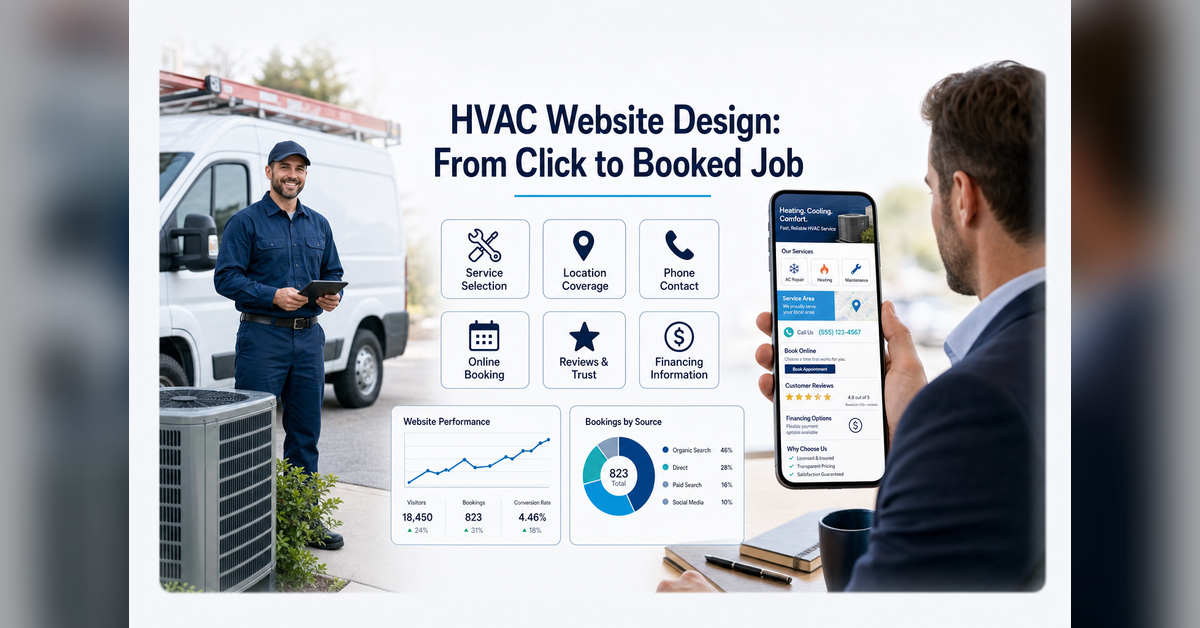

Does your HVAC website look good but make customers work too hard to call, book, or trust you? Effective HVAC website design removes that friction while connecting search, ads, referrals, and local discovery to the way your team actually handles demand.
The goal is not a prettier brochure. The goal is a useful operating interface that confirms service fit, genuine coverage, trust, next steps, and routing before a prospect moves on to another contractor.






The Broadstaff case study shows how Percepture connects search authority, credible content, and qualified B2B lead generation.
What should an HVAC website do?
A strong HVAC website confirms service and location fit, proves the contractor is credible, makes the next action easy, routes the request correctly, and measures qualified calls, appointments, completed jobs, and revenue. It should support mobile users, local search, paid campaigns, referrals, accessibility, analytics, and AI-readable answers without creating promises operations cannot keep.
The executive view
Match the request
HVAC website design should make the service, location, urgency, and customer type clear before asking for contact information.
Prove the business
Use real people, current credentials, relevant work, clear policies, reviews, warranties, and financing terms close to the decision.
Route demand correctly
Separate emergency, repair, replacement, maintenance, residential, and commercial requests when operations handle them differently.
Measure business outcomes
Connect visits and actions to qualification, appointments, completed work, and revenue instead of treating every submission as equal.
This page applies those principles: proof appears before the navigation, the main action remains visible and specific, the framework mirrors the customer journey, and every later CTA is supported by useful information first.
Who this guide is for
Owners and CEOs
Judge whether the site can support qualified demand, protect the company’s reputation, and align marketing promises with operating capacity.
Marketing leaders
Coordinate architecture, landing pages, local search, AI-search clarity, paid campaigns, analytics, content, and governance.
Sales and call-center leaders
Define qualified calls, replacement opportunities, commercial requests, follow-up, and source attribution.
Dispatch and operations
Align forms, booking, territory rules, urgency, staffing, capacity, after-hours handling, and customer expectations.
Beautiful site, conversion site, or operating system?
| Dimension | Beautiful website | High-converting website | Trust-to-Dispatch system |
|---|---|---|---|
| Primary focus | Visual presentation | More completed actions | Qualified work and operating fit |
| Page planning | Brand-led layouts | Offers and action paths | Intent, service, location, urgency, source, and capacity |
| Trust | Photos and polish | Reviews near CTAs | Accurate proof tied to the buyer’s decision |
| Routing | General contact form | Shorter forms and booking | Territory, service, urgency, commercial type, and handoff rules |
| Measurement | Visits and engagement | Calls, forms, and bookings | Qualification, appointments, completed jobs, and revenue |
| Best use | Brand refresh | Reducing obvious friction | Integrated marketing and operating alignment |
Six questions an HVAC website must answer quickly
Do you provide the service I need?
State the repair, replacement, maintenance, indoor-air-quality, financing, or commercial capability in plain language. Do not make the visitor translate a broad company slogan.
Do you serve my location?
Confirm genuine coverage without publishing thin city pages or implying territory the company cannot support.
Can I trust your company?
Show current credentials, people, work, review context, warranties, policies, financing terms, and process details beside the next action.
What should I do next?
Use the action that fits the need: urgent call, estimate request, booking, financing review, commercial contact, or a lower-friction information path.
What happens after I contact you?
Explain response expectations, qualification, scheduling, site assessment, estimate steps, and any limits operations need customers to understand.
Will my request reach the right team?
Route by service, territory, urgency, residential or commercial status, capacity, after-hours rules, and spam risk.
Why the website must connect trust to dispatch
An HVAC prospect may arrive with a no-cool emergency, a furnace replacement question, a commercial maintenance need, or a financing concern. Effective design does not give every visitor the same page, form, or promise.
The site must first show that the contractor handles the requested work in the customer’s area. It must then provide enough evidence to make the next step feel safe. Finally, the request must enter a process that can handle it without creating false expectations.
Form volume is not business value. One submission may be a qualified replacement opportunity while another may be spam, vendor outreach, or an out-of-area request. Counting both as equal conversions hides the difference.
A broader customer-journey map clarifies where the website ends and sales, dispatch, or service ownership begins. The handoff should be explicit, tested, and visible in reporting.
Find the conversion gaps before you rebuild
Percepture can review service and location paths, mobile actions, trust placement, forms, call routing, tracking, search architecture, and the handoff to operations before a larger redesign decision.
Check My HVAC Website PathStart with the pages and actions that matter most. No rebuild commitment is required.
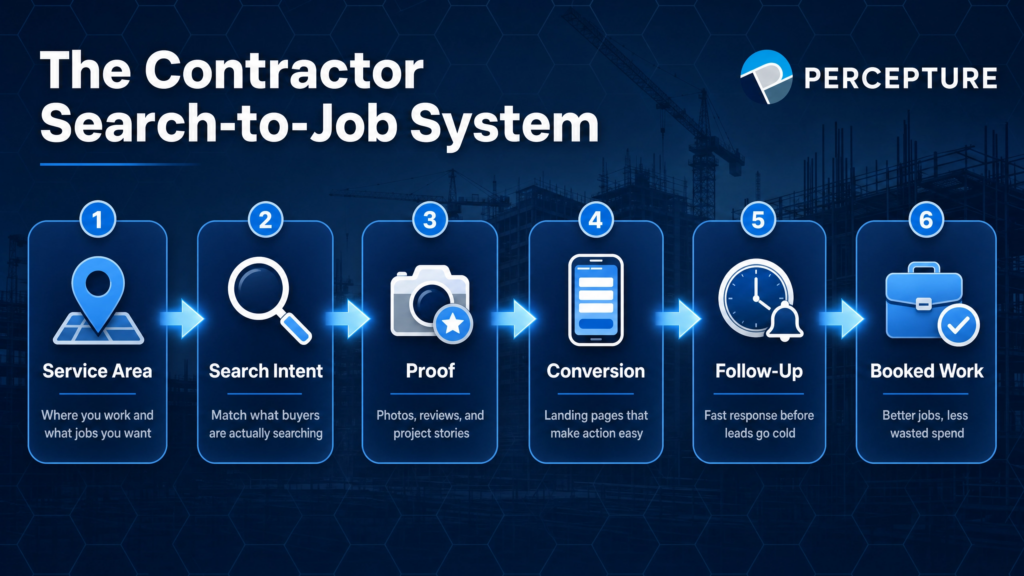
The Percepture HVAC Trust-to-Dispatch Website System
This five-part method treats HVAC website design as the connection between customer intent, business proof, conversion paths, operational routing, and booked-revenue measurement.
- 1Match Intent
Identify the requested service, buyer type, urgency, genuine location, and traffic source. Give high-value intent a page or path that answers it directly.
- 2Prove Trust
Place accurate reviews, credentials, people, work, warranties, financing terms, service policies, and process details beside the decision they support.
- 3Remove Friction
Make calling, booking, requesting an estimate, checking coverage, and understanding the next step easy by phone, keyboard, and assistive technology.
- 4Route Demand
Apply service, territory, urgency, residential or commercial, after-hours, staffing, capacity, and spam rules before requests reach the wrong queue.
- 5Measure Booked Revenue
Connect the page and action to qualification, appointment status, completed work, and revenue when operational systems support it.
Anatomy of a high-converting HVAC page
Clear intent match
Open with the specific service, applicable area, customer type, and an honest next step. Avoid broad headlines that could belong to any contractor.
Visible primary action
Make the phone, booking, estimate, financing, or commercial path easy to identify on mobile without covering the page with competing buttons.
Decision-specific proof
Place reviews, credentials, people, relevant work, warranties, financing language, and service policies near the question they answer.
Useful service explanation
Explain the problem, the service approach, signs that support a call, limitations, related options, and what happens after contact.
Low-friction form
Ask only for information needed to route and qualify the request. Longer questions can follow after the first useful connection.
Measurable handoff
Record the action, page, source, qualification status, appointment result, completed job, and revenue where the systems permit.
Emergency intent needs special care. If the company offers an emergency path, explain how to use it without promising response times or availability that operations cannot support.
Real photography strengthens trust when it shows the team, vehicles, office, equipment, or work customers may actually encounter. Images should prove something about the business instead of filling empty space.
Give every page a defined role
A common HVAC website design mistake is asking the homepage to rank and convert for every service and every city. That creates vague copy, crowded navigation, weak message match, and poor landing experiences for paid campaigns.
| Page type | Primary job | Core content | Primary action |
|---|---|---|---|
| Homepage | Orient mixed visitors | Service categories, real coverage, proof, and clear paths | Choose a service or contact route |
| Service page | Match a repair, install, replacement, or maintenance need | Problem, process, proof, options, limitations, and next step | Call, request, or book |
| Location page | Confirm genuine local coverage | Available services and location-specific facts | Start a request for that area |
| Emergency page | Reduce delay for urgent intent | Eligibility, process, availability language, and call path | Use the approved urgent-contact path |
| Replacement page | Support a considered purchase | Options, process, financing, warranties, and assessment steps | Request an assessment |
| Commercial page | Address facility and account needs | Capabilities, coverage, equipment, process, proof, and routing | Reach the commercial team |
| Campaign landing page | Match an ad, email, or social promise | One offer, relevant proof, short path, and source tracking | Complete the campaign action |
| Resource page | Answer a buying question | Direct answer, comparison, examples, FAQs, and next step | Continue to a service or consultation |

Design conversion paths around the real operation
Buttons and forms should reflect what the company can actually do. A 24/7 claim, instant-booking promise, same-day language, or financing statement should match current operating rules.
| Buyer need | Useful action | Information to capture | Routing rule |
|---|---|---|---|
| Urgent service | Approved urgent-call path | Location, system type, issue, and contact | Territory, hours, service eligibility, and capacity |
| Repair request | Call, short form, or booking | Service type, location, urgency, and availability | Residential or commercial queue and applicable service team |
| Replacement | Assessment or estimate request | Property, equipment, timing, financing interest, and contact | Replacement or comfort-advisor workflow |
| Maintenance | Plan review or scheduling request | Equipment, location, plan status, and timing | Membership, service, or account team |
| Commercial HVAC | Commercial contact path | Facility, systems, locations, scope, timeline, and role | Commercial sales or account-management workflow |
| Financing question | Clear terms and approved next step | Minimal contact and project context | Financing-compliant follow-up process |
A strong conversion-rate optimization program studies where qualified visitors hesitate, leave, call, submit, or book. It should not simply push more people through a path that operations cannot handle.
Build trust with facts buyers can use
Trust is not a badge wall by itself. Trust comes from accurate statements that reduce uncertainty at the point of decision.
- People: show the team, leadership, technicians, service standards, and who may contact the customer.
- Work: use relevant job evidence, equipment, facilities, before-and-after context, or anonymized examples that are safe to publish.
- Credentials: keep licenses, certifications, affiliations, insurance language, and awards current and properly scoped.
- Policies: explain warranties, guarantees, financing, service limits, maintenance plans, and cancellation or scheduling expectations accurately.
- Reviews: provide useful context instead of placing an isolated rating far from the action it supports.
- Process: explain what happens after the call, form, booking, estimate request, or commercial inquiry.
Percepture can connect these assets with content marketing, public relations, and SEO for construction companies so the same proof supports both discovery and conversion.
Use dedicated landing pages for message match
A paid search visitor should land on a page that reflects the ad’s service, market, offer, and next step. A broad homepage can force the visitor to restart the search.
Dedicated pages should keep the navigation and actions focused without hiding basic company identity, policies, or trust. They should use campaign-specific source tracking and route requests according to the promise made in the ad.
Percepture’s paid-search services, lead-generation programs, and omnichannel marketing can coordinate the promise, page, form, follow-up, and reporting around one buyer path.
Protect technical quality during design and migration
A redesign can improve the experience while damaging page ownership, URLs, internal links, tracking, structured data, or search visibility. Technical planning must begin before templates are approved.
Search protection requires a URL inventory, page-ownership map, redirect plan, canonical review, internal-link update, sitemap update, schema review, and post-launch crawl. Staging controls, backups, rollback steps, and version history reduce launch risk.
Performance work should follow current Core Web Vitals guidance. Interactive controls should also use practical target sizes and spacing informed by WCAG target-size guidance.
A technical SEO audit service can identify crawlability, performance, indexing, page architecture, structured-data, and migration risks before development decisions become expensive.
Make HVAC content clear for search and AI answers
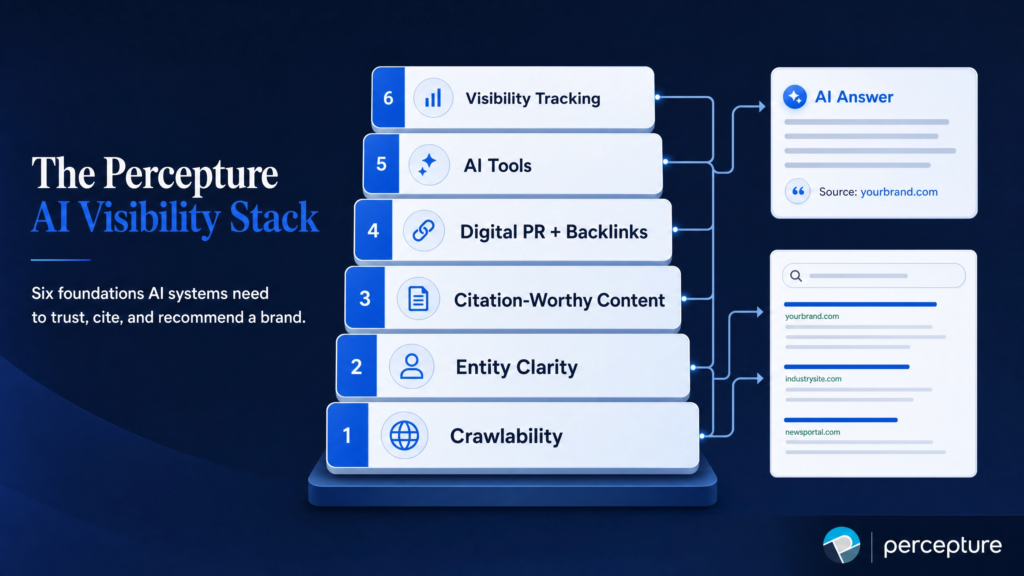
Search engines and answer systems need the same basic clarity customers need: which company provides which service, in which area, for which buyer, with what proof and next step.
Use direct answers, descriptive headings, visible definitions, useful tables, short paragraphs, relevant images, internal links, current company facts, and structured data that matches the page. Do not hide important service or location information inside scripts, images, or vague brand language.
Generative engine optimization services can help organize owned content, entity clarity, digital authority, and retrievable answers across Google AI experiences and other answer engines. They do not replace foundational SEO or guarantee citations.
Measure the whole visit-to-revenue path
Calls, forms, bookings, chats, financing clicks, and commercial requests are different actions. They should not all share one conversion definition.
| Stage | What to measure | Question it answers |
|---|---|---|
| Visit | Landing page, source, device, campaign, location, and new or returning user | Which demand reached the site? |
| Action | Call click, connected call, form, booking, chat, financing click, or commercial contact | What did the visitor try to do? |
| Qualification | Service fit, territory, urgency, buyer type, spam, vendor, and disqualification reason | Was the request useful? |
| Appointment | Scheduled, completed, canceled, rescheduled, or no-show | Did the request become an operating opportunity? |
| Work | Estimate, sold job, completed job, maintenance plan, or commercial opportunity | Did the opportunity produce value? |
| Revenue | Booked revenue, realized revenue, margin, repeat work, and customer value where available | Which pages and channels deserve more investment? |
Attribution and analytics should document tracking limits, offline gaps, call-recording rules, privacy requirements, and how source credit is assigned.

Is the website helping dispatch or creating more cleanup?
Percepture can review the customer path from search or advertising through trust, contact, qualification, scheduling, completed work, and reporting.
- Identify pages that mismatch buyer intent
- Find trust, form, routing, and measurement gaps
- Prioritize optimization before recommending a rebuild
HVAC website design: optimize, redesign, rebuild, or wait?
| Path | Choose it when | Warning signs | First step |
|---|---|---|---|
| Optimize | The platform, ownership, architecture, and integrations can support the operating plan | Teams assume every problem requires new templates | Audit pages, actions, routing, tracking, speed, and search ownership |
| Redesign | The information and platform work, but the experience, hierarchy, components, and mobile flow need broad revision | Visual changes are planned without content or measurement changes | Prototype high-value service and landing-page paths first |
| Rebuild | Platform, ownership, architecture, performance, security, integrations, or governance prevent needed improvements | The team selects technology before defining requirements | Create the operating, content, migration, and measurement plan |
| Wait | Service strategy, brand, territories, systems, leadership, or ownership will change soon | Waiting becomes an excuse to ignore broken forms or urgent risks | Fix critical friction now and define the trigger for the larger project |
Enterprise web development is appropriate when the operating plan requires stronger architecture, integrations, ownership, performance, or governance than the current site can support.
How to plan cost without inventing a universal price
| Investment area | Questions that affect scope | Evidence to request |
|---|---|---|
| Discovery and architecture | How many services, markets, buyers, systems, campaigns, and stakeholders must the site support? | Research plan, page map, content ownership, conversion paths, and requirements |
| Content | Which pages need writing, interviews, photography, proof, FAQs, comparisons, and governance? | Page briefs, source process, review roles, and content inventory |
| Design system | How many templates, components, states, devices, and accessibility requirements are needed? | Component library, prototypes, responsive states, and interaction rules |
| Development and integrations | Which CMS, forms, booking, CRM, call tracking, financing, chat, analytics, and dispatch systems must connect? | Technical specification, ownership, testing, security, and support plan |
| Migration and SEO protection | How many URLs, redirects, schemas, internal links, media files, and tracking rules must be preserved? | Migration inventory, redirect map, launch checklist, crawl, and rollback plan |
| Optimization and governance | Who will review calls, forms, page performance, search visibility, proof, and operating changes? | Reporting model, testing plan, roles, change process, and decision cadence |
Compare HVAC website design proposals using the same assumptions. A lower price can exclude discovery, content, migration, analytics, testing, or post-launch validation. A larger price is not automatically better when deliverables and ownership remain vague.
See Pricing OptionsA practical 30-, 60-, and 90-day roadmap
Audit services, markets, buyer paths, trust, content, calls, forms, booking, routing, technical quality, analytics, search ownership, and operating constraints. Define the pages and actions that matter most.
Build the page architecture, prototypes, design components, content briefs, proof plan, measurement model, and technical requirements. Test high-value paths with sales, dispatch, marketing, and leadership.
Launch or improve prioritized pages, integrations, routing, tracking, technical changes, and content. Test forms, calls, mobile actions, redirects, schema, reporting, and the real handoff to operations.
The roadmap is a planning model, not a completion guarantee. Larger websites, integrations, migrations, and approval cycles may require phased delivery.
Eight mistakes that weaken an HVAC website
- Leading with design before service and operating requirements. The site can look polished while sending the wrong demand into the wrong process.
- Asking the homepage to serve every service and city. Vague architecture weakens message match, local clarity, and paid landing experiences.
- Using one generic CTA everywhere. Emergency, replacement, financing, maintenance, and commercial needs require different paths.
- Putting trust far from the decision. Proof at the bottom cannot answer uncertainty beside the call, form, booking, or financing action.
- Counting every form as a lead. Spam, vendors, job seekers, out-of-area requests, and unqualified inquiries should not receive equal credit.
- Rebuilding without a migration plan. Lost URLs, links, tracking, schema, content, and page ownership can erase hard-earned visibility.
- Publishing repetitive location pages. Genuine local facts and service differences matter more than changing a city name.
- Ending measurement at the thank-you page. Qualification, appointments, completed jobs, revenue, and disqualification reasons explain business value.
HVAC Website Conversion Scorecard
Score each control as ready, needs work, or unknown. Three or more unknown controls usually indicate that discovery should come before a major rebuild.
| Control | Ready | At risk |
|---|---|---|
| Service and territory clarity | Visitors can confirm fit quickly | Coverage or services remain vague |
| Mobile actions | Calls, forms, booking, and financing are easy to use | Actions are hidden, crowded, or difficult to tap |
| Trust placement | Proof appears beside the decision it supports | Generic badges sit far from high-intent actions |
| Routing | Service, urgency, market, commercial type, and capacity guide the handoff | Every request enters one general queue |
| Tracking | Different actions and outcomes have separate measurement | Every submission is counted as the same conversion |
| Search architecture | Services, locations, resources, and campaigns have clear page ownership | The homepage competes with thin or duplicated pages |
| Technical quality | Performance, indexing, accessibility, schema, security, and migration are controlled | Technical requirements begin after the design is approved |
| Governance | Named owners maintain services, territories, proof, policies, forms, and tracking | The website becomes outdated between redesigns |
Website strategy must reflect the work customers actually buy
Commercial HVAC, critical facilities, data centers, healthcare, hospitality, and multi-site service buyers evaluate different proof than a residential emergency customer. Architecture, content, routing, and conversion paths should reflect those differences.

Frequently asked questions
What is HVAC website design?
HVAC website design is the planning of page structure, mobile layouts, navigation, service and location content, trust evidence, and conversion paths for a heating and cooling company. A complete plan also accounts for development, accessibility, search requirements, analytics, lead routing, dispatch, and follow-up.
What makes an HVAC website convert?
A converting HVAC website quickly confirms the requested service, genuine coverage, credibility, and next step. It makes calling, booking, requesting an estimate, checking financing, or reaching the commercial team easy. The request must also reach a process that can qualify and handle it correctly.
What pages should an HVAC website include?
Most contractors need a homepage, core service pages, genuine location pages, emergency or urgent-service guidance when applicable, replacement and financing content, maintenance information, commercial capabilities, reviews or case studies, company information, and clear contact paths. The exact architecture should reflect services, territories, buyers, and operations.
Should an HVAC company optimize or rebuild its website?
Optimize when the existing platform and architecture can support the required content, speed, tracking, accessibility, and integration changes. Redesign when the experience and presentation need broad revision. Rebuild when ownership, platform, architecture, performance, tracking, or integration limits prevent the operating plan from working.
How much does an HVAC website cost?
Cost depends on discovery, architecture, page volume, content, design systems, development, photography, integrations, accessibility, migration, analytics, testing, and governance. Compare proposals using the same assumptions and deliverables. A universal price without a defined scope is not a useful benchmark.
How long does an HVAC website project take?
Timing depends on scope, content readiness, stakeholder access, photography, platform complexity, integrations, migration risk, and review cycles. Use a phased plan for audit, architecture, implementation, quality assurance, launch, and validation rather than treating a sample roadmap as a fixed promise.
Do HVAC service and location pages need separate content?
Yes, when they answer different customer questions. A service page explains a repair, installation, maintenance, or replacement need. A location page confirms genuine coverage and applicable local facts. Repeating the same copy with a different city name creates a weak experience and can blur page ownership.
How should HVAC calls and forms be tracked?
Track the initial action, then connect it to call connection, qualification, disqualification reason, appointment status, completed work, and revenue when the systems allow it. Use separate events and thank-you paths for materially different actions, such as emergency calls, estimate requests, financing clicks, and commercial inquiries.
Does an HVAC website need special optimization for AI search?
No separate AI trick replaces useful content and foundational SEO. The site needs crawlable pages, clear services and locations, consistent company facts, direct answers, visible proof, descriptive headings, useful tables, relevant media, internal links, and structured data that matches visible content.
How often should an HVAC website be improved?
Review the website after service, territory, staffing, financing, dispatch, tracking, platform, or brand changes. Stable sites should still be checked regularly for broken forms, call routing, page speed, search visibility, conversion quality, outdated proof, and changes in customer questions.
Turn the website into a managed operating asset
Use the form below or schedule a call to share the services, markets, website, conversion paths, routing issues, redesign plans, and measurements you need reviewed. Percepture can help prioritize what to optimize, redesign, rebuild, or leave alone.
You will receive a practical next-step discussion, not an automatic recommendation to rebuild.
Key takeaway: the strongest HVAC website design does not stop at a polished page or a completed form. It connects intent, trust, action, routing, completed work, and measurable business outcomes.