


Strong HVAC public relations turns field knowledge, technical expertise, and real company news into authority that customers, reporters, partners, employees, search engines, and AI systems can recognize.
Percepture connects traditional PR, digital PR, content, search, AI visibility, reputation support, crisis readiness, and business-focused measurement so earned attention can keep working after a story appears.
Technical expertise creates more value when buyers can find and trust it
OPTK Networks operates in fiber, telecom and digital infrastructure. In this client conversation, Cody Clegg explains why specialization, clear positioning and repeated visibility matter when a technical company needs to earn trust.

In the client video, Cody explains why specialized market knowledge, clear positioning and repeated visibility matter when a technical company needs to earn trust.
Important: OPTK is an adjacent infrastructure client, not an HVAC client. The video proves the working relationship and approach, not a guaranteed result for every campaign.
What does an HVAC public relations agency do?
An HVAC PR agency uses HVAC PR to help contractors, mechanical firms, manufacturers, distributors, refrigeration businesses, controls providers, and multi-location operators develop credible stories, prepare experts, earn relevant media attention, manage stakeholder communications, and connect third-party authority to search visibility, recruiting, partnerships, reputation, and business development.
Executive summary
Build authority from real work
The strongest HVAC public relations stories usually begin with verified operational facts, useful expertise, customer needs, technical change, community activity, or company milestones.
Choose media by buyer
Local news, HVAC trades, business media, consumer outlets, construction publications, podcasts, and partner channels serve different HVAC PR goals.
Plan distribution before pitching
Coverage is more useful when the supporting expert page, article, press room, sales asset, social copy, and tracking plan are ready.
Measure beyond impressions
Track message pull-through, qualified coverage, links, referral activity, branded search, target-account response, recruiting interest, and influenced opportunities.
Who needs HVAC public relations?
HVAC PR is most useful when a company has expertise worth sharing, a defined audience, reliable spokespeople, and enough internal discipline to verify claims quickly. It can support local contractors, commercial mechanical firms, OEMs, distributors, controls providers, refrigeration companies, franchise systems, and private-equity-backed platforms.
Residential and local service
Useful HVAC PR lanes include seasonal education, community involvement, technician recruiting, expansion news, consumer questions, and local expert commentary.
Commercial mechanical firms
Strong topics can include complex project delivery, commissioning, controls, building performance, workforce development, and facility operations.
Manufacturers and distributors
HVAC PR programs may support product launches, technical education, channel relationships, executive visibility, research, events, partnerships, and trade-media outreach.
Multi-location and PE platforms
PR can help align corporate and local messages while supporting acquisitions, market entries, leadership changes, recruiting, and community relationships.

A broader HVAC marketing plan may generate demand through several channels. HVAC PR has a narrower job: earn credible attention and third-party validation rather than buying every exposure.
When PR is—and is not—a fit
Use these readiness signals to determine whether HVAC PR can operate with the proof, access, news value, coordination, and measurement discipline it requires.
| Readiness signal | Good fit | Warning sign |
|---|---|---|
| Proof | Facts, experts, examples, documents, and approved visuals are available. | The company expects the agency to create claims without evidence. |
| Access | Leaders and technical staff can support interviews and review. | No spokesperson can respond or approve information. |
| News value | The company has useful expertise, change, data, milestones, or community relevance. | The only objective is publishing routine promotional copy. |
| Operations | Marketing and operations can coordinate around capacity and customer experience. | Publicity could create demand the business cannot serve. |
| Measurement | Communication goals connect to search, reputation, recruiting, sales, or partnerships. | Success is defined only as a large impression total. |
HVAC company-type decision matrix
The right HVAC PR priorities depend on the company type, the audiences that influence growth, and the stories the business can substantiate.
| Company type | Priority audiences | Useful story lanes | Practical outcome |
|---|---|---|---|
| Local contractor | Homeowners, local reporters, recruits, community partners | Weather readiness, maintenance education, workforce, community | Local trust and expert recognition |
| Commercial mechanical firm | Facility leaders, developers, general contractors, engineers | Project delivery, controls, commissioning, operations | Buyer confidence and partner visibility |
| Manufacturer | Contractors, distributors, specifiers, trade editors | Products, research, technical education, leadership | Category authority and launch support |
| Distributor | Contractors, manufacturers, employees, local markets | Training, branches, partnerships, supply and service expertise | Channel trust and recruiting support |
| Controls or refrigeration provider | Facilities, engineers, operators, technical media | Building automation, uptime, monitoring, technical change | Clearer market understanding |
| Multi-location platform | Local markets, investors, recruits, partners | Expansion, acquisitions, leadership, operating standards | Consistent corporate and local narratives |
What an HVAC PR agency should deliver
A serious HVAC public relations program starts with objectives and evidence, not a predetermined press-release quota. The exact mix depends on the buyer, market, technical complexity, spokesperson access, and business event.
| Service | Audience | Typical deliverable | Useful KPI |
|---|---|---|---|
| Story discovery | Marketing, operations, leadership | Story inventory and evidence map | Approved, pitchable themes |
| Media relations | Local, trade, business, consumer, national media | Pitches, briefings, interviews, source responses | Qualified coverage and message pull-through |
| Executive positioning | Buyers, partners, media, associations | Message platform, commentary, bylines, speaking themes | Relevant expert opportunities |
| Digital PR | Publishers, search users, online researchers | Source-backed assets and outreach | Relevant links, mentions, referral activity |
| Issue readiness | Customers, employees, media, partners | Approval paths, holding materials, spokesperson map | Preparedness and response consistency |
| Measurement | Executives, finance, marketing, sales | Objective-based reporting | Audience response, outcomes, and business impact |
Check your PR readiness
See whether your company has enough proof, expert access, story value, approval speed and measurement discipline to support a useful PR program.
- Find missing proof and spokesperson gaps
- See which media lanes fit your buyers
- Know what to fix before outreach begins
The Percepture HVAC public relationsESSURE Framework
The PRESSURE Framework gives HVAC PR a practical operating system. It connects story development to technical review, media fit, search retrieval, reputation safeguards, and economic goals.
P — Proof
Collect verified facts, field expertise, data, documents, approved examples, visuals, sources, and limitations before making claims.
R — Relevance
Connect expertise to seasonality, weather, energy, maintenance, workforce, community, products, partnerships, research, or company change.
E — Expert Voices
Prepare owners, service leaders, technicians, engineers, product leaders, HR leaders, customers, or partners for the right conversations.
S — Story Architecture
Build distinct angles for local news, HVAC trades, construction media, business publications, consumer outlets, podcasts, associations, and partners.
S — Search and AI Retrieval
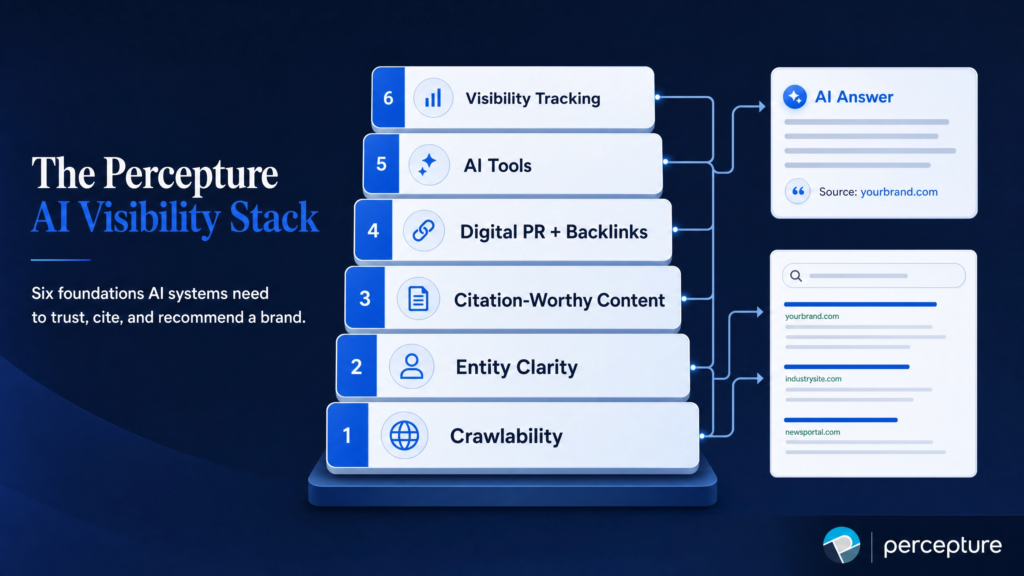
Create clear source pages, expert profiles, press materials, transcripts, coverage pages, links, descriptive media, and consistent entity information.
U — Urgency and Issue Readiness
Set monitoring, approval paths, spokesperson backups, stakeholder lists, holding materials, media protocols, and recovery steps.
R — Reputation Resilience
Coordinate reviews, customer recovery, community relationships, executive profiles, corrections, access controls, and escalation.
E — Economic Impact
Connect qualified attention to branded search, referrals, target accounts, calls, meetings, recruiting, partnerships, opportunities, and risk reduction.
The governance rail
- Accuracy: every technical and business claim needs a reliable source.
- Approval: owners for legal, technical, operational, and executive review must be clear.
- Speed: prepared facts and backups make timely response possible.
- Attribution: reporting should show what happened after attention was earned.
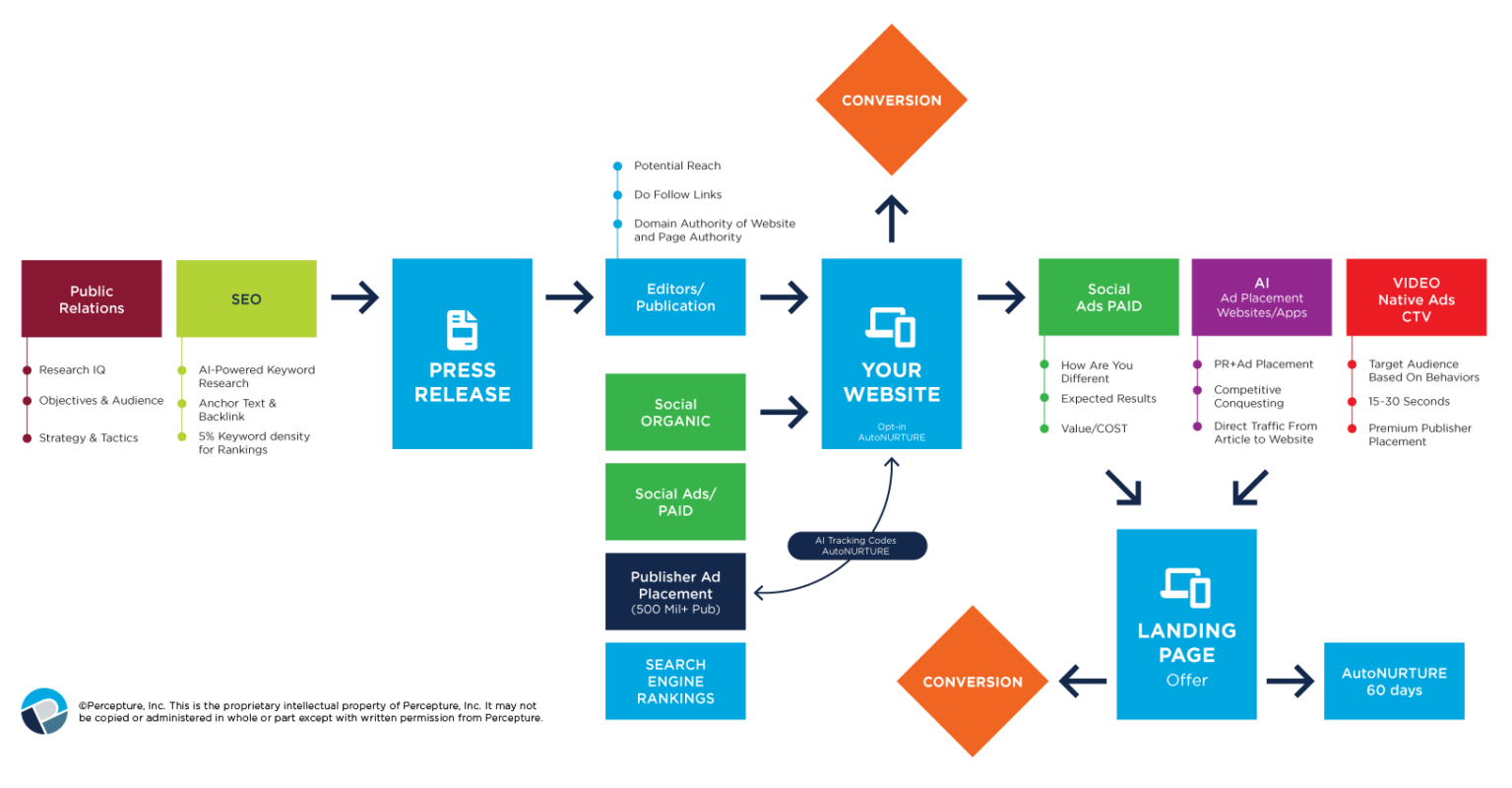
HVAC public relations vs. digital PR, SEO and paid media
These channels can support one another, but they do not do the same job. Buyers should ask who owns each outcome and how handoffs work. Percepture’s omnichannel marketing services provide a broader planning path when HVAC PR and several other channels must move together.
| Channel | Primary job | Control level | Best use | Common mistake |
|---|---|---|---|---|
| Traditional PR | Earn third-party attention and position credible sources | Message and preparation can be controlled; coverage cannot | Trust, news, executive visibility, stakeholder communication | Treating release distribution as a complete strategy |
| Digital PR | Earn online mentions, links, and discoverable authority | Assets and outreach can be managed; editorial response cannot | Online authority, referral traffic, search support | Judging every placement only by link quantity |
| SEO | Improve the relevance, accessibility, and visibility of owned pages | High control over the website | Durable discovery for defined searches | Publishing claims without outside validation |
| Paid media | Buy targeted reach and traffic | High control while budget is active | Fast distribution, testing, retargeting | Calling paid exposure earned media |
For a deeper definition, see what is digital PR. Percepture also provides dedicated digital PR services when online authority and publisher outreach are central to the assignment.
Choose the media lane before building the pitch
One story rarely fits every outlet. Effective HVAC PR changes the angle, evidence, spokesperson, language, and timing to match the audience.
| Media lane | What it often values | Possible spokesperson | Useful outcome |
|---|---|---|---|
| Local news | Community relevance, weather, people, timely service information | Owner or local operations leader | Regional recognition and trust |
| HVAC trade media | Technical depth, products, workforce, channel issues, field insight | Engineer, product leader, service manager | Industry authority |
| Business media | Growth, leadership, expansion, acquisitions, workforce, economic impact | CEO, CFO, platform leader | Corporate credibility |
| Consumer media | Plain-language education tied to real household concerns | Qualified technical expert | Consumer understanding |
| Construction and facilities media | Project delivery, building systems, operations, controls, commissioning | Mechanical or controls leader | Commercial buyer confidence |
| National media | Broad trends supported by strong evidence and accessible experts | Senior subject-matter expert | Wider category recognition |
A twelve-month HVAC story system
Seasonal demand matters, but HVAC PR should not disappear between heat waves and cold snaps. A rolling calendar gives experts time to prepare evidence before reporters and customers need it.
| Planning window | Potential themes | Preparation |
|---|---|---|
| Winter and pre-spring | Cold-weather operations, training, planning, maintenance education | Review spokespeople, approved claims, field examples, and regional angles |
| Spring and early summer | Cooling readiness, workforce, products, expansions, partnerships | Prepare consumer explanations, trade detail, visuals, and interview availability |
| Peak summer | Timely expert commentary, operations, service capacity, community response | Use a fast approval path and avoid unsupported performance or savings claims |
| Fall and planning season | Commercial planning, research, budgets, acquisitions, awards, recruiting | Build deeper business and trade stories before annual planning cycles |
Useful story triggers include weather, maintenance, energy, refrigerants, indoor air quality, workforce, training, research, new locations, products, partnerships, certifications, awards, events, community programs, and leadership changes. Each HVAC PR topic still needs verified facts and a reason the audience should care.
Build a spokesperson system, not a single talking head
Owner or CEO
Best for company direction, growth, acquisitions, community commitments, partnerships, and industry outlook.
Operations leader
Best for dispatch, service capacity, customer experience, field processes, and operational preparedness.
Technical expert
Best for equipment, controls, refrigeration, commissioning, maintenance, and plain-language explanations of technical subjects.
HR or training leader
Best for recruiting, apprenticeships, technician development, workplace programs, and career pathways.
Every HVAC PR spokesperson needs a defined subject area, approved biography, interview preparation, availability rules, backup contact, and escalation path. Technical or regulated claims should move through the appropriate company review before publication.
How earned media supports search and AI discovery
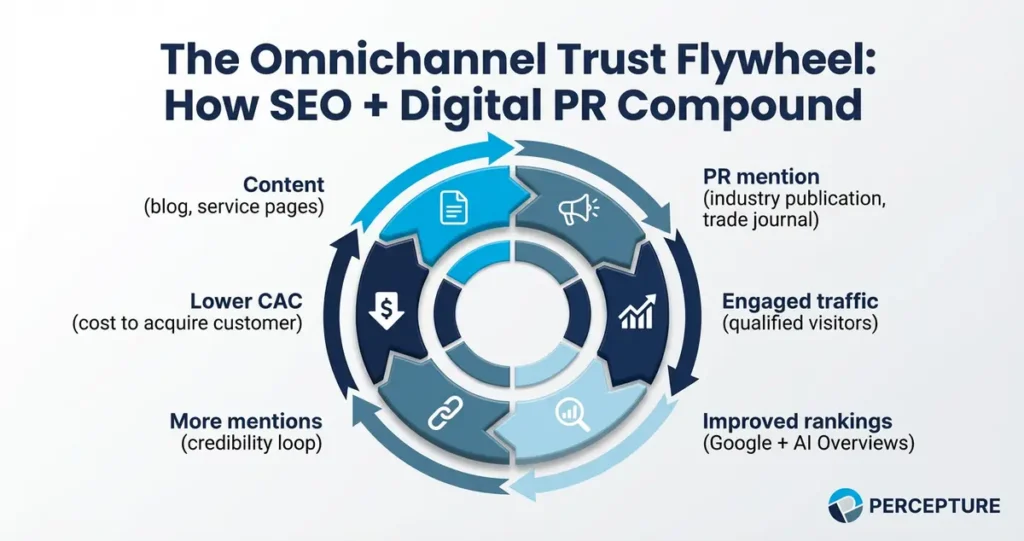
Coverage alone is not the full asset. A well-planned HVAC PR program gives the story a clear owned destination, consistent expert information, source-backed detail, descriptive media, and a path for readers to continue their research.
Percepture’s content marketing services can turn interviews and subject-matter expertise into durable owned resources. Generative engine optimization services focus on making entities, expertise, and source material easier for AI systems to understand and retrieve.
A practical HVAC PR flow is: verified expertise becomes a useful owned asset; targeted outreach earns attention; relevant coverage creates third-party validation; links and mentions help people discover the source; and sales or recruiting teams reuse the result where it supports a real conversation.
Companies with commercial and construction buyers can also coordinate PR with SEO for construction companies. Search rankings, links, AI citations, or revenue cannot be promised, but the underlying source quality and distribution system can be improved.
Reputation, community, and issue readiness
Reputation work and crisis communications are related to HVAC PR, but they are not interchangeable. Routine PR builds familiarity and authority. Reputation programs monitor and strengthen the information buyers find. Crisis work prepares the company to communicate under pressure.
Useful HVAC PR preparation includes stakeholder lists, an approval tree, spokesperson backups, issue monitoring, holding materials, media protocols, website and social update procedures, and a correction process. Percepture’s crisis communications services address the deeper preparedness and response work.
Do not wait for an incident to decide who can speak, which facts can be released, or how legal, technical, operational, customer, and media reviews will work. Speed without accurate information creates avoidable risk.

Launches, expansions, awards, M&A, and executive visibility
Company news earns HVAC PR attention when it has a clear audience consequence. A new branch may matter because it changes service coverage or employment. An acquisition may matter because it changes leadership, capabilities, or customer relationships. A product launch needs more than features; it needs evidence, context, technical accuracy, and a reason the market should pay attention.
Executive visibility follows the same rule. A leader should own a useful subject, bring informed perspective, and be available when the market is asking the question. Interviews, bylines, speaking themes, research, and source commentary should reinforce one credible area of expertise.

Transferable earned-media proof
Percepture’s public Amazon and Phantom Ranch case demonstrates story discovery, stakeholder coordination, production, privacy management, and earned-media execution. The documented case reports more than 70 million viewers and 378 stories, including 357 online stories and 21 broadcast stories.

The HVAC PR lesson is operational: find the true story inside the work, gather proof, coordinate stakeholders, protect sensitive information, prepare useful materials, and make it easy for a journalist to understand why the story matters. Buyers can review the Amazon and Phantom Ranch PR case study for the full example.
Specialized market knowledge builds stronger visibility
Broadstaff Global recruits across telecom, wireless, data centers and infrastructure. Its case study shows how industry knowledge, search visibility, digital PR and useful content can support qualified demand in a technical B2B market.

Measure business movement, not just media volume
Measurement for HVAC PR should begin with a business objective, a communication objective, an audience, a baseline, a target, and a timeframe. Coverage volume is an output, not the final business result.
| Level | What to examine | Examples |
|---|---|---|
| Preparation | Readiness and quality | Approved stories, evidence, trained spokespeople, response process |
| Outputs | Work completed and attention earned | Pitches, briefings, interviews, bylines, stories, links |
| Audience response | How people react | Message pull-through, sentiment, engagement, referral visits, branded search |
| Outcomes | Changes in visibility or behavior | Authority, search discovery, AI citations, recruiting interest, partner activity |
| Business impact | Commercial or organizational movement | Qualified calls, meetings, estimates, opportunities, hires, partnerships, risk reduction |
Percepture’s attribution and analytics services can help define HVAC PR reporting paths across referral traffic, calls, forms, CRM activity, target accounts, and assisted opportunities. Attribution should reflect the buying cycle rather than assigning every outcome to the last click.
In-house, generalist, specialist, or integrated agency?
| Model | Strength | Possible gap | Best fit |
|---|---|---|---|
| In-house only | Deep company context and direct access | Limited media reach, surge capacity, or outside story judgment | Organizations with experienced communications leadership and adequate resources |
| General PR agency | Broad media and communications experience | May require more technical and market education | Companies with strong internal technical review and broad corporate needs |
| HVAC specialist | Category language, trade-media familiarity, and market context | May not cover search, AI visibility, analytics, paid amplification, or crisis depth | Programs centered on HVAC trade audiences |
| Digital-PR shop | Online outreach, content assets, links, and search alignment | May offer less broadcast, corporate communications, community relations, or executive preparation | Programs primarily focused on online authority |
| Integrated agency | Coordinates PR, content, search, AI visibility, analytics, and amplification | Requires clear ownership so integration does not create unnecessary scope | Companies that need earned authority to support several business channels |
Percepture’s HVAC PR operating position combines traditional PR with digital PR, content, search, AI visibility, crisis support, and business-focused measurement. That makes the model useful when the company wants earned attention to support more than one department or channel.
HVAC public relations pricing and scope factors
There is no responsible universal price for HVAC PR because the workload changes with geography, media lanes, technical complexity, executive access, research, content, production, approvals, rapid-response needs, reporting, and amplification. Buyers should compare scope and operating assumptions before comparing totals.
| Cost factor | Why it changes scope | Question to ask |
|---|---|---|
| Markets and locations | Local, regional, national, and multi-location programs require different lists, messages, and coordination. | Which markets and locations are included? |
| Media lanes | Trade, consumer, business, broadcast, local, and national outreach require different angles and relationships. | Which media audiences are in scope? |
| Technical complexity | Specialized subjects require more interviews, sourcing, review, and explanation. | Who verifies technical claims? |
| Executive work | Message development, coaching, bylines, speeches, and rapid commentary add preparation. | How many spokespeople are supported? |
| Content and production | Research, articles, visual assets, video, photography, and press-room work require separate resources. | Which assets are included? |
| Issue response | Monitoring and urgent support require availability and escalation rules. | Is crisis or rapid-response support separately scoped? |
| Third-party costs | Wire distribution, travel, research, production, and paid amplification may sit outside agency fees. | Which expenses are passed through? |
| Measurement | CRM, call tracking, search data, dashboards, and account-level reporting increase setup requirements. | How will PR connect to business reporting? |
Review Percepture’s public relations pricing packages for the current published HVAC PR scope structure. Coverage, links, rankings, AI citations, leads, and revenue remain earned or market-driven outcomes and cannot be guaranteed.
See pricing and scope options
PR retainers can cover very different work. Compare strategy, media relations, content, executive support, rapid response, reporting and third-party costs before you choose.
- See published service and pricing paths
- Match the scope to your markets and goals
- Know what is included before work begins
A practical 30-, 60-, and 90-day plan
The first 90 days of HVAC PR should create a repeatable system, not force premature pitching. Timing still depends on access, approvals, evidence, events, and media opportunity.
| Phase | Primary work | Decision point |
|---|---|---|
| First 30 days | Business objectives, audience map, proof inventory, message review, spokesperson map, issue scan, measurement baseline | Is there enough verified material to support credible outreach? |
| Days 31–60 | Story architecture, media lanes, source assets, interview preparation, approval process, outreach planning | Which stories are timely, differentiated, and ready? |
| Days 61–90 | Targeted outreach, source response, content activation, coverage reuse, search and sales handoffs, initial reporting | Which messages and audiences show useful response? |
After the first HVAC PR cycle, the team should refine the calendar using response quality, message pull-through, referral behavior, target-account activity, and operational feedback.
HVAC PR agency evaluation scorecard
| Evaluation area | Strong answer | Score |
|---|---|---|
| Proof discipline | The agency asks for sources, owners, limitations, and technical review. | 0–5 |
| Story judgment | It can explain why a story matters to a defined audience. | 0–5 |
| Media architecture | It separates local, trade, business, consumer, and national lanes. | 0–5 |
| Spokesperson preparation | It maps experts, subjects, availability, approvals, and backups. | 0–5 |
| Search and AI integration | It plans owned source pages, links, mentions, expert entities, and reuse. | 0–5 |
| Issue readiness | It establishes escalation, monitoring, holding materials, and response roles. | 0–5 |
| Measurement | It moves from outputs to audience response, outcomes, and business impact. | 0–5 |
| Commercial clarity | Scope, exclusions, expenses, responsibilities, and reporting are explicit. | 0–5 |
A low score does not mean HVAC PR can never work. It shows where the operating system needs attention before a company commits to aggressive outreach.
Choose the right communications workstream
Use the primary need to decide whether HVAC PR agency selection, detailed strategy, reputation management, or crisis communications should lead the assignment.
| Buyer need | Primary workstream | Main focus |
|---|---|---|
| Hire an agency or compare services | This buyer guide | Agency fit, services, process, pricing factors, measurement |
| Build a detailed media and digital PR plan | HVAC PR strategy | Story development, media relations, thought leadership, digital PR |
| Improve reviews and branded results | Reputation management | Monitoring, reviews, customer recovery, branded search |
| Prepare for or respond to an urgent issue | Crisis communications | Preparedness, stakeholder response, escalation, recovery |
Risks, limits, and buyer safeguards
- Earned coverage cannot be guaranteed because editors and reporters control publication decisions.
- A press release is a format, not a complete media strategy.
- Paid placement should never be presented as earned editorial coverage.
- Technical, safety, health, savings, environmental, regulatory, warranty, and rebate claims require reliable sources and appropriate review.
- PR should not create demand without an operations and capacity check.
- Search rankings, backlinks, AI citations, calls, opportunities, and revenue cannot be promised.
- Every program should define correction, approval, recordkeeping, and escalation procedures.
Good HVAC PR makes these limits visible. Honest constraints protect the company, the audience, the journalist, and the long-term value of the story.
Frequently asked questions
What is HVAC public relations?
HVAC PR is the planned use of credible stories, expert commentary, media relations, stakeholder communication, digital PR, and owned source material to build third-party trust around an HVAC company. It can support contractors, manufacturers, distributors, mechanical firms, refrigeration companies, controls providers, and multi-location platforms.
What does an HVAC PR agency do?
An HVAC PR agency plans and executes HVAC PR by identifying useful stories, verifying evidence, preparing spokespeople, developing audience-specific angles, conducting media outreach, supporting interviews, coordinating approvals, helping reuse coverage, and reporting what happened. The work should connect communication outputs to audience response, business outcomes, and risk controls.
How is HVAC PR different from marketing?
Marketing is the broader system used to understand buyers, shape offers, generate demand, and manage customer journeys. HVAC PR focuses on earned attention, expert positioning, stakeholder communication, and third-party validation. PR can support marketing, but editorial coverage cannot be purchased or controlled like an advertisement.
Can HVAC PR help SEO and AI visibility?
HVAC PR can support those goals by creating credible mentions, relevant links, expert entities, source-backed articles, interviews, and third-party references. Results depend on editorial decisions, source quality, website quality, competition, and search or AI systems. Rankings, backlinks, and AI citations cannot be guaranteed.
What stories can HVAC companies pitch?
HVAC PR themes can include weather readiness, maintenance education, workforce development, training, community programs, research, products, partnerships, expansions, acquisitions, awards, technical change, commercial projects, executive perspective, and industry events. A pitch still needs verified facts, a clear audience, and a timely reason to care.
What does an HVAC PR agency cost?
HVAC PR cost depends on markets, locations, media lanes, technical complexity, spokesperson support, content, production, research, rapid-response needs, reporting, and third-party expenses. Compare the actual scope, responsibilities, exclusions, and measurement plan instead of evaluating a retainer total without context.
How long does HVAC PR take?
The HVAC PR setup phase often includes objectives, proof collection, message development, spokesperson preparation, media mapping, approvals, source assets, and measurement. Timely stories may move quickly, while long-term authority develops through repeated credible work. No responsible agency can guarantee a publication date controlled by an editor.
How should HVAC PR ROI be measured?
HVAC PR ROI should start with objectives, audiences, baselines, targets, and timeframes. Then track outputs, message pull-through, sentiment, links, referral activity, branded search, target-account response, recruiting interest, meetings, estimates, opportunities, partnerships, influenced revenue, and risk reduction where reliable data is available.
Build an HVAC PR authority plan
Percepture can review your HVAC public relations proof, stories, expert voices, media targets, search visibility and issue readiness. You will leave with a clear view of what should happen first.
- Find the strongest stories already inside the business
- Choose the right spokespeople and media lanes
- Build a practical 90-day action plan