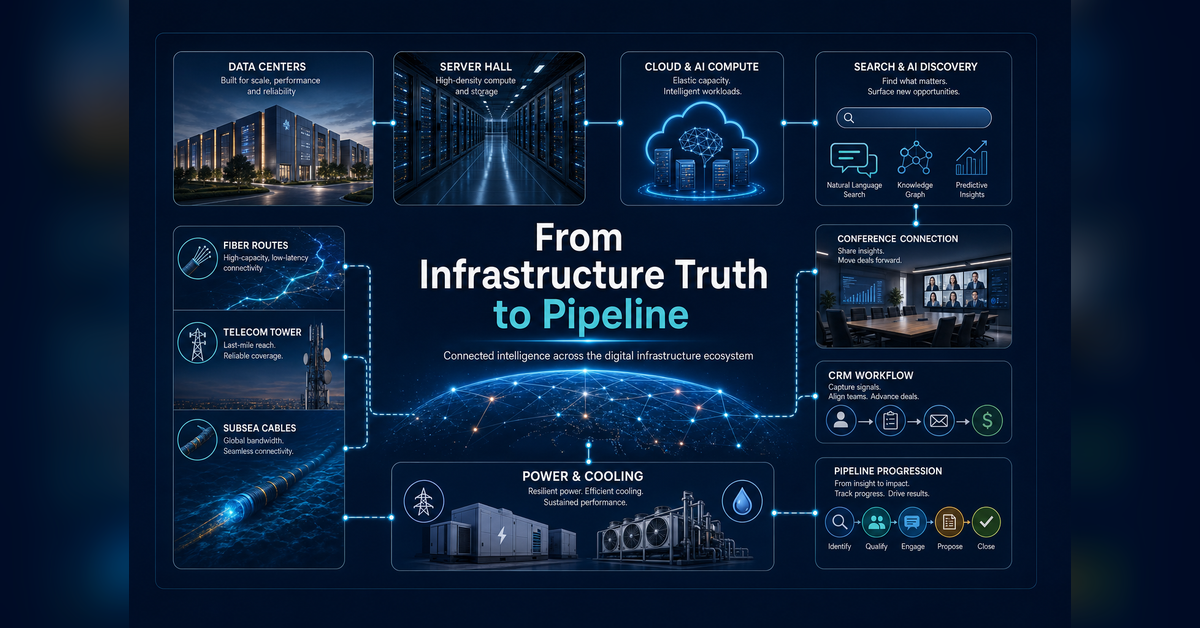

A digital infrastructure marketing agency helps data center, telecom, fiber, cloud, edge, power, cooling, subsea, and AI infrastructure companies become easier to find, understand, trust, and buy from. It connects technical positioning, PR, SEO, GEO, content, events, paid media, account-based marketing, sales enablement, automation, and attribution around complex buying cycles.
This guide is for CEOs, founders, CMOs, communications leaders, sales teams, operators, investors, developers, and infrastructure vendors. It explains what the agency should do, how services fit together, what to keep in-house, how to evaluate partners, and how to measure the work without mistaking activity for revenue.
Digital infrastructure experience buyers can recognize
Percepture has worked across telecom, fiber, data centers, infrastructure, staffing, technology, and complex B2B markets since 2004.
 Founded in 2004
 Inc. 5000 recognized
 NMSDC certified
 Integrated PR, SEO and GEO
What does the right specialist agency do?
A digital infrastructure marketing agency turns verified operating facts into authority, discovery, qualified demand, sales tools, follow-up systems, and measurable commercial actions.
Real infrastructure expertise still has to be found and trusted
Cody Clegg and the OPTK Networks team discuss Percepture’s support across AI search, SEO, enterprise targeting, paid media, digital PR, and generative-search visibility for a telecom infrastructure company.
What this proves: Technical buyers research across search, AI answers, media, events, websites, and sales conversations. The marketing system must connect those surfaces around the same verified facts and buyer outcomes.
What executives should take from this guide
Start with infrastructure truth
Confirm services, locations, availability, timing, limitations, and proof before a campaign turns them into claims.
Build one connected system
A digital infrastructure marketing agency should connect authority, search, AI discovery, events, demand generation, sales follow-up, and measurement.
Measure buyer movement
Track qualified engagement, meetings, accepted opportunities, progression, sales use, and gross-profit signals under agreed attribution rules.

“The best marketing translates technology into outcomes.”
Clegg also notes that “Customers research everything.” Buyers want to know whether the service works, what it costs, how installation works, how long it takes, and whether support will be available when a problem occurs.
Learn about OPTK Networks, a Nebraska fiber network provider
What Is a Digital Infrastructure Marketing Agency?
A digital infrastructure marketing agency is a specialist firm that markets the physical and enabling systems behind connectivity, compute, storage, cloud, AI, and digital services. Its first job is not producing more campaigns. Its first job is understanding what the company can deliver, who buys it, what evidence each stakeholder requires, and where the buying group looks for answers.
That boundary matters. This page covers the integrated agency category. For a sector-specific operating plan, use Percepture’s data center marketing guide. Buyers comparing firms focused on that sector can review the top data center marketing agencies guide.
Core Focus Areas
- Data centers and colocation: facilities, capacity, markets, connectivity, resilience, power, cooling, and buyer fit.
- Telecom and connectivity: networks, services, coverage, reliability, relationships, and enterprise outcomes.
- Fiber and broadband: routes, serviceability, construction, community trust, adoption, and account development.
- Cloud and edge: workloads, locations, latency requirements, integrations, and operating outcomes.
- AI infrastructure: compute, power, cooling, networks, deployment constraints, and supporting vendors.
- Power, cooling, and construction: delivery capability, technical fit, project risk, timelines, and supply relationships.
- Subsea and infrastructure technology: transport, interconnection, enabling platforms, and partner ecosystems.
Typical Services
- Category positioning, messaging, entity clarity, and executive narratives
- Public relations services, analyst engagement, reputation, and crisis preparation
- Digital PR services that connect earned authority with discoverable assets
- Enterprise SEO services for intent ownership, architecture, and demand capture
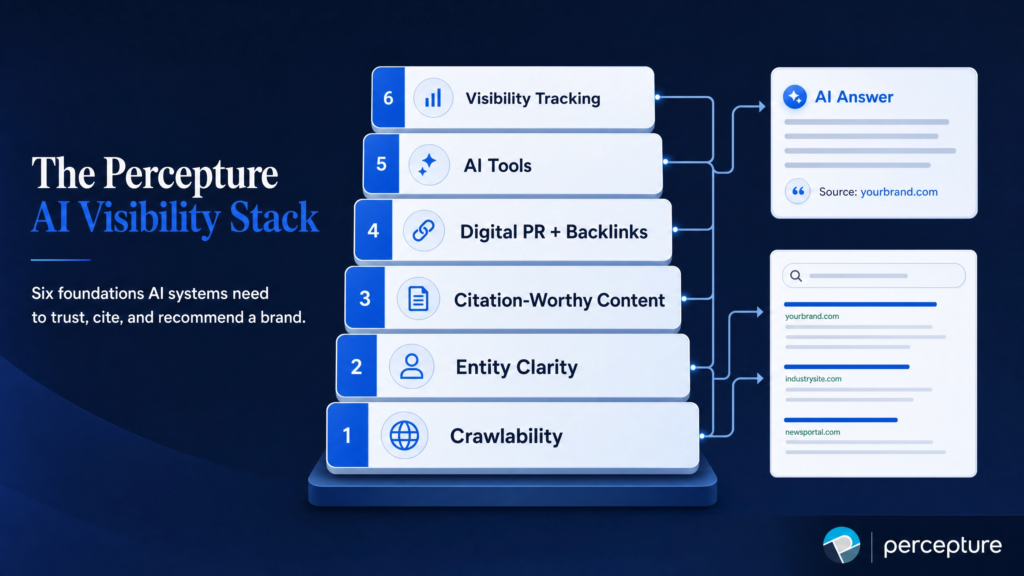
- Generative engine optimization services for clear entities, direct answers, and evidence
- Technical content marketing for buyers, sales teams, partners, and subject-matter experts
- Conference strategy, account planning, executive visibility, and post-event follow-up
- Paid search services, ABM, media, retargeting, and controlled demand tests
- Sales enablement, nurture, CRM workflows, and response ownership
- Attribution and analytics plus conversion testing and financial reporting
Who is a strong fit?
A digital infrastructure marketing agency is a strong fit when technical complexity, multiple decision-makers, disconnected channels, or weak attribution obstruct buyer progress.
Complex offer
Your value depends on technical, geographic, financial, operating, or delivery details that a general campaign can flatten. A digital infrastructure marketing agency can preserve those details while translating them into buyer outcomes.
Multiple buyers
Technical, financial, legal, operations, sales, procurement, government, or community stakeholders influence the decision.
Disconnected channels
PR, search, events, paid media, and sales exist, but they do not reinforce the same evidence-backed narrative. A digital infrastructure marketing agency should define how each channel supports the next buyer action.
Weak attribution
Reporting stops at reach, clicks, scans, or mentions instead of showing what buyers did next.
Find the first pipeline gap
Start with a low-friction diagnostic of account quality, buyer intent, and the path from visibility to sales follow-up before assigning a broader digital infrastructure marketing agency scope.
Why Hire a Digital Infrastructure Marketing Agency?
Infrastructure marketing is tied to physical and operating reality. A digital infrastructure marketing agency must account for the facility, route, service area, deployment window, construction plan, power position, support model, or compliance claim rather than marketing around it. If marketing gets ahead of operations, the company creates confusion and commercial risk.
Physical truth controls the message
The fact base should come from operations, engineering, product, finance, legal, and sales. A digital infrastructure marketing agency then translates approved facts into buyer outcomes. That translation must preserve limits as well as strengths.
A useful message explains what the offer is, where it applies, who it fits, what changes for the buyer, what proof supports it, and what action should follow. It does not hide the offer behind broad claims.
The buyer committee is broad
The CEO may care about category authority and growth. The CFO wants cost, payback, and defensible attribution. Marketing needs an integrated plan. Sales needs proof that advances a live deal. Operators care about accuracy. Legal and procurement need clear boundaries, while community stakeholders may judge local impact and responsiveness.
A digital infrastructure marketing agency must build a shared narrative without pretending every stakeholder asks the same question. Content, coverage, event conversations, landing pages, and sales assets should each address a specific decision.
Buying cycles cross many trust surfaces
Buyers may encounter a company through an article, AI answer, conference panel, referral, executive post, search result, trade publication, paid placement, partner, or sales message. One isolated channel rarely carries the full decision.
That is why omnichannel marketing should mean coordinated evidence and next steps, not the same message copied into every channel.
The Percepture Digital Infrastructure Visibility-to-Pipeline System
This seven-stage method gives a digital infrastructure marketing agency a controlled path from verified facts to authority, discovery, qualified demand, sales progression, and financial learning.
- Infrastructure truth: Verify services, markets, locations, timing, proof, constraints, and claims. Operations and leadership own the fact gate.
- Buyer ecosystem: Map accounts, buying roles, partners, analysts, media, communities, events, procurement stages, and sales ownership.
- Narrative and entities: Define the category, offer, experts, relationships, proof, messages, and language buyers can understand.
- Authority and trust: Activate PR, expert viewpoints, research, cases, partners, community engagement, and crisis readiness around approved evidence.
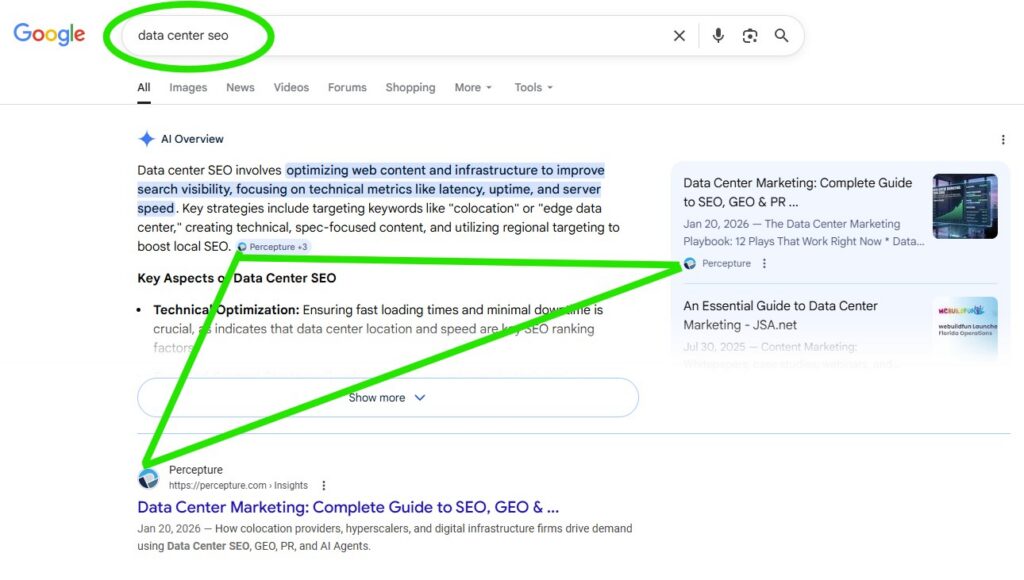
- Search and AI discovery: Build pages, topic clusters, definitions, comparisons, FAQs, schema, links, images, and video summaries that answer real questions.
- Demand and sales activation: Connect events, ABM, paid media, intent, landing pages, nurture, automation, and sales assets to owned next actions.
- Attribution and expansion: connect documented influence to opportunities, progression, gross profit, retention, and the next operating decision.
Framework rule: Every channel must connect verified truth to a defined buyer, proof asset, measurable action, and accountable owner.
Price the system, not a disconnected list of tasks
Compare how each digital infrastructure marketing agency scopes strategy, authority, search, content, demand, technology, and measurement within one approved engagement.
Which Services Should a Digital Infrastructure Marketing Agency Connect?
PR, SEO, and GEO
PR builds third-party authority. SEO makes owned pages discoverable for known demand. GEO improves the clarity and evidence available to generative systems. A digital infrastructure marketing agency can connect them to turn an expert idea into coverage, links, search pages, direct answers, social material, and sales proof.
Percepture’s digital infrastructure PR strategy explains the reputation and media layer in more depth. Its guide to JSA telecom PR and marketing provides category context without turning this page into a competitor profile.
Technical content and sales enablement
Technical content from a digital infrastructure marketing agency should answer a buyer question and leave sales with something useful. A strong asset may clarify an architecture, compare operating approaches, explain an implementation risk, document a use case, or help a buyer brief an internal committee.
The handoff matters. Sales should know which asset fits each stage, which objection it addresses, and what follow-up question to ask. Marketing should learn which assets are used in active opportunities.
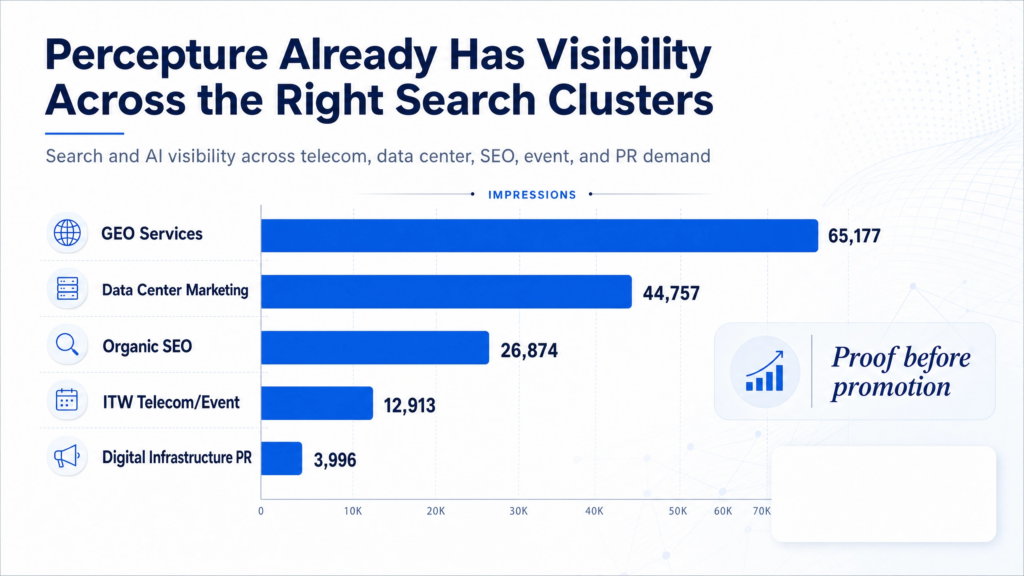
Events, ABM, and paid media
Events create concentrated access, but a booth or sponsorship is not a pipeline system. A digital infrastructure marketing agency should start account selection before the event, use content and paid media to build familiarity, establish relevance through meeting outreach, and preserve the context from each conversation in post-event workflows.
B2B intent data can help teams prioritize research signals, while media buying services can place messages in selected environments. Neither replaces fit, proof, or sales judgment.

Intent data, automation, and CRM
Intent signals are useful when they change an action. Teams need rules for account fit, signal strength, routing, response time, privacy, and sales acceptance. Automation should preserve context rather than send generic messages at higher speed.
AI sales agents can support approved follow-up workflows. Human owners should still control claims, escalation, account judgment, and the transition into a real sales conversation.
Community engagement and crisis readiness
Infrastructure projects can affect local stakeholders. Community questions, project facts, executive communication, issue monitoring, and escalation paths should be planned before promotion increases attention. Percepture’s crisis communications services address the preparation and response layer.
Analytics, CRO, and gross-profit measurement
Reporting from a digital infrastructure marketing agency should show where the buyer entered, what proof was consumed, which action followed, whether sales accepted the opportunity, and how the opportunity progressed. Conversion-rate optimization can reduce friction in the buyer path, but higher form volume is not automatically better lead quality.
How Should Marketing Change by Sector?
A digital infrastructure marketing agency needs a common operating system and sector-specific evidence. The channels may overlap, but the decision drivers do not.
Data centers and colocation
Marketing should explain fit by market, workload, connectivity, resilience, operating model, timing, and other approved service facts. It should give technical and financial stakeholders enough clarity to decide whether a deeper conversation is warranted.
Telecom, fiber, and connectivity
Coverage, serviceability, reliability, installation, support, relationships, and business outcomes shape the story. Percepture’s telecom marketing page covers its vertical approach.
Cloud, edge, and AI infrastructure
The narrative should connect architecture to workload and operating outcomes. Buyers need a clear explanation of where the offer fits, which dependencies apply, and what evidence supports the proposed use.

Power, cooling, construction, and vendors
These companies sell into projects where delivery risk, technical fit, supply, integration, timing, and stakeholder confidence matter. Construction-focused companies can also use Percepture’s guides to SEO for construction companies and construction content marketing.
Subsea, transport, middle-mile, and interconnection
A digital infrastructure marketing agency must clarify the role of the asset or service within a larger ecosystem. Partner relationships, routes, access, technical dependencies, and commercial relevance should be expressed only through approved facts.
What Should Stay In-House vs. Go to a Digital Infrastructure Marketing Agency?
| Work | Best internal owner | Agency contribution | Control |
|---|---|---|---|
| Operating facts and limitations | Operations, engineering, product | Interview, organize, and translate | Internal approval |
| Commercial priorities | Executive, finance, and sales leaders | Market analysis and planning | Leadership decision |
| Positioning and narrative | Shared leadership team | Research, synthesis, message architecture | Executive and legal review |
| PR, SEO, GEO, and content execution | Marketing owner | Specialist strategy and delivery | Editorial and technical review |
| Events, paid media, and ABM | Marketing and sales | Account planning, activation, optimization | Budget and account rules |
| CRM and opportunity status | Sales operations | Workflow design and reporting support | System-of-record governance |
| Attribution and financial outcomes | Finance, sales, marketing | Modeling and dashboard support | Approved attribution rules |
How Should You Choose an Agency?
Choose the operating model before comparing presentation decks. A digital infrastructure marketing agency should be able to explain who leads each discipline, how technical review works, how conflicts are handled, what gets measured, and what happens when the market changes.
Agency model and fit scorecard
| Model | Best fit | Strength | Risk to test | Interview question |
|---|---|---|---|---|
| Full-service infrastructure specialist | One coordinated partner | Sector immersion and integration | Uneven channel depth | Who leads each discipline? |
| Integrated PR, SEO, and GEO | Authority and discovery | Earned and owned visibility | Limited event or demand depth | How does authority support sales? |
| PR specialist | Media, analysts, reputation | Relationships and judgment | Weak demand integration | What survives the news cycle? |
| SEO and GEO specialist | Search and AI discovery | Architecture and demand capture | Limited third-party authority | How will credible authority be earned? |
| Demand or ABM agency | Selected-account activation | Targeting and measurement | Promotion of weak positioning | What proof makes an account respond? |
| Hybrid internal and specialist | Strong internal expertise | Control plus outside depth | Handoff gaps | Who owns the complete buyer journey? |
Score each digital infrastructure marketing agency on sector fluency, accuracy controls, seniority, PR, SEO, GEO, content, events, paid media, ABM, sales enablement, automation, community awareness, analytics, references, conflicts, scope, and working chemistry. Set weights based on the company’s actual risk and growth priorities.
What Should the First 90 Days Include?
The first 90 days with a digital infrastructure marketing agency should create a fact base, buyer map, narrative, authority plan, discovery architecture, activation path, and decision-ready measurement system.
A practical first 90 days
Days 1–30: Establish truth and map the market
Audit services, markets, locations, proof, constraints, revenue model, sales stages, active channels, claims, accounts, buyers, partners, media, events, search demand, and conversion paths. The gate is an approved fact base and a buyer map with clear proof needs.
Days 31–60: Build the narrative and authority base
Create positioning, entity relationships, messages, topic architecture, PR themes, expert viewpoints, page priorities, event plans, offers, and measurement rules. Produce the first pillar, service, proof, comparison, and sales assets. Technical and legal reviewers approve claims.
Days 61–90: Activate, measure, and decide
Launch selected PR, search, GEO, event, ABM, paid, landing-page, nurture, and sales-enablement work. Assign every response to an owner. Review visibility, buyer quality, meetings, sales use, accepted opportunities, progression, cost, and gross-profit signals. Reporting ends with decisions.
How Much Does a Digital Infrastructure Marketing Agency Cost?
Cost depends on the approved scope, markets, research, interviews, technical review, PR, content, design, video, SEO, GEO, website work, events, travel, paid media, ABM, intent data, social, email, automation, CRM, CRO, analytics, and pass-through expenses. A universal range would ignore those variables.
Buyers should separate professional fees, media, software, travel, production, and other pass-through costs. Percepture publishes current options on its integrated marketing pricing page.
Budget categories to define
| Category | What to scope | Buyer control |
|---|---|---|
| Strategy and research | Interviews, audits, market mapping, positioning, measurement | Deliverables and decision gates |
| Authority and content | PR, expert material, cases, pages, sales assets | Volume, depth, and review process |
| Demand activation | Events, media, ABM, paid search, nurture | Accounts, channels, spend, and tests |
| Technology and data | Intent, automation, CRM support, analytics | Platforms, access, privacy, and ownership |
| Optimization | SEO, GEO, CRO, reporting, iteration | Cadence, benchmarks, and priorities |
How Should ROI Be Measured?
The digital infrastructure marketing agency and buyer should approve attribution rules before reporting begins. Rankings, mentions, citations, impressions, scans, and clicks can show visibility or engagement. They should not be converted into revenue without documented influence and an accepted model.
- Cost per qualified meeting: attributable program cost divided by qualified meetings.
- Cost per accepted opportunity: attributable program cost divided by sales-accepted opportunities.
- Opportunity progression: influenced opportunities moving forward divided by influenced opportunities reviewed.
- Sales-use rate: opportunities using proof assets divided by opportunities reviewed, multiplied by 100.
- AI citation share: verified citations divided by monitored relevant answers, multiplied by 100.
- Event-to-meeting rate: qualified meetings divided by qualified engaged event accounts, multiplied by 100.
- Assisted pipeline: opportunity value with documented marketing influence under approved rules.
- Attributable gross profit: attributed revenue minus direct delivery cost and attributable marketing cost.
- Marketing ROI: attributable gross profit plus verified avoided cost, minus program cost, divided by program cost, multiplied by 100.
Bob Generale Interviews Cody Clegg on Marketing Infrastructure Buyers
The Infrastructure Growth Field Exchange: Percepture asks. OPTK answers from the operator’s seat. The exchange gives a digital infrastructure marketing agency a grounded view of specialization, repeated visibility, digital reputation, and relationships.

What marketing strategies are working best today?
Market signal: “Specialization wins.”
Marketing implication: Buyers should be able to recognize the company’s category, expertise, market fit, and evidence without decoding broad language.
What messaging resonates when buyers have heard too many promises?
Market signal: “The best marketing translates technology into outcomes.”
Marketing implication: Explain what changes for the buyer and support that explanation with technical and operating facts.
Which channels generate the highest-quality leads?
Market signal: “One advertisement rarely creates trust. Repeated visibility does.”
Marketing implication: Coordinate search, media, events, executive visibility, paid activity, and sales follow-up around the same buyer and proof.
How has buyer behavior changed in 2026?
Market signal: “A company’s digital reputation is part of its sales organization.”
Marketing implication: Treat the website, search results, AI answers, media coverage, profiles, and sales assets as parts of one trust surface.
Why are relationships a competitive advantage?
Market signal: “Infrastructure can be duplicated. Relationships are much harder to duplicate.”
Marketing implication: Marketing should support credible, repeated human contact rather than trying to replace the relationship with automation.
Field sequence: Technology → outcome → proof → repeated visibility → trusted relationship.
Responses were lightly edited for clarity while preserving meaning. OPTK comments reflect an operator perspective and do not guarantee outcomes.
Use proof where a buyer feels risk
Place evidence beside the claim or decision it supports. Technical visuals explain the system. Search proof demonstrates discoverability. Testimonials and case studies reduce uncertainty about execution.


Digital Infrastructure Marketing Agency FAQs
What is a digital infrastructure marketing agency?
A digital infrastructure marketing agency helps companies that build, power, connect, cool, or operate data centers, telecom networks, fiber, cloud, edge, subsea, and AI infrastructure. It combines technical positioning, PR, search, content, events, demand generation, sales enablement, and measurement around complex buying cycles.
What does an infrastructure marketing agency do?
A digital infrastructure marketing agency turns approved technical and operating facts into positioning, proof, search visibility, AI-ready answers, media programs, event activity, account demand, sales assets, follow-up workflows, and reporting. Strong programs connect each activity to a defined buyer, decision, next action, and owner.
Why is infrastructure marketing different from SaaS marketing?
Infrastructure decisions can involve physical capacity, geography, construction, power, latency, resilience, procurement, compliance, capital, serviceability, and long commitments. Marketing must match what can be delivered and support technical, financial, legal, operational, government, community, and commercial stakeholders.
Which marketing channels work best?
The mix depends on the market and buyer. A digital infrastructure marketing agency may connect PR, SEO, GEO, technical content, conferences, partnerships, paid media, ABM, intent data, executive social, email, referrals, and sales follow-up. The advantage comes from coordinating them around one evidence-backed narrative and measurable next step.
How do PR, SEO, and GEO work together?
PR builds third-party authority. SEO makes owned pages easier to discover through traditional search. GEO improves entity clarity and the evidence available to generative systems. A connected program can turn one expert story into coverage, links, search assets, direct answers, social material, and sales proof.
Can an agency guarantee rankings or AI citations?
No digital infrastructure marketing agency can control a search ranking, featured result, AI answer, or citation. An agency can improve competitiveness through useful content, technical quality, clear entities, evidence, authority, internal links, media, accessible visuals, video summaries, testing, and regular updates.
How long does the first implementation phase take?
A practical opening phase with a digital infrastructure marketing agency can be organized over 90 days. The sequence covers fact verification, buyer mapping, narrative and architecture, authority assets, selected channel activation, sales ownership, and measurement. Scope and review speed determine what can be completed within that period.
How should buyers measure ROI?
Measure qualified engagement, meetings, sales acceptance, response time, proof-asset use, opportunity progression, assisted pipeline, contracts or installs where relevant, retention, avoided cost, and attributable gross profit. The buyer and digital infrastructure marketing agency should agree on attribution rules before converting marketing influence into a financial result.
Build Your Digital Infrastructure Growth System
A digital infrastructure marketing agency should make technical truth easier to discover, trust, evaluate, and act on. Bring Percepture the current fact base, buyer priorities, sales stages, channel data, and growth constraints. The working conversation can identify the first gap and the right owner.
Bob Generale
Bob Generale leads executive strategy across PR, SEO, GEO, digital marketing, and integrated growth programs. His work focuses on turning complex business expertise into clear market positioning, discoverability, buyer trust, and accountable action.