
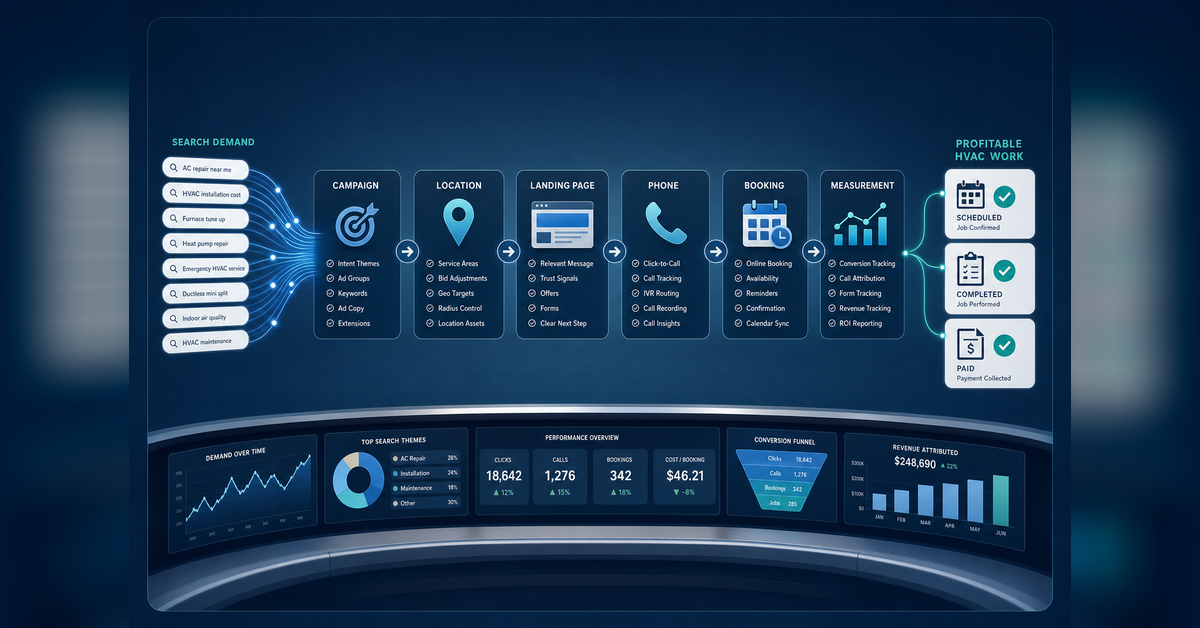

Most HVAC PPC problems do not start with the bid. They start when campaigns, landing pages, calls, booking, capacity, and job economics are managed as separate systems.
A stronger account follows demand from the search query to qualified, booked, completed, and paid work. That gives owners and marketing leaders a practical way to decide whether to scale, fix, pause, or stop spending.
See how Percepture turns technical expertise into visible demand
OPTK Networks operates in fiber, telecom and data-center markets where technical buyers expect clear proof. The case study shows Percepture’s execution approach and working relationship. It is not presented as a paid-search result or a promise that every campaign will move at the same speed.

OPTK Networks
“They understand the technical side, but they also understand how to make the market care.”
A direct quote from Cody Clegg about Percepture’s technical-market execution.
What is HVAC PPC?
HVAC PPC is a paid-media system that uses Google Search, eligible local advertising, landing pages, call tracking, and downstream conversion data to turn active service demand into measurable business outcomes. Strong management separates markets, services, customer types, and job economics instead of optimizing every campaign toward clicks or raw inquiries.
The executive view
Control demand
In paid search, separate brand from non-brand traffic, serviceable areas from excluded areas, and urgent repair demand from replacement, maintenance, or commercial work.
Define the outcome
A call or form is not automatically a qualified lead. Write the service, location, timing, buyer, and exclusion rules before directing automated bidding toward conversions.
Connect operations
Campaign schedules must reflect call coverage, technician capacity, sales availability, service areas, and the work the company can fulfill.
Protect ownership
The advertiser should retain access to the account, billing, domain, landing pages, tracking numbers, conversion records, and raw exports.
Who this guide is for
Owners and CEOs
Use it to connect paid-search demand with growth, capacity, and contribution rather than platform activity alone.
CFOs
Use it to define all-in acquisition cost, reporting boundaries, ownership, and the difference between revenue and profit.
Marketing leaders
Use it to evaluate paid-search campaign architecture, landing pages, testing, conversion signals, and agency governance.
Operations and call-center leaders
Use it to align lead flow with serviceability, response, qualification, booking, dispatch, and completion.

Does paid search work?
It can capture people who are actively looking for repair, replacement, installation, maintenance, or commercial service. Whether that demand becomes profitable work depends on more than the ad account.
The campaign must reach a serviceable customer, present an accurate offer, send the visitor to the right page, route the inquiry to an available team, and preserve the outcome. If any link breaks, the platform may report a conversion while the business sees no useful job.
This is why paid search management should be tied to operating decisions. It is also why paid search should not be judged only by click-through rate, raw cost per lead, or platform revenue.
The HVAC PPC Control Tower
The HVAC PPC Control Tower is Percepture’s seven-stage method for controlling what demand enters, where it lands, how it is handled, which outcomes return to the ad platform, and when spend can safely scale.
Check your HVAC PPC setup
Find the first gap in tracking, service areas, calls, landing pages or booking before you add more budget.
- Check what the account counts as a lead
- Find waste between the click and the booked job
- See which controls should change first
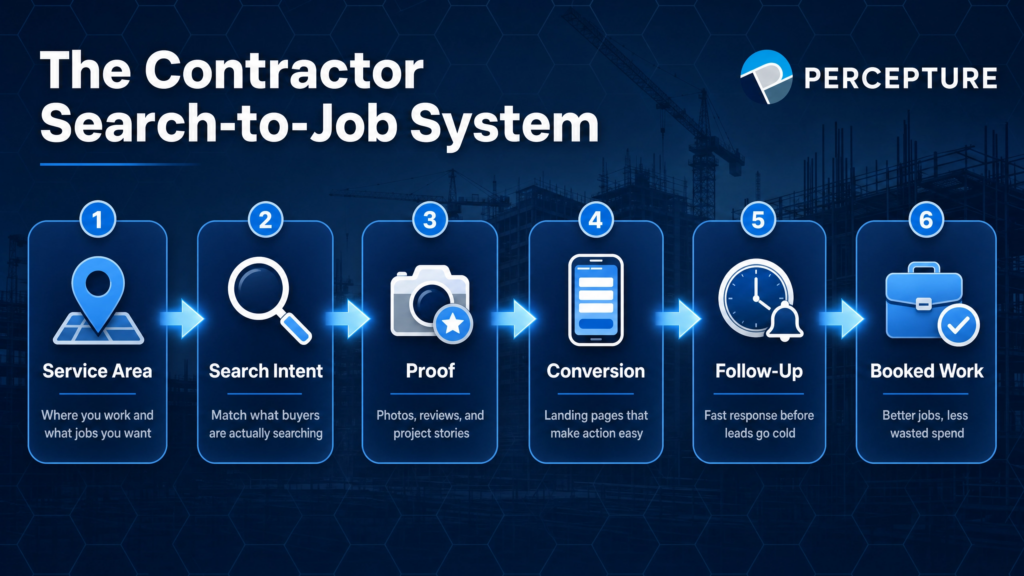
Build a channel role map before building campaigns
A paid-search channel map prevents Search, local pay-per-lead advertising, standard Performance Max, remarketing, display, video, and paid social from chasing the same loosely defined lead and making reporting hard to trust.
Paid-search channel scorecard
| Channel | Primary role | Required control | Hold when |
|---|---|---|---|
| Google Search | Capture explicit service demand | Queries, negatives, location, schedule, page, and conversion quality | Serviceability or conversion definitions are unclear |
| Local pay-per-lead | Reach eligible local prospects | Profile accuracy, job types, service areas, reviews, routing, and lead disposition | The team cannot maintain eligibility or review lead quality |
| Standard Performance Max | Serve a distinct goal across Google inventory | Accurate outcomes, assets, pages, exclusions, and an incrementality question | It duplicates Search or is being used to repair weak tracking |
| Remarketing | Re-engage prior visitors or audiences | Audience rules, privacy, frequency, creative, and a defined conversion path | The audience or measurement purpose is vague |
| Paid social and video | Create or reinforce demand | Audience, creative, offer, attribution, and a stop rule | It is being judged as direct Search demand without an agreed method |
Brand and non-brand Search also need separate reporting. Brand traffic often includes people who already know the company. Mixing it with cold acquisition can make account-wide lead cost appear healthier than new-customer demand really is.
Structure campaigns around business decisions
A useful account structure is not the one with the most campaigns. It is the one that gives the operator a separate lever when budget, geography, schedule, page, margin, goal, or capacity differs.
Campaign structure decision table
| Dimension | Why it matters | Possible split | Decision enabled |
|---|---|---|---|
| Market | Auction conditions, serviceability, staffing, and economics differ | Branch, metro, county, or approved service zone | Shift budget by market |
| Service | Repair, replacement, installation, and maintenance have different paths | Service line or job type | Match budget and page to demand |
| Customer | Residential and commercial work use different qualification and sales cycles | Residential, commercial, new, or existing | Protect acquisition reporting |
| Urgency | Emergency work requires truthful availability and immediate response | Emergency versus scheduled | Align ads with coverage |
| Brand | Known-company searches behave differently from cold searches | Brand versus non-brand | Measure incremental demand |
| Conversion path | Calls, forms, estimates, and commercial inquiries require different handling | Call-led, form-led, or opportunity-led | Bid toward the right outcome |
Residential repair, replacement, and maintenance
Repair campaigns need tight service areas, truthful hours, fast call routing, and enough dispatch capacity. Replacement campaigns need estimate handling, financing accuracy, sales capacity, cancellation tracking, installation capacity, and completed-sale economics.
Maintenance may have a smaller first transaction than repair or replacement. Do not assume future value. Use verified renewal, repeat-work, and contribution records before assigning value to a membership or tune-up lead.
Commercial HVAC campaigns
Commercial demand may require qualification by building type, account fit, service scope, site location, urgency, contract potential, and estimating resources. A phone call is not equal to an accepted opportunity, site visit, proposal, service agreement, or won account.
Multi-location operators should report by branch, market, service, call team, and capacity where those factors change decisions. A portfolio average can hide a weak branch or a service line that cannot fulfill the demand being purchased.
Control keywords, queries, negatives, and geography
Keyword research starts the account, but search-term review runs it. Build live keyword themes from the company’s real services, markets, exclusions, conversion history, and economics rather than copying a generic list.
Exact and phrase match can support control and learning. Broader matching requires reliable conversion signals, active query review, negative keywords, location checks, sufficient budget, and a written experiment. Automation should have a question, a control, and a stop rule.
Common negative themes may include employment, salary, school, training, do-it-yourself research, manuals, diagrams, unsupported parts, wholesale demand, used equipment, unsupported services, and locations the company does not serve. Apply negatives from evidence and inspect conflicts before placing them in shared lists.
Match type and automation decision matrix
| Option | Test when | Hold when | Stop or reset when |
|---|---|---|---|
| Exact and phrase | Campaign themes and services need direct control | Volume is too limited to evaluate | Queries show persistent mismatch that negatives cannot correct |
| Broad match | Conversion-based bidding, sound outcomes, negatives, budget, and query review are in place | Only raw calls or forms are measured | Qualified bookings fall while reported conversions rise |
| AI-assisted Search expansion | Brand, URL, location, page, and outcome controls are documented | Final destinations or conversion signals are unreliable | Traffic reaches inaccurate pages or unsupported services |
| Standard Performance Max | The campaign has a distinct role and incrementality can be evaluated | Search overlap and customer rules are unresolved | It adds reported volume without useful downstream outcomes |
Location settings deserve their own review. Google’s location guidance explains that targeting can use location signals and that advanced location options affect who is eligible to see ads. Service-area companies should evaluate the available settings against actual serviceability and inspect geographic results rather than assuming the boundary is exact. Review Google’s location targeting guidance.
Location, schedule, and capacity controls
| Control | Account check | Operating check | Action |
|---|---|---|---|
| Geography | Target and excluded areas | Actual service range and travel economics | Exclude unsupported locations |
| Schedule | Ad and call-asset hours | Answer, booking, dispatch, and sales coverage | Run only with truthful handling |
| Weather | Budget and bid changes | Technician, inventory, and installation capacity | Use documented triggers and rollback rules |
| Service | Keywords, ads, and landing pages | Available skills, equipment, licensing, and parts | Pause unsupported demand |
| Capacity | Budget and campaign status | Call, technician, sales, and installation availability | Do not scale into a capacity problem |
Match the ad, offer, and landing page
A paid-search click should not land on a generic homepage when a specific service and market can be addressed accurately. The visitor should see the same service, area, urgency, offer, and next step promised by the ad.
A paid-traffic page needs a clear service description, service-area rules, truthful availability, a primary call or form path, relevant proof, offer terms, privacy information, and practical answers. Mobile speed and accessibility matter because a page that is hard to use can waste high-intent traffic.
Forms should collect only what is needed to route and respond. Tracked phone numbers should remain owned or portable. Calls and forms should route by service, market, time, language, and capacity where those factors affect fulfillment.
Percepture’s conversion rate optimization services address the page and user path, while lead generation strategy connects acquisition with qualification and follow-up.
Measure calls, bookings, completed work, and payment
Good paid-search measurement preserves the path from the ad interaction to the business outcome. The account should distinguish delivered, valid, reachable, qualified, booked, canceled, dispatched, completed, sold, and paid outcomes where the company’s systems support those states.
Calls, forms, directions, and page actions can help diagnose the funnel. They should not automatically become the primary bidding goal. A business may choose qualified leads, booked appointments, accepted opportunities, completed jobs, or sales as stronger signals when data quality, consent, identifiers, and platform requirements allow.
Attribution and analytics can connect advertising records with call, CRM, field-service, scheduling, and finance records. Reconciliation also helps separate new customers from existing customers and revenue from gross profit.
HVAC PPC metrics that matter
| Level | Measures | Question answered |
|---|---|---|
| Traffic | Spend, impressions, clicks, CPC, query, geography, time, device, page, and budget status | What demand did the account buy? |
| Lead | Delivered, valid, reachable, qualified, duplicate, existing customer, outside area, unsupported service, and spam | Was the inquiry useful? |
| Booking | Booked, canceled, dispatched, estimate set, opportunity accepted, and follow-up state | Did the team convert demand into scheduled work? |
| Outcome | Completed, sold, paid, revenue, direct cost, gross profit, and commercial pipeline | Did the booked work become a business result? |
| Economics | All-in CPL, qualified lead cost, cost per booking, cost per completion, CAC, contribution, and payback | Should the company scale, fix, pause, or stop? |
| Control | Change history, experiments, conversion diagnostics, policy status, negative conflicts, URL errors, ownership, and capacity | Can the result be trusted and repeated? |
How much does HVAC PPC cost?
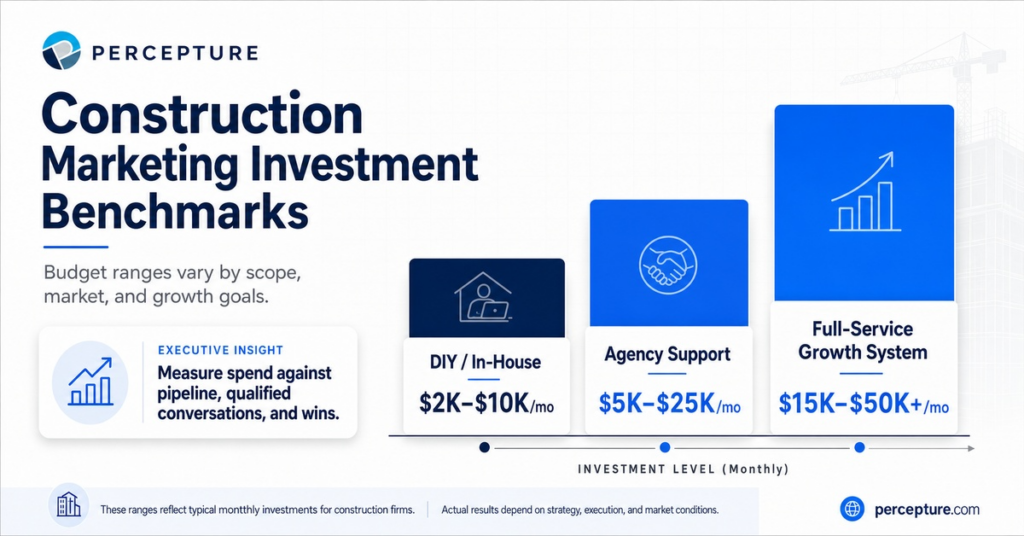
There is no responsible universal budget or lead-cost target. Cost changes by market, service, season, competition, channel, landing page, response, capacity, and the definition of a qualified lead.
Build the paid-search budget from the desired number of customers, a verified lead-to-customer rate, expected all-in lead cost, available operating capacity, and a controlled test reserve. Review contribution before increasing spend.
What belongs in the all-in cost model
| Cost | What to clarify | Why it matters |
|---|---|---|
| Media or lead charge | Advertising spend, valid-lead charges, credits, and taxes where applicable | Separates platform cost from agency fees |
| Management | Flat retainer, percentage, hybrid, project, or performance component | Shows how compensation changes with spend |
| Setup and migration | Account build, restructuring, historical export, tracking, and launch QA | Prevents one-time work from being hidden |
| Pages and creative | Landing pages, copy, assets, testing, and maintenance | Accounts for the conversion experience |
| Technology | Call tracking, analytics, integrations, CRM, or field-service connections | Exposes measurement cost |
| Internal labor | Call handling, sales follow-up, QA, reporting, and operations | Connects marketing cost with fulfillment |
Percepture publishes paid advertising pricing options for buyers comparing engagement structures. The quoted scope should still state which costs sit inside and outside the management fee.
HVAC SEO versus PPC
Paid search can capture active demand quickly and offers direct budget control. Its visibility usually depends on continued spend. SEO develops owned search visibility over a longer period through technical, editorial, and authority work.
Use paid-search query and landing-page learning to improve search-led content, but keep channel attribution separate. Content marketing services can turn recurring customer questions into useful owned resources. Digital PR services can support authority and branded demand, while generative engine optimization services help structure clear, retrievable information for AI-assisted discovery.
How to choose an HVAC PPC agency
A paid-search agency should be able to explain the lead definition, campaign map, location controls, call-review process, downstream reporting, automation rules, fees, and failed-test plan in plain language.
Paid-search agency ownership and accountability scorecard
| Item | Preferred condition | Question to ask |
|---|---|---|
| Ad account | Client-owned with appropriate administrative access | Who controls access during and after the engagement? |
| Billing | Visible to the client | Can the company inspect platform charges directly? |
| Domain and pages | Client-owned and portable | What happens to landing pages at termination? |
| Tracking numbers | Owned or portable under clear terms | Can the number and history move with the company? |
| Conversion data | Exportable with definitions and access rules | Which outcomes return to the platform? |
| Search terms and changes | Available for inspection | Who reviews queries, exclusions, locations, pages, and automation? |
| Offboarding | Written process for access, assets, exports, and final reporting | What does the client receive when the contract ends? |
Warning signs include guaranteed results, hidden account access, click-only reporting, mixed brand and non-brand data, agency-owned pages or numbers, unexplained automation, and no clear offboarding process.
Common paid-search mistakes that waste budget
- Sending every service, market, and customer type into one campaign and one page.
- Treating every call or form as a qualified customer.
- Mixing brand and non-brand cost per lead.
- Running ads outside profitable service areas.
- Advertising after hours without reliable answer and booking coverage.
- Optimizing toward existing-customer support calls.
- Expanding automation before conversion quality is reliable.
- Allowing final URLs to expand without checking destinations.
- Using broad match without conversion-based bidding, negatives, and governance.
- Using Performance Max without a distinct role.
- Scaling while technician, sales, call-center, or installation capacity is constrained.
- Changing bids, budgets, offers, pages, and geography at the same time.
- Calling platform revenue return profit.
- Letting a vendor control the account, number, page, or data.
The first 90 days
The first 90 days of paid-search management should create a controlled operating baseline. The goal is not constant change. It is to make each decision traceable to demand quality, operating capacity, and business outcomes.
| Period | Work | Decision produced |
|---|---|---|
| Days 1–15 | Confirm access, ownership, billing, services, capacity, conversions, call and form routing, geography, pages, costs, and baseline reporting | Identify broken definitions and control gaps |
| Days 16–30 | Build architecture, keyword themes, negatives, brand split, schedules, budgets, bidding rules, ads, pages, consent checks, and reporting | Approve a launch-ready control plan |
| Days 31–60 | Run a controlled launch and review queries, geography, calls, pages, invalid leads, bookings, budget, and capacity | Fix waste and isolate testable changes |
| Days 61–90 | Review completed-work economics, service and market performance, automation tests, ownership, and next-quarter priorities | Scale, fix, pause, or stop by segment |
Do not scale without reliable tracking, written definitions, serviceability, stable lead quality, downstream outcomes, available capacity, and an approved economic target.
See HVAC PPC pricing options
Compare strategy, account management, landing pages, tracking, reporting and support before you choose a scope.
- See clear service and pricing paths
- Match the scope to your markets and goals
- Know what is included before work starts

Want a second opinion on your HVAC PPC setup?
Bring your account, service areas, search terms, landing pages, calls, tracking and booked-job data. We will help you see what to scale, fix, pause or stop.
Talk With PerceptureFrequently asked questions
What is HVAC PPC?
HVAC PPC is paid advertising used to reach people searching for heating, cooling, ventilation, repair, replacement, maintenance, installation, or commercial services. Effective management connects campaign controls with landing pages, calls, qualification, booking, completed work, payment, and acquisition economics.
Does PPC work for HVAC companies?
Paid search can capture active service demand, but results depend on service-area accuracy, offer and page match, call response, qualification, capacity, conversion data, and job economics. Advertising cannot correct unsupported services, missed calls, weak booking, or a lack of technicians.
How much should an HVAC company spend on Google Ads?
Build a paid-search budget from target customers, a verified lead-to-customer rate, expected all-in lead cost, operating capacity, and a controlled test reserve. Avoid choosing a budget from a generic benchmark because markets, services, seasons, response, and conversion definitions differ.
What is a good HVAC cost per lead?
A useful cost per lead supports the company’s targets for qualified leads, bookings, completed work, customers, and contribution. A cheap raw inquiry can be expensive if it is outside the service area, unqualified, duplicated, unreachable, or tied to an unsupported service.
Should an HVAC company use Search Ads or local pay-per-lead ads?
The channels have different billing, eligibility, placement, control, and lead-review processes. Use distinct reporting and compare valid, qualified, booked, completed, and paid outcomes instead of treating every delivered lead as equal.
Should HVAC companies use broad match or automated campaign expansion?
Test broader matching only when conversion-based bidding, reliable outcomes, negatives, location controls, accurate pages, sufficient budget, query review, and a control plan are in place. Hold it when the account measures only raw calls or forms.
How are booked HVAC jobs tracked from Google Ads?
Preserve eligible ad and lead identifiers, reconcile calls and forms with CRM or field-service records, and record qualification, booking, completion, sale, and payment states. Suitable downstream events can be returned to the ad platform when privacy, consent, and technical requirements permit.
How do I choose an HVAC paid-search agency?
Evaluate a paid-search agency’s workflow knowledge, lead definitions, account ownership, location and call review, landing-page control, downstream reporting, automation governance, fee clarity, raw data access, and offboarding. Avoid guarantees and arrangements that leave the agency owning the account or tracking assets.
Want help with your HVAC PPC account?
Use the form below or schedule time with Percepture. We can review your account, service areas, calls, landing pages and next steps in plain English.
Schedule a Call