

Most managed service providers do not have a simple promotion problem. They have a timing, visibility, and trust problem. A strong MSP marketing strategy makes the company easy to find before demand spikes, credible during buyer research, and easy to evaluate when sales finally receives a signal.
MSP buyers often enter the market after an outage, a poor vendor experience, cyber-insurance pressure, a compliance deadline, a renewal, a budget cycle, or a leadership change. The work is not to publish more random content. The work is to build a system that appears at the right moment with the right proof and routes real intent to sales.





The Broadstaff case study shows how Percepture connected search visibility, industry authority, and qualified B2B demand.
What is an MSP marketing strategy?
It is a structured plan for creating demand and trust across the full managed-services buying cycle. It defines the ideal customer, trigger events, market timing, search and AI visibility, proof, paid and owned channels, nurture, buyer-intent signals, sales response, and the metrics connecting attention to qualified conversations, recurring revenue, and payback.
Executive summary for MSP leaders
The problem
Many MSPs run ads, blogs, LinkedIn, referrals, reviews, and events as separate activities. The buyer receives fragments instead of a clear reason to trust the provider now.
The strategic shift
Organize the plan around outages, compliance pressure, vendor churn, renewals, budget cycles, leadership changes, and other moments that cause buyers to research.
The Percepture method
The MSP Market Timing & Trust Engine connects SEO, GEO, digital PR, proof, AutoNURTURE, buyer-intent data, analytics, and CRM handoff.
The metric that matters
Track qualified conversations, target-account activity, sales response, pipeline quality, MRR potential, close rate, and payback. Clicks alone do not prove growth.
Who this playbook is for
MSP owners and CEOs
You need a repeatable growth system that does not depend only on referrals, a founder’s network, or one salesperson.
Marketing leaders
You need channel discipline, useful proof, clean measurement, faster implementation, and stronger alignment with sales.
Sales leaders
You need clearer account signals, stronger context, useful follow-up assets, and a defined response standard when buyer activity appears.
MSPs serving complex markets
Healthcare, legal, finance, manufacturing, data centers, and other risk-sensitive sectors require visible expertise before the first call.
Why most MSP marketing fails
Marketing fails when the plan is only a collection of tactics. A provider buys Google Ads, posts on LinkedIn, sponsors an event, publishes a few blogs, asks for reviews, and calls the activity a strategy.
Those channels may help, but they do not answer the buyer’s central question: Why should I trust this MSP with operational risk at this moment?
Tactics without timing
Demand rises during vendor reviews, outages, security scares, cyber-insurance renewals, compliance deadlines, budget cycles, acquisitions, and leadership changes. A flat monthly plan misses those windows.
Traffic without trust
Visitors need proof of process maturity, responsiveness, vertical understanding, onboarding discipline, continuity planning, and business communication. Generic service pages do not carry enough weight.
Paid clicks without conversion
Paid search can capture urgency, but the landing page, offer, service area, call handling, and next step must match the buyer’s concern. More clicks cannot repair a weak handoff.
Content without buyer pain
A general article about backups is rarely enough. Buyers want clear answers about onboarding, escalation, response expectations, communication, risk, integrations, and proof.
Sales follow-up without signals
Many buyers research quietly. A form-only process misses accounts showing intent through repeated visits, pricing-page views, service-page activity, case-study consumption, and branded research.
Find the quiet buyers already researching you
Before adding media spend, check whether the site attracts the right companies, whether sales can identify useful account signals, and whether the current traffic has a defined path into follow-up.
Get 5 Free Verified LeadsUse the sample to test company relevance, contact quality, researched topics, and the next sales action.

MSP marketing tactics vs. MSP marketing strategy
Tactics are individual actions. Strategy assigns each action a buyer, timing window, role, proof requirement, conversion path, owner, and metric.
| Area | Tactic-only approach | Strategy-led approach |
|---|---|---|
| SEO | Publish articles and chase disconnected keywords | Own service, location, vertical, comparison, and buyer-risk questions |
| Paid search | Buy clicks and report cost per lead | Capture urgent demand with serviceable-market controls and conversion-ready pages |
| Programmatic media | Retarget every visitor with the same message | Reach named personas and accounts with proof matched to buying stage |
| Content | Maintain a publishing calendar | Create decision assets mapped to objections, triggers, and sales conversations |
| Reputation | Ask for more reviews | Build search-visible proof, response discipline, third-party authority, and resilience |
| Sales | Follow up only after form submissions | Use behavior, intent, account context, CRM routing, and response accountability |
The MSP Market Timing & Trust Engine
The framework aligns visibility, proof, nurture, and sales response with the moments when an IT buyer becomes more likely to evaluate a provider.
- 1Landscape readiness
Map the ideal customer profile, service areas, vertical opportunities, competitor positioning, branded search footprint, and gaps in visibility.
- 2Surge and seasonality mapping
Identify renewals, vendor reviews, outages, cyber events, compliance pressure, budget cycles, acquisitions, leadership changes, and other demand triggers.
- 3Search and GEO ownership
Build service, location, vertical, comparison, direct-answer, FAQ, and expert assets that support Google and AI-assisted research.
- 4Trust-token creation
Create case studies, reviews, executive commentary, digital PR, proof pages, process explanations, and branded-search protection.
- 5AutoNURTURE activation
Keep the right personas and accounts exposed to relevant proof across paid, social, programmatic, owned, earned, and CRM channels.
- 6Signal-to-sales handoff
Connect account behavior, intent topics, firmographics, CRM workflows, response standards, and opportunity feedback.
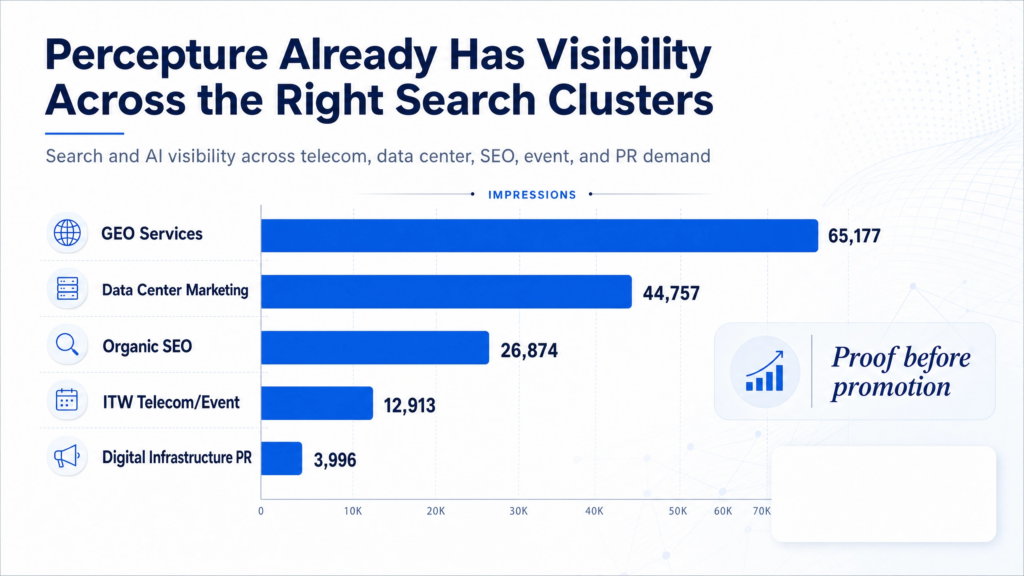
Landscape readiness: know the market before spending
A useful plan begins with where the buyer already looks. That includes local and regional searches, vertical queries, branded research, review platforms, peer recommendations, AI answers, event conversations, and competitors already earning attention.
Percepture typically connects strategy and planning, enterprise SEO, and content marketing before media scales. The work names the ICP, priority verticals, disqualifiers, serviceable markets, proof gaps, and the questions a buying committee asks before taking a meeting.
Seasonality and surge mapping for MSPs
Budgets should not sit on autopilot. Q1 can bring planning and vendor review. Q2 may support implementation. Summer can slow some decision cycles. Q4 can create renewal, budget, risk, and next-year planning conversations.
Outages, ransomware news, cloud disruptions, cyber-insurance pressure, audits, compliance deadlines, acquisitions, and leadership changes can create sudden research spikes. The MSP that prepared useful pages, proof, and sales assets before the spike is easier to evaluate when urgency rises.
Search and GEO ownership
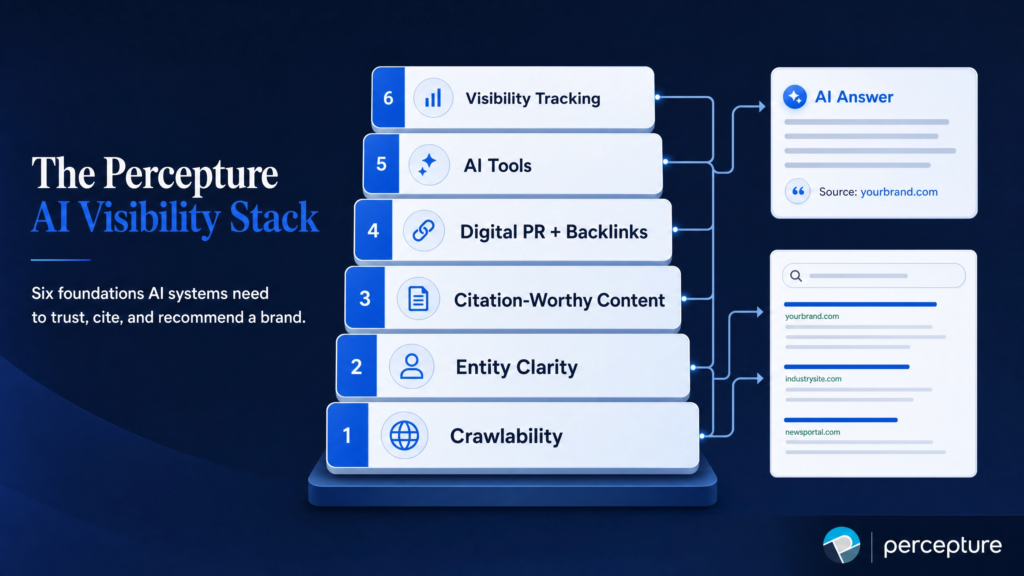
A defensible MSP marketing strategy covers traditional search and AI-assisted research. Service-area pages clarify where the provider operates. Vertical pages explain context. Direct answers and FAQs make complex services easier to retrieve. Consistent entity information helps search systems understand the company, its locations, expertise, and buyer fit.
Percepture connects this work through GEO services, an SEO Sprint, and KeywordIQ. The objective is not to chase every possible phrase. It is to own the questions that shape a shortlist.
Related guides on corporate SEO, organic SEO services, and SEO sprints explain how architecture, execution windows, content, and authority work together.
Trust tokens: content, reviews, digital PR, and reputation
Trust tokens are the assets that make an MSP safer to consider. They include reviews, case studies, onboarding explanations, escalation processes, technical articles, executive commentary, comparison content, vertical pages, earned media, certifications, and partner proof.
Percepture uses digital PR, public relations, and earned and owned media to place credible assets in the buyer’s research path. The practical goal is stronger trust and reputation resilience, not a promise that every unfavorable result can be removed.
This article is marketing guidance, not legal, cybersecurity, insurance, or compliance advice. Review technical claims, security language, guarantees, and regulated statements with qualified advisers before publishing.
AutoNURTURE: stay visible between search and sales
Managed-services buyers often need several touches before they speak with sales. They may read a service page, compare reviews, ask an AI system for options, inspect a case study, return through a branded search, and still avoid a form.
AutoNURTURE addresses that gap by coordinating proof across LinkedIn, Google Ads, programmatic websites and apps, retargeting, content, case studies, media, and CRM-triggered follow-up. Percepture’s supplied program materials describe targeting by job title, company, industry, certifications, revenue, employee size, conference activity, search behavior, and publisher consumption.
The operating lesson is simple: define the buyer, surround the account with useful proof, and keep the message consistent through omnichannel marketing, media buying, paid search, and paid social.
Intent data and LeadSeeker: find hidden MSP buyers
Not every buyer submits a form. Some visit pricing, service, location, comparison, and case-study pages while trying to remain anonymous. A better system gives sales context without treating every visitor as a qualified opportunity.
B2B intent data can identify stronger research signals. LeadSeeker supports company-level visitor identification, researched topics, firmographic enrichment, contact research, CRM handoff, and sales prioritization. Pair those signals with lead generation and attribution and analytics so the team can distinguish more traffic from better timing.
What a strong signal-to-sales handoff looks like
- The account fits the service area, vertical, company size, and service model.
- The signal includes useful page, topic, campaign, or engagement context.
- The CRM records source, activity, owner, status, and next action.
- Sales knows which proof asset or question should lead the first outreach.
- Response time has an owner and service-level expectation.
- Sales outcomes return to marketing so targeting and content improve.
90-day MSP marketing strategy roadmap
Audit and map. Review rankings, local visibility, vertical pages, branded search, AI answers, paid media, analytics, CRM flow, proof assets, call quality, and response time. Define the ICP, priority markets, triggers, and baseline.
Build the foundation. Repair priority technical issues, sharpen service and location pages, create direct-answer content, improve conversion paths, add proof, and structure FAQs and entity signals for search and GEO.
Activate and learn. Launch priority paid and nurture programs, connect LeadSeeker and CRM workflows, monitor lead quality, test the offer, review sales response, and establish the next-quarter roadmap.
MSP marketing budget and ROI
Revenue percentage can provide an initial planning reference, but it should not replace an operating budget. Shape the investment around maturity, service margin, MRR targets, sales capacity, local competition, technical debt, proof gaps, media costs, and acceptable payback.
| Budget layer | What it funds | What to measure |
|---|---|---|
| Foundation | Research, SEO audit, analytics, tracking, service pages, conversion paths, content gaps, and CRM basics | Technical completion, indexing, visibility, tracking quality, and conversion readiness |
| Growth | Paid search, retargeting, vertical pages, nurture, CRO, events, and content production | Qualified conversations, service-area fit, sales acceptance, opportunity cost, and response speed |
| Authority | Digital PR, executive commentary, case studies, reputation assets, reviews, and GEO expansion | Branded demand, share of search, credible mentions, AI visibility, and proof usage |
| Pipeline intelligence | Intent data, LeadSeeker, attribution, CRM workflows, alerts, scoring, and reporting | Target-account activity, opportunity value, MRR potential, close rate, and payback period |
Useful planning formulas: marketing-sourced MRR divided by marketing investment provides one efficiency view. Customer-acquisition cost divided by monthly gross profit per new account estimates payback months. Both depend on accurate source, sales-stage, revenue, churn, and margin data.
MSP Marketing Strategy Scorecard
Score each area from zero to five. A zero means the control is absent. A three means it works consistently. A five requires strong evidence, clear ownership, and regular improvement.
| Readiness area | What good looks like | Score |
|---|---|---|
| Clear ICP | Named verticals, buyer roles, geography, service fit, disqualifiers, and priority triggers | 0–5 |
| Local search | Priority services are visible in the markets the MSP can actually serve | 0–5 |
| Vertical content | Industry-specific language, risks, proof, objections, and conversion paths | 0–5 |
| GEO answer assets | Direct answers, FAQs, experts, source support, and clear entity information | 0–5 |
| Reviews and proof | Search-visible evidence that reduces buyer risk and supports the sales conversation | 0–5 |
| Digital PR | Relevant third-party authority, executive commentary, and useful earned coverage | 0–5 |
| AutoNURTURE | Persona and account-based proof stays visible across the buying cycle | 0–5 |
| Buyer-intent tracking | Account activity, topics, firmographics, and engagement history are available | 0–5 |
| CRM handoff | Clean routing, sales alerts, response ownership, statuses, and feedback | 0–5 |
| MRR reporting | Qualified pipeline, recurring revenue potential, close rate, and payback are visible | 0–5 |
Eight MSP marketing mistakes to avoid
- Running every month the same way. Buyer urgency changes with renewals, budgets, outages, compliance pressure, and market events.
- Writing only generic IT content. Buyers need clear answers about onboarding, response, escalation, continuity, vertical experience, and business risk.
- Scaling paid media before fixing the offer. More traffic amplifies weak positioning, unclear geography, poor call handling, and slow follow-up.
- Treating GEO as a shortcut. AI visibility depends on crawlability, useful content, clear entities, credible sources, reputation, and authority.
- Collecting intent without a sales process. Signals create little value when no one owns qualification, response, follow-up, or feedback.
- Measuring only leads. Track fit, sales acceptance, opportunity value, MRR potential, close rate, and payback.
- Using unsupported security or compliance language. Claims should reflect what the MSP can document and defend.
- Letting marketing and sales use different definitions. Agree on qualified account, qualified conversation, accepted opportunity, source, stage, and next action.
Proof: how visibility turns expertise into qualified demand
Broadstaff is an adjacent technology and complex B2B example, not an MSP case study. Its relevance is the operating problem: strong expertise needed to become easier for buyers to find, understand, and trust.
90% page-one visibility
The source article reports that 90% of target keywords reached page one within 12 months.
3× qualified leads
The same case study reports a threefold increase in qualified leads within the 12-month period.
The transferable lesson
Technical expertise creates more value when it is organized into search-visible proof, clear buyer answers, third-party authority, and a measurable follow-up path.
Review Percepture’s Broadstaff search visibility and qualified-lead case study or browse additional case studies.
Compare the investment before scaling spend
Separate strategy, SEO, GEO, content, digital PR, paid media, nurture, intent data, analytics, and sales enablement before comparing retainers or adding another channel.
Review Pricing OptionsUse the pricing structure as a planning reference, then build the final scope around markets, goals, proof gaps, implementation, and sales capacity.
Frequently asked questions
What is an MSP marketing strategy?
An MSP marketing strategy is a coordinated plan for attracting, educating, nurturing, and converting managed IT buyers. It connects market timing, SEO, GEO, content, reputation, paid media, account-level intent, and sales follow-up so the MSP is visible before demand peaks and credible when a buyer begins due diligence.
How is MSP marketing strategy different from a list of tactics?
Tactics are individual actions such as Google Ads, LinkedIn posts, email, webinars, blogs, events, referrals, or review requests. Strategy defines the buyer, market, trigger event, message, proof, channel role, budget, sales handoff, and measurement standard that make those tactics work together.
What are the best marketing channels for MSPs?
The strongest mix often includes organic search, local SEO, vertical content, digital PR, LinkedIn, paid search, retargeting, email nurture, events, account-based media, and intent data. The right mix depends on geography, vertical focus, service margin, sales capacity, proof assets, and where the buying committee researches.
How should MSPs use seasonality and surge events?
Map campaigns around planning cycles, renewals, vendor reviews, budget windows, summer slowdowns, compliance deadlines, cyber-insurance reviews, outages, ransomware news, cloud disruptions, and leadership changes. Build useful assets before urgency rises, then adjust media, messaging, and sales outreach when buyer activity increases.
How should MSPs market around outages and cyber events?
Prepare service explanations, incident-communication content, comparison pages, response expectations, FAQs, and proof before an event occurs. When urgency rises, activate search, paid media, digital PR, nurture, and sales follow-up without making legal, security, insurance, recovery, or compliance claims that require specialist review.
What is AutoNURTURE for MSPs?
AutoNURTURE is Percepture’s approach to keeping priority buyer personas and accounts exposed to relevant proof across paid search, LinkedIn, programmatic media, retargeting, content, case studies, expert advice, earned media, and CRM-triggered follow-up while the buying committee moves toward a decision.
Can GEO help MSPs generate qualified leads?
GEO can improve the probability that an MSP is understood and cited in AI-assisted research by strengthening entity clarity, direct answers, expert content, structured FAQs, authoritative sources, digital PR, and consistent business information. GEO should support SEO, reputation, conversion, and attribution rather than operate as a separate shortcut.
How long does MSP SEO take?
Timing depends on technical condition, authority, competition, geography, content quality, implementation speed, and the maturity of the current site. Early improvements may appear within several months, while meaningful pipeline impact usually requires consistent execution, measurement, sales follow-up, and enough time for buyers to move through a longer decision cycle.
How much should an MSP spend on marketing?
Use revenue percentage only as an initial planning reference. The working budget should reflect growth targets, service margin, MRR goals, sales capacity, current visibility, proof gaps, media costs, competition, implementation needs, and acceptable payback period. Separate foundation, growth, authority, and pipeline-intelligence investments.
What should MSPs track besides traffic?
Track qualified conversations, target-account engagement, form and call quality, service-area fit, sales acceptance, first-response time, opportunity value, MRR potential, close rate, payback period, branded search, local visibility, AI-answer visibility, content influence, and the reasons opportunities advance or stall.
Build the system before the market moves
Your next buyer may search after an outage, ask an AI system for recommendations, compare reviews, inspect case studies, and remain quiet for weeks. Percepture helps connect visibility, trust, nurture, intent signals, and sales follow-up before that moment arrives.
Request an MSP Market Timing & Visibility AuditStart with one market, one vertical, one demand problem, or the current 90-day plan.

Key takeaway: an effective MSP marketing strategy aligns the market, trigger event, buyer question, proof, channel, sales response, and revenue measurement before the buyer begins active research.