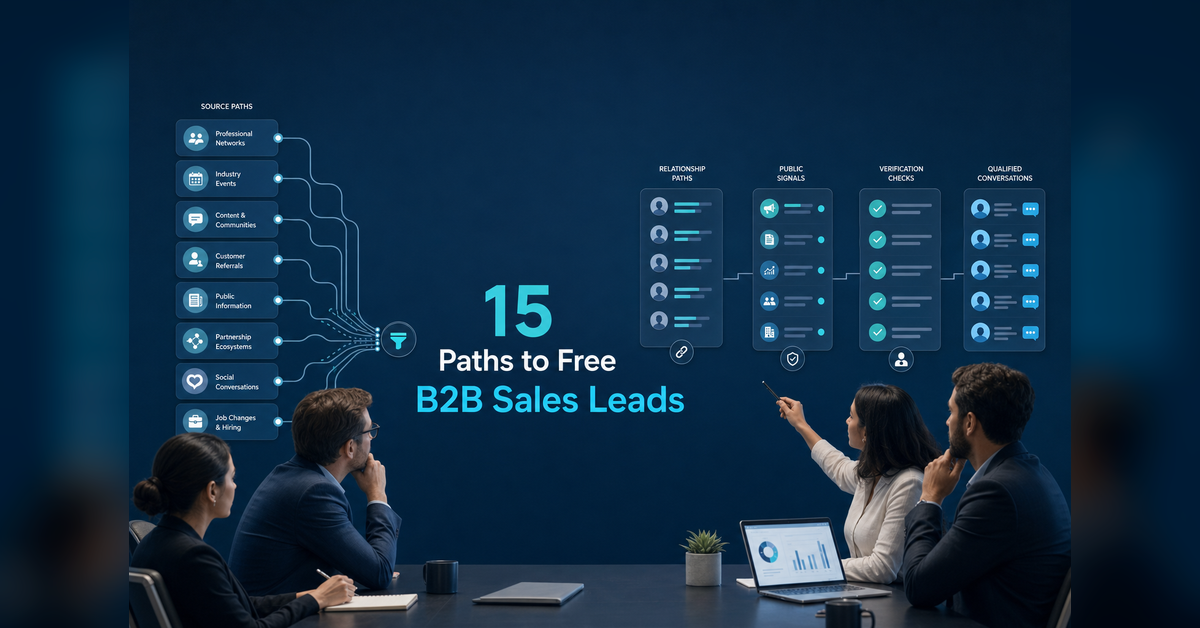

You can learn How to get sales leads for free through referrals, customer reactivation, LinkedIn research, Google searches, public directories, communities, partnerships, content, company news, job postings, events, and limited software trials. Start with one ideal customer profile, verify each prospect, and measure conversations rather than names collected.
“Free” does not mean effortless, exclusive, interested, or ready to buy. Every source still requires research, review, outreach, follow-up, and sound judgment. The real goal is not a longer list. It is a shorter list of accounts that deserve a relevant sales conversation.





What is the fastest practical way to start?
How to get sales leads for free starts with people and data you already control: referrals, former customers, CRM records, partner relationships, and public account research. Define the account, buyer, problem, geography, and timing first. Then verify the person, record the source, add a relevant contact reason, and assign a measurable next step.
The executive summary
Start with fit
A contact is not useful merely because an email address exists. Set the account, role, region, problem, and value criteria before searching.
Preserve the source
Record where the account surfaced and what public, inbound, or relationship-based context made it relevant.
Measure pipeline truth
The operating answer to How to get sales leads for free is found in replies, meetings, qualified opportunities, pipeline, and labor cost—not export volume.
Who this guide is for
Teams evaluating How to get sales leads for free should use the guidance differently according to their role, sales motion, and reporting responsibility.
Business owners and CEOs
Use How to get sales leads for free to test a market without approving a large media or data budget first.
CMOs and demand leaders
Use it to connect owned content, search visibility, public signals, and sales follow-up.
Sales and RevOps leaders
Use How to get sales leads for free to define verification, ownership, qualification, CRM stages, and source-level reporting.
SaaS teams
Use it when a narrow ideal customer profile matters more than collecting a broad list of companies.
Score a lead before spending sales time
Before applying How to get sales leads for free at scale, run a simple diagnostic across account fit, buyer fit, timing, verification, message relevance, channel fit, next step, and measurement.
How to get sales leads for free without confusing leads and buyers
A sales lead is a person or account with enough fit and contact information to justify review. A lead has not necessarily expressed interest. A prospect is a lead that a salesperson has reviewed and considers relevant to the offer and market.
A verified lead has company and contact information checked through available sources. Verification does not prove need, timing, permission, exclusivity, or buying intent. A qualified lead meets the company’s agreed criteria for account, role, geography, problem, timing, value, and next step.
A buyer-intent signal is a public or permissioned event that may make an account more relevant. Hiring, expansion, a new executive, a technology change, or a public project can provide timing context. None of these events proves that the company wants to purchase your product.
A free sales lead is acquired without a direct media, marketplace, or per-contact charge at the point of acquisition. Labor, software, validation, content, enrichment, and follow-up remain real costs. That distinction matters when a CFO compares a free tactic with a managed lead generation program.
A free database or trial typically limits searches, contact reveals, or exports. A lead list is simply a set of contacts. It can be large and still be weak when the records lack freshness, source context, account fit, or a credible reason for outreach.
Public availability does not automatically grant permission for every contact channel. Any plan for How to get sales leads for free must follow current laws, platform rules, suppression lists, privacy practices, and legal guidance appropriate to the market and message.
The Percepture Free-Lead Signal-to-Pipeline System
The Percepture Free-Lead Signal-to-Pipeline System is a seven-gate method for turning a no-cost name into a reviewed, relevant, permission-aware, measurable sales opportunity. It makes How to get sales leads for free an operating process rather than a list-building exercise.
Seven gates from source to pipeline
Use these gates to evaluate whether How to get sales leads for free is producing reviewable opportunities rather than unqualified records.
1. ICP fit
Question: Is this an account and buyer we serve?
Evidence: Industry, size, geography, role, problem, value
First metric: ICP-fit rate
Common failure: Collecting anyone with an email
2. Source truth
Question: Where did the lead come from?
Evidence: Referral, CRM, search, directory, community, content, signal, or tool
First metric: Source completeness
Common failure: Losing the original context
3. Contact verification
Question: Can the team identify and reach the person responsibly?
Evidence: Current role, company, usable channel, and source
First metric: Verified rate
Common failure: Treating old records as current
4. Timing signal
Question: Why might this matter now?
Evidence: Public change, action, need, relationship, or inbound behavior
First metric: Signal-to-reply rate
Common failure: Presenting an event as proof of demand
5. Relevance and permission
Question: Is the message useful and appropriate?
Evidence: Honest identity, relevant value, channel controls, suppression process
First metric: Opt-out and complaint rate
Common failure: Confusing public data with consent
6. Conversation control
Question: Who owns follow-up?
Evidence: Owner, service level, stop-on-reply rule, CRM stage
First metric: Contact and reply rate
Common failure: Allowing leads to sit unworked
7. Pipeline truth
Question: Did the source create a business outcome?
Evidence: Reply, meeting, opportunity, pipeline, revenue, loss reason
First metric: Pipeline per source
Common failure: Reporting only contacts exported
Framework rule: Free describes direct acquisition cost at one point in the funnel. For How to get sales leads for free, it does not describe quality, effort, permission, conversion, or value.
This framework also clarifies where specialist support fits. B2B intent data can strengthen signal selection, while attribution and analytics connects source activity to pipeline. Neither replaces a defined ICP or disciplined follow-up.
The 15 best ways to find free B2B sales leads
The strongest answer to How to get sales leads for free depends on buyer motion. Referrals work differently from cold research. Inbound content works differently from a database trial. For each method, decide the lead type, speed, time cost, ownership, prerequisite, first action, metric, and likely failure point.
Customer and partner referrals
Referrals are warm inbound or warm outbound leads. They may move quickly when the request is specific, but they are difficult to scale predictably. Ask for one introduction tied to a buyer, problem, and account type—not a general request to “send anyone who needs help.”
The prerequisite is a relationship strong enough to justify the request. The first action is a permission-based introduction. Track introductions accepted and conversations created. The common failure is asking for vague referrals that make the partner explain your market for you.
Past-customer and CRM reactivation
CRM reactivation is often the fastest place to test How to get sales leads for free because the organization already owns the relationship history. Segment records by account fit, former stage, last contact, known objection, and a current reason to reconnect.
The direct data cost is low, but record cleanup can take time. Assign an owner and track valid records, replies, meetings, and reopened opportunities. Weak segmentation and generic “checking in” messages are the main failure modes. If the handoff spans several channels, map it through a clear customer journey.
Warm introductions
Employees, advisors, investors, vendors, and industry peers may know a specific buyer. Give the connector a short explanation of the mutual reason for the introduction and an easy way to decline.
The first metric is accepted introductions, not names suggested. Ownership is high because the connection belongs to your network. The method fails when the seller asks for access without showing why the introduction would help the other person.
LinkedIn manual research
LinkedIn can support role, company, job-change, post, comment, and mutual-connection research. It is useful for account mapping, but profile visibility is not permission for every outreach channel. Follow current platform rules and avoid mass automation.
Use How to get sales leads for free as a research question, not a reason to message every matching title. The prerequisite is a narrow role and account definition. Track reviewed profiles, verified fits, replies, and positive replies. Generic connection requests and shallow personalization create noise.
Google Search and company websites
Search company sites for leadership, locations, services, public news, careers, resources, and contact paths. For teams researching How to get sales leads for free, this method is slower than exporting a list, but it gives the seller more control over source quality and context.
Start with a precise industry, geography, company type, and role. Save the source page and review whether the information is current. Track accounts researched per hour and qualified prospects per research batch. The failure mode is spending time on companies that never matched the ICP.
Google Maps and local profiles
Maps can reveal local companies by category and location. It is best for businesses with a clear geographic market. When using Maps for How to get sales leads for free, verify the business category, service area, company site, likely size, and decision roles before adding the account to a sales workflow.
Maps supports discovery, not qualification or intent. The first conversion action should be a manual fit review. Track valid local accounts and conversations created. Reviews, categories, and listed details should be treated as research inputs rather than private facts.
Directories, registries, and associations
Industry directories, public registries, membership lists, and association sites can narrow research by category. Source authority, record age, permitted use, and update practices vary, so each record still requires review.
This route can help teams learning How to get sales leads for free in a specialized market. The prerequisite is a trusted source and a precise category. Measure verified fits per directory. The method fails when a seller copies old records without checking the current company and role.
Job postings and hiring signals
Job postings can show where a company is investing, which roles it is building, and what capabilities it values. In a How to get sales leads for free workflow, use hiring as timing context—not proof of budget, internal problems, or purchase intent.
The first action is to connect the public role or expansion to a useful question. Track signal-to-reply rate by job type. For deeper signal programs, combine careful research with account-level signal planning only where the separate destination and implementation scope are relevant.
Funding, expansion, acquisition, and company news
Public company changes can explain why a conversation might be timely. Expansion could affect territory design, hiring, systems, positioning, or reporting. Funding and acquisitions may create change, but they do not prove a need for your offer.
Save the original source, note the publication date, and write a message that does not pretend to know a private problem. Track responses by signal type. The common failure is sending the same congratulatory pitch to every company mentioned in the news.
Communities and professional groups
Communities can produce relationship-led leads when a person contributes useful answers before requesting attention. Follow each group’s rules. Do not harvest member details or turn a discussion into an unsolicited pitch.
This method is slower, but it can reveal the words buyers use and the problems they discuss openly. Track helpful interactions, invited conversations, and qualified opportunities. Reputation damage is the main risk when sellers treat a community as a contact database.
Educational content and SEO
Content can create inbound leads through answers, templates, comparisons, calculators, examples, and original analysis. As a method for How to get sales leads for free, it takes longer than manual prospecting, but the asset remains owned and can support repeated discovery.
A strong program connects B2B content marketing, enterprise SEO, and generative engine optimization services to a useful next step. The prerequisite is a real search problem and a conversion path. Track qualified inquiries and pipeline by landing page, not traffic alone.
Webinars and live Q&A
Teach one defined problem and make follow-up expectations clear. For How to get sales leads for free through webinars, remember that an attendee is not automatically a qualified lead. Ask for only the information needed to deliver the event and support the stated next step.
Track registrations, attendance, questions, requested follow-ups, meetings, and opportunities separately. The method fails when every registrant receives aggressive outreach regardless of fit or permission.
Partnerships and co-marketing
Work with non-competing companies that serve the same buyer. Joint research, webinars, guides, referrals, and events can create shared demand without direct media spend.
Define audience, ownership, follow-up, data handling, attribution, and stop rules before launching. An omnichannel marketing strategy can coordinate the touchpoints when several teams and channels are involved. Track partner-sourced conversations and pipeline, not shared impressions alone.
A free diagnostic, calculator, or template
A useful tool lets a buyer assess a real decision before speaking with sales. Ask for the minimum information required to provide the result. Make the scoring logic and next step understandable.
This is a practical route for How to get sales leads for free when the team has expertise that can be turned into a repeatable assessment. Track completed assessments, qualified follow-ups, and opportunities. A weak tool collects information but gives the user little value.
Free lead-intelligence trials
A trial can reduce the cost of testing a database or research workflow. To test How to get sales leads for free with a trial, start with one sharp ICP. Review the source, company, role, timing context, and contact path before moving a prospect into outreach.
The Lead Seeker workspace provides a Percepture product path for this research use case. Measure verified fits, replies, meetings, opportunities, and time saved. The failure mode is treating verification as interest or scaling a weak prompt before reviewing results.
Connect each source to pipeline, ownership and cost
Compare the labor, tools, content, research and follow-up required by each source. Then decide what should remain internal, what should be automated carefully and where specialist support would improve quality or measurement.
How to get sales leads for free: source and cost comparison
A useful comparison includes direct cost, time cost, ownership, intent strength, and the first operational risk. That is the economic reality behind How to get sales leads for free. Zero media spend does not mean zero acquisition cost.
Free lead source decision matrix
| Source | Lead type | Speed | Ownership | Intent strength | Best fit | Primary risk |
|---|---|---|---|---|---|---|
| Referrals | Warm inbound or outbound | Medium | High | High when specific | Complex or trust-led sales | Unstructured volume |
| CRM reactivation | Known account | Fast | High | Medium to high | Renewal, expansion, re-entry | Old records |
| LinkedIn research | Cold outbound | Medium | Medium | Low to medium | Role and relationship discovery | Generic automation |
| Google and company research | Cold outbound | Slow | High | Low to medium | Account research | High labor cost |
| Directories | Cold outbound | Medium | Medium | Low | Category-based discovery | Stale records |
| Job and news signals | Signal-based outbound | Medium | High | Medium | Timing-sensitive offers | Event mistaken for demand |
| Communities | Relationship-led | Slow | Medium | Medium | Trust and market learning | Spam and reputation damage |
| Content and SEO | Inbound | Slow to medium | High | Medium to high | Compounding demand | No conversion path |
| Webinars and tools | Permissioned inbound | Medium | High | Medium | Education-led sales | Downloads treated as qualified |
| Lead-intelligence trial | Research-assisted outbound | Fast for research | Exportable workflow | Depends on ICP and signal | Testing a narrow market | Verification mistaken for intent |
Decision rule: When deciding How to get sales leads for free, choose the source by buyer motion, not by how many contacts it promises.
How Lead Seeker supports source-backed prospect research

A static list begins with stored rows. A source-backed workflow begins with the ideal customer profile and the context that made an account relevant. That difference helps a seller decide whether a lead deserves review before it enters a sequence.
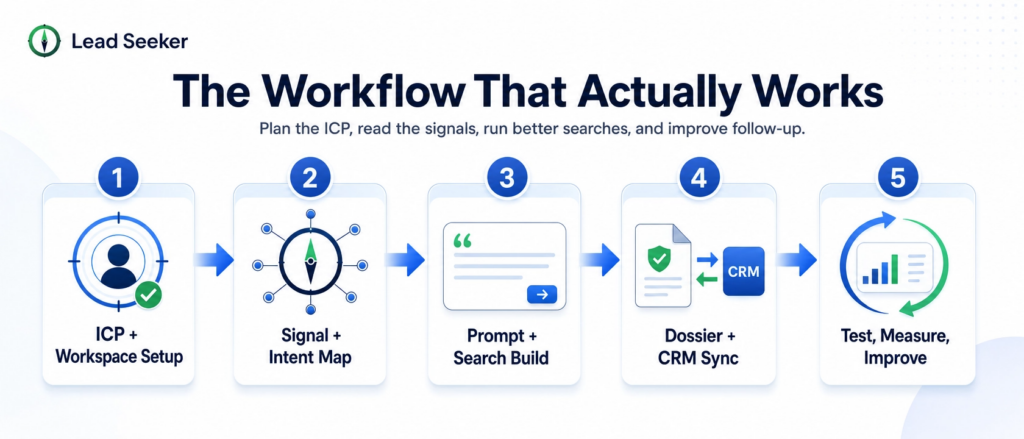
A practical workflow for How to get sales leads for free has five steps:
- Set the ICP. Define industries, company sizes, roles, regions, exclusions, and the offer.
- Map useful signals. Choose public events that may make the offer timely without presenting those events as private intent.
- Build the search. Translate the ICP and signals into a focused search rather than a broad title query.
- Review and hand off. Check the company, contact, source, trigger, fit, and outreach angle before export or CRM entry.
- Test and improve. Compare searches, signals, replies, meetings, opportunities, pipeline, and time spent.
This approach helps teams asking How to get sales leads for free test a real market definition instead of measuring how many rows they can download. Human review remains part of the process. No prospecting system can establish interest, permission, or qualification from contact verification alone.
“Prospecting tools have become powerful, but often too mechanical.”
Lead Seeker team
Teams considering automated research or follow-up should also review where AI sales agents fit and where human approval must remain in control. The related analysis of AI agents making outbound calls explains why channel rules and oversight cannot be treated as an afterthought.
Qualified demand matters more than a bigger contact export
Broadstaff Global provides an adjacent B2B example of connecting specialist visibility, account intelligence and qualified conversations. The lesson for free lead generation is to preserve the source, verify the buyer and measure pipeline rather than list size.

Free sales lead quality scorecard
Score each lead from 0 to 2 across ten criteria. The score helps prioritize research and outreach; it does not prove that a person wants to buy. Use it whenever How to get sales leads for free begins producing more names than the sales team can review carefully.
Lead quality scoring table
| Criterion | 0 points | 1 point | 2 points |
|---|---|---|---|
| Account fit | Outside ICP | Partial fit | Strong ICP fit |
| Buyer fit | Wrong or unknown role | Influencer | Decision role or strong access |
| Geography | Unsupported | Unclear | Supported |
| Problem relevance | No clear connection | Possible connection | Clear offer-to-problem fit |
| Timing signal | None | Weak or old | Current and relevant |
| Contact verification | Unverified | Partially checked | Current and source-backed |
| Message relevance | Generic | Some personalization | Useful view tied to context |
| Permission and channel fit | Risky or unknown | Requires review | Approved process |
| Next step | No clear ask | Broad ask | Specific low-friction step |
| Measurement | No source or owner | Partial tracking | Source, owner, stage, and outcome |
- 17–20: Strong candidate for a thoughtful sales motion.
- 12–16: Research or refine before contact.
- 7–11: Weak fit or weak timing.
- 0–6: Do not spend sales time yet.
Apply the score consistently when How to get sales leads for free produces records from sources with different levels of context, verification, and buyer intent.
How fast should you follow up?
Respond promptly to inbound requests and specific referrals because the person has taken an action or a trusted party has made an introduction. Cold prospects require accurate research and relevance more than instant automation.
For How to get sales leads for free, set a service level by lead type. Assign one owner, record the source and date, stop automation when a person replies, suppress opted-out contacts, and separate no response, not now, wrong person, not a fit, and active opportunity.
If several channels are involved, an email marketing process should document consent, suppression, handoff, and reporting rules. Automation should enforce those controls rather than remove human accountability.
How to measure free lead generation
Track the full path: leads found → leads verified → ICP fits → contacts attempted → contacts reached → replies → positive replies → meetings → qualified opportunities → pipeline → revenue.
State every denominator. Verification rate is verified leads divided by leads found. ICP-fit rate is confirmed fits divided by leads reviewed. Reply rate is replies divided by delivered attempts. Meeting rate is meetings divided by reached contacts or positive replies, depending on the question being answered.
Also track pipeline per verified lead and hours per qualified opportunity. Include labor, software, enrichment, research, content, management, and follow-up when comparing sources. This is the financial test for How to get sales leads for free.
For a broader measurement model, use data visualization to make source performance understandable and enterprise SEO ROI modeling when owned search is part of the acquisition mix.
Mistakes that turn free leads into wasted time
Most failures in How to get sales leads for free come from weak qualification, missing source context, or unclear operating controls rather than a shortage of names.
- Starting without an ICP. Broad filters create more review work and weaker messages.
- Treating verification as interest. A valid contact can still have no need, authority, timing, or permission.
- Discarding source context. The seller loses the reason the account appeared relevant.
- Using one message for every source. A referral, webinar attendee, directory record, and cold prospect require different handling.
- Presenting public events as private intent. Hiring or funding may be relevant, but neither proves demand.
- Ignoring labor cost. Research hours belong in the source comparison.
- Scaling before reviewing quality. A weak search becomes a larger weak list.
- Reporting contacts instead of outcomes. Export volume hides whether sales conversations occurred.
- Leaving ownership unclear. Unassigned leads age quickly and create duplicate outreach.
- Ignoring channel and privacy controls. Public data does not remove legal, platform, suppression, retention, or deletion duties.
A focused SEO sprint can help test a narrow owned-search opportunity before expanding content production. SaaS teams can also compare the operating demands described in Percepture’s guide to choosing a SaaS content marketing agency.
Frequently asked questions about free sales leads
How can I generate sales leads without paying for ads?
The practical answer to How to get sales leads for free includes referrals, CRM reactivation, warm introductions, manual LinkedIn research, Google, local profiles, directories, public company signals, communities, partnerships, educational content, events, useful tools, and limited software trials. Define one ICP, verify every record, preserve the source, and measure conversations and pipeline.
How to get sales leads for free without buying a database?
Start with customers, partners, former opportunities, public company research, professional communities, job postings, company news, and educational content. Build a small account list, identify the right buyer, verify the current role, and write a message tied to a real relationship or public context.
Are free B2B lead databases reliable?
When testing How to get sales leads for free, databases can support a small test, but record freshness, sourcing, limits, and verification methods vary. Treat each record as unqualified until the company, role, contact path, source, account fit, and channel process have been reviewed.
Can LinkedIn be used to find free leads?
LinkedIn can support How to get sales leads for free through company, role, job-change, content, and mutual-connection research. Follow current platform rules, avoid mass automation, and do not assume profile visibility grants permission for outreach through every available channel.
Can Google Maps generate sales leads?
Google Maps can support How to get sales leads for free by helping discover local accounts by category and geography. Verify the company, service area, likely size, website, buyer roles, and ICP fit before adding it to a sales workflow. Maps supports discovery; it does not establish qualification or buying intent.
What is the difference between a lead and a prospect?
A lead is a person or account collected for review. A prospect is a lead that a seller has reviewed and considers relevant. A qualified opportunity has stronger evidence of fit, need, timing, value, buyer involvement, and an agreed next step.
Are free sales leads exclusive?
Public records, directories, communities, search results, and trial databases may also be available to other sellers. Exclusivity should never be assumed. Even an exclusive contact would still require checks for freshness, fit, relevance, reachability, channel suitability, and qualification.
How quickly should a sales team contact a free lead?
Respond promptly to direct inquiries and referrals. For cold prospects, prioritize accurate research and a relevant message over immediate automation. Set a service level by lead type, assign an owner, record the source and date, and stop automated follow-up when a person replies.
How do you turn a free lead into a meeting?
Verify account and buyer fit, identify a credible reason for contact, offer a useful observation or question, and request a low-friction response. Follow up according to the lead type and stop when the person opts out or indicates the offer is not relevant.
Put How to get sales leads for free into a measurable system
If your team has tried How to get sales leads for free but still cannot connect source activity to qualified pipeline, Percepture can help align ICP strategy, owned demand, lead intelligence, conversion, and reporting.