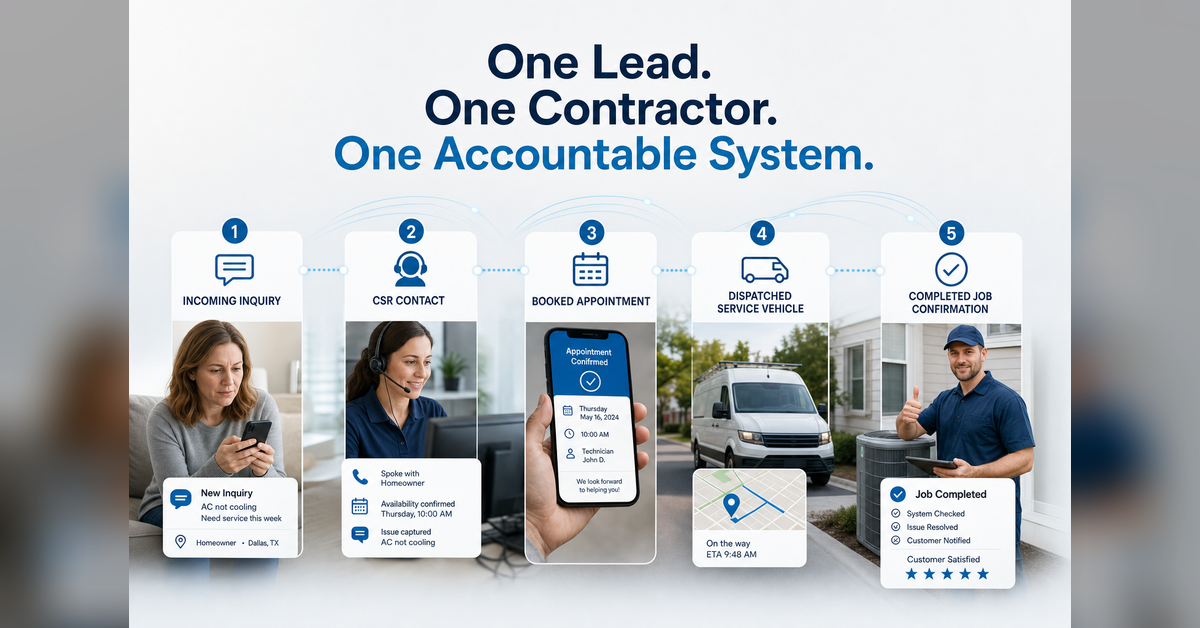

A vendor says its exclusive HVAC leads go only to your company. The real question is whether the vendor can prove where each inquiry came from, what the person requested and how the record was routed.
Exclusivity can reduce direct competition, but it cannot fix a bad phone number, the wrong service area or a missed call. Judge the source by booked work, completed jobs, gross profit and what your company learns from every outcome.
What is an exclusive HVAC lead?
Exclusive HVAC leads are consumer or business inquiries distributed to one HVAC contractor under a defined service, territory and delivery rule. A credible record should also show the source, request, contact details, service-area fit, delivery time and outcome. Exclusivity limits distribution, but it does not guarantee qualification or a sale.
The decision in five points
Define the rule
Write down what exclusive HVAC leads means by service, ZIP code, campaign, time and resale policy.
Audit the source
Require a record of the offer, request, source, timestamp, routing path and expected caller.
Separate quality from distribution
A lead may be exclusive yet invalid, out of area, unreachable or outside your service mix.
Measure completed work
Track contact, booking, dispatch, completion, collected revenue and gross profit by source.
Build an owned option
Use purchased demand for a defined need while improving the website, search presence, reputation and first-party data you control.





These credentials establish company history and operating experience. They do not replace source-level proof for any HVAC lead vendor or campaign.
Who should use this guide?
Owners and CEOs
Use it to test the control, territory, contract risk and completed-job economics of exclusive HVAC leads .
Marketing leaders
Use it to compare purchased exclusive HVAC leads with contractor-owned search, paid media, content and brand demand.
GMs and sales leaders
Use it to define qualification, routing, follow-up and appointment outcomes.
CSR and dispatch teams
Use it to match lead volume with answer coverage, routes, service areas and technician capacity.
Finance and data teams
Use it to connect the acquisition cost of exclusive HVAC leads with attribution, customer records and collected gross profit.
Exclusive HVAC leads are not automatically qualified
“Exclusive” should describe the distribution rule, not replace proof. A vendor may send an inquiry to one contractor while the record still has the wrong phone number, service, ZIP code or customer type. The person may also be impossible to reach or unable to accept an appointment.
For exclusive HVAC leads , qualification should follow the operating rules your company approved. Those rules may include residential or commercial status, repair or replacement work, service area, timing, property relationship, equipment type and available capacity. Qualification should be written before a campaign begins.
Use one reporting dictionary across marketing, sales and operations:
- Raw inquiry: Any call, form, text, chat or booking request.
- Valid lead: A plausible request with usable contact information.
- Qualified lead: A request that fits the approved service, location, timing and customer rules.
- Exclusive lead: A record distributed to one contractor under the agreed rule.
- Contacted lead: A person the contractor reached.
- Booked lead: A person who accepted an appointment or estimate.
- Dispatched lead: A booked request placed on the operating schedule.
- Completed job: Work the company performed.
- Revenue-producing customer: A customer from whom revenue was collected.
- Retained customer: A customer who creates maintenance, repeat or referral value.
This shared language stops teams from calling every form submission a lead and then arguing about performance. It also keeps reporting for exclusive HVAC leads tied to the same definitions used by sales and operations. Percepture’s HVAC marketing methodology uses this operating view because profitable demand must fit work the contractor can answer, book, dispatch and complete.
Score your HVAC lead quality
Test whether your exclusive HVAC leads have documented source, consent, territory, routing, qualification and outcome data. A diagnostic can expose the missing records before you add volume.
Shared, purchased and owned HVAC demand compared
The best source depends on capacity, urgency, control and economics. This table compares exclusive HVAC leads with shared and owned sources based on operating differences rather than treating every inquiry as the same product.
| Model | Recipients | Source control | First-party data | Speed pressure | Asset value | Main risk | Best use |
|---|---|---|---|---|---|---|---|
| Shared marketplace | Multiple contractors | Low | Limited by terms | High | Low | Direct competition and weak source visibility | Short tests when response capacity is strong |
| Purchased exclusive | One contractor under a defined rule | Depends on vendor | Depends on ownership terms | High | Low to moderate | Unclear origin, resale or replacement rules | Filling a documented service or territory gap |
| Live transfer | One receiving contractor at transfer | Depends on source | Depends on record delivery | Immediate | Low | Caller may not fit service or capacity rules | Teams staffed to answer and qualify now |
| Pre-set appointment | Usually one contractor | Depends on provider | Depends on terms | Moderate | Low | Appointment may not verify, show or qualify | Teams with a strong confirmation process |
| Owned SEO and Maps | The contractor | High when accounts are owned | High | Normal inbound pressure | High | Requires sustained work and accurate service signals | Long-term contractor-controlled demand |
| Owned paid media | The contractor | High when accounts and pages are owned | High | High for urgent searches | Moderate | Spend can be wasted by weak targeting or handling | Service, territory and seasonal demand capture |
| Referral or partner | The referred contractor | Moderate | High after direct contact | Usually lower | High relationship value | Volume may be inconsistent | Trust-led growth and local partnerships |
Purchased exclusive HVAC leads can help test a market or fill open capacity. They should not become a black box. Your team should know who created the inquiry, whether another broker handled it and which party owns the customer record.
Owned inbound demand comes from assets and channels the contractor controls. These can include the website, search visibility, local listings, content, reviews, referrals and paid campaigns. A connected omnichannel marketing strategy can coordinate those sources instead of measuring each one in isolation.
How to verify the one-contractor rule
To verify exclusive HVAC leads , start with the contract, but do not stop there. Ask the vendor to explain the rule using a sample lead record and a simple routing diagram. The explanation should be clear enough for marketing, dispatch, data and legal teams to understand.
- Define the unit. Is exclusivity based on a ZIP code, market, service, campaign, lead record or time window?
- Define the recipient. Is the record delivered to one contractor, one location, one brand or one call center?
- Define resale. Can the inquiry be sold later, placed in another category or used for remarketing?
- Trace the origin. Did the seller create the inquiry, buy it from another company or route it through several brokers?
- Review the request. What did the person see, ask for and expect to happen next?
- Check delivery. Which timestamp shows creation, verification, routing and receipt?
- Test duplicates. How does the system identify prior customers, repeated forms and records from another source?
- Review invalid reasons. Which wrong numbers, services, locations and customer types qualify for a credit or substitute?
- Confirm ownership. Who controls the landing page, phone number, ad account, data export and customer relationship?
- Audit outcomes. Can results be reported through booking, dispatch, completion and collected revenue?
If a vendor cannot answer these questions in plain language, its exclusive HVAC leads carry little operating value. Percepture treats lead generation services as a connected targeting, conversion, data, routing and follow-up system rather than a list of names.
The Percepture HVAC ONE Lead Quality System
The HVAC ONE system evaluates both purchased and contractor-created demand. It connects source trust with operating fit and completed-job economics.
O: Origin and ownership
For exclusive HVAC leads , verify the source, consumer-facing offer, request record, broker path and ownership of accounts, numbers, pages, data and the customer relationship.
N: Need, neighborhood and now
Match the requested service, customer type, ZIP code, urgency, timing and available capacity. Add enough form and call logic to route correctly without making the process hard for the customer.
E: Exclusivity, engagement and economics
Document one-contractor distribution, delivery, response, booking, dispatch, completed work, gross profit and replacement outcomes.
The system has six operating layers: source trust, service and territory fit, one-contractor delivery, fast activation, completed-job economics and owned learning. It gives buyers a practical way to evaluate exclusive HVAC leads without assuming exclusivity equals quality.
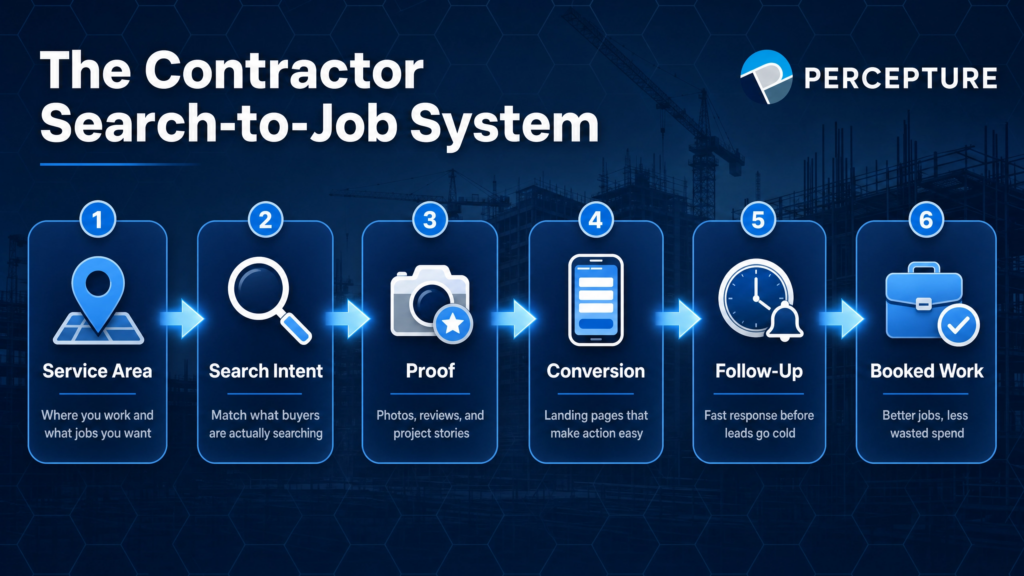
Which channels create contractor-controlled demand?
The strongest lead portfolio usually combines short-term demand capture with assets the contractor can keep. That balance reduces dependence on exclusive HVAC leads from any single vendor. The right mix depends on service margins, location, season, capacity and the team’s ability to handle calls.
Organic and local search
Service pages, location information, local listings and useful answers can create direct calls and forms. A disciplined approach to SEO for construction companies provides a foundation for contractor-controlled discovery. Larger organizations can use enterprise SEO services to coordinate locations, technical standards and content governance.
Paid search
Paid search can capture urgent repair or replacement intent, but the campaign must reflect the services and areas the team can serve. Paid search services should connect search terms, landing pages, calls, bookings and completed work. Campaign access and data ownership matter because the learning should remain usable if a vendor relationship ends.
Content and AI discovery
Homeowners and business buyers ask about repair, replacement, financing, comfort, equipment and maintenance before contacting a contractor. Content marketing services can turn those questions into useful pages, while generative engine optimization services help clarify entities, services, locations and source-worthy answers for AI search systems.
Authority and reputation
Reviews, community visibility, expert commentary and earned coverage can reduce buyer doubt before the call. Digital PR services can support authority and discoverability, but reputation still depends on the real customer experience.
These channels can produce first-party calls, forms, chats or bookings that operate like exclusive HVAC leads because the inquiry enters the contractor’s system directly. The contractor still needs clear attribution, qualification and follow-up.
What should every lead record contain?
A useful record for exclusive HVAC leads lets a team trace each inquiry from source to outcome. It should not require staff to search through email threads or vendor dashboards to understand what happened.
- Unique record or source ID
- Creation and delivery timestamps
- Original source and campaign
- Consumer-facing offer or request context
- Name and usable contact details
- Requested service
- Residential or commercial status
- Service address or ZIP code
- Urgency and preferred timing
- Existing-customer and duplicate status
- Consent and disclosure record where applicable
- Assigned location, CSR or salesperson
- Contact attempts and response times
- Appointment, dispatch and completion status
- Invalid, replacement or credit disposition
- Collected revenue and gross profit fields when available
Data teams should also monitor delivery failures. A broken webhook, blocked email or overwritten source field can make working exclusive HVAC leads look weak. Attribution and analytics should preserve the original source while connecting later operating outcomes.
Exclusive HVAC Lead Verification Scorecard
Use this scorecard to inspect exclusive HVAC leads . Score each item as 0 for missing, 1 for partial and 2 for documented. The score is a diagnostic, not a universal pass or fail rule.
| Category | Question | Evidence to inspect |
|---|---|---|
| Origin | Can the original source be traced? | Source ID, URL, campaign and broker path |
| Request | Is the consumer’s request clear? | Offer, form context, call record or booking details |
| Exclusivity | Is one-contractor distribution documented? | Routing rule, recipient log and contract language |
| Territory | Are services and locations defined? | ZIP, market and service filters |
| Qualification | Does the record fit operating rules? | Service, customer type, timing and property details |
| Delivery | Can creation and receipt be compared? | Timestamps and delivery logs |
| Replacement | Are invalid reasons and dispute steps clear? | Written criteria, window and disposition data |
| Ownership | Can the contractor access and export its data? | Account rights, exports, numbers and page ownership |
| Activation | Can the team answer and follow up? | Coverage, assignments and contact attempts |
| Economics | Are booked and completed jobs measured? | Spend, bookings, completions, revenue and gross profit |
Exclusive HVAC leads pricing: calculate the full cost
There is no responsible universal price for exclusive HVAC leads . Public vendor offers vary, and a low cost per lead may hide invalid contacts, missed calls, low booking rates or work that does not fit the company’s margin and capacity.
Build the full cost view for exclusive HVAC leads from all program inputs. Include media, purchased records, agency or vendor management, call tracking, software, internal labor, follow-up, credits, no-shows and financing costs where relevant. Keep revenue separate from profit.
Four formulas to use
| Metric | Formula | What it answers |
|---|---|---|
| Cost per booked job | Total lead spend ÷ booked jobs | What did each accepted appointment cost? |
| Cost per completed job | Total lead spend ÷ completed jobs | What did each performed job cost? |
| Customer acquisition cost | Total acquisition cost ÷ new customers | What did it cost to gain each customer? |
| Gross-profit return | Attributable gross profit ÷ total program cost | How much attributable gross profit was produced per dollar of program cost? |
For a clearly illustrative example, imagine a contractor spends $10,000 across media, purchased records, software, management and assigned labor. If the source produces 40 booked jobs, the cost per booked job is $250. If 25 jobs are completed, the cost per completed job is $400. Those figures do not show profit until the contractor adds collected revenue, direct job costs, credits, no-shows and other acquisition costs.
Compare the same fields across cohorts. Separate repair, replacement and maintenance work because their economics differ. Also separate service areas, time periods and sources. Percepture’s published paid ads pricing packages can help buyers understand available paid-media structures, but actual lead economics still depend on the contractor’s program and operating results.
Is your company ready to test a lead source?
| Readiness area | Ready signal | If the signal is missing |
|---|---|---|
| Capacity | Open appointment and technician capacity is known | Pause or pace demand |
| Services and ZIPs | Accepted and excluded work is documented | Fix qualification rules |
| Answer coverage | Calls and messages have clear owners | Fix handling before buying volume |
| CRM | Source and disposition fields are used | Build a basic tracking workflow |
| Financing | Relevant options and handoffs are clear | Fix the sales process for larger jobs |
| Reviews and trust | Customers can verify the business and service fit | Strengthen local trust |
| Ownership | Accounts, pages, numbers and exports are defined | Revise vendor terms |
| Contract | Pause, replacement and exit rules are written | Do not start until terms are clear |
| Data handling | Collection, routing, contact and opt-out processes are reviewed | Review the workflow with qualified counsel |
A company with strong handling but a short-term capacity gap may be ready for a controlled test of exclusive HVAC leads . A company with weak ownership but steady demand may need to build owned channels. Many contractors will fit a hybrid model.
When buying leads makes sense
Purchased exclusive HVAC leads can make sense when the company has measurable open capacity, a defined service gap or a market it wants to test. The test should have a budget, timeline, service area, qualification rule and stop condition.
Start with one controlled source of exclusive HVAC leads . Compare promised rules with delivered records. Review calls and dispositions each week. Do not expand just because raw volume rises.
A contractor should not buy more demand than the company can answer, book, dispatch, complete and learn from. More inquiries will not repair unanswered phones, weak scripts, poor reviews, missing CRM fields or an overbooked schedule.
When to build owned demand
Build owned demand when the company wants more control over message, source, data and customer experience. This is especially useful when dependence on purchased exclusive HVAC leads is high or the business cannot explain why one source performs better than another.
Owned demand does not mean relying on one channel. A practical digital marketing plan for contractors can combine search, local visibility, content, paid media, reputation, email and referrals. Organic SEO services support long-term search demand, while conversion work improves the calls and forms already reaching the website.
The contractor should own more after each campaign: better pages, cleaner data, stronger calls, tested offers and a clearer view of revenue. That learning can improve both future marketing and operations.
Contract and replacement questions to ask
A sales presentation for exclusive HVAC leads may focus on volume and territory. The contract should explain the business rules that apply when a record is invalid, late, duplicated or outside the approved service.
- What is the exact definition of exclusive?
- Does one-contractor distribution apply forever or for a set period?
- Can the record be resold, recategorized or used for remarketing?
- Which services, ZIP codes and customer types are included?
- Does the vendor create the inquiry or obtain it from another source?
- What did the person request, and which caller did the person expect?
- What source, timestamp and routing evidence is available?
- Which contact and service fields are verified?
- How quickly is the record delivered?
- What counts as a duplicate or invalid inquiry?
- Which records qualify for a credit or substitute?
- How long does the contractor have to submit a dispute?
- Who owns the data, customer relationship, phone numbers and landing pages?
- Can the contractor export all records and dispositions?
- Can volume pause when capacity changes?
- How are delivery failures found and corrected?
- Which reports connect leads to booked and completed jobs?
- What are the term, renewal and exit rules?
- Can the contractor run a limited test before expanding?
Replacement terms for exclusive HVAC leads should define evidence and process, not just promise good service. A replacement also does not erase the labor spent calling, researching and disputing a bad record.
Consent, privacy and data handling
Quality exclusive HVAC leads start with a truthful offer, a clear customer choice and documented data handling. The record should show what the person saw, requested and provided, when it happened, who may contact the person and how the inquiry was routed.
This guide provides general marketing and lead-management information, not legal advice. Have qualified counsel review current federal, state, platform, privacy, calling, texting, email, recording, data-sharing and opt-out requirements.
Ask counsel and the vendor to review the complete data flow. Include forms, call recordings, text messages, email, automated routing, suppression lists, retention, exports and third-party access. A platform delivery record does not by itself prove that a third-party inquiry was exclusive.
Agency, marketplace, in-house or hybrid?
| Model | Strength | Tradeoff | Best fit |
|---|---|---|---|
| Marketplace | Can provide quick access to purchased demand | Source, consumer experience and data control may be limited | Controlled capacity tests with clear rules |
| Agency-led | Can connect strategy, channels, conversion and reporting | Quality depends on access, scope and operating alignment | Companies needing coordinated expertise |
| In-house | Close to dispatch, sales and customer data | Requires enough skill and time across several disciplines | Teams with established marketing operations |
| Hybrid | Combines internal knowledge with outside channel depth | Roles and ownership must be explicit | Contractors building owned demand while testing selected sources |
An HVAC specialist may understand service language and seasonality. A broader partner may bring deeper search, paid media, content, PR, conversion and analytics skills. Evaluate the actual team, access, deliverables and reporting rather than the label.
A contractor SEO agency guide can help assess organic partners. For commercial prospecting, keep homeowner demand separate from HVAC contractor lead research based on business classifications and account targeting.
A practical 30, 60 and 90-day plan
Days 1 to 30: define and baseline
Define qualified work. Audit calls. Map services, margins, ZIP codes and capacity. Review ownership and contract terms. Create required CRM fields. Record baseline contact, booking, completion and cost metrics. Test one controlled source of exclusive HVAC leads rather than several sources at once.
Days 31 to 60: repair the path
Improve forms and service pages. Connect call tracking and CRM records. Review calls and invalid reasons. Adjust filters. Improve missed-call follow-up. Separate repair and replacement economics. Publish priority owned pages and strengthen local trust.
Days 61 to 90: compare and decide
Compare purchased exclusive HVAC leads and owned cohorts. Move budget using completed-job economics. Improve estimate follow-up and nurture. Expand only when capacity supports it. Document source and request records. Use real customer questions to guide future content. Decide whether to scale, pause or shift.
Common mistakes to avoid
- Buying the label. Treating exclusive HVAC leads as proven without a distribution record.
- Using CPL alone. Ignoring booking, completion, gross profit and internal handling cost.
- Skipping capacity planning. Buying demand when calls, appointments or technicians are already overloaded.
- Mixing service types. Reporting repair, replacement, maintenance and commercial inquiries as one cohort.
- Ignoring missed calls. Blaming source quality when the team does not answer or follow up.
- Accepting vendor-controlled assets. Losing access to accounts, pages, numbers or customer data when a relationship ends.
- Failing to disposition records. Leaving the CRM unable to explain invalid, contacted, booked and completed outcomes.
- Expanding too fast. Adding markets or sources before the first test produces reliable operating data.
How Percepture approaches the problem
Percepture evaluates exclusive HVAC leads by connecting demand creation, source trust, service and territory fit, routing, lead handling, completed work and owned learning. The method can draw on search, paid media, content, GEO, digital PR, conversion and analytics without treating any one channel as a complete answer.
The supplied asset below represents adjacent contractor and infrastructure work. It is not presented as a residential HVAC lead marketplace case study.

Percepture’s construction content marketing guide also shows how contractor expertise can become useful buyer content instead of generic promotional copy.
Compare your current lead sources
Put shared sources, purchased exclusive HVAC leads and owned demand into one scorecard. Compare source proof, ownership, cost per completed job and the operating work required to turn each inquiry into revenue.
Frequently asked questions
What are exclusive HVAC leads?
Exclusive HVAC leads are inquiries sent to one contractor under a stated distribution rule. The rule should define the service, area, recipient, timing and resale terms. The record can still be invalid or unqualified, so source, contact, routing and outcome evidence also matter.
Are exclusive HVAC leads worth it?
Exclusive HVAC leads may be worth testing when a contractor has open capacity, clear qualification rules and reliable tracking. Measure cost per booked and completed job rather than cost per lead alone. Stop or adjust the source when operating outcomes do not support the total cost.
How much do exclusive HVAC leads cost?
There is no universal responsible price for exclusive HVAC leads . Costs vary by source, market, service, delivery model and program terms. Include media, records, software, management, labor, no-shows, credits and follow-up when calculating the real cost.
What is the difference between shared and exclusive leads?
A shared lead is distributed to multiple contractors. Exclusive HVAC leads are distributed to one contractor under an agreed rule. Exclusive distribution can reduce direct competition, but it does not prove that the contact is valid, qualified or likely to book.
Can an exclusive lead still be bad?
Yes. Exclusive HVAC leads can go to one contractor and still contain an invalid number, wrong service, wrong area, duplicate customer or request the company cannot schedule. Exclusivity and qualification must be measured separately.
What should a replacement policy cover?
A replacement policy for exclusive HVAC leads should define invalid contacts, duplicates, excluded services, out-of-area requests, dispute evidence, submission windows, credits and substitutes. It should also explain whether the vendor reviews call records and how disagreements are resolved.
Should an HVAC contractor buy leads or build its own demand?
Many contractors benefit from a hybrid plan. Purchased exclusive HVAC leads can fill a short-term capacity or market gap. Owned search, paid campaigns, content, reviews and referrals create more control over source, message, data and customer experience.
How should HVAC lead quality be tracked?
Track exclusive HVAC leads by valid rate, qualification, contact, response time, booking, dispatch, completion, collected revenue, gross profit, replacement rate and customer acquisition cost. Break results out by source, service, territory, time and season.
Request an exclusive HVAC lead generation plan
Percepture can help evaluate your current exclusive HVAC leads , owned demand channels, source records, handling process and completed-job reporting. The goal is one accountable system that connects demand with work your company can serve and measure.