
An ISP marketing strategy should align serviceability data, audience targeting, local trust, SEO, paid search, programmatic media, PR, direct mail, CRM follow-up, and reporting. The goal is not traffic alone. The goal is to turn serviceable homes, businesses, buildings, and communities into measurable subscribers and qualified leads.
Most broadband providers do not fail because the network has no value. They struggle when marketing, sales, operations, and serviceability data do not work together. A strong ISP marketing strategy connects the physical network to the buyer’s decision path.





Last updated: August 5, 2026
What is an ISP marketing strategy?
An ISP marketing strategy is the operating plan a broadband provider uses to connect serviceability data, local trust, search visibility, paid media, direct mail, PR, offer strategy, conversion tracking, CRM follow-up, and sales reporting to subscriber and lead growth.
An The plan should not ask, “Where can we advertise?” first. It should ask, “Where can we sell, where can we install, and who is ready to buy?”
A normal marketing strategy may start with personas. Broadband growth starts with the network map. An ISP cannot sell everywhere. The network has limits, construction has timing, and marketing must respect both.
Executive summary for ISP leaders
Start with network truth
Live homes, pre-sale homes, future-build areas, suppressed addresses, MDU targets, and DIA prospects need different messages and follow-up paths.
Build trust before launch
Residents, property owners, and businesses need a local reason to believe the provider before they switch, register, or request a quote.
Connect every lead to revenue
Clicks are not enough. Address checks, calls, forms, installs, subscribers, and pipeline must be visible in the same reporting system.
Use channels by serviceability stage
SEO, PPC, direct mail, PR, programmatic, GEO, and sales follow-up should match where the buyer lives and what the network can deliver.
Who this guide is for
Each team should use the the broadband growth plan to make channel decisions against the same serviceability, revenue, and follow-up reality.
CEOs and owners
Use this to align marketing spend with passings, installs, subscriber growth, take-rate, and investor reporting.
CMOs and growth leaders
Use this to set channel roles for local SEO, omnichannel marketing , paid search, direct mail, digital PR, and AI search visibility.
Sales and operations leaders
Use this to improve lead routing, address checks, speed-to-lead, install scheduling, and serviceability handoff.
Fiber, BEAD, MDU, and DIA teams
Use this to separate residential fiber, funded broadband builds, property-owner outreach, and business connectivity demand.
Why ISP Marketing Strategy Is More Than a Channel Plan
An A broadband growth strategy is not a list of channels. SEO, PPC, direct mail, PR, and social media matter, but they are tools. The strategy decides what each tool should do, where it should run, who should see it, and what happens after the buyer responds.
ISP marketing is the full discipline of creating demand for internet service providers. The strategy is the growth system, buyer path, targeting logic, offer architecture, channel role, and KPI model. The ISP marketing plan turns that system into a calendar, budget, owners, assets, and launch steps.
Residential fiber, BEAD-funded builds, MDUs, DIA, and business fiber should not share the same buyer journey. A homeowner checking availability is not the same as a property owner comparing managed Wi-Fi options or an IT director requesting a DIA quote. Strategy protects the budget from that mistake.
If you need the broader discipline first, start with what is ISP marketing . This guide goes one layer deeper into the operating system behind growth.
Why Serviceability Comes First
A broadband provider can only sell where the network can serve, where construction timing is clear, or where pre-registration makes sense. Marketing built only around ZIP codes, broad demographics, generic interests, or top-of-funnel traffic creates waste.
The campaign must account for live service areas, pre-sale markets, future-build zones, suppressed addresses, MDU targets, business fiber buildings, high-intent search areas, competitor pressure, and install capacity. When marketing ignores serviceability, the ISP pays to create demand it cannot convert. This is where an This operating model separates reachable buyers from audiences that cannot become subscribers yet.

Serviceability messaging matrix
The matrix helps an a broadband growth plan match message, CTA, and follow-up to what the network can actually support.
| Market Segment | Message | CTA | Follow-Up |
|---|---|---|---|
| Serviceable now | Fiber is available at your address | Check Your Address | Sales, checkout, install scheduling |
| Pre-sale | Fiber is coming soon | Get Updates | Nurture, construction updates, pre-registration |
| Future build | Help bring better broadband to your area | Register Interest | Demand mapping, future campaign |
| Not serviceable | Stay informed for future availability | Notify Me | Suppression and future segmentation |
| MDU target | Improve resident connectivity and property value | Build an MDU Plan | Property-owner outreach |
| DIA target | Upgrade business connectivity and reliability | Request a Quote | Sales engineering handoff |
Get an ISP Growth Audit
Percepture will review your serviceability, search visibility, content gaps, paid media, PR signals, lead funnel, and follow-up system to show where your your current growth system is leaking demand or revenue.
The Percepture ISP Growth Strategy System
The Percepture ISP Growth Strategy System gives broadband teams a simple way to connect the network map to the buyer path. It keeps the the plan focused on sellable demand, not channel activity.
1. Network truth
Define what can be sold, where, when, and with which install constraints.
2. Market trust
Identify what residents, property owners, businesses, and local leaders need to believe before they act.
3. Search visibility
Make sure Google, AI systems, and buyers can understand who the provider is, where it operates, and what it sells.
4. Demand capture
Aim SEO, PPC, direct mail, PR, social, and programmatic at the correct serviceability stage.
5. Conversion architecture
Use landing pages, offers, forms, calls, and address lookup tools that help buyers take the next step.
6. Follow-up system
Route forms, calls, address checks, AI sales agents, and human teams toward clear next actions.
7. Revenue reporting
Tie leads to installs, subscribers, pipeline, and take-rate.
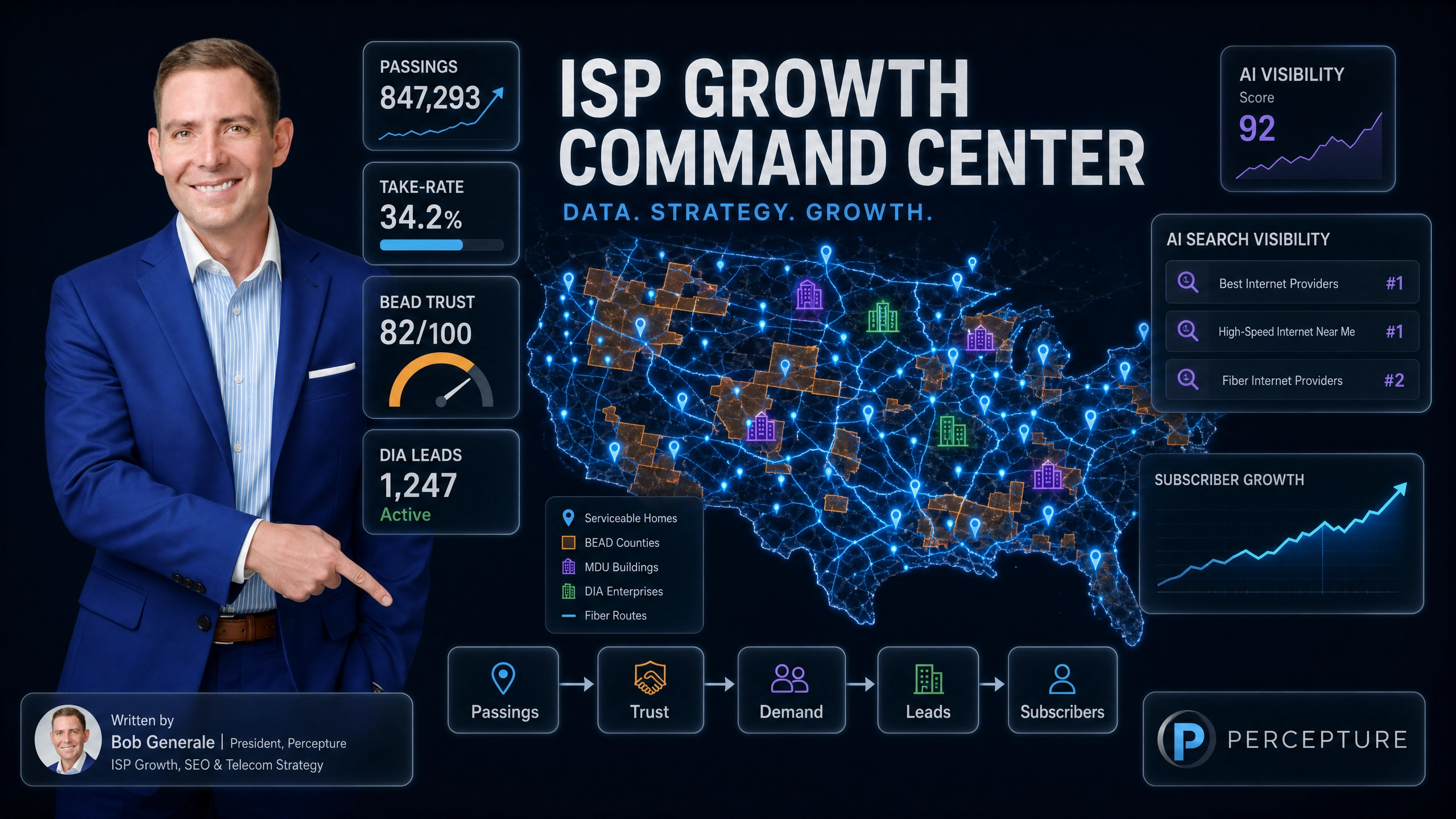
The 7 Strategic Lanes for ISP Growth
Each lane gives the the growth system a clear job, so serviceability, trust, visibility, demand capture, conversion, follow-up, and reporting do not compete for different outcomes.
1. Serviceability and data strategy
The serviceability layer tells marketing where money can be spent. It tells sales what follow-up is needed. A live address, pre-sale address, and future-build address should not receive the same message. The strategy must know the difference between a passing, a serviceable address, and a subscriber.
2. Local SEO and service-area strategy
Local SEO captures buyers already searching for better internet in a specific place. Town pages, neighborhood pages, fiber internet pages, business internet pages, reviews, citations, Google Business Profile work, and service-area schema help buyers find a clear local answer. See Percepture’s organic SEO services and guide to local SEO for fiber internet providers .
3. GEO and AI search visibility strategy
AI search changes how residents, property owners, IT directors, and investors research providers. They may ask ChatGPT, Google AI Overviews, Perplexity, Claude, Copilot, or Brave to compare options. AI search visibility improves when the ISP publishes clear, factual, citable content. Percepture supports this through generative engine optimization services and AI search visibility strategy .
4. Paid search and address-level demand capture
Paid search should be judged by address checks, calls, qualified forms, orders, scheduled installs, and subscriber growth. A PPC campaign that drives unserviceable clicks is expensive noise. Serviceability query matching, call tracking, address lookup conversion, and ad suppression should guide the budget. Read more about fiber internet PPC strategy .
5. Digital PR and community trust
Broadband adoption requires trust. Residents may not know the provider. Property owners may worry about disruption. Businesses may not switch without proof. Digital PR services can help turn a network build into a community story. An ad can create awareness. PR can create trust before the buyer clicks.
6. Offer strategy and conversion architecture
The offer is part of the the broadband growth plan. Price points, install promotions, speed tiers, free months, construction timing, landing-page copy, address lookup flow, call tracking, and checkout paths affect conversion. In one broadband campaign, traffic stayed steady but conversions dropped after promotional incentives were removed. The lesson was simple: media cannot fix an offer the market does not understand or value.
7. CRM, AI follow-up, and sales handoff
Lead generation is only useful if follow-up is clear. Keep-me-updated leads, pre-registration leads, serviceability checks, calls, SMS, email, AI sales agents, sales routing, install scheduling, human escalation, attribution, and lead scoring need a defined path. An A broadband plan fails when leads go from the website into a slow or unclear follow-up path. See how AI outbound calling agents fit into speed-to-lead work.
Residential Fiber Strategy
Residential fiber strategy should be built around the household decision path. Buyers compare price, speed, reliability, installation timing, reviews, and local trust. Many do not switch the first time they see an ad.
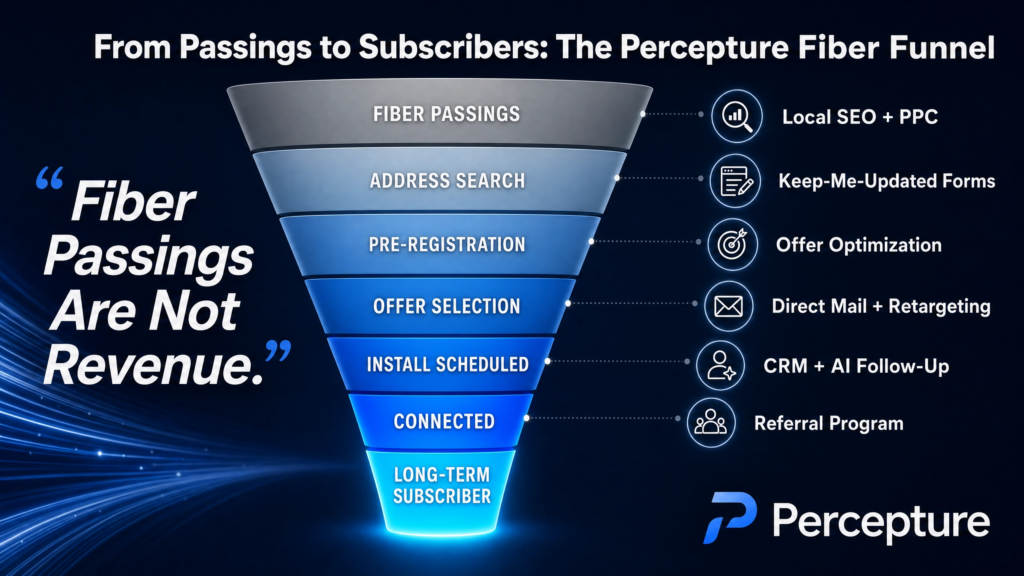
Fiber passings are not revenue. A passing becomes valuable when the household trusts the provider, checks availability, chooses an offer, schedules installation, and stays connected. Strong fiber take-rate marketing looks at each step from local awareness to referral growth.
The practical work includes passings, take-rate, local search, direct mail, PPC, pre-registration, address lookup, keep-me-updated forms, retargeting, install scheduling, referrals, offer testing, review generation, and churn prevention. In an the broader growth plan, those tactics should be sequenced around the household’s readiness to switch, not around a generic media calendar. If your team is still defining the metric, start with what is fiber take rate .
BEAD and Community Trust Strategy
BEAD funding can support a build. It does not automatically create local trust or subscriber adoption. A funded broadband build still needs education, construction updates, affordability messaging, community outreach, local PR, and adoption planning.
A BEAD marketing strategy should not wait until the network is complete. It should help residents understand why construction is happening, when service will be available, how the provider will communicate updates, and why the new option matters. Within an the broadband growth plan, BEAD messaging has to connect funding, construction, serviceability, and adoption without overpromising availability. Percepture’s guide to BEAD marketing and subscriber adoption expands this path.
Libraries, schools, county offices, broadband offices, anchor institutions, public meetings, press releases, workforce messaging, and local leaders can help reduce confusion. The goal is not noise. It is trust before construction and adoption after build. See also how ISPs build community trust before broadband construction .
MDU and Business Fiber Strategy
MDU broadband strategy
MDU growth is not the same as single-family residential growth. Property owners and managers care about resident experience, managed Wi-Fi, bulk agreements, property value, installation disruption, tenant satisfaction, and smart-building positioning. A strong outreach program gives owners a reason to talk before residents complain about connectivity. Percepture’s MDU broadband marketing guide covers that path.
DIA and metro Ethernet strategy
Business fiber, DIA, and metro Ethernet campaigns need a different logic. IT directors and business leaders care about serviceable buildings, route diversity, SLA proof, cloud connectivity, SASE, cybersecurity concerns, redundancy, uptime, quote requests, and sales engineering handoff. Account-based campaigns should be built around building lists and business pain points. The The growth plan should keep those lists separate from residential demand so sales engineering receives better-fit opportunities. See DIA lead generation for ISPs and metro Ethernet lead generation .
ISP marketing strategy framework by growth path
| Growth Path | Best Fit | Main Risk | Strategy Priority |
|---|---|---|---|
| Residential fiber | Serviceable homes and pre-sale markets | Passings do not become subscribers | Address checks, offers, reviews, install scheduling |
| BEAD builds | New funded construction areas | Local confusion or low adoption | Community education, PR, pre-registration |
| MDU broadband | Apartments, condos, and managed properties | Owner objections and install disruption | Property-owner education and resident launch plans |
| DIA and business fiber | Serviceable commercial buildings | Weak sales engineering handoff | Quote paths, proof, account-based targeting |
The 90-Day ISP Marketing Roadmap
A strategy becomes useful when it turns into a work plan. The first 90 days should clean the data, launch demand capture, improve follow-up, and build reporting that connects channels to business outcomes. A 90-day A 90-day broadband growth plan should also define what will not be marketed until serviceability or install capacity is ready.
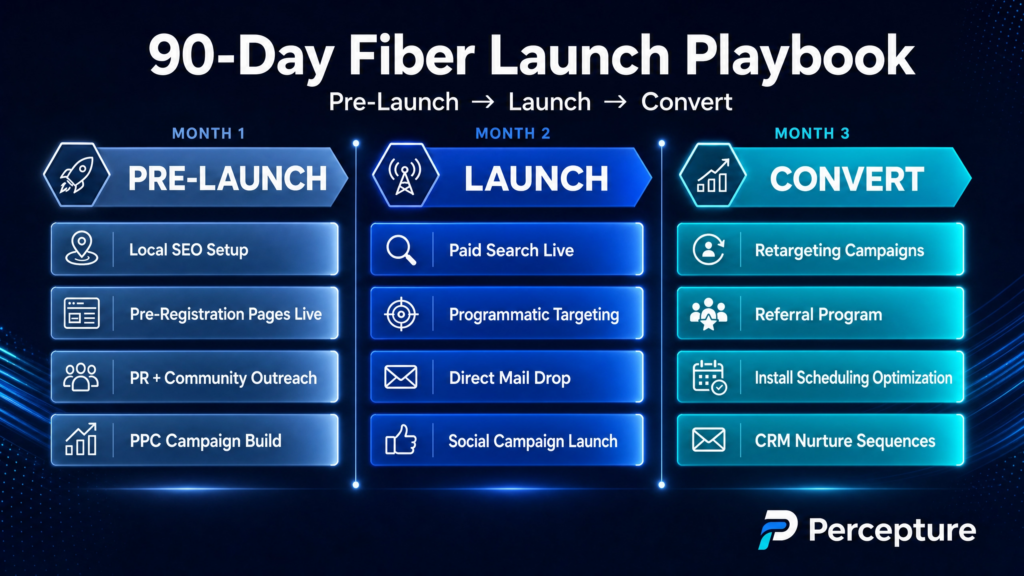
Days 1–30: Market intelligence and serviceability
Audit search visibility, AI-search visibility, serviceability data, live areas, pre-sale areas, future-build zones, do-not-market areas, competitors, offers, local pages, PPC waste, PR signals, content gaps, CRM routing, conversion events, and KPIs. Deliverables include a serviceability map, market segment map, keyword map, content gap map, offer diagnosis, KPI outline, and launch calendar.
Days 31–60: Demand capture and trust building
Launch local pages, PPC by serviceability stage, direct mail by segment, PR and community messaging, answer-ready content, retargeting, address-search improvements, keep-me-updated nurture, sales routing, AI follow-up scripts, and MDU or DIA target lists.
Days 61–90: Conversion, follow-up, and reporting
Improve forms, calls, address lookup, lead routing, AI and human follow-up, install scheduling, CPL monitoring, channel reporting, retargeting, offer testing, referrals, and handoff. Deliverables include conversion, subscriber, pipeline, install, and next 90-day reports.
Build Your 90-Day ISP Marketing Plan
Turn strategy into an execution calendar for service areas, local SEO, PPC, PR, direct mail, retargeting, and sales follow-up.
How Strategy Improves Fiber Take-Rate
A strategy improves fiber take-rate by creating trust before launch, matching campaigns to serviceable addresses, capturing address searches, testing offers, nurturing keep-me-updated leads, retargeting non-buyers, and giving sales a clear follow-up path.
The blockers are often practical: low awareness, unclear construction timing, weak local trust, poor address-search experience, weak offer, slow sales follow-up, generic landing pages, no retargeting, no referral plan, poor install communication, weak local SEO, thin reviews, weak proof, and poor MDU communication. An A strong broadband growth plan should turn those blockers into prioritized work instead of treating take-rate as a media-only problem.
A take-rate strategy should look at every step from passing to subscriber. The best campaigns keep educating, retargeting, following up, and converting. For a deeper path, read how to convert fiber passings into subscribers .
AI Search and Digital PR in an ISP Marketing Strategy
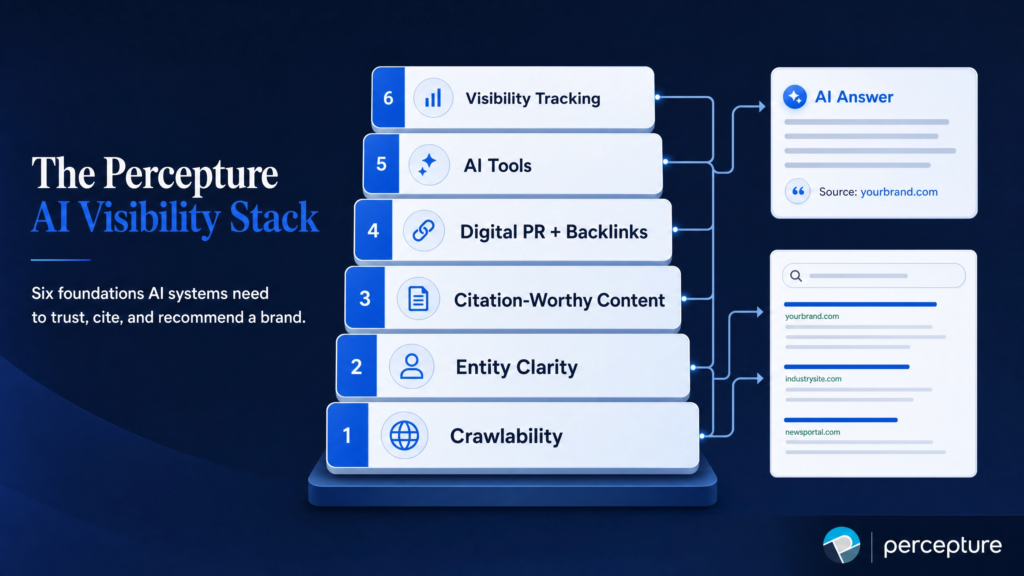
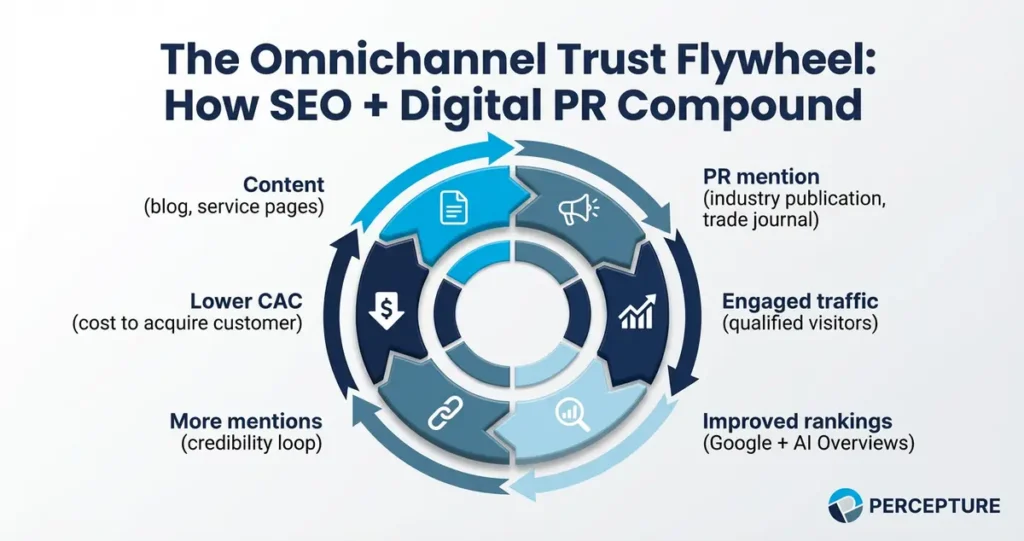
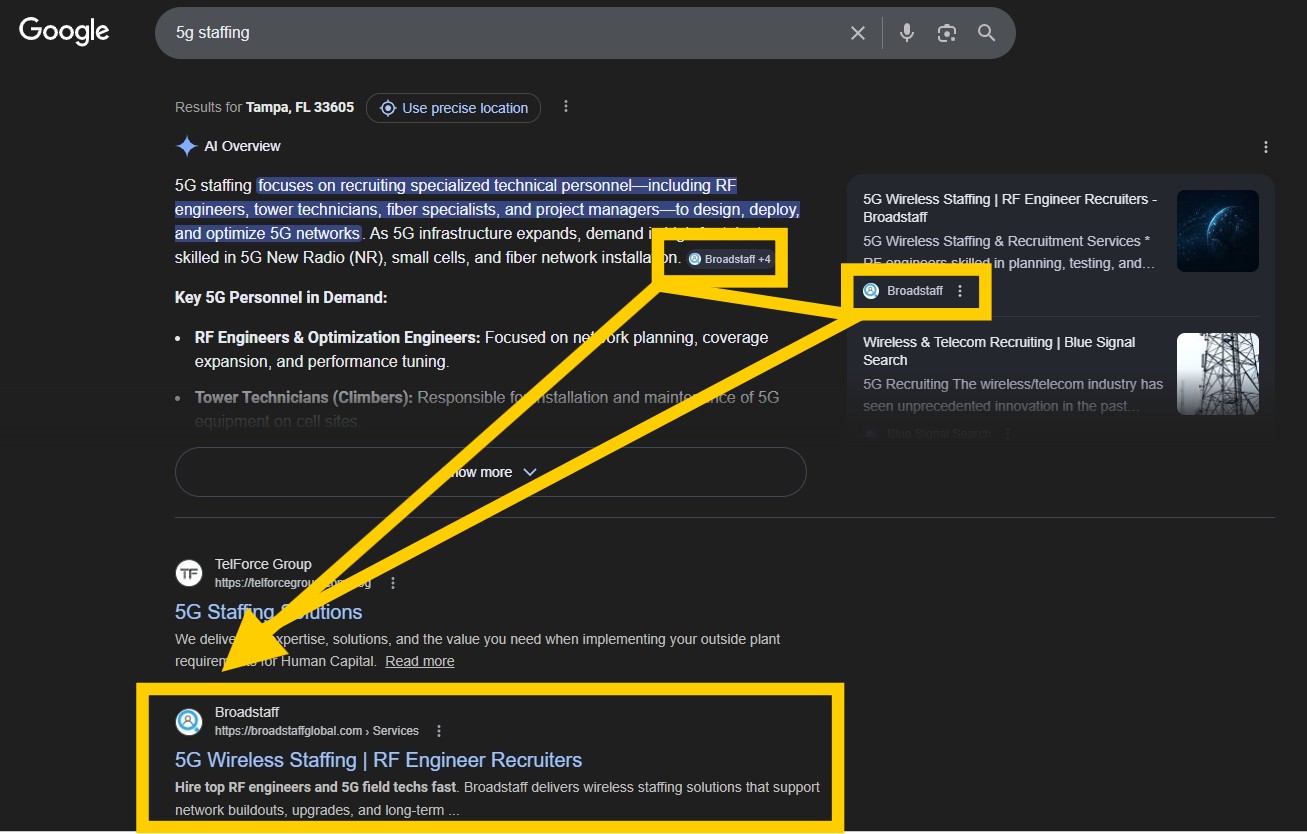
AI search does not remove the need for SEO. It raises the value of clear, source-worthy, expert content. Buyers now research providers in search engines and AI systems, including ChatGPT, Perplexity, Claude, Copilot, Google AI Overviews, and Brave.
An ISP that wants AI search visibility should not publish generic content. The company should publish clear service-area pages, service definitions, FAQs, proof, case studies, leadership signals, reviews, original frameworks, and schema. In an the broader growth plan, this content should also support sales conversations, PR proof, and local trust. Percepture’s answer engine optimization strategies explain how answer-ready content supports retrievability.

KPI Dashboard
Clicks are not enough. An A broadband growth plan should connect marketing data to installs, subscribers, and pipeline.
The dashboard should make the the growth plan visible across marketing, sales, operations, and leadership so teams can see whether demand is turning into serviceable revenue.
| Strategy Area | KPI | Why It Matters |
|---|---|---|
| Serviceability | Address searches by service area | Shows real market demand |
| Pre-registration | Keep-me-updated submissions | Captures future buyers |
| Paid search | Cost per qualified address search | Measures demand-capture efficiency |
| Local SEO | Non-branded service-area traffic | Shows organic visibility |
| GEO / AI search | AI answer mentions and referral traffic | Shows retrievability |
| PR | Local mentions and referral traffic | Measures trust-building |
| Direct mail | Matchback response rate | Shows offline-to-online impact |
| CRO | Form and address-check conversion rate | Shows landing-page quality |
| Sales | Speed-to-lead and appointment rate | Shows handoff performance |
| Install | Scheduled installs | Connects leads to revenue |
| Subscriber growth | New active subscribers | Shows business impact |
| Retention | Early churn and referral rate | Shows customer quality |
ISP growth readiness scorecard
Use this scorecard to diagnose whether your current your current broadband growth plan is ready to scale.
- Do you segment serviceability by live, pre-sale, future-build, and suppressed addresses?
- Do paid campaigns suppress unserviceable areas?
- Do landing pages use address-search CTAs?
- Is construction timing clear to buyers?
- Do keep-me-updated leads receive nurture?
- Does direct mail target serviceable homes?
- Do local SEO pages match actual service areas?
- Is content answer-ready for AI search?
- Does PR begin before launch?
- Are leads routed by serviceability and intent?
- Is speed-to-lead tracked?
- Is install scheduling tied to reporting?
- Can subscribers be traced to source?
- Do MDU, DIA, and residential journeys differ?
- Is there a clear monthly dashboard?
- Can the the growth plan be adjusted when serviceability, offers, or install capacity change?
Score: 0–5 yes answers means fragmented. 6–10 means a base exists but leaks revenue. 11–15 means advanced and ready for optimization.
Common Strategy Mistakes
The worst The worst broadband growth plan is a channel plan that is disconnected from the network.
- Starting with channels before serviceability.
- Using broad ZIP targeting when address-level logic is needed.
- Treating passings as subscribers.
- Running PPC without suppression.
- Waiting until construction is complete to build trust.
- Publishing generic SEO content with no local proof.
- Using PR only after a problem.
- Sending every lead into the same follow-up path.
- Removing offers without measuring conversion impact.
- Reporting clicks instead of installs, subscribers, and pipeline.
- Ignoring AI search and answer-ready content.
- Letting marketing, sales, and operations use different data.
- Treating MDU, DIA, and residential buyers as the same journey.
- Measuring form fills without lead quality.
- Leaving the Leaving the growth plan unchanged after construction timing, competitor offers, or sales capacity shifts.
How Percepture Builds ISP Strategy
Percepture has developed ISP-specific marketing planning around marketing departments, sales teams, C-suite executives, and investors in the ISP industry. The strategy is designed to put the logical buyer at ease while helping the emotional buyer achieve their goals.
Percepture builds Percepture builds broadband growth strategy around the full path from network availability to buyer trust, search visibility, paid demand, conversion tracking, CRM follow-up, and revenue reporting.
Since 2004, Percepture has worked at the intersection of digital marketing, public relations, search visibility, paid media, analytics, and lead generation. For ISPs, that experience matters because broadband growth is not one channel. It is a connected system.
In one regional residential fiber campaign, Percepture found that keep-me-updated forms, pre-sales, address-search flow, conversion tracking, and sales handoff were central to growth. The lesson was simple: take-rate depends on the full path from address search to installation, not just ad clicks.
A real A real broadband growth plan starts with the network. If the campaign ignores serviceability, sales follow-up, and install readiness, it will create noise instead of revenue.
— Bob Generale, President, Percepture
FAQs
What is an ISP marketing strategy?
An ISP marketing strategy is the operating plan connecting serviceability data, SEO, PR, paid media, direct mail, offers, lead follow-up, and reporting to subscriber and lead growth. It defines where to market, what to say, who should see it, and how each lead moves toward revenue.
Why should ISP marketing start with serviceability?
ISP marketing should start with serviceability because an ISP can only sell where the network can serve. Serviceability prevents wasted spend, broken trust, unqualified clicks, and leads that sales cannot convert.
What channels should the strategy include?
The strategy can include local SEO, GEO, paid search, programmatic media, direct mail, digital PR, community outreach, conversion tracking, retargeting, CRM follow-up, and AI sales support. In an the broader plan, the channel mix should depend on serviceability stage and buyer type.
How does strategy improve fiber take-rate?
Strategy improves fiber take-rate by building trust before launch, targeting serviceable addresses, improving address-search conversion, testing offers, retargeting non-buyers, nurturing keep-me-updated leads, and improving sales follow-up.
How should an ISP market before construction is complete?
An ISP should educate the community, explain timelines, collect pre-registrations, publish service-area updates, build local trust, coordinate PR, and avoid promising service before the network can deliver.
How do ISPs use AI search?
ISPs use AI search by publishing clear, crawlable, expert content that defines services, service areas, proof, FAQs, case studies, local relevance, and buyer paths. The goal is to make the provider easier for AI systems and humans to understand.
What KPIs should be tracked?
Track address searches, pre-registrations, forms, calls, cost per qualified lead, service-area traffic, install scheduling, conversion rate, subscriber growth, sales pipeline, speed-to-lead, and early churn.
What is the biggest ISP marketing mistake?
The biggest mistake is building a channel plan before understanding serviceability. The network defines where marketing can create value. Without that data, campaigns can create demand the provider cannot sell or install.
How often should strategy be updated?
Update strategy monthly during active launches and quarterly during steady-state growth. Active builds, construction delays, offer changes, competitor moves, review trends, and sales capacity can all change the the broadband growth plan.
Who should own the strategy?
Marketing, sales, operations, finance, and leadership should own the strategy together. Marketing can drive the work, but the plan must reflect network reality, install capacity, sales follow-up, budget, and revenue goals.
Next Step: Build Your ISP Marketing Strategy
If your ISP needs stronger local trust, better search visibility, more serviceable leads, and a cleaner path from address search to subscriber, meet with Percepture. We will review your market, serviceability, search visibility, content gaps, paid media, PR signals, lead funnel, and follow-up system, then identify which parts of your ISP marketing strategy should be fixed first.

About Bob Generale
Bob Generale is President of Percepture, a PR, SEO, GEO, paid media, and AI-search visibility agency founded in 2004. Bob works with telecom, broadband, data center, private equity, B2B, healthcare, and complex infrastructure companies to turn visibility into trust, leads, and revenue.