
How to run Connected TV Ads for Local Business Growth starts with a simple question: what local buyer should see your message, and what should they do after they see it? Connected TV can be a strong local awareness channel, but it only works when the targeting, creative, landing page, and follow-up are planned together.
Most local businesses do not need a national TV-style campaign. They need a focused market plan that reaches the right households, supports search demand, and gives the sales team a clean way to track interest.





What should a local business do first?
How to run Connected TV Ads for Local Business Growth means defining a local audience, setting one campaign goal, building a short video ad, sending viewers to a trackable next step, and measuring lift across calls, form fills, branded search, and assisted conversions.
Executive summary for local leaders
Best use
Connected TV is best when your market already knows the problem but does not know why to choose you. It helps build local trust before a buyer searches, calls, or asks for a referral.
Budget risk
The risk is not only media cost. The bigger risk is running a nice-looking ad with weak targeting, no landing page plan, and no way to connect exposure to pipeline.
Local advantage
How to run Connected TV Ads for Local Business Growth is really a local market discipline: choose the geography, define the customer, show one strong reason to act, and support the ad with search, social, email, and remarketing.
Percepture angle
Percepture ties CTV into omnichannel marketing, media buying, creative, analytics, and conversion work so the campaign is not treated as a standalone video buy.
Check your local lead path before you buy media
If your campaign cannot connect viewing activity to a real next step, fix that first. If you are evaluating How to run Connected TV Ads for Local Business Growth, a quick lead-quality diagnostic can show whether your market, landing pages, and follow-up path are ready for CTV traffic.
Run a Lead Quality DiagnosticHow to run Connected TV Ads for Local Business Growth without wasting budget
The best local CTV campaigns start with market discipline. How to run Connected TV Ads for Local Business Growth starts by rejecting broad impressions that do not match your trade area, buyer profile, or sales capacity. A local business should not buy impressions just because streaming inventory is available. The better move is to choose a trade area, build a clear audience, and decide what action matters after the ad runs.
That action may be a phone call, appointment request, location visit, quote request, email signup, or branded search. The exact action depends on the business model. A medical practice, hotel, construction firm, home services company, and B2B supplier will not all measure success the same way.
Before a campaign goes live, Percepture looks at the full path from awareness to conversion. That may include paid search coverage, paid social retargeting, conversion rate optimization, and attribution and analytics. Connected TV does not replace those channels. It gives them more local demand to capture.
When CTV makes sense for a local business
Connected TV is a fit when a local business has a clear service area, a defined customer profile, and enough margin to benefit from better awareness. It is not a shortcut for a broken offer. It should make a strong local business easier to remember and easier to choose.
How to run Connected TV Ads for Local Business Growth is often the right question when a company already spends on digital ads but wants more reach than search alone can provide. Search captures active demand. CTV can help create memory before the buyer searches.
Buyer fit: who should consider CTV now?
Good fit
Local brands with a clear service area, a proven offer, trackable inquiries, and a need to build trust before buyers compare providers. These businesses are usually ready to plan How to run Connected TV Ads for Local Business Growth as part of a larger demand path.
Proceed carefully
Businesses with limited landing page tracking, unclear sales ownership, or a message that changes every week. Fix the operating basics before scaling media.
Poor fit
Businesses that need immediate last-click sales from a very small budget. In that case, start with search, local SEO, and conversion cleanup.
Build the campaign around one local buyer
A CTV campaign should not speak to everyone in town. It should speak to the households, professionals, or local audiences most likely to care. In practice, How to run Connected TV Ads for Local Business Growth depends on making that buyer specific before inventory is selected. That may mean targeting by geography, customer behavior, business category, first-party lists, or contextual viewing environment, depending on the available platform and campaign setup.
For B2B and higher-value local categories, intent signals can help sharpen the plan. Percepture can connect campaigns with B2B intent data and lead generation strategy when the goal is not only awareness but qualified pipeline.
How to run Connected TV Ads for Local Business Growth works best when the buyer is defined in plain language. Who are they? Where do they live or work? What problem puts them in market? What would make them remember your business three weeks from now?
Percepture’s Local Streaming Growth Framework for How to run Connected TV Ads for Local Business Growth
Percepture uses a four-part planning model for local CTV: Market, Message, Motion, and Measurement. This keeps How to run Connected TV Ads for Local Business Growth tied to operating decisions instead of treating the campaign as a simple media placement.
1. Market
Define the trade area, audience segments, local demand patterns, and buyer value before choosing inventory.
2. Message
Build one clear promise. The ad should say who you help, what problem you solve, and why the viewer should remember you.
3. Motion
Plan what happens after the ad. Search, social, email, landing pages, call handling, and remarketing should all support the same local offer.
4. Measurement
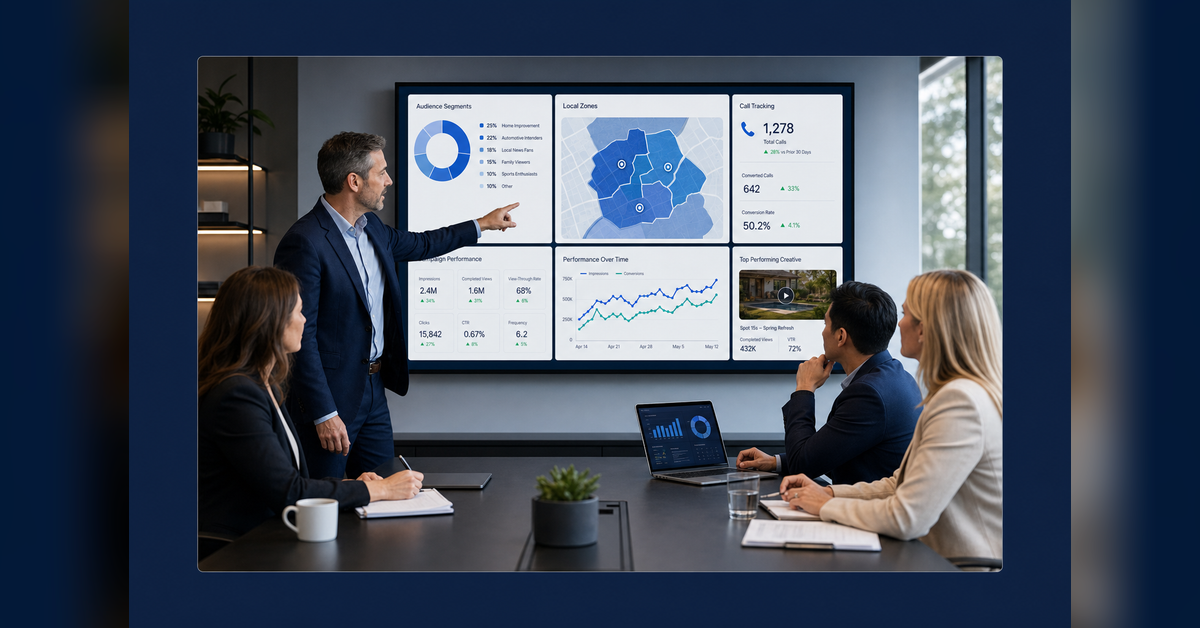
Track the signals that matter: calls, forms, branded search movement, assisted conversions, campaign landing page behavior, and lead quality.
Creative that works on a living-room screen
Connected TV creative has to be clear fast. Viewers may not click the ad, so the message must be easy to remember. Local businesses should avoid crowded scripts, tiny text, and generic stock footage that could belong to any company.
A strong CTV spot usually has one audience, one problem, one proof point the business can safely support, and one next step. If the call to action is too complicated, the viewer will not carry it into a later search or phone call.
How to run Connected TV Ads for Local Business Growth also depends on creative consistency. The offer in the ad should match the website, search ad, landing page, email follow-up, and sales script. If each channel says something different, the campaign leaks trust.
A simple three-step launch process
Step 1: Plan the local market
Choose the service area, define the audience, set the goal, confirm tracking, and decide what a qualified response looks like. This is the planning base for How to run Connected TV Ads for Local Business Growth without waste.
Step 2: Build the ad and landing path
Create a short video message, align it with a landing page or local offer, and make sure phone and form tracking are ready before launch.
Step 3: Measure and adjust
Review reach, frequency, site behavior, call quality, form quality, branded search movement, and assisted performance before increasing spend.
Measurement should be planned before the first impression
CTV reporting can show media delivery, but local leaders need more than delivery numbers. They need to know whether the campaign helped create demand that later appeared in calls, search, form fills, appointment requests, or sales conversations.
That is why Percepture ties media planning to analytics and conversion paths. A local CTV campaign should have clean tracking for landing pages, call sources, CRM notes when available, and channel lift. For companies with existing organic visibility, the plan can also connect with organic SEO services and search engine positioning so the brand captures more of the demand it creates.
How to run Connected TV Ads for Local Business Growth is not a one-report exercise. The first round of learning should shape creative, audience settings, follow-up channels, and budget pacing.
CTV vs. other local advertising options
| Option | Best use | Strength | Watchout |
|---|---|---|---|
| Connected TV | Building local awareness and trust before search or inquiry; often central to How to run Connected TV Ads for Local Business Growth | High-attention video environment | Needs strong measurement and follow-up channels |
| Paid search | Capturing buyers already searching | Clear intent and fast feedback | Can be expensive in competitive categories |
| Paid social | Retargeting, interest building, and offer testing | Flexible creative and audience testing | May not carry the same viewing attention as TV |
| Local SEO | Building durable visibility for local searches | Compounds over time | Usually slower than paid media |
| Digital PR | Building authority, reputation, and third-party visibility | Supports trust and search authority | Requires strong story selection |
Budgeting How to run Connected TV Ads for Local Business Growth
There is no single right CTV budget for every local business. The right investment depends on the size of the market, audience, creative requirements, campaign length, offer value, and how many supporting channels are already in place. Budgeting How to run Connected TV Ads for Local Business Growth should therefore start with the business case, not a preset impression target.
For planning, leaders should separate three cost areas: media, creative, and measurement. A lower media spend with better creative and tracking often beats a larger buy with no operating discipline. Percepture’s paid ads pricing packages and broader pricing resources can help buyers frame the conversation before scope is set.
Investment planning table
| Planning area | What to decide | Why it matters |
|---|---|---|
| Media | Market size, audience, pacing, and flight length | Controls reach, frequency, and waste |
| Creative | Script, video production level, offer, and local proof | Determines whether viewers remember the business |
| Landing path | Page, phone number, form, CRM routing, and follow-up | Turns attention into a measurable next step |
| Measurement | Call tracking, form tracking, branded search, and lead review | Shows whether the campaign is creating useful demand |
Score your local CTV readiness
Before asking How to run Connected TV Ads for Local Business Growth at scale, score the basics. If too many answers are weak, start with the operating gaps before buying more impressions.
Local CTV readiness scorecard
| Question | Green signal | Red signal |
|---|---|---|
| Is the audience clear? | You can describe the buyer in one sentence. | The campaign is aimed at everyone in the market. |
| Is the offer clear? | The ad has one memorable promise for How to run Connected TV Ads for Local Business Growth. | The script lists too many services. |
| Is the landing path ready? | Calls and forms are tracked and routed. | The viewer is sent to a generic homepage. |
| Is search coverage ready? | Branded and service searches are easy to capture. | Competitors can intercept the demand you create. |
| Is lead quality reviewed? | Sales and marketing can review real inquiries. | The only report is impressions and clicks. |
Common mistakes that make CTV underperform
The first mistake is treating CTV as a video upload instead of a market plan. The second is sending viewers to a weak website path. The third is judging the campaign only by last-click conversions, even though CTV often helps create demand that appears later in other channels.
Another common issue is running CTV while ignoring search visibility. If a viewer remembers your name or service and searches later, your business should be easy to find. That is where enterprise SEO, corporate SEO, and B2B SEO agency thinking can support paid media, even for local and regional companies.
How to run Connected TV Ads for Local Business Growth should never be reduced to buying the cheapest impressions. The work is to connect local reach with memorable creative, measurable demand, and a sales path that can handle the response.
Pre-launch checklist
- Define the local service area and exclude markets you cannot serve well.
- Write the buyer profile in plain language before choosing inventory.
- Set one primary goal and two secondary signals.
- Build creative around one problem, one promise, and one next step.
- Use the same message across the ad, landing page, and sales response when planning How to run Connected TV Ads for Local Business Growth.
- Confirm landing page, call tracking, form tracking, and sales routing.
- Plan search and paid social support before launch.
- Review lead quality with sales after the first learning window.
Where AI search and GEO fit into a CTV plan
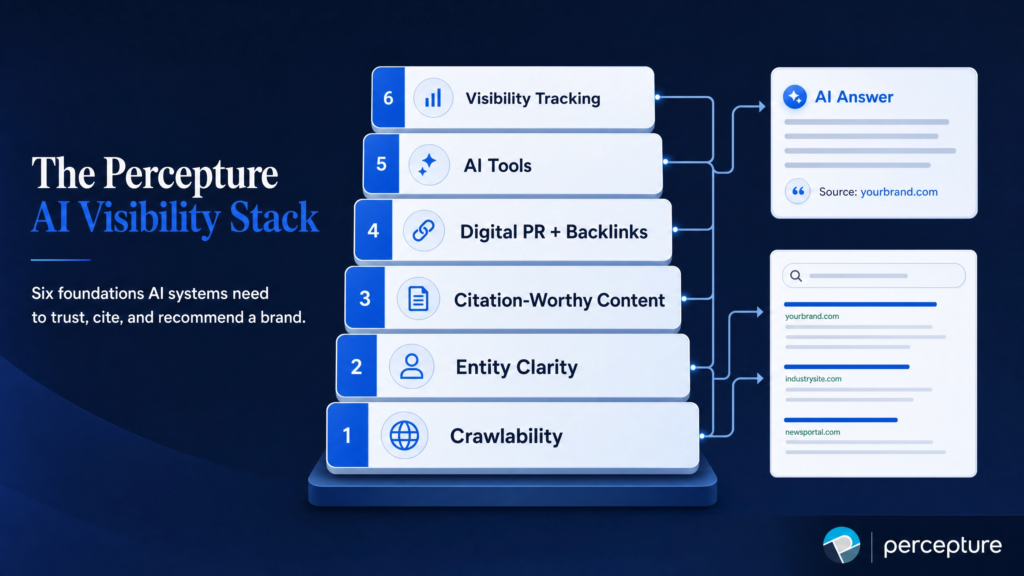
CTV can create brand memory, but buyers now research through search engines, AI answers, review sites, social platforms, and industry content. If a local buyer sees your ad and later asks a search engine or AI tool for options, your brand still needs a strong digital footprint.
Percepture connects paid media with GEO services, content, and authority-building when the buyer journey includes AI-assisted research. The goal is not to chase every channel. The goal is to make the brand findable and credible wherever the local buyer checks next.
That is why How to run Connected TV Ads for Local Business Growth belongs inside an omnichannel plan, not in a media silo. The ad starts the memory. Search, AI visibility, reviews, landing pages, and sales follow-up help turn memory into revenue.
What proof should you ask for before hiring a CTV partner?
Planning proof
Ask how the team defines local audiences, chooses geography, and connects the media plan to business goals. A serious answer to How to run Connected TV Ads for Local Business Growth should explain those choices before spend is approved.
Measurement proof
Ask what will be measured beyond delivery numbers and how lead quality will be reviewed.
Channel proof
Ask how CTV will work with search, social, landing pages, analytics, and follow-up.
Operator proof
Ask who will make decisions when the early data is mixed, not just who will launch the campaign.
Compare the full omnichannel plan
If you are weighing CTV, paid search, paid social, SEO, and follow-up together, review how Percepture approaches connected channel planning before setting budget. That broader plan is where How to run Connected TV Ads for Local Business Growth can be judged against real market, creative, and measurement needs.
Compare the Proof
How Percepture builds a local CTV campaign
Percepture starts with the business case, not the platform menu. The team looks at the market, the buyer, the message, the landing path, and the reporting plan before deciding how CTV should be used.
The campaign may sit inside a broader paid media strategy, with content marketing and strategy and planning used to support the buyer journey. For higher-value sales cycles, enterprise SEO ROI thinking can help leadership judge whether paid awareness, organic visibility, and lead conversion are working together.
How to run Connected TV Ads for Local Business Growth is a practical operating problem. The right partner should be able to discuss media, creative, analytics, conversion, sales follow-up, and executive reporting in the same conversation.
FAQs about local Connected TV ads
What is Connected TV advertising?
Connected TV advertising places video ads within streaming TV environments on internet-connected screens. For a local business, the value is targeted reach in a market where buyers may later search, call, visit, or request a quote.
How to run Connected TV Ads for Local Business Growth if my budget is limited?
Start with a focused trade area, one audience, one offer, and one trackable next step. How to run Connected TV Ads for Local Business Growth on a limited budget is about reducing waste first, not trying to look like a national TV advertiser.
How long should a local CTV campaign run?
A local campaign should run long enough to build reach, learn from early signals, and review assisted results across other channels. How to run Connected TV Ads for Local Business Growth over the right timeline depends on market size, budget, sales cycle, and how quickly your team can evaluate lead quality.
Should CTV replace paid search?
No. CTV and paid search do different jobs. CTV can build local awareness before a buyer searches. Paid search captures buyers who are already showing intent. Many local businesses need both working from the same message and measurement plan.
What should I measure besides impressions?
Measure calls, forms, landing page behavior, branded search changes, assisted conversions, sales notes, and lead quality. Impressions show delivery. They do not tell leadership whether the campaign created useful demand, which is why How to run Connected TV Ads for Local Business Growth must include lead review and channel lift.
Do I need a new landing page for CTV?
Often, yes. A focused landing page can match the ad message, simplify the next step, and make tracking cleaner. Sending CTV viewers to a broad homepage can make it harder to measure campaign influence and lead quality.
Can CTV help with local SEO or AI search?
CTV can create brand memory that may lead to more searches, but it does not replace SEO or GEO work. If buyers later research your company in search engines or AI tools, your site, content, authority, and local signals still need to support the campaign.
Who should manage local CTV campaigns?
Choose a team that understands media buying, creative, analytics, conversion, and follow-up. How to run Connected TV Ads for Local Business Growth usually requires operating judgment across several channels, not a platform-only launch that delivers impressions in isolation.
Plan How to run Connected TV Ads for Local Business Growth with Percepture
If you are ready to test CTV as part of a serious local growth plan, Percepture can help you define the audience, message, budget, measurement, and follow-up path before spend is committed. How to run Connected TV Ads for Local Business Growth starts with a tighter plan.
Book a Strategy Conversation
About Bob Generale
Bob Generale is President of Percepture, a PR, SEO, GEO, paid media, and omnichannel growth agency founded in 2004. He works with local, regional, B2B, telecom, healthcare, hospitality, and service businesses that need marketing to create real sales movement, not just impressions.
For Connected TV, Bob’s focus is the commercial path after the ad: who saw the message, what they searched next, how the landing page handled the visit, how the call or form was routed, and whether sales could turn attention into a qualified conversation. His work connects media strategy, creative, search visibility, lead generation, attribution, and follow-up into one operating system.