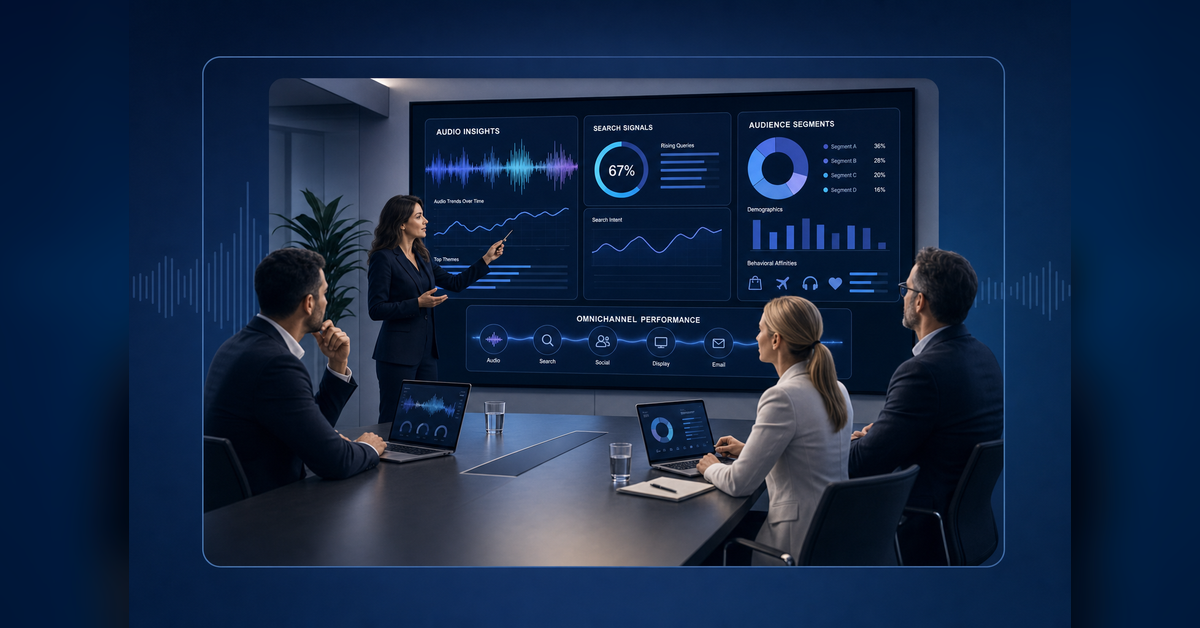

Streaming Radio Ads can be a smart addition to a media plan when the buyer knows who should hear the message, what action matters, and how the campaign will be measured. The channel works best when it is not treated as a cheaper version of broadcast radio, but as one part of a connected digital media system.
This guide is for business owners, CEOs, CMOs, and marketing leaders who want a clear way to judge the opportunity before committing budget. It explains where streaming audio fits, what to ask vendors, how to compare options, and when Percepture would connect audio with omnichannel marketing, paid media, SEO, and conversion strategy.





What are streaming audio campaigns?
Streaming Radio Ads are paid audio messages delivered through internet-connected radio, music, news, and audio platforms rather than only through traditional broadcast radio. They help brands reach listeners by audience, market, context, or behavior, then connect that reach to landing pages, search demand, remarketing, and attribution.
Executive summary for decision makers
Best fit
Streaming Radio Ads fit brands that need efficient awareness, local or regional reach, repeat exposure, and a media layer that supports search, social, and direct response.
Main risk
The biggest risk is buying audio as a stand-alone placement with no message system, no landing-page plan, and no measurement agreement before launch.
Budget logic
Budget should be based on the role of audio in the funnel, the audience size, the creative rotation, and the supporting media around the campaign.
Percepture view
Percepture evaluates audio inside a broader media buying plan so the campaign supports visibility, demand capture, and lead quality.
Who should consider Streaming Radio Ads?
Good fit
- Regional brands that need repeated reach in defined markets.
- Companies with a clear offer, phone path, store path, or landing page.
- Brands already investing in paid media and looking for Streaming Radio Ads as an audio layer.
- Marketing teams that can test creative and track downstream behavior from Streaming Radio Ads.
Poor fit
- Businesses with no clear audience or message.
- Campaigns that expect Streaming Radio Ads alone to close complex sales.
- Teams that cannot connect media spend to search, site, lead, or sales data.
- Brands that need only bottom-funnel capture this month.
Start with a media-fit diagnostic
If you are not sure whether audio belongs in the plan, start by scoring the audience, message, market, landing path, and measurement setup. Percepture can review whether Streaming Radio Ads should sit beside paid search, paid social, SEO, or a different channel mix.
Why audio deserves a different planning lens
Audio is often bought too loosely. A brand hears that listeners are spending time with digital audio, then buys inventory before the team defines the job of the channel. That creates a familiar problem: Streaming Radio Ads may deliver impressions, but leadership still cannot tell whether the spend helped the business.
A better question is simple: what should the listener do after hearing the message? For some companies, the answer is branded search. For others, it is a direct visit, a phone call, a store visit, or a later conversion after remarketing. Streaming Radio Ads should be planned around that next step, not just the audio spot itself.
This is where customer journey planning matters. The ad may create the first moment of recall, but the website, search result, social proof, and follow-up path have to carry the buyer forward.
Streaming Radio Ads inside an omnichannel plan
Streaming Radio Ads are strongest when they work with other channels. The audio message creates reach and memory. Paid search captures high-intent demand when people look up the brand or offer. Paid social can reinforce the message with visual proof. SEO and content help the buyer confirm that the company is credible.
This is different from placing an audio buy and hoping the market responds. In an integrated plan, each channel has a role. Streaming Radio Ads drive awareness and recall. Search captures demand. Social retargeting keeps the message visible. Content answers buyer questions. Analytics shows whether the system is moving in the right direction.
Leaders should also compare the buying model. Some campaigns are local, some are national, and some are built around audience segments. The right choice depends on market concentration, sales coverage, creative capacity, and how quickly the team can read performance signals.
The Percepture Audio-to-Action Framework
The Percepture Audio-to-Action Framework is a simple way to decide whether Streaming Radio Ads are ready for investment. It keeps the discussion focused on business movement instead of media jargon.
1. Audience clarity
Define the listener group, market, buyer stage, and exclusion logic before budget is assigned.
2. Message discipline
Use one clear promise, one reason to believe, and one next step. Streaming Radio Ads have no room for clutter.
3. Channel connection
Connect Streaming Radio Ads to search, site experience, remarketing, email, and content marketing.
4. Measurement agreement
Decide in advance which signals matter: branded search, visits, calls, forms, store actions, or assisted conversions.
5. Optimization rhythm
Review creative, audience, market, and landing performance on a set schedule, not only at the end of the buy.
What to evaluate before buying inventory
The first evaluation is fit. Does the campaign need broad reach, a defined market, or a specific audience? A local healthcare group, a regional travel brand, and a B2B company selling to a narrow committee should not buy the same way.
The second evaluation is creative. Creative for Streaming Radio Ads demands clarity. A listener cannot scan a paragraph, click a chart, or compare features while the message plays. The script needs a clear pain point, a simple offer, a memorable brand cue, and a next step that is easy to remember.
The third evaluation is measurement. Many leaders ask whether Streaming Radio Ads are trackable. The practical answer is that they can be measured through a combination of platform reporting, web analytics, search behavior, landing-page performance, call tracking, and assisted-conversion analysis. That measurement plan should be built before launch through attribution and analytics, not added after the campaign is already live.
Streaming Radio Ads comparison and pricing framework
Streaming Radio Ads should be compared against the job you need the media to do. The table below is not a rate card. It is a planning framework for deciding where audio belongs in the budget.
| Media option | Best use | Buyer advantage | Common mistake |
|---|---|---|---|
| Streaming audio | Awareness, recall, local or audience-based reach | Can support search, direct traffic, and retargeting | Running audio without a landing or measurement plan |
| Broadcast radio | Market-wide reach and traditional local presence | Can build familiarity in a geographic market | Assuming broad reach equals business impact |
| Paid search | Capturing active demand | Strong intent signal when buyers are already searching | Using search alone when demand is too low |
| Paid social | Visual reinforcement and retargeting | Supports proof, offers, and audience testing | Chasing cheap clicks instead of qualified movement |
| SEO and GEO | Long-term discoverability and answer visibility | Builds trust when buyers research the brand | Waiting for organic to fix a short-term awareness gap |
Pricing depends on inventory, market, audience, flight length, creative needs, and supporting media. A small Streaming Radio Ads test should still have a serious plan. A larger buy should not scale until the team understands whether the campaign is helping the buyer move from hearing the brand to searching, visiting, calling, comparing, or converting.
If leadership needs a broader budget view, Percepture can connect audio planning with paid ads pricing and the economics of a wider growth program. For organic demand capture, the team can also compare audio investment with SEO ROI planning.
Audio campaign readiness scorecard
Use this scorecard before approving Streaming Radio Ads. A campaign does not need a perfect score, but weak areas should be fixed before media goes live.
| Readiness area | Green signal | Red flag |
|---|---|---|
| Audience | The team can name the listener, market, and buying stage. | The audience is described as everyone in the market. |
| Creative | The script has one message and one next step. | The spot tries to explain every feature. |
| Landing path | The next step is easy to find, remember, and complete. | The ad points to a general homepage with no campaign logic. |
| Search support | Branded and offer searches lead to strong pages. | Search results do not support the claim made in the ad. |
| Measurement | Leadership agrees on the main success signals before Streaming Radio Ads launch. | The team plans to judge the campaign only by impressions. |
How to brief creative for audio
A strong audio brief is short. It should tell the writer who is listening, what problem they recognize, why the brand is believable, and what action should happen next. If the brief cannot explain the offer in plain language, the spot will likely be unclear.
The best message usually sounds like a real person speaking to a real problem. Avoid a list of features. Avoid crowded scripts. Avoid forcing the listener to remember a long URL or a complicated promotion. Streaming Radio Ads need quick comprehension and a brand cue that can survive distraction.
For B2B campaigns, creative should respect the buyer committee. The person hearing the ad may not be the final signer. That is why the follow-up path should help the listener share, search, or revisit the brand later. Percepture often connects this work with B2B intent data when the sales process is more complex.
A practical launch process
Step 1: Plan the role
Decide whether Streaming Radio Ads are meant to create awareness, support a launch, build local recall, or reinforce a campaign already running in other channels.
Step 2: Build the path
Prepare the landing page, branded search coverage, analytics, phone path, and retargeting before the first impression runs.
Step 3: Review movement
Look at downstream signals during the campaign. If people hear the message but do not search, visit, or act, adjust creative and channel support.
For teams that need a fast planning cycle, this process can be handled like an SEO sprint: define the objective, tighten the assets, launch a controlled test, and review the data without letting the project become a long committee exercise.
Common mistakes that make audio spend look weak
The first mistake is judging audio by the wrong KPI. If Streaming Radio Ads are built for awareness, they should not be judged only by immediate form fills. If they are built to drive calls, the call path should be ready before launch. The KPI has to match the assignment.
The second mistake is treating the ad like a brochure. Audio is not the place to explain every service line, credential, or feature. It is the place to make the right buyer remember one useful thing and know what to do next.
The third mistake is leaving search and AI visibility exposed. A listener may hear the ad, then search the company, the category, or the problem. If the brand does not show up with useful content, strong pages, and clear entity signals, the media investment leaks. That is why Percepture often pairs media strategy with GEO services, organic SEO services, and broader visibility work.
How Streaming Radio Ads support search and AI visibility
Streaming Radio Ads can create demand that later appears as branded search, category search, direct traffic, or assisted conversion activity. The campaign is stronger when the brand already has pages that explain the offer, answer common questions, and make the company easy to understand.
This matters because buyers rarely move in a straight line. They may hear the message in the car, search later on a laptop, ask an AI tool for options, visit review pages, and come back through a paid or organic result. Media planning has to account for that behavior.
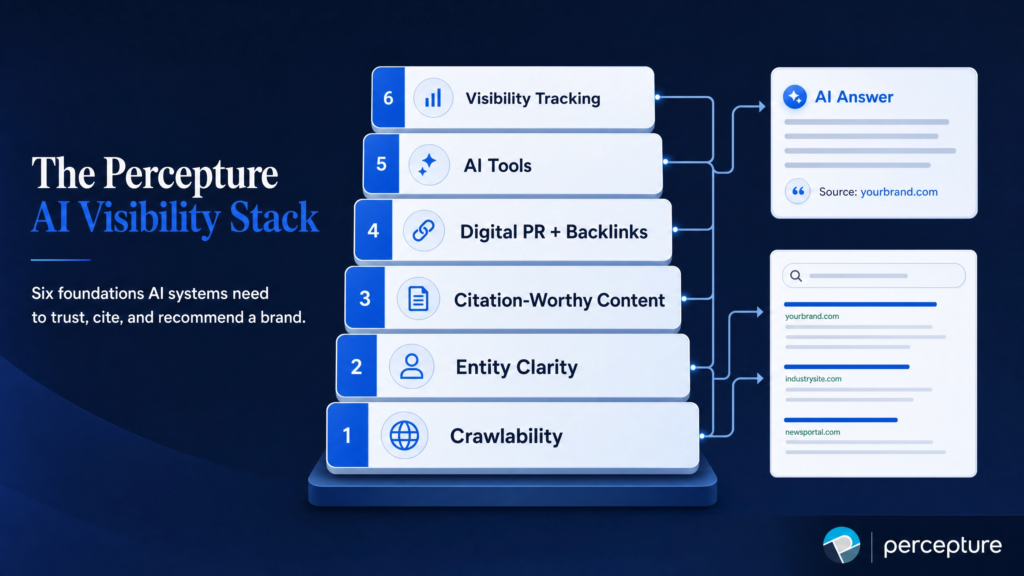
Percepture treats this as a visibility system. Corporate SEO, GEO, PR, content, and paid media each help the buyer confirm that the brand is real, relevant, and worth the next step.
What proof should leadership ask for?
Before approving budget for Streaming Radio Ads, leadership should ask for proof of thinking, not just proof of inventory. A vendor should be able to explain the audience, placement logic, creative plan, measurement limits, optimization cadence, and how audio connects to the rest of the media plan.
- Ask how the audience is defined and excluded.
- Ask which supporting channels should run at the same time.
- Ask how the campaign will be reviewed while it is active.
- Ask what the team will do if reach is delivered but business signals do not move.
- Ask whether the media plan supports the buyer journey after the ad is heard.
Compare the plan before you buy
If you already have a Streaming Radio Ads proposal on the table, Percepture can help pressure-test the audience, message, budget, and measurement plan. The goal is not to add more channels. The goal is to make sure the channels you fund have a clear job.
Buyer committee checklist
CEO
Does the campaign support a clear growth priority, market push, launch, or reputation goal?
CFO
Is the test sized to learn something useful without hiding weak measurement behind broad reach?
CMO
Do Streaming Radio Ads connect to search, social, content, CRM, and reporting instead of sitting alone?
Sales leader
Will the message create better conversations, better recall, or better-qualified inbound activity?
Marketing operator
Are tracking, pages, naming conventions, creative versions, and reporting responsibilities ready?
When to scale, pause, or rework the buy
Scale when the campaign is creating the movement you expected. That may mean more branded search, better direct traffic, more calls, stronger retargeting pools, or improved conversion assisted by other channels. The signal should match the original plan.
Pause when the media is spending but the path after the ad is broken. If the offer is unclear, the landing page is weak, or the search result does not support the audio message, more impressions will not solve the problem.
Rework the buy when the audience, market, or creative is too broad. Streaming Radio Ads give leaders a way to test and refine, but only if the campaign is set up with enough discipline to learn from the data.
FAQs about audio media buying
What are Streaming Radio Ads?
Streaming Radio Ads are audio ads delivered through internet-connected listening platforms rather than only through broadcast stations. They can be planned by market, audience, context, or campaign goal, then measured alongside web, search, call, and conversion activity.
Are streaming audio ads better than traditional radio?
Neither option is automatically better. Traditional radio can provide broad local reach. Streaming Radio Ads can offer more digital planning and measurement options. The better choice depends on the audience, market, budget, creative, and the business action you need after the ad is heard.
How should a company measure Streaming Radio Ads?
Measurement should be agreed on before launch. Useful signals may include branded search, direct traffic, landing-page visits, calls, assisted conversions, retargeting pool growth, and sales feedback. Impressions matter, but they should not be the only way leadership judges the campaign.
How much budget should a business test first?
The right Streaming Radio Ads test budget depends on the market, audience size, flight length, creative needs, and supporting channels. A useful test should be large enough to create a readable signal, but disciplined enough that the company can adjust before scaling spend.
What creative works best for audio ads?
Strong creative for Streaming Radio Ads uses one message, one reason to believe, and one next step. It should sound natural, be easy to remember, and avoid long lists of features. If the listener cannot repeat the basic offer, the script is probably too crowded.
Can audio ads help SEO or AI search visibility?
Audio ads can create demand that later appears as search, direct traffic, or research activity. They do not replace SEO or GEO, but they can support them when the brand has clear pages, helpful answers, and consistent entity signals across the web.
When should a company not buy Streaming Radio Ads?
A company should wait if the audience is unclear, the offer is weak, the landing path is not ready, or leadership has no measurement plan. Streaming Radio Ads can create reach, but they cannot fix a broken message or a poor buyer journey by themselves.
Build an audio plan that connects to revenue movement
If Streaming Radio Ads belong in your next media plan, Percepture can help define the audience, message, channel mix, landing path, and measurement system before budget is committed. If they do not belong, we will say that too and point the plan toward the channels with a stronger fit.