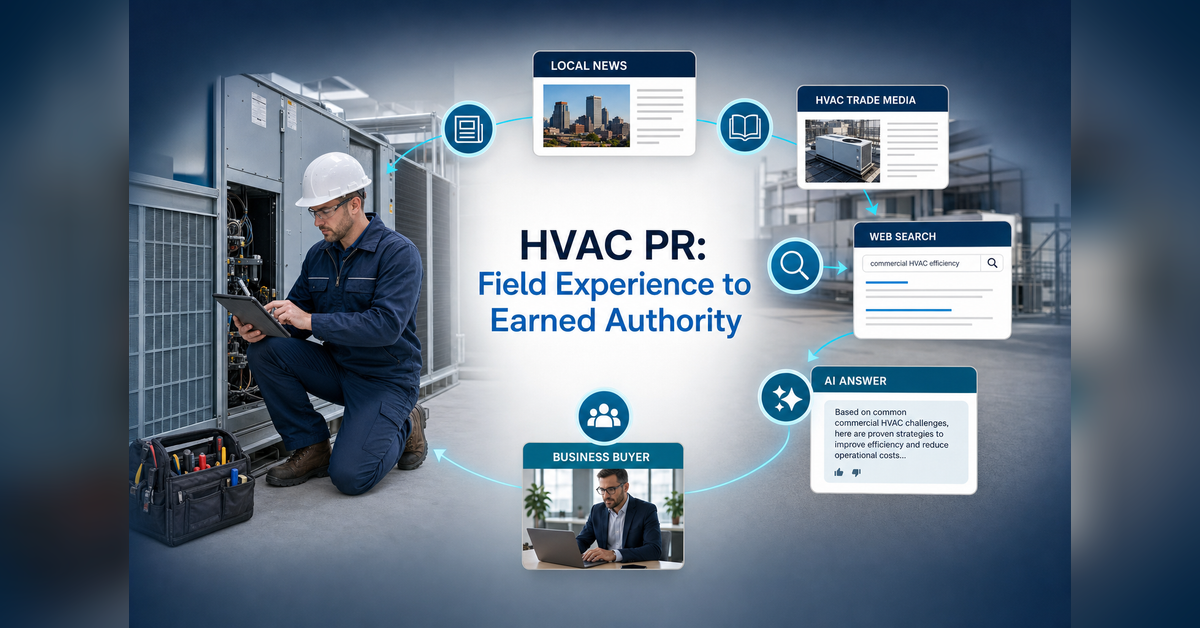

HVAC PR, meaning public relations for heating, ventilation, air conditioning, refrigeration, controls and mechanical companies, turns real field experience into useful stories and trusted evidence. The strongest hvac pr programs start with what technicians, engineers, service managers and customers already know.
This guide gives owners and marketing leaders a working system for hvac pr, from proof capture and technical review to media outreach, search visibility, AI retrieval and business measurement. It also shows where public relations ends and SEO, content, GEO and paid amplification begin.
How specialist expertise becomes visible, trusted and commercially useful
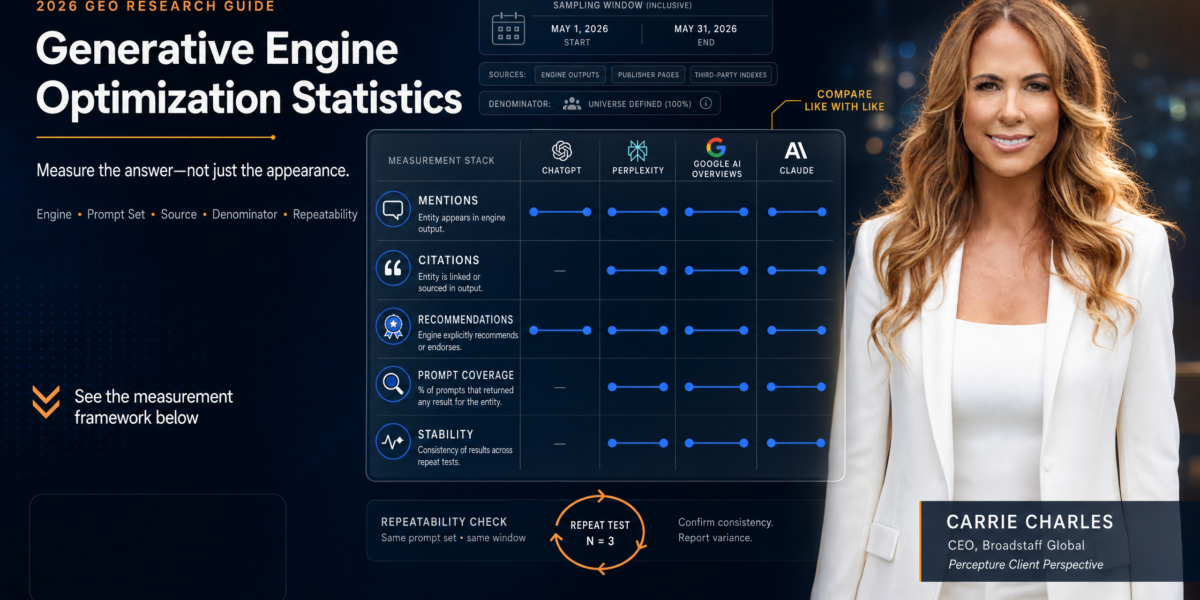
Carrie Charles, CEO of Broadstaff Global, discusses Percepture’s work connecting specialized B2B expertise with SEO, digital PR, AI-search visibility and qualified demand. Broadstaff is not an HVAC company. The transferable lesson is that technical buyers respond to clear expertise, third-party authority and consistent visibility across the places they research.
Adjacent technical B2B proof. The video demonstrates Percepture’s operating approach and does not promise an identical HVAC result or timeline.
Verify the team before evaluating the framework
Public relations for HVAC depends on senior judgment, technical review, media discipline and the ability to connect earned authority with owned search and AI visibility.




Percepture applies the same authority system to its own categories
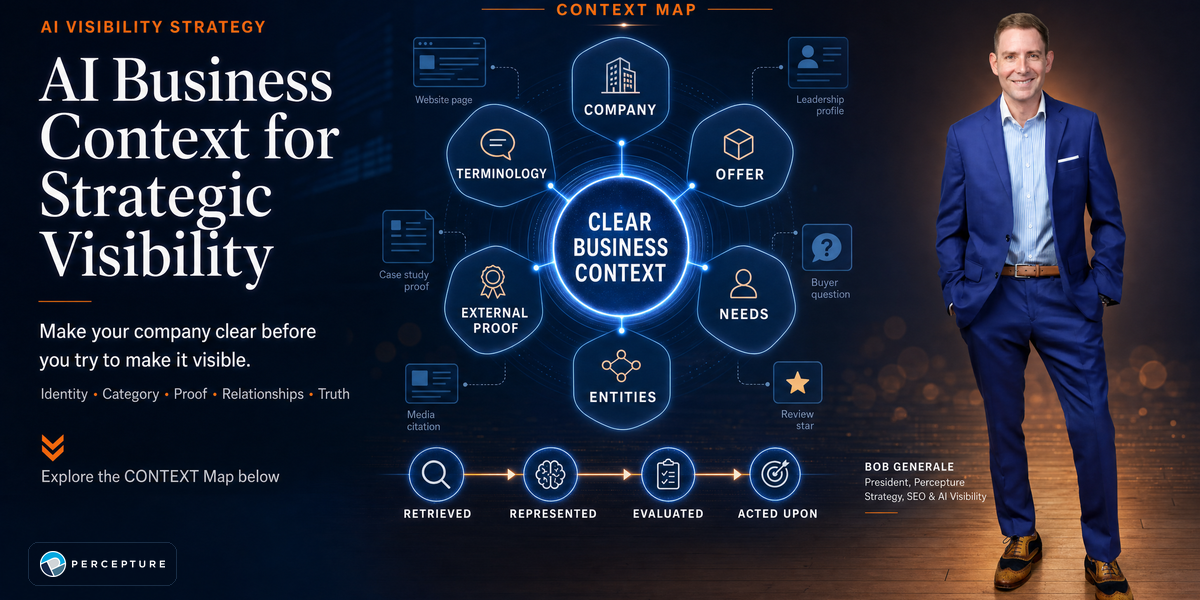
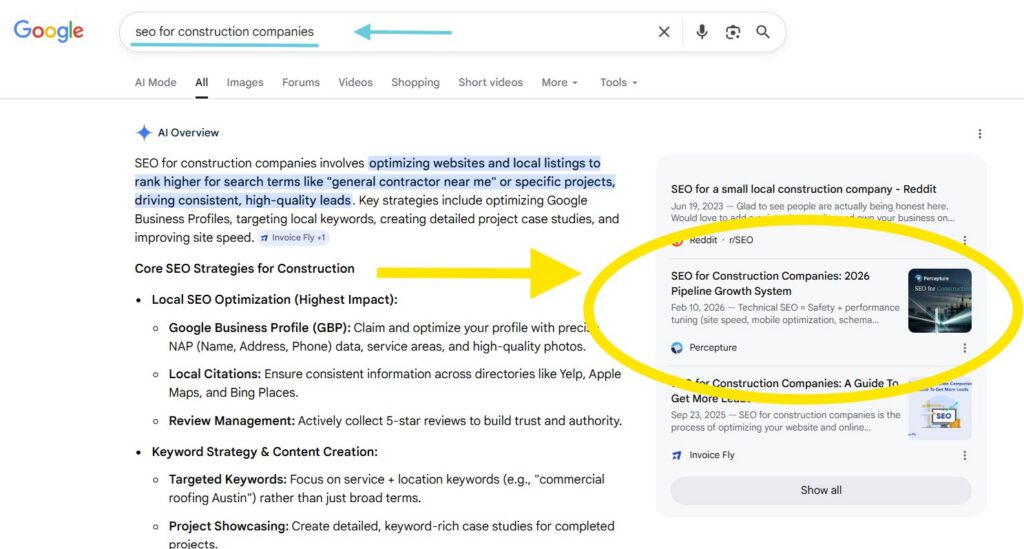
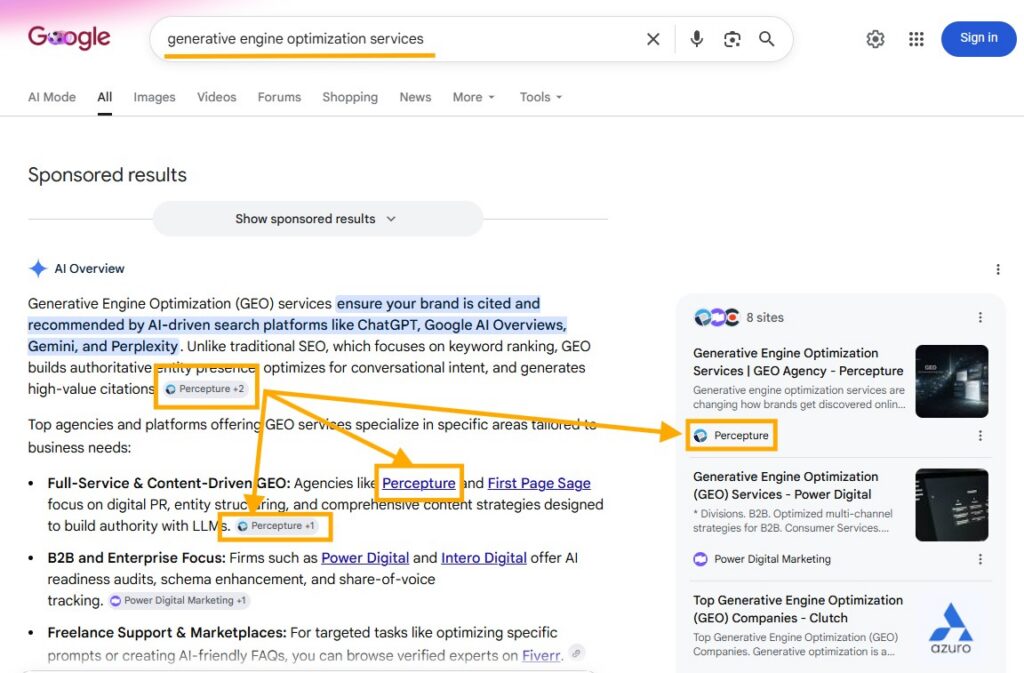
An HVAC PR agency should be able to show how expertise, evidence, search architecture and third-party authority work together. These stacked examples demonstrate Percepture’s visibility in adjacent contractor and AI-search categories without presenting them as HVAC PR guarantees.
What should your HVAC company become known for?
Percepture can map the experts, stories, publications, buyer questions and search surfaces shaping your category. The objective is not more publicity. It is a clearer path from field experience to trust, visibility and qualified conversations.
What is HVAC public relations?
hvac pr is a continuous process that turns verified operating experience into expert commentary, timely stories, earned media, digital citations and reusable buyer proof. It combines media relations, content, E-E-A-T, SEO, AI visibility, technical review and measurement. No agency can guarantee editorial coverage, rankings, links or AI citations.
Executive summary
Start with evidence
Build the story inventory from service calls, installations, retrofits, commissioning, customer questions, training and recurring field patterns.
Name the right expert
Match each claim to a technician, engineer, service manager, executive, product specialist or other qualified reviewer with a defined scope.
Package a useful story
Give the audience a timely reason to care, supporting facts, practical context and a clear explanation of why the expert is qualified to speak.
Make proof compound
Connect hvac pr coverage to owned content, internal links, expert pages, sales follow-up, recruiting, email and measurable audience response.
Who needs HVAC public relations?
Residential and multi-location contractors
Use HVAC public relations to build local trust, support recruiting, explain seasonal issues and give owners, service managers and technicians a stronger public voice.
Commercial mechanical and facility-service firms
Use HVAC B2B PR to reach facility leaders, developers, engineers, general contractors, healthcare organizations, data-center operators and committee buyers.
Manufacturers, controls and refrigeration companies
PR for refrigeration and HVAC companies can support product education, application expertise, distributor relationships, technical media and market-category authority.
Private-equity platforms and growing brands
Use a public relations agency for HVAC to coordinate executive positioning, acquisitions, market expansion, local-company credibility and shared standards across a larger platform.
Find the gaps in your HVAC PR system
Review evidence, experts, approval controls, media assets, owned sources and measurement before committing to a campaign. The scorecard later in this guide gives your team a practical baseline.
Jump to the HVAC PR Readiness ScorecardBuild E-E-A-T into the operating process
E-E-A-T means experience, expertise, authoritativeness and trustworthiness. It is not a single score that a company earns by adding an author biography. It is a way to evaluate whether the page and the people behind it demonstrate first-hand knowledge, qualified review, outside authority and reliable publishing practices.
For hvac pr, experience may come from a no-cool call, a commercial retrofit, commissioning, technician training, a recurring maintenance pattern or an unusual customer question. Expertise comes from naming the person qualified to explain that experience and setting limits around what the person can responsibly claim.
Authoritativeness can include earned coverage, bylines, speaking, research, partnerships and consistent expert profiles. Trust comes from accurate claims, sources, consent, disclosures, review dates, limitations and a process for correcting errors.
HVAC E-E-A-T evidence matrix
| Category | Evidence | Expert or owner | Review | Publication use | Main risk | Update schedule |
|---|---|---|---|---|---|---|
| Experience | Service notes, project records, interviews, approved photos and recurring questions | Technician, installer, service manager or project lead | Confirm what happened, where and when | Case context, commentary, guide or pitch | Missing consent or incomplete context | After the project or reporting period |
| Expertise | Role, credentials, years of relevant work, topic scope and geography | Named subject-matter expert | Technical and business review | Expert page, byline, interview or source note | Expert speaking outside scope | When the role or scope changes |
| Authoritativeness | Earned coverage, bylines, speaking, research and independent mentions | PR and content owners | Verify source and media type | Press room, proof block or sales asset | Presenting paid placement as earned | After each verified result |
| Trust | Sources, disclosures, permissions, limitations and correction records | Technical, legal or risk owner | Claims and consent review | Every sensitive public asset | Unsupported safety, health, savings or regulatory claims | Before publication and during scheduled review |
A useful Who, How and Why check keeps the process grounded. Who created and reviewed the asset? How was the evidence gathered? Why was it published for this audience? Generic quotes, fake review markup, thin AI-targeted pages and empty thought leadership do not answer those questions.
The Percepture HVAC SIGNAL Expert-News Engine
The Percepture HVAC SIGNAL Expert-News Engine is a six-stage hvac pr methodology: Source, Inspect, Generate, Network, Amplify and Link. It moves real operating experience through verification, publishing, outside validation and measurement without confusing promotion with expertise.
How the SIGNAL methodology works
S — Source real experience
Purpose: Find credible material in service calls, installations, retrofits, training, maintenance, customer questions and community work.
Owner and evidence: Operations, technicians, project leaders and marketing provide dated notes, interviews, records and permissions.
Output: A searchable story inventory. The common failure is starting with a promotional theme instead of evidence.
I — Inspect every claim
Purpose: Check accuracy, scope, geography, timing, confidentiality, consent and possible safety implications.
Owner and evidence: The appropriate technical, business, legal or customer reviewer checks the source material.
Output: An approved claims matrix. The failure mode is fast publishing without qualified review.
G — Generate useful assets
Purpose: Turn approved evidence into commentary, pitches, bylines, guides, studies, fact sheets, video, transcripts and source pages.
Buyer benefit: Every asset explains why the topic matters now, why the expert is relevant and what supports the claim.
N — Network with authority channels
Purpose: Match each story to local news, HVAC trades, business journals, facilities media, podcasts, associations or national outlets.
Buyer benefit: The channel is selected for stakeholder influence, not audience size alone.
A — Amplify the proof
Purpose: Reuse verified results in press-room entries, expert pages, email, sales follow-up, recruiting, proposals and executive posts.
Search role: Strong owned pages and internal links help people and retrieval systems understand the expert, topic and company relationship.
L — Link communication to outcomes
Purpose: Measure resources, outputs, audience response, outcomes and supported business impact.
Buyer benefit: Leaders see more than an impression total; they can inspect coverage quality, referrals, inquiries, account activity and assisted opportunities.
An eight-step HVAC PR strategy
- Choose a business objective. Decide whether the priority is local trust, commercial credibility, recruiting, a launch, expansion, partnerships, expert visibility or stronger support for sales. One campaign can help several groups, but it still needs a primary objective.
- Build a proof inventory. Gather approved service patterns, projects, customer questions, research, training programs, operational changes and community work. A credible hvac pr story begins with evidence that can survive technical and editorial questions.
- Create an expert roster. Do not make the owner the only spokesperson. Map technicians, engineers, service managers, product specialists and executives to specific subjects, markets and media formats.
- Plan seasonal and evergreen angles. Combine predictable topics such as peak weather and maintenance with durable subjects such as workforce development, commissioning, controls, commercial performance and customer education.
- Build the media map. Separate local news, HVAC trades, business media, facilities and construction publications, podcasts, associations and national consumer outlets. Each needs a different story, expert and proof package.
- Create useful assets and conduct outreach. Prepare source pages, fact sheets, original data, videos, transcripts and visuals before pitching. Then use proactive pitches, editorial calendars, journalist requests, reactive commentary, bylines, interviews and speaking opportunities where they fit.
- Amplify without mislabeling. Earned media is selected by a publisher. Paid, sponsored, shared and owned media have different roles and should be labeled accurately. Paid amplification can extend useful proof, but it does not turn a purchased placement into earned coverage.
- Measure what changed. Track inputs, outputs, audience response, outcomes and supported impact. Connect coverage to referrals, branded search, account engagement, inquiries, recruiting or sales activity when the underlying data permits.
Capture field experience without slowing the operation
Many HVAC companies already have enough raw material. It is trapped in dispatch conversations, service notes, training sessions, callbacks, sales questions, project retrospectives and the memory of experienced employees. The answer is not to ask technicians to become full-time creators.
Use short, structured interviews. Ask what happened, what made the situation unusual, what the team checked, what changed and what another operator should understand. Record the date, geography, equipment or application context, customer permissions, sources and limits.
One interview to ten usable assets
- An approved interview transcript
- A journalist source profile
- A short expert commentary
- A trade-media pitch
- A local story angle
- A byline outline
- A source-backed web article
- A sales proof block
- An executive social post
- An internal FAQ or training note
The same verified source can support authority content services, media outreach and sales enablement. Each public version still needs the correct reviewer, audience and disclosure.
Build expert profiles that reporters and buyers can use
An expert profile should identify the person’s name, role, relevant credentials, experience, topic scope, market or geography, source materials, review date and limitations. It should also connect to a stable author or expert page and a consistent professional profile.
Useful boundaries make spokespeople safer and faster. A service manager may discuss maintenance patterns but not interpret a regulation. An engineer may address a defined technical application but not make broad health or savings claims. A company spokesperson can explain business strategy without speaking for a customer or partner.
HVAC story and media matrix
| Business type | Strong story sources | Likely expert | Useful channels | Proof required |
|---|---|---|---|---|
| Residential contractor | Seasonal questions, maintenance patterns, training and community programs | Service manager or technician | Local news, consumer media and community outlets | Dated patterns, scope, geography and customer privacy controls |
| Commercial mechanical firm | Retrofits, commissioning, facility challenges and workforce development | Project executive, engineer or commissioning lead | Business, facilities, construction and trade media | Project records, permissions, application context and technical review |
| Manufacturer or OEM | Product research, training, application trends and original data | Product specialist or engineer | HVAC trade, manufacturing and business media | Methodology, limitations, sources and approved product claims |
| Distributor | Inventory patterns, training, contractor support and market education | Market leader or training manager | Trade, regional business and partner channels | Defined sample, time period and non-confidential data |
| Refrigeration company | Maintenance, cold-chain operations, training and application changes | Refrigeration specialist | Trade, facilities, food-service and business media | Technical review and careful treatment of regulatory subjects |
| Controls company | Building automation, commissioning, operator education and integration | Controls engineer or commissioning specialist | Facilities, energy, construction and technology media | System context, approved diagrams and performance limitations |
| Franchise or multi-location group | Local programs, training systems, market expansion and governance | Corporate leader plus local operator | Local media and business publications | Corporate-local approval rules and consistent claims |
| PE-backed platform | Expansion, recruiting, operating systems and market education | Platform executive or operating leader | Business, finance, trade and local media | Disclosure, transaction boundaries and portfolio-level governance |
Plan seasonal stories before the weather arrives
Reactive commentary works best when experts, claims and approval paths are ready before the news breaks. Build a rolling calendar around peak weather, shoulder-season maintenance, energy questions, IAQ, heat pumps, workforce, community programs, building performance, data-center cooling and emergency preparation.
Refrigerant, code, incentive, safety and regulatory topics require qualified review. A general article can explain how a company prepares its communications process, but it should not interpret a rule for a specific business without the appropriate expertise.
Evergreen work fills the gaps between seasonal moments. Training programs, original field data, maintenance guides, commissioning lessons, buyer questions, benchmarks, calculators, surveys, forecasts, case studies, fact sheets and transcripts can create a dependable source library.
Which media channel fits the story?
| Channel | Best use | Best spokesperson | Evidence expected | Potential business value |
|---|---|---|---|---|
| Local news | Weather, community, consumer education, jobs and local projects | Local operator or field expert | Local relevance, availability and clear practical guidance | Market familiarity and community trust |
| HVAC trade media | Technical lessons, products, operations, training and industry change | Engineer, product specialist or senior operator | Technical depth, sources and defined application scope | Peer authority, partner recognition and trade visibility |
| Business media | Growth, leadership, workforce, acquisitions and market strategy | Owner, CEO or operating executive | Business context, supporting records and disclosure | Executive positioning and stakeholder confidence |
| Facilities and construction media | Commercial projects, retrofits, commissioning and building operations | Project, engineering or facilities expert | Project context, permissions and measurable evidence | Specifier, facility and committee-buyer recognition |
| National consumer media | Broad seasonal education and widely relevant household questions | Media-ready consumer expert | Clear guidance, strong limitations and national relevance | Large-scale awareness when the story truly fits |
The biggest outlet is not automatically the best outlet. A focused trade article may matter more to a specifier, facility manager, distributor or commercial buyer than a broad mention with little message pull-through.
HVAC PR compared with digital PR, SEO, GEO and paid media
| Discipline | Primary job | Evidence used | Main channel | Useful KPI |
|---|---|---|---|---|
| Traditional public relations | Build relationships and earn editorial attention | Experts, stories, facts and timely relevance | Reporters, editors, producers, podcasts and events | Coverage quality, expert inclusion and message pull-through |
| Digital PR | Earn online mentions, citations, links and reusable trust | Original sources, expert commentary, data and useful assets | Online publishers and digital platforms | Relevant mentions, referral activity, links and source reuse |
| SEO | Make owned content crawlable, understandable and discoverable | Structured pages, entities, expertise and internal relationships | Search results | Qualified visibility, engagement and conversions |
| GEO | Improve entity clarity and source usefulness for AI retrieval | Named experts, sourced facts, transcripts and third-party validation | AI-assisted search and answer systems | Prompt visibility, accurate mentions and cited-source patterns |
| Content | Explain the company’s knowledge in owned formats | Interviews, research, cases and approved claims | Website, email, video and sales materials | Engagement, assisted journeys and reuse |
| Paid media | Purchase targeted reach and controlled distribution | Approved creative, audience data and offers | Advertising platforms and sponsored inventory | Reach, response, cost and conversion |
These disciplines work best when they share a source library and entity model. Percepture’s digital PR services, enterprise SEO services and generative engine optimization services address different jobs, but they can reinforce the same verified expertise.
How digital PR supports search and AI visibility
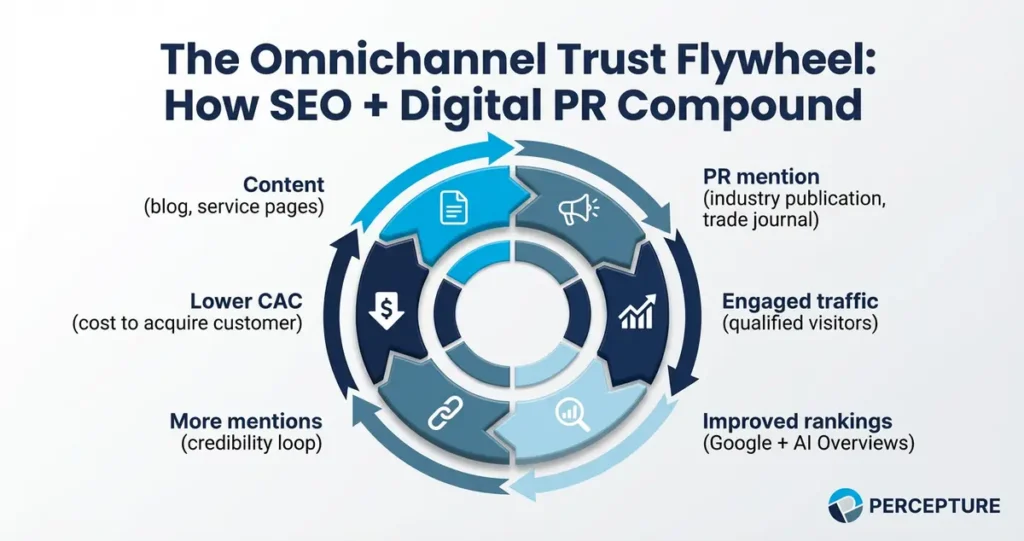
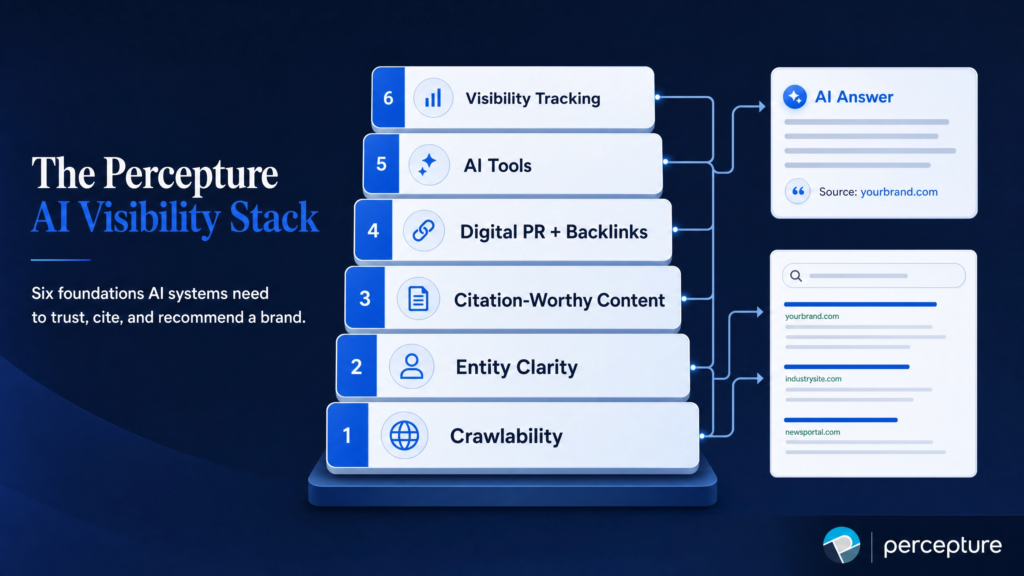
Digital PR may help discovery, referral traffic, relevant links, entity clarity and outside validation. It can also create source material that supports expert pages, transcripts, internal linking and answer-ready content. Those benefits depend on the quality of the story, publication, owned page and technical implementation.
Search engines and AI platforms make their own decisions. Percepture can strengthen evidence, entities, publishing structure, outreach and measurement, but it cannot guarantee that any platform will rank, quote, link to, recommend or cite a company.
A practical program connects coverage to a strong owned source rather than treating the press hit as the finish line. Read more about what digital PR is and how digital PR supports AI search.
For owned sources, a technical SEO audit service can reveal crawlability, canonical, template and internal-link issues that prevent strong PR evidence from being retrieved. Percepture also publishes a focused guide on what strategies improve brand visibility in AI search engines.
Proof before promotion
A newsworthy story may already be hidden inside a route, installation, repair, training program, product design, facility or customer problem. The work is to find it, verify it, explain why it matters and package it for an audience that can use it.
A transferable public relations example

The public Amazon and Phantom Ranch PR case study shows how an operational story can become broad media interest when the route, people and challenge are made visible. The HVAC lesson is not to copy the campaign. It is to inspect ordinary operations for a distinctive, supportable story.
Construction offers another adjacent model because both sectors involve technical claims, project proof, local trust, workforce issues and committee buying. Percepture’s guide to PR for construction companies explains that related authority model without presenting construction work as direct HVAC evidence.
Measure HVAC PR beyond impressions
Good measurement starts with the objective and moves through a ladder. Inputs include expert time, evidence, budget and assets. Outputs include pitches, briefings, coverage, bylines, mentions, links, videos and source pages.
Audience response can include referrals, engagement, branded search, target-account activity, recognition, AI mentions and sentiment. Outcomes may include inquiries, recruiting activity, partnerships, meetings, shortlist inclusion and assisted opportunities. Business impact should be reported only when the available data supports the relationship.
| Level | Questions | Example measures |
|---|---|---|
| Inputs | What resources did the program use? | Expert time, research, source records, budget and production capacity |
| Outputs | What did the team produce or earn? | Pitches, briefings, coverage, bylines, links, mentions and source pages |
| Audience response | Did the right people notice or engage? | Referrals, branded search, message pull-through, account activity and recognition |
| Outcomes | Did stakeholder behavior change? | Inquiries, meetings, recruiting, partnerships, shortlist inclusion and assisted opportunities |
| Impact | Can a supported business effect be documented? | Influenced revenue, retention, expansion, reputation or recruitment when attribution permits |
Connect reporting to attribution and analytics rather than centering the report on advertising-value equivalency or raw impression totals.
A practical 90-day plan
Days 1–30: establish the foundation
- Set the objective, audiences and baseline.
- Inventory experience, claims, existing coverage and owned sources.
- Create the expert roster and approval path.
- Map seasonal and evergreen stories.
- Build the media list and source library.
- Define disclosure, consent and escalation rules.
Days 31–60: build and test assets
- Interview experts and verify source material.
- Create commentary, fact sheets, source pages and transcripts.
- Improve the press room and expert pages.
- Begin focused outreach and executive publishing.
- Connect new assets with contextual internal links.
- Test approval speed and spokesperson readiness.
Days 61–90: expand and measure
- Pursue appropriate local, trade and business opportunities.
- Develop bylines, interviews and approved cases.
- Reuse proof in sales and recruiting workflows.
- Monitor search visibility, referrals and AI mentions.
- Report outputs, audience response and outcomes.
- Build the next-quarter calendar from what worked.
A 90-day plan creates an operating rhythm; it does not set an editorial deadline for independent publishers. The right pace depends on expert access, evidence quality, technical review, approvals, news timing and media interest.
Build a 90-day HVAC media roadmap
Compare scope, channels, expert access and measurement before choosing a program. Review public relations pricing packages and identify which parts of hvac pr should remain in-house, move to an agency or use a hybrid team.
Review HVAC PR Pricing and Scope Review a Public Relations Case StudyScore your readiness from 0 to 40
Give each item 0 points when it is absent, 1 when it is inconsistent and 2 when it is documented and active. This hvac pr readiness score is an operational diagnostic. It is not a Google score or ranking factor.
HVAC PR readiness scorecard
| Area | 0 points | 1 point | 2 points |
|---|---|---|---|
| Experience documentation | Absent | Informal | Documented process |
| Named experts and credentials | Absent | Partial | Current and scoped |
| Technical review and sources | Absent | Inconsistent | Assigned and recorded |
| Story inventory and media map | Absent | Ad hoc | Prioritized and current |
| Spokesperson readiness and press room | Absent | Limited | Tested and usable |
| Author pages and expert profiles | Absent | Incomplete | Clear and connected |
| Cases and testimonials | Absent | Unstructured | Approved and contextual |
| Coverage and internal links | Absent | Occasional | Maintained and reused |
| AI retrieval and measurement | Absent | Limited | Monitored against objectives |
| Corrections, disclosure, crisis escalation and sales reuse | Absent | Partial | Documented and active |
- 0–12: Hidden Experience. Useful knowledge exists, but outsiders cannot reliably find or verify it.
- 13–24: Inconsistent Authority. Some experts and assets are visible, but the system depends on individual effort.
- 25–32: Media-Ready Foundation. Evidence, experts and channels are organized well enough to support regular outreach.
- 33–40: Compounding Authority System. Verified proof moves across media, owned content, search, AI monitoring, sales and reporting.
Common mistakes and ethical risks
- Pitching without evidence. Promotion cannot replace field experience, sources or technical review.
- Sending news with no audience value. A company update is not automatically useful to a reporter or reader.
- Leaving claims unreviewed. Health, safety, environmental, savings, efficiency and regulatory statements require careful scope and qualified review.
- Using only the owner as an expert. A broader roster improves accuracy, availability and subject depth.
- Chasing outlet size. Relevance and stakeholder influence often matter more than raw reach.
- Relying on weak syndication. Repetition across low-value sites is not the same as meaningful editorial validation.
- Hiding methodology. Research without a defined source, sample, period or limitation is hard to trust.
- Presenting sponsored content as earned. Buyers and publishers should be able to see the media type.
- Creating PR and SEO entity conflicts. Names, titles, service descriptions and expert topics should stay consistent.
- Publishing video without transcripts. A text equivalent makes the content easier to access, search and reuse.
- Failing to reuse coverage. A placement should support press-room, expert, sales and recruiting assets when appropriate.
- Reporting impressions alone. Coverage quality, message pull-through and stakeholder behavior provide better context.
- Publishing thin prompt pages. AI visibility requires useful sources, not a separate page for every possible question.
- Making guarantees. Editorial, search and AI systems retain independent discretion.
- Operating without a crisis approval tree. Sensitive events need assigned decision-makers and escalation rules before outreach begins.
Companies should connect ongoing media work with crisis communications services when reputation, safety, litigation, recalls, injuries, disputes or emergency response may be involved.
When should an HVAC company hire outside PR support?
Outside support becomes useful when strong experience remains hidden, the company is expanding or launching, recruiting pressure is rising, media relationships are limited, or PR, SEO and content operate as separate workstreams. It can also help when internal teams lack interview capacity, technical governance, outreach time or outcome reporting.
An in-house team may own expert access, approvals and day-to-day context. An agency may add strategy, media relationships, production, digital PR, search integration and measurement. A hybrid model often works when responsibilities are explicit and the company retains technical control.
Buyers evaluating a partner can use Percepture’s HVAC public relations agency guide to compare agency fit without turning this educational strategy page into a vendor list.
How to choose an HVAC PR agency
Public relations companies for HVAC should be evaluated on the operating system behind the pitches, not the number of emails they promise to send. Ask every HVAC PR firm to show the same evidence.
Percepture publishes this article and offers HVAC B2B public relations services. Buyers should use the same evaluation criteria for Percepture and every competing agency.
Frequently asked questions
What does HVAC PR mean?
hvac pr means public relations for heating, cooling, refrigeration, controls and mechanical companies. It turns verified experience into useful expert commentary, media stories, digital citations and owned proof. The process includes evidence capture, technical review, media targeting, outreach, amplification and measurement.
How does E-E-A-T apply to HVAC public relations?
E-E-A-T helps teams evaluate experience, expertise, authoritativeness and trust. In practice, that means documenting real work, naming qualified experts, reviewing technical claims, earning independent validation, disclosing media types and keeping sources, dates, permissions and limitations visible.
Is E-E-A-T a direct ranking factor or score?
No single E-E-A-T score is created by this readiness framework. Companies should treat E-E-A-T as a publishing and trust discipline rather than a badge. Author biographies alone cannot replace first-hand evidence, expert scope, technical review, sources and reliable owned content.
What is the difference between public relations and digital PR?
Public relations focuses on useful stories, spokespeople, media relationships and earned attention. Digital PR applies that work to online publishers and assets that may produce mentions, citations, referral traffic, links and reusable digital trust. Both still depend on editorial discretion.
How is HVAC public relations different from SEO?
Public relations works through experts, stories and outside publishers. SEO improves how owned pages are crawled, understood and discovered. They support each other when earned coverage points to a strong source page and owned content accurately explains the company, expert and topic.
Can digital PR make an HVAC company appear in AI answers?
Digital PR may strengthen entity clarity, source diversity and third-party validation that AI systems can retrieve. Transcripts, named experts, current facts and connected owned pages also help. No company can guarantee that an AI platform will quote, cite or recommend a source.
Does every HVAC story need a technical reviewer?
The reviewer should match the claim. A basic community announcement may need business and permission review, while a story involving refrigerants, safety, IAQ, savings, performance or regulations may require qualified technical or legal review. The scope should be set before outreach.
How long does an HVAC media strategy take?
A team can organize objectives, experts, evidence, media targets and initial assets in a 90-day operating plan. Earned coverage has no guaranteed timetable because publishers control editorial decisions. Timing also depends on evidence quality, approvals, expert availability and the news cycle.
How do I choose a public relations agency for HVAC?
Choose an agency that can document relevant technical-market experience, senior ownership, field-expert interviews, claim review, media relationships, digital PR, search integration, AI-visibility support and business measurement. Ask for inspectable examples and clear scope rather than coverage guarantees.
Does HVAC PR also cover refrigeration, controls and mechanical companies?
Yes. HVAC public relations can support heating, cooling, refrigeration, building controls, mechanical contracting, manufacturers, distributors and related service companies. The expert roster, media map, technical review and buyer audience should be adapted to the specific market.