

The best questions to ask when hiring an SEO company test what the provider will understand, protect, build, measure, own, and transfer. Do not settle for a promise about rankings. Ask for named people, a safe process, commercial measures, clear limits, and evidence behind every important answer.
This guide gives owners, CEOs, CMOs, and marketing leaders a 12-question shortlist, a complete 25-question interview, proof requests, pricing checks, agency red flags, first-90-days expectations, and a scorecard for comparing finalists on one evidence standard.



See how Percepture connected search authority, credible content, and qualified B2B lead generation in the Broadstaff Global case study.
What should you ask before hiring an SEO company?
Ask how the company will learn your business, define success, prioritize technical and content work, earn authority, address AI-assisted search, report qualified outcomes, protect your brand, staff the account, price the engagement, and transfer assets if you leave. Strong answers name the process, owner, proof, limitations, dependencies, and business decision each answer supports.
The executive view
Test understanding
The agency should learn your buyers, economics, sales process, priority offers, internal limits, and existing search history before prescribing work.
Request evidence
Ask for a redacted audit, roadmap, report, responsibility map, assigned-team biographies, ownership schedule, and examples relevant to the proposed work.
Score fit, not charm
Use one zero-to-three scoring method and weight technical, governance, authority, measurement, implementation, and brand risks for your organization.
Protect the exit
Confirm who controls the domain, analytics, accounts, approved content, creative files, data, business profiles, documentation, and exports.
What should you decide before interviewing an agency?
Commercial priority
Identify the offers, markets, buyers, and pages that deserve the most attention. The proposed strategy should follow those priorities instead of becoming a keyword inventory.
Available resources
Document who can approve claims, edit the site, review technical work, provide subject expertise, and connect marketing data with sales data.
Risk tolerance
List the pages, brand terms, executives, systems, and revenue paths that require stronger review, access control, staging, or rollback procedures.
Decision rights
Name the executive sponsor, marketing owner, technical verifier, financial reviewer, and legal or procurement contact before interviews begin.
The first 12 questions to ask when hiring an SEO company
Use these questions for an initial screening call. A finalist should answer with names, examples, limits, and evidence rather than secret methods or a generic activity list.
- How will you learn our business, buyers, and sales process?
- How do you decide whether SEO is the right investment for us?
- What outcomes will define success beyond rankings and traffic?
- What will you audit first, and what access will you need?
- How will you prioritize technical, content, and authority work?
- What will happen during the first 30, 60, and 90 days?
- Who will work on our account, and what will be outsourced?
- How do you earn links and third-party authority?
- How do you approach organic search, answer engines, and AI-assisted search?
- How will you measure qualified leads, opportunities, and commercial outcomes?
- Which content, accounts, data, creative files, and tools will we own?
- What can you not guarantee, and what happens when the relationship ends?
Turn the interview into a scored decision
Bring the same questions, proof requests, scope assumptions, and ownership rules into every finalist meeting. Record the assigned team, evidence received, open risks, total cost, and score by proof gate.
Start With an SEO Diagnostic SprintUse a defined sprint to establish facts and priorities before committing to a broader retainer.
The Percepture SEO Partner Proof Interview
The framework turns the questions to ask when hiring an SEO company into seven proof gates. Each gate tests a different failure point and requires something your team can inspect before it signs.
-
1
Business and buyer understanding
Tests: Market, buyer, economics, sales cycle, fit, and success definition Request: Discovery agenda, buyer map, assumptions, and a relevant work example Watch for: A generic keyword plan
-
2
Technical and search eligibility
Tests: Crawlability, indexation, rendering, templates, performance, data, and implementation risk Request: Redacted audit, access matrix, tickets, QA process, and rollback plan Watch for: Unsafe recommendations or no implementation owner
-
3
Intent, content, and entity strategy
Tests: Page ownership, buyer intent, expertise, information gain, and internal linking Request: Topic map, brief, review workflow, and internal-link plan Watch for: Scaled content without expert input
-
4
Authority, GEO, and brand defense
Tests: Digital PR, links, citations, AI visibility, branded search, and reputation risk Request: Authority plan, citation-testing method, and brand-search review Watch for: Purchased links or unsupported AI claims
-
5
Team, governance, and ownership
Tests: Staffing, outsourcing, approvals, access, communication, data, and intellectual property Request: Team biographies, responsibility map, subcontractor disclosure, and ownership schedule Watch for: Senior sales pitch followed by unnamed delivery
-
6
Measurement and economics
Tests: Reporting, attribution, qualified outcomes, costs, assumptions, and exclusions Request: Sample report, measurement plan, pricing table, and forecast assumptions Watch for: Vanity reporting without decisions
-
7
First 90 days and exit
Tests: Launch, dependencies, escalation, transition, exports, and accountability Request: 90-day roadmap, dependency register, cancellation terms, and export checklist Watch for: No practical start or professional exit
The complete 25-question SEO company interview
Use one repeatable format: why the issue matters, what a strong answer sounds like, what should raise concern, which proof to request, who should verify it, and how to score the response.
| Question | Why it matters and a strong answer | Red flag | Proof and verifier | Score |
|---|---|---|---|---|
| 1. How will you learn our business, customers, and buying committee? | Search demand only matters when it connects with a real buyer and offer. This belongs among the agency interview questions because a strong answer describes interviews, sales input, customer language, priority services, buying roles, objections, and the sales cycle before finalizing the roadmap. | The provider starts with a keyword export and never asks how the company makes money. | Request the discovery agenda and buyer map. Verifier: CEO, marketing, and sales. | 0–3 |
| 2. Is SEO the right channel for our goals and economics? | A reliable provider should be willing to identify cases where another channel deserves priority. Among the agency interview questions, this one tests whether the answer examines demand, margins, sales capacity, competition, implementation speed, sales cycle, and the cost of building authority. | SEO is recommended before the provider understands the offer, economics, or available resources. | Request a channel-fit rationale with assumptions. Verifier: CEO and CFO. | 0–3 |
| 3. Which business outcomes will define success? | Rankings help diagnose visibility but do not define commercial success. A strong answer connects search work with qualified visits, accepted leads, opportunities, sales progression, defensible attribution, and decisions that improve the program. | The report stops at impressions, rankings, traffic, or raw form submissions. | Request a measurement map and sample report. Verifier: marketing, sales, and RevOps. | 0–3 |
| 4. What assumptions are you making? | Every proposal contains assumptions about competition, technical access, content production, approvals, data quality, and implementation. Add this to the agency interview questions so the agency must make those assumptions visible and explain what changes when one proves false. | The proposal presents forecasts as certainty and hides dependencies in general contract language. | Request an assumptions and dependency register. Verifier: project owner and procurement. | 0–3 |
| 5. What will you audit first? | The opening audit should focus on issues that affect eligibility, priority pages, buyer journeys, measurement, and execution. The provider should explain why each review comes first rather than presenting a fixed checklist as strategy. | The audit produces hundreds of findings without business impact, priority, owner, or sequence. | Request a redacted audit and prioritization sample. Verifier: marketing and technical lead. | 0–3 |
| 6. What access do you need, and how will you protect it? | The agency interview questions should establish required systems, minimum permission levels, access owners, credential practices, offboarding, and restrictions. Sensitive access should be limited to what the work actually requires. | The agency requests shared administrator credentials or cannot explain who will access each system. | Request an access matrix and offboarding checklist. Verifier: technical and security owners. | 0–3 |
| 7. How will you prioritize technical work? | A strong answer balances search impact, commercial importance, effort, risk, dependencies, and engineering capacity. Recommendations should become clear tickets with acceptance criteria rather than staying in a slide deck. | Every issue is labeled high priority, or priorities are based only on a tool score. | Request sample tickets and a prioritization model. Verifier: technical lead and product owner. | 0–3 |
| 8. Who implements the recommendations? | Use the agency interview questions to establish whether the agency, client, or another vendor changes templates, content, schema, analytics, internal links, and redirects. The proposal should also define review and acceptance responsibilities. | The agency delivers recommendations but excludes implementation without making that limit clear. | Request a responsibility map and implementation scope. Verifier: marketing and technical leads. | 0–3 |
| 9. How do you handle staging, QA, change logs, and rollbacks? | Material site changes need a controlled path. A strong answer covers testing, approval, backups, monitoring, documentation, release ownership, and recovery when a change causes an unexpected result. | Changes are made directly in production without approval, records, monitoring, or a recovery plan. | Request a release checklist and sample change log. Verifier: technical lead. | 0–3 |
| 10. How do you map keywords, prompts, entities, and buyer intent? | This is one of the agency interview questions that tests whether the provider connects traditional search queries, buyer questions, entities, commercial stages, and answer-engine prompts with distinct page purposes. The plan should avoid creating a separate thin page for every wording variation. | A large keyword count is presented as the strategy without page ownership or buyer-stage logic. | Request a topic map and page-purpose plan. Verifier: marketing and subject experts. | 0–3 |
| 11. How do you prevent cannibalization and scaled-content waste? | A strong answer explains how existing pages are inventoried, grouped by intent, consolidated, redirected, refreshed, or assigned distinct roles. New content should earn its place in the site architecture. | The plan publishes many overlapping pages and treats volume as evidence of progress. | Request a cannibalization map and consolidation rules. Verifier: content and SEO owners. | 0–3 |
| 12. Who creates and reviews the content? | The agency interview questions should identify the interviewer, writer, editor, subject expert, claim reviewer, technical reviewer, and final approver. The answer should show how first-hand knowledge reaches the finished page. | The agency promises unlimited content but cannot identify its writers, experts, or review process. | Request the editorial workflow and a completed brief. Verifier: marketing and subject experts. | 0–3 |
| 13. How will you create information competitors cannot easily copy? | Strong content uses interviews, internal expertise, original frameworks, practical examples, decision tools, credible proof, and clear opinions. The provider should explain how it will find and validate those inputs. | The content plan depends on rewriting top-ranking pages or generating generic summaries at scale. | Request an information-gain plan. Verifier: executive sponsor and subject expert. | 0–3 |
| 14. How do you earn links and third-party authority? | Authority belongs in the agency interview questions because the answer should explain target audiences, source-worthy assets, outreach, editorial relevance, quality review, and reporting. Link work should support useful authority rather than chase a raw quantity target. | The provider sells guaranteed link counts, hides sources, or relies on unrelated placements. | Request an authority plan and redacted placement examples. Verifier: marketing and communications. | 0–3 |
| 15. How do SEO and digital PR work together? | A strong provider can show how expert commentary, research, media relations, useful assets, branded search, links, and priority pages reinforce one another without turning every PR activity into a link scheme. | SEO and PR teams operate separately with conflicting topics, messages, calendars, and measures. | Request an integrated campaign map. Verifier: marketing and communications. | 0–3 |
| 16. How do you approach AI-assisted search and GEO? | Include AI methods in the agency interview questions to determine whether the agency separates durable SEO foundations from experiments, tests relevant questions across selected platforms, and records cited pages and competing sources. No provider controls inclusion, ranking, or citations. | It guarantees AI citations or sells one markup change, file, or prompt trick as the solution. | Request a testing protocol and sample citation log. Verifier: marketing and technical leads. | 0–3 |
| 17. How will you protect branded search and important assets? | The answer should identify high-value pages, executives, products, accounts, data, reputation risks, and response owners. Protection should include monitoring, accurate source material, access controls, and escalation paths. | Brand defense is ignored until a negative result, false claim, or access problem becomes visible. | Request a brand-risk map and escalation plan. Verifier: communications, legal, and executive sponsor. | 0–3 |
| 18. Who exactly will work on the account? | Staffing is central to the agency interview questions because buyers should know the strategist, technical lead, content lead, account owner, analyst, and executive sponsor. The answer should state expected involvement and how staff changes are handled. | Only sales leaders are named, while the delivery team remains unknown until after signature. | Request assigned biographies and allocation by role. Verifier: marketing and procurement. | 0–3 |
| 19. What work is outsourced or subcontracted? | Outsourcing can work when it is transparent and controlled. The provider should identify subcontracted tasks, review standards, data access, confidentiality requirements, and who remains accountable for quality. | The agency refuses to disclose subcontractors or cannot explain their access and review controls. | Request subcontractor disclosure and oversight terms. Verifier: procurement, legal, and security. | 0–3 |
| 20. How will approvals, communication, and documentation work? | A strong operating model defines meeting cadence, response expectations, decision owners, escalation, documentation, and approval windows. It should reduce stalled work without bypassing necessary review. | The proposal promises collaboration but provides no operating rhythm, decision path, or record system. | Request the communication plan and responsibility matrix. Verifier: project owner. | 0–3 |
| 21. Which assets will we own? | Ownership should be explicit in the agency interview questions. The contract should address the domain, website, accounts, data, approved content, creative files, profiles, reports, exports, tools, and licenses before work starts. | Core accounts are created under the agency’s control, or ownership language remains vague. | Request an ownership schedule and export list. Verifier: legal, technical, and procurement. | 0–3 |
| 22. How will results be measured and attributed? | The provider should define conversion events, source data, CRM stages, attribution limits, reporting cadence, and decision rules. It should distinguish documented influence from revenue claims. | Every organic lead, meeting, or impression is converted into revenue without an approved method. | Request the attribution design and data dictionary. Verifier: CFO, RevOps, sales, and marketing. | 0–3 |
| 23. What is included, excluded, and billed separately? | Pricing belongs among the agency interview questions because a comparable price requires a comparable scope. The answer should cover implementation, content, design, tools, authority work, reporting, travel, expenses, internal labor, rush work, and transition costs. | The monthly price looks simple, but necessary production and implementation appear later as extras. | Request an itemized scope and pricing schedule. Verifier: CFO and procurement. | 0–3 |
| 24. What forecast assumptions, risks, and dependencies should we understand? | A responsible forecast uses ranges and states the inputs that affect timing and outcomes. The answer should address competition, approvals, engineering, content, authority, seasonality, tracking, and sales follow-up. | A single growth number is promised without assumptions, scenarios, or sensitivity to delayed execution. | Request the forecast model and risk register. Verifier: CFO and marketing. | 0–3 |
| 25. What happens in the first 90 days and when the relationship ends? | Close the agency interview questions by requiring details about discovery, baselines, audits, priorities, implementation, reporting, dependencies, review points, cancellation, exports, access removal, and handoff. A professional exit is part of good governance. | The engagement has a long commitment but no dated launch plan, review gate, or transfer process. | Request the 90-day roadmap and exit checklist. Verifier: executive sponsor, legal, and procurement. | 0–3 |
What should strong SEO agency answers sound like?
Specific
The provider describes what it will inspect, produce, implement, test, review, and document.
Adapted
The answer changes based on your buyers, site, market, risk, available staff, data, and implementation reality.
Measurable
The answer identifies baselines, milestones, data sources, decision rules, and known attribution limits.
Verifiable
The provider supplies an appropriate sample, report, roadmap, reference, case study, or contract provision.
Bounded
The provider states what it cannot control or guarantee and explains what depends on your team or another system.
SEO agency red flags that should slow the decision
Weak proposals often sound polished until proof is requested. Pause when a provider guarantees first place, hides its methods, avoids naming the delivery team, sells bulk links, publishes without expert review, or reports activity without business context.
Guaranteed outcomes
Search engines and answer systems control their results. A provider can improve eligibility, relevance, authority, clarity, and measurement, but it cannot sell control of a platform.
Secret methods
Confidential tools may be reasonable. An unexplained strategy is not. Establish the work, risk, ownership, and governing rules.
Unclear delivery
Do not assume the people in the pitch will run the account. Put names, roles, outsourcing, involvement, and review responsibility in writing.
Activity-only reporting
Published pages and completed tasks need context. Reports should explain what changed, what was learned, and what decision follows.
What questions should the SEO company ask you?
The interview should work in both directions. An agency should test fit before prescribing a plan. If it does not ask about your business model, buyers, implementation capacity, sales process, data, and risk, it lacks the inputs required for a tailored strategy.
- What do you sell, to whom, and in which markets?
- Which offers have the greatest strategic or economic value?
- What must a buyer believe before contacting sales?
- How long is the sales cycle, and which CRM stages are reliable?
- Which pages, products, executives, and brand terms require protection?
- Who can approve content, code, claims, and public statements?
- Which technical and subject-matter resources are available?
- What has been tried, and what did the team learn?
- Which systems or data sources are unavailable?
- What internal condition could make the engagement fail?
Compare SEO delivery models
The right operating model depends on the work, internal ownership, risk, and production capacity. Compare full-service agencies, specialist firms, consultants, in-house teams, and hybrid arrangements before comparing price.
| Model | Best fit | Strength | Risk | Ask |
|---|---|---|---|---|
| Full-service agency | Multiple disciplines and sustained execution | Team depth and coordinated production | Sales and delivery teams may differ | Who performs each workstream? |
| Specialist boutique | A focused technical, vertical, local, ecommerce, or B2B need | Concentrated specialist attention | Adjacent skills may require another partner | Which gaps sit outside your scope? |
| Independent consultant | Strategy, audit, governance, or senior guidance | Direct senior access | Limited production capacity | Who implements the roadmap? |
| In-house team | Continuous product and company knowledge | Control and operating speed | Hiring and authority gaps | Which skills need outside support? |
| Hybrid model | A strong internal owner with specialist support | Internal control plus outside depth | Handoffs and divided ownership | Who owns the full roadmap? |
Complex sites can review enterprise SEO services. B2B teams can compare the requirements in the B2B SEO agency guide. Teams that need a defined diagnostic can review what an SEO sprint includes.
How should you compare SEO company pricing?
Compare total scope, not just the monthly fee. Put written proposals side by side and confirm which work, production, implementation, tools, internal labor, expenses, ownership, and transition obligations are included.
| Cost area | What to confirm | Decision risk |
|---|---|---|
| Monthly fee | Named workstreams, capacity, senior involvement, and deliverables | A low fee may exclude work required to execute the strategy |
| Setup or sprint | Discovery, audits, baselines, tracking, roadmap, and implementation | The initial fee may produce analysis without fixes |
| Technical implementation | Who writes tickets, edits templates, tests releases, and monitors changes | Recommendations may wait in a backlog |
| Content production | Interviews, writing, editing, technical review, design, and publishing | Cheap volume may lack expertise or useful differentiation |
| Authority development | Digital PR, research, outreach, link review, and reporting | Link quantity may hide weak relevance or unsafe sources |
| GEO monitoring | Platforms, prompts, testing cadence, citation records, and reporting limits | Unclear monitoring can become an unsupported AI visibility claim |
| Internal labor | Approvals, expert interviews, engineering, analytics, sales, and legal review | The client’s real cost may exceed the agency fee |
| Transition | Cancellation, exports, licenses, access removal, documentation, and handoff | Exit costs and asset control may appear too late |
Review Percepture’s current SEO pricing packages and AI search optimization pricing when comparing program structure.
See Pricing OptionsHow should SEO results be measured?
Measurement should move from technical health to commercial decisions. Start with crawl and index status, priority visibility, useful engagement, qualified conversions, sales acceptance, opportunity progression, and documented search influence. Add brand-defense incidents and AI citations when they support the business case.
Use attribution and analytics to define data sources and limits before assigning revenue. The enterprise SEO ROI calculator can help structure an economics review without treating every touchpoint as attributable revenue.
A practical reporting stack
Eligibility
Crawl, index, rendering, templates, structured data, performance, implementation status, and unresolved blockers.
Visibility
Priority queries, result features, cited pages, competing sources, branded results, and changes by platform.
Conversion
Qualified visits, meaningful actions, lead quality, sales acceptance, disqualification reasons, and progression.
Economics
Program cost, internal labor, documented influence, gross-profit method, risk, and the next investment decision.
What should happen in the first 90 days?
The timing will vary, but the roadmap should show discovery, baselines, technical review, page priorities, measurement, implementation owners, dependencies, and formal review gates.
Confirm business priorities, access, analytics, site history, technical risks, page ownership, buyer questions, competitors, baselines, and decision rights. A technical SEO audit service should turn findings into ranked actions.
Fix agreed eligibility issues, improve priority pages, establish editorial review, build internal links, configure reporting, and begin approved authority work. Content marketing services should use expert input rather than detached production.
Review implementation, visibility, lead quality, dependencies, citation tests, sales feedback, and conversion paths. Use conversion-rate optimization when qualified traffic reaches weak decision paths.
How should the agency address authority, AI search, and brand defense?
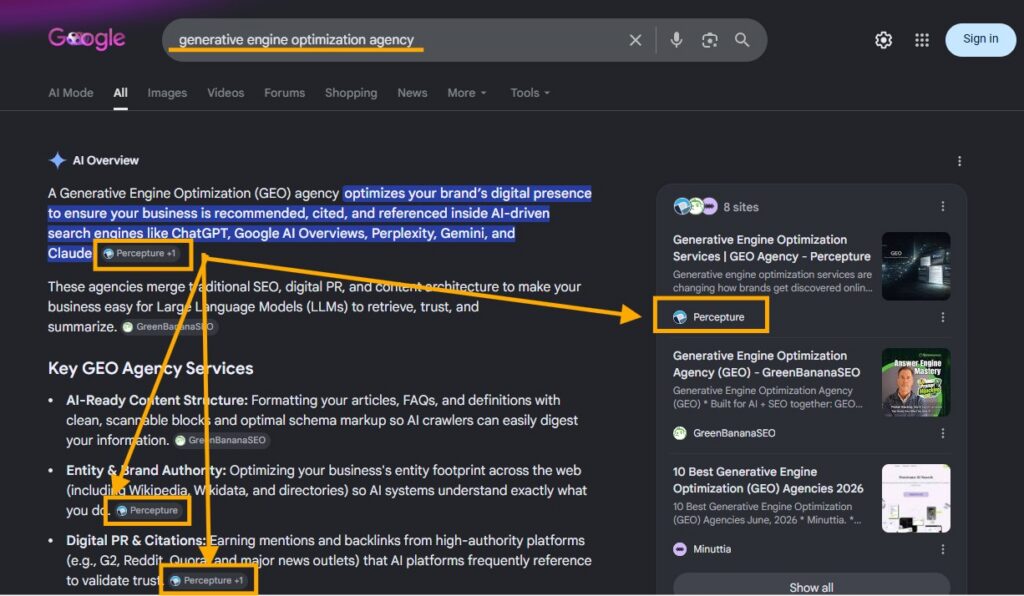
Ask which search and answer surfaces the agency measures, how it records answers and citations, how it compares cited sources, how often it retests, and how it separates durable search work from experiments. No agency can guarantee a ranking, snippet, answer, or citation.
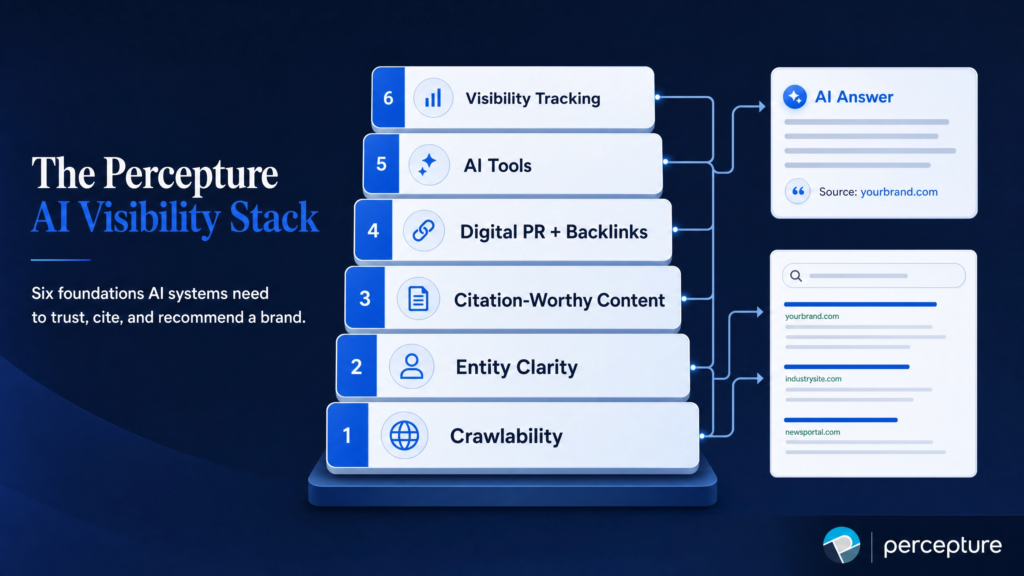
A coordinated plan may combine generative engine optimization services, digital PR services, and SEO reputation management. The agency should explain how those disciplines build clear, useful, well-supported source material and how each discovery surface is measured.
Proof should connect visibility with qualified action
Percepture’s public Broadstaff case study reports that Broadstaff reached page one for 90% of tracked keywords within 12 months and that qualified leads increased threefold during the campaign period. Review the complete Broadstaff SEO case study for its stated context.
A case study should not replace diligence. Ask which terms were tracked, which period was measured, how qualified leads were defined, what work was performed, and which limits affect comparison with your company.

Compare the complete operating model
SEO rarely works as an isolated activity. Percepture can review how each proposal connects search, content, PR, analytics, conversion, paid media, implementation, and lead follow-up.
- Find missing scope and implementation risk
- Compare ownership, staffing, proof, and total cost
- Separate durable SEO from unsupported AI-search claims
SEO company hiring FAQs
What are the top questions to ask when hiring an SEO company?
The top questions cover business understanding, technical safety, content quality, authority, AI-search methods, staffing, outsourcing, ownership, pricing, reporting, the first 90 days, and exit terms. Ask for proof with every material answer and have the appropriate internal owner verify it.
How do I know whether an SEO company is legitimate?
Verify the legal business, leaders, assigned team, public work, client references, methods, contract, pricing model, reporting, and ownership terms. A credible provider explains uncertainty, protects access, discloses subcontractors, documents changes, and does not guarantee a specific ranking or AI citation.
Can an SEO company guarantee first place?
No provider controls how a search or answer platform crawls, indexes, ranks, extracts, or cites a page. An SEO company can improve technical eligibility, relevance, authority, clarity, measurement, and conversion paths, but it should not sell guaranteed control over a third-party result.
How much should an SEO company cost?
Cost depends on technical complexity, markets, content requirements, implementation, authority development, GEO monitoring, reputation support, analytics, and senior involvement. Compare written scopes, internal labor, tools, expenses, exclusions, ownership, and transition costs.
How long should I hire an SEO company?
The appropriate term depends on the site, competition, implementation speed, content and authority needs, and sales cycle. The agreement should define an initial diagnostic period, implementation milestones, review points, cancellation terms, and asset transfer.
Who should own SEO content and accounts?
The client should control the domain, website, analytics, search accounts, tag management, CRM data, business profiles, approved content, creative files, reports, and exports unless the written agreement clearly states otherwise. The contract should also define licenses, access levels, offboarding, and transition responsibilities.
Should an SEO agency have experience in my industry?
Relevant experience can shorten the learning curve and reduce claim risk, but it does not replace technical skill, research, or strategic judgment. Ask which buyers, sales cycles, regulations, terminology, and proof requirements transfer to your situation and which areas still require discovery.
What should I ask about AI search and GEO?
Ask which platforms and questions the agency monitors, how it records citations, how it compares competing sources, which technical access it reviews, how often it retests, and what it cannot guarantee. Reject any claim that one prompt trick, file, or markup change guarantees inclusion.
What should happen in the first 90 days?
The first 90 days should establish business priorities, access, baselines, technical risks, page ownership, buyer questions, measurement, implementation owners, and review gates. The provider should then implement agreed priorities and report what changed, what remains blocked, and what decision follows.
What proof should I request from an SEO agency?
Request a redacted audit, roadmap, topic or page map, sample implementation ticket, content brief, authority plan, reporting example, responsibility matrix, assigned-team biographies, pricing schedule, ownership terms, 90-day plan, and exit checklist. The proof should match the work being proposed.
Review your agency shortlist with one evidence standard
Bring your proposals, interview notes, pricing, assigned-team information, proof, ownership terms, and the questions to ask when hiring an SEO company. Percepture can help identify missing scope, unclear ownership, technical risk, weak measurement, and unsupported AI-search claims before you commit.
The review is designed to clarify the decision, not force a specific engagement model.
Key takeaway: strong questions to ask when hiring an SEO company do more than test sales confidence. They reveal the people, process, proof, ownership, risks, economics, and operating discipline behind the proposal.