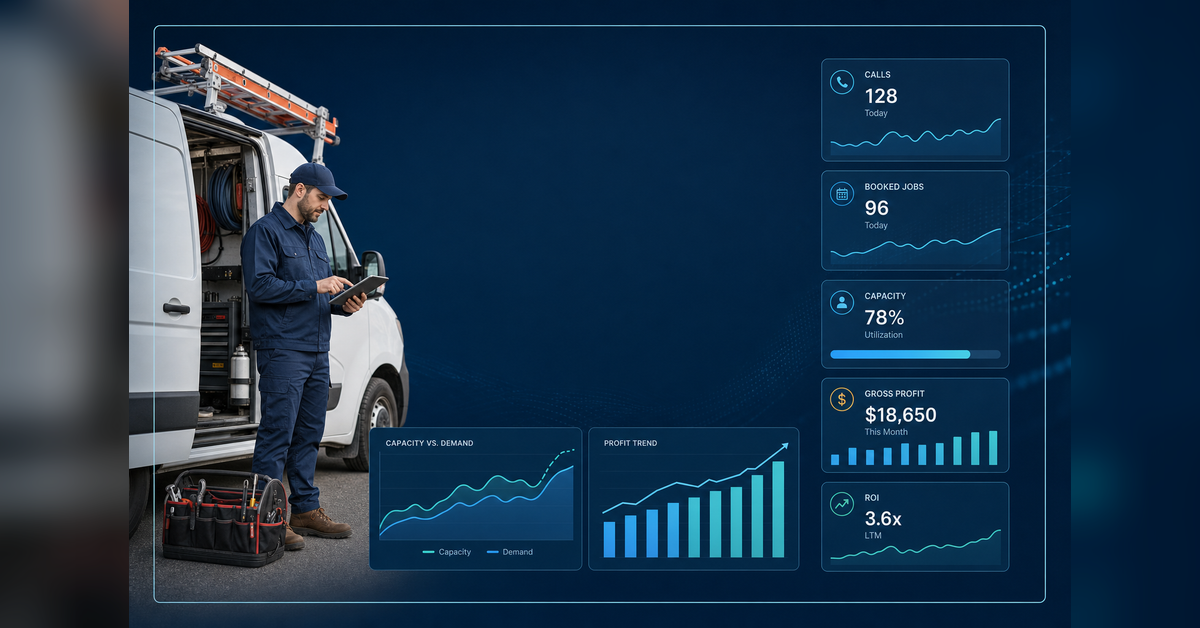

Most HVAC spending advice starts with a percentage of revenue. A responsible HVAC marketing budget starts somewhere else: the profitable work your team can answer, book, sell, complete, and collect.
This guide shows owners, finance leaders, and marketing operators how to connect capacity, gross profit, funnel performance, customer acquisition cost, and market type. It covers local residential demand and long-cycle commercial opportunities inside data centers, laboratories, manufacturing facilities, healthcare sites, campuses, and national portfolios.






How much should an HVAC company spend on marketing?
An HVAC marketing budget should equal the number of additional profitable jobs the company can fulfill multiplied by the allowable acquisition cost per job. Use revenue percentages only as a reasonableness check. The working number must reflect capacity, gross margin, booking rate, close rate, cash flow, service mix and the return required by the business.
Executive summary
Start with capacity
Count the additional repair calls, estimates, installations, maintenance visits and commercial opportunities the operation can fulfill without hurting response time or service quality.
Use gross profit
Revenue shows production. Gross profit is the stronger input for deciding whether marketing created enough economic value to cover its cost.
Measure the full funnel
Track qualified leads, connected calls, bookings, completed opportunities, sold jobs, completed jobs and collected revenue. A break between any two stages changes CAC.
Set a decision rule
Every channel should have a documented stop, maintain or scale condition. The HVAC marketing budget should follow marginal economics and available capacity, not platform reports alone.
Who this planning model is for
Owner or CEO
Use the HVAC marketing budget model to decide how much growth the company can absorb and what return the added risk must produce.
CFO or controller
Audit the HVAC marketing budget using fully loaded acquisition cost, gross-profit ROI and payback to test cash requirements and reporting quality.
Marketing leader
Allocate the HVAC marketing budget using funnel and service-line economics instead of treating every lead or channel as equal.
Operations leader
Treat answer rate, dispatch coverage, technician availability and install capacity as gates on the HVAC marketing budget and its demand-generation targets.
From local residential HVAC companies to the world’s largest facilities
Percepture works with businesses of all sizes. That includes owner-operated HVAC companies, growing residential brands, multi-location operators, commercial contractors, and companies pursuing work inside some of the world’s largest data centers, laboratories, manufacturing facilities, healthcare environments, campuses, and infrastructure portfolios.
Residential and local service
Percepture applies global search, media, AI visibility, reputation, content, and measurement discipline to one local service area. The strategy is global in capability and local in execution, down to geography, weather, service mix, call handling, reviews, and open capacity.
That changes the competitive equation. A local in-house generalist or small agency is no longer competing with one channel. It is competing with a coordinated senior team across local SEO for HVAC, paid demand, content, public relations, conversion, and AI-assisted search.
Commercial and mission-critical
Large contracts are not won with a generic “commercial HVAC” page. Buyers care about uptime, escalation, safety, procurement, technical scope, staffing, evidence, geographic coverage, and the ability to deliver inside sensitive facilities.
Percepture’s experience in telecom, data centers, construction, healthcare, manufacturing, and complex B2B markets means the team does not only know the audience on paper. In many of these markets, Percepture personally knows operators, advisors, partners, and executives the campaign is trying to reach because the team has spent years in the same industry rooms, conferences, partnerships, and conversations.
One operating system, different buyer journeys
A homeowner may make a decision in minutes after a no-cooling search. A data center, laboratory, or manufacturing buyer may evaluate vendors for months and involve facilities, engineering, procurement, finance, security, and executive leadership. The budget model must separate those paths instead of blending them into one cost-per-lead report.
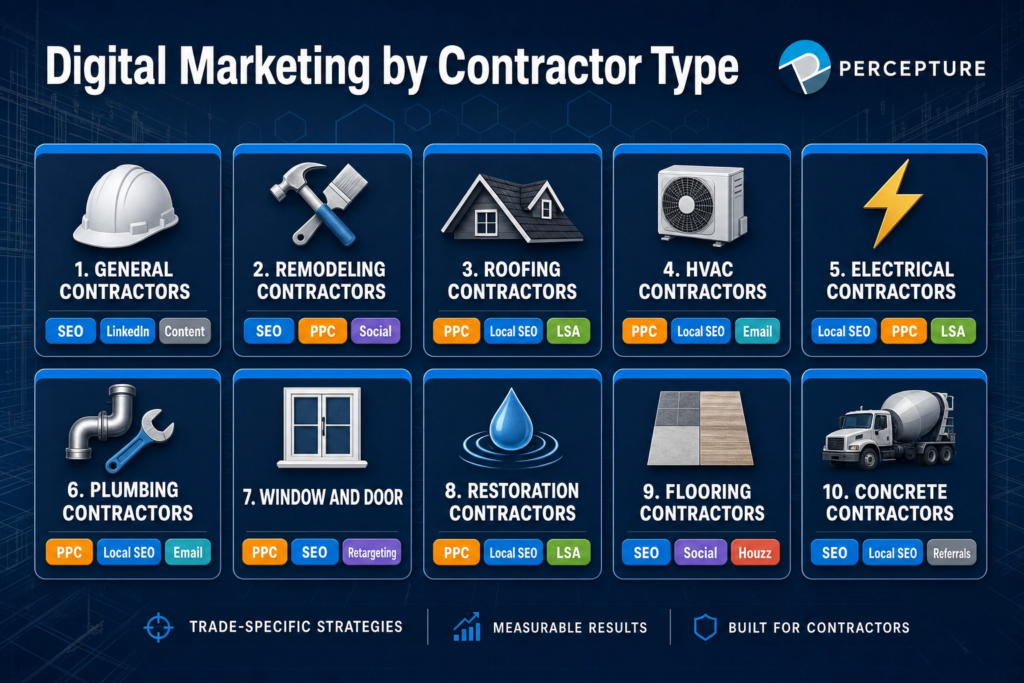
The global-to-local HVAC advantage
Residential growth is local, but the strongest operating model does not have to be small. Percepture brings the research, systems, specialization, and pattern recognition of a global B2B agency into each neighborhood, service area, and market.
Global intelligence
Industry trends, search behavior, AI-answer patterns, media economics, digital PR, competitive research, and conversion lessons are shared across markets instead of rediscovered one city at a time.
Local precision
Campaigns are narrowed to profitable services, weather patterns, local reviews, map visibility, neighborhoods, response coverage, route density, technician capacity, and the exact work the company wants.
That is the real advantage over an in-house generalist or a disconnected agency roster: one coordinated system, senior specialists, and a local plan built from the full market rather than one platform dashboard. Read Percepture’s approach to HVAC SEO and HVAC AI search optimization for the search and answer-engine layers.
Check lead quality before increasing the budget
Before buying more demand, confirm that current inquiries match the right geography, service, company profile, and revenue potential. Five real prospects tell you more than another platform estimate.
Lead Seeker is built by Pyra, Percepture’s AI systems company. Use the five-lead sample to inspect fit, source context, and sales usefulness before scaling.
How to set an HVAC marketing budget without guessing
Start by documenting the operating constraint that governs the HVAC marketing budget. An owner-operated company may be limited by call coverage. A larger residential company may have technicians available but no open install dates. A multi-location operator may have enough total capacity while one market remains full and another is underused.
The right HVAC marketing budget ceiling changes when capacity, margin or conversion changes. That is why a fixed revenue percentage cannot serve as the complete model.
| Planning question | Data required | Why it matters | Action if unclear |
|---|---|---|---|
| How many additional jobs can be completed? | Schedule, technician and install capacity | Caps the demand the operation can profitably accept | Plan scenarios instead of increasing spend |
| What is the gross profit per sold job? | Collected revenue and direct job cost | Sets the economic value available to cover acquisition | Separate service lines before calculating CAC |
| How much can acquisition cost? | Gross profit, overhead allowance and return target | Establishes allowable CAC | Use a conservative ceiling until costs are complete |
| Can the funnel convert more demand? | Answer, booking, completion and close rates | Shows whether the constraint is media or operations | Repair the weakest stage before scaling |
| Can cash support the lag? | Payment timing, media terms and operating reserves | Prevents profitable-on-paper growth from creating a cash squeeze | Slow pacing or shorten the payback path |
What belongs in an HVAC marketing budget?
Count every material cost used to create, capture, convert and retain demand during the measurement period so the HVAC marketing budget reflects the full investment. Excluding labor, technology or agency fees makes acquisition look cheaper than it is.
| Cost category | Include | Allocation rule | Common reporting error |
|---|---|---|---|
| Media | Paid search, paid social, sponsorships, direct mail and marketplace fees | Assign directly to a channel or market when possible | Reporting platform spend without fees or credits |
| Agency and contractors | Strategy, management, optimization, reporting and specialist support | Allocate by channel, location or service line when the work is separable | Calling media-only CPA fully loaded CAC |
| Creative and production | Copy, design, video, photography and landing-page production | Amortize durable assets over a disclosed period | Ignoring production because it was paid in another month |
| Owned-demand work | SEO, content, service pages, location resources and review programs | Track production, technology, labor and maintenance | Treating owned demand as free |
| Website and conversion | Development, hosting, testing and landing pages | Separate baseline infrastructure from campaign-specific work | Ignoring conversion costs when comparing channels |
| Software and measurement | CRM, call tracking, analytics, attribution and reporting tools | Allocate based on users, locations or acquisition use | Leaving required tracking outside marketing cost |
| Internal labor | Marketing labor and acquisition-related sales follow-up | Use a documented share of time and compensation | Comparing an internal team with an agency without labor cost |
| Promotions | Discounts, incentives and referral rewards when material | Attach cost to the job or campaign that generated it | Counting discounted revenue without the promotional cost |
Percepture’s strategy and planning services can help connect the HVAC marketing budget cost structure to operating goals, while attribution and analytics can establish the measurement path from source to completed work.
CPL, booked-job cost, CAC, ROAS, ROI, LTV and payback
A useful marketing budget does not collapse every performance measure into cost per lead. Each metric answers a different question and requires a different denominator.
| Metric | Formula | Best use | Common mistake | Decision supported |
|---|---|---|---|---|
| CPL | Channel spend ÷ qualified leads | Compare lead-generation efficiency | Counting spam, duplicates, wrong geography or unsupported services | Investigate lead cost and quality |
| Cost per booked appointment | Attributable spend ÷ booked appointments | Evaluate media plus booking performance | Calling an estimate appointment a sold job | Improve call handling or scheduling |
| Cost per sold job | Acquisition spend ÷ new sold jobs | Evaluate replacement and project acquisition | Mixing new and returning customers | Compare spend with job economics |
| Fully loaded CAC | Total sales-and-marketing acquisition cost ÷ new customers | Company-level acquisition planning | Using advertising spend alone | Set the allowable acquisition ceiling |
| ROAS | Attributed revenue ÷ advertising spend | Paid-media revenue efficiency | Treating revenue return as profit | Adjust paid-media bidding and mix |
| Marketing ROI | (Incremental attributed gross profit − marketing cost) ÷ marketing cost | Judge economic contribution | Using total revenue without direct job cost | Maintain, reduce or scale investment |
| LTV:CAC | Expected lifetime gross profit ÷ CAC | Evaluate repeat and retention value | Using lifetime revenue while ignoring delivery cost | Set acquisition tolerance by customer type |
| Payback | CAC ÷ average monthly gross-profit contribution | Evaluate cash recovery for recurring cohorts | Forcing one-time replacement work into a subscription model | Plan cash and growth pacing |
For channel-level questions, separate the company model from individual source performance so one source does not distort the HVAC growth budget. Percepture’s lead generation services focus on demand capture, while conversion rate optimization addresses the path from interest to action. A focused HVAC lead cost, CPL, and CAC guide can help separate source metrics from company economics.
The Percepture HVAC Capacity-to-Profit Budget Model
The Percepture HVAC Capacity-to-Profit Budget Model sets the acquisition budget by multiplying the number of profitable jobs a company can fulfill by the acquisition cost it can afford. The result is then adjusted for seasonality, channel maturity, cash flow and measurement confidence.
- Set the profit target. Define the incremental gross profit the working budget should create. Do not begin with gross revenue alone.
- Apply the capacity gate. Count available calls, appointments, estimates, service jobs, installations and commercial opportunities by market and service line.
- Model service economics. Separate repair, replacement, maintenance, membership, indoor-air-quality and commercial work because the sales event and repeat value differ.
- Calculate allowable acquisition cost. Start with gross profit per sold job, then reserve room for overhead, cancellations, callbacks, warranty exposure and the required return.
- Build the channel portfolio. Assign the budget model to immediate demand, owned assets, retention and authority according to the business constraint.
- Run the measurement loop. Reallocate from qualified, booked, sold, completed and gross-profit data rather than lead volume alone.
The central formula is allowable acquisition spend = available profitable jobs × allowable CAC. This converts the marketing investment from a broad benchmark into an operating model.
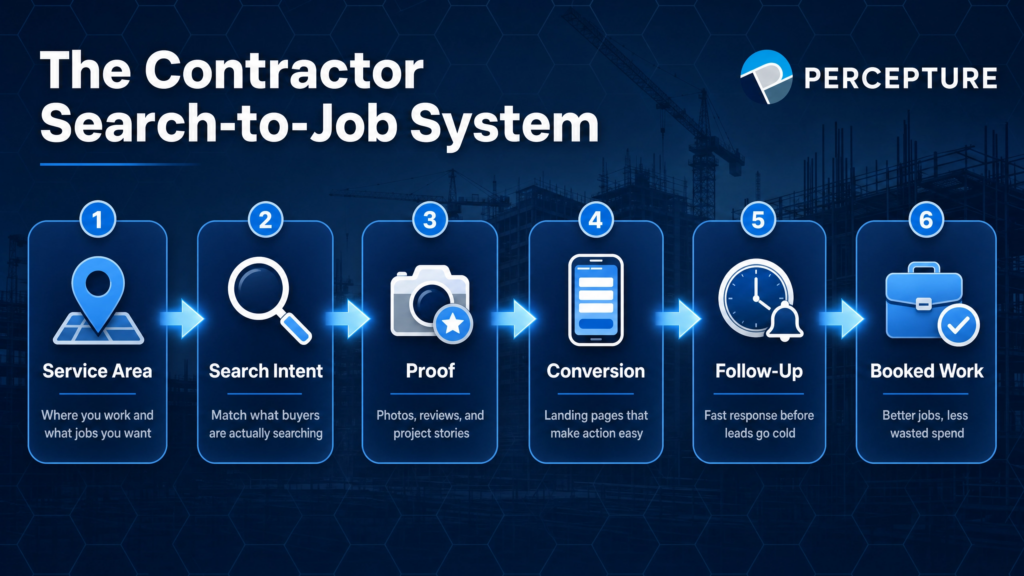
Capacity and unit-economics worksheet
Use the sequence below as a server-rendered planning worksheet for the marketing budget. Enter company data in a separate spreadsheet or financial model, retain the assumptions and run low, expected and high cases.
| Step | Input or formula | Output | Control question |
|---|---|---|---|
| 1 | Available profitable jobs | Capacity ceiling | Can operations complete this work within the target period? |
| 2 | Gross profit per sold job | Economic value per job | Are direct job costs complete and service-line specific? |
| 3 | Allowable CAC | Maximum acquisition cost | Does the amount preserve overhead coverage and the required return? |
| 4 | Available jobs × allowable CAC | Planning ceiling | Can cash flow support the conversion and collection lag? |
| 5 | Booking × completion × close × gross profit per sold job | Break-even CPL before safety adjustments | Are rates based on qualified new-customer demand? |
| 6 | Total acquisition cost ÷ new customers | Fully loaded CAC | Are media, labor, agency, creative and technology included? |
Data-quality warning: Tracking and unit-economics inputs are incomplete. Treat the resulting HVAC growth budget as a scenario, not a spending recommendation.
Worked HVAC marketing ROI example
The following numbers are illustrative only. They demonstrate how funnel results can inform an acquisition budget and are not an industry benchmark or forecast.
- 100 qualified leads
- 70 answered or connected leads
- 50 booked appointments
- 40 completed estimates or service opportunities
- 20 new sold jobs
- $30,000 total acquisition spend
- $200,000 attributed revenue
- $80,000 attributed gross profit
| Illustrative metric | Calculation | Illustrative result | Interpretation |
|---|---|---|---|
| CPL | $30,000 ÷ 100 | $300 | Cost for each qualified lead |
| Cost per booked appointment | $30,000 ÷ 50 | $600 | Acquisition cost through the booking stage |
| CAC | $30,000 ÷ 20 | $1,500 | Cost per new sold customer in this example |
| ROAS | $200,000 ÷ $30,000 | 6.67× | Attributed revenue divided by acquisition spend |
| Gross-profit marketing ROI | ($80,000 − $30,000) ÷ $30,000 | 166.7% | Return after acquisition cost, using attributed gross profit |
The 6.67× ROAS looks stronger than the 166.7% gross-profit ROI because ROAS uses revenue. The working budget decision should account for the gross profit remaining after direct job costs and the full acquisition cost included in the model.
Repair, replacement, maintenance and commercial economics
One blended target can hide major differences between service lines and misdirect the budget model. Build a separate funnel and acquisition ceiling for each meaningful sales path.
| Service line | Sales event and path | Revenue timing | Margin and repeat-value input | Best acquisition metric | Capacity constraint | Attribution window |
|---|---|---|---|---|---|---|
| Repair | Call or online request to scheduled service | Often tied to completed service | Job-level gross profit plus documented future value | Cost per completed new-customer job | Call coverage, dispatch and technician hours | From inquiry through completed and collected work |
| Replacement | Lead to estimate, follow-up and sold installation | After sale and installation milestones | Installation gross profit and supported customer value | Cost per sold or completed installation | Comfort advisor, financing and install crews | Long enough to include estimate and sales lag |
| Maintenance | Enrollment or scheduled tune-up | At purchase or service delivery | Initial gross profit plus measured renewal contribution | CAC and cohort payback | Route density and seasonal appointment capacity | Through enrollment and the defined renewal period |
| Membership | Plan sale with recurring service relationship | According to billing and service schedule | Lifetime gross-profit contribution by cohort | LTV:CAC and payback | Service capacity and retention execution | Through the disclosed cohort period |
| Indoor air quality | Service call, assessment or estimate to sale | At installation or collection | Product and labor gross profit | Cost per sold job | Qualified staff and product availability | Through completed sale |
| Commercial | Inquiry, qualification, site review, proposal and contract | Based on project or contract terms | Contract or project gross profit and collection risk | Cost per qualified opportunity and acquired account | Estimator, technical and delivery capacity | Long enough to reflect the actual sales cycle |
Residential, commercial, and mission-critical HVAC economics
A residential no-cooling call, a manufacturing plant retrofit, and a data center maintenance agreement should never share one acquisition target. The same budget model applies, but the conversion event, sales cycle, proof, margin, capacity, and attribution window change.
| Market | Primary buyer | Typical decision | Proof that matters | Best economic measure |
|---|---|---|---|---|
| Residential | Homeowner or property resident | Call, booking, estimate, repair, replacement, or membership | Local reviews, response, availability, financing, communication, and service confidence | Cost per completed new-customer job, sold replacement CAC, and cohort payback |
| Commercial | Facility, property, operations, procurement, or ownership team | Site review, scope, proposal, approved-vendor process, contract, or portfolio agreement | Technical team, process, safety, escalation, similar work, reporting, and procurement readiness | Cost per qualified opportunity, acquired account, contract gross profit, and sales-cycle-adjusted payback |
| Mission-critical | Data center, laboratory, manufacturing, healthcare, or infrastructure leadership | Technical qualification, risk review, site assessment, proposal, pilot, maintenance agreement, or major project | Uptime, redundancy, QA, documentation, controls, security, safety, references, and executive trust | Qualified-account cost, influenced pipeline, contract value, gross profit, and long attribution window |

For active-demand programs, compare the economics of HVAC PPC and Google Ads with owned visibility, account-based outreach, and the longer path required for commercial contracts.
Budget priorities by company stage
The marketing investment should reflect the company’s current constraint and measurement maturity. These scenarios are decision guides, not spending promises.
| Company stage | Primary constraint | Budget priority | Owned-demand priority | Paid-demand role | Minimum tracking | Scale trigger |
|---|---|---|---|---|---|---|
| Owner-operated or new | Answer coverage and limited capacity | Reliable intake and high-intent demand | Core service and location clarity | Controlled tests around open capacity | Source, qualified lead, booking and completed job | Reliable response and acceptable completed-job cost |
| Established residential | Service-line balance and seasonality | Conversion, retention and portfolio balance | Service resources, reviews and customer database | Fill profitable capacity and support priority services | New-customer CAC and gross profit by service line | Marginal CAC holds while volume rises |
| Five-to-ten-truck growth company | Dispatch, sales follow-up and crew utilization | Integrated acquisition and operations reporting | Compounding local and service authority | Capture demand where staffing can absorb it | Connected, booked, sold and completed funnel | Capacity, cash and quality remain stable |
| Multi-location | Uneven market maturity and capacity | Location-level economics and governance | Distinct local assets with shared standards | Fund market-specific gaps | Location, source, service line and customer status | Each market clears its own economic gate |
| Residential-commercial hybrid | Different sales cycles and attribution | Separate funnels and payback rules | Audience-specific resources and proof | Match campaigns to each sales path | Segmented opportunities, jobs, contracts and gross profit | Each segment performs under its own target |
How to allocate an HVAC marketing budget
Do not use one universal pie chart. Give each dollar in the HVAC growth budget a job, then adjust the mix according to capacity, market maturity and measurement confidence.
Immediate or rented demand
Paid search, paid social and lead marketplaces can capture current demand. Their role is strongest when profitable capacity is open and source-to-sale tracking works.
Compounding or owned assets
SEO, service pages, location resources, content, reviews, video and customer data can build durable discovery. They still require production, technology, labor and maintenance.
Retention
Email, reactivation, membership, maintenance and referral work can create value from existing relationships. Measure incremental gross profit and avoid attributing automatic renewals to unrelated campaigns.
Authority
PR, expert commentary, third-party mentions and AI-search citation work can improve recognition and trust. Measure visibility and qualified influence without presenting either as closed revenue by itself.
An integrated acquisition budget may combine omnichannel marketing, media buying, content marketing and digital PR. The mix should follow the economic job each channel must perform. For a category-level view, use Percepture’s HVAC marketing guide.
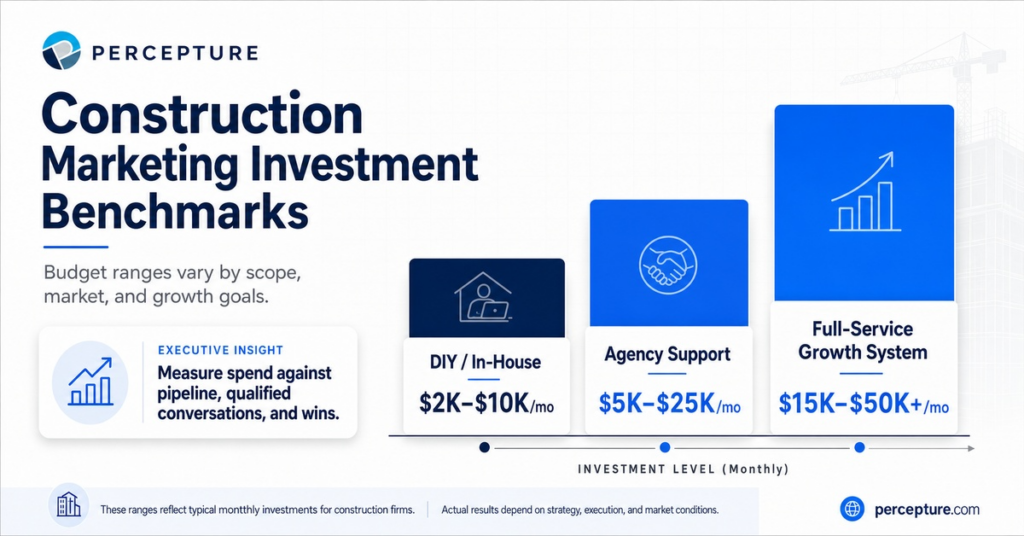
Seasonality and pacing
Seasonality changes demand, capacity and response risk at the same time. A sound working budget therefore uses monthly and weekly pacing rather than dividing an annual total into equal parts.
- Pre-season: Build service pages, creative, tracking, call coverage and remarketing audiences before demand rises.
- Peak demand: Watch marginal CAC, missed calls, schedule availability and service quality. High demand is not a reason to buy work the operation cannot fulfill.
- Shoulder season: Use open capacity to support maintenance, reactivation and selected demand campaigns with clear economics.
- Weather events: Use documented pacing and overspend limits. Confirm that dispatch, inventory and field capacity can support the response.
- Market differences: Plan by climate, location and service mix. Do not force every market into one calendar.
- Cash control: Pace the budget model around media payment timing, financing, collections and the lag between a lead and completed work.
Compare SEO, paid search, PR, retention and AI visibility
| Channel class | Speed | Control | Measurement confidence | Cost pattern | Compounding value | Best metric | Primary risk | Scale requirement |
|---|---|---|---|---|---|---|---|---|
| Paid search | Can begin capturing active demand after launch | High control over targeting and pacing | Strongest when calls and offline sales are connected | Media plus management, creative and tracking | Limited unless learning improves other assets | Qualified opportunity, sold-job cost and gross-profit return | Optimizing to leads that do not become profitable work | Open capacity and acceptable marginal CAC |
| SEO and content | Builds over time | High control over owned content; limited control over rankings | Requires source, call and CRM integration | Production, technical work and maintenance | Potentially durable while assets remain useful and visible | Qualified organic demand and assisted gross profit | Calling visibility or traffic revenue | Technical access, publishing capacity and conversion paths |
| Digital PR | Timing varies | Control over story and outreach, not coverage | Direct revenue attribution is often limited | Strategy, research, production and outreach | Mentions can support authority over time | Relevant coverage, referral quality and assisted influence | Valuing all mentions equally | Credible expertise and useful stories |
| Retention | Can reach known customers quickly | High control over audience and message | Strong when customer and transaction data are clean | Platform, creative, offers and service capacity | Builds first-party relationship value | Incremental repeat gross profit and cohort retention | Crediting purchases that would have happened anyway | Permission, clean data and available service capacity |
| AI-search authority | Timing varies by crawl, ranking and citation behavior | Control over source clarity, not answer inclusion | Requires prompt tracking and referral analysis | Research, content, technical SEO and authority development | Supports discoverability across answer surfaces | Relevant citations, qualified visits and assisted outcomes | Treating mentions as attributable revenue | Clear entities, crawlable sources and credible supporting material |
Use the scorecard to assign each channel an explicit role in the marketing investment. Percepture supports paid acquisition through paid search services and organic visibility through enterprise SEO. For answer-engine discovery, GEO services can be evaluated as part of the broader authority portfolio.
Run sensitivity before buying more leads
A small funnel improvement can change the allowable marketing budget without adding lead volume. The effect must be calculated from the company’s actual rates rather than assumed.
| Input | Low case | Expected case | High case | Output affected |
|---|---|---|---|---|
| Qualified leads | Enter scenario | Enter scenario | Enter scenario | Lead volume and CPL |
| Answer rate | Enter measured rate | Enter measured rate | Enter measured rate | Connected opportunities |
| Booking rate | Enter measured rate | Enter measured rate | Enter measured rate | Booked appointments and booked cost |
| Completion or estimate rate | Enter measured rate | Enter measured rate | Enter measured rate | Completed opportunities |
| Close rate | Enter measured rate | Enter measured rate | Enter measured rate | Sold jobs and CAC |
| Average sold-job value | Enter service-line value | Enter service-line value | Enter service-line value | Attributed revenue and ROAS |
| Gross margin | Enter service-line margin | Enter service-line margin | Enter service-line margin | Gross profit and ROI |
| Cancellation and callback allowance | Enter risk allowance | Enter risk allowance | Enter risk allowance | Realized gross profit and payback |
Test a five-point increase in booking rate and then a five-point increase in close rate while holding lead volume constant. The HVAC growth budget can rise only if the resulting gross-profit economics, capacity and cash requirements remain acceptable.
The monthly economics dashboard
Review the acquisition budget dashboard by location, service line, channel and new-versus-returning customer status. The company total is useful, but blended reporting can hide one strong segment and one losing segment.
Investment
- Budget versus actual
- Spend by channel and location
- Media, labor, agency, creative and software cost
Funnel
- Qualified leads and connected calls
- Booked appointments and completed opportunities
- Sold and completed jobs
Economics
- Revenue and gross profit
- CPL, booked cost and CAC
- ROAS, gross-profit ROI and payback
Operations
- Answer and booking rates
- Capacity utilization
- Cancellation, callback and collection effects
Visibility belongs on the dashboard as a leading indicator, not as proof of profit. Search impressions, rankings and answer-engine citations become financially meaningful only when they connect to qualified demand, sales, completed work and gross profit. Percepture’s guide to enterprise SEO ROI calculation provides a related methodology for separating visibility from economic return. When traffic is qualified but action is weak, review HVAC website design and CRO.
Stop, maintain or scale
Stop or investigate
Pause expansion of the working budget when tracking fails, demand is repeatedly unqualified, calls go unanswered, unit economics are negative or the channel is creating work outside service capacity. Diagnose the cause before declaring that all marketing failed.
Maintain or test
Hold the current budget model when economics are plausible but the sample is small, conversion lag is unresolved or the work is building a strategic asset. Set a review date and the evidence required for the next decision.
Scale
Increase the marketing investment when tracking is reliable, capacity exists, marginal CAC remains acceptable, cash supports the lag and lead quality holds as spend rises. Scale in controlled steps so the next dollar can be evaluated.
Why the team doing the work matters
Percepture’s senior SEO team averages about 20 years of experience. We are grateful for that depth, and we built the operating model so the people shaping the strategy are also the people doing the work, reviewing the evidence, and owning the next decision.
“I built this team partly so I would get fewer phone calls. More seriously, I wanted a blueprint that did not depend on one person and a team I would trust with my own company.” — Bob Generale, President of Percepture
| Operating question | Senior Percepture model | Common in-house or generalist constraint |
|---|---|---|
| Who builds the strategy? | Senior specialists across SEO, GEO, PR, media, content, analytics, and conversion | One generalist, a rotating account team, or disconnected vendors |
| Who does the work? | The same experienced operators involved in diagnosis and planning | Execution may pass to junior staff with limited context |
| How is the market understood? | Direct industry relationships plus search, buyer, competitor, and account intelligence | Platform data or surface-level keyword research |
| How is performance judged? | Qualified demand, sales response, sold work, completed work, gross profit, and payback | Traffic, form fills, impressions, or channel-reported conversions |
A company comparing an internal hire with an HVAC marketing agency should compare the complete specialist bench, management time, tools, production, implementation speed, and measurement system, not only the monthly invoice.

Compare the real cost of building the team
Review Percepture’s published pricing beside the internal cost of senior SEO, paid media, content, public relations, GEO, analytics, conversion, and management. The fair comparison is capability and economic output, not one retainer versus one salary.
Common budgeting errors
- Using a market benchmark as the final marketing budget.
- Calling advertising CPA fully loaded CAC.
- Using attributed revenue as if it were incremental gross profit.
- Leaving agency, labor, creative, software or sales follow-up outside acquisition cost.
- Counting every call or form submission as a qualified lead.
- Mixing new customers with existing customers seeking service.
- Comparing repair and replacement against one acquisition target.
- Ignoring missed calls, slow response, cancellations, refunds and callbacks.
- Optimizing to form fills rather than sold and completed work.
- Treating last-click attribution as complete truth.
- Scaling while technicians or installation crews are full.
- Cutting owned and authority work because its evaluation window differs from paid demand.
A strong HVAC growth budget makes every inclusion, exclusion, attribution window and service-line assumption visible. That transparency lets finance, marketing and operations challenge the same model instead of arguing from separate reports.
HVAC marketing economics FAQs
What percentage of revenue should go to an acquisition budget?
No universal percentage fits every HVAC company. A revenue share can be used as a reasonableness check, but the working working budget should come from available profitable capacity, service-line gross profit, funnel conversion, allowable CAC, cash flow and growth goals. Companies with different staffing, margins and market maturity can responsibly reach different answers.
How do I create an budget model?
Count the additional profitable jobs the operation can fulfill, calculate gross profit by service line and set the acquisition cost each job can support. Multiply available jobs by allowable CAC, then adjust the marketing investment for cash flow, seasonality and measurement confidence. Allocate the resulting ceiling across immediate demand, owned assets, retention and authority.
What is a good HVAC CPL or CAC?
A good CPL or CAC is one that lets the marketing budget produce the required gross-profit return within the company’s capacity and cash limits. There is no safe universal number. Qualified-lead cost must be converted through actual answer, booking, completion and close rates before it can be compared with allowable customer acquisition cost.
What is the difference between ROI and ROAS?
ROAS divides attributed revenue by advertising spend. Marketing ROI compares incremental attributed gross profit, less marketing cost, with marketing cost. Use both carefully when evaluating an HVAC growth budget: ROAS is useful for paid-media efficiency, but it does not show company-level profitability because it can exclude direct job costs and non-media acquisition expenses.
Should HVAC marketing ROI use revenue or gross profit?
Use incremental attributed gross profit for the primary acquisition budget decision. Revenue can be reported alongside it, but revenue does not account for direct labor, equipment and other job costs. Gross profit provides a clearer view of the value available to cover marketing, overhead and the required return.
How do answer, booking and close rates affect CAC?
Each rate controls how many leads become customers and how far the working budget can go. Missed calls reduce connected opportunities. Weak booking reduces appointments, and weak closing reduces sold jobs. When acquisition cost stays constant but fewer leads become customers, CAC rises. Improving a constrained funnel stage can lower CAC without purchasing another lead.
Should an HVAC company use SEO or paid search first?
The answer depends on timing, capacity and current visibility. Paid search may fit open near-term capacity when tracking and conversion are ready. SEO and content build owned discovery over a longer period. Many companies need both, but each channel should have a distinct economic job and evaluation window within the budget model.
How often should the marketing budget be reviewed?
Review marketing investment pacing and operational constraints frequently enough to catch missed calls, full schedules or deteriorating lead quality. Conduct a structured monthly economic review using sold jobs, completed work, gross profit, CAC and capacity. Longer-window channels should be judged over a period that reflects their conversion and compounding lag.
Does Percepture work with residential and commercial HVAC companies?
Yes. Percepture works across owner-operated residential companies, multi-location service brands, commercial contractors, and businesses pursuing work in data centers, laboratories, manufacturing facilities, healthcare environments, campuses, and national portfolios. The strategy, proof, sales cycle, and measurement model change by buyer.
Why compare a senior agency with an in-house HVAC marketing team?
Compare the full capability required: SEO, GEO, paid media, content, digital PR, analytics, conversion, design, technical implementation, and management. Percepture reports that its senior SEO team averages about 20 years of experience and that the specialists involved in strategy also perform and review the work.

Build the marketing budget around profitable growth
Bring the service mix, markets, capacity, funnel rates, acquisition costs, gross-profit data, and the contracts you want to win. Percepture will map the budget, visibility, proof, and measurement system around the business you actually operate.
Key takeaway: A strong HVAC growth budget is not a percentage copied from another company. It is an operating model built around profitable capacity, buyer type, senior execution, measurable sales outcomes, and the exact residential or commercial market the company wants to win.