
An FTTH Marketing Strategy helps fiber-to-the-home providers turn residential serviceability into subscribers. The strategy should connect neighborhood awareness, local trust, address checks, paid media, direct mail, SEO, PR, CRM follow-up, install scheduling, reviews, and referrals.
FTTH marketing is not the same as generic broadband advertising. A fiber provider cannot sell everywhere. The strategy has to follow the network, match construction timing, answer household objections, and make it easy for each serviceable address to check availability and schedule installation.
Why Percepture Belongs in This Conversation
Percepture is not approaching FTTH marketing as a generic agency. The work connects PR, SEO, GEO, paid media, direct mail, CRM, AI sales agents, content, analytics, CRO, and telecom-specific market conditioning. For residential fiber, that matters because the buyer journey starts with a home address and ends with an installed subscriber. In an FTTH Marketing Strategy, those functions have to work from the same serviceability truth.
Founded in 2004
Percepture brings long-running PR and digital search experience to complex growth work.
PR + SEO + GEO
The strategy connects local trust, search visibility, AI-search clarity, and conversion.
Telecom-aware planning
Percepture works across telecom, fiber, data center, infrastructure, and complex B2B markets.
Operator-led execution
Senior strategy, content, analytics, CRO, paid media, and follow-up systems work from one plan.

What is an FTTH Marketing Strategy?
An FTTH Marketing Strategy is a residential fiber growth system that starts with serviceability, builds local trust, creates search visibility, targets households by neighborhood, drives address checks, clarifies offers, follows up fast, schedules installs, and turns early subscribers into reviews and referrals. The goal is take-rate growth, not marketing activity.
Executive Summary for Residential Fiber Leaders
Follow serviceability
Marketing must follow the network. Paid media, direct mail, local pages, and sales follow-up should know which homes can buy now. That is why an FTTH Marketing Strategy starts with address-level availability.
Build trust before the switch
Residential buyers need confidence on price, reliability, installation, support, and availability before leaving an existing provider.
Use address checks as the middle step
The address check is the bridge between awareness and install. Every channel should make that step obvious.
Measure subscribers
Traffic and leads are not enough. Track address checks, installs, new subscribers, reviews, referrals, and neighborhood take rate.
Who This Guide Is For
This guide is for ISPs, FTTH providers, regional fiber companies, municipal broadband networks, BEAD-funded providers, private equity-backed broadband companies, and residential growth teams trying to turn fiber-to-the-home passings into active subscribers. It is especially useful when the FTTH Marketing Strategy has to coordinate construction timing, sales capacity, and neighborhood-level demand.
If you need the broader cluster view, start with Percepture’s ISP marketing agency guide. If you are focused on commercial subscriber adoption, read the fiber take-rate marketing guide. This page owns the residential FTTH Marketing Strategy: household segmentation, neighborhood trust, offer clarity, address checks, installs, reviews, and referrals.
FTTH Marketing Is Not Generic Residential Advertising
A residential fiber buyer does not wake up thinking about network architecture. The buyer thinks about price, reliability, speed, installation, switching hassle, customer support, and whether the provider can actually serve the home.
Most weak campaigns start with speed claims. Speed matters, but it does not fix poor targeting, low trust, a buried address checker, or slow follow-up. Residential fiber marketing fails when the campaign does not match the home, the neighborhood, and the network. An FTTH Marketing Strategy has to correct those mismatches before spend scales.
- They target homes that cannot buy yet.
- They use one message for every neighborhood.
- They promote fiber without explaining installation.
- They send direct mail without tracking.
- They run paid search outside the serviceable footprint.
- They fail to nurture pre-registrations and keep-me-updated forms.
- They measure traffic instead of address checks, installs, and subscribers.
FTTH marketing starts with the home, but it cannot ignore the network.
Is your FTTH market ready to convert?
Percepture can review your serviceability map, household segments, offer pages, address-check flow, direct mail, paid media, local SEO, PR, CRM routing, and install handoff. The FTTH Marketing Strategy review shows where demand is being created, qualified, and lost.
The Percepture FTTH Trust-to-Install Strategy
The Percepture FTTH Trust-to-Install Strategy connects serviceability, household demand, local trust, address checks, offer clarity, CRM follow-up, install scheduling, and proof into one residential fiber growth system. It is built for providers that need marketing to follow real network availability, not a generic campaign calendar. This FTTH Marketing Strategy framework keeps awareness, qualification, installation, and proof connected.
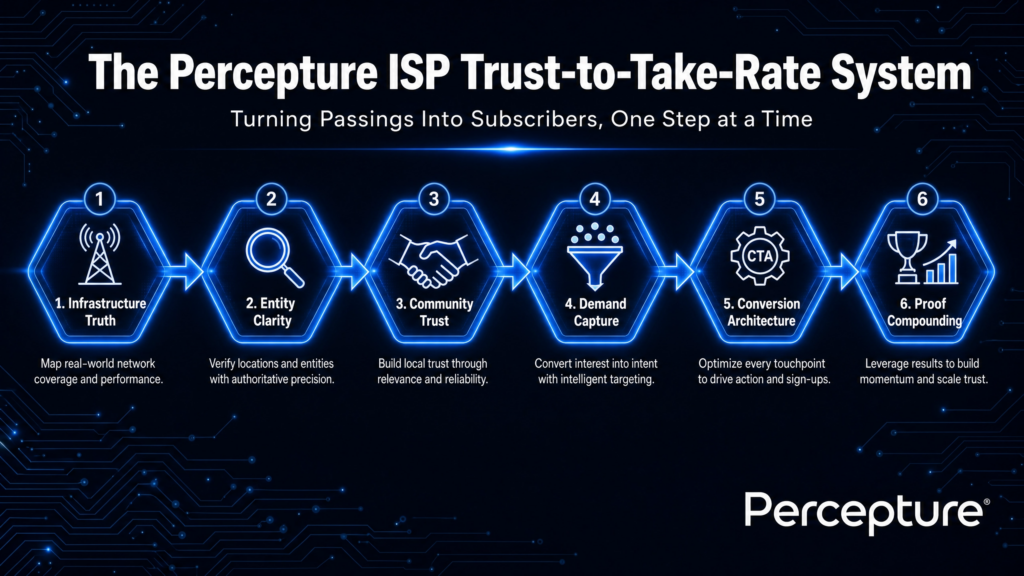
Six parts of the framework
1. Serviceability Truth
Know which homes can buy now, which homes are coming soon, and which homes should be suppressed from paid spend.
2. Household Demand
Remote work, gaming, streaming, home security, upload speed, price, reliability, and local support can all trigger a buying decision.
3. Neighborhood Trust
Local proof, construction clarity, reviews, PR, and simple switching language make the decision feel safer.
4. Address-Check Conversion
Every channel should lead to a clear address-check or pre-registration action.
5. Install Handoff
The form is not the finish line. Scheduling, reminders, and expectations turn intent into a subscriber.
6. Proof Loop
Reviews, referrals, local testimonials, and early subscriber proof lower risk for the next household.
Map Serviceability Before You Market FTTH
The first job is to connect the campaign to the network. If an ISP promotes service to homes that cannot buy, it wastes money and breaks trust. The network map should control the marketing map.
A sound FTTH Marketing Strategy separates serviceable homes, coming-soon homes, under-construction areas, planned build areas, not-serviceable homes, high-interest neighborhoods, low-take-rate neighborhoods, competitor-heavy streets, direct mail zones, paid media suppression zones, pre-registration zones, and review priority zones.
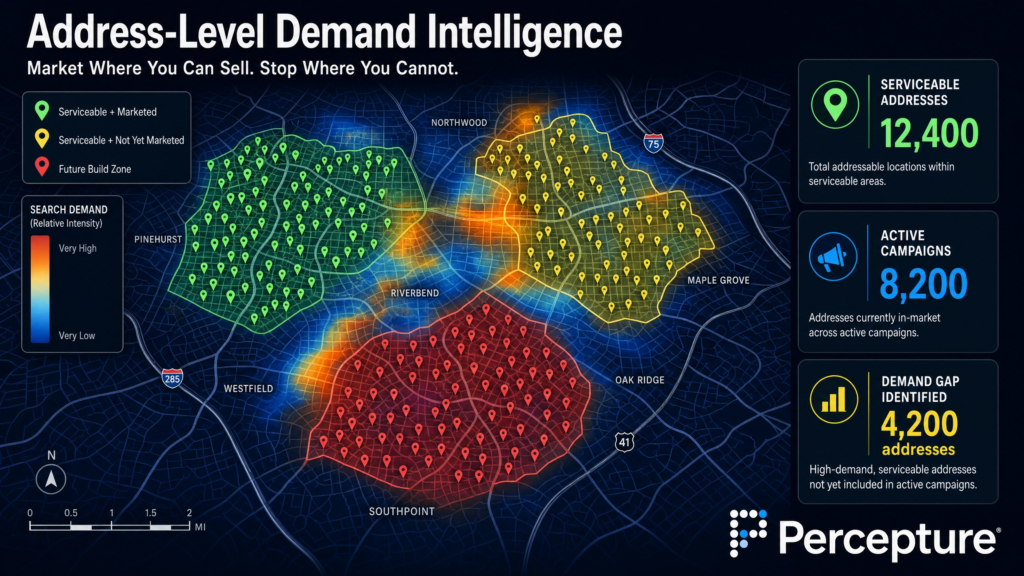
Ask simple operating questions: Which homes can buy today? Which homes need pre-registration? Which neighborhoods need education before launch? Which paid audiences should be suppressed? Which homes searched but did not install? Which early subscribers can create proof for the next block? The answers decide whether the FTTH Marketing Strategy should push installs, nurture interest, or pause spend.
Providers building a market from the ground up can pair this page with Percepture’s guide on marketing fiber internet in a new service area. This article stays focused on the residential FTTH growth motion after the strategy is ready to sell by home and neighborhood.
Segment Residential Fiber Buyers by Household Need
Not every household buys fiber for the same reason. Strong FTTH marketing speaks to the household’s real switching trigger instead of using one broad “better internet” message.
Remote workers want reliable video calls and upload performance. Streaming households care about device load and buffering. Gamers care about latency and consistency. Families care about Wi-Fi coverage, schoolwork, entertainment, and support. Senior households often need simple installation language, clear pricing, and access to a real support path. Within an FTTH Marketing Strategy, those needs should influence audience, message, offer, and follow-up.
Residential fiber buyers buy trust, reliability, support, and a clear install path. A strong FTTH Marketing Strategy sells the household outcome, not only the network feature.
Build Neighborhood Trust Before Asking People to Switch
Residential buyers may not switch unless the provider feels credible and local enough. Trust is not decoration. It is conversion infrastructure.
Buyers ask practical questions: Is this provider real? Is fiber available at my home? Will installation be disruptive? Will the price change later? Is Wi-Fi included? Is support reachable? Are my neighbors switching? What happens if my address is not ready? An FTTH Marketing Strategy should answer those questions before the buyer reaches the order form.
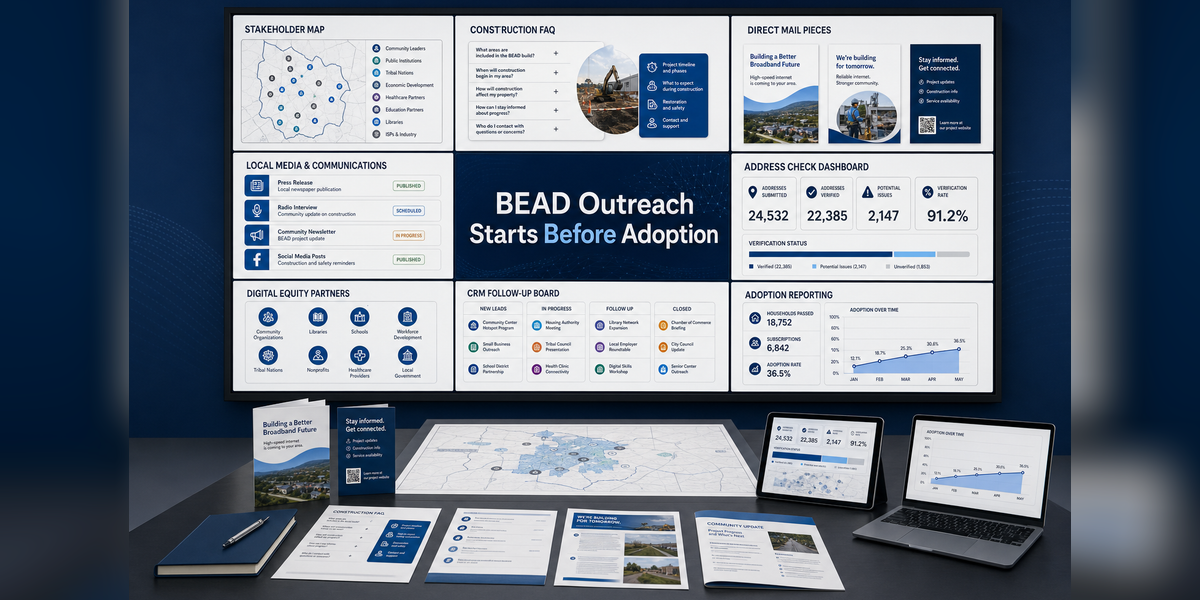
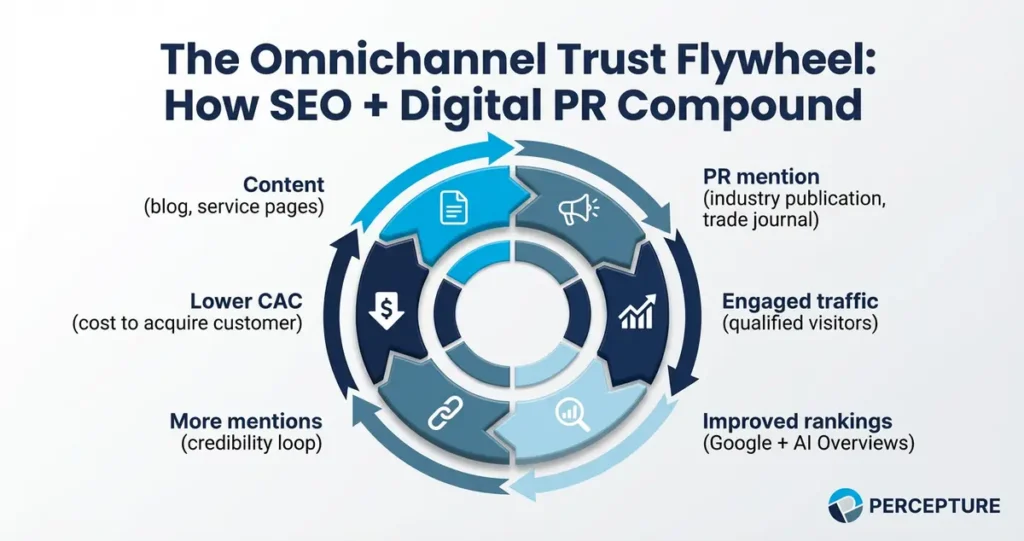
Trust assets include local service-area pages, construction FAQs, installation FAQs, local PR, Google Business Profile updates, reviews, testimonial snippets, switching guides, transparent offers, neighborhood updates, and referral prompts. Percepture’s digital PR services can support local credibility when a provider needs community visibility, not only ad impressions.
Build Local SEO and GEO for Residential Fiber Demand
FTTH buyers search before they switch. The provider should be findable when households ask about fiber availability, internet speed, installation, pricing, local support, and cable alternatives.
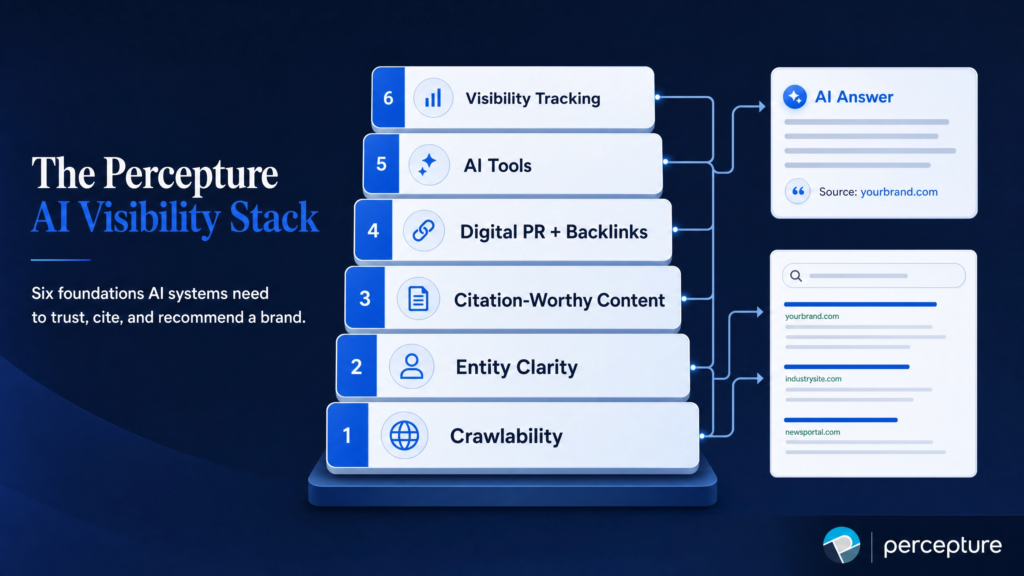
Build or improve fiber internet service-area pages, FTTH availability pages, neighborhood pages, construction update pages, installation FAQ pages, fiber-vs-cable comparison pages, work-from-home internet pages, gaming internet pages, Google Business Profile content, review flows, schema-rich FAQs, and AI-friendly direct answers. A complete FTTH Marketing Strategy treats those assets as demand capture, not just content production.
AI search tools need clear entity signals. The page should make it easy for AI systems to understand who the provider is, where it operates, what it offers, and why buyers trust it. Percepture’s generative engine optimization services and organic SEO services help connect search visibility to serviceable demand.
For deeper local guidance, read Percepture’s article on local SEO for fiber internet providers.
Use Paid Media and Direct Mail With Serviceability Controls
Paid media and direct mail can work well for FTTH, but only when they match serviceability, launch timing, and conversion paths. Interest from the wrong address still creates frustration. An FTTH Marketing Strategy should set the suppression rules before the media plan goes live.
Paid search should focus on high-intent searches such as fiber internet near me, fiber internet in a city, high-speed internet, internet provider near me, and residential fiber availability. For more channel detail, use Percepture’s fiber internet PPC strategy.
Direct mail should go to serviceable homes, coming-soon neighborhoods, construction completion zones, offer announcement areas, and install-push lists. It should include a tracked URL, QR code, call tracking number, offer, address-check CTA, campaign tag, and matching landing page. Percepture’s paid search, media buying, and omnichannel marketing work can connect those channels into one residential fiber plan.
Make the Address Check the Main Conversion Event
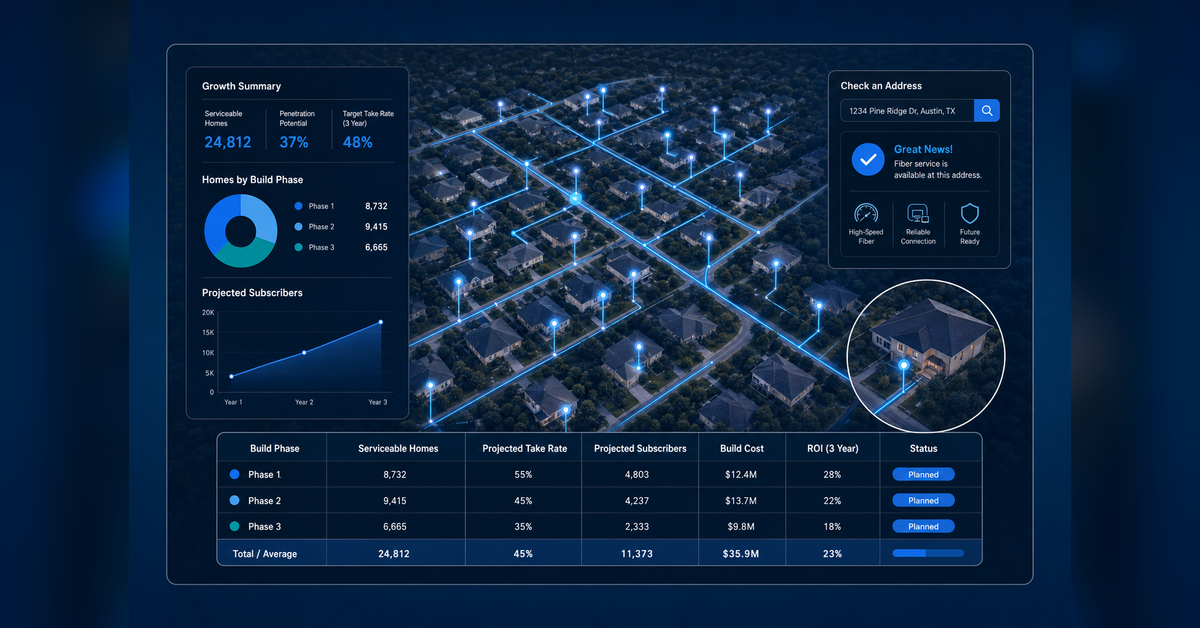
For FTTH marketing, the address check is usually the bridge between awareness and install. It should be obvious, fast, mobile-first, and segmented by outcome. In an FTTH Marketing Strategy, the address check is the operating signal that tells marketing, sales, and installation teams what should happen next.
A strong address-check page has the form above the fold, short fields, privacy reassurance, clear button text, offer preview, serviceable routing, coming-soon routing, not-serviceable routing, MDU routing, business routing, CRM integration, retargeting audiences, follow-up automation, and call tracking.
If the address is serviceable, show plans, installation options, a phone number, and follow-up. If the address is coming soon, capture pre-registration and launch alerts. If the address is not serviceable, capture keep-me-updated demand and future-build interest.
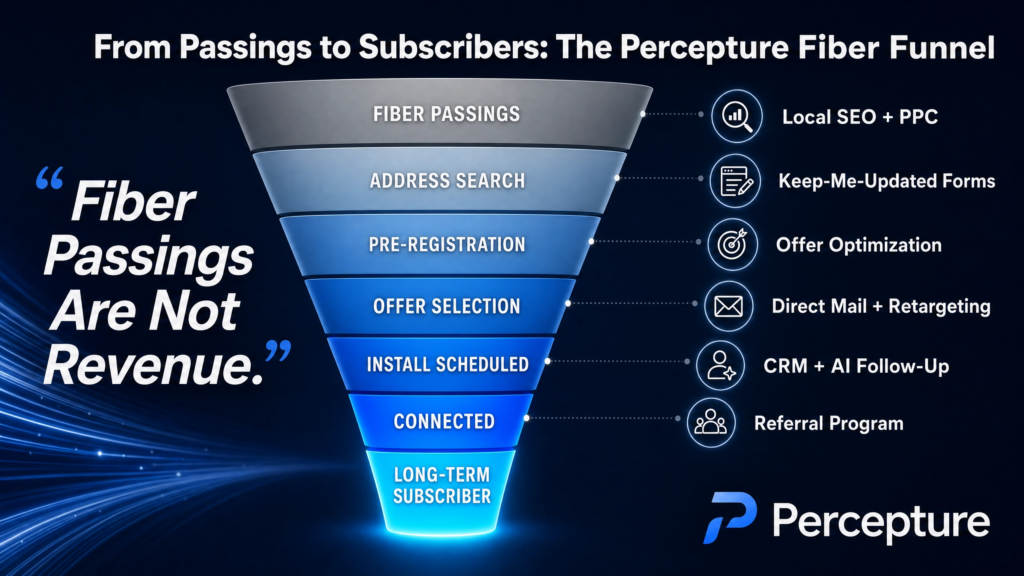
For the narrower conversion funnel, read Percepture’s guide on how to convert fiber passings into subscribers. If your team needs to clarify bundles, plans, or switching offers, review broadband offer strategy.
Connect CRM, AI Agents, and Human Follow-Up
FTTH campaigns often leak revenue after the form. A strong FTTH Marketing Strategy routes every lead by serviceability, geography, buyer type, campaign source, offer, segment, launch phase, install readiness, and urgency.
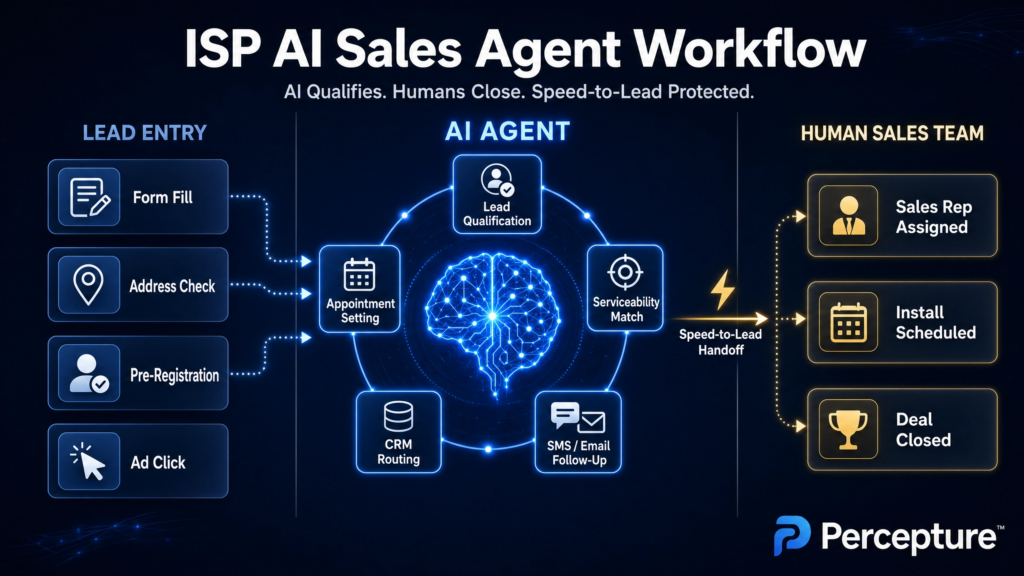
AI agents can help answer availability questions, confirm address-check results, re-engage abandoned leads, send install reminders, route MDU and business leads, collect missing information, schedule calls, and protect speed-to-lead. Complex business, DIA, MDU, municipal, or installation issues should move to human sales quickly. The FTTH Marketing Strategy should define where automation helps and where a person must take over.
Percepture’s AI sales agents, conversion rate optimization, attribution and analytics, and guide to AI outbound calling agents can help operators see where follow-up breaks down.
Turn FTTH Installs Into Reviews and Referrals
The first subscribers in a neighborhood should make the next subscribers easier to win. The best residential fiber marketing creates proof at the same time it creates subscribers. An FTTH Marketing Strategy should plan that proof loop before the first neighborhood launch.
After installation, send a welcome email, Wi-Fi setup note, support explanation, installation satisfaction request, review request, approved referral prompt, and local testimonial request. Then retarget non-converted neighbors with proof that the service is active nearby.
Teams tracking adoption should also understand what fiber take rate means and how reviews, referrals, and neighborhood trust influence the next stage of demand.
Why Physical Network Truth Matters in FTTH Marketing
FTTH marketing should not be detached from the physical network. Hunter Newby’s physical-network perspective reinforces why broadband marketing has to respect infrastructure reality. The campaign has to follow what the network can actually support. A credible FTTH Marketing Strategy turns that operational reality into clear public messaging.
Hunter explains why the physical network matters. Percepture explains how to turn that physical truth into market trust, search visibility, demand, and sales. For more telecom context, read the Hunter Newby telecom interview and Percepture’s article on AI interconnection and the physical internet.


Which Channels Belong in an FTTH Marketing Strategy?
The right channel mix depends on footprint, timing, competition, and install capacity. The FTTH Marketing Strategy should give each channel a clear role in moving a household from awareness to address check to install.
| Channel | Role in FTTH Strategy | Best Use | Common Mistake |
|---|---|---|---|
| Local SEO | Captures fiber availability and local intent | Service-area pages, availability pages, FAQs | Thin city pages |
| GEO / AI search | Builds entity clarity and answer visibility | Direct answers, schema, proof-rich content | Generic AI content |
| Digital PR | Builds local trust | Construction, investment, community benefit | PR with no conversion path |
| Paid search | Captures high-intent demand | Fiber near me, internet provider, availability | Spend outside footprint |
| Direct mail | Reaches serviceable homes | Neighborhood offers and launch notices | No QR or tracking |
| Programmatic | Builds awareness and retargeting | Neighborhood launch and warm audiences | Broad impressions only |
| Email/SMS | Converts pre-registrations and leads | Launch alerts and install reminders | One message for all |
| CRM | Routes leads correctly | Address status and segment routing | Generic follow-up |
| AI agents | Protect speed-to-lead | Re-engagement, reminders, scheduling | No human handoff |
| Reviews/referrals | Build neighborhood proof | Post-install campaigns | No structured ask |
FTTH Messaging by Household Segment
Use this view to keep the FTTH Marketing Strategy close to actual household motivation instead of forcing every buyer into the same speed message.
| Segment | Primary Pain | Message | CTA | KPI |
|---|---|---|---|---|
| Remote workers | Unstable video calls | Reliable fiber for work-from-home | Check availability | Address checks and installs |
| Streaming households | Buffering and device load | Better streaming across the home | See plans | Plan selection |
| Gamers | Lag and latency | Fast, stable connection for gaming | Check fiber availability | Address checks |
| Families | Many devices | Reliable home internet for school, work, and entertainment | Check your home | Installs |
| Cable-frustrated homes | Price and reliability pain | A fiber alternative to cable | Compare plans | Switchers |
| Rural homes | Poor access | Fiber is coming or available | Pre-register or check availability | Pre-regs and installs |
| Senior households | Support and simplicity | Simple installation and clear support | Talk to a specialist | Calls and installs |
| Home businesses | Upload and uptime needs | Fiber for work, calls, uploads, and continuity | Request quote | Business inquiries |
FTTH Marketing Strategy KPI Dashboard
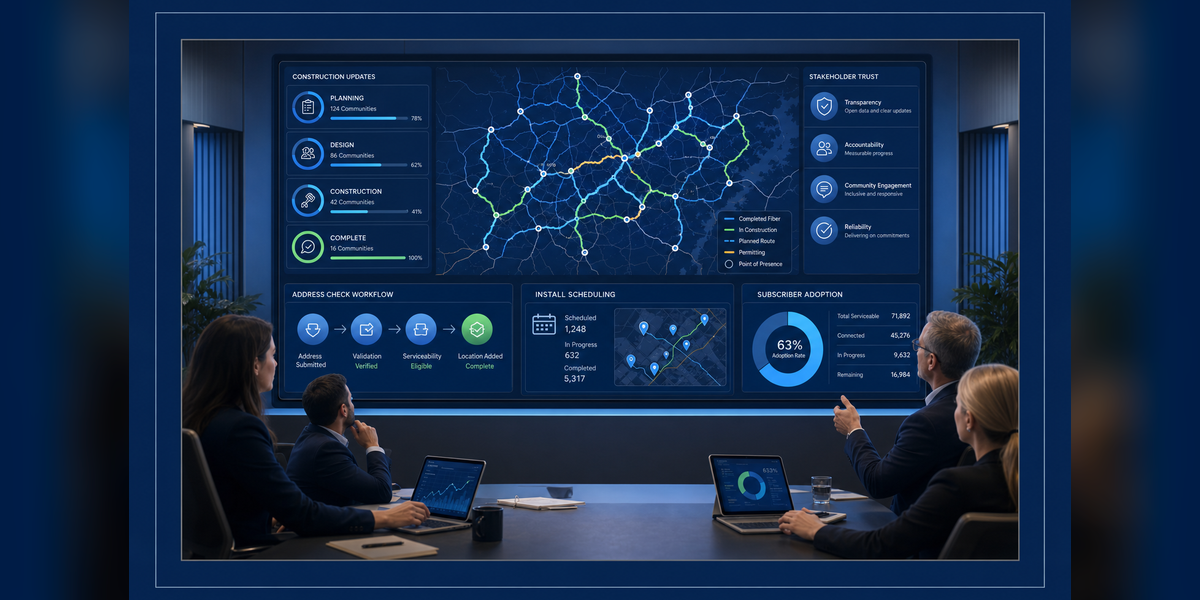
The KPI dashboard should show whether the FTTH Marketing Strategy is creating revenue movement in serviceable neighborhoods, not just impressions or unqualified leads.
| KPI | What It Measures | Why It Matters | Owner | Cadence |
|---|---|---|---|---|
| Serviceable homes | Real sales inventory | Shows where marketing can sell | Ops/marketing | Weekly |
| Pre-registrations | Future demand | Shows launch interest | Marketing | Weekly |
| Address checks | Buyer intent | Shows awareness conversion | Marketing | Weekly |
| Serviceable address checks | Qualified demand | Shows targeting quality | Marketing ops | Weekly |
| Install appointments | Near-revenue action | Shows buyer commitment | Sales/ops | Weekly |
| Install completion | Activated subscribers | Shows handoff success | Ops | Weekly |
| New subscribers | Revenue movement | Shows growth | Leadership | Weekly/monthly |
| Take rate by neighborhood | Adoption efficiency | Shows where FTTH converts | Growth | Monthly |
| Cost per install | Acquisition efficiency | Connects spend to subscribers | Marketing/finance | Monthly |
| Speed-to-lead | Follow-up quality | Protects intent | Sales | Daily/weekly |
| Referral rate | Proof loop | Shows customer-driven growth | Marketing/CS | Monthly |
| Review volume | Trust signal | Supports local proof and conversion | CS/marketing | Monthly |
FTTH Marketing Strategy Scorecard
Score each item from 0 to 3: 0 = missing, 1 = weak, 2 = adequate, 3 = strong. A useful scorecard shows where the growth system leaks before the team spends more. It also keeps the FTTH Marketing Strategy grounded in operational readiness.
| Readiness Item | Score 0–3 |
|---|---|
| Serviceability map is complete | |
| Neighborhood segments are defined | |
| Local SEO pages are live | |
| Google Business Profile is optimized | |
| Address-check CTA is clear | |
| Pre-registration path exists | |
| Keep-me-updated path exists | |
| Direct mail is trackable | |
| Paid media suppresses non-serviceable homes | |
| PR supports local trust | |
| Construction and installation FAQs exist | |
| Offers are clear | |
| CRM routing is defined | |
| AI follow-up is used carefully | |
| Install reminders are active | |
| Reviews are requested | |
| Referrals are promoted | |
| Dashboard reports subscribers, not just leads |
Score interpretation: 0–20 means the FTTH strategy is not ready to scale. 21–36 means the provider has activity but likely has major conversion leaks. 37–48 is usable but needs sharper targeting, trust, or follow-up. 49–54 signals a strong growth system.
FTTH Marketing Strategy Budget and 90-Day Timeline
Budgets depend on footprint, competition, channel mix, media spend, install capacity, and current market awareness. The following starting ranges are planning ranges, not guarantees. A practical FTTH Marketing Strategy should also account for how fast the operations team can turn demand into completed installs.
| Program | Typical Starting Range | Best Fit |
|---|---|---|
| FTTH Growth Readiness Audit | Starting at $2,500–$5,000 | Teams that need a map of leaks before spend increases |
| Local SEO + GEO Setup | Starting at $5,000–$10,000/month | Providers that need local and AI-search visibility |
| FTTH Subscriber Growth Program | Starting at $7,500–$15,000/month | Providers with serviceable passings and conversion goals |
| Residential Fiber Launch Campaign | Starting at $10,000–$25,000/month plus media | Neighborhood campaigns with direct mail, paid media, PR, and follow-up |
| Full ISP Growth Engine | Custom | Multi-market growth tied to serviceability, media mix, and install capacity |
Days 1–30 should map serviceability, audit the address-check path, build household segments, review offers, create trust assets, and set up reporting. Days 31–60 should launch local SEO, paid search, direct mail, PR, retargeting, pre-registration, and nurture. Days 61–90 should improve follow-up, push installs, request reviews, activate referrals, and optimize by neighborhood.
For broader planning structure, use Percepture’s ISP marketing plan, ISP marketing strategy, and guide to what ISP marketing means.
Common FTTH Marketing Strategy Mistakes
Most mistakes happen when the FTTH Marketing Strategy is separated from serviceability, installation capacity, or the buyer’s confidence threshold.
- Starting with speed claims. Speed matters, but trust and serviceability come first.
- Marketing outside the footprint. This wastes spend and frustrates buyers.
- Using one message for every household. Remote workers, gamers, families, seniors, and cable-frustrated homes need different angles.
- Hiding the address checker. The address check should be obvious and mobile-friendly.
- Treating direct mail as a one-off. Direct mail should connect to QR codes, landing pages, call tracking, and follow-up.
- Ignoring construction questions. Residents need to know what is happening and how installation works.
- Letting pre-registrations sit. Pre-registered buyers need updates and launch prompts.
- Measuring traffic instead of subscribers. Traffic only matters when it leads to address checks, installs, and subscribers.
- Forgetting reviews. Reviews reduce risk for the next household.
- Over-automating follow-up. AI agents can help, but complex leads need human handoff.
How Percepture Builds FTTH Marketing Strategies
Percepture builds FTTH marketing around the network first. The work starts with serviceability, neighborhood readiness, household demand, local trust, content, paid media, direct mail, CRM routing, install handoff, reviews, referrals, and reporting. Every FTTH Marketing Strategy is evaluated against the homes that can buy, the buyers most likely to switch, and the proof needed to make that switch feel safe.
Percepture connects SEO, GEO, PR, paid media, direct mail, CRM, CRO, content, analytics, and AI sales agents. The operating point is simple: marketing must follow serviceability. A strong FTTH Marketing Strategy is not a random mix of ads and mailers. It is a coordinated system that moves a serviceable home toward an installed subscriber.
Ready to turn residential fiber availability into subscribers?
Percepture can help map your FTTH growth system around serviceability, household demand, local trust, SEO, GEO, PR, paid media, direct mail, CRM, AI follow-up, install handoff, reviews, referrals, and reporting. The result is an FTTH Marketing Strategy built around homes that can be served and buyers that can be converted.
Build Your FTTH Growth Strategy Read the Fiber Take-Rate Marketing Guide
FTTH Marketing Strategy FAQs
What is an FTTH Marketing Strategy?
An FTTH Marketing Strategy is a residential fiber growth plan that connects serviceability, local trust, search visibility, paid media, direct mail, address checks, CRM follow-up, install scheduling, reviews, and referrals to turn fiber-to-the-home availability into subscribers.
How do you market FTTH services?
Market FTTH services by mapping serviceable homes, segmenting households, building local SEO pages, running serviceability-aware paid media and direct mail, using PR to build trust, driving address checks, and following up quickly. The FTTH Marketing Strategy should keep those actions tied to the network footprint.
What is the most important conversion action in FTTH marketing?
For residential fiber, the address check is often the most important middle-funnel action because it shows buying intent tied to a specific home. In an FTTH Marketing Strategy, it also determines routing, offer logic, and follow-up priority.
How does FTTH marketing improve take rate?
FTTH marketing improves take rate by turning awareness into address checks, pre-registrations, installs, subscribers, reviews, and referrals in serviceable neighborhoods.
Should FTTH providers use direct mail?
Yes, when direct mail is sent to serviceable or coming-soon homes and includes a tracked URL, QR code, call tracking number, offer, and landing page.
How does SEO help residential fiber providers?
SEO helps residential buyers find fiber availability pages, service-area pages, installation FAQs, comparison content, reviews, and local proof when they are researching internet options.
How does GEO help FTTH marketing?
GEO helps AI search systems understand the provider, service areas, offers, proof, and expertise so the brand can become easier to find and summarize in AI-assisted search.
Can AI sales agents help with FTTH marketing?
Yes. AI agents can help answer common questions, route leads, send reminders, re-engage abandoned address checks, and protect speed-to-lead, but complex opportunities still need human handoff.
What KPIs should FTTH providers track?
Track serviceable homes, address checks, serviceable address checks, pre-registrations, install appointments, install completion, new subscribers, take rate by neighborhood, cost per install, speed-to-lead, reviews, and referrals. Those KPIs show whether the FTTH Marketing Strategy is producing subscriber growth.
How can Percepture help with FTTH marketing strategy?
Percepture can build the FTTH Marketing Strategy around serviceability, household demand, local trust, SEO, GEO, PR, paid media, direct mail, CRM, AI follow-up, install handoff, reviews, referrals, and reporting.
Build an FTTH Marketing Strategy That Follows the Network
FTTH marketing should not be a random mix of ads, mailers, and speed claims. The strategy should follow serviceability, match household needs, build neighborhood trust, drive address checks, schedule installs, and turn early subscribers into proof.
Percepture can help your team connect SEO, GEO, PR, paid media, direct mail, CRM, AI follow-up, install handoff, reviews, referrals, and reporting into one residential fiber growth system. If your current FTTH Marketing Strategy is creating interest but not installs, the next step is to find the leak.
Build Your FTTH Growth Strategy Talk to Percepture About Residential Fiber Growth

About the Author: Bob Generale
Bob Generale is President of Percepture, a digital PR, SEO, GEO, and AI search visibility agency that helps B2B, telecom, infrastructure, private equity, healthcare, and complex service companies become easier to find, trust, and choose. Bob’s work focuses on market conditioning, search visibility, content architecture, digital PR, and conversion systems that connect authority to measurable business outcomes.