

Online Reputation Management in NYC is not just cleanup after a bad search result. It is narrative control across Google, news coverage, reviews, social proof, crisis response, and AI-generated answers.
For New York City leaders, the stakes move fast. Investors, buyers, employees, partners, patients, boards, journalists, and AI tools can all judge the brand before your team gets a chance to explain the full story.

What is Online Reputation Management in NYC?
Online Reputation Management in NYC helps companies, executives, and organizations protect what appears in Google, news coverage, review platforms, social channels, and AI-generated answers. A serious ORM program combines SEO, digital PR, crisis communications, review strategy, content, monitoring, and AI visibility so one result does not define the whole brand.
The reputation problem is no longer only page one
The risk
One article, lawsuit mention, review thread, Reddit discussion, outdated profile, or AI answer can shape trust before a buyer talks to your team.
The Percepture view
Reputation management works best when enterprise SEO, PR, crisis response, content, and GEO operate as one system.
The operating rule
Protect page one for human searchers and strengthen the wider source set that AI platforms may use to summarize the brand.
The first move
Run a confidential search, media, review, and AI visibility audit before deciding whether the fix is removal, suppression, PR, or crisis response.
Who this guide is for
Executives and founders
You need to protect an individual name, leadership profile, investor narrative, public-facing issue, or acquisition story.
Healthcare and professional services groups
You need trust signals that support patients, referral partners, boards, compliance-minded buyers, and local searchers.
CMOs and communications leaders
You need a plan that connects public relations services, branded search, reviews, owned content, and reporting.
Why NYC reputation management is different
New York is dense with media, capital, healthcare competition, finance relationships, legal scrutiny, executive visibility, and referral networks. A reputation issue can move from a search result to a stakeholder conversation quickly.
Online Reputation Management in NYC should account for local search, branded search, news visibility, industry publications, reviews, executive profiles, and the source material that AI tools may summarize. Treating ORM as a narrow “bad link” project leaves too much exposure.
Start with a quiet reputation diagnostic
Before you react, map what people and AI systems can already find. Percepture can help identify the search, review, PR, and AI visibility risks that deserve action first.
Best fit: executives, founders, private companies, healthcare groups, professional services firms, and high-trust B2B organizations.
Page one matters for humans. The first two pages matter for AI.
Human search behavior often centers on page one. AI search is different because an answer may draw from a wider source environment, including pages that a human buyer may never click.
That is why Percepture connects digital PR services, generative engine optimization services, crisis communications, and search architecture. The job is not only to improve rankings. The job is to improve what trusted sources say and how clearly those sources describe the brand.
Key reputation terms leaders should understand
ORM
Online reputation management improves the trust environment across search, reviews, media, social profiles, owned content, and AI answers.
SEO reputation management
SEO reputation management helps stronger owned, earned, and third-party assets rank for branded and issue-related searches.
Online reputation repair
Repair work reduces the influence of harmful, outdated, incomplete, or misleading results through valid correction, removal, and stronger asset building.
Crisis communications
Crisis communications gives executives, legal teams, PR teams, and stakeholders disciplined messaging during urgent public pressure.
Suppression
Suppression means building and ranking better assets so an unwanted result carries less influence. It should be done with real content and authority, not spam.
GEO
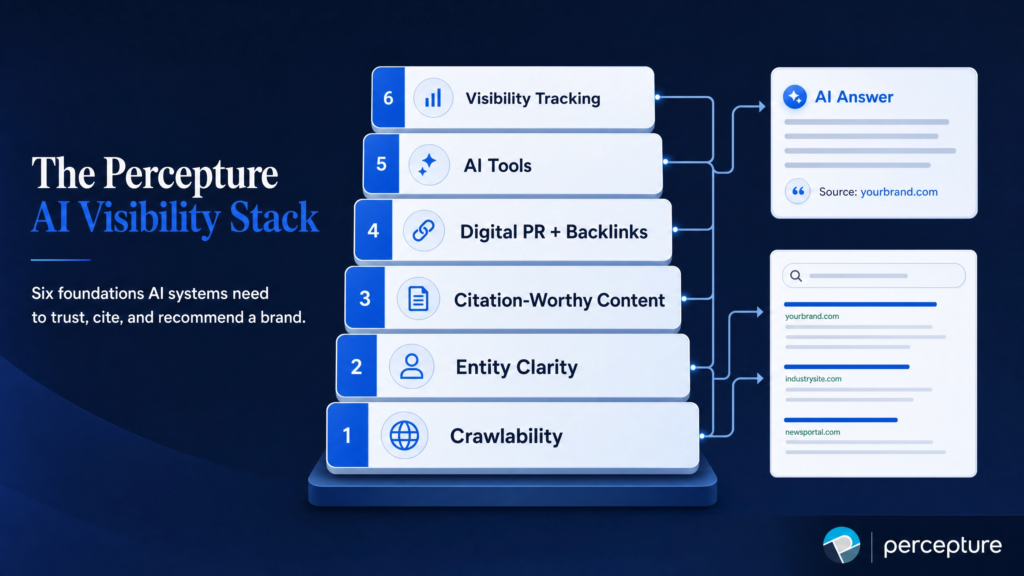
Generative engine optimization improves the source environment that AI tools can understand, retrieve, summarize, and cite.
What Percepture does for Online Reputation Management in NYC
Percepture starts by separating what is urgent from what is simply uncomfortable. A negative item that is already spreading through media, search, reviews, or AI answers requires a different operating rhythm than a weak profile page or missing content asset.
The work may connect omnichannel marketing, content marketing, public relations, SEO, executive positioning, review strategy, and AI visibility. The plan depends on the risk, not a generic ORM package.
1. Map the search environment
Audit branded queries, executive queries, issue-related searches, review platforms, news results, social profiles, and AI answer outputs.
2. Identify controllable assets
Find the pages, profiles, articles, bios, directories, case studies, and owned media assets that can be improved or created.
3. Build credible replacement signals
Create stronger owned and earned assets that are useful to humans, parsable by AI systems, and aligned with the narrative you want the market to understand.
4. Strengthen third-party trust
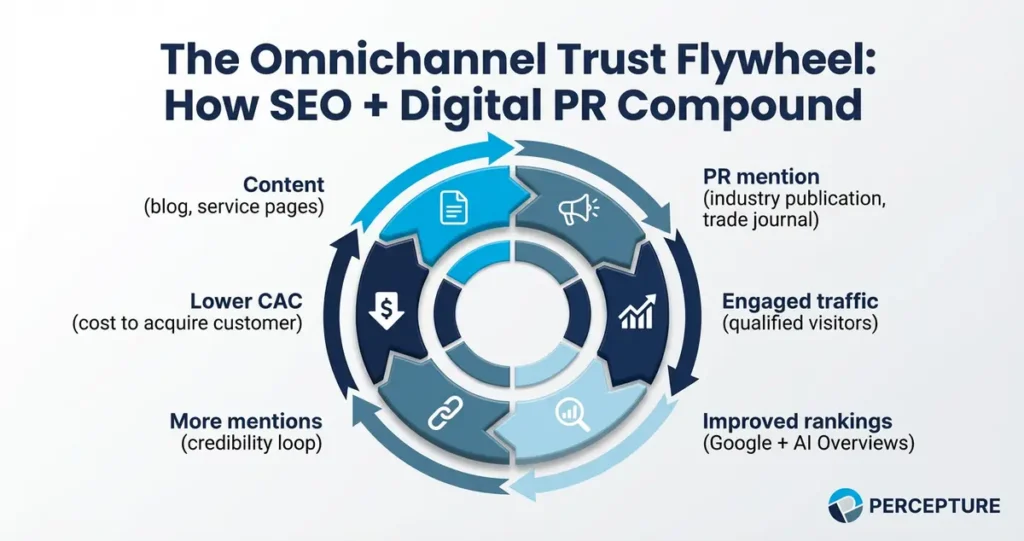
Use PR, digital PR, thought leadership, expert commentary, and credible mentions to support the reputation story beyond your own website.
5. Monitor movement
Track rankings, reviews, AI answers, press mentions, sentiment shifts, branded searches, and stakeholder risk indicators.
6. Keep the system alive
Reputation does not stay fixed by accident. The source environment needs continued content, authority, updates, and monitoring.
The Reputation Control Matrix
The Reputation Control Matrix is Percepture’s system for protecting what people and AI platforms find when they search a company, executive, product, or issue.
Protect the Queen
Identify the brand, executive, product, issue, page, or narrative that must be defended first.
Control the Narrative
Decide what buyers, investors, journalists, employees, patients, and AI engines should find and trust.
Build Trust Tokens
Create credible proof across Google, media, reviews, social profiles, owned content, and third-party sources.
Dominate the Landscape
Rank favorable owned, earned, and third-party assets across branded, executive, product, and issue searches.
Monitor the Signal
Track Google results, AI answers, review movement, sentiment, media coverage, and stakeholder risk.
Refresh the Proof
Keep the best signals current so old or incomplete sources do not become the easiest story to summarize.
ORM vs SEO reputation management vs PR vs crisis communications
Reputation management is strongest when each discipline has a clear job. The mistake is expecting one tactic to solve every risk.
| Discipline | What it solves | What it does not solve alone | Percepture use |
|---|---|---|---|
| ORM | Online trust environment across search, reviews, profiles, and content. | Full media strategy or urgent public response by itself. | Search, reviews, content, monitoring, reporting, and asset prioritization. |
| SEO reputation management | Ranking stronger owned, earned, and third-party assets. | Immediate message control during an active crisis. | Branded SERP control through better content, internal linking, schema, and authority. |
| Digital PR | Third-party authority, expert commentary, and credible external signals. | Technical search cleanup or review management by itself. | Source building that supports Google rankings and AI answers. |
| Crisis communications | Urgent stakeholder messaging under public pressure. | Long-term search repair unless paired with SEO and content. | Triage, message discipline, media response, and post-crisis repair. |
| GEO and AI visibility | Clearer entity signals and better AI-answer source environments. | Guaranteed control over every AI-generated answer. | Source environment improvement, entity clarity, structured content, and retrievable proof. |
Reputation risk scorecard
Use this scorecard before hiring a reputation management firm. The goal is to find the highest-leverage problem, not to overreact to every uncomfortable result.
Search risk
- Do negative or incomplete results appear for the brand name?
- Do issue-related searches surface outdated or one-sided information?
- Do executive searches support credibility or create doubt?
AI-answer risk
- Do AI tools summarize the company accurately?
- Are the strongest sources clear, current, and easy to cite?
- Can AI systems understand the company’s services, leaders, locations, and proof?
Review risk
- Are reviews recent enough to look active?
- Are negative patterns addressed with substance?
- Do responses sound professional and consistent?
Media and PR risk
- Do third-party sources tell the story clearly?
- Is there enough earned authority to balance weaker results?
- Are leaders positioned as credible operators, not anonymous executives?
How AI search changes reputation management
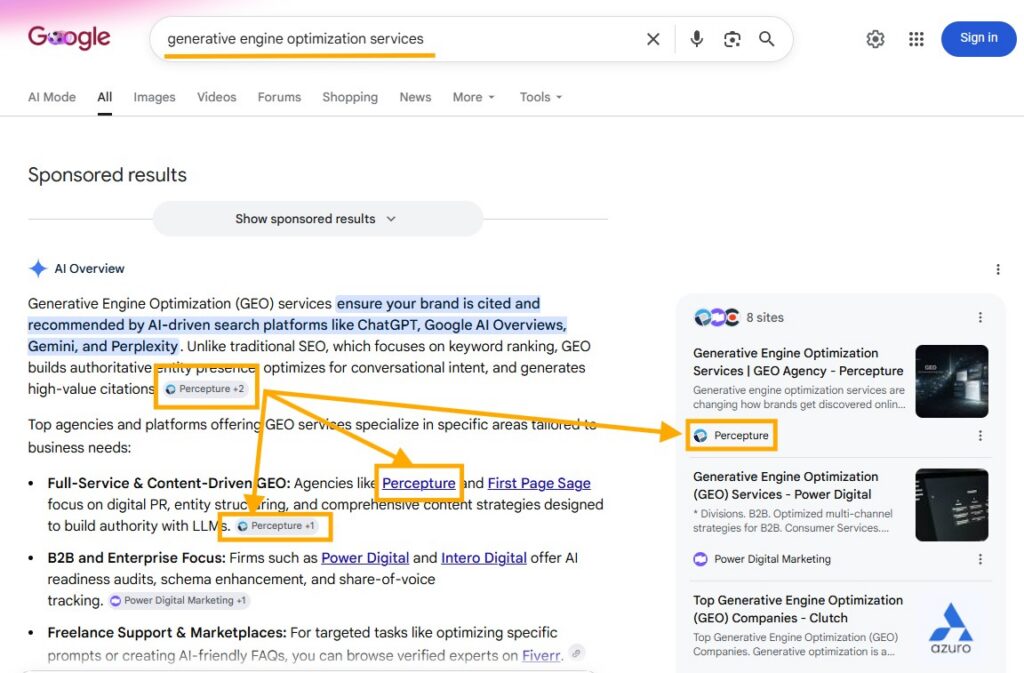
AI tools do not only display links. They summarize. That creates a different reputation challenge because incomplete source material can become a confident-sounding answer.
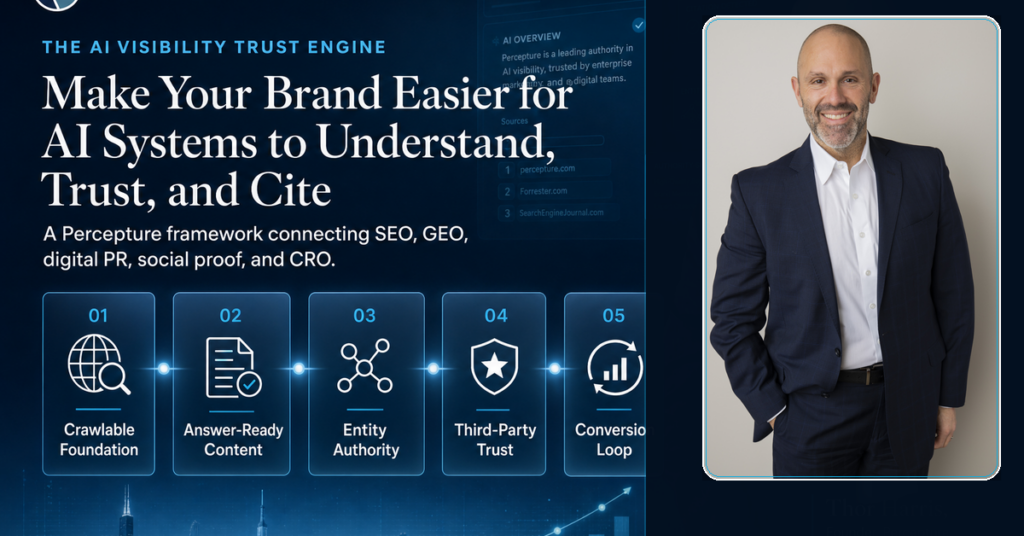
Percepture’s approach to improve brand visibility in AI search engines focuses on source quality, entity clarity, authority signals, structured answers, and cross-channel credibility. The goal is to give AI systems better information to retrieve and better context to summarize.
Crisis communications and reputation repair
Not every reputation problem is a crisis. But when the issue involves legal exposure, public accusations, patient trust, investor confidence, employee safety, regulatory sensitivity, or press momentum, the response needs message discipline.
Percepture can support the search and narrative side of crisis response while communications, legal, and leadership teams align around what should be said, what should not be said, and what needs to be repaired after the immediate pressure drops. For a deeper look, read what a crisis communications agency does.
Reputation repair is not about hiding the truth. It is about making sure the market can find the full story, the current story, and the credible proof behind it.
How long does Online Reputation Management in NYC take?
Timelines depend on the severity of the issue, the strength of existing assets, the authority of negative results, the number of affected queries, and whether media, reviews, legal references, or AI answers are involved.
| Situation | Typical work | Planning horizon |
|---|---|---|
| Weak branded search | Profile cleanup, owned content, internal links, schema, and brand entity reinforcement. | 30–90 days for early movement. |
| Negative review patterns | Review response strategy, review generation, local SEO, service-page trust improvements. | 60–120 days depending on review volume. |
| Negative article or legal mention | Source analysis, suppression strategy, PR, new authoritative assets, and monitoring. | 3–9 months depending on domain strength. |
| Executive reputation issue | Executive bio, thought leadership, third-party authority, branded search, and AI visibility work. | 90 days for foundation; ongoing for authority. |
| Active crisis | Message triage, stakeholder communications, search monitoring, media support, and post-crisis repair. | Immediate triage plus long-term repair. |
How much does Online Reputation Management in NYC cost?
Reputation work should be scoped after the diagnostic. A light branded search cleanup is very different from a high-stakes executive, healthcare, legal, or investor-facing reputation issue.
- Lower-complexity ORM: profile cleanup, search improvements, content refreshes, and basic monitoring.
- Mid-complexity ORM: content creation, SEO reputation management, review strategy, digital PR, and AI visibility improvements.
- High-complexity ORM: crisis communications, legal-sensitive messaging, executive reputation, media issues, and long-term suppression strategy.
What ethical online reputation management does not do
Shortcuts usually create more risk. Ethical ORM should improve the truth environment, not create fake proof.
Do not fake reviews
Fake reviews can create compliance, platform, and trust problems. A real review strategy is slower but safer.
Do not spam low-quality profiles
Thin profiles may look busy, but they rarely create the authority needed to influence serious branded search.
Do not overpromise removals
Some content can be corrected or removed. Some cannot. The strategy must be honest about the difference.
Do not ignore AI answers
Even if Google results improve, AI systems may still summarize older or weaker sources unless the source environment is improved.
Proof that search, PR, and AI visibility can be engineered
Percepture’s reputation work is built on the same operating logic used across SEO, GEO, digital PR, content systems, and executive visibility: define the narrative, build the proof, strengthen the sources, and measure what changes.
For reputation management, that means the work is not limited to damage control. It is also a visibility system that helps better information become easier to find, easier to trust, and easier for AI systems to understand.
Want to see how reputation work connects to search, PR, and AI visibility?
Review related Percepture resources before you choose a reputation management firm. The best partner should be able to explain search behavior, media influence, stakeholder trust, and AI visibility in one operating plan.
Online reputation management FAQs
What is Online Reputation Management in NYC?
Online Reputation Management in NYC is the process of improving what people and AI systems find when they search a company, executive, product, or issue. It can include SEO, digital PR, review strategy, crisis communications, content, monitoring, and AI visibility work.
Is online reputation management the same as PR?
No. PR is one part of reputation management. ORM also includes search results, reviews, profiles, owned content, SEO, AI visibility, and monitoring. The strongest programs connect PR with search and content strategy.
Can negative search results be removed?
Sometimes. Removal depends on the platform, accuracy, legality, editorial control, and whether the content violates a policy. If removal is not realistic, suppression and stronger asset building may be the better path.
How long does reputation repair take?
Some basic cleanup can happen quickly, but meaningful search movement often takes months. The timeline depends on the authority of the negative result, the strength of existing assets, and how many queries are affected.
How does AI search affect reputation management?
AI search can summarize a brand from multiple sources, not just page-one results. That means reputation work needs to improve the broader source environment, including owned content, third-party credibility, entity clarity, and structured answers.
Who needs SEO reputation management?
SEO reputation management is useful for executives, healthcare organizations, professional services firms, private companies, funded companies, and any brand where trust is checked through Google before a decision is made.
What should a reputation diagnostic include?
A serious diagnostic should review branded searches, executive searches, review platforms, news results, social profiles, owned content, third-party mentions, AI answers, schema, internal links, and the strength of positive assets.
Does Percepture handle crisis communications?
Yes. Percepture supports crisis communications, search monitoring, reputation repair, digital PR, and post-crisis visibility strategy for organizations that need disciplined messaging and stronger source control.
Protect the name. Control the narrative.
Online Reputation Management in NYC is not about panic. It is about building a stronger trust environment before one result, review, article, or AI answer defines the brand.
If the search results, review profile, media story, or AI answers around your company need a closer look, Percepture can help you map the risk and decide what deserves action first.

Author and strategic lead
About Bob Generale
Bob Generale is President of Percepture, a search, PR, GEO, and reputation strategy firm that helps companies condition the market before buyers, investors, journalists, and AI systems form a conclusion. His work connects SEO, digital PR, executive visibility, crisis communications, lead quality, and AI-answer visibility into one operating system.