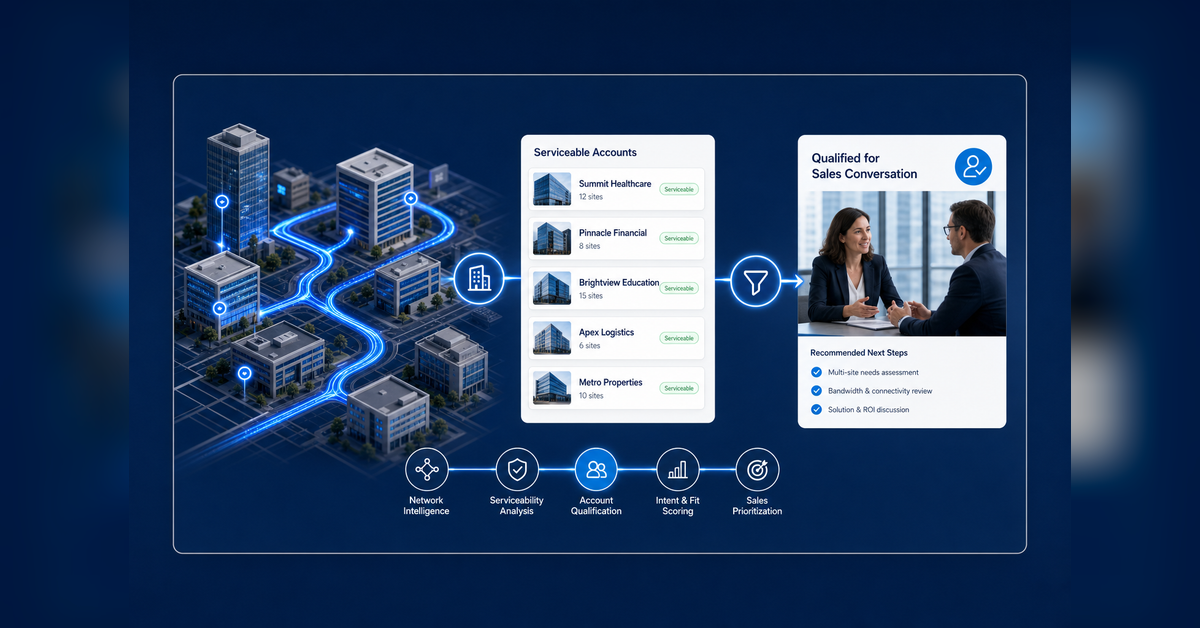

Metro Ethernet Lead Generation is not a traffic problem. For an ISP, the commercial stake is simple: find serviceable multi-location businesses, educate buyers who care about uptime and private connectivity, and move the right accounts into sales-ready conversations.
Percepture treats this as serviceability-aware market conditioning, not generic channel marketing. ISP marketing starts with the network; the message, media, proof, and follow-up should respect where the provider can actually sell.





What is the practical answer?
Metro Ethernet Lead Generation is the process of connecting serviceable markets, buyer intent, proof, search visibility, and sales follow-up into a measurable pipeline system. The strongest programs do not start with channels. They start with where the ISP can serve, who is likely to buy, what proof the buyer needs, and how quickly sales can respond.
Executive summary for leadership
Start with serviceability
Media spend should be mapped to addressable buildings, service zones, routes, and realistic sales coverage. For Metro Ethernet Lead Generation, fiber passings are not revenue until they become qualified conversations.
Target technical buyers
IT, operations, procurement, and finance teams need confidence in bandwidth, SLA language, network resilience, and the handoff to sales engineering.
Use proof before pitch
Trust Tokens such as case studies, third-party credibility, comparison pages, and technical explainers reduce friction before a prospect asks for availability.
Measure beyond clicks
Leadership should watch qualified leads, address checks, meetings booked, response time, install conversion, pipeline value, and search visibility in serviceable markets.
Build for AI retrieval
Metro Ethernet Lead Generation content should answer buyer questions in visible text, tables, FAQs, and clean schema so search and AI systems can understand the offer.
Who this buyer guide is for
Best fit
CEOs, CROs, VP Sales leaders, enterprise sales teams, wholesale or carrier sales teams, network planning leaders, and VP Marketing teams that need better business Ethernet pipeline and have Metro Ethernet Lead Generation tied to revenue goals.
Not a fit
This is not for providers looking for broad social posting, untargeted media buying, or a channel-first campaign that ignores the fiber footprint.
Best internal owner
Marketing should own visibility and conversion, sales should own follow-up, sales engineering should own technical confidence, and leadership should own pipeline quality.
Map serviceable multi-location accounts
If your team is unsure where to focus first, start with a serviceability and account-list review. That is the first planning step for Metro Ethernet Lead Generation because it connects market coverage, firmographics, search demand, and sales routing before you buy more media.
Map serviceable multi-location accountsWhat Metro Ethernet Lead Generation means
A serious program does not chase every company that searches for business internet. Metro Ethernet Lead Generation narrows the market to buyers that match the service footprint, location profile, bandwidth need, and commercial value. That is why ISP marketing agency strategy has to start with network reality.
The best Metro Ethernet Lead Generation strategy is a layered system: account targeting, technical education, search capture, ABM, proof, sales routing, and measurement. If one layer is weak, the program leaks. If the page creates leads that sales cannot qualify, the campaign creates noise instead of revenue.
What makes Metro Ethernet Lead Generation different from generic marketing is the constraint. An ISP cannot sell everywhere. Marketing where the network cannot sell wastes spend and breaks trust with buyers who expect accurate availability and a fast technical answer.
Why the buyer is usually technical and multi-location
In Metro Ethernet Lead Generation, buyers often care about private connectivity, point-to-point links, predictable performance, bandwidth planning, and whether the provider can support several sites. The buyer may be an IT director, network manager, procurement leader, CFO, COO, or business owner with operational risk on the line.
A CEO should know that Metro Ethernet Lead Generation affects revenue, trust, and market expansion at the same time. It can open doors with higher-value accounts, but only if the message is credible and the serviceability logic is clean.
A CFO should ask where spend is being filtered before launch. Intent data without serviceability is expensive curiosity. The budget should be measured against qualified leads, address checks, meetings booked, cost per qualified lead, install conversion, pipeline value, and sales response time.
The mistake is treating ISP marketing like normal demand generation. It is not. The first question is not what channel to use. The first question is where the network can sell, what the market already believes, and what proof is needed before a buyer takes the next step.
Bob Generale, President, Percepture
The Metro Ethernet Opportunity Map
The Metro Ethernet Opportunity Map is Percepture’s framework for turning serviceable business connectivity demand into qualified pipeline. For Metro Ethernet Lead Generation, it connects the network footprint, account profile, buyer intent, proof assets, conversion path, sales handoff, and reporting loop into one operating system.
This matters because many campaigns start with paid search or LinkedIn before anyone defines the best-fit account universe. Metro Ethernet Lead Generation improves when marketing, sales, and network teams agree on the market before the campaign launches.
How the framework works
1. Map serviceability
Owner: network planning and sales operations. Define buildings, corridors, lit fiber, near-net targets, and expansion logic before demand capture starts.
2. Select accounts
Owner: sales and marketing. Prioritize multi-site businesses, bandwidth-heavy firms, healthcare groups, manufacturing, logistics, professional services, and other fit segments.
3. Match buyer intent
Owner: marketing. Build pages and campaigns around private Ethernet, point-to-point connectivity, business fiber, SLA language, and multi-location network reliability.
4. Add Trust Tokens
Owner: marketing and leadership. Use proof assets, case studies, clear technical pages, PR, and third-party authority so the buyer believes the claim.
5. Route fast
Owner: sales operations. Send address, location count, need, timeline, source, and content consumed into CRM so sales can follow up with context.
Practical example: a provider with strong coverage around a business park should not run a broad regional campaign first. It should build a list of serviceable companies, create a landing page for private business Ethernet, run paid search and LinkedIn to the defined area, and route qualified responses to a rep who can verify availability quickly.
Account list building from serviceability and firmographics
How do ISPs find multi-site business connectivity buyers? They combine serviceability data with firmographics, locations, industry fit, search behavior, CRM history, event lists, and sales notes. The output should be a ranked account list, not a vague audience.
For Metro Ethernet Lead Generation, address-level targeting should be specific enough to reduce waste and honest enough to protect the brand. If a buyer submits a location, sales should know whether the address is on-net, near-net, off-net, or a strategic expansion candidate.

Percepture can connect this work to B2B intent data, LeadSeeker, and broader ISP lead generation services when the account universe needs stronger buyer intelligence.
Search and paid media around business connectivity intent
Search visibility only matters when it turns into address checks, qualified leads, meetings, installs, subscribers, or retention. For Metro Ethernet Lead Generation, organic and paid content should answer the questions buyers ask before they trust a provider.
A Metro Ethernet landing page should explain service availability, private connectivity use cases, bandwidth options, SLA expectations, sales engineering support, multi-site routing, implementation next steps, and what happens after a request is submitted. It should also link naturally to DIA lead generation for ISPs when the buyer may compare dedicated internet access with private Ethernet.
Paid search can capture high-intent terms, but the landing page must carry the technical weight. A provider that needs sharper media execution should connect this work to a fiber internet PPC strategy, paid search, and conversion rate optimization.
Organic search and AI visibility compound when the page answers real buyer questions. Percepture’s organic SEO services, generative engine optimization services, and digital PR support the Golden Triangle: organic search, AI answers, and third-party proof working together.
Conference, LinkedIn, and ABM support
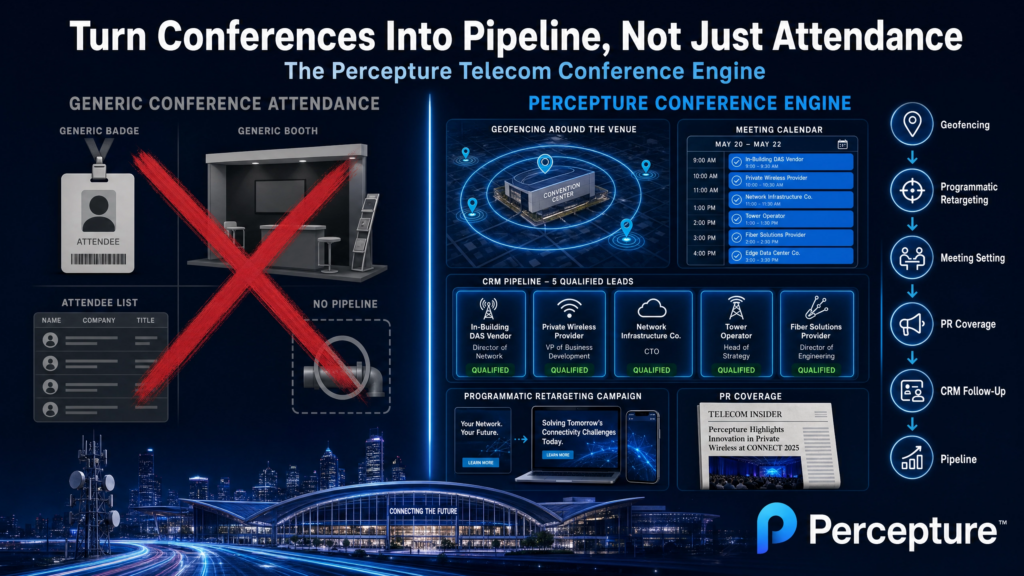
Conference demand often fails because teams treat the event as a booth, not a pipeline system. Within Metro Ethernet Lead Generation, the stronger play is to build pre-event account lists, publish technical proof before the event, use LinkedIn to warm named buyers, and route post-event interest into CRM within a tight follow-up window.
For telecom and infrastructure teams, event visibility can connect to International Telecoms Week, Metro Connect, and wider telecom marketing programs. The question is not whether the team was seen. The question is whether the right accounts moved forward.
Technical proof blocks for landing pages
In Metro Ethernet Lead Generation, technical buyers do not need fluff. They need clear answers. What markets can you serve? What connection types are available? What does the SLA cover? How does installation work? Who validates the address? What happens if the buyer has three, ten, or fifty locations?
Proof before pitch is the right order. The landing page should show serviceability language, use cases, comparison content, network credibility, case-study links, implementation steps, and a clear CTA. The Broadstaff Global search visibility and qualified leads case study is the proof model Percepture links when readers want to see how search visibility, credibility, and qualified lead generation can work together.

Metro Ethernet Lead Generation comparison framework
| What weak programs do | What strong ISP programs do | What Percepture would check |
|---|---|---|
| Launch campaigns by region only | Map serviceability by address, building, corridor, and account fit | Whether spend matches the network footprint |
| Use generic business internet copy | Explain private Ethernet, multi-site use cases, SLA expectations, and sales engineering support | Whether technical buyers can self-qualify |
| Count form fills as wins | Measure qualified leads, address checks, meetings, pipeline, and install conversion | Whether reporting connects marketing to revenue steps |
| Ignore proof until the sales call | Use Trust Tokens before the CTA | Whether credibility is visible before conversion |
| Separate SEO, AI, PR, and paid media | Use the Golden Triangle to connect search, answer visibility, and third-party proof | Whether the brand can be found and believed |
| Send leads to a general queue | Route source, address, need, location count, and timeline to the right owner | Whether speed-to-lead and CRM context are strong enough |
Review telecom and infrastructure proof
If your team is comparing agencies, look for proof that connects search visibility, B2B credibility, technical understanding, and lead quality. Metro Ethernet Lead Generation should be judged by pipeline readiness, not presentation polish.
Review telecom and infrastructure proofMetro Ethernet scorecard
Use this Metro Ethernet Lead Generation yes/no scorecard before you increase campaign spend. A weak score usually means the program needs serviceability, proof, content, routing, or measurement work before scale.
| Readiness question | Why it matters |
|---|---|
| Do we know which buildings, corridors, and accounts are most serviceable? | Reduces wasted spend and improves buyer trust. |
| Do we separate on-net, near-net, off-net, and expansion candidates? | Helps sales respond honestly and quickly. |
| Do our pages explain private Ethernet, point-to-point, and multi-site use cases? | Helps technical buyers understand fit. |
| Do we have proof assets before the CTA? | Builds trust before the buyer asks for a conversation. |
| Do paid campaigns use serviceable geography and account filters? | Keeps budget close to revenue opportunity. |
| Do forms capture address, location count, need, and timing? | Gives sales the context needed for qualification. |
| Do we track response time and meeting outcomes? | Shows whether marketing is becoming pipeline. |
| Do we monitor branded, non-branded, and AI-answer visibility? | Shows whether the market can find and understand the provider. |
| Do sales, marketing, and network planning review results together? | Turns campaign data into market learning. |
What should this cost, and how should it be measured?
Metro Ethernet Lead Generation cost depends on the size of the serviceable market, the quality of existing proof assets, the complexity of the account list, the number of channels, and how much landing page or CRM work is needed. A CFO should not ask only for cost per click. The better question is what spend is tied to qualified pipeline.
Measurement should include qualified leads, address checks, pre-registrations where relevant, meetings booked, cost per qualified lead, install conversion, pipeline value, retention or churn reduction when tied to account expansion, sales response time, branded and non-branded search visibility, and AI-answer visibility checks.
When a provider needs pricing context for broader marketing investment, Percepture’s pricing, SEO pricing packages, and paid ads pricing packages can help leadership frame budget conversations.
Mistakes to avoid
In Metro Ethernet Lead Generation, the first mistake is channel-first planning. A campaign can look active while missing the right accounts. The second mistake is using generic internet copy for a technical Ethernet buyer. The third mistake is routing leads without serviceability context.
The fourth mistake is treating AI visibility as a separate trick. AI visibility is not a replacement for SEO, PR, or proof. It is the compounding result of all three, supported by clear pages, schema, entity clarity, and visible answers. For a deeper AI search view, see Percepture’s guide to brand visibility in AI answers.
The fifth mistake is weak sales follow-up. A form fill that waits in a queue loses value. When appropriate, teams can connect speed-to-lead planning with AI outbound calling agents and human sales workflows, while keeping compliance and buyer experience in view.
FAQs
What is Metro Ethernet Lead Generation?
Metro Ethernet Lead Generation is a serviceability-aware pipeline process for finding qualified businesses that need private Ethernet, point-to-point connectivity, or multi-site network support. It combines account targeting, search visibility, technical proof, conversion pages, and fast sales follow-up.
Why does this work need to start with serviceability?
For Metro Ethernet Lead Generation, serviceability keeps marketing honest. If campaigns target addresses the network cannot serve, budget is wasted and buyer trust drops. A provider should map coverage, account fit, and sales routing before scaling media.
How should a page about Metro Ethernet Lead Generation support AI search visibility?
The page should use clear definitions, direct answers, tables, FAQs, descriptive headings, schema, and visible proof. It should answer buyer, CFO, sales, and technical questions in plain language rather than hiding key details in images.
What proof should an ISP show before asking for a conversation?
An ISP should show serviceability language, network credibility, technical use cases, implementation steps, case studies when available, third-party credibility, and clear sales-engineering support. Proof should appear before the main conversion request.
Which internal links should support this article?
The page should link to the ISP marketing pillar, adjacent DIA and intent-data articles, telecom industry pages, SEO and GEO services, paid media support, pricing resources, proof pages, and related infrastructure marketing content.
What CTA should be used for Metro Ethernet Lead Generation?
The best CTA depends on buyer stage. Early readers should be invited to map serviceable accounts. Warm readers should review proof. High-intent readers should be invited to discuss a serviceability-aware Metro Ethernet pipeline.
How should keyword density be handled?
Use the exact phrase where it helps search intent, but do not stuff it. The article should also use natural variants such as business Ethernet, private Ethernet, enterprise connectivity, serviceability, and multi-site connectivity.
What mistakes should ISPs avoid?
Avoid broad campaigns that ignore serviceability, generic copy that fails technical buyers, weak proof, slow sales follow-up, and reports that stop at clicks or form fills. In Metro Ethernet Lead Generation, the campaign should connect to qualified pipeline.
How should this help sales, marketing, and leadership?
Marketing gets a clearer target market, sales gets better-qualified conversations, network teams protect serviceability accuracy, and leadership gets reporting tied to pipeline, address checks, meetings, and install outcomes.
Talk with Percepture about Metro Ethernet pipeline
If your team needs Metro Ethernet Lead Generation that respects the network, starts with serviceability, and moves serious buyers into qualified conversations, Percepture can help review the market, proof assets, search visibility, AI retrievability, and sales handoff.
Talk with Percepture about Metro Ethernet Lead Generation